Mitsubishi Lancer 1600GSL vs Nissan Violet Hardtop 1600SSS (1973)
Publication: Auto Sport
Format: Group Test
Date: April 1973
Author: Juichi Kanmoto, Auto Sport Editorial Staff (uncredited)
Comparative Test: Lancer 1600GSL vs. Violet 1600SSS
Two new models of comparable class have recently appeared in quick succession: Nissan’s Violet 1600SSS and Mitsubishi’s Lancer 1600GSL. Both place strong emphasis on family-car comfort and character, yet as both manufacturers possess extensive rally experience, it seems only a matter of time before dedicated rally kits are offered for each.
For this comparison, two leading figures from the rally world–Juichi Kanmoto and Kenjiro Shinozuka–were invited to put the pair through their paces.
Bound for Yabitsu Pass (Juichi Kanmoto)
The Bluebird 510, a car with an unmistakably Nissan character, has now disappeared, replaced by the all-new Violet–a machine with an entirely different personality. Compared with the distinctly sporting nature of the 510, the Violet feels, if anything, more like a soft and refined passenger car.
Set against it is Mitsubishi’s Lancer, whose body shell features an extreme short-deck, long-nose proportion. Even so, at first glance it too gives the impression of being a fairly restrained and conventional sedan.
With the cooperation of fellow rally driver Kenjiro Shinozuka, we arranged a comparative test of the two cars. Strictly speaking, the Violet tested was the Nissan Violet 1600SSS Hardtop, while the Lancer was the Mitsubishi Lancer 1600GSL 2-Door.
The Violet uses Nissan’s L16 engine fitted with SU twin carburetors, producing 105ps/6200rpm. Opposing it, the Lancer carries Mitsubishi’s Saturn engine with a single carburetor, rated at 100ps/6300rpm. In terms of outright engine performance, the Violet holds the advantage, but its body is noticeably larger than the Lancer’s, and weight is greater by no less than 170kg.
The Violet does, however, possess one major weapon in the form of its fully independent four-wheel suspension. The Lancer, by contrast, relies on a rigid rear axle, but counters with an excellent power-to-weight ratio of 8.2kg/ps (the Violet’s is 9.4kg/ps), suggesting a particularly lively character on the road. Both cars are equipped with 5-speed transmissions.
Having assembled at the Atsugi Interchange, our group immediately set off on the test route. Kenjiro took the wheel of the Lancer, while I drove the Violet. Our first destination would be Yabitsu Pass in the Tanzawa mountains.
Heading west along National Route 246, now largely free of traffic congestion, we turned right at an intersection just before Hadano and began climbing toward the pass. About 1km beyond the village of Minoge, the road surface turned to dirt and remained that way for roughly 3km. The final 3km before the summit, however, had been paved over at the end of last year.
Perhaps because of its proximity to Tokyo, Yabitsu Pass has become a favorite practice route for local rally drivers. The surface varies considerably–hard-packed sections alternating with loose gravel–while the corners range from tight hairpins to fast sweepers, making it an unusually diverse and demanding course.
My first impression while driving along Route 246 was that the Violet possessed a calmer, more composed character than the old 510. Road noise is comparatively subdued, and at cruising speed the cabin remains impressively quiet. Even the harsh impacts transmitted through pavement joints were well controlled despite the fitment of radial tires.
Steering response during lane changes could not exactly be called sharp (the steering ratio is 15:1), yet the car tracked faithfully and delivered a smooth, composed feel. This SSS model equipped with the 5-speed transmission also features reinforced suspension: spring rates are increased by 50% front and rear compared with the standard model, while shock absorber damping is strengthened considerably–100% at the front and 50% at the rear.
The steering wheel itself is one size smaller than that of the 510, and because the rim is now thicker, it provides a more reassuring feel in the hands. Steering effort may be slightly heavy for some women drivers, perhaps, but the self-centering action is well judged and inspires confidence.
The instrument panel uses all round gauges, with a square cluster at the far right housing the oil-pressure gauge, water-temperature gauge, fuel gauge, and warning lamps. It is somewhat inconvenient, however, that the water-temperature gauge–the one most frequently checked while driving–is positioned at the upper right, where it tends to be obscured by the steering wheel rim. It would arguably make more sense for it to trade places with the fuel gauge at lower left. Even so, the instruments are generally easy to read.
One small detail worth mentioning is the indicator lamp for the heated rear glass. It is not so bright as to interfere seriously with driving, but it is slightly distracting.
As with both the 510 and 610, the driving position leaves some room for improvement. The steering wheel sits somewhat too high and too close to the driver, forcing the arms into a rather bent posture that gives a slightly cramped impression.
The placement of the brake and clutch pedals is also problematic. Not only are they positioned unusually high above the floor, but the height difference relative to the accelerator pedal is excessive, making operation quite awkward. With a little more consideration given to this pedal relationship, the car would be much easier to drive in a genuinely sporting manner.
Compared with the 510, the single greatest change in controls is the parking brake. The previous umbrella-handle arrangement has been replaced by a conventional lever mounted on the transmission tunnel–in other words, a true handbrake. With the old arrangement, reaching the brake while fully belted could be extremely awkward, so this change neatly resolves the problem.
Visibility, too, proves not nearly as poor as the exterior styling initially suggests, and is probably comparable to–or perhaps even slightly better than–that of the 510. Rearward visibility, however, inevitably suffers somewhat due to the hardtop body style and the unusually wide rear quarter pillars.
In terms of quietness, the Lancer appears to concede a slight advantage to the Violet, though it is by no means inferior compared with other cars in the same class. Road noise is well suppressed and remains relatively low overall, though there does seem to be slightly more harshness. This may not necessarily come from the car itself, however, and could instead be influenced by the Yokohama steel-belted radial tires fitted to the test car.
Steering response during lane changes is particularly good, and the car tracks faithfully along the driver’s intended line. By comparison, the earlier Galant FTO could feel rather vague and rubbery at times, and the improvement here is likely the result of replacing the former A-arm transverse link arrangement with a combination of I-arm and tension rod, together with measures to increase the lateral rigidity of the rubber bushings.
The steering wheel itself has a thick rim that inspires confidence. Combined with the variable-ratio steering gear, steering effort remains surprisingly light even when winding on handfuls of lock. Although there is a sense of agility that naturally comes from the car’s low weight, the steering also has an appropriate degree of heft, leaving no trace of nervousness and creating a very good impression overall.
The instrument panel contains three round gauges arranged side by side. The speedometer is in the center position, with the tachometer to the left and a combination gauge for water temperature, oil pressure, and fuel level on the right. These instruments use wide colored bands to distinguish their yellow and red warning zones, but unfortunately this treatment detracts from the panel’s visual simplicity and makes the gauges slightly more difficult to read than they should be.
The driving position, however, is excellent. The steering wheel sits at a natural distance, allowing the driver’s arms to extend comfortably, while its height is also well judged. In addition, Mitsubishi’s unique tilt steering column allows further adjustment, meaning drivers of almost any build should be able to find a satisfactory position.
Pedal layout is likewise well executed. The pedals are not mounted excessively high above the floor, and the difference in height between brake and accelerator is small enough to make operation easy and natural. Particularly commendable is the fact that both brake and clutch pedals remain light in action despite their relatively short travel.
Perhaps the greatest virtue of the Lancer, however, is its excellent visibility. Despite the distinctly long-nose styling, the car never feels cumbersome from behind the wheel. This is likely due to the wedge-shaped treatment of the nose, which keeps the front end visually low. The design not only helps reduce aerodynamic lift at high speed, but also appears to contribute to lower air resistance overall. And because the car retains a conventional sedan body style, rearward visibility is exceptionally good as well.
Lightness Goes to the Lancer, Handling to the Violet
At last, we began our hill-climb runs up Yabitsu Pass. On the first run, we took things slowly, covering the 6km to the summit at an unhurried pace. Near the entrance, the surface consisted of fairly deep gravel, but after roughly 1.5-2km it changed to a hard-packed road, heavily rutted and undulating in places. Around 3km of the route had recently been paved, though the asphalt was so fresh it scarcely showed any sign of use. A couple of corners near the summit had even frozen over slightly with patches of ice.
I set off first in the Violet. On dirt roads, the independent rear suspension makes the car remarkably easy to handle. Even while cornering on loose gravel, the rear never breaks away abruptly, and corrections are easy to make. The pronounced understeer tendency associated with the 510 is almost entirely absent, the car turning faithfully in proportion to steering input.
Even when power is applied, rear grip diminishes only gradually, and one can clearly feel the driving force being transmitted effectively to the surface. Crossing badly rutted sections produces very little upward jolt from full compression, while shock at full rebound is almost nonexistent. This is undoubtedly due both to the generous wheel travel and to the shock absorbers, whose damping rates are set unusually high for a standard-production car.
Pitching motions after such impacts also settle quickly, contributing to excellent directional stability and an overall sense of reassurance.
Although the body has grown somewhat larger compared with the 510, this increased size is hardly noticeable once underway, which is a welcome surprise. I had expected the additional weight to dull the car’s liveliness, yet from the moment I began driving it my first reaction was, “Oh? It doesn’t actually feel that heavy.” Even after entering the dirt section, that impression never really disappeared.
After several days of clear weather, the road surface had become completely dry, and the dust clouds were tremendous. I couldn’t help feeling sorry for Kenjiro, following behind.
Then came the paved section. The gradient here was fairly steep as well. The Violet climbed hard enough to make the tires squeal, but because the road itself was narrow, and because rear traction remained so strong–not understeering, but simply gripping well–it proved difficult to induce much power oversteer, and speed tended to fall away slightly.
I mostly used first and second gear in the 5-speed transmission. Since reverse is positioned opposite first in the shift pattern, downshifting from second to first posed no particular problem. Upshifting from first to second, however, felt awkward, perhaps simply because of unfamiliarity. When rushed, or while the car was being tossed around over rough pavement, I occasionally found myself selecting fourth gear accidentally, forcing a hurried correction.
As we neared the summit of Yabitsu Pass, the Lancer following behind began to grow larger in the rearview mirror. It was clearly the lighter and more agile car. The Violet’s weight, which had been almost imperceptible on dirt, became very apparent now on the steep paved climb. Even the engine note had taken on a somewhat strained quality.
In the end, both cars arrived at the summit almost simultaneously.
Next, we switched cars and made several runs up and down the paved section. Here, the Lancer clearly held the advantage by two or three steps. On uphill climbs, its lightweight 815kg body pulled by a 100ps engine feels nothing short of vigorous. Combined with the excellent visibility and responsive handling, it inspires enough confidence to brake very deep into corners. Acceleration out of bends is also exceptionally quick. In tighter corners, power slides can be induced relatively easily, making the car very enjoyable to drive fast.
Downhill performance is equally reassuring. The brakes are extremely light in operation and respond well to what might be called a featherweight touch. This, too, can probably be counted as one of the benefits of the car’s low weight.
In direct comparison, the Violet’s more deliberate and heavy-feeling character became especially apparent.
The Lancer is also equipped with a 5-speed transmission, but unlike the Violet it uses a conventional H-pattern layout with fifth gear up and to the right opposite reverse. On roads like this, where nearly all driving is done in low and second gear, the arrangement feels very well suited.
All-Independent Violet Takes Victory on Dirt
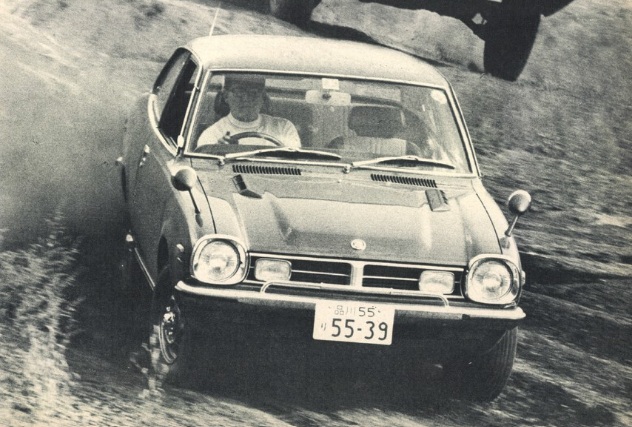
We next tried both uphill and downhill runs on the dirt sections as well. It had scarcely been noticeable on the pavement, but on rougher surfaces the Lancer’s springs seem slightly too soft, while the shock absorbers also feel somewhat lacking in damping force. Once the road becomes uneven, the driven wheels lose contact with the surface rather easily and wheelspin occurs readily.
As a result, the car quickly develops an oversteer tendency and the rear begins to slide outward, demanding quite a lot of concentration to correct.
Crossing larger undulations also produces a sharp upward jolt as the suspension reaches full compression, while on rebound the dampers extend completely and strike the stops with a harsh thump. Even after clearing such sections, pitching motions tend to linger for quite some time, forcing the driver to remain constantly alert.
In the final analysis, it seems fair to say that on dirt roads, victory goes to the Violet.
The following day, we headed to Fuji Speedway and drove the same approximately 1.9km dirt course running from the main gate to the sub-gate that had previously been used for our Levin-versus-Galant comparison test.
This is a fairly high-speed course with a comparatively smooth surface, though there are undulations scattered throughout. At speeds of roughly 80-100km/h, the Lancer begins to feel somewhat ill at ease. Pitching motions refuse to settle down, and the car becomes prone to jumping quite easily. As a result, one is inevitably forced to ease off the throttle.
The Violet, by contrast, feels far more composed over this sort of surface. Even when driven hard, it never jumps as violently as the Lancer, and pitching motions settle much more quickly afterward. Here again, the benefits of fully independent four-wheel suspension together with strong shock-absorber damping seem to make themselves clearly felt.
Kenjiro Shinozuka’s impressions were much the same:
“The Violet doesn’t feel as heavy as I expected. Still, on paved uphill sections it does seem to struggle somewhat. On dirt, though, the more power you apply, the more it simply drives itself forward, so in that environment it’s faster than the Lancer. Relatively speaking, I think it’s a very good car.”
His opinion of the Lancer was as follows:
“The car’s lightness is really its greatest strength. It would probably be able to run on equal terms with–or even outperform–the Trueno and Levin. On pavement it’s excellent, but on dirt, even if you apply power, the car simply can’t find enough grip. As it is now, I think that makes it slower than the Violet.”
For Rally Tuning, Weight Gives the Lancer the Advantage
Finally, let us consider the potential of these two cars as rally machines.
The Violet’s greatest weakness, unquestionably, is its weight. On paved uphill special stages, therefore, it will probably remain at a disadvantage no matter how extensively the engine is tuned. It may also be at a slight disadvantage on steep dirt climbs.
The Violet’s greatest strength, however, lies in the excellent balance of its fully independent four-wheel suspension. Depending on the setup employed, it seems entirely capable of competing on equal terms–or better–on dirt surfaces.
After all, rallies are not composed solely of uphill sections. A car with superior stability can always make up time on the descents.
The shift pattern of the Violet’s 5-speed transmission is poorly suited to Japanese rally competition. Because first and second gears are used so frequently, it really ought to employ a conventional H-pattern layout with those gears arranged directly ahead of and behind one another. For that reason, it may actually be preferable to choose the 4-speed 1600SSS instead, or, if a 5-speed is absolutely required, to fit the Bluebird U’s transmission instead.
Pedal height is another issue. Unless the difference in height between the accelerator and brake pedals is reduced, the driver’s ankle quickly becomes fatigued, and when moving the foot from accelerator to brake it can catch easily–a potentially dangerous situation. Fortunately, this is something that could likely be improved through adjustment.
In any case, the overall balance of the car is undeniably good, and even if it is not especially fast, it would almost certainly make an extremely stable rally machine that remains easy and undemanding to drive over long distances.
The Lancer’s greatest weapon, meanwhile, is unquestionably its light weight. With careful suspension tuning, it should by no means be impossible to achieve handling characteristics as balanced and confidence-inspiring as those of the current Galant 16L GS.
Its power-to-weight ratio also suggests the possibility of matching–or perhaps even surpassing–the Trueno and Levin, which makes its future development particularly interesting.
That said, compared with the current 16L GS, it may become somewhat more of a wild machine, and inexperienced drivers would probably require quite a lot of time they could truly master it.