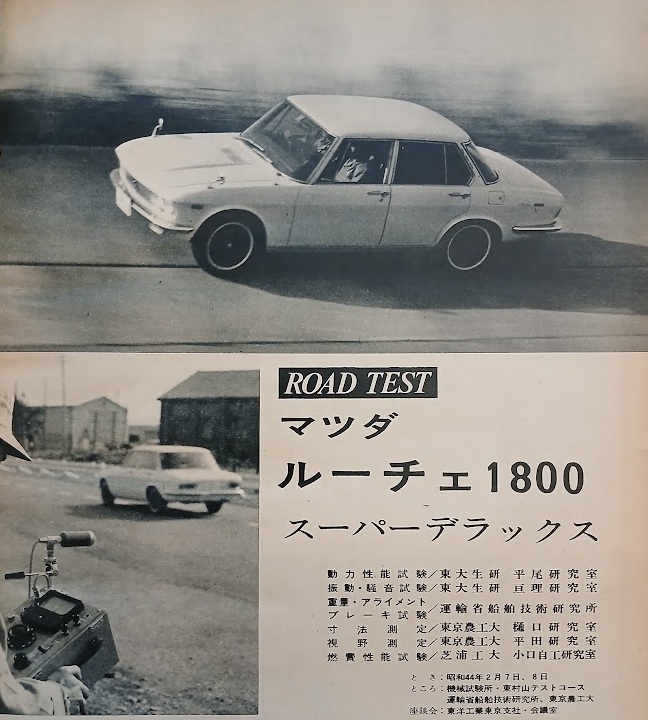
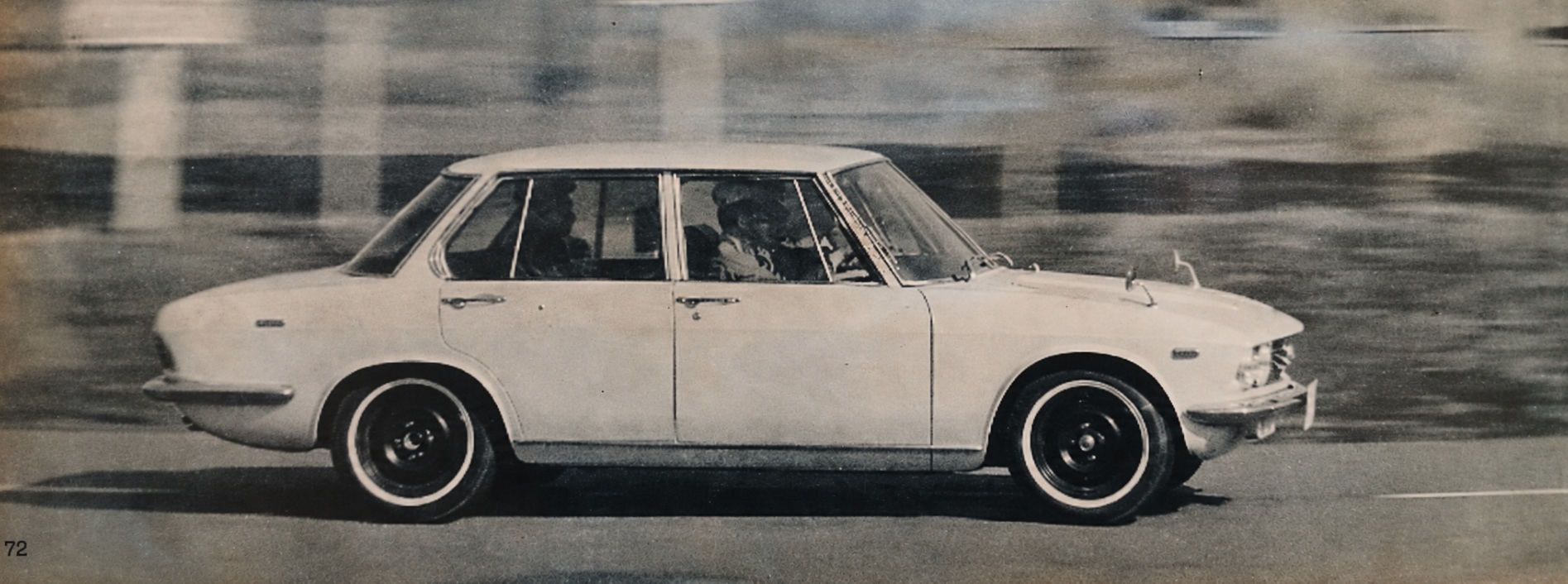
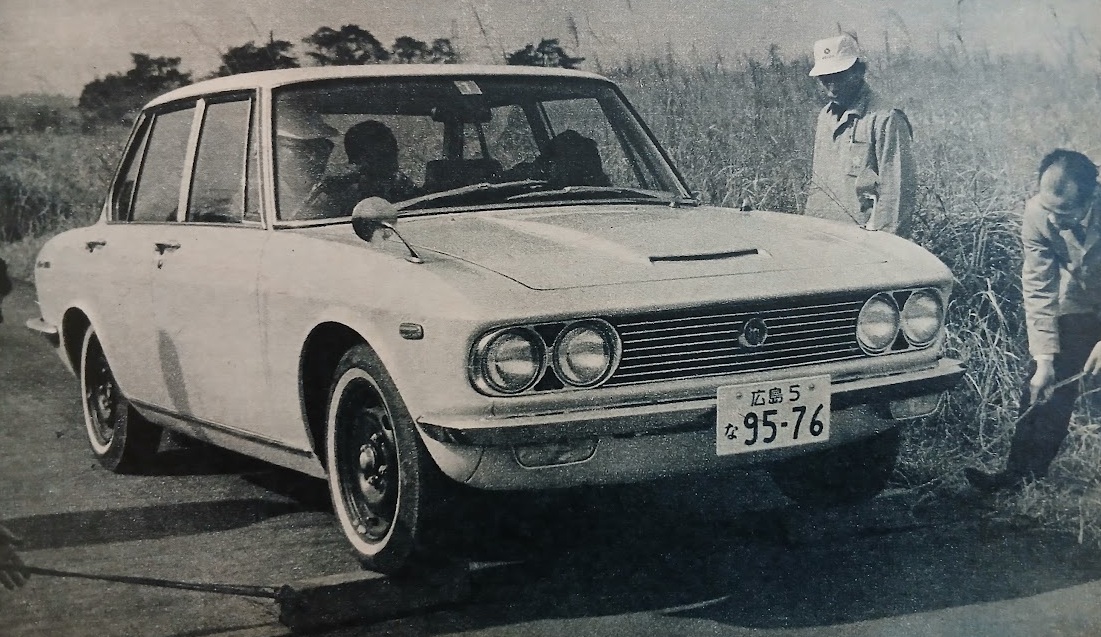
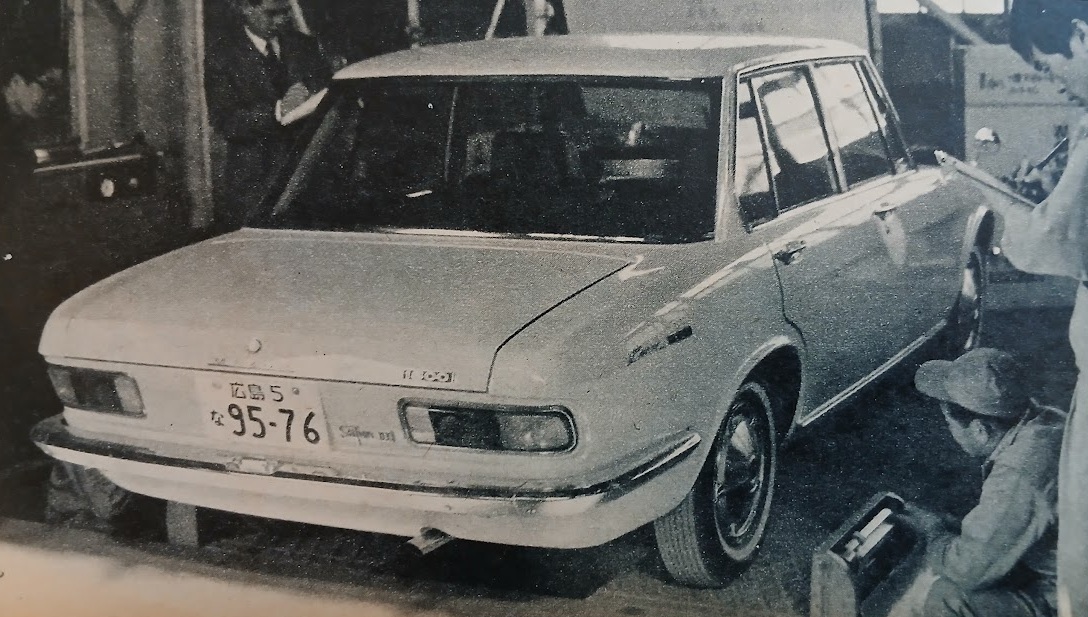
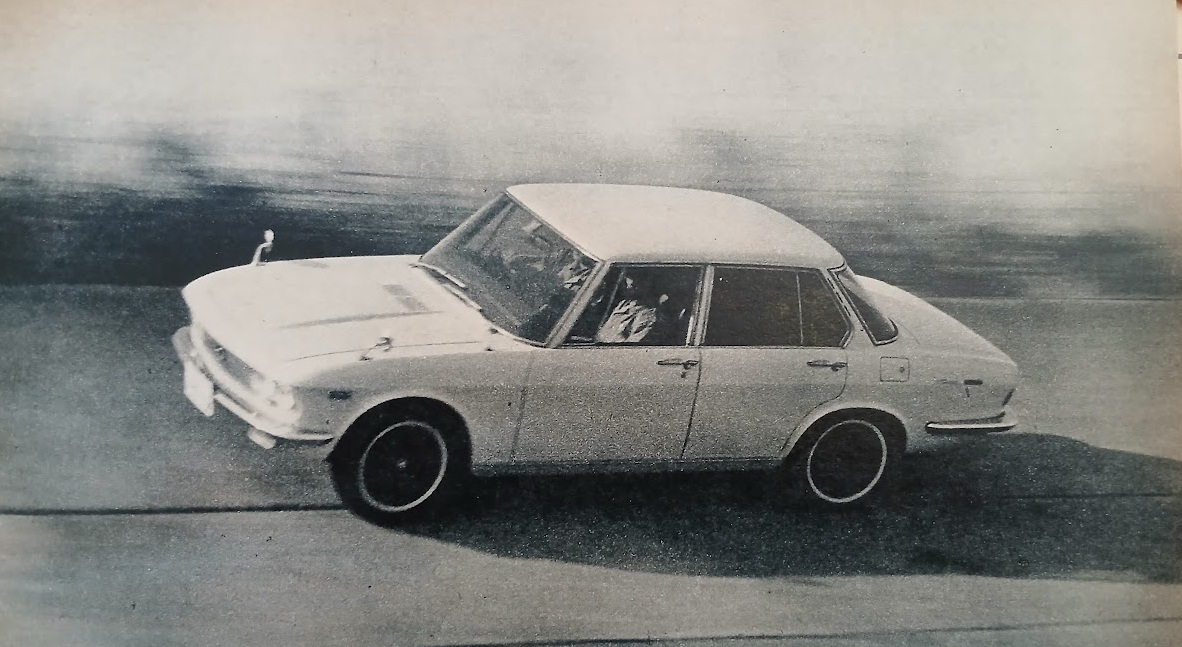
Mazda Luce 1800 Super Deluxe (1969)
Publication: Motor Fan
Format: Road Test
Date: April 1969
Authors (roundtable): Nobumichi Yokota, Kenji Higuchi, Osamu Hirao, Masaichi Kondo, Atsushi Watari, Kenichi Yamashiro, Kazuo Kumabe, Hiroshi Ikeda, Mineo Yamamoto, Kazufumi Sakashita, Nobuo Shibata, Yasuhei Oguchi, Shoichi Nishiyama, Kenzaburo Ishikawa, Toshihide Hirata, Minoru Onda, Motor Fan Editorial Staff (uncredited)
Aiming for a “100mph Car”
Magazine: First, we’d like to ask Toyo Kogyo to give us an outline of the Luce 1800.
Yokota: I’ll begin by explaining what we were aiming for with the new Luce 1800. In August 1966, we introduced the Luce 1500 series as a high-speed touring sedan fitted with an overhead-camshaft engine. It now sells in fairly substantial numbers, but recently there have been marked changes in traffic conditions both at home and abroad, and we have also begun to see considerable changes in what people expect from a car.
What I mean is that as high-speed, long-distance driving becomes more common, while urban traffic grows increasingly crowded, there is a demand for the necessary maneuverability and driving stability to cope with those conditions, as well as still greater safety measures to accompany higher speeds. At the same time, there are demands which come from the move toward more upmarket and diversified tastes, and from the need to make the car even more competitive in export markets. We planned this car in response to those requirements.
As for the car itself, starting with the engine, we set the “100mph car” as our overall performance target. At the same time, we stipulated that the major components should be capable of being machined on the same transfer machines as those of our existing 1500cc overhead-camshaft engine. We therefore retained the same bore and increased the stroke from 78mm to 94mm, giving it a relatively long-stroke configuration and increasing the displacement.
As for the styling, we used the 1500 body as the basic starting point, and added an air scoop to the front of the hood that serves both a functional purpose and as a styling feature.
In terms of safety, we set out to improve it even further. In addition to naturally meeting all Japanese safety standards, the car also fully complies with the American MVSS requirements. We have incorporated various other new mechanisms as well, and I believe we have been able to achieve our original objectives to a significant degree.
Magazine: When did development begin? For example, were the Luce 1500 and 1800 developed in parallel?
Yokota: No. As mentioned, this engine was developed afterward.
Magazine: So the body was originally designed for the 1500…
Yokota: Yes, that’s right.
The Image of a “Fulfilled Man”
Magazine: Now that the Luce 1800 has joined the 1500, we’ve noticed from the radio and television advertising that you’re strongly emphasizing the image of a “man’s car.” We’d like to ask what exactly you’re aiming for with that.
Yokota: The basic idea behind what we call “masculine” is really a sense of being “fulfilled.” Whether or not that is the most appropriate word is another question, but what we have in mind is a car with a distinct personality—something that makes its own individual statement.
So when we look at the car as a whole, we aren’t simply focusing on the fact that it has an 1800cc engine. Along with the increase in power, we’ve raised the level of everything else as well—its equipment, its safety, its ease of use, and so forth. That is the thinking behind the car. It certainly doesn’t mean that we intend for only men to drive it. (laughs) I think that’s how we’d like you to interpret the advertising slogan. We’re presenting it as a car with a distinctive character of its own.
Higuchi: The trouble with calling it a “man’s car” is that it can mean two different things. It could mean a quick, sporty car for young men in their teens and twenties, or it could mean a car for a fully grown man in his thirties or forties. The catalog doesn’t make it very clear which you mean. But when you actually get into the car and see things like the power windows, you certainly don’t get the impression that it’s aimed at teenagers or men in their twenties. If you’re aiming at men in their thirties and forties, though, I think the car could stand to have a little more “presence” in its appointments and equipment.
Yokota: When we say, “fulfilled man,” we do mean someone in his thirties or forties. The Luce itself has always been described as “chic,” and our starting point this time was to raise the level of all its equipment and appointments still further, making it a car appropriate for people in their thirties and forties.
Hirao: A “man’s car” is all very well, but it would be a problem if women stopped driving it. I wonder about that. (laughs)
Yokota: That’s why the idea of the “fulfilled man” is simply one way of expressing the car’s image at a certain level. We’d be in trouble if people seized on the words alone and concluded, “So this isn’t a car for women”…
Kondo: A “fulfilled man,” huh…? (laughs)
Watari: It sounds like you might be better off finding another way of putting it.
Yamashiro: Women, even when they become more mature, tend to like adding extra touches here or there and to be attracted to decorative, eye-catching things. A man, on the other hand, once he becomes settled both personally and socially, tends to prefer something with more substance, something more refined, rather than things like that. He would regard a car almost as part of his own body and know how to make full use of it in his work. I think the image is that this is a car that a person leading that kind of full, satisfying life would have. That’s probably where the advertising phrase came from.
Kondo: If you said something like “a car for a full and satisfying everyday life,” I think I’d start to understand what you mean…
Higuchi: And that’s why I think this car would be ideal for women too—women around forty who are working, of whom there are quite a few now. It would be a shame to limit it to men. Women who are teachers or doctors may already have owned several cars, know all there is to know about them, and have reached the point where they choose a car based on its function. I get the feeling that this car would suit people like that perfectly.
Yamashiro: I think that’s exactly the sort of person we were aiming at.
SU-Type Carburetor
Kumabe: It seems to me that, with the increase from 1500cc to 1800cc, the engine has become a little noisier.
Watari: I agree that the engine is noisy.
Kumabe: I get the feeling that all the extra features that have been added are rather spoiled by that noise.
Higuchi: It’s a rather harsh sort of sound. The 1500 had a clear, pleasant engine note.
Magazine: At 1796cc and 100ps, it doesn’t seem to be an engine that’s been particularly highly stressed for its displacement. What would you say are its main characteristics, or what were you aiming for from the engine standpoint?
Ikeda: In terms of specific output per liter, as you’ve pointed out, this isn’t an engine from which we’ve tried to extract power by pushing it particularly far.
Our basic intention was, of course, to increase output at high speeds while at the same time placing significant emphasis on low-speed performance. Another consideration was the parts commonality mentioned earlier. Even where parts were shared, however, we made changes at the important points where we felt they were necessary. One externally visible difference I might mention is the carburetor. The previous engine used a downdraft twin-barrel carburetor, but because of the increased stroke, one of the distinguishing features of this engine is its sidedraft SU-type carburetor.
Higuchi: In my own everyday driving, I hardly ever go above about 60km/h. In that sense, now that engines have become larger and cars have top speeds of 160 or 170km/h, ordinary driving at 60km/h means that you’re using, at most, something around 2500rpm, or maybe close to 3000rpm. In other words, in everyday use you’re really already there by about 2000rpm.
Looked at that way, the sort of mature, established person who has already owned two or three cars and would buy something like this has accumulated enough experience that he isn’t going to make a big fuss about maximum horsepower. When maximum horsepower is the first thing you’re told about, it almost sounds as though someone is making excuses. I think you could just as well turn it around and say, “Compare what it does at 2500 and 3000rpm.”
If you recorded engine speed on something like a tachograph, I imagine you’d find that almost all the time was spent around 2000-2500rpm. Then perhaps once or twice a month you go out on the expressway and need a few more revs. Isn’t that how a car is actually used? Lately, though, so many cars seem to spend their time running as though they’re out of breath that I thought I’d deliberately raise the point.
Ikeda: As you’ve just said, when we examine how frequently engines are actually used at various loads, the results bear out your point. With this car, I believe 1000rpm corresponds to a road speed of about 30km/h. From that standpoint as well, there’s no question that torque in the region from 1000-2500rpm is extremely important in ordinary use. This engine develops its maximum torque of 15.5kgm at 2500rpm, which is a very good figure, and the torque curve remains quite flat beyond that.
0–400m in 18.1 Seconds
Yamamoto: How does the body structure differ from that of the 1500?
Sakashita: It is basically almost unchanged.
Magazine: One thing we noticed about the styling is that, in addition to that air scoop, there is now a ventilation outlet at the rear pillar. The previous car didn’t have that. How was the air discharged before?
Sakashita: The previous 1500 didn’t have an outlet.
The intake side has been changed as well. On the previous 1500, air entered through a cowl ventilator, but the volume of airflow wasn’t sufficient, so we’ve changed to a ducted ventilation system that takes in air from around the headlamps. At the rear, air passes through slots below the rear window and is discharged through the rear pillars. We added this to help prevent the rear window from fogging and also to improve ventilation inside the car.
Yokota: The current 1500 has also been fitted with this system since the end of last year.
Hirao: I would still like to see the air intake located somewhere that won’t draw in the exhaust from the car ahead. During the rainy season, for example, if you shut off the ventilation when you stop, the inside of the car fogs up. Then, when you try to use the defroster, you get foul-smelling exhaust coming in.
If you take in the air from the front, that’s almost inevitably what happens.
If you bring outside air in from below the windshield instead, then when the car is moving, you don’t get much air coming in from there. So there are difficulties either way.
Magazine: Let’s move on to the test data. We’d like to hear the results of the performance testing carried out by the Hirao Laboratory.
Shibata: Here are the performance results. First, the odometer reading was 3,284km. The test load, three people plus the instruments, was 206.5kg. Adding that to the catalog curb weight gave a test weight of 1,256.5kg.
For standing-start acceleration, 0-50m took 4.8 seconds, 0-100m 7.4 seconds, 0-200m 11.5 seconds, and 0-400m 18.1 seconds. In terms of time to speed from a standing start, the results were 0-40km/h in 3.0 seconds, 0-50km/h in 4.8 seconds, 0-60km/h in 5.6 seconds, 0-80km/h in 9.2 seconds, and 0-100km/h in 13.6 seconds.
Next, for passing acceleration in third gear from 30km/h, it reached 40km/h in 2.6 seconds, 60km/h in 7.3 seconds, 80km/h in 11.8 seconds, and 100km/h in 16.4 seconds. In top gear from 40km/h, it reached 60km/h in 7.4 seconds, 80km/h in 14.5 seconds, and 100km/h in 22.6 seconds.
Hirao: How far can it be taken in first, second, and third gears?
Ikeda: Up to 40km/h in first, about 70km/h in second, and 110km/h in third. There are marks on the speedometer at those points.
Magazine: Are the figures we’ve just heard about what you obtained in your own testing as well?
Yokota: Yes, I think they’re about what we expected.
Oguchi: I only spent a short time at the wheel, so I can’t say for certain, but in the past, cars using SU carburetors have sometimes had a slightly ragged feel when pulling away. This time there was none of that at all. At first I didn’t even realize it had an SU carburetor, and I was surprised when I found out afterward.
Magazine: Let’s please hear the results of the fuel-consumption tests.
Fuel Economy Aimed at High-Speed Driving
Oguchi: First, the test load was 225kg for three people plus the instruments. We had some fairly heavy people aboard, so you could regard it as being close to the equivalent of four people.
To begin with the steady-speed fuel-consumption results, in top gear we recorded 19.9km/l at 40km/h, 17.8km/l at 60km/h, 15.4km/l at 80km/h, and 12.5km/l at 100km/h. The best figure was 19.9km/l at 40km/h in top.
For the simulated driving-cycle fuel-consumption test, which is intended to represent driving in urban traffic conditions, we use a prescribed pattern of acceleration, constant-speed running, deceleration, and waiting at traffic lights, repeated with target speeds of 40km/h and 60km/h.
With the 40km/h cycle, the average speed came to 20.8km/h and fuel economy was 10.3km/l. With the 60km/h cycle, the average speed was 24.8km/h and fuel economy was 8.8km/l.
If we compare these figures with our fuel-economy curve, looking at the 60km/h steady-speed results, an ordinary sedan comes out at around 15km/l, so in that sense this car shows quite good fuel economy. Naturally the figures become lower as a car becomes more sporting in character, but considering that this car has been developed as a high-speed tourer, its fuel economy clearly falls within the normal sedan class. I think careful control of the carburetor’s fuel flow has contributed to that.
It’s also better than the fuel economy of the 1500cc model. I wonder if the larger displacement has given the engine more reserve and made things easier in that respect, or perhaps 1800cc simply happens to be particularly well suited to the car.
Ikeda: Those figures are about what we had expected. As for the point you’ve just raised, we’ve made the final-drive ratio taller, which gives it an advantage there. And, as you mentioned, I think the fuel economy at high speeds in particular has reached a fairly good level.
When we exported the 1500cc model to Europe, there was quite a lot of concern about the so-called DIN fuel consumption—fuel economy at high speed—and there was a very strong demand that consumption should definitely be kept below 10 liters per 100km. We paid particular attention to that area with this engine, so its fuel-economy curve favors somewhat higher speeds than usual. That characteristic was achieved through the selection of the carburetor needle.
Yokota: With the car in this form, our actual fuel consumption on a round trip from Hiroshima to the Meishin Expressway was just under 14km/l.
Magazine: Returning to the scoop on the engine hood that was mentioned at the beginning, does it provide any benefit in terms of performance or function?
Kondo: The front opening projects slightly above the hood, but it’s basically in a negative-pressure area. The grille section behind it, on the other hand, is roughly at the boundary between negative and positive pressure. So I don’t think it has much effect when the car is running at high speed. I get the feeling that its greater benefit is in allowing hot air to escape while the car is stationary.
Ikeda: During summer, in places such as Tokyo where traffic is extremely crowded, the main aim is to prevent fuel-system problems that can cause rough idling or even make the engine stall. Hot air that has passed through the radiator is allowed to escape through the rear slots in the hood.
Sakashita: That’s exactly right. The main purpose is to provide ventilation when the car is stationary. Air certainly does enter through the front opening, but because it’s basically in a negative-pressure area, not very much comes in. When the car is moving, air escapes upward through the rear slots. That area becomes one of positive pressure, but up to an air speed of about 40km/h, the air still flows upward. The dynamic pressure of the air entering from the front, together with the fan forcing air through, causes it to escape upward.
Above that speed, however, the negative pressure beneath the body causes the airflow to reverse, so that air flows downward from above. The openings do, of course, help ventilate the engine compartment, but they weren’t designed specifically to improve ventilation at high speeds.
Hirao: I suppose another reason is that the engine has become a little taller, so you’ve had to raise this part of the hood.
Higuchi: To the layman, it looks as though air ought to come pouring in through there, and that if you put the air cleaner right underneath it, you’d gain some power. Wasn’t that part of the idea too? (laughs)
Quiet at High Speeds, but…
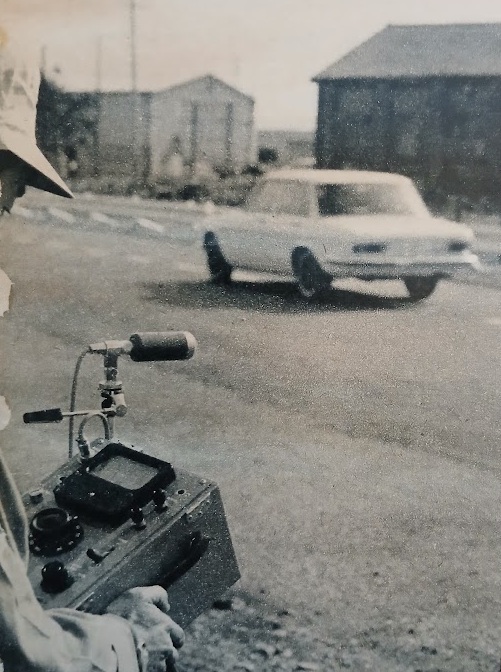
Magazine: Let’s move on to vibration and noise. Could we have the data from the Watari Laboratory?
Nishiyama: I’ll start with the suspension vibration frequencies. The sprung-mass frequency was 1.4-1.5cps, and the unsprung-mass frequency 13-14cps. Exterior noise, measured in second gear at a steady 50km/h, was 70 phons, rising to 77.5 phons under acceleration.
Interior noise was 64 phons at 40km/h, 67 phons at 60km/h, 71 phons at 80km/h, 74 phons at 100km/h, and 75 phons at 120km/h.
Watari: If you plot that as a curve, the noise is relatively high at low speeds, while the car is quiet at high speeds. That makes me wonder if there’s a peak somewhere in between.
Nishiyama: There isn’t any particular peak, but the noise becomes very well suppressed from around 80km/h upward.
Watari: Around 40km/h, I’d say it’s rather high for a car in this class. We’ve been hearing that “the engine has been enlarged” in this car, but looking at it the other way around, you could say that for a car of this size, carrying six people, the engine it had until now was actually rather small, and that this is why it became necessary to enlarge it. So rather than comparing it with the 1800cc class, I think that in terms of noise and vibration it would really be more appropriate to compare this car with what we call the 2000cc class.
Looked at that way, the noise at low speeds is still on the high side. At high speeds, though, it has been very well suppressed all the way to 120km/h, and I think that’s quite an achievement. I wonder what happens beyond that. (laughs)
Hirao: So would you say the noise level is low?
Watari: No, it’s high. I don’t know how it would compare with one of the noisier cars in the 1800cc class, but compared with a quiet 1800cc car, this would certainly be on the high side. There are cars at both extremes, some noisy and some quiet, so perhaps you could say this falls somewhere in the middle. But since this is a new model being introduced now, I’d still like to see it closer to the lower end of that range.
Hirao: If you’re driving at 40km/h in top gear, I think this is a quiet car. But at 40km/h in second, I imagine it’s extremely noisy.
Ishikawa: At 40km/h in top, there’s a sort of booming sound, isn’t there?
Watari: The 65-phons figure at 40km/h in top is high compared with other cars of this class, but 75 phons at 120km/h is a good figure. With most other cars, the noise level rises steadily as speed increases. With this one, it’s more as though the lower-speed end of the curve starts unusually high. And what Professor Hirao and I have just been talking about is really a separate matter from the noise level itself. Perhaps what it needs is simply a more pleasant quality of sound.
Hirao: Yes, that may be it.
Major Changes to the Brakes
Magazine: What about the suspension vibration frequencies?
Watari: Well, I think they’re about normal, although they do seem a little high. Perhaps there’s something off in our measurements.
Sakashita: You gave the sprung-mass frequency as 1.4cps, but I think that’s a little too high. At the front it’s around 1.1cps.
Magazine: Have you changed things such as the suspension spring rates from those of the previous Luce 1500?
Sakashita: We’ve made the rear slightly stiffer than before. One reason was that we’d heard criticism that the car sat rather low at the rear, and we also felt that the understeer was a little too strong, so we raised the rear. Apart from that, about the only change is the use of variable-ratio steering. Nothing else has been changed.
Magazine: Then let’s hear the weight and brake data from the Ship Research Institute.
Ishikawa: First, the catalog weight of the Super Deluxe is 1,090kg, while our measurement at the Ship Research Institute, including the spare tire and tools, was 1,111kg in total. Of that, 621kg was on the front and 490kg on the rear, giving a distribution of 56:44. With either one or two people in the front seats, the percentage distribution remained almost unchanged. We also measured it with five people on board, two in front and three in the rear. Total weight was then 1,418kg, with 720kg on the front and 698kg on the rear, giving a distribution of 51:49.
Compared with the Luce 1500 Deluxe we previously tested for Motor Fan, the catalog vehicle weight has increased by 40kg. I imagine that’s because of the various more luxurious items of interior equipment.
Judging from the figures measured with the side-slip tester, front wheel alignment with one person in the driver’s seat indicates a small amount of camber and toe-in. With five people aboard, however, both change to almost zero. At the rear, both camber and toe-in are zero, with virtually no change under load. Have the alignment settings been changed from those of the previous Luce?
Sakashita: No, they haven’t.
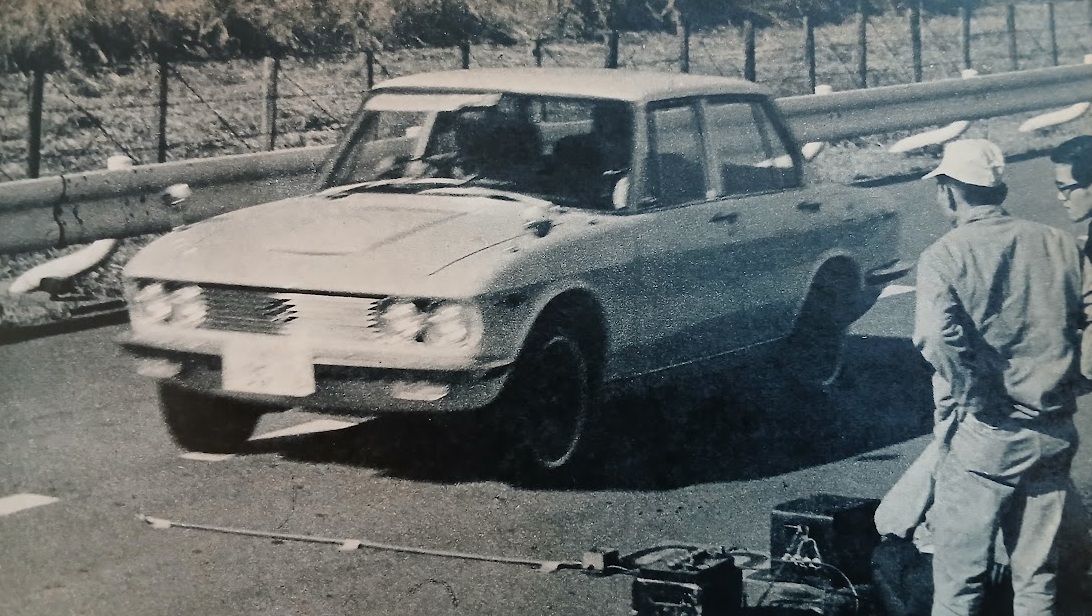
Ishikawa: I think the brakes are the one area that has changed substantially from the previous car. The front brakes are Bendix-type discs and the rears are leading-trailing drums, with a Master-Vac servo fitted to reduce operating effort.
In our measurements, the pedal effort required for 0.6g deceleration was 24kg. There was virtually no imbalance between the front brakes, although there was a slight imbalance at the rear. The brake-force distribution was approximately 70:30. In the road test, decelerating from 50km/h, the required pedal effort was lower, with 0.6g being obtained at around 20kg.
Looking at the curves, one point that concerned me was the operation of the Master-Vac servo. When we were measuring braking force, the servo assistance appeared to level off at a pedal effort of around 10kg. From the curve obtained in the brake-pedal operating test, however, it appears to continue to around 15-16kg, or perhaps as much as 18kg. If the servo assistance had continued farther into that range, I think we would have obtained a somewhat lower pedal-effort figure in the bench test as well. Had the vacuum level been higher during the measurement, I think the bench test, like the road test, would have shown more than 0.6g deceleration with a pedal effort of around 20kg.
As for pedal operation, the brakes begin to take effect at an effort of about 2kg, and there is 24mm of free play, which is a little on the large side. So when you first press the pedal, it immediately falls away under your foot. I think that’s due to the amount of free play.
Light Accelerator Pedal
Kondo: As for the brakes, I didn’t notice the finer points that Mr. Ishikawa has just mentioned. Generally speaking, though, servo-assisted front discs tend to work extremely well at high speeds, but at low speeds they can sometimes feel slightly delayed in taking effect, or rather dull in their response. In the limited testing I did yesterday, however, I felt virtually none of that delay, which I was pleased to find.
Ishikawa: Next, here are the results of our measurements of the various control efforts. The gearshift has four forward speeds and reverse, and the effort required both to engage and disengage the gears was between 0.5 and 2kg. To select reverse, however, the lever has to be pushed firmly forward, requiring 5kg.
As for the pedals, I believe the head of the design department told us that the target for the clutch was a maximum effort of around 10kg, and that’s exactly what we found: 10kg to disengage and 5.5kg to engage.
The accelerator pedal requires 1.5kg under acceleration, and only 0.5kg to maintain a constant 50km/h, so it’s extremely light. The seat slide, reclining lock, and door opening effort were all around 2kg. Opening and closing the vent windows required 4-4.5kg, which isn’t particularly high. Releasing the hood lock was somewhat heavy, at 12-16.5kg.
The head restraint is comparatively light, requiring 2.5kg to raise it. To lower it requires a 6kg push to release the lock, after which it drops under its own weight. Once locked, it won’t go down no matter how hard you strike it. I think that’s very good, but there is no stop to prevent it from being pulled upward, so it will move with only 2.5kg of force. If the seatback was fully reclined, and the seat was then forced forward in a rear-end collision, is there any danger of the head restraint coming out? As for downward movement, in rear-end collision tests we find that the head tends not so much to strike the restraint horizontally as to come down onto it from above, so the locking arrangement in that direction is quite satisfactory.
Sakashita: We were concerned about exactly that point, and we carried out tests with a dummy. The results showed that it was safe. I can’t say there would be absolutely no danger under particularly unfavorable circumstances—for example, if someone were riding in the passenger seat with the seatback reclined when the car was struck from behind. Under normal conditions, however, there is no problem in that respect.
Magazine: This time, because of scheduling difficulties at the Kondo Laboratory, we weren’t able to carry out our handling and stability tests. Toyo Kogyo has therefore provided us with its own test data, and we’d like Professor Kondo to comment on those results.
Kondo: First, I should apologize. We’re very busy at present with graduation presentations, and I’m sorry that we had to omit our own testing. This time Toyo Kogyo has provided us with its data, so I’ll explain the results.
In the understeer-oversteer tests, the basic characteristic appears to be mild understeer. They have tested the car up to 0.8g lateral acceleration. The car evidently grips the road very well, and I imagine conducting the test itself must have been quite difficult.
They have also measured the roll rate in considerable detail on a tilt table. At 0.5g, the figure is 5° with six people aboard, 4.3° with two people in the front seats, and 3.7° with the car unloaded.
In the stationary steering-effort test, carried out on dry, coarse-surfaced concrete, they turned the steering wheel as far as 720° in either direction. Maximum effort was 20kg when turning to the right and 18kg to the left. In the figure-eight test used to measure steering effort at low speeds, the effort was 6kg at a lateral acceleration of 0.25g. For steering effort at higher speeds, a slalom test was carried out at 80km/h with a wavelength of 70m. At a maximum lateral acceleration of 0.25g, the effort was 2.9kg when turning to the right and 3.5kg when turning to the left.
As usual, I’d say all of these figures are entirely normal apart from the rather high steering effort when stationary. The steering effort in the slalom is fairly high as well, but personally I regard that as desirable.
Finally, there is the hands-off directional-stability test. I assume this is indicated speed, but measurements were made up to 140km/h. Even at that speed, the car converges back into line. In addition to the damped oscillation of the body itself, however, I get the impression that another oscillation of somewhat shorter period is superimposed on it.
We were able to do only a very brief hands-off stability test yesterday because crash tests happened to be taking place at the Mechanical Engineering Laboratory test course. During that test, though, I had the feeling that the rear of the car was being pulled slightly off line. I wonder if that isn’t reflected in the shape of the damping curve. At the time, I also had the impression that the lateral stiffness of the tires was a little low.
Watari: At any rate, there were moments when the steering and the car didn’t seem properly connected to one another.
Sakashita: I don’t think the shape of the damping curve is directly related to the sensations you experienced. As for the stiffness of the tires, we’re using low-profile tires, so I don’t think that would be the cause…
Convenient Intermittent Wipers
Magazine: Next, we’d like to hear the results of the visibility measurements from the Hirata Laboratory.
Hirata: Here are the results of our measurements of the driver’s field of vision. We took measurements with the seat in its fully forward, middle, and fully rearward positions. With the seat in the middle position, the driver’s eye point was 119.3cm above the ground. The distance from the eye point to the windshield was 57.5cm, and to the center of the interior rearview mirror 50cm. Those were the test conditions.
Actually, I think the eye point may have been a little too high, and we may need to make some improvements to our dummy. Under those conditions, the visible range through the windshield was 35° to one side and 44.5° to the other. Those figures are very small, because the interior rearview mirror happened to obstruct the horizontal plane through the eye point. The total was 63°. That’s still quite small, but if the eye point were lower, the visible range would increase by about 25°. Vertically, the figures were 7.5° upward and 18.5° downward, for a total of 26.5°.
Through the rear window, the visible range was 9° to the right and 48.6° to the left, for a total of 57.6°. Vertically, it was 1.5° upward and 12° downward, for a total of 13.5°.
Expressed as angles, the area swept by the wipers was 30° to the right and 26.5° to the left, for a total of 56.5°. A somewhat shorter driver would be able to see about another 20° beyond that. The total blind angle under these conditions came to 82°, of which 47° was to the front.
Expressed in solid angle, the windshield provides 0.7 steradians of visible area, while the wiper-swept area is 0.439 steradians, or about 42.7%. The rearward visible range is 1.09 steradians, of which the rear window accounts for 0.232. The interior rearview mirror provides 35° of visibility; expressed as solid angle, this is 0.153 steradians, or about 65.9% of the rear window’s visible area. So the mirror provides roughly 66% of that field of vision.
Yamamoto: Comparing the Luce 1500 and 1800, as we’ve just heard, the 1800’s horizontal field of vision is more than 20° narrower. On the other hand, looking at the vertical field, the 1500 was worse. You’ve said that the body hasn’t changed, and that the driver’s position relative to the front of the car hasn’t changed either, but in practice that doesn’t seem to be the case. I wonder if the driver is sitting slightly farther back in the new car. I’m curious what you think about that.
There’s one other point. The wipers work very well, but I think the swept area could be made a little wider. You’ve gone to the trouble of providing two wiper speeds and intermittent operation, among other distinctive features, so I think it would be worthwhile increasing the swept area a little more.
Yokota: As far as the seat position is concerned, from the design standpoint it hasn’t been changed at all.
Sakashita: I believe the previously tested car had a bench seat, whereas this one has reclining seats. Perhaps the difference is simply due to how the seat was adjusted. Since the reclining adjustment allows quite a range of positions, if the measurement was made with the seat set differently from the previous car, the results would naturally differ.
Magazine: The Super Deluxe wasn’t available in time for the visibility measurements, so the tests were carried out with a Deluxe A fitted with a bench seat. I think that could also account for the difference in eye-point position.
Yokota: As for the wipers Professor Yamamoto mentioned, we’ve adopted an overlapping type, and we’ve paid considerable attention to providing as wide a field of vision as possible. Compared with other cars, it’s quite an elaborate mechanism.
Hirao: I think the intermittent wipers, which pause from time to time, are an excellent idea. They must be very convenient during the rainy season. How exactly does the mechanism work?
Higuchi: In practice, it’s a nuisance having to keep switching the wipers on and off, so having them stop by themselves is very useful.
Sakashita: We’ve found that people appreciate the system more than we expected. In Hokkaido in particular, even when there’s a fair amount of snow, apparently you don’t need the wipers running all the time. People use them only occasionally, and they find this mechanism very convenient for that reason.
Yokota: To put it simply, it uses a transistor circuit. The wipers operate for about four seconds, pause for ten seconds, then operate for another four seconds, repeating that cycle.
A Call for Original Safety Design
Magazine: The dimensions don’t seem to have changed very much either. Mr. Onda, perhaps you could tell us anything that caught your attention.
Onda: The dimensions are almost entirely unchanged, so it feels as though we’re the ones being tested this time. (laughs) I’ll just touch briefly on the main points. As far as the interior is concerned, the dimensions of the trunk have changed. The arrangement of the spare tire and fuel tank has been revised, and this results in some dimensional changes there.
The Super Deluxe has separate reclining seats, but I actually had the impression that the Deluxe A’s bench seat, with its divided backrest, might be even more appropriate for the Super Deluxe. The center section can serve as an armrest as well.
Higuchi: After living with one for years, you find that the space in the middle of a bench seat is extremely convenient for putting things. It would be a different matter if the gearshift were there, but with a column shift, I think the bench seat is preferable. Professor Hirao said he’d like an armrest, though, didn’t he?
Onda: I think a great deal of attention has been paid to safety in the positioning of the controls within the cabin. But equipment that’s optional on the Deluxe is all fitted as standard on the Super Deluxe. I wonder whether the layout was designed from the outset to accommodate all of that equipment, or whether it’s basically the Deluxe layout with the optional equipment simply added to it. The right-hand door lock in particular seems to be an example of that. You’ve gone to considerable trouble to make the area around the dashboard neat and uncluttered, yet it feels as though everything displaced from there has ended up somewhere else.
Yokota: We’re also allowing for the possibility of installing an air conditioner in the center of the dashboard. As you say, it would certainly be preferable simply to provide enough space on the dashboard for everything. But once you put the most important controls close at hand, the others inevitably have to be moved elsewhere one after another, so for now…
Onda: Among the welcome features are the parking-light button next to the ignition switch, as well as the intermittent wipers, power windows, and automatic door locks, all of which make the car more convenient and safer. There is also a cut-off switch for the driver, which I assume is another safety feature. I think it’s very commendable that safety has been considered in two or three different ways like this, including the safety of children. And the buzzer that sounds if a brake light burns out is another extremely useful feature.
Magazine: Then let’s hear from Professor Higuchi.
Higuchi: My area of responsibility is safety and maintenance, but lately safety has been more or less covered by established standards, and if a car complies with those standards it receives good marks. As for maintenance, we’ve now reached the point where for the first couple of years you need do little more than change the oil. So there isn’t much left for me to say. Instead, I’d like to offer a somewhat different point of view.
When we talk so much about safety today, we’re generally doing so with the American safety standards in mind. But when organizations such as the Society of Automotive Engineers of Japan investigate injuries sustained in accidents, we sometimes find that people are being injured by things that aren’t necessarily covered by those standards. If a lot of accessories and switches are fitted around the driver’s knees, for example, even fairly minor emergency braking or a rear-end collision can easily result in knee injuries. The circumstances may be different from those in America, but manufacturers now have accident data available to them, so I’d like to see them make use of it and develop safety measures of their own.
As for maintenance, in the beginning we had oil changes at 3,000km and all sorts of other maintenance intervals that seemed to follow no particular pattern. On this car, everything has been standardized around 6,000km intervals, which I think is excellent. Of course, annual mileage varies from one owner to another, and recently there have been more people driving less than 5,000km a year. In cases like that, I wonder whether it might be better to specify maintenance by season rather than simply by mileage.
Yokota: Then perhaps I could mention another point or two—not that I want to get carried away after hearing some praise. On the subject of safety, we’ve added nighttime illumination this time, and people have found it extremely useful. Another thing we put a great deal of thought into was bringing the most frequently used controls together on a single combination switch.
Magazine: What sort of production volume are you planning for the 1800?
Yokota: We’ve announced that initial production will begin at 1,500 units a month. But we only have results for December and January so far, so we can’t yet say what the overall proportions will be. At present, though, we expect the 1500 and 1800 to account for roughly 50% each.
Magazine: Thank you all very much.
Postscript: Story Photos