Mazda Familia Rotary SS (1969)
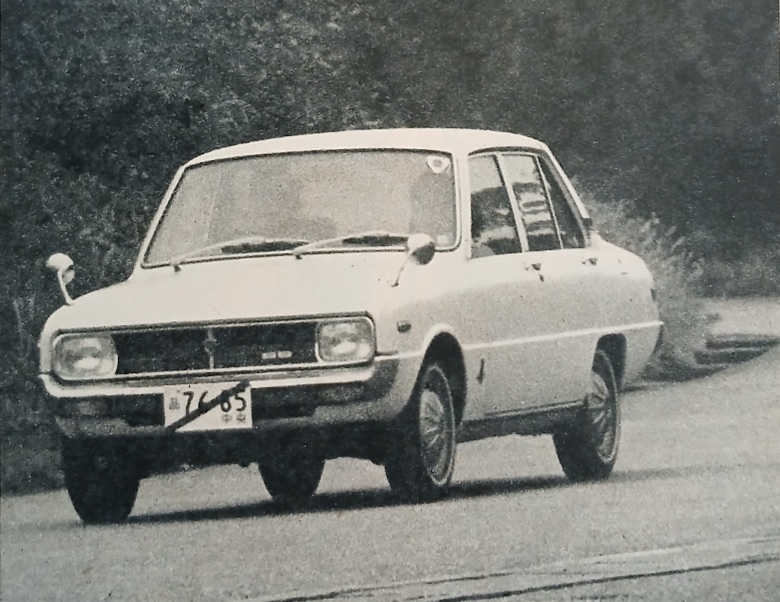
Publication: Motor Fan
Format: Test Drive Report
Date: September 1969
Author: Atsuro Sasaki
Rotary SS: Charging Along the Tomei and Through the Mountain Roads
The Familia Rotary SS is the third model to be introduced in Toyo Kogyo’s rotary series, following the Cosmo and the Rotary Coupe. The smooth, high-performance character unique to the rotary engine has already been amply demonstrated in those two earlier models. We approached this test drive with great anticipation, eager to discover whether the Familia Rotary SS would live up to its growing reputation…
The Japanese have always had a fondness for the haikara–though that expression may not immediately resonate with younger readers. Let us say instead that we are drawn to what is new. At times, we are also inclined to harbor aspirations somewhat beyond our station.
It is perhaps for that reason that, not even twenty years after the war, motorization has advanced in such vigorous fashion, and that cars of relatively high specification sell remarkably strongly in proportion to the national income. In the beginning, the novice driver is content simply to have an engine that runs and a car that drives. Yet such satisfaction does not last long.
“After all, the one I had until recently was a Familia 800 from five years ago. You can’t take that on the expressway, can you? Yes, well–that’s why I went ahead and bought one of these.”
And so it is that the car presently in the spotlight is the Rotary SS.
A Brilliant New Star in the Broad Familia Series
Toyo Kogyo’s acquisition of the production rights to the NSU Wankel rotary engine dates back some time. The first fruit of that effort was the rotary Cosmo Sport. It is no exaggeration to say that its introduction drew the attention of the entire world. Even NSU itself had not produced a rotary-powered car of such thorough execution. Then, in the following year, there appeared what might be called a rotary for the mass market: the Mazda Familia Rotary Coupe. That was last year. Already some 10,000 units have reportedly been sold. It seems there are indeed many who cannot resist the new and novel. Yet novelty alone cannot explain it.
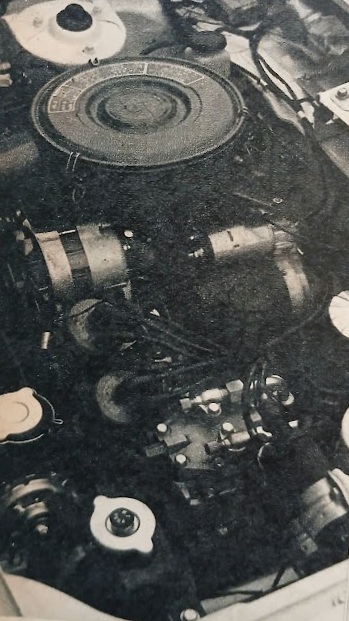
With its twin-rotor configuration–491cc × 2–for a total displacement of 982cc, and a maximum output of 100ps at 7000rpm, the engine possesses remarkable vigor. The sporty, quick response so characteristic of the rotary design is very much in evidence. Such qualities must surely have stirred the hearts of the growing number of sports-minded enthusiasts now found throughout the country.
Following these two models, Toyo Kogyo’s third effort has gone a step further still, offering the market a variation with even broader appeal. Watching the company’s progress year by year, one senses a deliberate, almost theatrical timing–as though the curtain were being drawn back gradually in response to the applause from the audience.
SS, one assumes, stands for Sport Sedan. True to its name, the Familia began life as a mass-market car aimed at the expanding “my car” class of private owners, yet as is well known, it has grown into a model offered in a remarkable number of variations. Perhaps taking a cue from the encyclopedic proliferation of the Ford Mustang, one could almost lose count listing them all, from the standard version to the four-door Deluxe. Both 1000cc and 1200cc engines are offered according to grade. And now, to this already expansive lineup, the company has added its prized rotary engine.
From the tiptoe strivers reaching above their station to the more pragmatic buyers trading up in orderly steps, there appears to be something for everyone.
In terms of price, whereas the Rotary Coupe stands at 700,000 yen–among the highest in its class–the SS arrives at 638,000 yen, a reduction of 62,000 yen. At the same time, an E grade of the Coupe has been introduced at 660,000 yen, creating a stepped pricing structure. For those who find 700,000 yen a difficult proposition, there is the 660,000 yen E Coupe. For those with families, or with business in mind, there is this SS model. One may choose according to circumstance.
As a representative of the Tokyo public-relations office explained: “Our basic intention is to promote the wider adoption of the rotary engine. We would like people to understand that it is not a car reserved solely for those with special skills or for a narrow group of sports enthusiasts.” The company’s determination to press the point could scarcely be stronger.
But how does the Familia Rotary SS fare in person?
To find out, we undertook a moderately long tour over a route with a fair variety of conditions: From Tokyo to the Tomei Expressway, onward to the Atsugi-Odawara Road, through Hakone and the Otome Pass to Gotemba, and then back to Tokyo via the Tomei again. What follows is our report from that drive.
A Well-Organized Interior — Yet Not Without Carelessness
It must have been just past 10:30am when we departed from the Yaesu exit of Tokyo Station. Driving through the city at that hour meant encountering the second wave of the morning rush. Under such conditions, we found ourselves fully occupied simply with becoming accustomed to the car.
Let’s begin by comparing it with the Rotary Coupe I test-drove last month. The Coupe featured what was described as a “T-shaped” dashboard layout, with a central console and a laterally flowing instrument panel. In the SS, this has been simplified to a single horizontal panel. Four circular gauges are arranged within a long hexagonal binnacle: water temperature, speedometer, tachometer, and fuel level, from left to right. To the left of these sits the radio, and beneath it the heater controls. All are set within a crash pad approximately 5cm deep. The panel between the gauges, as well as the vinyl leather of the crash padding, is finished in black.
Given the texture and surface quality of the leather, there are no concerns about reflections in the windshield.
The panel layout is restrained, even conservative, but when seated in a proper driving position, visibility presents no real problems.
The steering wheel is a slightly thick-rimmed wooden type. The spokes, however, are bare aluminum. This may lend a certain sporting flavor, but it seems somewhat at odds with the evident effort to reduce reflections from the instrument glass. A matte black finish might have been preferable.
The metal lower portion of the dashboard is painted in the same color as the body–in this case, white. The panel appears to have been pressed into shape and then simply folded inward along its lower edge, without further finishing. It is not a place one ordinarily touches, but when reaching around to deal with wiring or connectors, one could easily cut a hand. This is a minor detail, but it suggests a slight lack of consideration for the sensibilities expected of a family car.
The contrast between the white-painted metal and the black padding is somewhat too vivid. At the very least, wouldn’t it have been better to apply more of the same leather material to this section? On this particular day, with overcast skies from morning to evening, it did not trouble us. However, I recall driving another car with a similar color scheme along the Tomei and Meishin expressways and finding it surprisingly tiring for the eyes.
Perhaps I am overly sensitive to such matters, having spent many hours on long-distance tours. Yet when one considers the fatigue imposed by high speeds and long mileage, it seems only reasonable to reduce visual–and by extension psychological–burdens wherever possible. I offer these remarks based on firsthand experience.
Smooth Acceleration: The Quiet SS
Beyond these points, I found little else to criticize.
After passing the Tamagawa-Seta intersection and entering the Tomei Expressway, the rotary engine quickly revealed its strengths. In particular, leaving the Tokyo toll gate some seven kilometers beyond the entrance, the responsiveness was such that we were almost immediately up to mainline cruising speed.
In everyday use, I drive a well-worn 1300cc sedan. In that car, such a dash away from the toll gates on the Tomei would be unthinkable. Nor could it hope to match the smoothness with which the rotary climbs through its rev range.
With three occupants aboard, along with photography equipment and the like, the car was carrying less than its full five-passenger capacity. Each time we pulled away from the gates in formation with the other cars, ours glided effortlessly ahead, leaving them behind in a smooth, unhurried manner.
The car I drove had covered less than 1,000km and was still very new. However, taking Toyo Kogyo’s guidance that it was “already in a condition suitable for proper running,” I proceeded to test its performance in various forms of high-speed driving.
While following a truck traveling at 80km/h at the same speed, I accelerated to 100km/h to overtake. At 80km/h the engine was turning at just under 3000rpm. A slight press of the accelerator was enough for a light, unforced pass; a glance at the gauges showed 4,200rpm and approximately 120km/h. When a colleague timed our speed using a tachometer-equipped wristwatch, the result was about 115km/h.
(Note: Along the expressway, small boards marked with numbers are placed at 100m intervals at the roadside, with luminous markings visible at night. By reading the kilometer posts and timing between them with a stopwatch, one can calculate true speed. On the Tomei Expressway, the kilometer posts on both the up and down lanes are measured from Tokyo as the starting point.)
The word that best suits this acceleration is “effortless.” One might describe it as the difference between the up-and-down motion of pistons turning a crankshaft in a reciprocating engine, and the smooth rotation of a triangular rotor within a cylinder. I drove continuously at an indicated 110km/h. The engine note was subdued. There was no booming resonance within the cabin; in fact, one could hear the wind entering through the ventilators.
Speaking of the ventilators, the volume of air they deliver may well be the strongest among cars in this class and its immediate rivals. This particular car was equipped with air conditioning, yet I found myself leaving it switched off. Judging by the diameter of the vent outlets, I had not expected such forceful airflow, and it came as a surprise.
On the expressway, many drivers keep their windows closed because of high engine revs and wind noise. Naturally, no one drives at 100km/h with the windows fully open. But due to insufficient ventilation, one often has no choice but to crack a window slightly in order to get air to the face. This is a minor dissatisfaction in most cars. Setting the ventilation to maximum and directing the airflow toward my face, even in the muggy, overcast weather, proved distinctly comfortable.
Engine Braking Comparable to a Reciprocating Engine
From Atsugi Interchange, we turned onto the Atsugi-Odawara Road, then climbed in one continuous run via the Tokyu Hakone Turnpike to Taikanzan.
Although the Atsugi-Odawara Road is a toll road, it has several intersections along the way. Imagining a situation in which a car were suddenly to dart across one’s path, I tested sudden deceleration and the effectiveness of engine braking.
Downshifting was smooth. It hardly felt like a car with fewer than 1,000km on the clock; gear changes were remarkably easy. Over the entire 300km of the test route, there was not a single occasion when I found a gear resistant to engage.
The shift knob is a perfect sphere. It fits neatly into the palm, though some drivers may prefer a slightly oval shape. Recently, the spherical type seems to have fallen somewhat out of favor. The method of inserting a rubber sleeve inside the knob, gripping the tip of the lever, does have the advantage of preventing transmission vibrations from being transmitted to the hand. However, in a car of this sort, where gear changes are frequent, there is the drawback that over time the rubber may deteriorate, making the knob easier to pull off. For that reason, many owners of earlier Bluebird SS and SSS models removed the original knob and threaded on wooden ones instead. (Nissan’s current floor-shift models no longer use this method.)
Now, as for engine braking…
In a reciprocating engine, the up-and-down motion of the pistons, linked through the connecting rods and crankshaft, creates mechanical resistance. In a rotary, by contrast, the rotation of the rotor itself becomes the motive force. There is inherently less resistance to continued motion. From this, anyone might naturally suppose:
“Doesn’t that mean the engine braking is weak?”
Yet this proved to be nothing to worry about. Strictly speaking, it is true that it feels slightly weaker than in a reciprocating car, but the engine-braking effect is certainly present. This is merely a report on driving impressions, not a controlled comparative test against other reciprocating cars, so I cannot make definitive statements in that regard. However, whether at 100km/h on the Tomei, descending from the Turnpike’s Taikanzan toward Moto-Hakone, climbing and descending through the Hakone mountains, or negotiating the sweeping succession of bends from Sengokuhara down the Otome Road toward Gotemba, I found the engine braking characteristics to be admirably useful.
Last year, when test-driving a Rotary Coupe around the Metropolitan Expressway loop, both I and Mr. N, officials from the Metropolitan Expressway Authority who were riding alongside, paid close attention to the matter of engine braking. But on the largely level Shuto Expressway, it was difficult to reach any clear conclusion.
“Does it feel different from an ordinary car?”
“I don’t think there’s much difference.”
That was about the extent of the evaluation.
This time, however, we tested it over a variety of surfaces, curves, and descents. The conclusion of the three of us aboard was that while it may feel ever so slightly weaker, in practical terms one hardly notices. The resistance available is, we estimate, entirely sufficient.
A Rotary That Feels Close at Hand
On the mountain roads of Hakone, we examined the car in various ways–sometimes as a sports sedan, sometimes setting aside the rotary aspect altogether and judging it purely as a family sedan. Each of the three of us had our own method of evaluation.
We tried it on notably rough roads, studied its cornering characteristics through curves, and experimented with repeated patterns of shifting. Our impressions naturally differed in nuance and expression, yet the overall conclusion was the same: it can be enjoyed as a sports sedan, and at the same time it satisfies as a powerful family car.
The front seats are not poorly made for this class and price, and the rear compartment is by no means unusable. That said, with the Familia’s cabin width of 1265mm, three adults across the rear bench feel confined. This cannot be denied.
As for the suspension, the rear in particular felt on the soft side. For more demanding drivers, and those who will drive the car in the somewhat aggressive manner befitting a sporty sedan, it might have benefited from slightly firmer tuning.
From Gotemba, we rejoined the Tomei Expressway. During the two-hour afternoon rush, traffic volume amounted to roughly 13-15 cars per kilometer. Most were traveling at the speed limit or slightly above it. From the Ashigara Service Area, we made a single uninterrupted run back toward Tokyo. In terms of distance, this is not an especially long stretch, yet the ability to maintain 80–100km/h with only light throttle input may be counted among this car’s virtues.
By formal classification, it belongs to the 1-liter class. Ordinarily, in this category, sustaining a continuous 100km/h run brings early fatigue, owing to the combined effects of noise, vibration, and the strain of maintaining speed. Here, that burden feels reduced by a noticeable margin. That is something one appreciates.
After only 300km and half a day of use, perhaps this sounds like excessive praise.
Yet the fact remains that a rotary-engined car has been brought into the mass-market class and priced accordingly. That alone deserves commendation.
As I wrote at the beginning, Japanese owners are fond of novelty and inclined toward luxury. It would not be unreasonable to say that an attractive new option has now been added for such people.
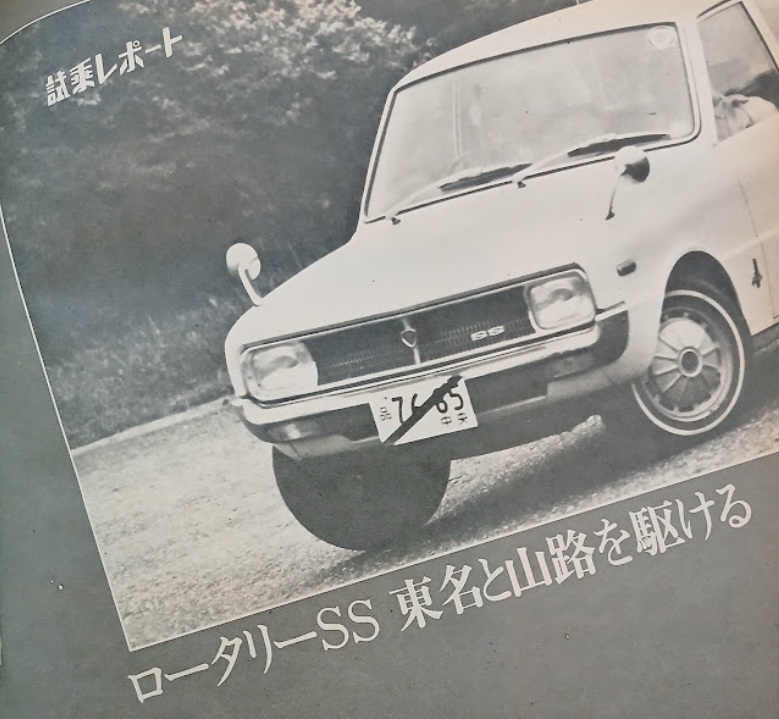
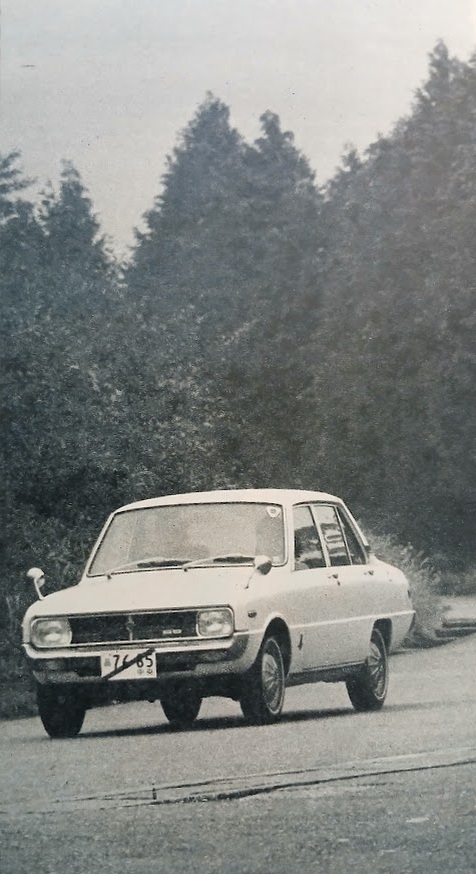
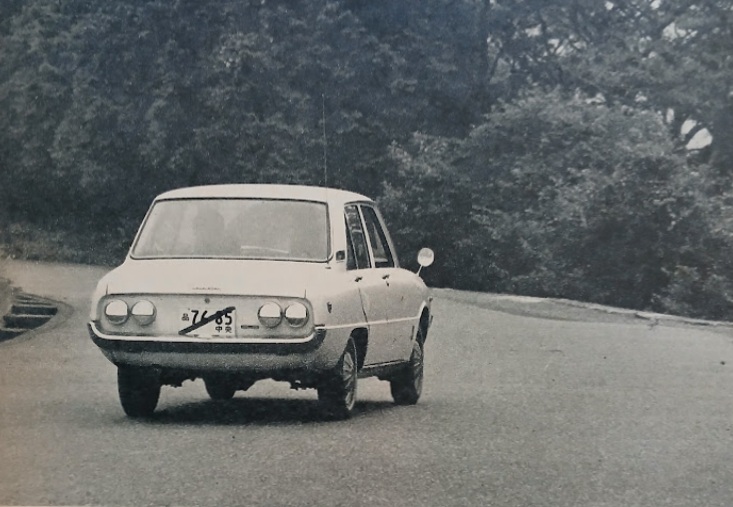
The body is that of the Familia sedan; the heart is the rotary. Yet it retains traces of the Rotary Coupe in the grille and tail lamps. For those who desire the coupe but hesitate due to budget or practical considerations, the rotary engine has suddenly become far more accessible. Existing users of the Familia 1000 or 1200 could step up to this model with comparatively little resistance. In that sense as well, it may be called a car in which speed can be enjoyed with ease.
Provided, of course, that one applies just a touch of driving discipline to keep its abundant power in check…
Postscript: Story Photos