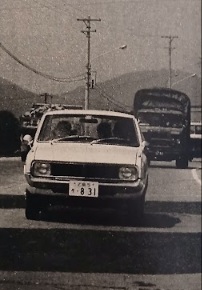
Mazda Familia Rotary Coupe (1968)
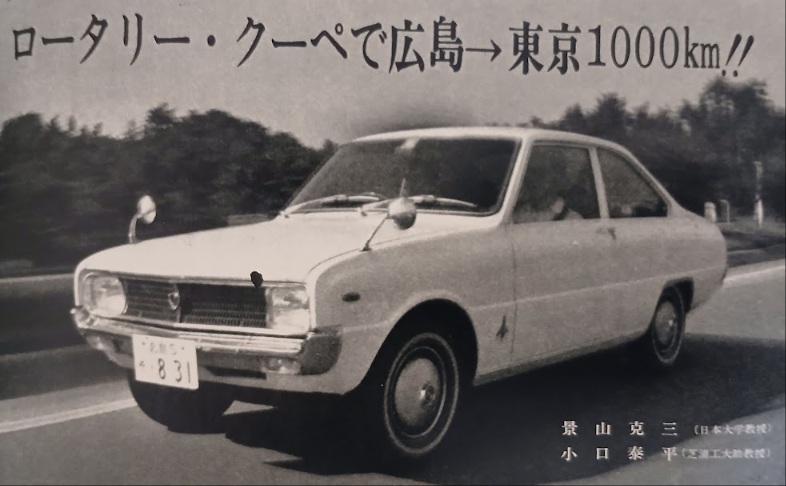
Publication: Motor Fan
Format: Test Drive Report
Date: September 1968
Author: Katsuzo Kageyama, Yasuhei Oguchi, Atsuhiko Okubo, Motor Fan Editorial Staff (uncredited)
Hiroshima to Tokyo—Over 1,000km in the Rotary Coupe!
What is the true character of the Familia Rotary Coupe? It is surely an ultra-high-speed family car with an emphasis on practicality. How well balanced is the combination of the rotary engine’s high power and the Familia’s family-car qualities, and how successfully can the resulting car serve as everyday transportation? To find out, Motor Fan undertook a long-distance drive of more than 1,000km from Hiroshima to Tokyo, covering expressways, ordinary roads and mountain routes.
…The result was a car that truly broke with convention.
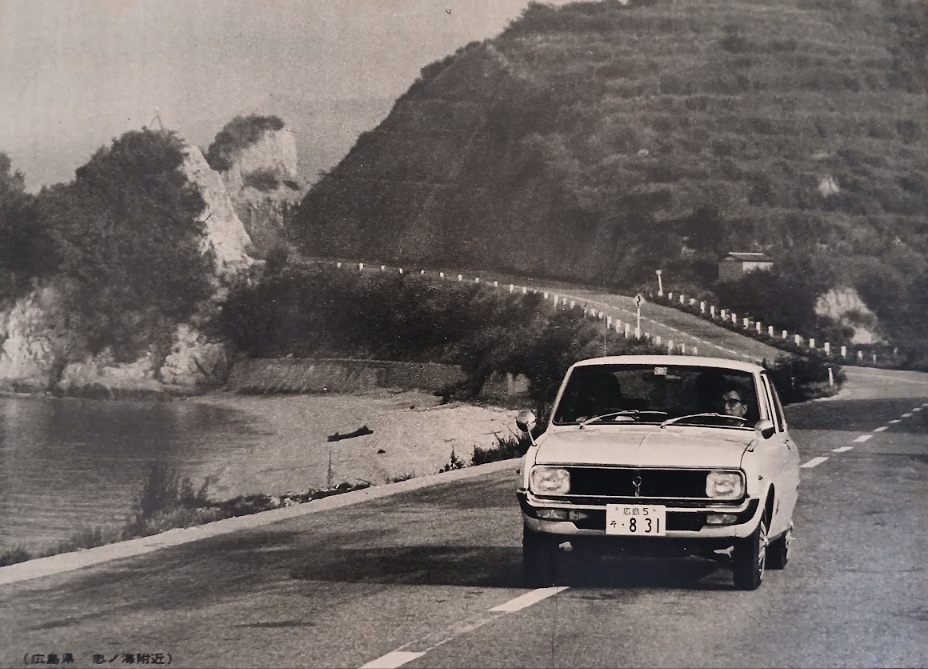
At 5:10am on July 19, the Chamonix White Familia Rotary Coupe left the Toyo Kogyo works in Fuchu-cho, on the outskirts of Hiroshima, and headed east.
From Hiroshima, our route followed National Highway 31 toward Kure, a pleasant, paved two-lane road with the Seto Inland Sea on the right. From Kure to Mihara, we took National Highway 185, which, although only in certain places, includes rough unpaved sections and sharp corners, making it an ideal test route for evaluating handling and ride comfort.
At Mihara, we joined National Highway 2, the main highway connecting Kansai with the Chugoku and Kyushu regions. Almost entirely a paved two-lane road, it carries heavy traffic, including a steady stream of scheduled commercial vehicles. Even for a high-speed tourer, negotiating crowded roads remains the most common driving condition today, so this, too, was an important part of the test.
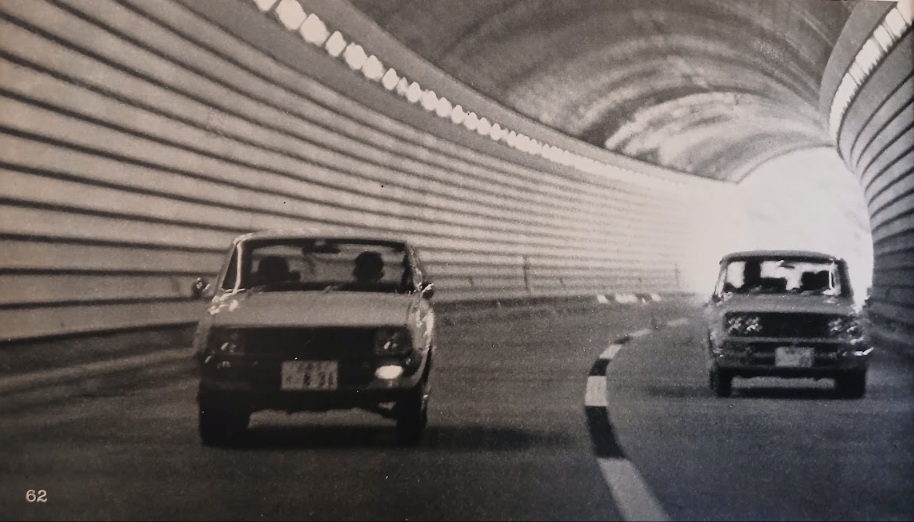
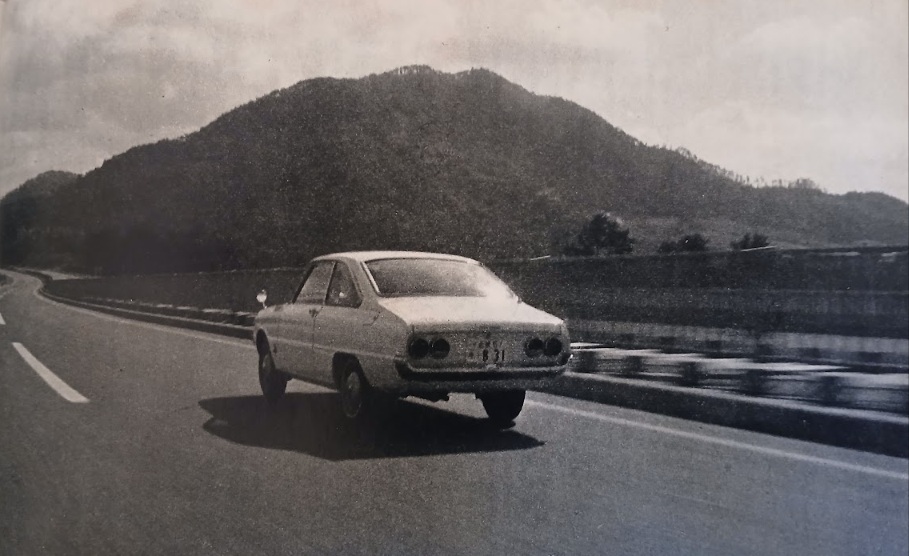
The first day’s journey ended with an overnight stop in Kobe. That evening, the Rokko Driveway provided an opportunity to test the car on steep gradients. The following day, we joined the Meishin Expressway at Nishinomiya and drove straight through to Okazaki. It felt very much like a high-speed endurance test of the rotary engine, and this little GT certainly demonstrated astonishing performance.
From Okazaki, we took National Highway 1. Traffic was relatively light, but when overtaking, the Coupe, with its powerful 100ps engine, darted past slower vehicles like a flying fish. From Shizuoka, we returned to the Tomei Expressway as far as Fuji. Through Hakone, we had to stop and start repeatedly behind slower traffic, but the rotary engine, designed to provide plentiful low-speed torque, showed no signs of distress. From Atsugi, we returned to Tokyo via the Tomei Expressway.
The total distance was 1,013.8km. It was a touring drive that swept away whatever concerns or doubts about the rotary engine had lingered in the minds of those who took the wheel, leaving them instead with a single impression: “Amazing!”
The following is a summary of their comments on this memorable touring drive.
—Atsuhiko Okubo, Motor Fan
Smooth, Sharp Acceleration
Magazine: Over a long-distance drive of more than 1,000km, you encountered a variety of driving conditions. Perhaps we could begin with your first impressions.
Kageyama: The acceleration is excellent. Above all, the engine revs with remarkable smoothness and sharpness. And its flexibility is better beyond comparison with that of a reciprocating engine. I felt that this was one of its outstanding characteristics.
Oguchi: You notice it when starting off in first gear and shifting up through second and third. The usable range of first gear is extraordinarily broad, far beyond anything I had imagined. It completely overturned the conventional notion that rotary engines are weak or lack torque at low speeds. Also, because second, third and fourth are closely spaced, you can drive at around 40km/h in any of those gears without the slightest difficulty. That’s a remarkable quality.
Magazine: We understand the transmission is from the Luce. Why do you think it gives the impression you just described?
Oguchi: More than anything, it’s because the engine note hardly changes at all as the revs rise.
Kageyama: It completely distorts your sense of speed. You think you’re going about 60km/h, but when you look at the speedometer, you’re actually traveling at something like 100km/h.
Oguchi: I completely agree. The sense of tension you feel at 120km/h in a 1600cc-class car doesn’t become apparent in this car until you’re going around 180km/h. We reached that speed on the test course, and the car is fully capable of reaching its rated top speed—in fact, it does so quite effortlessly. We didn’t take measurements of the degree of tension during this touring drive, but I think a comparison of the drivers’ heart rates would make the difference quite clear.
How to Handle a Knife That’s Too Sharp
Magazine: With a light body weighing only 805kg and a powerful 100ps engine, it’s only natural that the car’s performance should be exceptionally good. But how does it actually feel to drive on public roads?
Oguchi: It’s definitely relaxing. If someone overtakes you, you can simply say, “Go right ahead.” You have the peace of mind of knowing that you can overtake them again at any time, without the slightest difficulty. Until now, even with a 1500cc-class car, especially a normal Deluxe model, you had to judge your safety margin for overtaking quite carefully. But with the Rotary Coupe, the excellent overtaking acceleration means that you can complete such maneuvers safely in much less time. So if another driver wants to pass, you can let them go without feeling the least bit irritated.
Kageyama: That’s certainly true. But one thing we have to be careful about with this car is that its performance is so good that using it improperly could lead to a very serious accident. A knife that’s too sharp can be dangerous in the wrong hands.
Magazine: You mean there’s a danger of driving too fast?
Kageyama: Yes. Usually, as you increase engine speed, the noise serves as a kind of warning. No matter who’s driving, there’s a limit to how far they’ll hold a lower gear, and they also feel a certain reluctance to keep increasing their speed. But with this car, the engine note hardly changes, and the engine revs so effortlessly that there’s a danger of the road speed simply climbing higher and higher. If you’re not paying attention, you could easily find yourself exceeding the speed limit. More than that, you can very easily reach speeds beyond your ability to control the car.
Oguchi: That’s right. Of course, traffic conditions would normally prevent you from driving that fast, but someone determined to push their speed could certainly do so. And if that driver’s skill or judgment is even slightly lacking, the consequences could be serious. That’s why it’s essential to drive with a full understanding of the relationship between the driver and the car.
“No Reciprocating-Engine Car Can Catch Us!"
Magazine: You drove the entire length of the Tomei and Meishin Expressways. How did the car feel there?
Kageyama: With the Cosmo, I had thought of the rotary engine as something meant for a special kind of car. The Cosmo was designed for sports-car performance, and it was expensive, so even though the rotary engine had entered production, I still regarded it as something rather specialized. But after driving this car and realizing that one can buy this level of engine performance for 700,000 yen, my whole conception of the rotary engine has changed.
When it comes to overtaking on the expressway, there is virtually no car that can match the Rotary Coupe, other than a few very specialized sports cars.
Oguchi: Because the engine noise is so low, wind noise seems relatively loud by comparison. But perhaps that’s because Toyo Kogyo up to now has been concentrating its efforts on getting this engine, with its entirely new mechanism, into production and onto the road.
From an owner’s standpoint, there’s really nothing more one could ask for in terms of performance. What I’d like to see now is greater attention to safety and comfort—in other words, to making it a more thoroughly developed car. Of course, this car already exceeds the normal standard in those respects, but if I were to ask for further improvements, that’s where I would like to see them.
Kageyama: During the war, when one particularly fast naval reconnaissance aircraft appeared, its crewmen had a famous saying: “No Grumman can catch us!” Driving on the expressway, I found myself thinking, “No reciprocating-engine car can catch us!” I couldn’t help feeling very much the same way.
City Driving Is Also Very Easy
Magazine: The rainy season had just ended, and both days were extremely hot. Did you have any observations about the interior?
Kageyama: In terms of its size, this car is clearly a 2+2. It has an official seating capacity of five, but while the rear seat is somewhat more comfortable than in the previous Familia Coupe, carrying five people is still rather impractical. On the other hand, the front seats are comfortable, and the ventilation is also quite good.
Oguchi: I think it shows a certain thoughtfulness on Toyo Kogyo’s part that they’ve gone to the effort of making a 2+2 into a “2+3”. Of course, this isn’t really the sort of car intended to carry that many people, but there are plenty of times when it’s convenient to be able to carry five legally, even if it’s only to give a few friends a ride to the station.
Magazine: You also did quite a lot of driving in town, but apparently there were no particular difficulties.
Kageyama: Since this car belongs to the Familia series, it must offer more than just sporting qualities. It also has to be easy to drive in heavy traffic and on the kind of roads where low speeds are necessary.
With a reciprocating engine, conventional wisdom tells us that a high-powered car with acceleration as good as this would be a sports car, and therefore difficult to drive in town. But the rotary engine has completely overturned that conventional wisdom. Whether you drive for long periods in first gear or crawl along in stop-and-go traffic, covering less than 7km in an hour, as we did in the traffic near Himeji, the engine shows no signs of trouble whatsoever…
Oguchi: The coolant temperature hardly changes at all. Nor is there any tendency for the carburetor to flood. In that respect, it really is a grand touring car with remarkably flexible characteristics.
Kageyama: The only noticeable difference in feel compared with a reciprocating engine is that the engine braking is rather weak. But the car has dependable disc brakes, and the pedal effort is by no means excessive, so it isn’t really a concern.
Oguchi: I did feel that the clutch pedal had rather too much travel. Of course, that impression is relative to the other pedals. But there can hardly be another car in which you can maintain the same low road speed in either second or third gear with virtually no change in engine noise.
A Luxurious Interior “Mood”
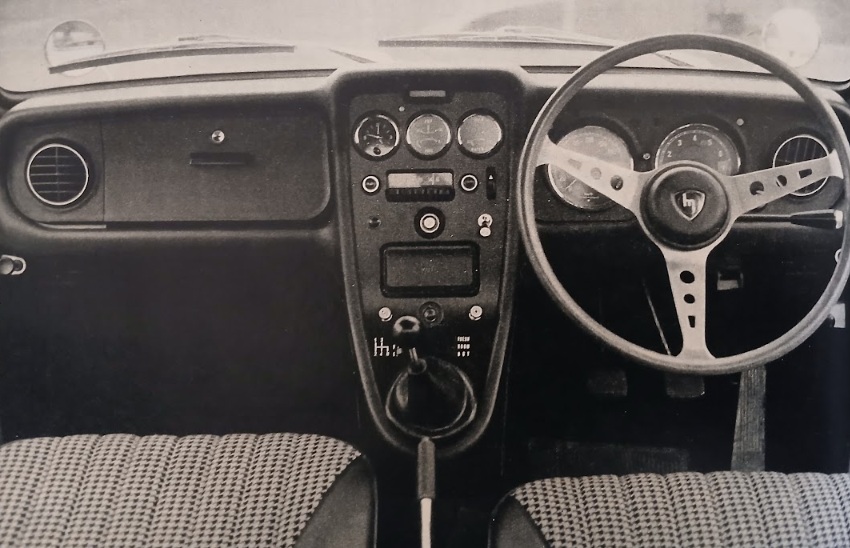
Magazine: We thought the dashboard was exceptionally luxurious for a car of this size. What did you think?
Oguchi: Well, it certainly looks like that of a high-performance car. But from the outside, unless you look carefully, you wouldn’t realize that this is an extremely fast car with a rotary engine. It’s easy to mistake it for an ordinary two-door Familia. Of course, there’s no need to make it overly flashy just to advertise the fact that it’s a rotary-engined GT. There are two ways of looking at this, and I think the car’s restrained appearance will appeal to people who prefer something more discreet.
Kageyama: It has a T-shaped dashboard, with a raised console carrying a whole array of instruments, and the overall atmosphere is luxurious. But there is one thing I’d like to see improved. The windshield wipers park so high that one of the blades sits directly across one’s view of the center of the right-hand fender mirror. The other point is that the turn-signal indicator lamps are not very easy to see. It seems to be a matter of the lamps being too dim rather than their position.
Oguchi: Toyo Kogyo cars have traditionally had a fairly loud turn-signal operating sound, but on this car it’s much quieter, and in daylight the indicator lights are also harder to see.
They’re round lamps positioned at either end of the gauge cluster, so it’s easy to leave the turn signal on without noticing. If possible, I’d like to see arrow-shaped indicator lights placed in the center, where the driver could recognize them more easily.
Magazine: The gearshift lever is very short and has a sporting feel. Did you notice anything about its operation or vibration?
Oguchi: I often hold the gearshift knob while driving to see how it feels. In some cars, at high speeds, so much vibration comes through that your hand starts to go numb. But in the Rotary Coupe, very little vibration is transmitted to the hand, and it varies remarkably little with engine speed.
Kageyama: There’s hardly any difference in vibration whether the engine is under power or not, either…
Magazine: There was very little rough-road driving on this route, but did you notice anything in those conditions?
Oguchi: Well, it’s something that’s only to be expected with a powerful car, but on a hard surface covered with sand or fine gravel, the balance of torque between the left and right wheels becomes uneven, and the rear end starts to swing from side to side.
Kageyama: It’s something you wouldn’t notice in a heavier, lower-powered car. We saw the same tendency when making quick starts, too.
The Rotary Engine Has Become Fully Practical
Magazine: Would you say that the rotary engine has now reached the stage of complete practical usability?
Kageyama: Absolutely, without question. During our 1,000km drive, people often turned to look as we passed, and whenever we stopped at a gas station, everyone would gather around. The rotary engine is clearly a subject of great interest to many people, but I got the impression that they still had some lingering doubts about its durability in everyday use.
Still, seeing it and driving it are two entirely different things. In terms of durability and ease of use, it is every bit the equal of a reciprocating engine, if not better. I would like to see the manufacturer do more to publicize these qualities and make people aware of the rotary engine’s true merits.
Oguchi: I agree. When the Cosmo first went on sale, I felt that the rotary engine was something of a “trial balloon.” But this car is no longer a trial balloon. I think we have reached the point where a new technology has truly come to fruition. Consequently, what I would like to see from the manufacturer is a greater effort to educate prospective owners about what the rotary engine is really capable of.
To put it plainly, the Familia Rotary Coupe is a GT car with tremendous potential, one in which performance has perhaps taken precedence over other considerations. But it is also an excellent car, fully capable of meeting the demands of normal everyday use.
Magazine: This has turned into a rather enthusiastic appraisal, but having driven the car ourselves, we have also had to completely revise the impression left by the NSU Wankel Spider—that a rotary-engined car was still something not quite fully developed.
Kageyama: And as for fuel economy, even with all the high-speed driving and crawling through traffic we did, we still managed better than 9km/l. It runs on regular gasoline, too, so it’s certainly not an uneconomical car…
Oguchi: Well, I doubt that the average owner would ever drive their car as hard on a touring trip as we did this time. Still, as the expressway network continues to develop, the demand for high performance will only become greater. In that respect, I think the rotary engine has opened up new possibilities as a means of meeting that demand.
Kageyama: That’s right. I think this has become not only an achievement for Toyo Kogyo, but something that Japan can be proud of on the world stage.
Postscript: Story Photos