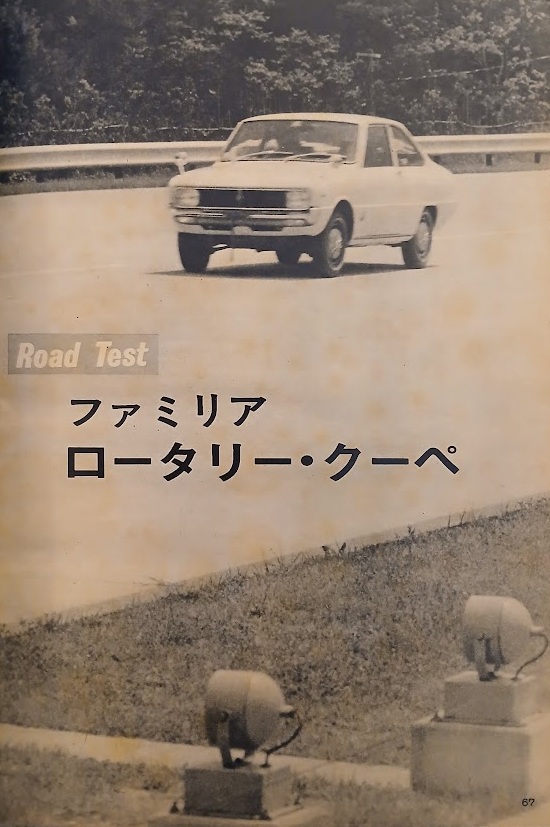
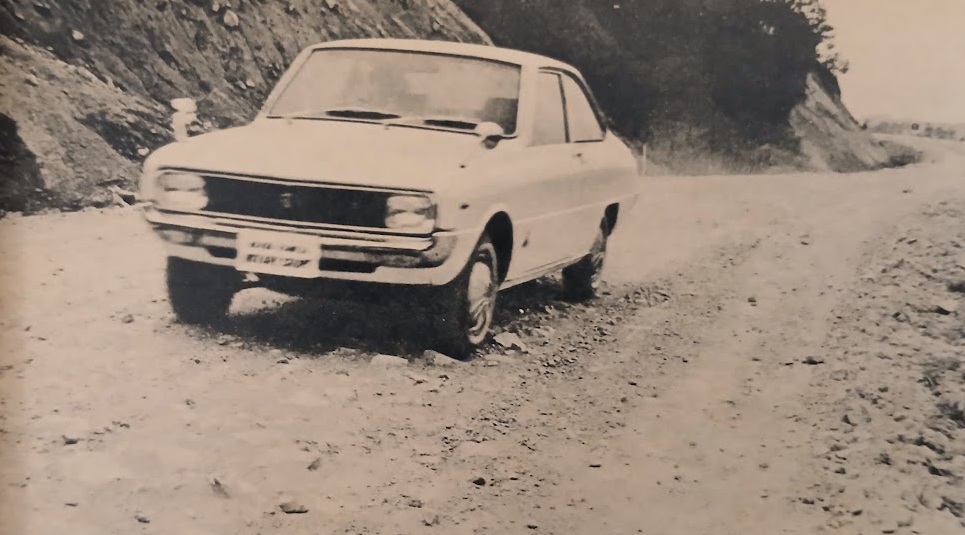
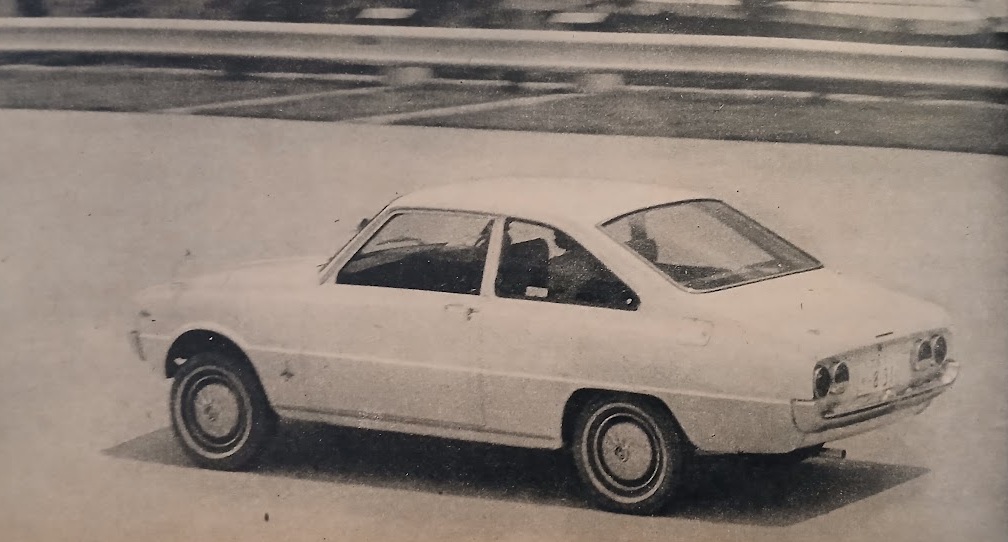
Mazda Familia Rotary Coupe (1968)
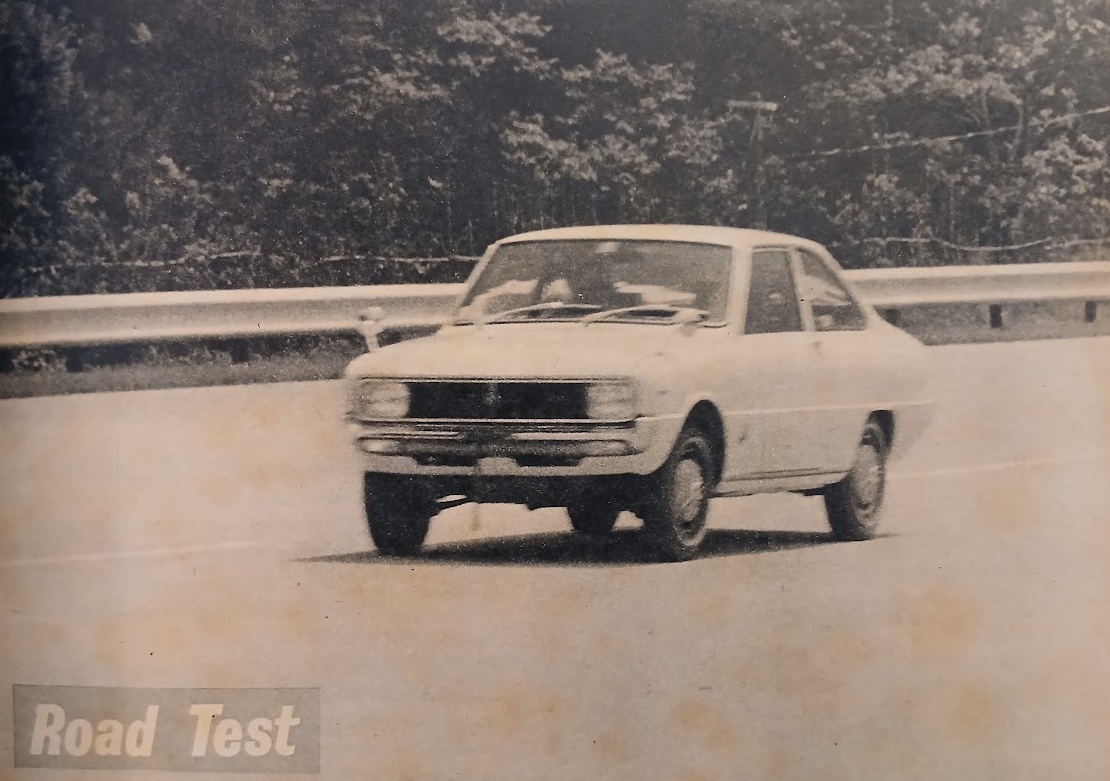
Publication: Motor Fan
Format: Road Test
Date: September 1968
Authors (roundtable): Yasuhisa Minagawa, Kenichi Yamamoto, Kazuo Kumabe, Osamu Hirao, Kenji Higuchi, Moriyuki Watanabe, Akio Miyamoto, Shozo Karasuda, Kenzaburo Ishikawa, Yoshio Akutsu, Yasuhei Oguchi, Kazufumi Sakashita, Masaichi Kondo, Minoru Onda, Hiroyuki Kaji, Motor Fan Editorial Staff (uncredited)
A Rotary-Engined Car for the Masses
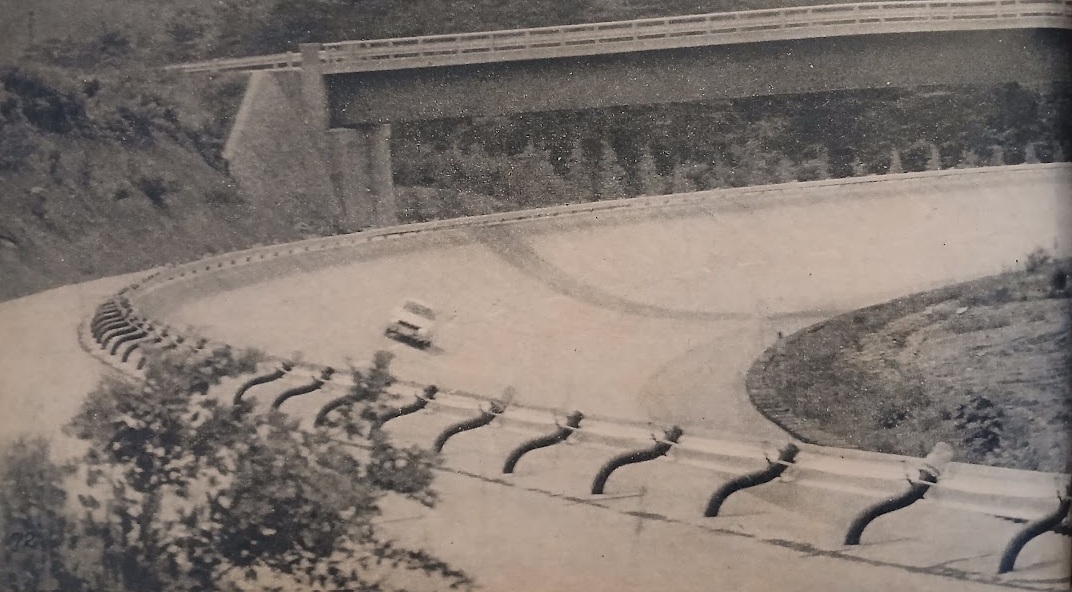
Magazine: This time, thanks to the cooperation of Toyo Kogyo, we conducted our test of the Familia Rotary Coupe at the company’s Miyoshi test course. First, we’d like you to tell us something about the thinking behind the development of this car.
Minagawa: At Toyo Kogyo, we’ve been developing the rotary-piston engine for about seven years now, and in May of last year we introduced the Cosmo Sport. One of the aims of that car, I think, was to serve as a demonstration that the rotary engine was genuinely capable of standing up to practical use. Consequently, the Cosmo Sport has a body that isn’t particularly suited to mass production, and its price is very high. It’s also a two-seater, which limits its usefulness, so in several respects it can’t really be called a car for the masses.
Fundamentally, however, our intention has been to create a new kind of passenger car using the rotary engine, one suited to changing road conditions and improvements in the driving environment. We’ve wanted to produce a rotary-engined car for the general public, and the Familia Rotary Coupe is one expression of that goal. At 700,000 yen, its price is also within the reach of ordinary buyers.
Looking at road conditions in Japan today, however, we have to contend with two very different situations: low-speed driving in crowded urban areas and high-speed driving on expressways. As a result, we felt that the car had to be suited to both. And given the current state of motorization in Japan, we considered it essential that the car should also be suitable for family use. We chose the existing Familia as the base car in order to keep costs as low as possible, and added the distinctive characteristics of the rotary engine.
Magazine: So you’ve used the Familia as the basis to produce a five-seater coupe for the general public. But the rotary engine itself also seems to have changed quite a bit from the one in the Cosmo. The 2-rotor configuration and displacement of 491cc × 2 are unchanged, but there are some differences in construction, output is now 100ps, and the engine speed at which maximum torque is developed has also been lowered.
Yamamoto: The rotary engine is still in the process of development, so there are many things we’d like to do with it. In developing the engine for the Familia Rotary Coupe, we had two main considerations: the character of the car and the further development of the engine itself. As far as the car’s character is concerned, the important thing was to provide high performance while ensuring trouble-free operation over a wide range of engine speeds. In other words, we wanted to make sure it was easy to drive at low and medium speeds.
Another consideration was noise, particularly since the car might also be driven in the manner of an ordinary sedan. The rotary engine inherently has relatively few mechanical parts, so in that respect noise is less of a problem. But there are still auxiliary components and a gearbox, and we made considerable efforts to eliminate noise from those sources.
As for the engine itself, unlike the Cosmo, this is a car intended for mass production, so we also had to work toward reducing costs as much as possible. Where we could reduce the number of parts even further than we had with the Cosmo, we did so. We also tried to use shapes that would be easier to manufacture and less expensive materials wherever possible. Of course, durability was our foremost consideration. It was also necessary to incorporate the various developments and improvements we had made since the Cosmo.
The Significance of the World’s First Mass-Produced Rotary
Magazine: In the Cosmo, the side housings were made of aluminum alloy with a carbon-steel coating applied by thermal spraying, whereas in the Rotary Coupe you’ve changed to special cast iron. You’ve also made changes to the oil seals and reduced the number of gears driving the distributor. But these changes don’t mean that you’ve cut corners or simplified things at the expense of quality, do they?
Yamamoto: As for reducing the number of parts, the fact is that we still haven’t arrived at any fixed configuration that we can say represents the definitive rotary engine. Eliminating unnecessary parts without sacrificing function is something engineers are constantly striving to do. We may well reduce the number of parts still further in future rotary engines, but that doesn’t mean we’ll be sacrificing either performance or durability.
In the case of the Rotary Coupe, unlike the Cosmo, we weren’t aiming for particularly extreme power output. We’ve modified the engine to suit a much broader range of uses.
Magazine: What were everyone’s impressions of the Rotary Coupe?
Kumabe: First of all, I’d like to express my respect for the Toyo Kogyo engineers who have opened the way toward bringing the rotary engine to the general public. With this Rotary Coupe, we can say that they’ve opened up even greater possibilities for the future. What’s more, as a passenger car it’s a remarkably well-executed machine, with splendid performance. I think it can rightly be called an epoch-making car.
Hirao: That’s certainly true. But precisely because it’s a new type of engine, while we have very high expectations for it, there’s also an underlying anxiety that we simply can’t quite shake off—will it really prove reliable? Even a minor problem that would be regarded as nothing unusual in a normal reciprocating engine tends to be seen as a major issue if it occurs in a rotary…
For that reason, I think the next year or so will be the crucial period.
Production will begin at 1,000 units a month, and I imagine that will rise to 2,000 or 3,000 by the end of this year. If so, by this time next year there will already be a great many Rotary Coupes on the streets. Let’s hope they’ve established a good reputation by then.
Higuchi: At any rate, this is the world’s first mass-produced family coupe fitted with a rotary engine, and that makes it extremely significant. And the price is only 700,000 yen. Even setting aside the fact that it has a rotary engine, the car is finished with exceptional care, and I think it could hold its own as a top-class sporting sedan among conventional 1000cc cars. Until now, the idea of a car capable of nearly 200km/h for 700,000 yen would have been unthinkable.
Rigorous Durability Testing of the Rotary Engine
Kumabe: Regarding the chrome plating on the inside of the rotor housing, I’m sure there have been many improvements, but how does it stand up to wear?
Yamamoto: Applying chrome plating to aluminum is itself technically very difficult. But aside from the manufacturing process, we’ve been studying the engine as a whole, including things like cooling and distortion, and taking measures to improve durability.
Kumabe: Since this is a car with an entirely new type of engine, if a car develops trouble, even if it’s due to improper use by the owner, people will blame the engine. And that will happen even if it’s only one car in a thousand.
Watanabe: Actually, my own background is in reciprocating engines, and I have to say that the rotary engine is being subjected to much more severe testing than conventional reciprocating engines. They’ve been carrying out continuous endurance tests of around 1,000 hours at 7000rpm and full throttle, for example, and I don’t think we’d have much confidence in putting a reciprocating engine through that. So as far as durability is concerned, I think it’s fair to say that the rotary engine is at least the equal of a reciprocating engine, and maybe even better.
Minagawa: We’ve already put about 350 Cosmo Sports on the market, and they’ve been subjected to some fairly severe use in places such as Europe, but there haven’t been any fundamental problems at all. The engine in the Rotary Coupe is a little different from the Cosmo’s, of course, but those results were also among the reasons we felt confident enough to go ahead with its introduction.
Yamamoto: In connection with that, I think after-sales service is extremely important. Precisely because this is a new product, we need to have systems in place to ensure that our customers aren’t inconvenienced under any circumstances.
Minagawa: That’s why, last year, we gave special training to 5,000 service personnel and 5,000 sales personnel, so that we would be fully prepared.
Kumabe: There was one thing I noticed during the test drive. When I drove at full throttle, there was a popping sound—pan, pan.
Yamamoto: When you close the throttle and use engine braking after running the engine at full power, a kind of afterburning occurs. But we think this can be improved through carburetor adjustment and other measures.
Hirao: I’d certainly like to see that eliminated.
Three Characteristics of the Rotary Engine
Higuchi: My impression from the test drive was that, compared with the Cosmo, the port timing has been revised to favor lower speeds, which makes the engine much easier to use. You can accelerate from 30km/h in top gear, and if you’re prepared to put up with a little unease, you can even drive at 20km/h. I thought that was remarkable.
Hirao: Maybe this would be a good opportunity to ask you to explain once again some of the advantages and disadvantages of the rotary engine.
Yamamoto: We don’t necessarily believe that the rotary engine is superior to the reciprocating engine. Rather, we feel that there is room for different types of power units in automobiles. Instead of thinking of reciprocating and rotary engines as opposing alternatives, we look at whether there are certain kinds of cars whose distinctive character would be very difficult to achieve with a conventional reciprocating engine.
If that character is something that would make the car particularly interesting both to motorists and in terms of the future development of motorization, and if the rotary engine makes such a car possible, then surely there is value in using it.
As for saying that this is an advantage over a reciprocating engine, or that is a disadvantage, the character of the car as a whole has to be taken into account…
Hirao: In other words, if we consider what kind of car is best suited to a reciprocating engine, what kind is suited to a diesel, and what kind to a rotary engine, I think we can begin to identify the particular characteristics of the rotary from that standpoint.
Yamamoto: Looked at in that way, among the various characteristics of the rotary engine, there are three particular advantages when it is used in a car: it is compact in relation to its power output, it is free from inertia-induced vibration, and it has a wide operating speed range. These three characteristics can be of great significance for certain types of cars.
As for disadvantages, torque at low speeds is relatively poor compared with that at high speeds, and fuel economy at low speeds is not necessarily good. Those are areas that present problems.
Watanabe: What you’ve just been discussing is something we’ve also debated quite extensively within the company. For example, even within the Familia range, we’ve fitted the rotary engine to a car with the character of this new coupe, while retaining the conventional reciprocating engine for the normal sedan. That’s because, after analyzing the requirements of sedan buyers, we concluded that the characteristics of the rotary engine weren’t particularly well suited to them.
Hirao: What is the oil consumption?
Yamamoto: Somewhere between 2,000 and 3,000km per liter.
Hirao: So it’s only a little higher than that of a reciprocating engine. Rather like the difference in gasoline consumption, then. But if we consider it as a 100ps engine, the tax is lower than on other production cars of comparable performance.
Wouldn’t that make up for the extra fuel cost? (laughs)
Minagawa: The difference in tax is only 3,000 yen, though. (laughs)
Assembly Line One-Quarter the Length of a Reciprocating Engine’s
Miyamoto: I think this relates to the question of economy, but how much lower is the parts count compared with a reciprocating engine of the same output?
Karasuda: Including the auxiliary equipment, it’s about 70% of the reciprocating engine’s parts count. If we exclude the auxiliaries and compare only those components whose construction is entirely different, the figure is about 45%.
Miyamoto: So less than half, then. And how much have you been able to reduce the number of production processes?
Minagawa: Right now, our rotary-engine production facilities are equipped for about 3,000 units a month, whereas our reciprocating engines are produced on a mass-production basis of 30,000 or 40,000 units. So it’s rather difficult to make a direct comparison.
Yamamoto: To give one example, the assembly line is only one-third to one-quarter the length of that for a reciprocating engine.
Miyamoto: In that case, it’s conceivable that the rotary engine could eventually become less expensive than the reciprocating engine.
Minagawa: There’s certainly that possibility.
The fact that it’s lighter naturally suggests the possibility of a lower price as well.
Kumabe: Some people say that 700,000 yen is rather expensive, but once you’ve actually driven this car and experienced its performance, you realize that it isn’t expensive at all.
Personally, I think it’s almost too cheap.
Magazine: At the Miyoshi test course, we were able to bring out the Rotary Coupe’s full performance. But aside from outright speed, what were your impressions of the car’s overall feel?
Higuchi: On the test course, the speedometer needle went all the way up to 200km/h. I also tried the rough-road section of the course, and there was very little pitching. As a touring car in the 1000cc class, I’d say its ride comfort is among the best. I was also pleased by how quiet the interior was.
Light Steering Without a Sense of Insecurity
Ishikawa: You really can achieve high speeds in this car. Even the catalog maximum of 180km/h seems well within the reach of an ordinary driver. I also used engine braking to bring the speed down to 140km/h, then applied the brakes repeatedly. Even after doing this several times, there was no noticeable change in braking effectiveness, which gave me a reassuring sense of safety. I think that’s thanks to the front disc brakes.
The only thing was that the engine braking didn’t seem very effective. However, when braking from 140-150km/h, there was quite a difference in the pedal effort required depending on whether I depressed the clutch or left it engaged. Judging from that, perhaps the engine braking was actually providing a significant amount of deceleration after all.
Hirao: I’m not so sure. Considering that it’s a 100ps engine, I would think the engine braking is only about half as effective.
Watanabe: We’ve subjected the brakes to some very severe testing, and I don’t think there are any problems in that respect.
Magazine: What did everyone think of the steering?
Akutsu: I thought it was relatively light. At high speeds, perhaps it’s a little too light, but even so, it doesn’t give any particular sense of insecurity. The company’s steering-effort test data are reproduced elsewhere, but in actual driving the steering felt a little lighter than those figures would suggest.
Hirao: I felt that the moment of inertia of the steering wheel could be reduced a little. In other words, I think the steering would feel better if the wheel itself were somewhat lighter.
Watanabe: Actually, the spokes are made of stainless steel. If we used duralumin, the wheel would be considerably lighter, but it would also be rather expensive…
Hirao: That’s too bad. It’s just that sort of thing that slightly spoils the feel of the steering.
Watanabe: Regarding the steering, we’re considering adopting a variable-ratio system. I think that would make a considerable improvement.
0–400m Acceleration in 16.2 Seconds
Magazine: Could we have the performance test results recorded yesterday at the Miyoshi test course?
Oguchi: The tests were conducted with a load of 202kg, and measurements were taken using the photoelectric timing equipment installed at the test course. First, in the standing-start acceleration test, looking at the relationship between distance and time, the car covered 0-50m in 4.3 seconds, 0-100m in 6.8 seconds, and 0-200m in 10.3 seconds. The 0-400m time was 16.2 seconds.
Looking at acceleration in terms of time to speed, the car accelerated from 0-60km/h in 3.4 seconds, 0-80km/h in 5.7 seconds, 0-100km/h in 8.7 seconds, and 0-120km/h in 12.6 seconds. The 0-140km/h time was 17.5 seconds.
Next, we conducted two passing-acceleration tests, one starting from 30km/h in third gear and the other from 40km/h in top gear. Starting from 30km/h in third, the car reached 60km/h in 6.5 seconds, 80km/h in 10.3 seconds, 100km/h in 14.1 seconds, and 120km/h in 18.4 seconds. We were even able to continue the measurement to 140km/h in third gear, which took 23.6 seconds.
Starting from 40km/h in top gear, the times were 6.8 seconds to 60km/h, 13.6 seconds to 80km/h, 19.5 seconds to 100km/h, 26.5 seconds to 120km/h, and 33.9 seconds to 140km/h.
Magazine: We didn’t carry out a formal maximum-speed test, but how fast did the car go?
Oguchi: We didn’t make any special attempt to measure it, but the speedometer needle went past 200km/h and swung right to somewhere around 220-230km/h. The actual road speed would, of course, have been somewhat lower, but in any case it was a tremendous speed.
Watanabe: In our own testing, we define maximum speed as the average speed calculated from the lap time for one complete circuit of the Miyoshi test course at full throttle. By that method, we’ve recorded 186.5km/h.
Magazine: And aside from its high-speed performance, the engine was remarkably flexible, wasn’t it?
Ishikawa: It certainly is a very flexible engine. In fact, I met someone recently who told me that he wanted to buy a rotary-engined car. He knew that the rotary was extremely good in terms of vibration and noise, and that its acceleration was excellent. But he was worried about how it would behave in city driving.
I think this was also a concern when the Cosmo was introduced. Somehow, people seem to have that impression of the rotary engine. I think more needs to be done to publicize its capabilities in that respect.
Acceleration That Makes Entering Expressways Safe
Yamamoto: We’ve just been discussing maximum speed, but there really aren’t any places in Japan where such speeds can be used. I think acceleration is actually the more important consideration.
Hirao: Yes, that’s true. I think we can regard the 0-400m time as an indication of acceleration at lower speeds, and the maximum-speed figure as an indication of acceleration at higher speeds. In other words, acceleration from around 100km/h is entirely different in a car with a maximum speed of 130km/h and one capable of 180km/h. So in situations such as entering an expressway, the latter offers a significant margin of safety.
Oguchi: As for flexibility, it was possible to slow down to around 20km/h in top gear and then accelerate again. The ratios of second, third, and top gears are very closely spaced, so, to take an extreme example, in city driving, if you want a little quicker acceleration, you can use second, third, and even top gear. The engine seems able to cope with just about any situation.
Another thing I’d like to ask about is the possibility of developing a wide variety of rotary engines. It would be interesting to have different versions with varying noise characteristics, power outputs, and so on. What do you think?
Yamamoto: Rather than simply fitting one standardized type of rotary engine, I think there can be rotary engines with a variety of characteristics and levels of performance.
Hirao: Would you change the side housings?
Yamamoto: There are various approaches we could take. Just as the bore and stroke can be varied in a reciprocating engine, with a rotary engine we can use different combinations of rotor width, generating radius, and other dimensions to alter its performance characteristics.
Magazine: The Familia 1000 had 58ps, but now you’ve fitted a 100ps engine into virtually the same body. Doesn’t that create any problems in terms of power balance and so forth?
Watanabe: When you fit a high-powered engine, the biggest concerns are things like “power hop” and handling during cornering. But this car has a power-to-weight ratio of only around 8.0kg/ps, so power hop is hardly a problem.
That also has something to do with the weight carried by the rear axle, but the balance isn’t unusually poor. As for cornering, even without radial tires, we’ve been able to obtain entirely satisfactory handling simply by fitting the so-called low-profile tires.
No Problems with Low-Profile Tires, Even at High Speeds
Magazine: How extensively has the suspension been modified?
Watanabe: We’ve slightly strengthened the front stabilizer and springs. We’ve also made fairly substantial changes to the damping forces and rear springs. Those modifications seem to have been sufficient.
Magazine: So the low-profile tires are standard equipment, with radial tires available as an option?
Watanabe: If you’re really going to drive continuously at 180km/h, radial tires are certainly preferable. However, the high-speed capabilities of today’s low-profile tires have also improved considerably, so I don’t think there should be any problems.
Magazine: What did you think of the parking brake?
Ishikawa: I didn’t test it specifically, but looking at these figures, the operating force required to produce 0.2g of deceleration is 16kg, so I don’t think there’s any problem.
Hirao: I think the parking-brake lever could be made a little shorter. I have the feeling it would be easier to use that way.
Ishikawa: I tried moving the seat to various positions to check the reach, but I had no difficulty operating either the gearshift lever or the parking-brake lever. The travel isn’t particularly long, and the action is light, so I thought both were quite satisfactory. However, the bench-test figures for the service brakes show that a pedal force of 24.5kg is required to produce 0.6g of deceleration. That seems a little heavy. I’d like to see the pedal effort reduced somewhat.
Hirao: I agree.
Watanabe: In ordinary driving, there are usually only one or two people in the car, and under those conditions the pedal force required for 0.6g is generally around 20-21kg. The figure of 24.5kg is for a car carrying a full load of passengers. But because we’ve adopted a tandem master cylinder, the pedal travel inevitably increases. There’s also more friction in the system, so quite a bit of effort is lost at the beginning of the pedal stroke.
Roll Angle of 3.6° with Two Occupants
Ishikawa: Judging from the figures alone, the clutch also seems rather heavy, but in actual driving I didn’t find it bothersome at all.
Watanabe: The clutch pedal effort is about 12kg. I tried various settings myself, and when I measured the effort at the point where I felt it was just right, it came to 12kg. So that’s the figure we settled on.
Magazine: Professor Akutsu, could you tell us about the results of your handling and stability tests?
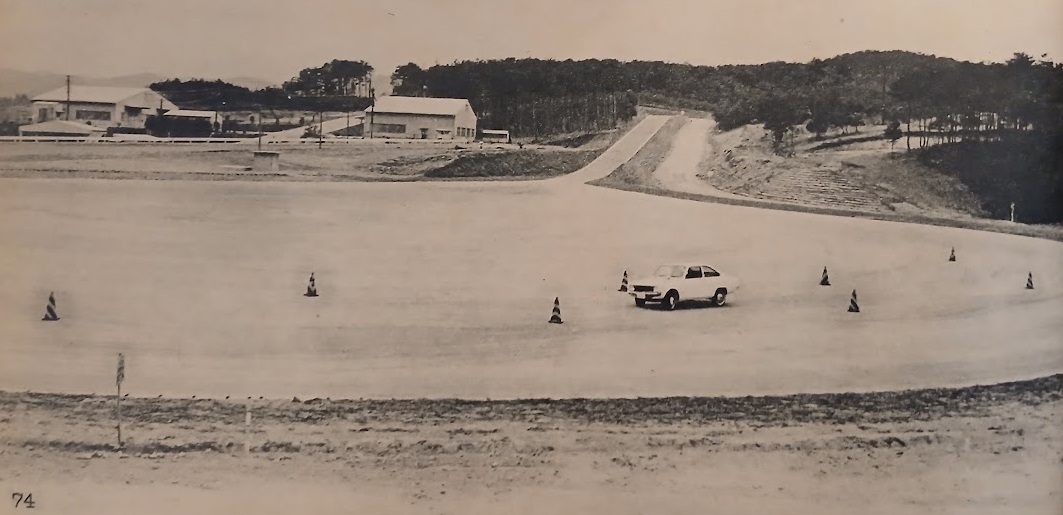
Akutsu: The detailed results are shown in the charts, but as for the turning test to examine understeer and oversteer characteristics, the company’s own figures indicate that, as speed increases, the car initially shows mild understeer, then begins to move inward slightly toward oversteer at the upper end of the range. In our tests, however, the car showed progressively increasing understeer from low speeds up to around 40km/h, then maintained neutral steer from there to about 70km/h.
The roll angle is small, and I think the figure of 3.6° with two occupants is quite good. As for the hands-off directional stability test, I felt that the oscillations converged a little more quickly than the data suggests. We carried out this test at speeds up to 180km/h, and there was absolutely no sense of insecurity.
Sakashita: I think that’s because we increased the tire pressures.
A Desire for Smaller, Lighter Components
Kondo: As for handling and stability, Akutsu has just reported our findings, so I’d like to offer a few comments on the Rotary Coupe as a whole. I have great respect for Toyo Kogyo, not only for finally bringing the Wankel engine into practical use, but also for putting it into mass production at a price of 700,000 yen, within reach of the general public.
Now, there are two or three things I noticed about the car that I’d like to mention.
When I opened the engine hood, I was struck by how far behind the auxiliary components have fallen in terms of size and weight reduction. In other words, while the engine itself has been made more powerful, smaller, and lighter, the dynamo, starter, air cleaner, and other accessories remain old-style conventional units. In a sense, it seemed as though the relative sizes of the engine and its accessories had been reversed.
Until now, the engine itself was so large that perhaps the accessory manufacturers had become rather complacent and hadn’t made serious enough efforts to reduce the size and weight of their products. I sincerely hope that, with strong demands from Toyo Kogyo and its cooperation and technical guidance, the accessory manufacturers will make a determined effort to produce an engine installation in which the main unit and its accessories are properly balanced.
Yamamoto: This was also pointed out to us during the previous roundtable discussion on the Cosmo, and we’ve been making efforts in that direction. Unfortunately, we have to depend on the accessory manufacturers to do their part, and as you’ve suggested, the results aren’t yet satisfactory. We certainly agree that unless the accessories become smaller along with the engine itself, making the entire installation compact, we haven’t really achieved our objective.
Magazine: Which components do you think could be made smaller relatively quickly?
Yamamoto: I don’t think it would be easy with something like the air cleaner, but I’m sure the starter motor and generator could be made somewhat more compact.
Watanabe: I wonder if the use of integrated circuits in alternators is something we can expect fairly soon. Historically, reductions in size have never happened all at once. It’s rather difficult to achieve the sort of dramatic reduction we’ve seen with the rotary engine. (laughs)
Yamamoto: Most of the accessories are common to reciprocating engines, and they’re manufactured in enormous quantities to meet reciprocating-engine production volumes. We’re simply making use of those existing components, and cost is another major consideration.
In other words, if we were to manufacture special accessories specifically for the rotary engine, they would be extremely expensive.
Hirao: To give one example, there are some components that you need two of precisely because it’s a rotary engine. The distributors and ignition coils, for instance. If you could somehow reduce those to one each, even if the cost of a single unit increased by 50%, it would still be cheaper than fitting two.
Yamamoto: That’s certainly possible, and it’s something we’d like to work on.
A Tachometer with an Audible Warning
Magazine: Another thing we’d like to ask about is the warning sound that comes on when the engine speed rises into the red zone, at which point the revs stop increasing. Could you explain how that mechanism works?
Yamamoto: First, as to why we fitted such a device, with a reciprocating engine, as the revs rise toward the red zone, the engine noise and other signs make it quite obvious, whether you like it or not. But with a rotary engine, particularly during acceleration, it’s so quiet that it can be difficult to tell when you’re approaching the engine’s speed limit.
So, partly to prolong engine life, we decided to provide an audible warning to let the driver know when the red zone had been reached. The tachometer itself is electrically operated, picking up pulses from changes in voltage at the ignition coil. The engine-speed control works on a similar principle, using the electrical signal at a predetermined engine speed to operate a relay, so that the control mechanism works in conjunction with the buzzer.
Magazine: It seems that it’s not just a buzzer. Something like a governor also comes into operation, doesn’t it?
Yamamoto: Fundamentally, with a rotary engine, as you increase the revs, there are no valves to start floating, and it’s possible for power to continue to rise. So if you deliberately try to rev the engine higher, it will go on to very high speeds.
For that reason, we needed some means of limiting the power. The carburetor is divided into primary and secondary stages, and when you try to increase the engine speed beyond 7000rpm at full throttle, the secondary stage closes automatically, producing an effect rather like that of a governor.
Hirao: If we consider a car in motion as a human-machine system, or more precisely a driver-car system, all the inputs from the driver to the car are made through physical contact. The feedback from the car to the driver, on the other hand, is generally conveyed through visual means. But ideally, we want to reserve the driver’s vision for watching the road ahead.
So I believe that, wherever possible, feedback from the car to the driver should avoid relying on sight. In the case of warnings, for example, I think it’s a good thing to appeal to the sense of hearing, as this Rotary Coupe does, rather than to sight through a warning lamp.
It might be interesting to make the tachometer itself an audio system. (laughs) Instead of sounding in the red zone, it could sound in the yellow zone. Then you’d simply listen for the warning and change gear… (laughs)
The Efforts Behind Making the Car So Quiet
Magazine: What about noise and vibration? Looking at the data, interior noise is 61 phons at 60km/h, 64 phons at 80km/h, 68 phons at 100km/h, and 72 phons at 120km/h, which is remarkably quiet. Even when we were driving around the test course at over 100km/h, we could carry on a normal conversation inside the car.
Oguchi: It certainly was a quiet car. In a conventional reciprocating-engined car, you can tell from the engine noise when the revs or road speed are increasing, but there’s nothing like that in this car. As Professor Hirao suggested, you almost wish there were some audible indication. It’s particularly quiet at idle. In fact, I wasn’t paying attention and thought the engine had stopped, so I turned the ignition key again. The transmission was also very quiet.
Magazine: I imagine achieving this degree of quietness involved considerable effort.
Watanabe: The rotary engine is inherently less difficult in terms of noise, but we still have to pay very careful attention to insulating the passenger cabin from the engine compartment. The exhaust note of a rotary engine is also somewhat higher-pitched than that of a reciprocating engine. That’s partly related to the port timing, so the exhaust system requires particular care.
Also, precisely because the car is so quiet, even slight noises and vibrations become much more noticeable. For example, if there’s any irregularity in the tires, it can resonate with the engine, producing a pronounced vibration that comes right into the car. So we have to be extremely particular about such things as engine mounting and the control of tire uniformity.
Magazine: With four occupants, the suspension vibration frequencies are 1.40cps at the front and 1.59cps at the rear for the sprung mass, and 13cps and 15cps respectively for the unsprung mass. How did the car feel in that respect?
Oguchi: I can’t say much about the vibration characteristics themselves, but as far as ride comfort is concerned, I had no particular complaints. On a different point, though, when I moved into the rear seat, I noticed that its construction seemed rather different from that of the front seats…
Watanabe: That’s right. Because of the limited headroom in the rear, we’ve reduced the thickness of the seat cushioning. It’s made entirely of urethane foam.
Minagawa: Since it’s a coupe, the rear seat inevitably has something of an auxiliary role.
Oguchi: I also felt that the front seats could have provided a little more lateral support.
Impressive Attention to Ventilation
Miyamoto: Personally, I think it would have been better to make the car a fastback rather than a coupe. That would have made the rear seat more comfortable, too, I imagine…
Ishikawa: Related to ride comfort, I’d like to see a little more thought given to ventilation.
Kondo: Recently, I’ve become interested in the broader field of air conditioning inside the passenger cabin, including ventilation, demisting, and heating—what might be called “interior micro-aerodynamics” or “interior micro-climatology.”
From that standpoint, several things about the Rotary Coupe particularly impressed me during the test drive. At 100km/h, wind noise is considerably lower than in cars we’ve tested previously. Even at high speeds, when the hinged rear windows are opened slightly, they remain firmly in position without fluttering, although the noise increases quite a lot. And the moment those windows are opened, the flow of air through the front-seat ventilation inlets increases dramatically.
My ears are also particularly sensitive to changes in air pressure, and even very slight fluctuations sometimes make me uncomfortable. But even when driving at speeds approaching 200km/h, I felt almost none of this. I learned that this was thanks to the carefully considered arrangement for exhausting air from the passenger cabin through the trunk and out through vents in the front pillars. I was very impressed by the attention the engineering staff had devoted to this aspect of the car.
A Layout Focused on the Front Seats
Magazine: Now, could we hear about the body dimensions and other measurements from Professor Higuchi’s laboratory?
Onda: The dimensions of the body and its various components, together with the reach measurements, are shown in the accompanying diagrams, so I’ll limit myself to a few observations. According to the catalog, this is a five-seater, but if we take that rating literally, the interior inevitably seems quite cramped. In terms of its dimensions, I think it’s more properly a 2+2. Of course, considering the car’s performance, the layout is clearly focused on the front seats, and if we accept that from the outset, the body dimensions are quite appropriate.
Even so, under current conditions in Japan, the ability to carry five people when necessary is certainly a big advantage. As for the reach measurements, when wearing the three-point seat belt, controls more than 700mm away become rather difficult to operate. In that respect, I found the side vents and the adjustment of the louvers somewhat awkward.
This car also has a so-called combination switch, with several functions brought together on a single control lever. As more devices like this appear, the problem of reaching the various controls should gradually diminish.
Hirao: From now on, we certainly can’t ignore the question of seat belts. However, there are now convenient belts that extend when pulled slowly but lock when pulled suddenly. With that type of belt, the problem of reaching the driving controls becomes much less difficult.
Onda: Another thing I liked was the seat upholstery. The surfaces in contact with the body are made of woolen fabric, so there was no problem with perspiration under the legs. I thought that was very good. However, I’d still like to see a little more ventilation…
Watanabe: We also feel that the area of the air extractors is somewhat insufficient, and we’re considering modifying them to make the outlet larger. There’s enough space for air to enter, but not quite enough for it to escape…
Hirao: There’s one more thing I’d like to ask for. I think the air delivered at face level should pass through a filter. As it is, it feels like dust and dirt come straight into your face.
Ishikawa: Actually, I drove with Professor Higuchi over the rough-road section of the test course at about 60km/h. As he said, the ride comfort was quite satisfactory, but another car happened to be driving ahead of us, and we were caught in its dust. When we closed the windows, the dust came pouring in through the ventilators.
Watanabe: The trouble is that if we fit a filter, the airflow becomes insufficient. It’s a difficult compromise.
Fundamentally the Same Styling as the Conventional Car
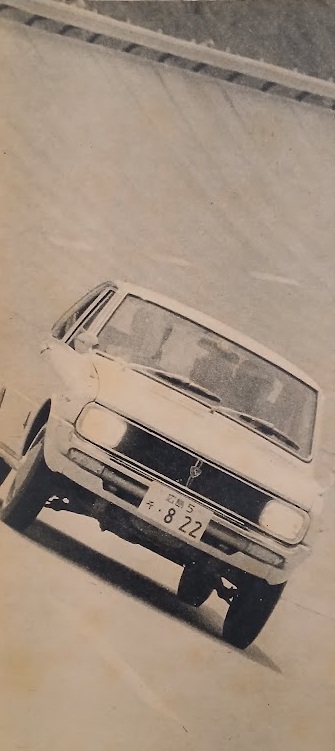
Magazine: Turning to the styling of the Rotary Coupe, some people seem to feel that, since you’ve gone to the trouble of fitting a rotary engine, the car ought to have a distinctive appearance that makes it immediately recognizable even from far away. But with this car, unless you get close enough to see the emblems, it’s almost impossible to tell it apart from the 1200 Coupe. What was your thinking on this point?
Hirao: As long as you’re using the rotary engine itself as the selling point, you haven’t really established it as a proper car. (laughs) I think it’s precisely by using the same styling as the normal car that the rotary can stand on its own merits.
Watanabe: That’s also the view within the company. It’s true, though, that there were people who had the other opinion.
Minagawa: There were certainly two schools of thought. Our basic approach, however, was to treat the Rotary Coupe as one model in the Familia range, sharing the body and suspension components as much as possible. That was how we intended to keep costs down.
At the same time, there’s naturally a difference in how someone who pays 700,000 yen for a car feels compared with someone who pays 550,000 yen. We therefore had to provide enough distinction to satisfy the buyer of the more expensive car. We’ve changed the front and rear styling and the interior trim to give them that sense of satisfaction.
Oguchi: There’s a sporty-looking louver on top of the engine hood, isn’t there?
Watanabe: That’s absolutely necessary, because the engine produces a lot of heat relative to the volume of the engine compartment.
Minagawa: So it serves a practical purpose, while also providing an attractive styling accent for the Rotary Coupe.
High Marks for Both Performance and Safety
Magazine: One of the major characteristics of this Rotary Coupe is said to be its high level of safety along with its performance. Professor Higuchi, what did you think in that respect?
Higuchi: In our laboratory, we’ve prepared a checklist of 30 items relating to passenger-car safety, and we grade each item on a 5-point scale. In other words, something we consider excellent receives 5 points, something average receives 3 points, and a problem we’d like to see corrected as soon as possible receives 1 point. When we evaluated the Rotary Coupe, it scored a total of 123 out of a possible 150 points, or 82 points on a scale of 100. That’s a very good result.
In fact, it’s the highest score we’ve given a passenger car in this class. Particularly noteworthy are the body structure, with crushable sections at the front and rear; the exterior, free of protrusions thanks to things like the recessed bumpers; the interior rearview mirror that detaches on impact; the fender mirrors with flexible mounts; and the disc brakes. All of these received 5 points, while almost everything else scored either 4 or 3. I think it’s especially commendable that there wasn’t a single item receiving 2 points or 1 point.
Magazine: Almost everything on this car is standard equipment, but what options are available?
Minagawa: As far as tires are concerned, radials are available, and there’s also an air conditioner. Both are factory options. There are various other items, such as a stereo, but the standard equipment is really quite sufficient as it is.
Kaji: Are the windshield wipers satisfactory at high speeds?
Watanabe: The current wipers begin to lift off the windshield above 120km/h. We don’t think anything more is particularly necessary for domestic use, so we’ve made the high-speed type optional. But for export models, we’re considering making standard a type fitted with plastic vanes that use wind pressure to hold the blades against the glass. Those should work satisfactorily up to about 150km/h.
Magazine: What about the name, Familia Rotary Coupe?
Minagawa: That was decided from the beginning. There was no particular debate about it. Since the car has a rotary engine, we simply inserted the word “Rotary” into the name. Whenever we use a different power unit from that of the basic model, our practice is to insert a word identifying it.
Watanabe: Well, if there was any disagreement, it was because the designation “RX-85” had become so widely known. Our advertising department apparently was quite fond of that name. But RX-85 was strictly an internal prototype designation, and we’d never intended to use it as the production car’s name.
Miyamoto: With a top speed of 180km/h and a body width of less than 1.5m, the car can negotiate back streets and narrow lanes just as easily as it can travel on the highway. I imagine that ability to serve equally well on highways and back streets was one of your objectives.
Minagawa: That’s one of the reasons we chose this size of car and fitted the rotary engine to the Familia. With a car in the Luce class, the layout of Japanese cities today imposes certain restrictions on where and how it can be used. That was another consideration in choosing these dimensions.
Magazine: Thank you all very much for your time.
Postscript: Story Photos