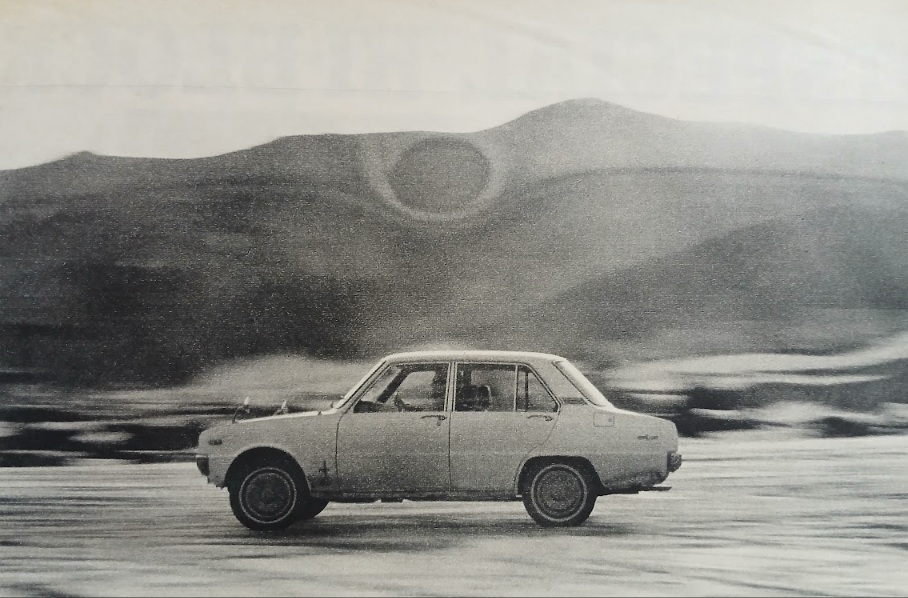
Mazda Familia Presto 1300 Super Deluxe (1970)
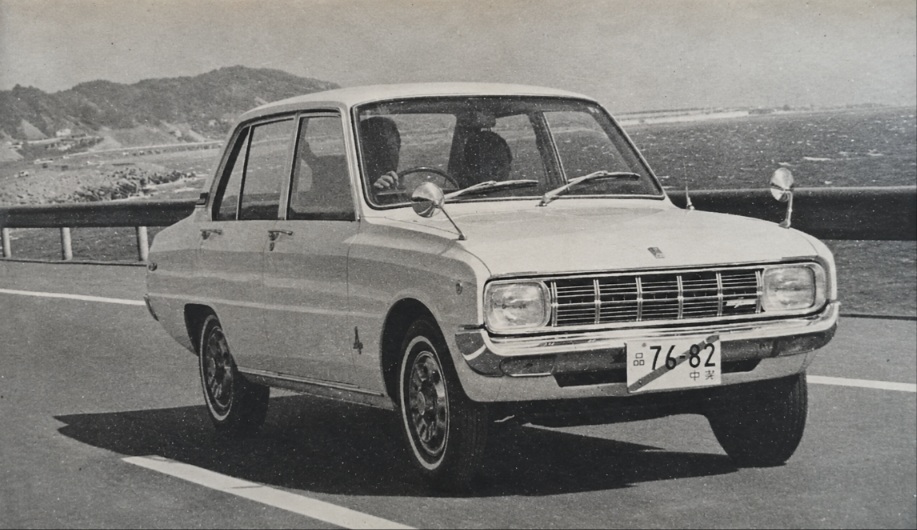
Publication: Motor Fan
Format: “Bubble Index” Road Test
Date: May 1970
Author: Yasuhei Oguchi, Masahide Sano, Atsuro Sasaki, Kazuhiko Sanbon, Atsuhiko Okubo, Hirokazu Ishizuka
Strengthening the Familia Lineup
Since January, it seems that a new car has been announced almost every month. At this rate, 1970 looks set to be quite a year for the “new-model rush.”
This month’s newcomer is Toyo Kogyo’s Familia Presto 1300. Although described as a new model, it is not an entirely new car. As readers will have seen in the color pages of last month’s issue, the main change is the installation of a new 1300cc OHC engine in the Familia. The exterior retains exactly the same silhouette as before.
The Familia has been a strong seller ever since the series was introduced six years ago, in the autumn of 1963. Cumulative production reached one million units in March of this year. The original model underwent a sudden model change in the autumn of 1967, when 1000cc and 1200cc versions were introduced. A rotary engine was subsequently fitted to a coupe using the same body design, and last summer the Familia Rotary SS sedan joined the range. In this way, the Familia has developed into a remarkably varied and ambitious lineup, offering buyers a wide selection of models.
Now a new branch of the family has been created, fitted with a 1300cc OHC engine and bearing the name “Presto.” With the range expanded this far, one cannot help feeling that it is becoming just a little excessive.
Presto is an Italian musical term meaning “fast,” used to indicate a quick tempo. The name may have been chosen to complement Luce, another Italian word meaning “light,” although Mazda has adopted the image of lightning in its advertising for the Presto.
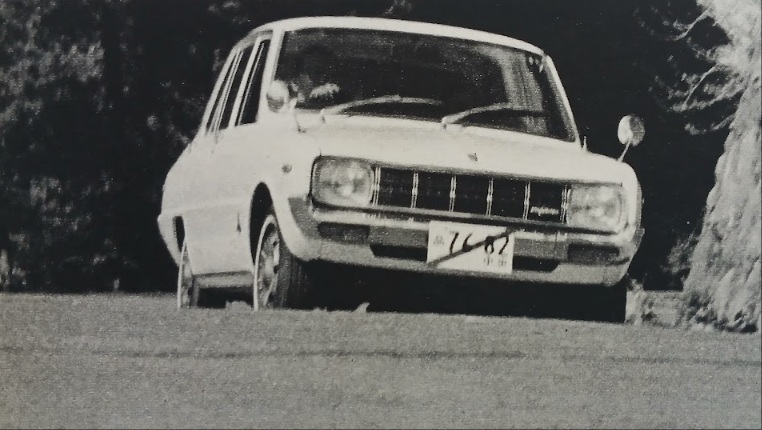
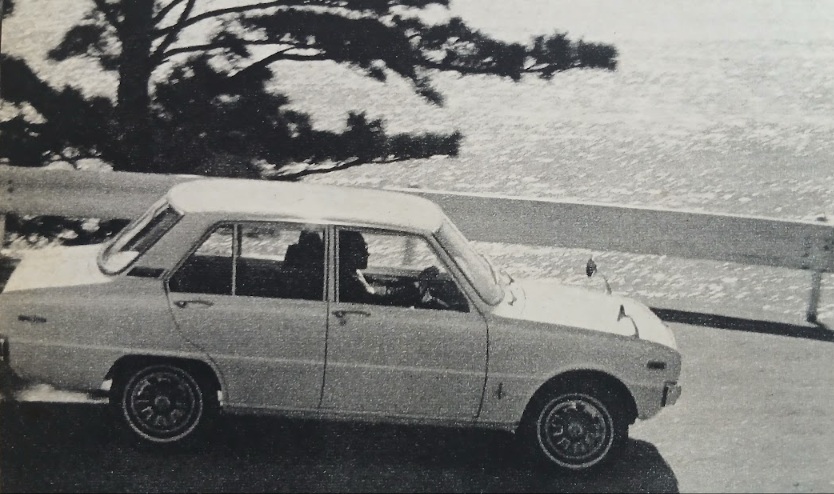
In appearance, particularly when viewed from the side, the car gives little impression of having changed, since it retains the existing Familia body shell. The wheel covers now have larger matte-finished areas, giving them a somewhat more luxurious appearance. The tires themselves, however, are substantial 6.15-13-4PR units, chosen to cope with higher-speed driving, although these are fitted only to the Super Deluxe.
At the front, the matte-black grille has horizontal bars intersected at regular intervals by vertical strips of satin-finished chrome. The orange turn-signal lamps beneath the bumper have also been enlarged, giving the front end a somewhat more dynamic appearance.
“It lacks freshness, but I suppose that’s unavoidable when the body shell is unchanged.” “Still, they’ve fitted quite a lot of equipment inside.” “But what do you make of that instrument panel? It reminds me of something else…”
As usual, the appraisal began while we were refueling at the Tokyo entrance to the Tomei Expressway. By now, these monthly tests have become such a regular occurrence that even the service-station mechanics join in with comments of their own, almost as though they were members of the test team.
“The Familia sells well enough, doesn’t it? You’d think they wouldn’t need to be quite so conscious of the Corolla.”
Well, that certainly put us in our place.
As usual, the test car set off with Kazuhiko Sanbon at the wheel, accompanied by Yasuhei Oguchi and Masahide Sano, the latter responsible for measurements and instrumentation. In the accompanying car were Atsuro Sasaki, who was taking notes, Atsuhiko Okubo, and Hirokazu Ishizuka of Motor Fan.
Discussion of the Presto began in the accompanying car as we watched it on the road.
“Maybe the arrival of the highway age has made that extra reserve of power necessary. But I wonder whether Toyo Kogyo shouldn’t have introduced a new model first. I can’t shake the feeling that they’ve taken an engine originally intended for another car and fitted it to the Familia body as a sort of trial. It’s also conceivable that they might use this engine in a more affordable version of the new rotary car that’s rumored to be coming…”
“In any case, it really is a quiet car. Last night I was driving along a road with very little traffic, and I could hear the engine of a sporty car following behind me more clearly than the engine of the Presto I was driving. I was astonished.” “That can’t be.” “No, really!”
We refueled at Gotemba. This time, however, we extended the test route farther, continuing along the Tomei Expressway as far as the Shimizu Interchange. On the elevated sections overlooking the sea around Yui and Okitsu, we encountered some fairly strong crosswinds. At times, the steering was pulled so sharply that it came as quite a surprise.
“I wonder if the wind is exceeding 7-8m/s. That’s a remarkably strong pull on the steering. Could the tire pressures be uneven?” Sano looked puzzled.
An Engine Designed with Practical Performance in Mind
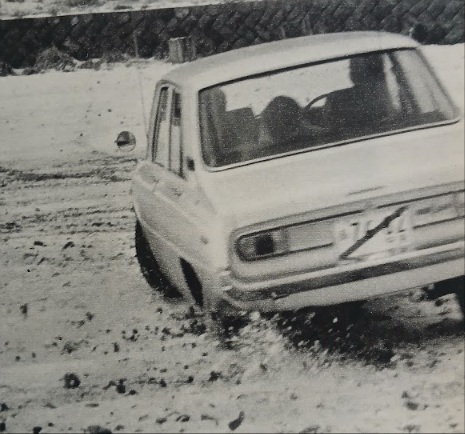
At the Shimizu Interchange, we turned around and headed back to Gotemba. From there, we climbed toward Otome Pass and continued over Nagao Pass in search of dirt roads. Along the way, despite it being March, we encountered sections covered with snow. Even so, the Presto made its way through with good grip on ordinary tires, without chains. We continued from Sengokuhara to Moto-Hakone, and then on to Taikanzan.
The Hakone Turnpike was completely frozen, so we had no choice but to abandon the hill-climbing test. As a result, we changed our route, descending from Jukkoku Pass to Atami, then following the winding coastal road from Atami toward Manazuru Point. From Odawara, we returned to Tokyo via the Odawara-Atsugi Road and the Tomei Expressway.
As we drove, the various members of the diagnostic group offered their assessments.
Oguchi: “It’s a flexible car with good low-speed torque. You can drive it around town with plenty in reserve. Even without constantly changing gears to match the road speed, it pulls away quite adequately. The earlier Familias had something of this character, too, but…”
Sanbon: “It sounds odd to call it a car for beginners, but it’s the kind of car that makes you feel like you’ve become a better driver. There’s a period when you’re still very much aware of your own lack of skill, isn’t there? During that stage, you often find yourself changing gears a moment too late. This is a car that doesn’t leave you flustered when that happens. Its character is clearly one of torque rather than outright power.”
Sasaki: “It doesn’t have exceptional acceleration, but it’s relatively easygoing, whether in town or in rural and mountainous areas. Couldn’t we simply call it an easy car to drive? I drove it for the first time last night, and even though it was unfamiliar, I felt very little of the usual hesitation about getting behind the wheel of a car I didn’t know.”
Sano: “You can see why from the performance curves. Other cars develop their maximum torque at around 4000rpm, but this one reaches it at 3000rpm. You could say it’s particularly well suited to rural and mountainous areas, where maximum power isn’t especially important. Even so, I’d like to see another choice of final-drive ratio.”
Sanbon: “But you could get a considerable increase in output from this engine with just a little ’extra something!’ (laughs) Just balancing the engine or raising the compression ratio might give you another 20% in horsepower. In other words, they’ve deliberately left that reserve of potential for ‘something’ else. Toyo Kogyo is the sort of manufacturer that’s quite good at testing the waters in this way.”
(All): “Taking no chances, eh? (laughs) Still, it’s too bad that the car falls a little short on the expressway.”
In the crowded traffic of the tourist areas, the engine certainly demonstrated its strong pulling power at low speeds. The same was true on the undulating roads through the Hakone mountains. On gentle inclines, there was little need to keep changing gears with the 4-speed transmission.
Oguchi: “We’re in top gear now. See? Open the throttle and it picks up speed, doesn’t it? I like to do this when I’m tired, and being able to drive this way makes things much easier. The fact that it can accelerate from as little as 30km/h is a real advantage.”
Sasaki: “It’s also well suited to the gentle-mannered housewife driving around town.”
On the expressway, the car admittedly felt just a little short of power. But this was a matter of driving impressions rather than actual performance. On both the Chuo and Tomei Expressways, we were able to maintain speeds comfortably above the posted limits.
“The figures are by no means unsatisfactory. For a car with an engine of only 1300cc, there’s really little reason to complain about the way it drives, but…”
Perhaps it was only natural that the testers should feel this way, having driven several exceptionally quick cars in recent months. Consider, for example, the acceleration test when merging onto the expressway.
Accelerating at full throttle in third gear from 40km/h to the 100km/h speed of traffic on the main lanes took 14.2 seconds and covered a distance of 275m. These are very good figures, comfortably meeting our performance standard. For a car in this class, the results are particularly impressive.
Sano: “That’s where the good low-speed torque shows itself. The overtaking acceleration figures are by no means poor, either.”
As in previous months, the overtaking acceleration test began with the test car approaching to within 30m of a vehicle traveling at a steady 60km/h. The driver then accelerated at full throttle in third gear, overtook the other vehicle, and moved back into the main lane 30m ahead of it.
The maneuver took 7.3 seconds and covered a distance of 182m.
By comparison, the Corona 1600SL tested in last month’s issue recorded 7.4 seconds and 183m, while the Colt Galant AI tested in the January issue returned exactly the same figures as the Presto.
For overtaking a vehicle traveling at 80km/h, the test began 60m behind the other car. The driver accelerated at full throttle in third gear, shifted into top during the maneuver, and moved back into the main lane 60m ahead.
This took 16.5 seconds and covered 540m, falling noticeably short of the Corona’s 14.0 seconds and 462m.
“The car does feel a little weaker at higher speeds. In practical use, however, there’s really no problem. If anything, perhaps we should say that it’s a car that doesn’t ask too much of its driver.”
Pronounced Understeer Characteristics
Let us move on to handling and stability. First, steering self-centering. The test consists of turning the steering wheel momentarily to the right, releasing it, and measuring the number of oscillations before it returns to a steady position.
As the graph shows, the results were exceptionally good, with just one oscillation at 60km/h and one at 100km/h.
“The stability is good. I think they’ve arrived at a very appropriate setting.”
“But why was the car affected so violently by the crosswinds? Especially when the steering recovery figures are this good.”
“I wonder whether there’s something wrong with the hands-off directional stability test itself. I don’t think we should draw firm conclusions from that test alone.”
We have already mentioned the car’s tendency to be blown off course by crosswinds. There was some wind on the day of the test, but it was not exceptionally strong. Admittedly, in places the windsocks were stretched out horizontally, and the highway traffic reports on the radio were warning drivers to beware of crosswinds. But stretches of the Tomei Expressway are regularly exposed to winds of this kind.
Even so, the extent to which the car was blown off course on the Tama River Bridge during the return journey was considerable. Sanbon, Oguchi and Sano, all experienced testers and veteran drivers, were unanimous in saying, “That really was frightening.” The Presto’s short wheelbase also seems to have played a part.
Oguchi, Sanbon: “The steering feel can only be described as strongly understeering.”
Oguchi, Sano: “Light steering is good for beginners, but this goes too far. The steering wheel is positioned too close to the driver. You can’t adopt the so-called straight-arm driving position. The wheel also seems a little too large in diameter, making it difficult to feed the rim through your hands. Depending on the driver’s build, your hands can almost become tangled up. It makes quick steering movements difficult.”
Sanbon: “Perhaps they’ve been too conscious of the Corolla in this respect as well. The steering has a ‘wet’ feel. Even within Toyo Kogyo’s own range, the Cosmo has a very dry, sharp steering feel, whereas this car’s response seems sluggish. Perhaps they’ve given it so much understeer to allow for beginners turning the wheel too sharply. The thin, large-diameter steering wheel must have something to do with it, too. In any case, it’s positioned much too close to the driver.”
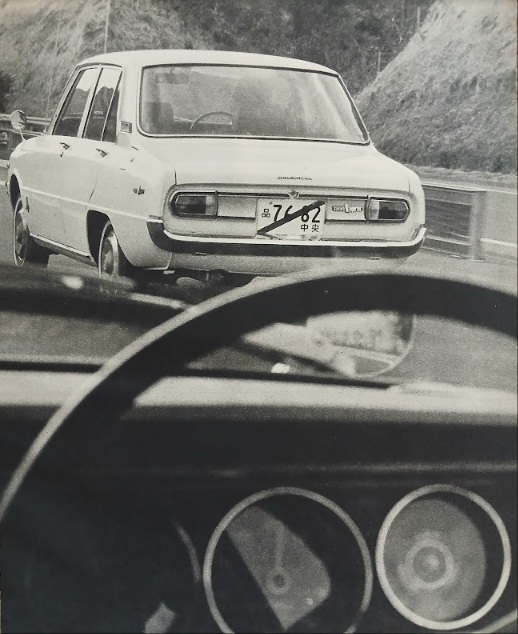
Viewed from the side, the steering column does appear rather long, projecting quite far toward the driver. On the other hand, it might be said that the instrument panel is set too far forward. Perhaps this arrangement is a consequence of the collapsible, energy-absorbing steering column. In the Coupe, the steering wheel has a simulated woodgrain finish and a somewhat thicker rim.
Comfort & Accommodation
Having brought up the position of the steering wheel, let us turn to the car’s accommodation and comfort.
Sasaki: “The transmission is excellent. It’s a Warner-type unit, and the gears engage with a firm, positive click. The feel is wonderfully crisp. When I first tried it, I looked at the odometer and found that the car had covered only 200km. I was astonished. I hadn’t expected a Toyo Kogyo transmission to have such a good, positive feel.”
Sanbon: “I agree. Of course, Toyo Kogyo also has a reputation as a machine-tool manufacturer. But this really is a first-rate gearshift.”
There was another item that earned considerable praise: the brakes. The front wheels have discs and the rear wheels leading-trailing drums. This is a conventional arrangement for a high-speed car, but the braking action was so good that one tester remarked, “I almost thought it had servo assistance—a Master-Vac.”
The disc brakes, however, are fitted only to the Super Deluxe. Other versions have twin-leading-shoe front drums.
Oguchi: “They really ought to fit brakes this good to every model.”
The suspension is on the firm side.
Oguchi: “Japanese cars are generally softly-sprung, rather like American cars. Toyo Kogyo’s cars, on the other hand, tend to be firmer, more like European cars. I rate that highly from the standpoint of safety, although it does raise some questions about ride comfort.”
Sanbon: “I find this firmness quite agreeable. I think they’ve struck a good balance.”
There were, however, some complaints.
“The three round gauges are in keeping with current fashion, and they’re easy to read, which is all very well. But it’s surprising to find the clock in the center.”
Sasaki: “I suppose they intend to put the optional tachometer there, but very few sedan buyers will order one. That means the great majority have to look to the right to read their speed or trip mileage. Why on earth did they arrange it this way?”
There was another complaint. The multifunction control stalk is a good idea, and convenient once one becomes accustomed to it. The headlight flasher, high- and low-beam selector, windshield wipers and washer can all be operated with a single lever, which is certainly welcome.
The lighting switch, however, is a small toggle switch mounted on the steering column, farther back than the control stalk. Its position makes it awkward to operate. This may be no problem for someone who switches on the headlights and leaves them on, but a driver accustomed to turning them off whenever possible can easily become confused. In particular, switching on the lights while steering requires reaching around the outside of the steering wheel. This complaint came only from Sasaki, who had first driven the car at night.
As for the seats, someone remarked, “I didn’t notice anything in particular about them. They must have suited me quite well,” which brought a laugh from everyone.
There was, however, general agreement that the rear seatback was too upright: “If they’d sacrificed a little of the rear parcel shelf, they could have made the seating position more relaxed.”
Noise levels were the lowest we had encountered so far. As mentioned at the beginning, the Presto was so quiet that the sound of a car following behind could be heard instead. Someone jokingly added: “You can hear the car next to you loud and clear!”
The quality of the sound was also exceptionally good. We understand that the camshaft drive uses a British-made Renold chain. Perhaps the principal reasons for the engine’s refinement are the cast-iron cylinder block inherited from the Luce, Toyo Kogyo’s particular expertise in precision casting, and the conscientious attention paid to sound insulation in the design.
A Quiet, Easy-to-Drive Family Car
It would not be quite right to call it a necessity of the times, but it is certainly welcome to see more and more safety equipment becoming standard.
The Presto has a collapsible steering column, effective brakes, laminated safety glass, folding fender mirrors and a breakaway interior mirror. The three-point safety belts with retractors were especially well received by everyone. Most people have had the experience of catching a seat belt in the door. Here, a curved-wire handle is provided. Give it a little pull, and the belt retracts with a quick whir. Simple and reliable.
The ventilation controls consist of knobs at either end of the dashboard. Move one down a notch, and air is directed toward the footwell. Move it down another notch, and a substantial flow of air comes rushing through the louvers at the ends of the dashboard.
Adjusting the vents aims the airflow directly at face level. This might be considered a matter of comfort, but in a sense it also contributes to safety.
As for visibility, there is the rear-window defroster, with heating elements embedded in the glass. We found it very effective at night with all the windows closed. The lower portion of the glass, where there were no heating elements, became completely obscured by fog, but the heated area remained perfectly clear. When we started the car on a frosty morning in Hakone, the ice on the rear window melted away right before our eyes.
There is, however, one complaint. The defroster appears to operate automatically whenever the control knob is turned to the defroster position. It consumes a considerable amount of electricity. This was evident from the heater fan and radio, which receded while the engine was idling, then suddenly picked up when the car moved off. At an intersection, they would fall again as soon as the car stopped. We would like to see a separate switch that allows the rear-window defroster to be turned off whenever it is not needed.
This time, the hill-climbing test in the Hakone mountains had to be omitted because of snow. We therefore extended the expressway portion of the route as far as Shimizu, then drove along ordinary roads and mountain routes from Jukkoku Pass through Atami and Manazuru to Odawara.
Fuel economy was 11.4km/l from Kinuta to Gotemba, 10.3km/l from Gotemba to Manazuru under rather unfavorable conditions, and 12.0km/l from Manazuru to Tokyo.
These cannot be called particularly good results for a car in the 1300cc class. Perhaps it is because the catalog figure of 21km/l remains so firmly fixed in our minds. Still, judged by the rule of thumb that actual fuel economy is about 60% of the catalog figure, the results seem reasonable enough. The considerable loads and high engine speeds involved in expressway driving, as well as our journey over snow-covered roads in Hakone, should also be taken into account.
Product Appeal: In Conclusion
The interior is well equipped, with the heated rear window, a power antenna and a console, not to mention the exceptionally quiet engine. This is a family car with a great deal to offer.
It is a car not for mechanical enthusiasts or speed fanatics, but for people who take a sensible approach to family life and car ownership. People who value ease of use over mechanical sophistication, and who enjoy driving at a leisurely pace. The Presto seems particularly well suited to such buyers. Moreover, at 568,000 yen, the Super Deluxe, which can fairly be described as “fully equipped,” is remarkably reasonably priced. This is undoubtedly the market Toyo Kogyo is aiming for, and perhaps another example of the company’s shrewd business sense.
There is a certain kind of student who is neither exceptionally popular nor particularly outstanding academically, but whose absence somehow leaves the class feeling a little empty, and who can always be counted on to play some useful part when needed. An ordinary sort of classmate, but a cheerful person whom everyone remembers long afterward. Somehow, the Presto strikes us as just such a car.
How to Read the Bubble Index
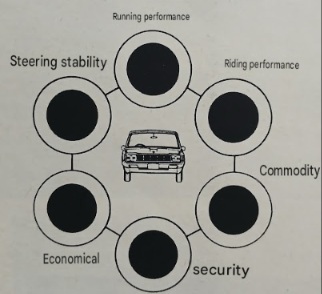
The aim of this road test is to assess a car’s character by evaluating six key aspects of its performance. The size of each of the six circles in the index (the black areas within them) represents the rating given to that particular aspect. The diagram is designed so that the balance among the six circles can be read at a glance, making it easier to form an overall judgment.
These ratings are not absolute. Each car is placed in its appropriate category according to engine displacement and price, and the scores are then adjusted accordingly. The evaluation method is the “Bubble Session,” developed with the cooperation of Professor Oguchi’s Automotive Engineering Research Laboratory at Shibaura Institute of Technology. This is a technique drawn from systems engineering, in which specialists from different fields gather around a hexagonal table (the “bubble,” representing a honeycomb cell) to discuss their opinions. Ultimately, however, the final judgment is one that readers must make for themselves.
Postscript: Story Photos