Mazda Familia Rotary Coupe (1968)
Publication: Car Graphic
Format: Road Test
Date: September 1968
Author: “C/G Test Group” (uncredited)
Summary: Car Graphic purchased the Mazda Familia Rotary Coupe as soon as it was released, and immediately began our customary long-term practical testing. Our magazine has already purchased the Toyota Corolla, Bluebird 1300, Lotus Europa, and Nissan Laurel one after the other, and is conducting controlled tests from a strictly objective standpoint while also putting them to use in daily life. The Familia Rotary Coupe is our fifth attempt to evaluate a new model through this method of long-term practical testing.
Road testing the Familia Rotary Coupe
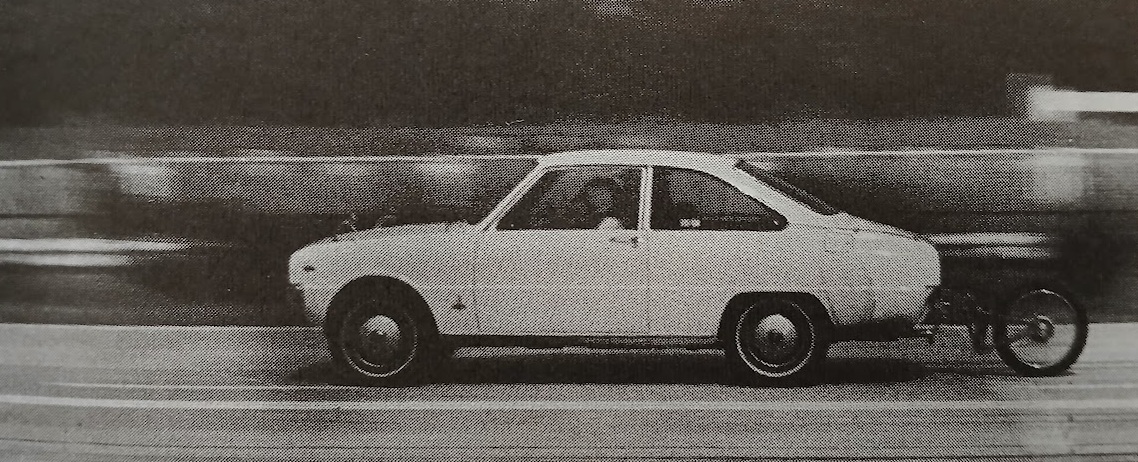
To begin with our conclusion after testing the Rotary Coupe over approximately 2,000km, its performance can be summed up in a single word: magnificent.
At Yatabe’s 5.5km High-Speed Test Course, our test car recorded a maximum speed of 184.0km/h (as measured by the fifth-wheel speedometer), with an average of 179.7km/h through the 400m timed section (measured by photocell). It covered the standing 0-400m in 17.23 seconds and reached 160km/h in 33.4 seconds. These figures place it very close to the performance of a standard Lotus Elan.
Yet while the Lotus is a pure two-seat sports car, the Rotary Coupe is a thoroughly practical five-seater (at least legally), and above all, a low-priced car at just 700,000 yen.
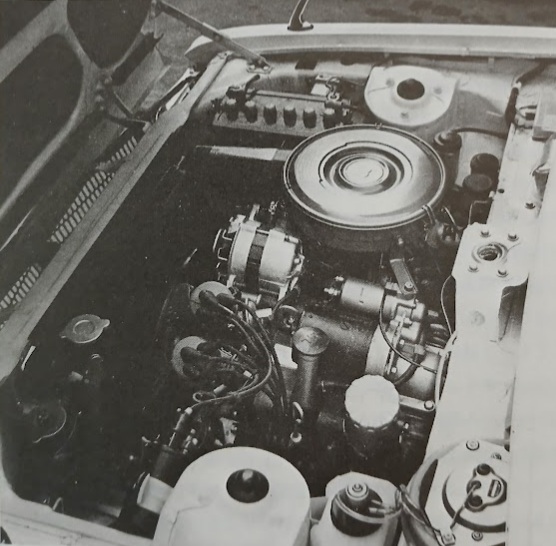
The key to this astonishing performance is, of course, the twin-rotor rotary engine built under the NSU Wankel patent. Fundamentally, it is the same 491cc × 2 unit (type L10B) introduced in the Cosmo, of which 340 examples have been sold since its launch last June. For the Rotary Coupe, however, it has been detuned slightly while also being redesigned for mass production.
Output has been reduced from the Cosmo’s 128ps/7000rpm to 100ps/7000rpm, while torque goes from 14.2kgm/5000rpm to 13.5kgm/3500rpm. Even so, because the Rotary Coupe weighs just 805kg—a full 150kg less than the Cosmo—there is almost no difference in power-to-weight ratio.
The Cosmo’s engine has already earned a reputation for smoothness and flexibility, but the new Rotary Coupe’s 100ps version makes an even stronger impression in both respects. Cold starts on a chilly morning are, quite literally, one-touch starts: the engine starts instantly with a single turn of the starter, and even if the throttle is released immediately, it settles into a smooth idle at 600-700rpm (this being the output-shaft speed; the rotors themselves are turning three times faster).
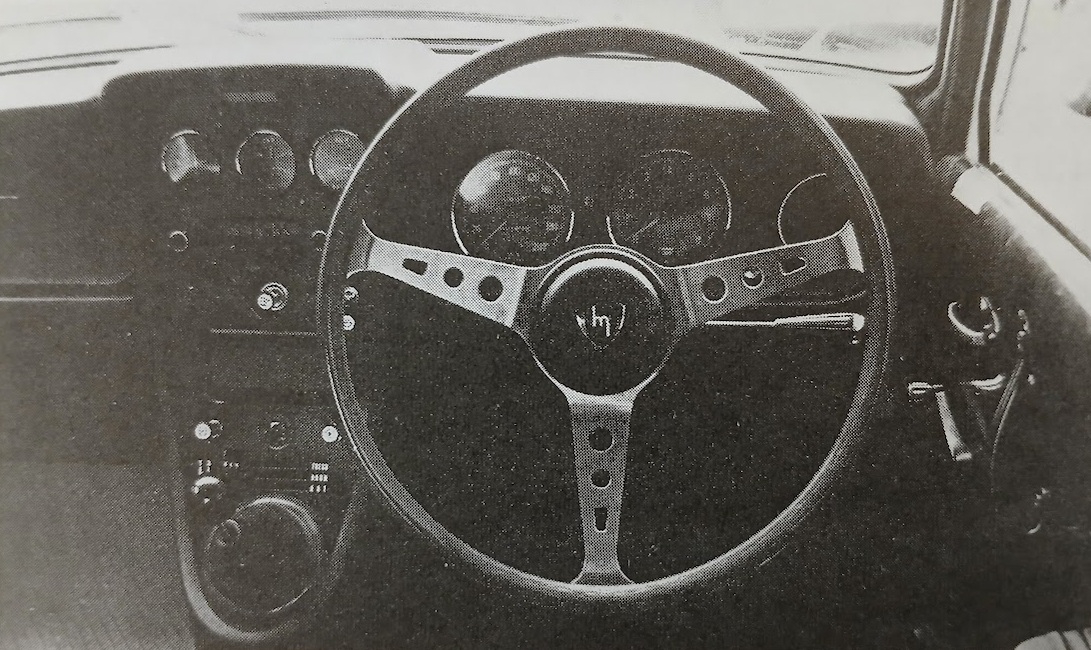
Even if driven away after only the briefest warm-up, it responds instantly to the throttle and accelerates powerfully. The tachometer marks 6500-7000rpm as the yellow zone and 7000-8000rpm as the red. With no valve gear to be damaged, and with a highly efficient intake and exhaust system, the only thing capable of preventing a rotary engine from over-revving is the driver’s own self-restraint. (Only after the test, when we read the owner’s manual more carefully, did we discover that the car is fitted with a safety device that sounds a warning buzzer and automatically cuts fuel to the secondary induction system if engine speed exceeds 7100±200rpm. On our test car—fortunately?—it never operated.)
The engine’s eagerness to rev and superb balance invite comparison with a well-tuned two-stroke. A two-stroke, however, becomes rough at low speeds and has only a narrow useful power band. Mazda’s rotary, by contrast, pulls surprisingly well at low engine speeds and produces consistently strong torque across an exceptionally wide operating range.
Upon first getting behind the wheel, one naturally finds oneself holding the lower gears and using high engine speeds—partly out of curiosity, and partly because the engine revs so freely. Once the initial excitement has worn off and one begins driving more calmly, however, it becomes apparent just how well the engine will run at low speeds. In practice, its generous power reserve allows the car to pull away quietly from as little as 1000rpm, once one gets used to it.
The owner’s manual recommends that, during the first 1000km of running-in, engine speed be kept below 3000rpm. Whatever the psychological effect of this restriction, in practical terms it proved no inconvenience whatsoever. Acceleration remains outstanding, and even using 3000rpm as the shift point, the Rotary Coupe has already left everything else behind by the time one shifts into third gear.
We drove the C/G Rotary Coupe to and from FISCO on the same day we purchased it, combining its running-in period with coverage of a race meeting. Even on the Tomei Expressway, 3000rpm corresponds to approximately 90km/h, so the running-in restriction was no real hardship.
The Rotary Coupe is an exceptionally easy car to drive in city traffic. Its generous power reserve makes it feel remarkably forgiving, even to an inexperienced driver. Despite being powered by a rotary engine, it requires no special driving technique. As already noted, its low-speed flexibility is exceptional, and it can maintain as little as 30km/h in top gear (approximately 1100rpm) without difficulty. So one can drive quietly, observing the 50km/h urban speed limit while using third and fourth gears half-and-half. Its exhaust note is among the quietest of any automobile. Inside the cabin it is barely audible below 80km/h, becoming only slightly louder while accelerating.
Yet the rotary engine truly comes into its own in high-speed driving, where one can make full use of its willingness to rev. Taken up to its 7000rpm power peak, the car easily reaches 90km/h in second gear and 135km/h in third, while still seeming eager to rev higher. The smoothness and immediacy of its throttle response between 2500-5000rpm in third gear is something no reciprocating engine can begin to equal. Engine noise increases somewhat from around 4000rpm, but changes very little thereafter, even all the way to maximum speed. Because the engine is so quiet—and because the balance of the entire driveline, not merely the engine itself, is exceptionally good—there is no sense of strain whatsoever, even while driving at 180km/h.
There is not the slightest trace of the rough-edged character so often associated with high-performance cars. Instead, one has the impression that numbers coolly calculated by an electronic computer are simply being displayed faithfully on the tachometer and speedometer.
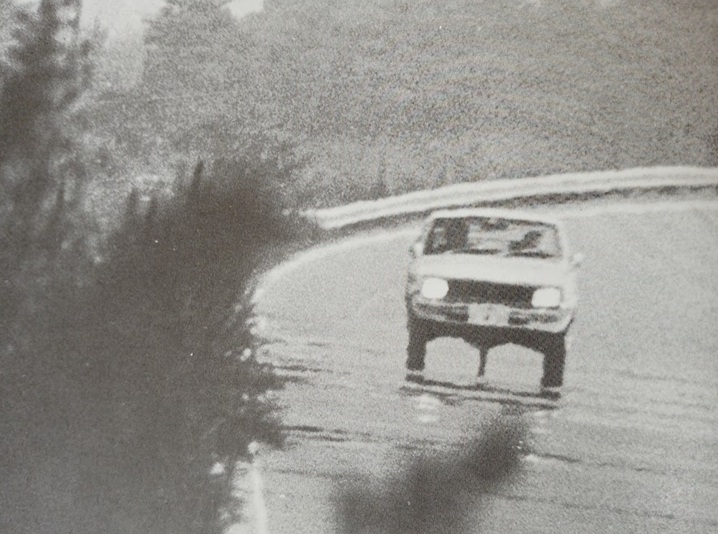
The catalog maximum speed proves entirely genuine, without exaggeration. At Yatabe, the car completed four consecutive laps of the 5.5km high-speed circuit while maintaining 170-180km/h, carrying two occupants along with about 50kg of test equipment (including the fifth wheel), for a total test weight of 1030kg. The highest instantaneous speed indicated by the fifth-wheel speedometer was 184.0km/h (with the engine turning 6500rpm, and the car’s own speedometer indicating 200km/h). The average speed through the 400m photocell timing section was 179.7km/h.
Throughout the approximately 2,000km of our test, the engine remained in consistently excellent condition. Coolant temperature was a steady 80°C, even in heavy city traffic, approaching the upper limit of the normal operating range (80-105°C) only during sustained maximum-speed running at Yatabe. At that time, however, the idle became somewhat rough, and the engine began to stall whenever the car came to a stop during the brake tests.
For these high-speed runs we fitted the engine with cold-type B-9EPD spark plugs. This produced occasional backfiring under engine braking. In addition, if the car was stopped for some time, restarting required the starter motor to be cranked for rather longer than usual. The latter may not have been attributable to the spark plugs, but instead to fuel percolation caused by heat.
For normal driving we used B-8EE plugs. After approximately 800km, the engine developed a slightly rough idle accompanied by occasional misfiring, so we removed the plugs for inspection. (The supplied spark-plug wrench proved cheaply made and quickly broke.) Of the four plugs, those on the leading side were particularly white, while all four were heavily coated with combustion deposits.
Apart from these minor observations, however, the engine has so far been entirely free of trouble.
The gearbox is very well matched to the engine’s characteristics. The gearshift has excellent feel and engages lightly even when new, while the synchromesh is remarkably effective. The clutch likewise requires only light pedal effort (though its travel is somewhat long), and engagement is wonderfully smooth, so even a novice would have no excuse for making a poor start.
The final-drive ratio is 3.70, appropriately higher than that of the 1200cc, 68ps reciprocating-engine Familia Coupe introduced at the same time as the Rotary Coupe (priced, incidentally, at 550,000 yen). In top gear, road speed per 1000rpm is 27.6km/h. A cruising speed of 100km/h on the expressway corresponds to approximately 3600rpm, almost exactly the point of maximum torque (13.5kgm). As a result, acceleration in top gear is impressively strong, responding decisively whenever the throttle is opened. Judged purely by its performance, the Rotary Coupe is ideally suited to high-speed motorway touring.
High performance can only be used safely when backed by dependable brakes, and in this respect the Rotary Coupe leaves little to be desired. The front brakes are Girling-type solid discs, while the rear uses leading-trailing drums, with separate hydraulic circuits for the front and rear. There is no servo assistance, yet pedal effort is generally light. The squeal often associated with disc brakes is entirely absent, and even under heavy braking from high speeds the brakes remained stable and consistent.
As shown in the data pages, we have introduced a brake-fade test beginning with this issue. The procedure consists of ten successive 0.5g stops from 100km/h at 1km intervals, observing changes in both pedal effort and braking performance. During the test, pedal effort measured 20kg for the first two stops, increased to 28kg on the third, then stabilized at 30kg for the remaining seven without increasing further. This amount of increase is considered entirely normal.
The suspension is based on that of the existing Familia Sedan, but has been stiffened throughout. We have previously noted that the Familia’s directional stability is sensitive to crosswinds, and the same tendency is evident in the Rotary Coupe. At speeds above 100km/h, it is noticeably buffeted by side winds. Fortunately, conditions at Yatabe were almost completely free of crosswinds, allowing us to explore the car’s maximum speed with confidence. On elevated expressways, however, particularly on long bridges, a windy day demands constant steering corrections.
Our test car was fitted with Toyo 6.15-13 low-profile tires, but these simply cannot keep up with the car’s high-speed capability. We began testing at Yatabe with front and rear tire pressures of 2.0kg/cm², but after four or five laps at maximum speed the tires had become too hot to touch, and pressures had risen to 2.5kg/cm². Drivers who regularly travel at high speeds are strongly advised to specify the optional 155SR-13 radial tires.
Ride quality is quite firm. While the suspension absorbs small surface irregularities well, over larger bumps it reacts with a surprising amount of vertical movement. Applying power in a low gear through a tight corner causes the rear wheels to lose grip and spin surprisingly easily. This probably reflects not only the suspension’s characteristics, but also the tires’ low limit of adhesion.
The handling is fundamentally safe, maintaining an appropriate degree of understeer throughout. Simply replacing the tires with radials with greater cornering power would produce a considerable improvement on its own. The steering is surprisingly light, even when parking, but remains reassuringly positive at high speeds. Kickback from the road surface is transmitted to the driver’s hands only slightly.
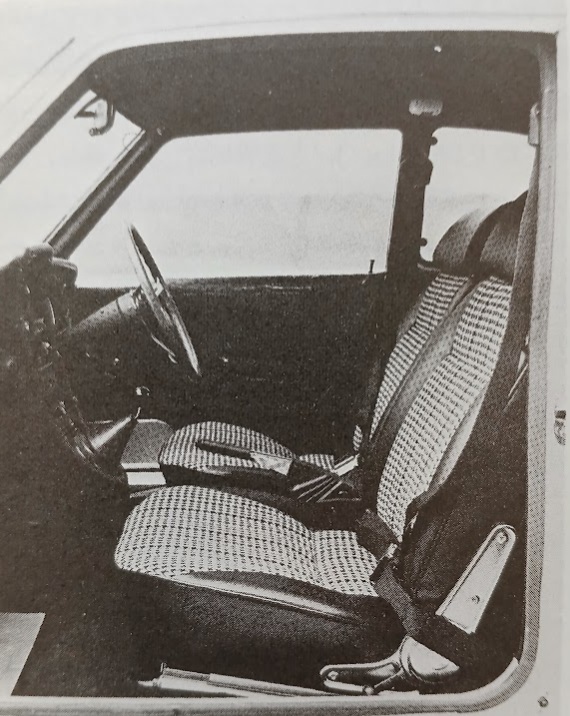
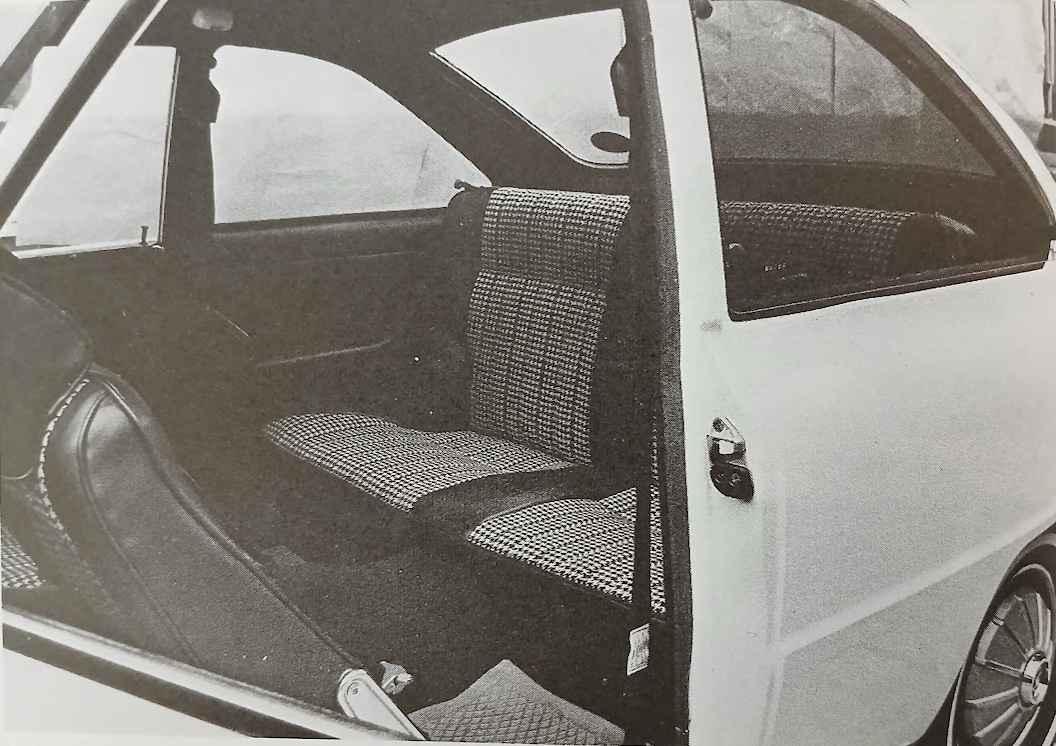
Turning next to the interior, the cabin has a luxurious atmosphere that is quite hard to believe in a 700,000-yen car. The reclining seats are upholstered in the same black-and-white checked fabric used in the Cosmo, and are among the best fitted to any domestic car. Adjustable headrests are provided, while three-point seat belts are standard equipment. The seats themselves are generously sized, allowing even a driver 180cm tall to assume a comfortable driving position. The controls are all well-arranged, with one exception: the clutch and brake pedals. Both are rather too high off the floor (and, moreover, have a long stroke), making them awkward to operate with the legs comfortably extended.
The instruments are pleasingly simple in design, though the speedometer and tachometer would be easier to read if they were positioned some 50mm higher, closer to the driver’s normal line of sight, and without obstructing the forward view. One particularly well-designed control is the multi-function lever to the right of the steering wheel, identical to that used in the Cosmo. It allows the wipers, washer, headlamp dip switch, and turn signals to all be operated without removing a hand from the steering wheel.
Although the official seating capacity is five, the Rotary Coupe is, in reality, a 2+2. The rear seat backrests are almost upright, while headroom for an average-sized adult is just barely adequate. Legroom, too, is insufficient unless the front seats are moved well forward (in which case the front passenger’s knees come into contact with the lower edge of the dashboard).
The Familia has unusually good ventilation for a low-priced car, and the Coupe uses the same system. There are no opening quarter windows; instead, fresh-air outlets are provided at each end of the dashboard and at foot level. The arrangement is extremely effective. Even in the present hot weather, adequate ventilation is maintained at high speed with the windows fully closed.
The trouble is that, after driving on the expressway for a while, the floor gradually becomes hot. This is apparently due to the exhaust pipe running close under the floor. This is a pity, since the car has such good ventilation otherwise.
Finally, a word about fuel consumption. One of the commonly cited drawbacks of the rotary engine is its relatively high fuel consumption, and our test confirmed that there is some truth in this. Constant-speed fuel consumption falls from 13.5km/l at 40km/h to 8.9km/l at 100km/h. Measured in everyday use by the full-tank-to-full-tank method, the poorest figure—recorded during all short-distance driving—was 5.6km/l, while the best, achieved during highway running that included the trip to and from Yatabe, was 9.9km/l. Our overall average to date has been 6.18km/l.
Even so, despite its relatively high 9.4:1 compression ratio, the rotary engine runs perfectly well on regular-grade gasoline, which should somewhat offset its higher fuel consumption. Oil consumption amounted to 1 liter over approximately 300km, including the testing at Yatabe.
With acceleration comparable to that of a 2-liter sports car, an exceptionally small 4.1m turning circle, and a rotary engine that is easier to use at low speeds than the average reciprocating engine, the Rotary Coupe is an ideal city runabout for modern metropolitan traffic. As for its other specialty, grand touring on expressways, our conclusion is that it needs a chassis worthy of the superb rotary engine—even if that results in a higher price.
Postscript: Story Photos