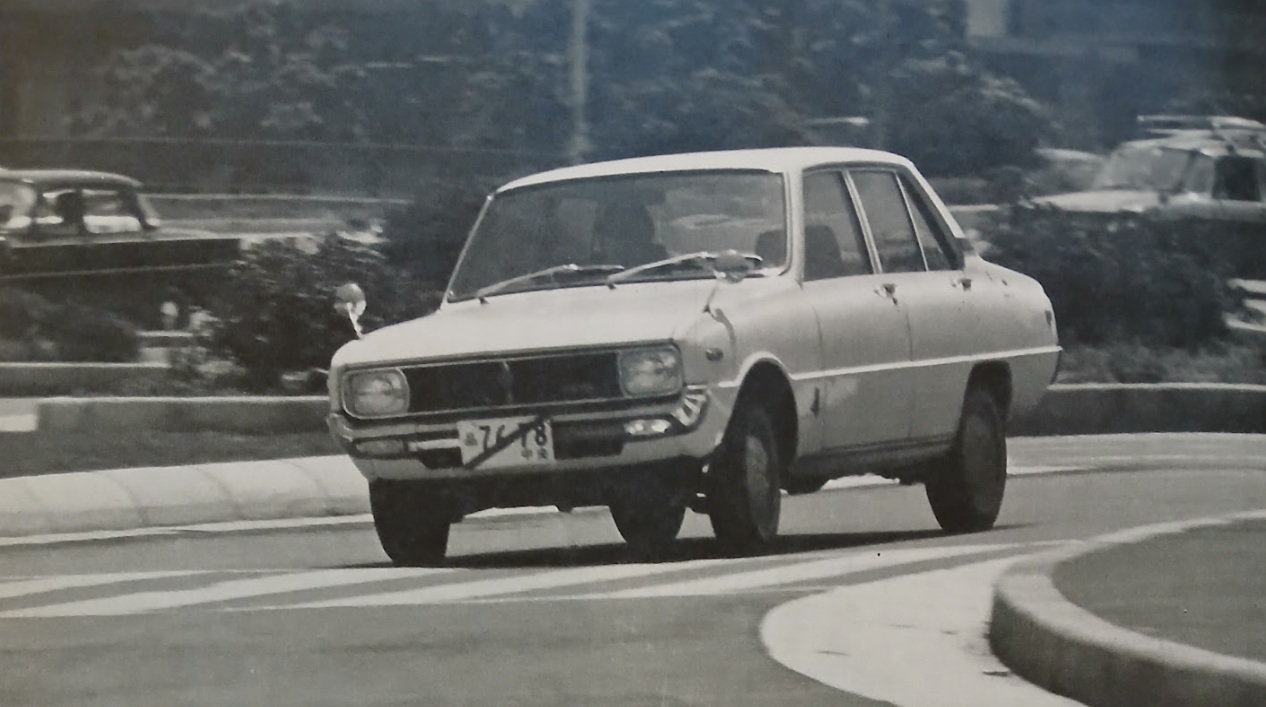
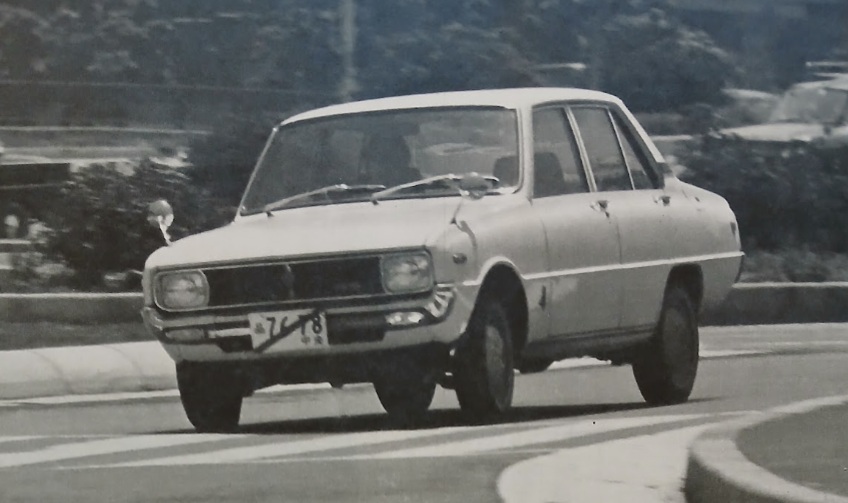
Mazda Familia Rotary SS (1969)
Publication: Car Graphic
Format: Road Impression
Date: September 1969
Author: Masaru Mino
Road-testing the Mazda Familia Rotary SS
The Familia Rotary SS is a demonstration of the confidence Toyo Kogyo has in its aim of bringing the rotary engine into widespread everyday use. C/G has evaluated the rotary engine as a whole on several occasions and rated it highly.
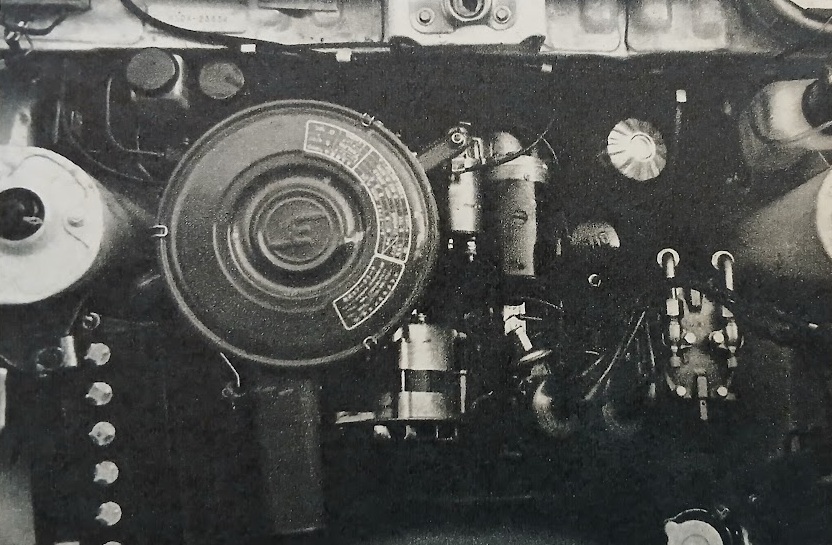
The engine in the Rotary SS (and in the lower-priced E-type version of the Rotary Coupe announced at the same time) is the same 2-rotor, 982cc, 100ps unit used in the Rotary Coupe, which has now been on the market for a year, installed here in the Familia 4-door sedan. The engine and its ancillaries are exactly the same, but the manufacturer currently offers a choice of 2-barrel and 4-barrel Solex-Stromberg carburetors at the same price. With the 2-barrel type, maximum torque falls slightly from 13.5kgm/3500rpm to 12.8kgm/3500rpm, but the test car was fitted with the same 4-barrel type as the Rotary Coupe.
Naturally, the performance of the Rotary SS, with a 100ps engine equivalent to that of a 2-liter reciprocating-engine car, is outstanding for a small family sedan in the 1-liter class—at least in terms of its body dimensions.
This time, however, the duration of our test was extremely short—only a day and a half—and the car came with the welcome burden of an air conditioner (more on its effectiveness later). As a result, we did not conduct any formal performance testing, but instead chose to drive almost entirely on the kind of roads the owner of this car would be likely to enjoy, as well as those he would use frequently in everyday driving.
Consequently, we cannot give precise figures. The catalog’s claimed 16.8-second standing quarter-mile with five aboard may be beyond reach, but there is little doubt that the SS would run in the 17-second range, on equal terms with the C/G Rotary Coupe. During the test we twice accepted challenges (?) from sharp-eyed young men driving Bluebird SSSs, and in traffic-light races we were able to leave them behind on both occasions despite their best efforts—though only because they were shifting up before the beginning of the yellow zone, out of concern for their own engines. Its acceleration, then, is in the 2-liter GT class.
Maximum speed is quoted as 175km/h, which, like the Honda 1300, gives it the speed of a car one or even two classes above.
We have written several times that the directional stability of the Familia series, including the Rotary Coupe, is sensitive to crosswinds at high speeds. Ironically, however, the day we drove the Rotary SS on the Tomei Expressway was almost completely windless. At 100km/h on the expressway, one needed only to hold the steering lightly, and there was no cause for anxiety whatsoever.
At an indicated 100km/h the engine is turning at only about 3400rpm, while at a true 100km/h it is turning at about 3600rpm, with the speedometer indicating 105km/h. With high-speed running in mind, 6.15-13 low-profile tires (Bridgestones on the test car) are fitted, while 155SR-13 radials are available as an option.
The Rotary SS naturally comes into its own on the highway rather than in crowded city streets, but the rotary engine’s characteristic willingness to rev is evident under any conditions. From its idle of around 700rpm to its maximum of 7000rpm, it is completely smooth.
It should also have exactly the same excellent flexibility at low and medium engine speeds as the Rotary Coupe, but in this car it was somewhat compromised by the air conditioner. Above 3000rpm, the loss of 7-8ps absorbed by the compressor is barely noticeable, but below that speed the additional load makes itself felt quite suddenly.
The air conditioner’s temperature-control dial is marked up to 10, and to have any real effect it has to be kept at 6 or above. Things are somewhat better with the air conditioner switched off, but after dawdling along in top gear at around 2000rpm, the response is still a little sluggish if one suddenly presses down on the accelerator to overtake. The C/G Rotary Coupe will tolerate this kind of lazy driving, and presumably the Rotary SS would do the same if the air conditioner were removed.
Even so, however much its low-speed pulling power may have suffered, this is only by the exceptionally flexible standards of the rotary engine. In absolute terms there is more than enough power, while its flexibility is on an altogether different level from that of a reciprocating engine.
The gearbox is exactly the same as that of the Rotary Coupe, with identical gear and final-drive ratios. The shift lever again sprouts from the floor in an oddly bent shape. Apart from being slightly stiff because the car was new, the shift action is typical of current Japanese cars, with the gears engaging positively and easily.
The clutch is much better than that of the early Rotary Coupe we tested. Its travel has been shortened to an appropriate degree, while the operating effort has been made firmer (though not to the point of being heavy). Until one is used to it, this tends to result in using slightly more revs than necessary when starting off, but the C/G test group unanimously preferred it this way, since it provides a better sense of feel.
The synchromesh is powerful, and not once did it protest, no matter how quickly we shifted, or even during full-throttle gear changes.
Fuel consumption was again poor. The C/G Rotary Coupe has averaged a disappointing 5.94km/l over the course of a year, a point we have mentioned many times. Yet whenever we speak to the manufacturer or visit one of its service shops, we are told that the poor fuel economy of our car is unusual, and that other cars do much better. As a result, we decided to measure fuel consumption carefully this time.
First, immediately after borrowing the car, we drove it around Tokyo for the afternoon and recorded an astonishing figure of just under 3km/l. With the midsummer sun beating down after the end of the rainy season, we had the air conditioner turned up to the maximum and deliberately chose the most congested roads we could, so there was no reason to expect a good result. Even so, the figure left us thoroughly stunned.
Next, cruising at 100km/h on the Tomei Expressway without using the air conditioner produced 9.886km/l. If one wants to cover long distances such as Tokyo to Nagoya without refueling, the large 60-liter fuel tank is welcome, and a capacity of about this size will probably become a practical necessity in the future. Incidentally, recent versions of the Rotary Coupe have also had their tank capacity increased from 40 to 60 liters.
Finally, after running around the twisting mountain roads of Hakone, we continued on the Tomei, varying our speed intermittently and occasionally using the air conditioner. Under these conditions the car returned 8.34km/l, the best figure in relation to the severity of the driving conditions. In other words, the most economical way to use the Rotary SS is to drive it fast—a result that bears out its intended role as a car for medium- and long-distance travel by a small family.
With this high-speed performance in mind, the brakes combine Girling-type SC discs at the front with leading-trailing drums at the rear. Braking performance proved entirely satisfactory at all speeds. There is no servo assistance, but pedal effort is light enough that we never felt the slightest need for it.
As for handling, the thoroughly conventional suspension—MacPherson struts at the front, semi-elliptic leaf springs at the rear, the same as on the 1200 sedan—cannot always keep pace with the considerable power, and occasionally produces some strange behavior.
The steering has a variable ratio, changing from 17.1 around the straight-ahead position to 19.1 near full lock, and with the small-diameter steering wheel its response is quite sharp. In contrast, the rigid-axle rear end feels somewhat insecure, and the rear tires begin to slide relatively early. The initial cornering characteristic is, of course, fairly strong understeer, but as the speed is increased it changes to oversteer surprisingly early, which can be disconcerting.
As for ride comfort, at least from the front seats (unfortunately we had no opportunity to spend much time in the rear), it is not as firm as the Rotary Coupe. Over large irregularities, however, the car reacts strongly in the vertical direction, jolting the occupants sharply upward.
Since the suspension settings are unchanged from those of the standard Familia sedan, it is not particularly set up for high-speed driving. At low speeds the ride feels somewhat rough, but it becomes progressively smoother as speed increases.
As for the interior, because the body is that of the Familia 4-door sedan, there is at least nominally enough space for three adults in the rear seat, although priority is clearly given to the front-seat occupants. Headroom is generous, but seat width and legroom feel cramped when compared with, for example, the Honda 1300 in the same class.
All the seats are upholstered in black vinyl, but, unusually for a recent Japanese car, the cushions are relatively firm, with little surface resilience. They therefore seem hard at first, but after spending a long time on a level expressway, one finds that they actually produce less fatigue. On the other hand, because the cushion is flat and one does not sink into it, the lower body is not held securely through a succession of corners unless the seat belt is used. A 3-point belt is standard for the driver; for the other occupants only the anchor points are provided, with the belts themselves available as options.
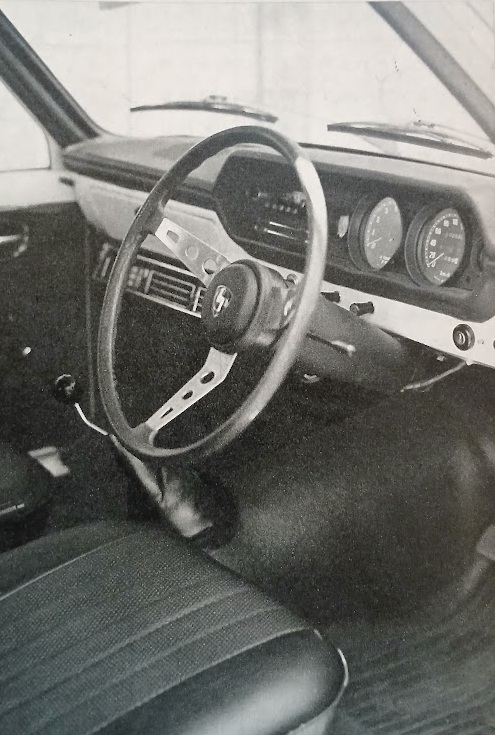
The relative positions of the seat, steering wheel, pedals and switches are the same as in the Familia 1200 Coupe, making them easy to use. The interior as a whole is also based on that of the Familia 1200 Coupe, but there were several places, such as the door trim and glovebox, where the finish struck us as rather crude.
In the center of the instrument panel are a circular speedometer (reading to 200km/h) and tachometer (with a yellow zone from 6500-7000rpm and a red zone from 7000-8000rpm), with smaller fuel and water-temperature gauges to either side. With the air conditioner operating, the coolant temperature rises to the upper end of its normal range (around 87°C), but never goes past it, and even when crawling along in traffic there was no sign of overheating.
The pull-type switches are lined up below the instrument panel on a sheet-metal panel painted the same color as the body. Their design is rather plain, while their ease of use is neither particularly good nor bad. The dashboard as a whole is simple and functional, but lacks any sense of luxury.
The ventilation is extremely effective. Fresh-air outlets are provided at either side of the dashboard, with two vents per side: the upper one is circular and adjustable, directing air toward the upper body, while the lower one blows cool air into the footwell. When cruising at more than 40km/h, the ventilation works very well, and on the expressway, provided one does not mind the wind noise, it is possible to travel comfortably without having to resort to the air conditioner.
The test car’s air conditioner, incidentally, was a dashboard-mounted Nippondenso unit, and it was truly a blessing when crawling along in the intense summer heat. Even if it does blunt acceleration slightly in the lower speed range and add a little to the gasoline bill, for a driver covering an average of more than 100km a day in midsummer it is difficult to overstate how beneficial an air conditioner can be to one’s frame of mind. This, however, is the opinion of a tester who merely has to sign the slip at the gas station.
Finally, a comparison of prices with the Honda 1300 77S and 99S, which may be regarded as almost equal in both size and performance, gives the following results.
| Model & Specifications | Price |
|---|---|
| Mazda Rotary SS (100ps, 175km/h) | 638,000 yen |
| Honda 1300 77S (100ps, 175km/h) | 605,000 yen |
| Honda 1300 99S (115ps, 185km/h) | 680,000 yen |
| *The air conditioner for the Rotary SS costs 130,000 yen. | |
| *The air conditioner for the Honda 1300 costs 98,000 yen. | |
Postscript: Story Photos