Honda N600E (1968)
Publication: Motor Fan
Format: Test Drive Report
Date: September 1968
Author: Hiroshi Hoshijima
The N Series Is Selling Well in Europe, Too
The Honda N600E went on sale in Japan on July 15, priced at 378,000 yen (ex-factory, Sayama). This makes it 65,000 yen more expensive than the N360, which costs 313,000 yen. Compared with the Toyota Publica, however, which may be regarded as a competitor, the N600E seems like a rather good buy. The Publica Standard costs 359,000 yen, while the Deluxe, equipped with a radio and heater, costs 409,000 yen. Although the N600E does not include a radio as standard equipment, it does have a heater, defroster, windshield washer and tachometer, so it may be considered slightly better value than the Publica.
The N360 was introduced in the spring of last year. If I remember correctly, Honda said at the time that it had no intention of selling the N600 in Japan. The N600 had been planned primarily as an export model for Europe. In Japan, where cars with engine capacities below 360cc are classified as kei cars and enjoy legal advantages in taxation, garage requirements and vehicle inspections, Honda would sell the 360cc model. In Europe, where no such regulations existed, it would offer the higher-performance 600cc version instead.
But when Honda began exporting the N series to Europe, it discovered that the N360 was unexpectedly well received there, too. The N360 sells for approximately 400,000 yen in France and 450,000 yen in West Germany. The N600 costs about 50,000 yen more in each country, so the cheaper N360 has been selling well. Europe has many 400-500cc cars on its roads, such as those made by Citroen and Fiat. Yet the N360 seems to have gained popularity because its performance is actually superior to that of those small cars.
Still, it cannot be said that the 360cc engine is the most natural choice for the Honda N series. Honda must, of course, have planned and developed the N360 and N600 together, but the 360cc engine was intended mainly to take advantage of the legal benefits afforded to kei cars in the Japanese domestic market.
In other words, the N600 was surely the more “natural” car of the two. Its present introduction to the Japanese market presumably reflects Honda’s intention to offer buyers a passenger car in something closer to its originally intended form.
Honda’s Confidence That the N600 Will Sell
In little more than a year since its introduction last spring, the N series has passed the 30,000-unit monthly production mark, overtaking even the Corona and Bluebird to become a bestseller.
Looking at the domestic sales figures for passenger cars in June of this year, almost one year since its introduction, the N360 reached 19,507 units, with the second-place Corolla at 17,563, followed by the Bluebird at 15,512, the Corona at 15,324 and the Sunny at 12,632.
Total sales of kei passenger cars also exceeded 50,000 units, surpassing the 48,000 recorded by popular cars up to 1100cc, the 48,000 in the 1200-1600cc class, and the 29,000 in the 1800-2000cc class. The fact that kei passenger cars have overtaken these other classes owes much, of course, to the N360, which accounts for 40% of their sales. But this should be attributed less to a renewed appreciation of the legal advantages enjoyed by kei passenger cars than to the overwhelming popularity of the Honda N360 itself.
This, in turn, gives rise to the expectation that the N600E, with the same layout and styling but higher performance, should also sell quite well in Japan, competing in the 1000cc class.
Traditionally, 600cc passenger cars have not sold well in Japan. In particular, attempts to fit larger-capacity engines into bodies shared with kei cars have ended in dismal failure. Both the Subaru 450 and the Carol 600 proved unpopular and suffered the fate of being discontinued. Even the Publica, which originated in the national-car concept and at one time enjoyed considerable popularity as a family car, is now limited to a monthly production level of around 4,000 units, with the 1000cc passenger-car class having become so well developed.
For the N600 to gain popularity in Japan, it will need performance sufficient to attract buyers who would otherwise choose a 1000cc car. And if it can sell more than 5,000 units a month, that will surely serve as proof that the N series is a truly exceptional car.
My introduction seems to have become rather too long. Let us now take the N600 for a drive and see whether it really is a car worthy of comparison with passenger cars in the 1000cc class.
A Lower Overall Height
I took delivery of the N600 on July 15, the same day it went on sale. The car, belonging to Honda’s public relations department, had already been used for several press test drives, and its odometer showed more than 2,000km.
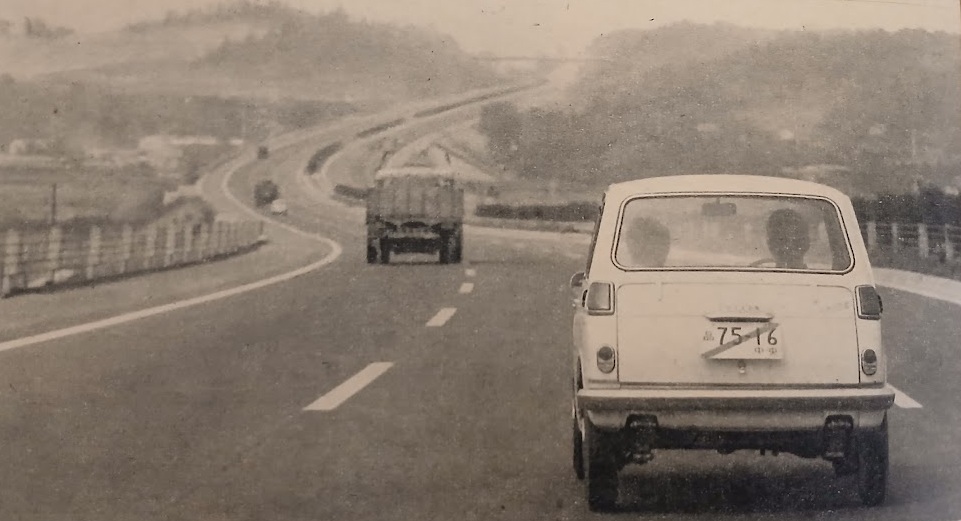
I decided on a route of approximately 200km, starting in central Tokyo, passing through Shibuya and taking the Tomei Expressway as far as Atsugi to include some high-speed testing.
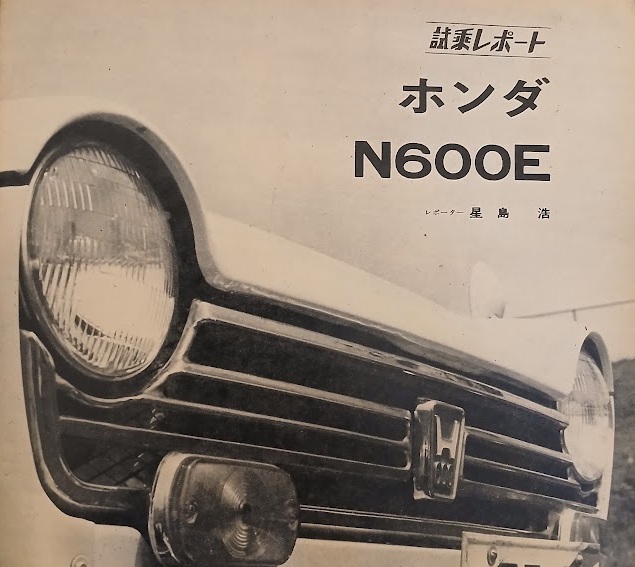
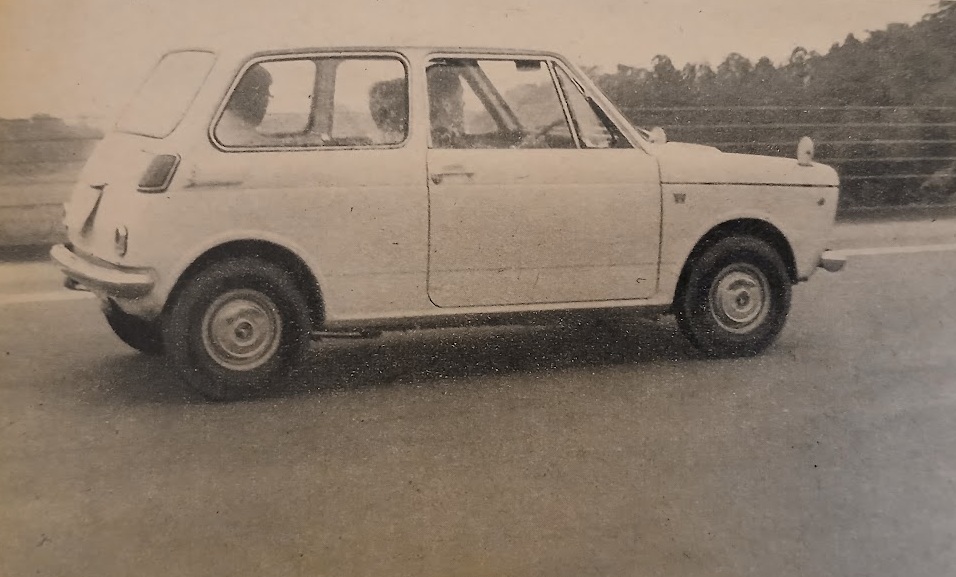
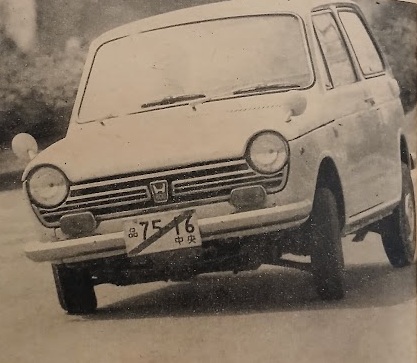
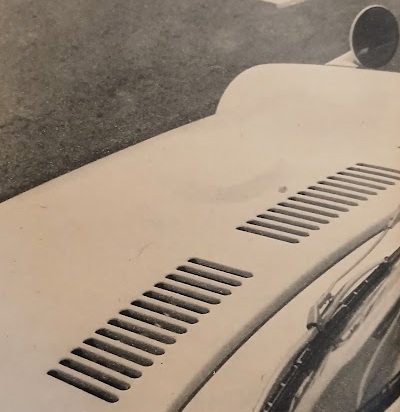
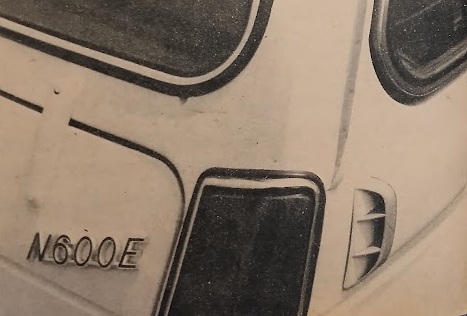
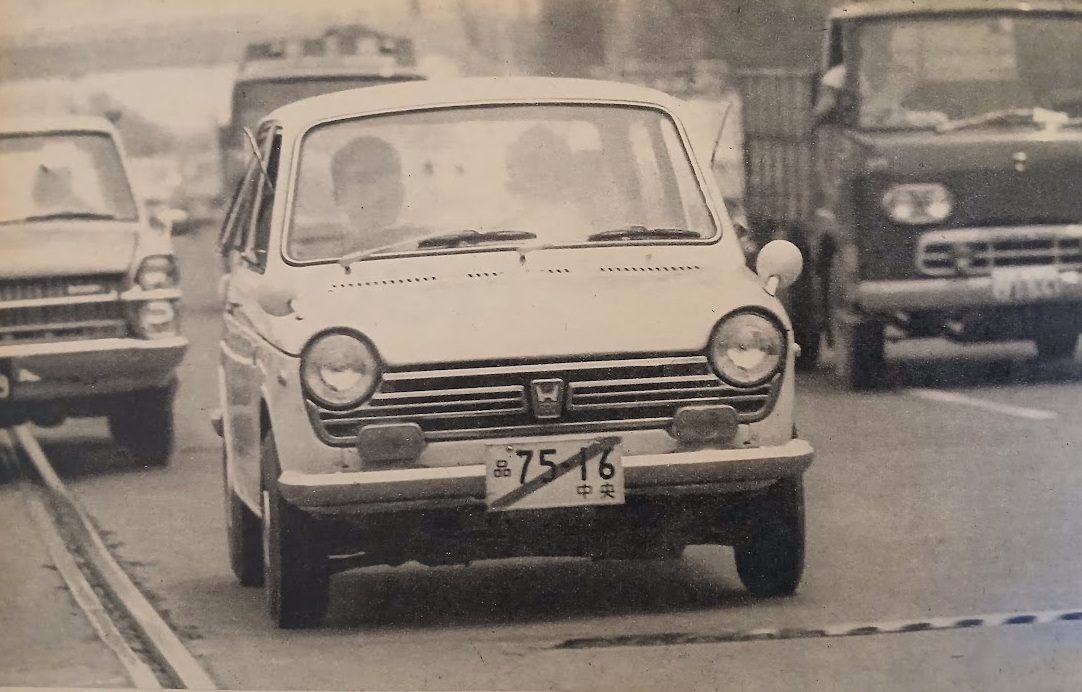
The styling is already familiar, so there is probably no need to describe it again. The exterior changes are limited to a horseshoe-shaped bulge in the engine hood, roughly above the carburetor, larger front and rear bumpers, and the addition of a cover over the cabin air outlet on the rear bodyside.
Overall length has increased by 105mm to 3100mm because of the added length of the bumpers at both ends. Overall height, however, has been reduced by 15mm, from the N360’s 1345mm to 1330mm. Tire size remains the same at 5.20-10, but whereas the N360 uses 2-ply tires, the N600 is fitted with 4-ply tires. If the tires alone had been changed, the car should actually have stood a few millimeters higher. The explanation is that the suspension layout has been revised to lower the body. As a result, ground clearance has also been reduced by a substantial 25mm, from the N360’s 185mm to 160mm.
This means that the N600E’s center of gravity has been lowered accordingly.
The 2000mm wheelbase is, of course, unchanged, but the front track has been widened by 25mm to 1150mm, while the rear track, conversely, has been narrowed by 45mm to 1055mm.
As I will describe later, the wider front track, together with the lower center of gravity, has brought about a welcome improvement in the Honda N600E’s cornering behavior.
A Completely Different Interior “Mood”
The interior gives a quite different impression from before.
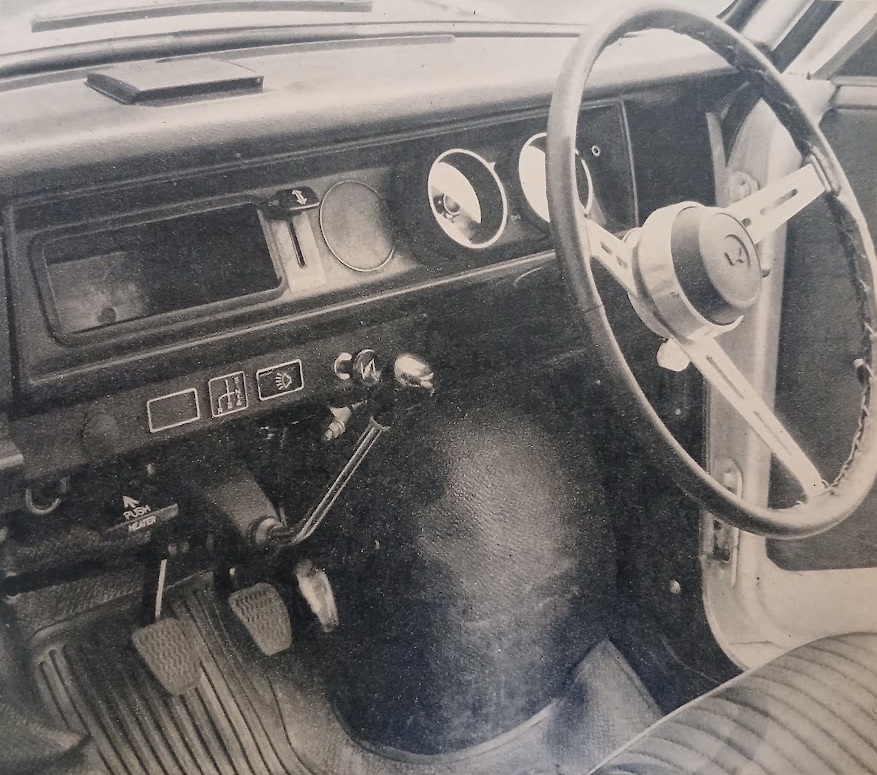
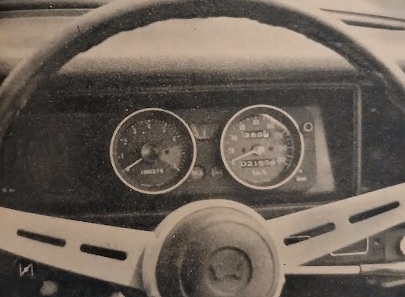
This is mainly due to the replacement of the N360’s two-spoke steering wheel with a sporty Nardi-type wheel with three metal spokes. The instruments directly ahead of the driver have also been changed. In place of the N360’s fan-shaped speedometer, there is now a round speedometer on the right and a tachometer on the left. The instrument covers are non-reflective, giving the impression from the driver’s seat that one could almost reach out and touch the needles.
The switches and heater/defroster controls are the same as those of the current N360. Safety has also received attention, with thick padding on the sun visors, instrument panel and steering column, recessed door locks, and an anti-burst device to prevent the doors from opening accidentally.
Two-point seat belts are standard equipment, while the large windshield wipers have also been given an anti-glare plated finish.
In relation to the N360 range, the N600E corresponds to what might be called the Standard model, and its seats do not recline.
The front seats can be adjusted 60mm forward and 80mm rearward from their neutral position. Unless the driver is exceptionally tall, there should be little need to move the seat all the way back. Front-seat headroom seems unchanged from the N360, but when I tried sitting in the rear, I noticed that my head was somewhat closer to the roof. The distance of 815mm from the seat to the headliner is certainly not inadequate, but perhaps the seat cushion is thicker. Or could my memory be playing tricks on me?
Even with the front seats moved all the way back, there is still more than 150mm between the front edge of the rear seat cushion and the backs of the front seats at the narrowest point. Once again, I found myself impressed by the spaciousness of the N-series’ cabin.
Acceleration on a Par with 1000cc Cars
The distinctive gearshift lever is unchanged from the N360, but the knob is made of wood, a sporting touch.
Holding first gear to 5900rpm gives a road speed of 30km/h, while second takes the car to just under 50km/h. In third, 5000rpm corresponds to 75km/h. Torque begins to build strongly from around 2500rpm, but seems to fall off once the engine passes 6000rpm.
Standing-start acceleration, however, is truly excellent.
The 0-400m time is quoted as 19.7 seconds, but with only the driver aboard, breaking 19 seconds should not be especially difficult. This off-the-line acceleration is fully on a par with the Sunny, Subaru 1000, Familia 1000 and Corolla. Indeed, when pulling away from a traffic light, the N600 is probably quicker than most 1000cc passenger cars.
The transmission ratios are 2.529 in first, 1.565 in second, 1.000 in third and 0.714 in top. The first three ratios are exactly the same as those of the N360, but top gear has been raised numerically from 0.60 to 0.714, bringing it somewhat closer to third.
The reduction ratios, however, have also been changed. The primary chain sprocket reduction is now 2.050, a taller ratio than the N360’s 2.812, while the secondary final-drive ratio has been raised considerably, from 3.739 to 3.037.
As a result, the overall final reduction ratio is 6.226, compared with 10.514 for the N360. Multiplying these figures by the transmission ratios given above shows just how much taller the effective gearing has become in each gear.
The engine’s flexibility is even more apparent than in the N360. Although there is little point in driving this way, and probably nobody would normally do so, the car will run quite comfortably in top gear at just 1500rpm, corresponding to 30km/h. Keep the accelerator down and it will gradually reach 60km/h, after which acceleration becomes quite energetic.
When joining an expressway, however, the proper approach is to hold third gear and let the engine rev freely. Taken to 6200rpm, third gear gives 90km/h, and shifting into top at that point drops the engine speed to 4500rpm, from which it passes 5000rpm almost immediately.
Before the N600 went on sale in Japan, I drove it on a circuit a couple of times. I remember that, once in top gear, it reached 120km/h at 6000rpm more quickly than the Sunny, Subaru 1000, Corolla or Familia 1000.
Admittedly, the final stretch from 120km/h to its maximum speed of 130km/h took some time, but even so, the N600 reached its top speed sooner than the 1000cc cars. I also recall that on the slightly downhill straight at Suzuka Circuit, it reached 140km/h, or approximately 7000rpm, with ease.
Engine Noise Is Rather High
The N600’s excellent acceleration is not limited to standing starts. Its ability to accelerate for overtaking, whether from around 30-55km/h in second gear in city traffic, or from 50-90km/h in third on suburban roads and expressways, is quite astonishing. I believe it is definitely quicker in these circumstances than the 1000cc cars.
Engine noise is by no means low.
The N360 has become considerably quieter since it first appeared, but the N600 is not as quiet as one might expect. Of course, when cruising in top gear at around 40-60km/h, with the engine turning 2000-3000rpm, it is quieter beyond comparison with the N360. Compared with the 1000cc passenger cars, however, its engine noise is still rather high.
Among cars in this class, the Familia, with its aluminum-alloy engine, stands out for its level of engine noise. Yet even compared with the Familia, the N600 is quite a lot noisier.
Even so, the N600’s engine noise increases with road speed, or in other words, with engine rpm. Perhaps because it rises in proportion to the sensation of speed, it does not strike one as unpleasantly noisy. Indeed, in a way, it can even be enjoyable. Much the same could probably be said of the N360, and the fact that this characteristic is part of its appeal to younger drivers should not be overlooked.
If this noise were accompanied by unpleasant vibrations resonating through the body, or unsettling vibrations in the body or steering wheel, it would certainly deserve criticism. But the N600 can be said to be free of vibrations that cause either discomfort or uneasiness. If I remember correctly, the N360 develops some vibration through the steering wheel at speeds above about 100km/h. In the N600, however, no such vibration is felt even at its maximum speed of 130km/h.
Engine Speed Well Matched to Gear Changes
One thing I noticed about the clutch pedal was that its engagement is no longer as abrupt as on the N360.
Gear changes, too, no longer bring out that clunking, jolting feel. But perhaps it is misleading to say that this has disappeared. Rather, when shifting up from first to second, second to third, or third to top, the rate at which the revs fall makes it easy to match the timing of the gear change.
As the driver moves the gear lever rhythmically from one position to the next, the engine speed drops by just the right amount. Likewise, when shifting down, there is no need to give the engine an exaggerated blip of the throttle. Just a light touch of the accelerator pedal is enough to engage the next gear without a sound. One might almost be fooled into thinking that one’s driving skill had suddenly improved. The transmission is a 4-speed constant-mesh unit, but it has no synchromesh mechanism, relying instead on the engagement of dog clutches. Consequently, double-clutching is advisable if one wishes to avoid clunks and shocks during gear changes.
The brakes have also become more powerful.
The N360 uses leading-trailing drum brakes at both front and rear, with braking force distributed approximately 70% to the front wheels and 30% to the rear. The N600, however, adopts twin-leading drums at the front, while retaining leading-trailing drums at the rear.
Despite their increased power, the brakes do not have an abrupt, grabby action. Their feel is rather like that of servo-assisted disc brakes. The way they come in progressively, with a firm, squeezing action in proportion to pedal pressure, deserves to be rated among the best.
I am somewhat concerned, however, about brake fade. Repeated braking from high speeds seems to diminish their effectiveness. Curiously, though, the N600’s brakes also seem to recover from fade very quickly. They are rather unusual brakes.
For slowing down from high speeds, I would recommend making full use of downshifting. Even if third gear is engaged at 100km/h, the engine will not exceed 7000rpm, so there is no cause for concern in that respect. The engine braking effect is good.
Nose Dive Has Been Reduced
It is worth noting that nose dive under braking has been greatly reduced compared with the N360. This is largely due to changes in the position of the spring eyes on the rear leaf springs, together with the lowering of the body as a whole.
Weight has increased by 70kg to 545kg, with a weight distribution of approximately 70:30. This ratio apparently remains virtually unchanged with either the driver alone or two occupants in the front seats. Even with two additional passengers in the rear, the rear-wheel load does not increase enough to bring the distribution beyond 60:40.
Heavy steering is an unavoidable characteristic of front-wheel-drive cars, and with the increased load on the front wheels, Honda has compensated for the additional weight by slowing the rack-and-pinion steering ratio from 15.2 to 17.4.
Perhaps because of the increased torque, the tendency toward understeer is stronger than in the N360. For an FF car, a type generally characterized by strong understeer, the N360 has a relatively mild tendency in this respect, giving a feeling rather close to that of a conventional FR car. The N600, however, leaves no doubt that it is FF.
The faster one enters a corner, the stronger the understeer seems to become. But ease off the accelerator slightly mid-corner, and the car neatly turns toward the inside. Apply the throttle again at that point, and cornering becomes remarkably enjoyable. Even when driven in this manner, the N600 does not readily lift its inside rear wheel as the N360 does.
If the N600 were fitted with tires with more cornering power, such as radials, I suspect it could be enjoyed as a sporting car just as it is.
Engine Mounting Also Improved
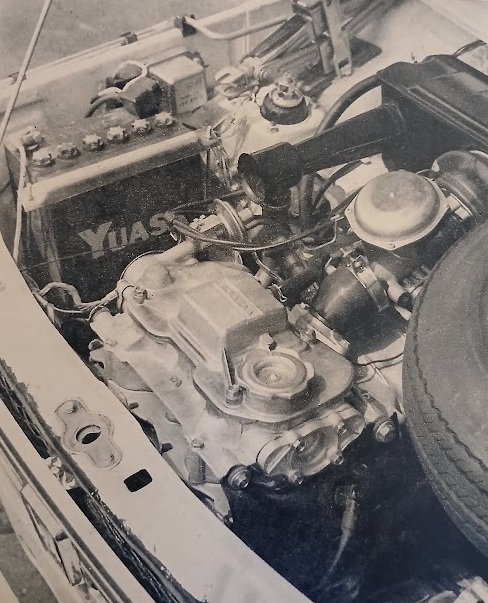
The forced-air-cooled, two-cylinder, OHC engine, with crossflow cylinder head and V-arranged intake and exhaust valves, looks almost identical to that of the N360. However, with a bore of 74mm and stroke of 69.6mm, displacement has been increased to 598cc, producing 43ps/6600rpm and torque of 5.2kgm/5000rpm. The basic construction, with engine, transmission and differential combined into a single unit, is unchanged from the N360, as is the arrangement of the half-shafts, with constant-velocity joints at the inner ends and double universal joints at the wheel ends.
The engine is installed at a forward inclination of approximately 10°, and I also noticed that its mounting arrangement has been revised. The rod connecting the cylinder head to the upper mounting of the front suspension strut has been eliminated, while the front engine mounting has been changed to an arrangement similar to that on the N360AT. This seems to have helped reduce vibration.
I did not measure fuel consumption precisely, so I cannot say for certain, but judging from the fuel economy figures on level roads, it would be reasonable to expect the N600 to consume about 10% more fuel than the N360. At a steady 100km/h on an expressway, however, I suspect the N600 might actually consume less.
Like the N360, the N600 uses an electromagnetic fuel pump, and the fuel tank beneath the rear-seat floor has the same capacity of 26 liters. Once the Tomei Expressway is open, it should be possible, with economical driving, to travel from Tokyo to Nagoya without stopping.
When driving the N360 at 80-90km/h with one’s hands off the steering wheel, a slight wandering tendency can be felt, giving rise to some uneasiness. The N600, however, showed no such tendency even at 100km/h, running with notable stability.
The day is fast approaching when a minicar of less than 600cc, with this much performance in reserve, will be able to travel from Tokyo to Kobe by expressway in around six hours. That the “highway age” should reach the lowest rung of Japan’s motoring market so quickly is something that would have been almost unimaginable in this country only two years ago.
The N600E is reportedly scheduled for production at 5,000 units a month, but by the time the Tomei Expressway is fully open, Honda will surely find it necessary to increase that figure.
Postscript: Story Photos