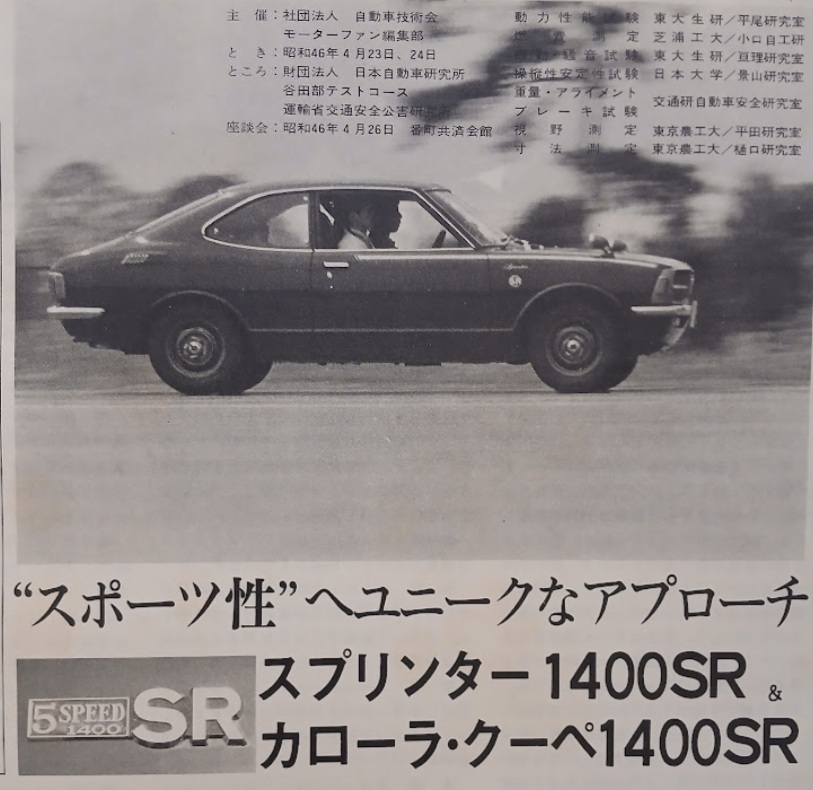
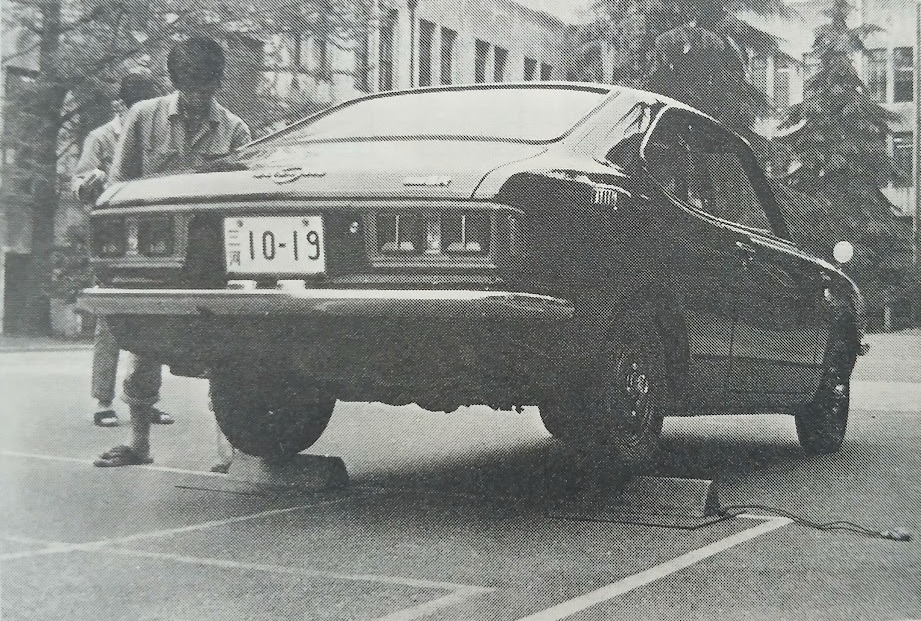
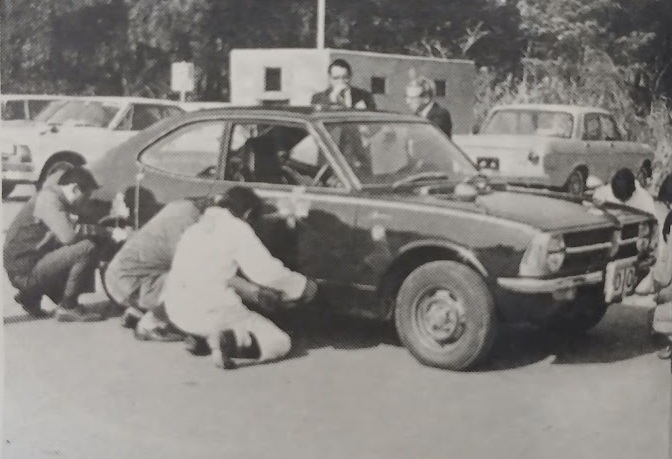
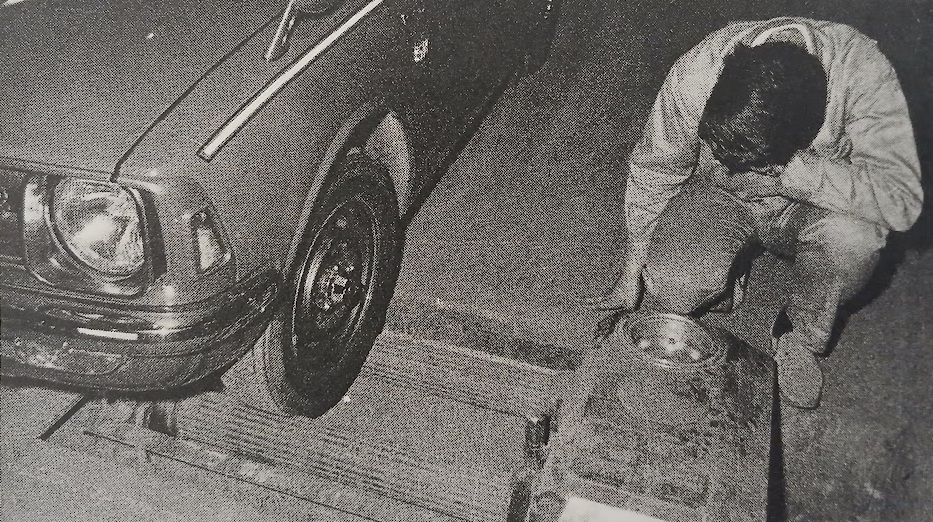
Toyota Corolla Coupe 1400SR and Sprinter 1400SR (1971)
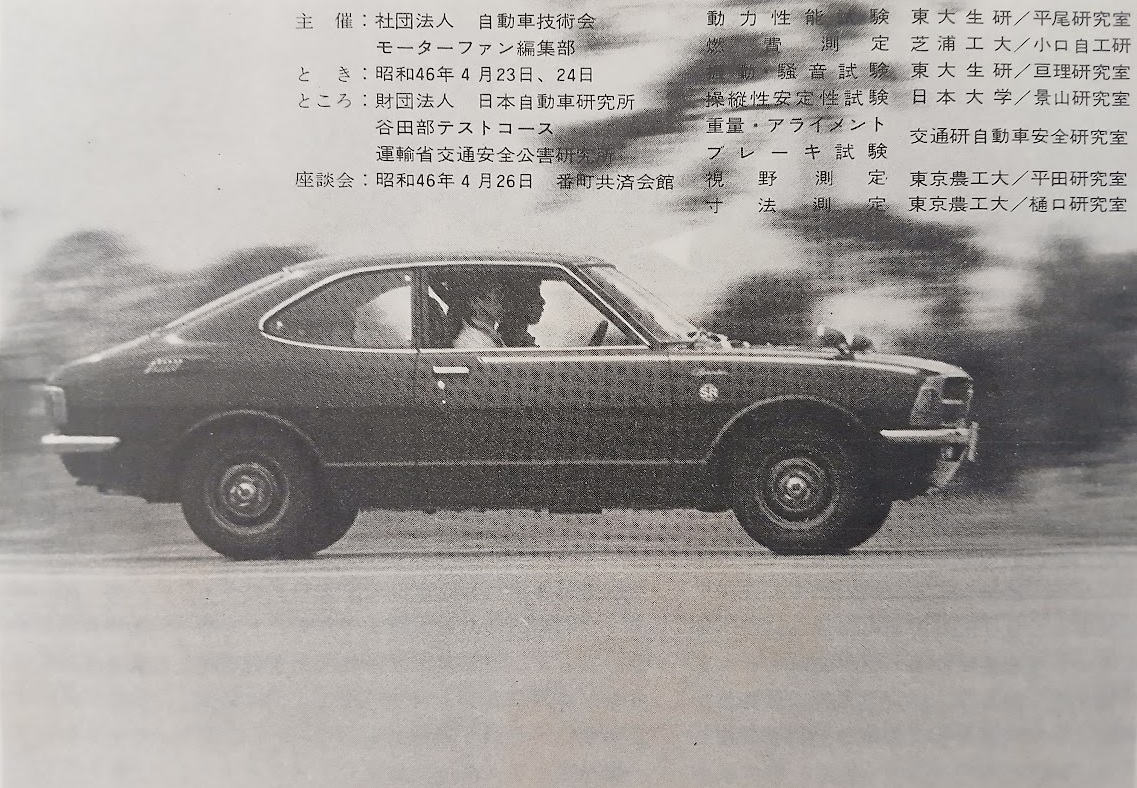
Publication: Motor Fan
Format: Road Test
Date: July 1971
Authors (Roundtable): Shiro Sasaki, Atsushi Watari, Shoichi Nishiyama, Osamu Hirao, Hiroshi Okazaki, Takahiko Kinoshita, Katsuzo Kageyama, Fumio Agetsuma, Kunitaka Furutani, Yasuhei Oguchi, Kenzaburo Ishikawa, Takeshi Toba, Minoru Onda, Kenichiro Noda, Motor Fan Editorial Staff (uncredited)
Is the Gear Ratio Too Low?
Magazine: To begin with, we’d like to ask about the development aims behind the 1400SR, and the kind of car you had in mind.
Sasaki: Last spring we carried out a model change for the Corolla, and in the autumn we introduced the 1400cc TE-series models. Now, as a further step, we’ve added new SL and SR versions to the Corolla/Sprinter line, powered by the twin-carburetor TB version of the 1407cc engine.
The new SL replaces the previous single carburetor with a twin-carb setup, raising output to 95ps at 6000rpm. In the SR, the same engine can be combined with either a 4-speed or 5-speed transmission. “SR” stands for Sports & Rally.
Within the Corolla/Sprinter range, the SL is, as the name suggests, the most sporting and luxurious model. The SR is essentially a version that places a stronger emphasis on the “S” (sport) character, while restraining the “L” (luxury) element.
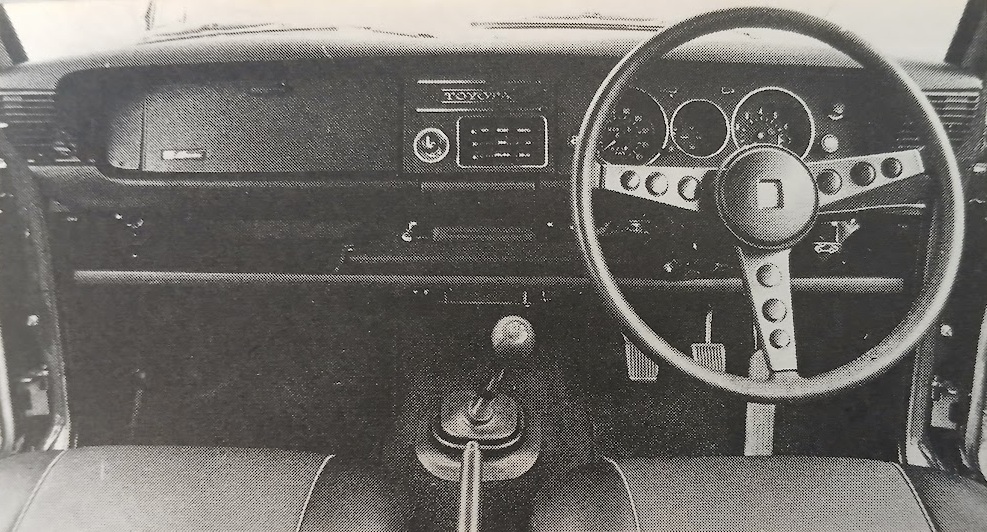
The 1400 twin-carb engine, 5-speed transmission, and disc brakes are all part of the “S” character. In addition, the suspension has been made firmer for this model, and radial tires are fitted as standard. The interior is unified in a black color scheme, including the steering wheel, and the exterior uses SR-specific wheel caps, moldings, and badging to give it its own identity.
The “L” element has been deliberately reduced in several areas. The SL uses heat-absorbing glass at the front, whereas the SR uses clear glass, and the amount of trim has been reduced. The console, radio, and rear window defogger have also been omitted. However, in consideration of rally use, laminated front glass and a rear defogger are available as options.
In terms of appearance, the SR also features dedicated side stripes, and special paint colors have been prepared exclusively for this model.
Magazine: The chassis has been changed quite a bit–could you go into the details?
Sasaki: First, the tires are radials. The suspension layout itself is the same, but the springs have been stiffened and the damping force of the shock absorbers has been increased. In terms of spring rates, the front coil springs have increased from 1.6kg/mm on the SL to 2.2kg/mm, and the rear leaf springs from 1.9kg/mm to 2.2kg/mm. The front stabilizer bar has also been increased in diameter, from 16mm to 19mm, to improve front roll stiffness.
Magazine: Was the suspension setup chosen to suit rally use? Or would further modification still be needed for rallying?
Sasaki: Actually, we’d like to hear your opinions on that… From a design standpoint, the previous setup had a relatively large difference between the front and rear spring rates, so we brought them closer together. When setting these spring rates, we actually had some of our younger staff act as a panel and tell us what they preferred.
That said, it’s not intended only for rally-style driving. It’s set so that even on rough roads in general use, it doesn’t feel overly stiff.
Our aim was a specification that would be appreciated when driving in a rally-like manner on routes like the Tomei Expressway or on winding roads.
Watari: The front setting seems about right, but at the rear, it might be a bit harsh on rough roads.
Sasaki: You mean the rear is too stiff?
Nishiyama: The bouncing frequency is about 1.65cps, and pitching around 1.5cps.
Watari: In that case, it should suit something like the Tomei quite well. But on mountain roads, when it starts to resonate, it could be tough.
Sasaki: We do have people competing in mountain rallies, so we measured times on mountain roads and selected the setup that gave the quickest results.
Hirao: Looking at how cars are driven in rallies, it seems the key points are spring stiffness and the amount of suspension stroke. If the stroke is too short, the car will get unsettled in corners. As it rolls in a corner, if the stroke runs out and it bottoms out two or three times, you lose cornering ability and the car gets thrown off line.
Roll itself is controlled by spring stiffness, but stroke—aside from cases of resonance—comes down to whether the dampers are doing their job, and ultimately to the road surface. So for rally use, you really need to decide what kind of road irregularities you’re designing for, and set the suspension stroke accordingly.
Sasaki: With five passengers aboard, the stroke is actually about 5mm longer than before.
Magazine: From the standpoint of stroke, wouldn’t coil springs have an advantage? In that sense, might it have been better to adopt something like the Celica/Carina suspension…?
Hirao: The Opel Kadett Rallye had rear coils, if I remember correctly. Though I’m not sure what its stroke characteristics were like…
Magazine: Were the gear ratios also designed with rally use in mind? They feel a bit different from other models.
Sasaki: The 5-speed transmission itself is the same as the Celica/Carina unit, but since we’ve adopted a 5-speed, we’ve raised the final drive ratio from 4.222 to 4.375. As a result, driving force in first through fourth gear is increased accordingly, while fifth is an overdrive—so engine speed is lower than in the top gear of a 4-speed.
Okazaki: Rough roads in Japan tend to have many tight hairpin-type sections. So raising the final drive may actually be working against it. As it is, the ratios are too low–first gear tops out too quickly, and in second there isn’t quite enough extension.
People who drive cars like this SR tend to prefer the feeling of extension at the top end rather than just strong pull at low speeds. From the perspective of real-world rallying, ideally you’d want first to reach about 50km/h and second around 90km/h. Personally, I think a 4.111 final drive might suit first and second gear much better.
Hirao: Yes, that sounds right.
Okazaki: As it stands, it only goes to around 40km/h in first and 70km/h in second. And unless you’re very careful with how you control it, you just end up with wheelspin, with the engine effectively hitting a ceiling.
Sasaki: At 6500rpm, first gives 45km/h, second 77km/h, and third 112km/h.
Okazaki: It may just have been the particular car I drove, but from around 5500rpm the engine seemed to lose its willingness to rev, and response dulled. I drove a Publica SR at the same time, and compared to that, this one felt a bit sluggish at the top end.
Hirao: It might be better to make 4.111 the standard, and offer 4.222 or 4.375 as options.
Magazine: Since it’s a 5-speed, it feels like it could even be set up with closer ratios.
Okazaki: Yes. Leaving aside the very top end, the engine’s power band is extremely flat. In that sense, a 4-speed with that final drive might actually feel quicker overall.
Hirao: If it doesn’t extend at the top, perhaps you’ve traded that for more low-end torque?
Kinoshita: The torque continues to build up to 6000rpm, so it’s a bit hard to understand why it would feel like it stops pulling from around 5000rpm…
The Merits of a 5-Speed Transmission
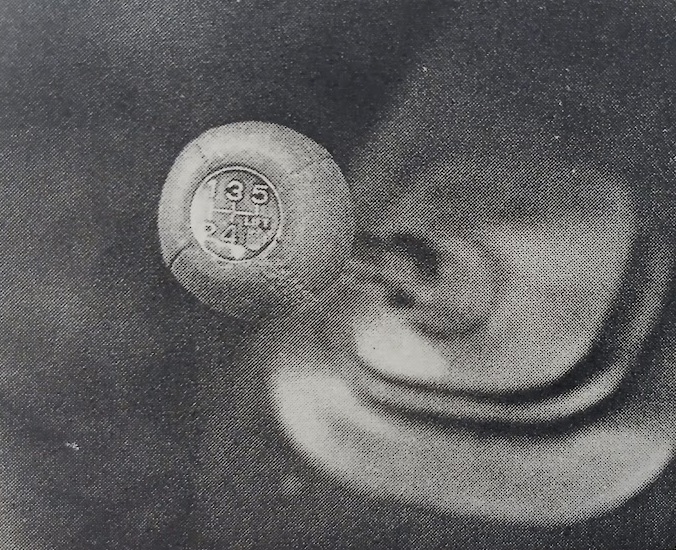
Hirao: Is this the standard shift pattern for a 5-speed?
Magazine: Yes, this is the most common layout.
Hirao: With 4-speeds, the position of reverse still varies depending on the manufacturer. That really ought to be standardized.
Watari: Torque-converter automatics have already settled into a common pattern, mostly by following overseas practice.
Hirao: As rental cars become more widespread, people are bound to select reverse by mistake now and then, so it would be better if its position were fixed.
Magazine: The 5-speed is one of this car’s key selling points…
Kageyama: I imagine we’ll be seeing more 5-speed cars from here on.
Hirao: Do you think so?
Watari: It depends on how the car is used. For those of us just driving normally, it’s actually easier to have fewer gears.
Hirao: If you’re planning to race, then sure—a 5-speed makes sense.
Sasaki: In racing, of course, it’s essential for making full use of the engine’s power. But generally speaking, people only enter rallies a few times a year. The rest of the time, the car is used for leisure. And on long-distance drives, people tend to pay attention to fuel economy. In that sense, the appeal of a 5-speed is that it can respond to a wide range of needs.
Hirao: I sometimes think the overdrive that used to be fitted to the Crown—the kind you could leave engaged, but still allowed kickdown—was a better solution. That sort of setup could be applied as a fifth gear.
Watari: Since this is a car you drive for enjoyment, having more gears isn’t really a problem. But that overdrive system was a good feature. It seems to have disappeared without much notice.
Hirao: Apparently it was expensive. From the manufacturer’s point of view, there may not have been much benefit to it—but from a user’s perspective, it was excellent.
Magazine: Though when it was engaged, there was a sense that engine braking was weaker.
Hirao: In that case, you could make the overdrive manually selectable.
Magazine: You do see that on some British cars.
Hirao: Exactly–just mount the switch on the shift lever. I think there are cars like that.
Sasaki: It also comes down to what kind of preferences people have when they choose a car like the SR…
Hirao: There’s something appealing about having five gears. That much I understand.
Sasaki: There does seem to be a strong element of people enjoying the shifting itself.
Hirao: Yes, I think that’s a big part of it.
In that case, if you gave it six speeds, would that be even more appealing? (laughs)
Okazaki: You probably wouldn’t use most of them.
What the Red Zone Really Means
Magazine: With 95ps from 1.4 liters, this is quite a high-output engine. Where have you focused the tuning?
Kinoshita: The main changes are the twin carburetors and a revised camshaft. Naturally, that brings changes to the intake manifold as well, and the valve timing has been set to improve high-speed performance. We’ve also made some revisions to the exhaust system to reduce muffler resistance.
We’ve raised the compression ratio as well, which gives about 9ps more than the T-type engine.
Magazine: It’s certainly a fairly high-power engine. In general, Japanese cars tend to emphasize high output–how do you see that?
Kinoshita: Why we pursue that level of power is, in a sense, more of a policy decision. This T-type engine uses a hemispherical combustion chamber, large valve diameters, and a crossflow intake and exhaust layout. Beyond that, we’ve paid close attention to reducing friction in areas like the pistons and crankshaft.
Hirao: As for why you’d want more horsepower–well, more is better, isn’t it? (laughs)
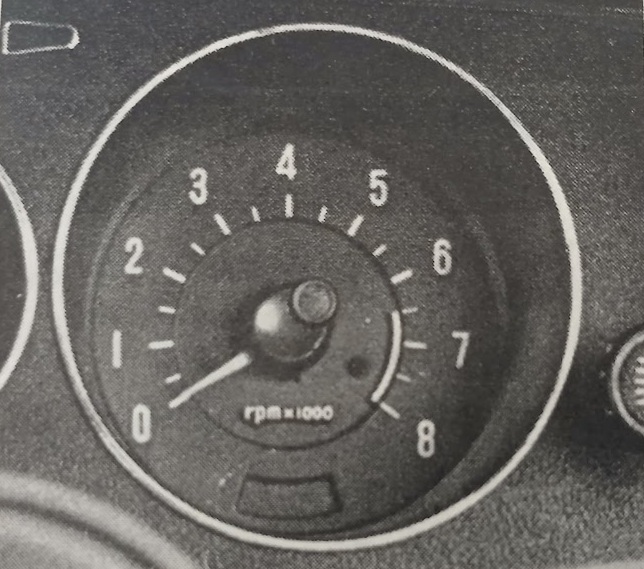
What is the maximum allowable engine speed?
Agetsuma: 6500rpm.
Hirao: There’s no yellow zone on the tachometer, only a red zone. Does that mean you’re not supposed to go into it at all? Or is it acceptable in some cases?
Kinoshita: We’d prefer that people not use that range…
Hirao: That’s what the red zone is, then. Below that, it’s fine for continuous use. But in that case, isn’t there a need for a warning zone?
Sasaki: We haven’t provided a separate yellow-zone range as such.
Hirao: Does that mean it’s not something you need to think about too strictly? Or that even a slight overrun could cause damage?
Sasaki: It’s difficult to define exactly where damage would occur, but in our testing we repeatedly cycle the engine up to and slightly beyond 6500rpm. In general, the red zone simply indicates that it’s better not to operate the engine beyond that point.
Hirao: For example, if you run continuously at 6500rpm, wouldn’t you start to see white exhaust smoke?
Kinoshita: That 6500rpm figure already takes such factors into account. In any case, engine rpm at the car’s maximum speed is lower–nominally around 6350rpm.
Hirao: If you keep running at high rpm, oil temperature rises, you start to get oil carryover, and the exhaust turns white. In other words, from a thermal balance standpoint, continuous use isn’t really feasible–but within the engine’s heat capacity, it’s still usable. That’s what I’d normally think of as a yellow zone.
But from what you’re saying, even this red zone would be acceptable as long as oil temperature is under control. The true “do not exceed” limit would be higher still. That makes a big difference in how the driver interprets it–whether it’s okay for the needle to just brush into the red under acceleration, or whether it must never enter it at all. As it stands, it feels like a slightly wasteful way to define the control range.
Kinoshita: However, power begins to drop off after 6500 rpm.
Hirao: It’s not just about power. If there’s still torque available, raising the allowable rev limit lets you hold each gear longer–right up to where the performance curves intersect–which improves acceleration. So if the permissible rev range were higher, overall performance would improve significantly.
If you have to shift at 6500rpm, that’s one thing—but if that point were a yellow zone and you could pull to 7000rpm, acceleration times would clearly benefit.
Magazine: For an OHV engine, 6500rpm is already quite a high limit, isn’t it?
Hirao: If the valves start to surge, then of course you shouldn’t be using that range. But if it’s a lubrication issue, then under certain conditions it might still be acceptable. It depends on the engine design–whether the bearings give out first, or the valvetrain fails first.
Agetsuma: In that sense, how wide do you think the yellow zone ought to be?
Hirao: I’d say it’s defined by what can be controlled from an oil temperature standpoint.
Kinoshita: In this case, oil temperature isn’t controlled that precisely.
Hirao: In that case, it goes straight from normal operation to the point of failure, doesn’t it? Even if the oil is fine, the bearings might give out first…
Kinoshita: Yes–mechanical failure would likely occur before anything else…
Outstanding Performance
Magazine: Let’s move on to the performance results.
Furutani: For standing-start acceleration, it recorded 0-50m in 4.4 seconds, 0-100m in 6.8 seconds, 0-200m in 10.7 seconds, and 0-400m in 16.8 seconds. In terms of time to speed, it recorded 0-20km/h in 1.3 seconds, 0-40km/h in 2.8 seconds, 0-60km/h in 4.7 seconds, 0-80km/h in 7.2 seconds, 0-100km/h in 10.5 seconds, and 0-120km/h in 14.7 seconds.
Earlier there was some discussion about the gear ratios being a bit too low, and during launch the tires are indeed slipping almost the entire time–proper traction only comes in for less than 0.5 seconds. It left me feeling the overall gearing might be better set slightly taller.
Magazine: It didn’t even reach 50m in first gear, did it?
Furutani: It was already in fourth by the 400m mark.
Oguchi: There’s still a bit of wheelspin even in second.
Furutani: About 0.6 seconds’ worth.
Hirao: That’s almost like an American car.
Oguchi: As Okazaki mentioned earlier, the initial acceleration off the line is very strong, but it seems to hit a ceiling sooner than expected. Because the low-end punch is so impressive, you naturally expect more at the top, which makes it feel like it doesn’t quite carry through.
I had the same impression myself.
Magazine: Even so, 16.8 seconds is a very quick time.
Hirao: Going by what we’ve been discussing, making the final drive a bit taller might actually improve the time further. You’d get better pull through both first and second.
Magazine: Since it requires a shift all the way up to fourth, there’s that extra time loss to consider…
Hirao: Shift loss is probably around 0.4 to 0.5 seconds. So if it could run through in third, the time would likely improve.
Heavy Accelerator Pedal
Magazine: The accelerator felt a bit heavy, didn’t it?
Furutani: Yes, it is heavy.
Hirao: On the first drive, if you didn’t stall it when pulling away, you deserved praise. (laughs)
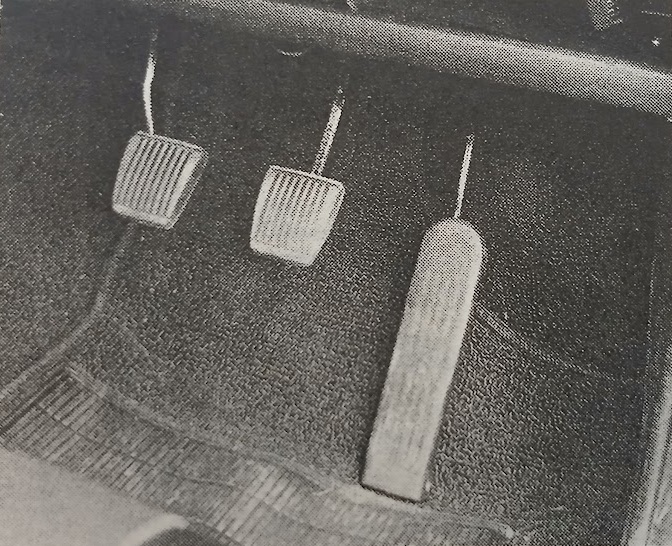
Ishikawa: The accelerator is 4kg at initial tip-in, 4.5kg under acceleration, and 2.5kg at steady throttle, so overall it’s fairly heavy. And in line with that, the clutch, brakes, everything is on the heavy side. The steering felt heavy as well.
Hirao: Initial tip-in is about twice the effort you’d normally expect. Is that better for rally use?
Okazaki: The steering being a bit heavy is probably fine, but throttle control on rough roads is very delicate. With this setup it gets difficult–you tend to end up applying too much throttle.
Hirao: I see. If you’re trying to make precise adjustments quickly, it’s probably hard to manage.
Okazaki: For ordinary drivers, especially on corner exit, it probably just leads to excessive wheelspin, and the car just not pulling forward.
Hirao: This is just a theory of mine, but control is easiest when the force you apply matches the weight of the part you’re moving with your hand. So with the foot, if you’re operating with the heel on the floor and the toe controlling the pedal, then the ideal would be a force matching the weight of the foot from the ankle down. That’s probably the most natural balance. It’s impedance matching between force and resistance.
Magazine: Roughly how much does the human foot weigh from the ankle down?
Hirao: About 1kg, I’d say. So 1-1.5kg, maybe up to 2kg at most is about right. But this is 4kg–so it’s roughly double.
Sasaki: If the accelerator is too light, that can be tiring as well.
Hirao: Yes, even 500g would be fatiguing. But 4kg is clearly too heavy. Toyota cars are all heavy in that respect. Maybe there’s someone there with very heavy feet. (laughs)
Watari: It feels like Toyota and Nissan have swapped philosophies when it comes to pedal feel.
Sasaki: Mechanically, it’s because there are two carburetors rather than one, so there’s more resistance in the system.
Hirao: A light accelerator with a short stroke gives a feeling of liveliness. If it’s heavy, it all feels sluggish.
Okazaki: Still, it’s really the initial resistance that stands out. The mid-range isn’t as bad.
Hirao: That’s exactly it.
Sasaki: Drivers used to a single-carb setup will find this quite heavy at first, but you get used to it…
Hirao: As you say, you get used to it. But if it really had to be lightened, then like the clutch, you could use hydraulics to reduce effort. Bicycle hydraulic brakes, for example, have excellent efficiency.
Sasaki: The clutch on the 1400 series is hydraulic, while the 1200 uses a cable. With hydraulics, you get losses from master and slave cylinder pressure and friction, so in some cases the cable system ends up lighter. On this car, our internal measurements show about 13-14kg at full clutch depression, which is typical for hydraulics. The 1200 is less than half that, at 7-8kg. With a cable, you do get wire friction, but it can still come out lighter than hydraulics.
Hirao: So maybe there are just too many springs in the system overall. There may be reasons for it, but it feels like springs have been added everywhere.
Sasaki: They are only used where necessary, of course.
Hirao: Still, why put springs in all these places?
Sasaki: The accelerator and brake both need dual redundancy…
Interior Noise Down by 2 Phons in 5th Gear
Magazine: Next, let’s have the vibration and noise results.
Watari: Regarding suspension vibration frequency, I think this is roughly where we’d expect it to be. There’s always a bit of a problem in trying to satisfy both high-speed expressway comfort and rough-road compliance at the same time. Given the character of this car, there’s also the question of keeping roll in check by setting it a bit firmer…
As for noise, the measurement conditions differ this time, so please take this as reference data, but on average, I don’t think it’s particularly noisy for this class.
Nishiyama: We recorded 66 phons at 40km/h, 71 phons at 60km/h, 72 phons at 80km/h, 75 phons at 100km/h, and 81 phons at 120km/h.
Magazine: Those are fourth-gear figures, correct? How much does it drop in fifth gear?
Sasaki: Since fourth gear is direct and fifth is 0.861, engine speed drops by about 14%. In terms of noise, below 80km/h there’s almost no difference between fourth and fifth. But between roughly 80-120km/h, fifth gear is about 2 phons quieter.
Oguchi: There’s rubber at the base of the shift lever, so there’s almost no vibration coming through. Engine-related vibration feels relatively well isolated. But in terms of noise… I’m not sure if it’s exhaust or intake-related, but there seems to be a slight change in character in fifth gear.
Sasaki: At about what speed?
Oguchi: Around 60km/h.
Watari: So that may be a peak effect showing up.
Hirao: 60km/h in fifth gear would be around 2200rpm. That’s right in the normal cruising range.
Magazine: Let’s please have the fuel economy results.
Oguchi: On the day of the test there was quite a strong wind–around 6m/s–so we measured runs in both directions and averaged the results.
In constant-speed testing, the figures were: 19.6km/l at 40km/h, 19.6km/l at 60km/h, 17.0km/l at 80km/h, 14.9km/l at 100km/h, and 12.9km/l at 120km/h. These were all in fifth gear.
In the model driving test, since we used up to fifth gear, the driving felt a bit sluggish, but at a 40km/h target speed the result was 12.5km/l at an average speed of 21.4km/h, and at a 60km/h target speed it was 10.3km/l at an average speed of 25.6km/h.
Magazine: How do the figures in fourth compare with fifth?
Agetsuma: According to in-house data, at 60km/h it’s 20.1km/l in fourth and 21.0km/l in fifth. At 100km/h it’s 14.5km/l versus 15.9km/l.
Hirao: So the effect of fifth gear shows up more clearly at higher speeds.
Watari: The steady-speed fuel economy shows a slightly larger drop at high speed.
Oguchi: With a twin-carb setup, this is about the normal range. The 40-60km/h band is very consistent, so it’s actually quite decent even in urban driving.
Hirao: How about exhaust emissions? At this point it’s only CO data…?
Kinoshita: CO is 1.3% in our internal measurements.
Well-Planted Suspension, with Some Nervousness
Magazine: Let’s have the results for handling and stability.
Toba: The minimum turning radius is 4.99m at the outer wheel, which is about what you would typically expect from the wheelbase.
The overall steering gear ratio is 17.7. Stationary steering effort at full lock is a little on the heavy side. Around 360°, it’s about 14-14.5kg, and at around 600°, roughly 17kg.
In the understeer/oversteer test, there is mild understeer up to about 0.4-0.45g of lateral acceleration, but beyond that the understeer becomes considerably stronger. I think this may also have been influenced by the skid pad surface.
Roll angle, by photographic measurement, comes out at 4.7°.
Straight-line stability tests with hands off the wheel were carried out up to 120km/h. Because the lateral g from steering input during this test was rather high, the results come out showing something of an unsettled feel, and I had a similar subjective impression as well.
Magazine: The catalog figure for the gear ratio is 18.1, isn’t it?
Sasaki: The catalog figure refers to the ratio of the steering gearbox itself.
Toba: Normally, the steering gear ratio is such that the overall ratio comes out larger, but in this case it’s the opposite.
Hirao: What is the lock-to-lock figure?
Toba: About 3.3 turns.
Hirao: That’s quite a quick ratio. That may be part of it. It gives a slightly unsettled feeling… Even a small steering input seems to result in a fairly large actual change in direction.
Kageyama: Even though the suspension is set fairly firm and the stabilizer is thicker, when you actually drive it, it still feels like it rolls quite a bit.
Toba: In this class, for reference, the roll angle for the Sunny Coupe GL is 4.5°, the Honda 1300 Coupe 9 is 4.6°, and the Cherry Deluxe is 5.5°, so it is not particularly large.
Hirao: How high is the center of gravity?
Sasaki: 505mm.
Watari: That’s not particularly high.
Magazine: The Yatabe skid pad’s mu seems a little low.
Kageyama: Yes, that’s true. However, we were able to keep running even above 0.6g this time, so I think the tires must have quite good grip on that surface.
Hirao: Is that due to the tires being radials?
Kageyama: I think so.
Sasaki: It is partly because they are radials, but I also think the front–rear distribution of roll stiffness plays a role.
Hirao: That may be so. After all, the front stabilizer has been stiffened.
Okazaki: In terms of handling, within what you might call the town-sports category, I think this is a very good car. But if you look at it from a rally standpoint, the feeling is that the springs are doing more of the work than the dampers. I feel it could use a bit more damping.
In particular, at higher speeds the front tends to go into full bump travel quite easily, and while rear grip is good, when it does break away, I’d like a more positive recovery at the front. With better damper control, I think it could even handle special stages.
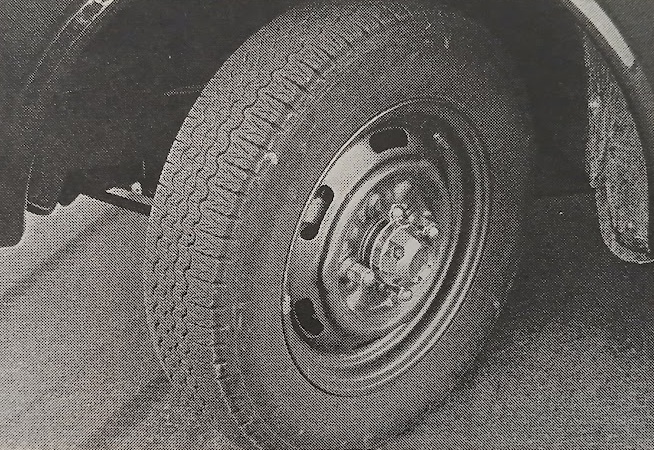
Also, the radial tires don’t seem suited to rough surfaces. They’re really more of a paved-road type tire–sort of a compromise, depending on how you look at it.
Sasaki: In that sense, the radial tire choice is primarily based on paved-road use being the standard. But tires can be replaced, and if someone is going to enter rallies, they would change to a tire suited for that purpose.
Okazaki: I don’t think anyone would enter a rally with it as it is…
Hirao: Would they even change the shock absorbers?
Sasaki: Our thinking is that damping should be matched to the spring rates as a basic principle, and tires can then be changed accordingly. As for damping force, you mentioned it may be a little low. I don’t think it is underdamped in the low-amplitude range or at low speeds. However, in larger amplitude situations, I also feel it could use a bit more damping force.
Magazine: So in that sense, it’s more of a paved-road-oriented car…
Okazaki: From a general standpoint, it is also quite capable on dirt roads.
Magazine: Is the heavy steering at full lock due to the tires?
Sasaki: Yes, that’s right.
Hirao: The contact patch load per unit area has a strong effect on steering resistance. Radial tires are good in that the load is distributed more evenly across the contact patch, but the downside is that steering becomes heavier.
Ishikawa: Is there a rally specification option?
Sasaki: Rather than a full rally specification, we offer a sports kit through dealer sales channels.
Braking Force Rises with Pedal Effort
Magazine: Please give us the results for weight, alignment, and braking.
Ishikawa: Vehicle weight is 846kg with a full tank of fuel (45 liters). Front-to-rear distribution is 57:43, and with five occupants on board it shifts to about 50:50.
As for alignment, camber and toe-in are both set small, and changes under load are minimal.
The brake system uses front discs and rear leading-trailing drums with a proportioning valve. The pedal effort required for initial “bite” is a bit high: 4.5kg for the front brakes, and 7kg for the rear. On most disc systems, you’d expect initial response around 1kg, so it is somewhat on the heavy side.
Pedal force for 0.6g deceleration is about 39kg, which is quite heavy. The proportioning valve starts to work at around 25kg pedal force, or roughly 0.4–0.45g deceleration.
Brake balance is about 65:35 at 25kg pedal force, and shifts to roughly 70:30 at 0.6g deceleration. There is no imbalance–the front and rear are well matched throughout.
Magazine: How does it feel in actual use?
Ishikawa: The pedal has a firm, heavy feel.
Hirao: Toyota brakes are all on the heavy side.
Magazine: In an SR, maybe the idea is braking that builds progressively with pedal force.
Sasaki: It’s a tandem master cylinder system, so pedal effort does come out a bit higher.
Hirao: Even so, it’s not really something to complain about at that level.
Oguchi: Since this is a performance-oriented car, a slightly heavier feel is probably appropriate. And compared with other controls on the car, it’s not out of place. You get used to it quickly. That said, this is subjective, but the pedal arm felt a little on the delicate side. Not that anyone would actually bend it…
Watari: Without servo assistance, that kind of feeling is fairly typical.
Oguchi: Under SAE test code, the allowable pedal force is up to 90kg… though someone with strong legs could probably reach that.
Hirao: If you really stomp on it, you can hit 180kg. People weigh 100kg or more, so if you pressed hard with one leg, you could easily exceed 90kg.
Ishikawa: Japanese safety regulations specify 120kg.
Sasaki: Our brake testing is conducted up to a 120kg pedal load.
Okazaki: On American freeways, in multi-car pileups, people must be stomping on the pedal with everything they’ve got.
Magazine: The effort to pull the reverse lockout for shifting into reverse is 13kg?
Okazaki: The perceived effort changes depending on technique. Once you’re used to it, it slots in cleanly.
Magazine: So again, it comes down to getting used to it. (laughs)
Ishikawa: In the end, as long as there are no misoperations, a bit of heaviness isn’t really a problem.
The Position of the SR
Magazine: Please give us the dimensional measurement results.
Onda: To state the conclusion first, there is almost no difference from the 1200 in terms of dimensions. The SR’s character is expressed through accessories and the way the interior is packaged.
The main exterior differences are the radial tires, and a slightly lower overall height and ground clearance.
The interior dimensions are exactly the same as the 1200.
The equipment differences seem aimed at distinguishing it from the SL, or rather, giving it a specific character. The pedals are the same, as are the gauges. The only addition is a choke knob.
Overall, rather than being a car intended for actual rally use, the SR feels more like a model positioned just below the top-grade SL.
Hirao: “Rally” is really just another way of saying “sports,” isn’t it. And “sports” doesn’t mean it’s only used for sport–you’re driving it normally most of the time anyway.
Onda: It’s more of a model-line variation from a marketing standpoint.
Sasaki: The SL is the top model, but the SR emphasizes the “S” (sport) character more strongly. Price-wise, it’s almost the same as the SL.
Noda: The twin-carb, 5-speed SL is ¥659,000. The SR is ¥644,000, which is the same price as the 4-speed twin-carb SL. (Tokyo showroom price)
Hirao: Cars like this are becoming popular in Europe, aren’t they?
Magazine: Is the SR only for the domestic market? Or are you considering exports?
Sasaki: Domestic only.
Magazine: What is the current production scale of the Corolla/Sprinter line?
Noda: The peak so far, for passenger models alone, is 45,686 units per month (October 1970).
Magazine: And how many of those are Sprinters?
Noda: About 6,000 units. The SR, across Corolla coupes and Sprinters combined, would be a little over 1,000 units.
Hirao: Does it offer any “easy-drive” convenience features?
Noda: No, it doesn’t.
Onda: In terms of safety, it earns points for features like laminated front glass and a heated rear window–both optional–and a collapsible steering column. With those, it scores 87 out of 100.
Magazine: That’s all for now…
Postscript: Story Photos