Toyota Sports 800 (1965)
Publication: Motor Fan
Format: Road Test
Date: June 1965
Authors (Roundtable): Tatsuo Hasegawa, Shozo Sato, Kazuo Kumabe, Osamu Hirao, Mineo Yamamoto, Masatoshi Yoshida, Yasuhei Oguchi, Atsushi Watari, Kenji Higuchi, Taizo Tateishi, Masashi Kondo, Kenzaburo Ishikawa, Tenji Kobayashi, Motor Fan Editorial Staff (uncredited)
Even Though It is Small…
Magazine: With the release of the Toyota Sports 800, Toyota has finally entered the sports car segment. Could you please explain the aims and thinking that went into designing this car?
Hasegawa: The common concept of a sports car is that it is something that needs a powerful engine, a unique suspension, and a lot of horsepower to force its way to high speeds. However, this is not a racing car with a top speed of 200km/h or more, but rather, it is what is now being called a “100-mile car,” designed to run continuously at high speeds of around 160km/h to 170km/h. To meet these aims, it does not need to be a highly specialized car with a high horsepower engine, but can be designed rationally by reducing air resistance and weight.
With this in mind, we bored out the Publica’s engine to 790cc, increased the compression ratio to 9.0:1, and made other improvements to increase its horsepower to 45ps. By putting it in a lightweight sports-type body, we succeeded in creating a high-speed car with a top speed of 155km/h. This gave us confidence that our original idea was not wrong.
Comparing this car with other sports cars, the data is quite interesting.
If you compare the maximum horsepower versus maximum speed of 22 domestic and foreign sports cars, you will see that, with the exception of the Fiat Abarth 1000 and Lotus Elite, the maximum speed increases linearly as the maximum horsepower increases. However, this car, like the Panhard CD, Glas 1300GT, and MGB, sits somewhat above the line, surpassing the standard.
Also, if you compare engine volume versus maximum speed against cars in the same cc class, the Toyota Sports 800, while not as good as the Fiat Abarth 1000 and Elite, again surpasses the standard.
Finally, if you compare horsepower per liter as a function of engine speed, this engine makes its maximum output at 5400rpm, and the horsepower per liter is 57ps/l. This is not inferior to engines that produce peak power at a similar speed.
From these comparative studies, we believe that by simply creating a lightweight body with low air resistance and improving the engine, we were able to create a fairly high-performance sports car. Also, since we were able to use basic Publica components for everything apart from the body, there were many advantages in terms of economics, allowing us to offer a mass-market price (595,000 yen) that not only enthusiasts, but many people can easily afford.
All-Weather Roof
Magazine: The body is not a fixed-roof hardtop. Can you tell us more about that?
Hasegawa: Without a hardtop, it is more difficult to reduce air resistance, but I think there is a demand for the feel of an open-top car. There are a few convertible-type cars in Japan, but they all have practical drawbacks in all-weather use, such as being vulnerable to cold winters, rain, and dust.
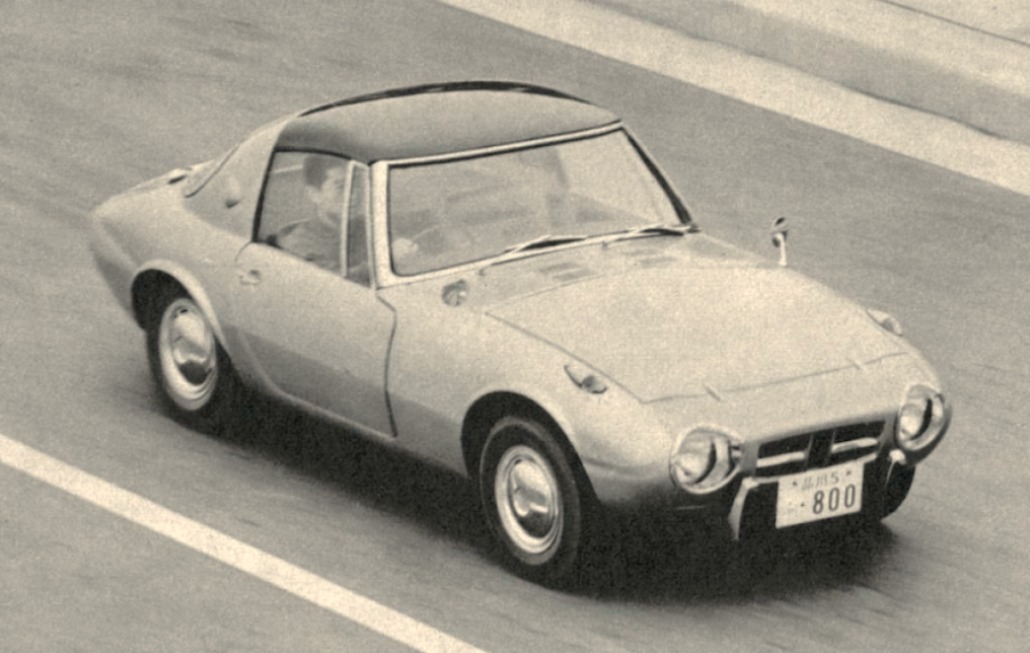
So, with this car, we decided on a removable roof. When the roof is attached, air resistance is reduced and the car can perform to its full potential. When it is not wanted, the roof can be detached with a few simple bolts, allowing you to enjoy the open-top feel. This is not to say that the setup is without problems, but it allows us to meet customers’ needs while addressing the issue of all-weather usability.
Magazine: Could you tell us about the difficulties faced by Kanto Jidosha Co., Ltd., which actually manufactures the body?
Sato: Two years ago, we built a prototype car, the Publica Sports, which can be said to be the predecessor of this car. It used a canopy-type roof where the entire upper part of the body slides back and forth. Toyota’s request to Kanto Jidosha Co., Ltd. was to make a commercially available sports car that was not too different from the Publica Sports.
Regarding the problem of air resistance, we conducted wind tunnel tests using both the prototype and the commercially available car, and the results for the new car were somewhat better. We also applied tape strips to the body and observed how the wind flowed over the car while driving. Because of the canopy-style roof, the prototype had guide rails along the sides of its body. These disturbed the air flow, and since the production car has adopted normal doors, it has actually improved in this area.
Also, Chief Engineer Hasegawa requested that we make the body surfaces as smooth as possible. A streamlined shape, in other words. He asked us to avoid any unevenness, so we struggled with the placement of the headlamps and taillamps, in particular. We couldn’t simply mount them on a vertical surface as usual, so we spent a lot of time before arriving at the current design.
Also, in terms of the aerodynamic shape, we found that the shoulders of the bonnet needed to be made a little larger and rounder than on the prototype, so we rounded them further. I think cars with a cross section this round are quite rare.
In terms of weight reduction, we designed the body so that there was almost no wasted space, with not even 1cm to spare. It is unlikely that the front or rear overhangs could possibly be shortened any further. In any case, we made the body as close-coupled as we could without encroaching on interior space. In fact, the interior space is quite comfortable.
Also, as we discovered later, there are FIA standards that require a minimum distance from the lowest point of the seat to the windshield in the vertical direction. As a result, after the car was practically finished, we had to raise the windshield slightly. Since the scuttle is lower compared to the prototype, though, it doesn’t look like such a big change.
Bore Diameter Increased by 5mm
Magazine: In terms of the technical content, what are the most important features of this car?
Hasegawa: Starting with the engine, the Publica’s 700cc engine had a bore of 78mm, but we enlarged it to 83mm, giving it a total displacement of 790cc. As a result of the bore-up, the cylinder head, piston rings, and other components have been changed.
Also, we changed the carburetor to a twin type, so the intake manifold has also changed. To increase overall strength, the valve springs, crankshaft, main bearings, and bearing metal have been reinforced.
The clutch has also been strengthened, and we took measures to prevent oil leakage in the transmission. The second and third gear ratios are both one tooth higher than standard, making them so-called close ratios.
The propeller shaft has been shortened and uses a Hooke-type universal joint. The differential ratio and breather relationship have been changed on the rear axle.
The suspension springs are stiffer overall, and while the steering system itself has not changed, the post angle and the alignment are different.
For the gear lever, we switched to a remote-controlled floor type. The tires are the same, but the pressure is increased.
Kumabe: Is there any problem with the strength of the Publica engine after being bored up?
Hasegawa: There is no problem in terms of the margin for bore-up, but the pistons of the sedan couldn’t be used as-is, so we changed the size and reinforced them. Having done that, we have no particular concerns about the strength of the engine.
Kumabe: For a bore diameter increase of 5mm, were no other changes needed?
Hasegawa: Fortunately, the crankcase and other parts were designed from the beginning with this kind of upgrade in mind, so we only had to change a few details. In the end, the cylinder mounting section has changed, but the basic structure is the same as the 700cc unit, with only minor modifications. Also, the shroud that covers the cylinders and guides the cooling air was able to be used as-is.
Better Fuel Economy Than a Light Car
Kumabe: What is the carburetor design based on?
Hasegawa: It’s what’s known as a Carter type, but it’s made by Aisan, and it’s basically the same as the sedan’s. However, the venturi, the mechanism for the twin-carb setup, and the jet system have changed.
Kumabe: How is the fuel economy?
Hasegawa: We didn’t expect this from the beginning, but it’s so good that it’s a bit of a problem. That is, it may be better than that of the sedan. According to data from the Ministry of Transport’s certification tests, the running fuel economy is 31km/l, and the constant-speed fuel economy is 34km/l. In other words, it’s better than a normal light car. It may be a bit off the mark to advertise good fuel economy in a sports car, but to give a real-world example, when driving on a typical road at 60km/h in top gear, the engine speed is around 2000rpm, which is very low. When combined with the low air resistance, and the light weight that comes with being a two-seater, it seems that various factors have led to this unexpected result.
Another thing we noticed is, when you’re driving down the road and try to coast to an intersection that’s approaching in the distance, the car just keeps on rolling and doesn’t stop. The coasting coefficient of the sedan is 0.0019 or 0.002, but in this car it’s 0.00155, which is very low.
Hirao: In addition to that, the tire pressures are higher. You’ve also increased the cylinder volume and raised the gear ratio, and all these things contribute to better fuel economy. So it’s only natural that the figures have improved.
Kumabe: Also, when you open the hood, this car’s engine is clean. Other Japanese cars often have oil leaks or are covered in dust, but this one is really clean.
Hirao: With this type of cylinder arrangement, it’s probably easier to arrange the twin carburetors neatly.
Kumabe: It would be nice if twin carburetors were installed more often, even on normal sedans. It would be a little more expensive, though…
Hasegawa: When it comes to fuel economy, people generally think that twin carburetors consume more fuel, but that’s not necessarily the case.
Hirao: Well, that’s assuming you can keep them both properly adjusted, but the problem is that can be quite difficult.
Lightweight Without Sacrificing Rigidity
Yamamoto: The vehicle weight is 580kg, which is very light. What kind of reinforcements have been done to ensure adequate strength?
Hasegawa: In fixed-roof type hardtops, the roof contributes to overall body rigidity, which helps a great deal. However, with this car’s removable roof, we couldn’t rely on that, and we struggled with it up to the very end. Considering this handicap, achieving 580kg was the reward for our efforts, but it is by no means a figure we’re satisfied with.
Structurally speaking, the front frame is similar to the sedan’s, but where the sedan’s is bolted on and detachable, it’s permanently attached on this car. Given the more specialized use of this car, we thought that we didn’t necessarily need to prioritize ease of servicing as much.
Also, light alloys are used for the bonnet and trunk lid. In any case, simply making the car as compact as possible was probably the biggest factor in reducing the weight. For a car of this class, a 50kg reduction in weight can make a difference of one second in 0-400m acceleration. That was why we reluctantly used acrylic material for the rear window and other parts.
Yamamoto: What type of light alloy did you use?
Yoshida: It’s aluminum, equivalent to JIS standard A2T1.
Yamamoto: What about the sheet metal, how thick is it?
Yoshida: The steel panels are generally 0.9mm thick, but it is thicker in areas where strength is required. The only parts we can really rely on structurally are the side rails. We struggled with the design of how the front and rear body sections are joined at both ends.
Hasegawa: With an open-top car, the cowl tends to flex sideways. Specifically, the instrument panel area. We had a hard time getting rid of that.
Yoshida: In the end we used reinforcing pipes. In terms of reducing the weight, even the seats helped. Both the driver and passenger’s seats weigh less than 13kg combined.
Acceleration Performance You Wouldn’t Expect From 800cc
Magazine: Now, here are the results of the power performance tests….
Oguchi: Looking at the standing-start acceleration in terms of time to distance, the results were 11.9 seconds for 0-200m and 18.8 seconds for 0-400m. These are excellent figures that you wouldn’t expect from an 800cc class car. Since the overall reduction ratio in third and top gear is small, we measured overtaking times by accelerating from around 20-30km/h in third gear, and 30-40km/h in top gear. From 30km/h in third gear it took 19.6 seconds to reach 100km/h, and from 40km/h in top gear it took 31.9 seconds.
As for the time spent in each gear during through-the-gears acceleration, low gear is used for 3.6 seconds and second gear for 4.2 seconds. We didn’t shift into top gear in the acceleration run, we just carried through to the end in third.
Up to now, we’ve conducted our Motor Fan tests with three people on board, but this car is a two-seater, so we only had two on board, plus the weather was good, so the conditions were very favorable. Even so, the acceleration performance is very good.
Sato: How high did you take the rotation speed in each gear?
Oguchi: We pulled it up to about 6000rpm.
Hasegawa: As far as the number of passengers goes, having one fewer person makes about a one-second difference in the 0-400m time. Even so, the time was slower than our in-house data, by 0.4 seconds…
Hirao: In-house figures are the peak numbers. A 0.4 second difference is fairly routine. Also, the test load was 137kg in total, with the driver at 57.5kg, the passenger at 68kg, and the test instruments at 11.5kg, so the weight was probably a little heavier.
Watari: The other day, during a test drive, the speedometer reached 130km/h before we exited a certain tunnel. Other cars don’t usually pick up that much speed at that spot, so the acceleration is certainly impressive.
Oguchi: On the subject of the speedometer, in most cars, the speedometer shows a higher reading than the actual vehicle speed. In this car, the actual vehicle speed was higher.
Watari: So, that means it actually went over 130km/h. But we need to tell people who buy cars like this that they can’t use top gear in the city. It seems like even 60km/h is a stretch. This is what the tachometer markings are for, but it would be safer if the speedometer also showed the range of use for each gear.
A “Husband’s Spec” We’d Like to See
Hirao: Along similar lines, I think it would be good to offer a “husband spec” model as well. I think it would be well received if the springs and gear ratios were left the same as the sedan, and sold as an option to people who won’t be going to Suzuka or places like that. With the current spec, which seems aimed at appealing to as many people as possible, drivers who prefer a more serious sports feel are going to find certain aspects lacking. For example, the rigidity of the steering. Given the stiffness of the springs and the acceleration, I think enthusiasts will be dissatisfied with it. I mean, the rigidity in the direction of turning the steering wheel.
Watari: It’s the same with the feel of the brakes; it’s not their effectiveness, but the touch that is too soft. Sports-minded drivers would be happier if they were a little firmer.
Hirao: For people who want to go racing, yes. I think it would be better to increase the rigidity of the steering and make the lock-to-lock two and a half turns at most. So, in terms of specifications, for people who want to go racing, take the current spec and increase the rigidity of the steering and brakes to match. And for the husband’s spec, the current steering and brake feel are fine, so use softer springs and a more relaxed gear ratio for easier driving and a more comfortable ride. I think it would be good to offer a choice of these two options.
Watari: Then there’s the shift lever. It has good mechanical feel and precision, but the 1-2 gate and the 3-4 gate are spaced a little too far apart. With a normal shift lever, when you shift out of second and push forward from neutral, it will naturally go right into the third and fourth gate. That one doesn’t. You have to guide it there yourself. I think the spacing should be about half of what it is now.
Higuchi: The shift and select efforts are about the same, too.
Hasegawa: There was a lot of discussion about whether we should use a return spring on the select plane, but in the end, we decided it wasn’t necessary…
Watari: I don’t think it’s strictly necessary, but the spacing of the H-pattern really should be tighter. It goes into gear so nicely, it’s a shame to have such a wide gate… Another thing is the rearview mirror inside the car. Something should be done about this too. Because the mounting point on the dashboard is low, the mirror is necessarily angled up, so all you can see is upwards. If you adjust it down, the bottom edge of the rear window intrudes on the view. You can’t see behind properly unless you crane your neck. This wouldn’t require any new parts, you could just put a spacer underneath it, like it’s wearing a little pair of geta.
Sato: The points you mentioned have certainly been challenges for us, but I think we’re getting there. We’ll continue to look into it.
Slight Understeer Continues Until the Limit
Magazine: We didn’t conduct fuel economy tests ourselves this time, so we’ll post Toyota’s data in a separate table. Next, what was the vibration and noise data like?
Watari: I think the values are normal for a commercially available sports car. The bouncing frequency was 1.6 times per second, or 96 times per minute, at the front, and at the rear it was 1.8 times per second, or 105 times per minute. Driving in the city, it doesn’t feel too bad. I think the low center of gravity helps. As for the sound level, the mounting parts of the test car’s roof weren’t fitting properly, so we’ll use Toyota’s in-house data as a reference.
Tateishi: The sound level rises gradually to 84 phons at 90km/h, so there’s nothing particularly special to say about it. However, in terms of numerical values, it’s a sports car, so the general noise level is 5 to 10 phons higher than a passenger car.
Watari: The higher noise level is also partly due to the fact that one extra gear is turning between the transmission and the drive axle.
Hirao: As mentioned, it’s a sports car, so there’s no need to try to suppress the quantity of sound, but in terms of sound quality, I’d like the exhaust note to be better. In this regard, the number of cylinders matters…
Magazine: How about the maneuverability and stability tests?
Kondo: Due to constraints at the laboratory, we were only able to do simple tests without using residue-marking equipment, but in the oversteer and understeer tests, it maintained mild understeer up to a lateral acceleration of about 0.7g, so I don’t think it ever reverses into oversteer.
During this test, the steering force was about 2kg, which I think is very light. It was also light in the figure-eight and slalom driving tests. In the figure-eight, maximum effort was 2.5 to 3.5kg at around 0.25g of lateral acceleration, and even in the high-speed slalom, it was around 2kg at 0.25g lateral acceleration. As Professor Hirao said, I think it would be better to make it a little heavier and sharpen the steering response.
The maximum steering force for turning the wheel at a standstill was 14 to 15kg, which is similar to other recent sports cars. We conducted the free-release stability tests up to a maximum of 110km/h, and I thought it was quite stable.
Hirao: This is all fine if you’re just enjoying sporty driving around town, but if you want to enter a race, the steering force will become an issue. If you make the steering gear ratio smaller, it will become heavier and rigidity will increase as well. I think the car would be improved by adjusting that.
High-Speed Brakes with Heavy Front Wheel Load
Magazine: Next, let’s please see the results of the Ship Research Institute’s tests.
Ishikawa: The official weight is 580kg, but with the spare tire and tools it came to 596kg. Weight distribution is 316kg, or 53%, at the front, and 280kg, or 47% at the rear. With two people on board, it’s roughly 50/50%. The footprint area is 5.24 square meters, which is a small cc displacement, but in terms of area it’s wider than an Austin Healey and narrower than a Triumph TR4. The weight per unit area is 110kg, which is a smaller value that you’ll find on any Japanese or European car. I think this confirms how serious the focus on weight reduction was.
Next, when we looked at the alignment with a side slip tester, there was almost no change in the front and rear wheels whether one or two people were on board. The front wheels have quite large camber and toe-in, in reverse they show toe-out but the balance is good in the forward direction. The rear wheels are slightly toe-out.
Magazine: What about the brakes?
Ishikawa: This car’s brake type is good for stability, with twin-leading drums in the front and leading/trailing drums in the rear, and the balance between the left and right is very good. For deceleration of 0.6g, pedal effort is about 23kg, making them very easy to use. The brake force distribution is heavily front-biased at 7:3, which is well suited to high speeds.
As for fade resistance, a 0.6g stop requires 20kg of pedal force at 50km/h, 24kg at 80km/h, and 25kg at 100km/h, so there is almost no change between 80km/h and 100km/h. In repeated braking from 100km/h at 0.5g deceleration, pedal effort for the first stop was 17-27kg, and on the tenth stop it was 22-34kg. The increase in pedal force is small, making it easy to control.
The parking brake is a floor lever type acting on both rear wheels that is well equalized on the left and right. Its capacity is high, giving 0.2g deceleration with 18kg of operating force.
As for the force required to operate other controls, the gear lever is a little on the heavy side, but the shift action is precise and positive. The clutch feels light, at 5.5-6kg to engage and 9kg to disengage, and the pedal stroke is easy to use.
Kumabe: This may have just been the test car, but when I slammed on the brakes at a high speed of about 70km/h, it became a little unstable. Is there a need for disc brakes on the front wheels?
Hasegawa: The Publica’s brakes are actually more than capable enough for the sedan, so we used them as-is, but in the future, as highways are built and if the need arises, we will consider discs. In general, no one has said the braking is unstable.
Excellent Forward Visibility, Rare For a Sports Car
Magazine: Now, here are the results of the visual field measurement…
Yamamoto: We placed a fisheye lens 93cm above the ground and measured the front and rear visibility in two positions, with the seat adjusted forward and with it slid back. The forward visibility range was 97 degrees left and right, and 33 degrees up and down with the seat forward. With the seat back, it was 85 degrees left and right, and 25 degrees up and down. The total blind spot in the line of sight was 69 degrees, or 19.1%. With the seat back, it was 85 degrees left and right, and 25 degrees up and down. The total blind spot in the line of sight was 80 degrees, or 23.9%.
These are not bad values compared to a normal car. In fact, the wiper swept area was wider than normal, at 74 degrees left and right with the seat forward and 66 degrees with it back. The rear visibility range was 81 degrees left and right, and 23 degrees up and down with the seat forward. With it back, it was 92 degrees left and right, and 29 degrees up and down. These are not bad values either.
For this test, we also measured the solid angle of the visible range. In general, we noticed that the area of the parts that are in the forward field of view is relatively small. For example, the bonnet, wipers, and steering wheel do not block much of the lower forward view.
However, if I had to say one thing, I felt that visibility to the rear could be improved. Specifically, I’m referring to the view through the rearview mirror mentioned by Professor Watari earlier.
Kondo: For a car with such a low seating position, the forward view is quite good.
Sato: We struggled with forward visibility too. We wanted to make the rear view better without adding unnecessary panel work and surface shapes. For example, although it is different from the part you pointed out, the area around the quarter panel is important for being able to see when you are being overtaken. However, if you open this area up, you have to make the door larger. Otherwise, you have to install a tiny rear quarter window there. There was a lot of debate about how big it should be. In the end, we decided to make it about the same as the Lotus Elite, and that this would be sufficient for practical use. After all, the absolute size of the car is small…
Yamamoto: Also, regarding the rear window, plastic windows will discolor over time. I think that has to be considered as well.
Hirao: Is the reason for making the quarters so wide for structural strength?
Sato: No, it wasn’t for strength specifically, it was for the visibility considerations I just mentioned.
Hasegawa: Overall, though, it does contribute to body rigidity, and also, when you remove the roof panel, the left and right roof arches act somewhat like a roll bar.
Similar Air Resistance to a Porsche
Hirao: There are also little ears on the rear quarters. What are those?
Hasegawa: That’s a new idea we tried. It’s a kind of air extraction device, but in addition to aiding ventilation, it also serves as a safety device to prevent the windows from fogging up.
Kondo: Does it affect air resistance?
Hasegawa: Since the whole car is aimed at a style that has low air resistance, something this small is not a big problem. The air resistance coefficient Cx of this car is 0.35, and the area F is 1.33. Cx x F = 0.465, which is roughly the same value as the Porsche Carrera, which is said to have low air resistance, which is Cx x F = 0.435. If you remove the roof, however, the wind will flow in from behind and exits around the sides of the windshield. That slight turbulence seems to reduce the maximum speed by about 10km/h.
Kondo: But even if you drive with the roof removed, your hat doesn’t fly off. It feels like the air remains still in the cockpit.
Hirao: I’m sure those little protrusions around the wheel cutouts must have a negative effect on air resistance.
Sato: FIA regulations state that no part of the tire may protrude from the bodywork when viewed from the front, so we had to be creative with the shape.
Kondo: In terms of style, the manufacturer has put together a car with a very low coefficient of air resistance, but if they had paid attention to the small details we’ve just mentioned, such as the rubber gaskets for the windshield and the bumpers, to the same extent that foreign manufacturers do, a car with even less resistance could have been created. This is something that can be said about all Japanese-made cars, but I feel disappointed that even though they have put together a car with low air resistance overall, it seems like there are small oversights that detract from it.
Relaxed Driving Position
Magazine: Since we’re on the topic of styling, let’s hear the test results for the dimensions and interior.
Higuchi: In terms of vehicle dimensions, for a hardtop type, it is longer and wider than others in its class, but extremely low in height. The wheelbase and tread width are average values. The ground clearance is also high, so there is no need to worry about driving around town, but those bumpers make me a little uneasy imagining someone doing their sports driving on crowded streets.
The interior dimensions are short in length and low in height, but since it has two separate seats and the seat height is extremely low, there is plenty of space in both the fore-and-aft and vertical directions. The glovebox behind the handbrake lever shares space with the trunk, and has a zipper on the cover, which is quite convenient. However, I thought it was difficult to operate the zipper from the driver’s side.
The driving position is very spacious, as the small-diameter steering wheel is angled toward the horizontal and low to the seat cushion, and there is ample space between the seat back and the pedals. As a result, it is easy to relax in a sporty driving posture with your arms stretched out and your body leaned back. The reach to the switches and knobs is also very good, with the ones that are often used while driving grouped close to the driver.
However, the handbrake lever is too close, so it is difficult to apply force to it. It is particularly difficult to use when turning right at high speed, so I think it should be moved a little further forward. The brake and accelerator pedals are positioned close to each other, so heel-and-toe is easy.
In terms of equipment, the monocoque body uses curved glass on all four sides, which I think contributes to the high overall rigidity. The rear quarter panel vents mentioned earlier certainly seem to be effective in extracting cabin air. However, the triangular windows are fixed, there are no sun visors, and I could not see any ventilators at floor level, so I expect it will get hot in the summer.
The gauges are nicely separated, good-sized, and well-placed, but I would have liked a clock. The safety belts include shoulder-type anchors, the assist grip is solid, and the crash pad is thick, so I thought the attention to safety was impressive.
Kobayashi: Thank you very much for these many valuable opinions. We will continue researching and improving the car, and hope to make it a car that will please many people.
We have a monthly production capacity of about 300 to 500 units, so we would like to sell it not only to young people, but also as a business car for gentlemen drivers who are still young at heart.