Toyota Sports 800 (1965)
Publication: Auto Sport
Format: Road Test
Date: Spring 1965
Author: Tojiro Ukiya
UP15: Toyota Sports 800 Suzuka Test
At both the 1st and 2nd Japanese Grand Prix, the Publica was the only car, across all classes, to score consecutive victories. Its high-speed performance has earned high praise not only from enthusiasts in Japan and abroad, but from ordinary owners as well. The Toyota Sports 800 was developed on the basis of that Publica.
But first things first—let’s take it to Suzuka and throw it around.
A Best Lap of 3 Minutes 10.0 Seconds
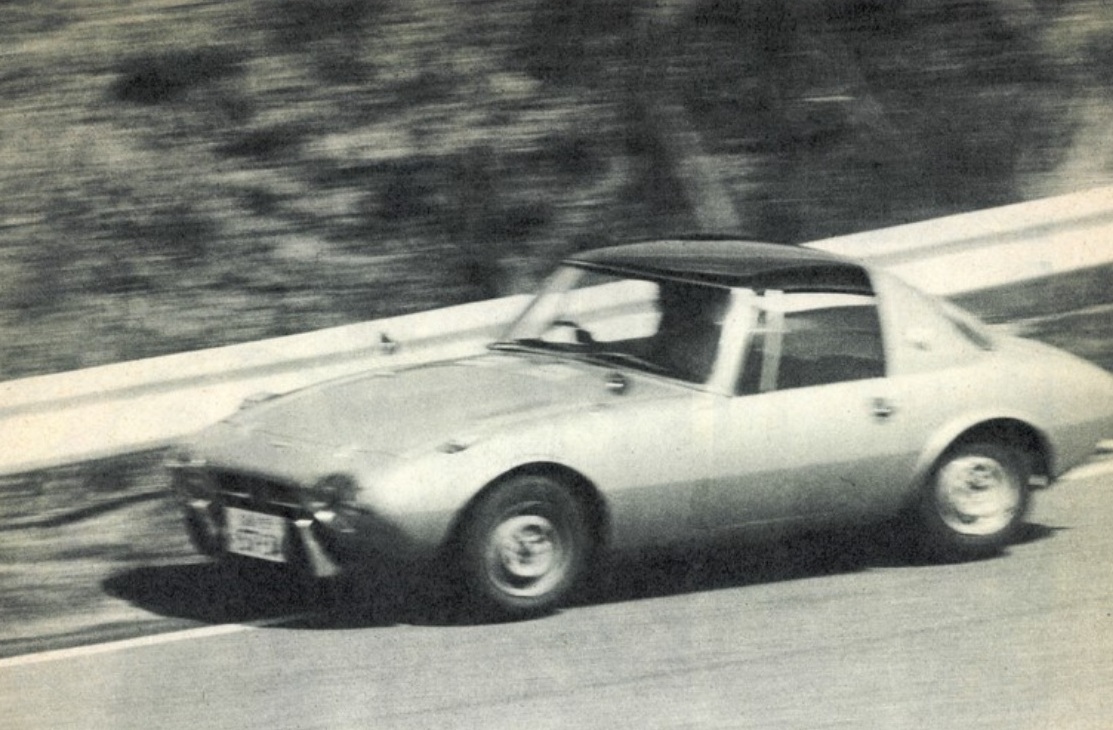
Our test car this time was completely stock from nose to tail; the only changes were removal of the air-cleaner element and the fitting of higher-heat-range spark plugs.
I would have liked at least to use racing tires, but there was no choice but to attack Suzuka on the standard tires (Bridgestone passenger-car tires).
According to the times recorded by Auto Sport on alternate laps, our best was 3 minutes 10.0 seconds. This invites comparison with the 3 minutes 09.2 seconds best lap recorded by the Publica in the 2nd Japanese Grand Prix. Needless to say, the Grand Prix Publica was a factory car, a racer that had undergone extreme competition tuning from engine to suspension with the sole aim of winning at Suzuka. When one considers that the Toyota Sports, even on standard tires, can lap in almost the same time as the competition Publica, one cannot help being startled by the sheer potential of the Sports 800. (With Bridgestone’s highly capable R2 racing tires fitted, it would undoubtedly record a better time than the works Publica.)
One of the Toyota Sports’ great “weapons” is its light weight—just 580kg.
To see just how light it really is, I chose twenty European cars in the 700–900cc class—Rene Bonnet, Panhard, Renault, DKW, BMW, Hillman, Fiat, DAF, and others—and compared their weights. The result was more striking than I had expected. The average was 668kg! That makes the Toyota Sports no less than 88kg lighter than average! Moreover, the only cars in this class I could find that were lighter than the Toyota Sports were the Alpine Berlinette (845cc, 565kg) and Austin Mini (845cc, 570kg). Even the expensive Abarth 850 weighs 583kg, while the Saab 96 (841cc), which has distinguished itself in competition around the world, weighs no less than 820kg.
The Publica on which it is based is itself a light car at 600kg, and the lengths to which the manufacturer went to strip away another 20kg of “fat” can be seen in the aluminum hood and trunk lid, the detachable top, and the plastic rear window. It is genuinely gratifying to see a Japanese manufacturer devoting this much attention to weight reduction.
Nor is the Toyota Sports’ shape only good-looking. It is aerodynamically clean as well, with an extremely small frontal area—the figure directly related to the considerable aerodynamic resistance encountered at high speed. At 1.33m², compared with 1.32m² for the Porsche 904, one can easily appreciate just how small it is. This body design contributes greatly to the Sports 800’s high-speed performance.
Is the Red Zone Red—or Yellow?
The engine is, of course, based on the Publica’s 697cc two-cylinder unit, bored out to 790cc and fitted with twin carburetors. Output rises by no less than 13ps, to 45ps/5400rpm. For a two-cylinder OHV engine in the 800cc class, that is quite respectable.
Maximum torque is 6.8kgm/3800rpm. At 2000rpm (about 60km/h in top), there is not quite enough torque, so a fair amount of shifting is necessary on public roads. Still, the torque curve is flat enough that the car is never difficult to handle.
The tachometer’s red zone begins at 5500rpm, yet, surprisingly enough, the scale runs all the way to 8000. It is hard to decide whether the red zone includes an exceptionally generous safety margin, or whether that 8000rpm marking is simply an extravagant boast; one almost begins to see everything up to 6500rpm as a yellow zone. A driver who charges recklessly into the red zone is hardly worthy of the name, but in first and second gear the engine spins so effortlessly that it seems all too ready to sail straight past 5500rpm. To make matters even more troublesome, the valves show no sign of surging even beyond 6500rpm.
There is no point in revving it beyond 6000rpm, however. Acceleration certainly does not improve; if anything, it seems to fall off.
165km/h at Suzuka
The combination of a 45ps, 6.8kgm engine and a curb weight of 580kg promises sharp acceleration off the line. And indeed, acceleration in first and second gear is excellent. The first time I drove the remarkably quick Honda S600, I remember thinking, “So even at 720kg, DOHC and four carburetors can make a car this fast! And this is only 600cc!” The Toyota Sports 800 produces a similar reaction: “So at 580kg, even a two-cylinder OHV can be this fast! It hardly seems possible that this is only 800cc!” But the difference in displacement is undeniable, and the Toyota makes a particularly strong impression in first and second gear, where it seems to pull well away from the S600.
Its extremely small frontal area also raises expectations for the way it will continue to accelerate in third gear and top, but perhaps because of the condition of our test car, it did not feel quite as strong as expected. At Suzuka, too, it would initially pull away from the Honda accelerating out of the hairpin, only to find the Honda right on its tail by the time we shifted into top somewhere between Turns 13 and 14. The Sports 800’s maximum speed in third gear is 110km/h, against 120km/h in the Honda, and this difference also has a significant effect (the corresponding figures in second gear are 70km/h and 75km/h). The Honda would also close in hard between the Reverse-Banked Curve (Turn 7) and Degner (Turn 10). This is particularly interesting when one considers that the section after the hairpin climbs uphill at 3.9%, while that following the Reverse-Banked Curve has Suzuka’s steepest gradient, at 7.8%.
Our test car had been fitted with a tachograph, but its speedometer scale went only to 140-145km/h. The needle would quickly run off the scale even on the Meishin Expressway, and at Suzuka the problem was especially severe, so we transferred the cable back to the car’s original 180km/h speedometer.
An NGK technician carefully tried several different spark plugs until he found the appropriate heat range (No. 9), and the car gradually began to run better. On the second day the wind direction was favorable as well, and by the end of the back straight the speedometer was showing a definite 165km/h. Even just before the 150R (Turn 17), it still indicated 150km/h.
Oversteer
The Publica’s outstanding handling is well known among those familiar with the car. The works Publicas (“works” meaning the factory team) were exceptional in the corners, and there is a famous story of skilled drivers in cars with more than twice the engine capacity complaining, “You can pull away from them on the straights, but as soon as you come to a corner they’re right back on your tail, and you simply can’t shake them off.”
In the Sports 800, the center of gravity has been lowered by no less than 120mm from that of the Publica, to 405mm. The track remains unchanged, while the wheelbase has been shortened by 130mm.
But the Sports 800 showed handling of an entirely different character from the Publica—oversteer—which was unexpected.
Looking at the weight distribution, the front is actually heavier with the car unloaded, but once the driver is on board, the distribution becomes almost exactly 50/50. There is little rear overhang. If anything, it is the front overhang that attracts attention, with the engine projecting well forward. There is a considerable amount of positive camber at the front, so much so that it becomes neutral only with two people on board. And yet the rear tires are surprisingly eager to slide. This is already noticeable on public roads, but at racing speeds around Suzuka the car’s oversteering character becomes even more pronounced.
I Don’t Want to Drive on Passenger-Car Tires Again
The standard tire pressure is 1.2kg/cm² front and rear, while 1.8kg/cm² is specified for high-speed driving. I started by setting them to 2.0kg/cm² and headed out onto the circuit.
They slide! I didn’t think I was pushing particularly hard yet, but the rear began sliding around alarmingly. After one lap I came back into the pits and raised the pressures to 2.4kg/cm² at the front and 2.7kg/cm² at the rear. The car became considerably easier to drive and the lap times improved, but the rear still broke away first.
I wanted to raise the pressures further, but even at those settings the centers of the tread were becoming worn on both front and rear tires, so going any higher was out of the question. (Looking back on it now, I should have lowered the front pressure by 0.1–0.2kg/cm² instead.)
Handling characteristics can be controlled to some extent with tire pressure, but even if racing tires were fitted to an oversteering car, it would surely remain an oversteerer, with the rear breaking away first. Even so, this test brought home to me once again just how ill-advised it is to attack Suzuka without changing the tires, and I resolved never again to drive there on standard tires. (Passenger-car tires wear extraordinarily quickly when treated this way, so racing tires actually work out cheaper in the end. Besides, I would like to stay alive.)
Yet even on tires completely unsuited to racing speeds on a circuit, the Sports 800 achieved impressively high speeds at the corner exits. It must be emphasized that we recorded a definite 95km/h at the exit of Turn 3, and as much as 105km/h coming out of Spoon.
It was also extremely reassuring that although the inside rear wheel would sometimes spin freely through the S-bends or the hairpin, it never once lifted a “foot” from the ground.
The brakes are carried over unchanged from the Publica, with drums front and rear. We did not perform the sort of braking test in which the car is brought to a hard stop from 100km/h, but at Suzuka they always gave consistent braking and stood up well to racing speeds.
Light weight is a great advantage not only in acceleration, but in braking as well, and the Sports 800 does not disappoint in this respect. Directional stability under braking is also outstanding, allowing one to charge deep into a corner with confidence. At places such as the hairpin, where the brakes are worked particularly hard, the Toyota can be driven harder than the S600, whose rear wheels can begin to hop and upset the car’s stability if the brakes are handled roughly.
A Glaring Dashboard
The driving position is very well laid out, and the steering wheel is a good size. I would like to see a wooden steering wheel to match the Toyota Sports’ handsome styling. The accelerator is of the organ type, and it is pleasing to find that heel-and-toe operation can be performed without difficulty. The seats, whose aluminum frames show the same careful attention to weight reduction, provide good support. The standard seat belts, however, are 2-point shoulder belts. These would seem to offer greater safety than the 2-point lap type and can be recommended for touring, but at racing speeds one’s hips move around in the corners and the body is not held securely in place. At Suzuka, I would want at least a 3-point belt.
Curved glass is used for the side windows, helping to keep the frontal area small while also providing more interior space.
What I simply cannot understand, however, is the dashboard in which the gauges are mounted.
The gauge layout itself is good and easy to read, but why must the part of the dashboard directly in the driver’s line of sight be covered with bright metal that reflects light and glares in one’s eyes? Black, non-reflective material is used for the safety padding on top of the dashboard and around the glovebox in front of the passenger, while the instruments themselves have white figures on black faces for easy reading. Why, then, deliberately surround them with a glaring metal panel? I simply cannot understand it.
There is a large ball on the end of the shift lever, making it look like the gear lever of a truck. I would much prefer a knob that fits the hand properly.
The handbrake lever, positioned behind the shift lever, is extremely awkward to operate. One has to twist the hand around almost as though caught in a reverse wrist lock in judo, and at times it is impossible to manage it quickly without using both hands.
The horn button is in the center of the steering wheel, which means that during sporting driving it cannot be reached quickly enough when it is suddenly needed.
Moving the turn-signal switch extending from the steering column forward and backward to dip and raise the headlights is a good arrangement, but it requires far too much movement, which is disappointing.
Compared with the Honda S600
The Toyota Sports 800 has only just been announced and put on sale, and I have not yet had a chance to drive one belonging to an owner, so I cannot tell whether our test car was in especially good or poor condition. Assuming that it was running well, a good Honda S600 in standard form can lap about seven seconds faster if driven hard. (It is fitted with Dunlop SP tires, which, at least to my taste, are much better to drive on around a circuit than Bridgestone passenger-car tires.) It therefore seems likely that, in completely standard form, the Honda S600 would produce better lap times.
But races are hardly ever run with completely standard cars. A sports car already close to being a racer may be another matter, but entering a normal sports car—or a “2-seater passenger car”—in a race entirely as it left the factory belongs to the same misguided school of thought as attacking Suzuka on passenger-car tires.
Much depends on the degree of tuning, but generally speaking, once one begins modifying the car in search of faster times, it is easy to imagine that the Toyota Sports has the advantage over the Honda S600. The Honda already extracts a highly-developed level of performance from a complicated engine that leaves the typical amateur little scope for tuning, whereas the Toyota has the much simpler Publica engine.
The remarkable durability of the Honda S600 engine is universally acknowledged, but here the Sports 800 appears to have a problem. Run the engine hard at high rpm and it blows quite a lot of oil out through the breather. And the amount is astonishing. After only five or six laps of Suzuka, the oil level falls from FULL to EMPTY—in other words, it blows out as much as half a liter. Yet even with the front shutter kept closed throughout, the oil temperature would not even reach 80°C (the specified range is 80–110°C), while the oil pressure, of course, was no different on the sixth lap than on the second. Even so, the oil level continued steadily to fall at a rate of about 100cc per lap, so we kept a 5-liter can in reserve and came into the pits every five laps to top it up.
Blowing out oil is not a problem unique to the Publica engine, but a major difficulty common to horizontally opposed two-cylinder engines. Toyota Motor says, however, that a solution to this weakness is now only a matter of time, so I believe it will have been completely resolved by the time cars actually reach their owners.
A Car I Would Very Much Like to Tune
The Toyota Sports 800 gives its driver a powerful sense of its latent possibilities—its “potentiality.” Given the time to settle down and work carefully on the engine and suspension, drawing out the “potentiality” that still remains hidden, I believe it could produce remarkably fast times at Suzuka for an 800cc car.
The Sports 800 is also a car I would very much like to see entered extensively in races overseas, giving it the chance to take on the opposition on equal terms.