Toyota Publica 1200ST and 1971 Publica 1200SR (1972)
Publication: Motor Fan
Format: “Photorama” Test Drive report
Date: April 1972
Author: Kazuhiko Mitsumoto
An Almost Too-Good “Beat Machine”
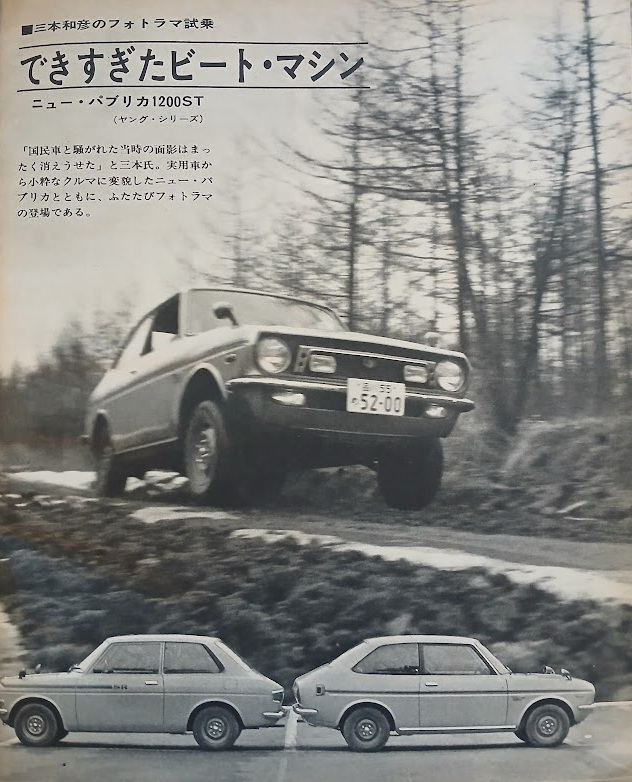
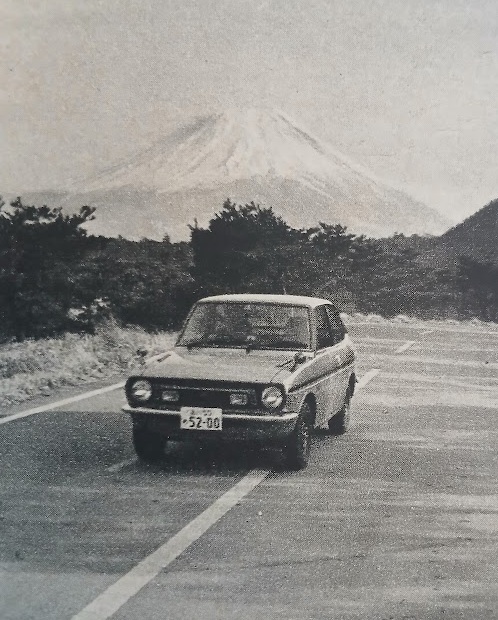
“The Publica has completely lost every trace of the days when it was hailed as the ‘People’s Car,’” says Mitsumoto. With the new Publica transformed from a practical utility car into something altogether more stylish, the Photorama series makes another appearance.
New Publica 1200ST (Young Series)
“New Styling, New Publica—Now in Two Series” is the advertising line. The two series, it seems, are divided into “Family” and “Young,” with the Young Series in particular promoted as having been “created by Toyota’s young power, with young people in mind.” Whatever the product, all this fuss about “young people” and “youth” in advertising is really aimed at getting young people to part with the money they have saved up. Statistics apparently show that unmarried people between the ages of 24 and 27 have the highest rate of savings.
What really gets me about the Young Series advertising is the claim that these are “models proving that only the young can truly understand the young.” That is almost too much. If car manufacturers are helping to turn the fierce energy of youth into something monstrous by cutting it off from the wisdom of middle age and the gravity of the old, then we have a social problem on our hands.
Still, within the long span of written history, limited though it may be, perhaps there is no harm in having one slightly ridiculous age in which advertising lines like these are allowed to flourish. It was in that spirit that I tried the Young Series 1200ST selected by the editorial staff.
Soon after the war, Toyota was quick to foresee the coming of motorization in Japan, and the UP10 Publica—a true “People’s Car”—might be regarded as the embodiment in production form of Toyota’s rationalist philosophy. I found myself strangely sentimental at the realization that both that character and that philosophy have vanished, and that the new Publica has become a car for an age of rising GNP, economic superpower status and a leisure society. I should have known better.
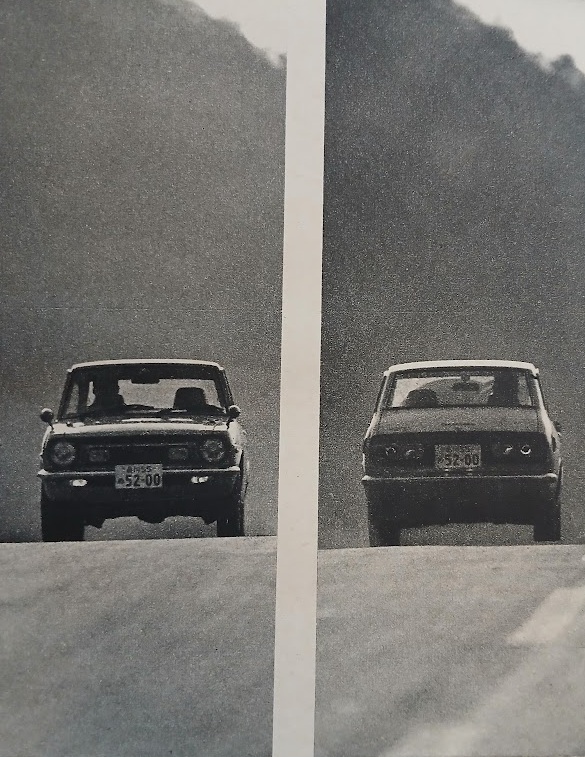
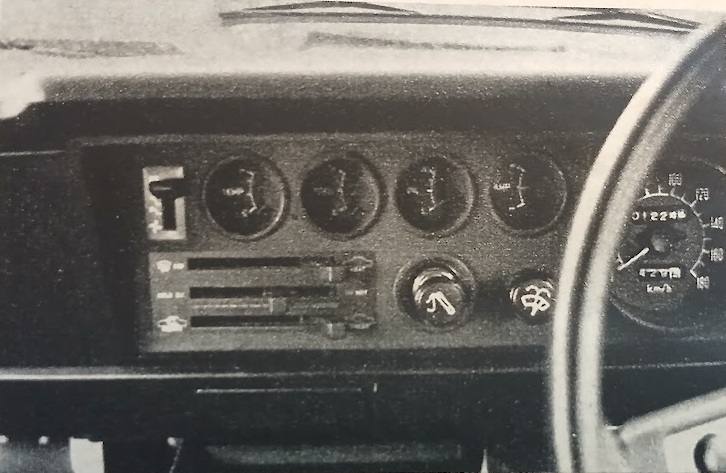
What bothered me most was that the car seemed almost too well finished, leaving no room for young owners to add ideas and ingenuity of their own. The manufacturer calls this “high performance plus full equipment.” Its generally blacked-out, “assassin”-like air is apparently described as “Black-in Mask!! Black-out Tail,” and its precocious attempt at menace has a certain charm of its own. Looking at this car, one can almost feel the heavy hand of the same “overprotective philosophy” found in the design of the latest study desks that education-minded mothers buy for their children. Most things are already built in as standard, while the car has also been designed so that, if desired, an air conditioner and stereo can be built in as well.
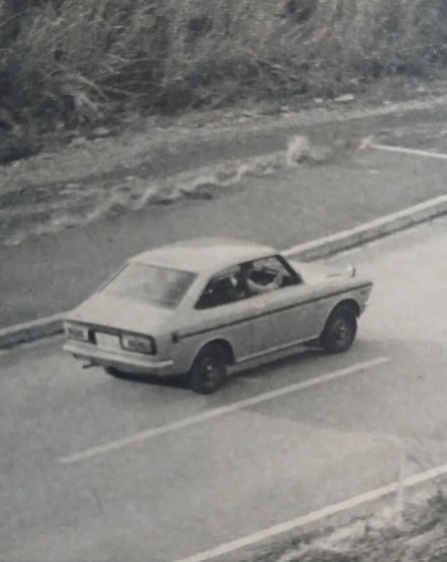
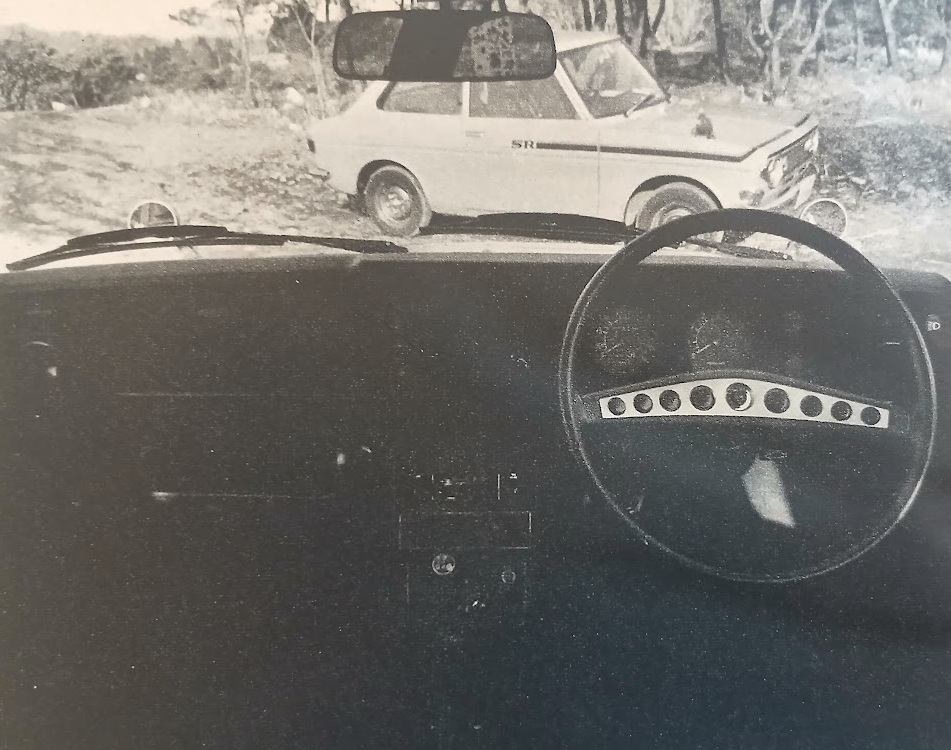
The editorial staff instructed me to alternate between the new car and the previous Publica SR so as to sharpen my impressions. But the old SR had been doing “duty” fitted with optional equipment such as an air conditioner, and was so worn out that it was no match for the new ST.
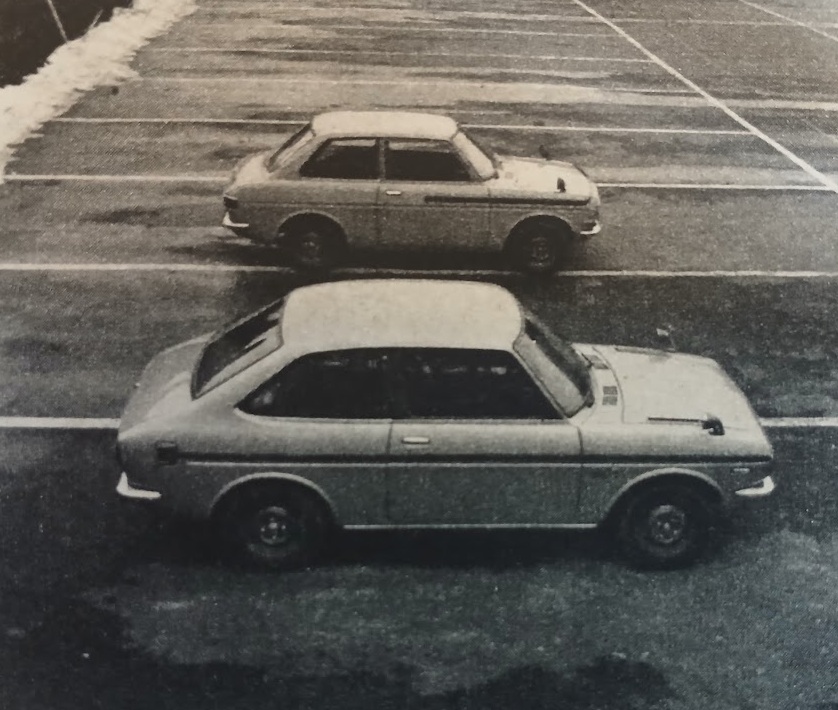
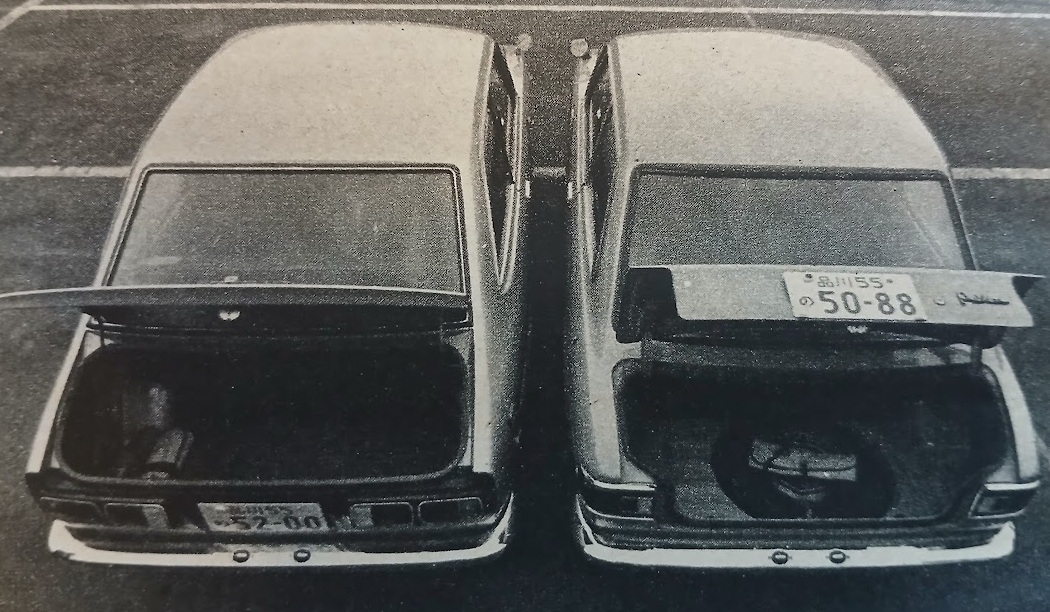
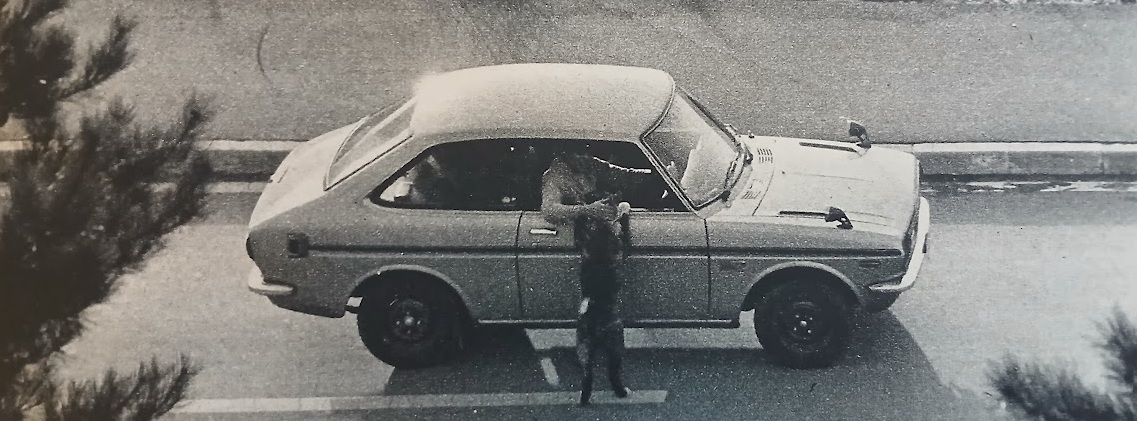
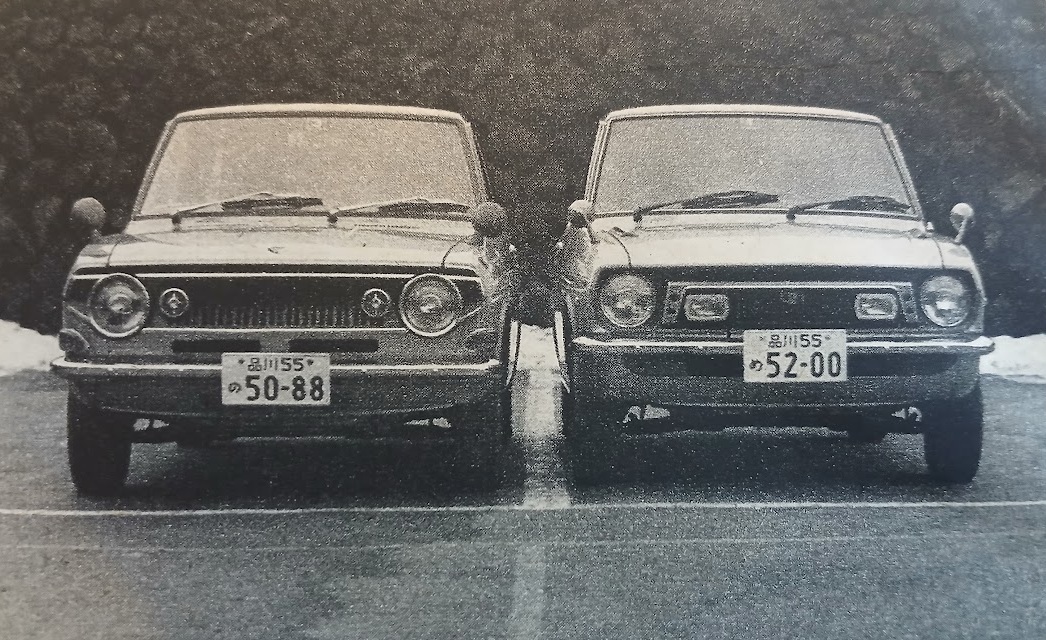
Putting the old and new Publicas side by side, it is surprising to find that, apart from the doors, not a single body panel is shared between them. If Toyota was going to go this far, I wondered why it did not simply adopt the lines of the Celica that is now at the height of its popularity. Perhaps that is simply an amateur’s way of looking at it.
Even so, the actual car gives an entirely different impression from the commercial that cries, “The Serow of the Highway!” My own candid impression is more like a wild boar—or perhaps a peccary. Behind the wheel, too, the image is much more that of a fierce, combative wild boar than of the rather delicate-looking serow.
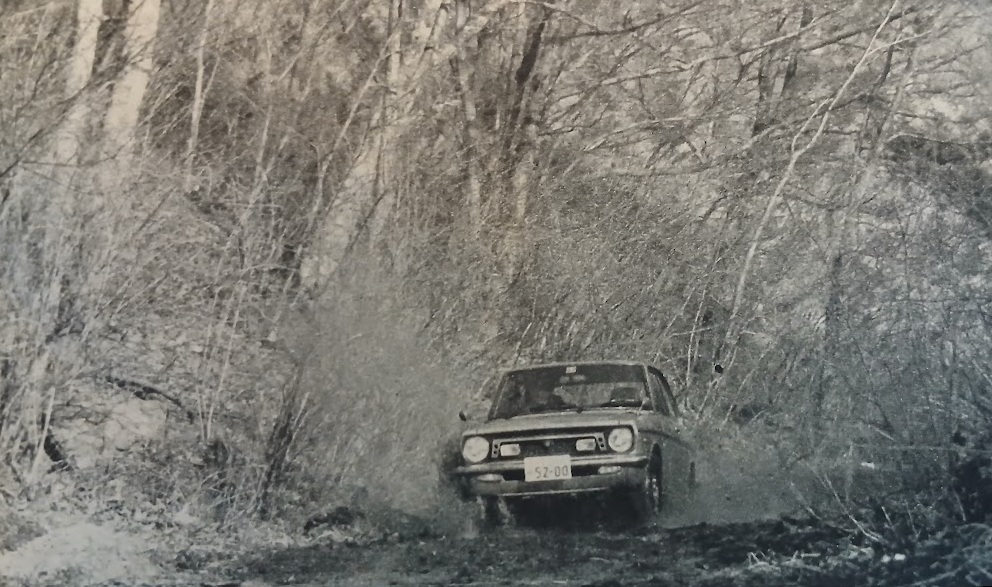
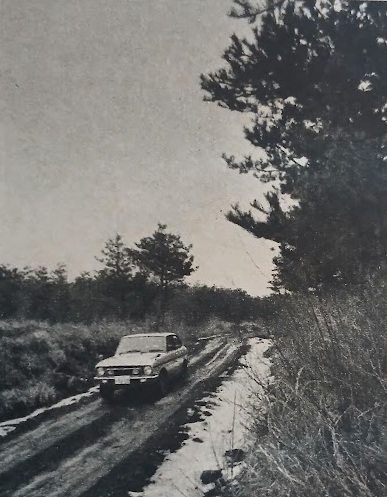
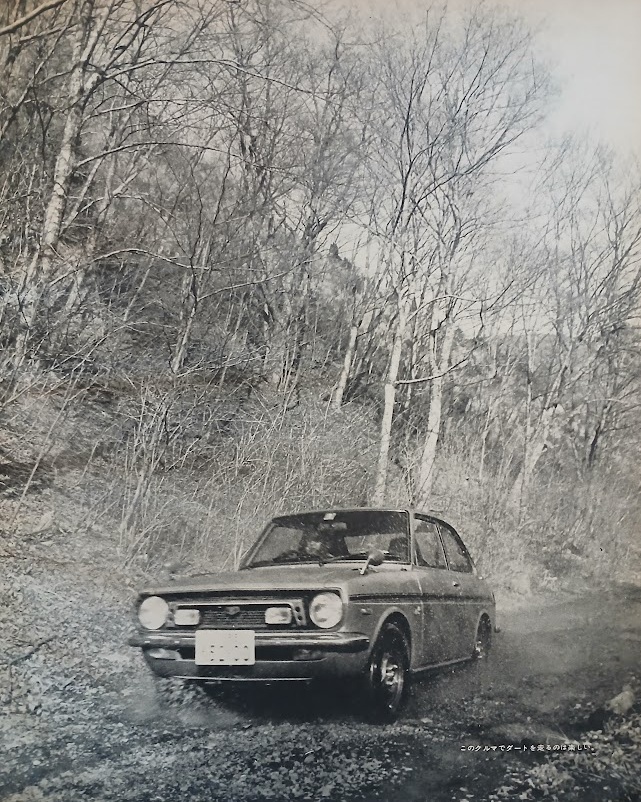
The firm suspension seems to have greater strength than that of the previous model, but on rough roads it tends to induce pitching, while in cornering on dirt the tail can be swung around to change the car’s direction. In terms of sheer enjoyment, there is no denying that the more pronounced such “quirks” are, the more entertaining a car can be.
The first thing that bothered me about the Publica ST’s driving position was the offset between the steering wheel and the pedals. But in less than ten minutes I had gotten used to it, and it stopped bothering me. Even these offset pedals will accommodate whatever footwork is required.
The difference in character between the new Publica and the old one is not something that can be understood simply by looking at the catalog, but once behind the wheel the efforts of the designers become readily apparent.
Although there have been no major changes, both the front and rear suspension are more resilient, and the ride has improved. The steering is lighter, while the brakes provide strong stopping power with little pedal effort.
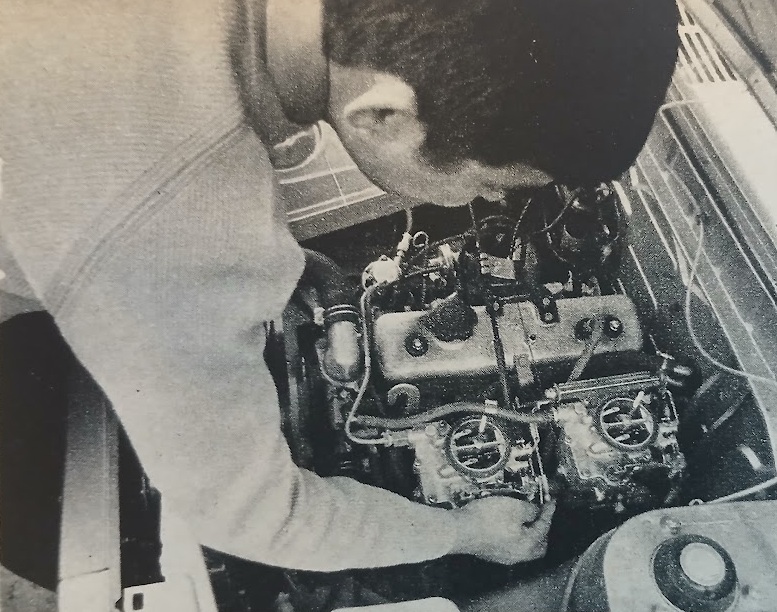
In the suspension, the damping rates have been changed and the spring rates of the leaf springs revised. The steering has been changed from worm-and-sector to a recirculating-ball type, with the ratio also made slightly quicker. The brakes use newly designed discs, while increased pedal travel has reduced the effort required. These must be the changes responsible for the new impression. Yet however closely one examines them, there is no single improvement that could be called particularly major. The fact that they nevertheless make the car feel so much milder shows just how wide the gulf is between the engineer and the critic.
Looking more closely at the details, one can see just how painstaking the engineers have been. There are measures to improve the action and feel of the synchromesh, the shape and construction of the ventilation outlets, and the heat-release slots cut into the hood—all areas where getting things wrong would impair their function.
Yet despite such painstaking attention, there are also some poor details. The defroster outlets are badly angled, so that while the rear window remains clear with its electric heating, the inside of the windshield can become so misted that one cannot see through it.
As a matter of personal preference, I cannot say that I like the Publica ST’s steering. It is strangely sensitive when running straight ahead, yet its response lags on twisting roads. Even so, it is certainly easier to handle than the old model, with its strong tendency toward axle steer.
Noise during high-speed cruising and on rough roads has been greatly reduced compared with the previous model. Even so, for anyone whose ears have not been toughened by electrified music, there is still rather too much of a beat—it brings a discotheque to mind.
It may be asking too much, but why not offer young people a model that leaves them some room for ideas and ingenuity of their own? However I look at it, the Publica ST seems an almost too-well-developed machine, and I cannot help feeling that the manufacturer’s efforts to pander to the young are just a little too obvious…
Postscript: Story Photos