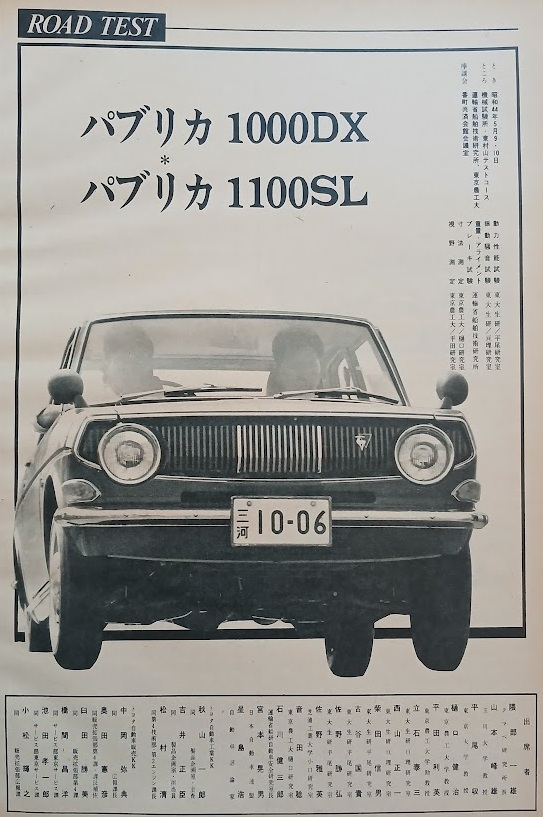
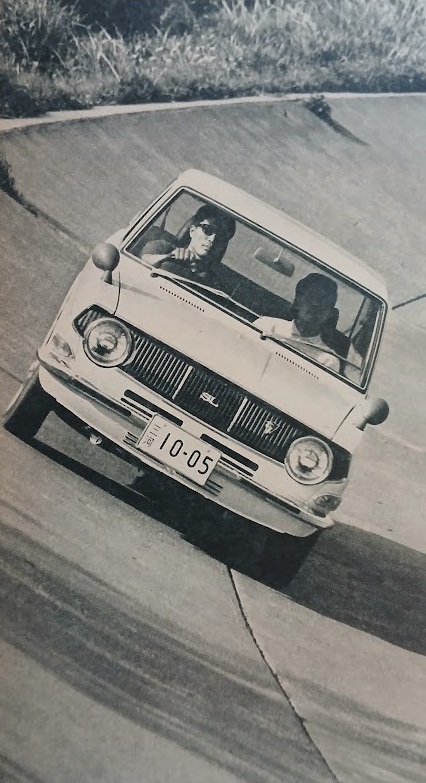
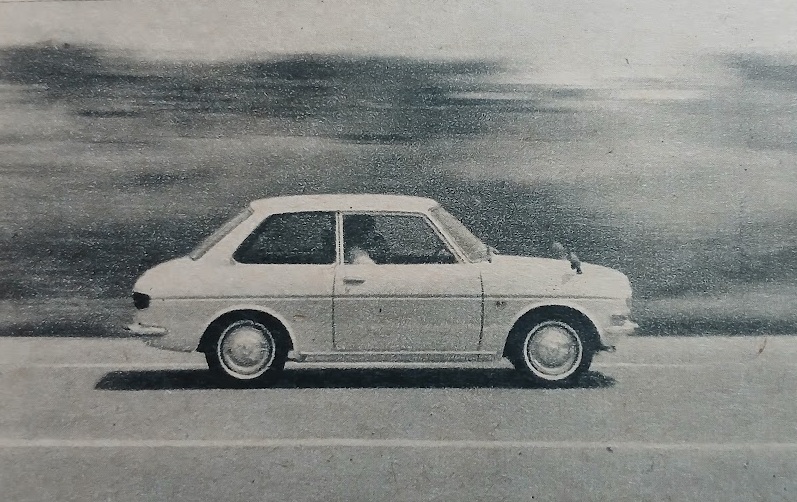
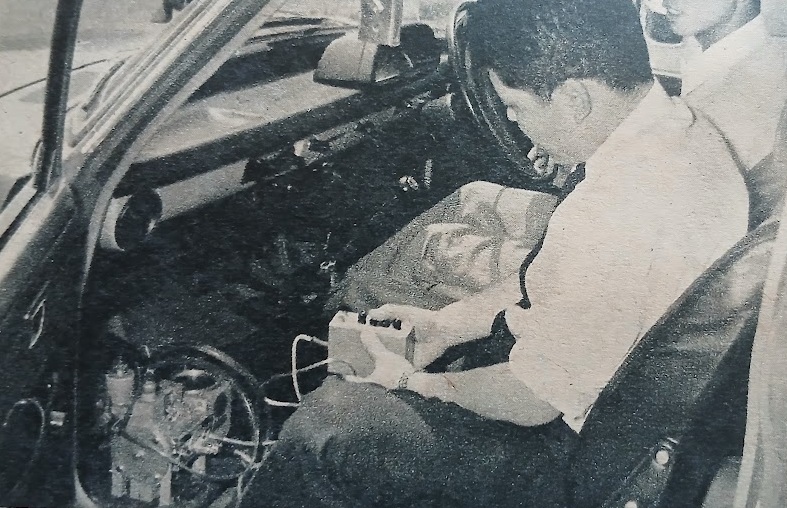
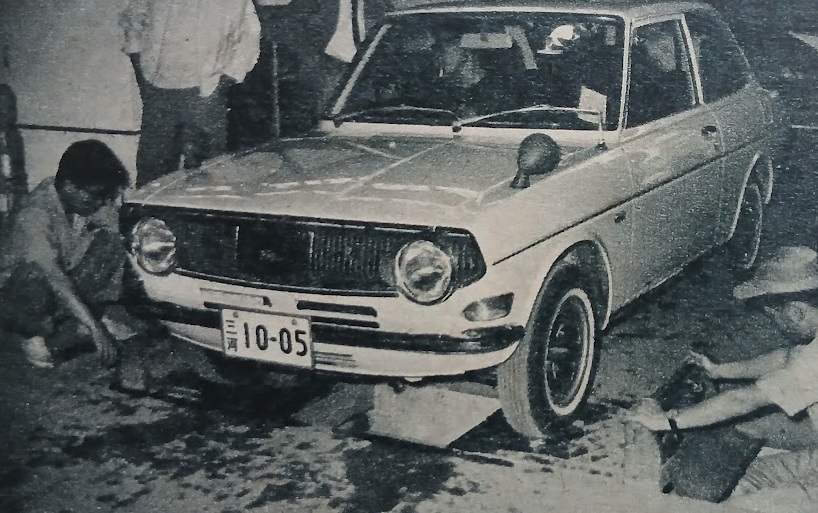
Toyota Publica 1000 Deluxe and 1100 SL (1969)
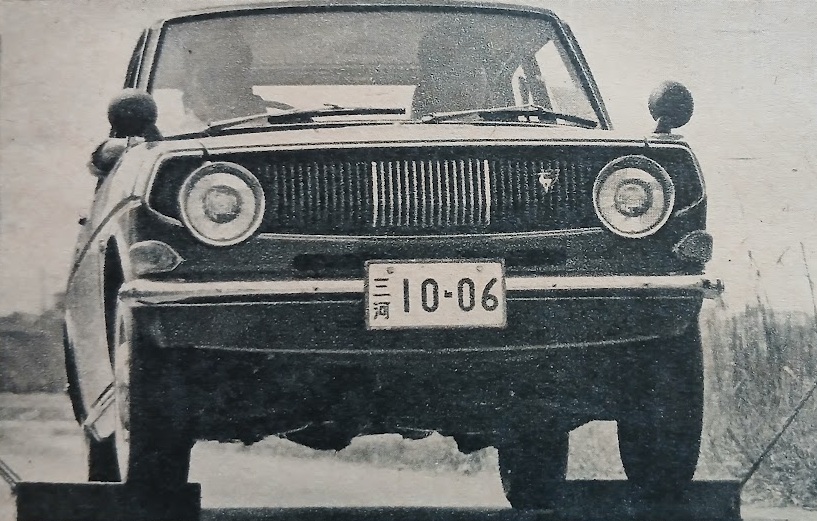
Publication: Motor Fan
Format: Road Test
Date: July 1969
Authors (Roundtable): Ichiro Akiyama, Masaomi Yoshii, Osamu Hirao, Kiyoshi Matsumura, Kenji Higuchi, Mineo Yamamoto, Kunitaka Furutani, Horishi Hoshijima, Masahide Sano, Nobuo Shibata, Taizo Tateishi, Kenzaburo Ishikawa, Toshihide Hirata, Minoru Onda, Mitsunori Nakaoka, Motor Fan Editorial Staff (uncredited)
A Charm Grown-Ups Don’t Have
Magazine: First, we’d like to ask Mr. Akiyama of Toyota Motor Company to give us an outline of the Publica.
Akiyama: First, I’d like to say a few words about what we were aiming for in developing the car.
The Publica first appeared in July 1961, and eight years have passed between then and this latest model change.
During that time, we have of course carried out frequent facelifts and minor changes. But times have gradually changed as well, and we felt that the car should be brought fully into step with the times. That is why we decided on this model change.
In approaching it, we returned to the beginning and reconsidered just what qualities a popular car ought to have. There are probably many different ways of looking at the question, but broadly speaking, we identified two.
First, if it is to be a popular car, the most important thing is surely that it should be readily affordable to anyone among the general public. At the same time, its running costs must be low—in other words, it must be economical.
Second, in terms of styling, function, and performance, it must be fully capable of holding its own against cars in the classes above and be sufficiently appealing in its own right. It must also be a car that satisfies the pride of ownership of the person who owns it.
Looking at the previous Publica in those terms, I think we can take some pride in saying that it earned a passing grade on the first point. Our various market surveys showed that many people bought it because it was economical.
As for the second point, people often tell us—whether they’re simply being polite or not—that it is a very thoroughly developed car. But when you look at actual sales, they have remained more or less flat, without showing any particularly significant growth. We felt that there must be a problem somewhere in that area.
Society, meanwhile, has increasingly moved into an age in which people enjoy speed and leisure, while at the same time taking a much greater interest in safety. We believe we had done everything reasonably possible through minor changes and such, but with this new model we decided to devote even greater effort to pursuing higher-speed performance, greater suitability for leisure use, and improved safety, while fully preserving the economy the Publica has offered up to now.
In pursuing that idea, this may be a rather odd analogy, but if we describe a popular car as a “child” in terms of its size, then surely there is something wrong with the idea that “a child is simply an adult, but smaller.” A child ought to have a charm of their own, one that an adult does not have.
To put that more concretely, given the character of this car, wherever something ought to be smaller than on a car in the class above, we have made it smaller; wherever it ought to be simpler, we have made it very simple. On the other hand, in those areas we considered necessary to bring out the unique qualities of the car, we set out to give it features that would surpass even those of higher-class cars.
Six Development Objectives
Magazine: What areas did you place particular emphasis on in the design?
Akiyama: We established six basic design objectives. The first was to completely renew the styling. The second was to improve maneuverability and performance. The third was to improve passenger accommodation and carrying capacity. The fourth was to improve the ride, while also making substantial improvements in vibration and noise. The fifth was to improve safety. And the sixth, broadly speaking, covered “everything else.”
For the styling, since this is a popular car, we wanted to retain fully its qualities as a family car while at the same time incorporating something of the flavor of the long-nose, short-deck look currently in fashion.
The second objective, improved performance and maneuverability, involved the engines. Until now this car has been fitted with an air-cooled 800cc engine, but we developed a water-cooled 1000cc engine as an alternative and fitted that as well. In addition, there is an 1100cc twin-carburetor engine—the same engine used in the Corolla and Sprinter SL—which we also decided to offer.
The third objective, improving passenger accommodation and carrying capacity, involved such measures as increasing the track and wheelbase, adopting curved glass, and using a shelf-type instrument panel. We made every effort to increase the interior space while keeping the overall dimensions of the car as close as possible to those of the previous model. The seating capacity has also been increased from the previous four people to five under the regulations.
For the fourth objective, ride comfort, we revised the basic design of the front suspension system, for example, changing it to the MacPherson type.
Previously we used a torsion-bar arrangement, which had virtues of its own, but this represents a major departure from that system. In improving vibration and noise as well, we went back and reconsidered the basic body structure. We believe we have achieved improvements in those areas too.
As for the fifth objective, safety, the first and most important thing is that the driver should be able to see well—in other words, that the field of vision should be wide. Second, we felt it was important that the driver should be able to communicate their intentions to other road users. Third, the car should respond exactly as the driver intends. And fourth, in the unfortunate event of an accident, the resulting damage should be kept to an absolute minimum.
To improve visibility, for example, we eliminated the vent windows and adopted larger-capacity windshield wipers. To make the driver’s intentions more readily apparent, we used larger lamps and also added a passing flasher for the first time.
Finally, under the heading of “everything else,” we wanted to provide thoughtful little touches—things that would give the owner a sense of familiarity with the car when getting into it. On the Deluxe, for example, there is a small pocket behind the sun visor. The rear-quarter trim is made as a one-piece molded resin panel incorporating a pocket and armrest. We also fitted what we call an “under-under tray,” with the idea of providing as much space as possible for storing things. We have also adopted features that make such things as operating the dimmer switch easier.
Those, broadly speaking, were the objectives around which we developed the new Publica. We have given the car an image mark in the form of a Japanese serow, with the hope that this too will help people become particularly fond of it.
Magazine: Thank you very much. As you’ve explained, there are three types of engine, and the range is quite unusual in that it includes both air- and water-cooled engines, as well as the engine used in Daihatsu’s Consorte Berlina. We’d like to hear something about the difficulties involved in accommodating these different engines.
Also, although we did not carry out engine testing on the existing air-cooled 800cc model during this test, we’d like to hear what changes have been made to that version as well.
Vibration Testing by Two Separate Groups
Akiyama: We felt that it would be a mistake to approach the car with the fixed idea that it had to be fitted with one particular engine. Why shouldn’t we fit a variety of engines and create cars with different individual characteristics? We thought it would be equally wrong to be bound by some fixed notion that a popular car must not have an engine larger than a certain size. We felt we ought to take a more flexible approach.
Yoshii: Once we decided to fit the different engines, the first problem was one of space. With the air-cooled horizontally opposed engine, the lower part is the widest, while the water-cooled slant engine is wider toward the top. So the engine compartment had to provide plenty of width all the way from bottom to top. That was one of the packaging problems we faced.
Then, when we built the first cars and started measuring vibration, there was a considerable difference in character between the two-cylinder engine on the one hand, and the four-cylinder on the other. The sounds produced by the air- and water-cooled engines were different as well. So we divided the group in our vibration-testing department into two teams and carried out the testing with almost as many people as we would have needed to develop two separate models.
Once the cars were in motion, the differences in vehicle weight distribution also produced considerable differences in handling. In that respect too, we effectively had to carry out two entirely separate development programs, so it involved quite a bit of additional work.
As for the Consorte Berlina, that also uses a water-cooled four-cylinder engine, but the vibration characteristics of its powerplant are quite different. Matching that engine to the car gave us a great deal of trouble. Daihatsu handled the work directly, but they did it in close cooperation with us, and dealing with the difference in vibration characteristics was the most difficult part. In terms of space, there wasn’t much of a problem.
Magazine: In that case, there are some differences in the performance of the 800cc and 1000cc versions. What about having cars of rather different character using the same body…?
Akiyama: The 800cc engine has always been known for qualities such as very good fuel economy, easy starting, and extremely simple maintenance, and I think you could say that it retains all of those characteristics.
At the same time, because of such factors as engine displacement and output, it naturally falls short of the water-cooled 1000cc engine in performance. So for customers who place particular importance on economy, we would like them to choose the 800cc version.
Hirao: How much difference is there in fuel economy?
Akiyama: The official figure for the 800 is 25km/l. For the water-cooled version, it’s 23km/l.
Hirao: That’s not a very big difference.
A Wide Variety of Engines
Magazine: We’ve got a little ahead of ourselves, but perhaps Mr. Matsumura could give us a brief outline of the engines.
Matsumura: We’ve just been talking about the air-cooled engine, but even in terms of basic engine construction, the new range offers quite a lot of variety. There is the horizontally opposed engine, as well as a water-cooled four-cylinder, and then there is the SL, fitted with the K-B engine also used in the Corolla SL. This is a sporting engine developed by tuning the K-type engine, so the lineup really is quite varied.
In terms of economy, the air-cooled 2U-C engine naturally has virtues of its own when it comes to maintenance, fuel consumption, and oil consumption. Recently, however, users have increasingly come to expect plenty of reserve power for passing acceleration, as well as good acceleration performance in general. I think that ultimately led us to offer such a varied range of engines.
The 2K engine is based on the 1100cc K-type engine originally fitted to the Corolla, but with the bore reduced from 75mm to 72mm. As a result, there are differences in such items as the carburetor, cylinders, and flywheel, but as far as the basic engine itself is concerned, the great majority of components are shared with the K-type. In this form, it produces 58ps/6000rpm and 7.9kgm/4000rpm, giving a specific output of 58.4ps/l.
As for the 2U-C engine, in adapting it for the new Publica we changed the lubrication system from the previous partial-flow type to full-flow filtration, with the aim of extending bearing life and lengthening maintenance intervals. At the same time, we increased the volume of cooling air somewhat, and gave it sufficient margin to ensure that the engine could be used with confidence at high speeds.
The K-B engine has been offered in the Corolla SL since April of last year. It has twin carburetors, a dual exhaust system, and a compression ratio of 10.0, compared with 9.0 for the 2K. Its rated maximum output is 73ps, with maximum torque of 9.0kgm. In adapting it to the Publica, the main changes were a slight modification to the shape of the air cleaner and matching the exhaust system to the car.
Hirao: Why did you take the Corolla engine as the basis and reduce it to 1000cc? What I’m really asking is, why you didn’t simply use the 1100cc engine as it was?
Akiyama: Well, there were family circumstances involved. (laughs) We already have the Corolla, which is itself described as a popular car, and then we have the Publica. In principle, there might have been nothing wrong with fitting the 1100cc engine, but we wanted to maintain a certain balance within the range and provide a wide variety, so we settled on 1000cc.
Hirao: From various experiments I’ve done, I’ve found that if you provide sufficient intake-manifold heating, output falls, but you can produce a very well-behaved engine. The mixture distribution is good, and the exhaust is clean.
So it occurred to me that, if you wanted to give a popular car a distinctive feature and were satisfied with 1000cc-class power, you could make good use of the 1100cc engine itself. You could say, “We’ve reduced the power by this much, but the exhaust is much cleaner and the engine much smoother.” Good mixture distribution also improves fuel economy considerably, and it allows you to keep raising the compression ratio as well.
Since you already have more than enough power available, I wondered whether you might direct all of that surplus toward cleaner exhaust emissions. It struck me that this could make a good selling point, and that’s really why I asked.
Akiyama: Thank you.
Many “Fans” of Air-Cooling
Higuchi: I had actually rather hoped that Toyota would move the Corolla upmarket first, and that most people would then be perfectly satisfied with an 1100cc Publica. There might also be a feeling that the Corolla should really have a 1300cc engine.
Hirao: Certainly, one of the most important qualities of a popular car is economy—and that doesn’t only mean fuel consumption. When you take things like oil and maintenance into account, for example, I wonder how much difference there is between the air- and water-cooled engines.
Higuchi: I’ve had the feeling that there may be a surprisingly large number of enthusiasts for the air-cooled Publica. Not every customer is demanding more and more power and higher engine speeds. In fact, I have a feeling that something like the air-cooled 800 may attract increasing interest from now on. Once you’re used to the Publica, it develops a kind of familiarity that’s difficult to describe.
Hirao: I agree. There may be people who think that if they’re going to have 1000cc, they might as well buy a Sunny. (laughs)
Akiyama: We’re still expecting the 1000cc model to account for the bulk of our sales. But now that we’ve actually put the cars on the market, we’ve found, just as you’ve suggested, that there are quite a few people who are very fond of the air-cooled engine. If it turns out that customers actually prefer the air-cooled version, we may even have to change our production plans at the last minute.
Magazine: What does everyone think of the styling? The treatment at the front is rather unusual…
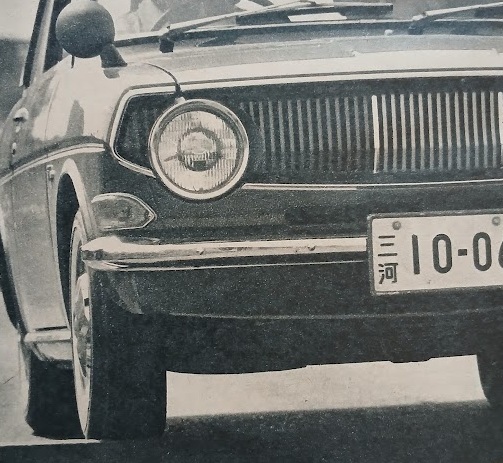
Hirao: Rather than saying whether it’s good or bad, I feel that the styling has been brought into line with current tastes. And then there’s that notchback shape at the rear—I suppose you’d call it the “hardtop notch”—which is becoming part of Toyota’s overall image. I get the feeling that Toyota’s styling has now been brought into one family line. The way the lower part of the rear pillar becomes a little thicker, and the general fullness of the body, make it feel very much like the Corolla’s little brother.
Magazine: You mentioned earlier that the vent windows had been eliminated partly for reasons of visibility. Was improved visibility the only reason for removing them?
Akiyama: It wasn’t only the field of vision. There are advantages and disadvantages either way, but when you’re driving on an expressway with the vent windows open, they also create a great deal of noise. From that standpoint, we thought it would be better to bring air in through the ventilator at the front.
Magazine: The “Boost Ventilator” also provides ventilation through the outlet at the rear of the unit, but models equipped with that system still have vent windows.
What we’d like to ask is whether Toyota intends, from now on, to move generally in the direction of eliminating vent windows like that.
Akiyama: As I said, there are preferences on both sides, and each arrangement has its advantages and disadvantages. So I think it will depend to a considerable extent on the thinking of the people responsible for each model—whether they decide that this car should retain vent windows while that one should do without them.
Hirao: Since customers have their own preferences too, perhaps that’s not a bad thing. Better than making everything the same…
Improved Safety
Magazine: We’d like to hear something about the body. The floor panel, for example, is made in five sections, which is different from the previous one-piece construction. What was the thinking behind that?
Akiyama: Safety was naturally one consideration, but another was production. Dividing the panels into sections improves material yield in production, among other things. With the previous Publica body, we had tended toward large one-piece pressings—the doors were pressed in one piece, for example, and the side panels were also made as large pressings. But when you consider material yield and various other factors, that entails considerable losses in other respects, so we decided to divide the panels into sections.
Safety has been improved considerably as well. Fundamentally, the body is constructed on the principle that even if the front or rear is crushed to some extent, the passenger compartment should remain intact.
Yamamoto: Looking at the technical description, I see there are three crossmembers. You didn’t arrive at that specifically because the floor was divided into sections, did you?
Akiyama: No, that came from considerations of body rigidity and strength. Similarly, the addition of side members at the rear and so forth also reflects consideration given to vibration and noise.
Magazine: What about the fact that it’s a two-door? The overall length has increased and there’s now a 1000cc engine, so it seems rather unusual to offer only a two-door body. What was the thinking there?
Akiyama: A two-door is simpler than a four-door, of course, so there is the question of ease of manufacture. Also, within our own model range, the Corolla already has four doors. We may produce one in the future if the need arises, but for now, when you look at our model range as a whole, we don’t see any particular need to make a four-door Publica.
Hirao: I think it would be fine as it is if the doors were just a little larger.
Akiyama: We actually made quite an effort to make them as large as they are.
0–400m in 17.7 Seconds for the SL
Magazine: Now, let’s hear about the performance testing carried out by the Hirao Laboratory.
Furutani: I’ll start with the 1000 Deluxe. Catalog weight is 680kg, and with the driver, recorder, and the instruments aboard, the additional load was 189.5kg, giving a total of 869.5kg. From a standing start, it covered 0-50m in 5.1 seconds, 0-100m in 7.8 seconds, 0-200m in 12.2 seconds, and 0-400m in 19.4 seconds.
For passing acceleration in third gear from 40km/h, it reached 60km/h in 8.5 seconds, 80km/h in 13.7 seconds, and 100km/h in 20.0 seconds. In top gear, accelerating from 40km/h, it reached 50km/h in 5.2 seconds, 60km/h in 9.2 seconds, 80km/h in 19.6 seconds, and 100km/h in 27.3 seconds.
The 1000SL weighs 690kg, 10kg more than the other 1000cc model, and with a load of 191.5kg the total was 881.5kg. From a standing start, it covered 0-50m in 4.7 seconds, 0-100m in 7.0 seconds, 0-200m in 11.1 seconds, and 0-400m in 17.7 seconds.
For passing acceleration in third gear from 30km/h, it reached 40km/h in 3.8 seconds, 60km/h in 8.0 seconds, 80km/h in 12.2 seconds, and 100km/h in 17.1 seconds. In top gear from 40km/h, it reached 50km/h in 4.9 seconds, 60km/h in 8.2 seconds, 80km/h in 15.2 seconds, and 100km/h in 24.1 seconds.
Hirao: Looking at those figures, somehow they don’t give me much of a “serow” impression. (laughs)
Magazine: Even so, its performance is better than the Corolla SL’s, and someone who owns a Sprinter SL might naturally find that rather curious. The Publica is considerably lighter than the Corolla, of course. Its top speed is about the same as the Corolla’s, while the Sprinter has a considerably higher top speed.
Considering that, though, it’s only natural that the Publica’s overall performance should be better.
Akiyama: Its weight per horsepower is slightly better.
If you think of that as giving the car a greater reserve of performance, then I don’t think it’s much of a problem if its top speed is a little lower.
Magazine: How do you see the relationship between Corolla SL customers and Publica SL customers?
Akiyama: People have different preferences, after all. The Corolla has its own virtues and the Publica has its own, so I think it really comes down to customers buying whichever one they prefer.
Higuchi: Quite a few people who drive the Corolla SL are relatively mature, and they drive it in a rather grown-up way. But this car is for the 20-year-old, so the important point becomes that it’s inexpensive and goes well. In that sense, I think a car like this would have more appeal if, rather than being fitted with all sorts of embellishments like a higher-class model, the interior were kept as simple as possible and the car focused purely on driving.
Hoshijima: I was talking with some people from Toyota, and they said, “There’s nothing wrong with the younger brother being better in a fight than the older one.” (laughs) Isn’t that about the size of it?
Magazine: We’ve been talking about economy quite a bit. Could we hear the results of the fuel-consumption tests?
Sano: Here are the fuel-consumption test results. We tested only the Deluxe. First, for steady-speed fuel economy, in top, or fourth gear, we recorded 28.5km/l at 40km/h, 25.5km/l at 60km/h, 21.7km/l at 80km/h, and 17.0km/l at 100km/h. We heard earlier that the official figure is 25km/l, but the results were quite good—better than we had expected. The fact that there were three people on board, and that the temperature that day was quite warm, around 25°C, may have had some effect, but these are still very good figures.
Next, for our simulated urban-driving fuel-consumption test, as usual we set maximum acceleration at 0.3g. With an indicated speed of 40km/h, the average speed was 22.6km/h and fuel economy was 17.8km/l. With an indicated speed of 60km/h, the average speed was 25.4km/h and fuel economy was 14.2km/l.
Magazine: Is there anything in particular you’ve done to achieve such good fuel economy?
Akiyama: I suppose it’s just a Toyota tradition. (laughs)
Hoshijima: I actually made a round trip between Tokyo and Nishinomiya, and despite accelerating fairly quickly, it returned somewhere between 14 and 15km/l.
It wasn’t on the same day, but when I made the same trip in a Corolla, I got a little over 11km/l, so I would say the Publica is perhaps 15% better. The difference from the Corolla is probably mainly the difference in weight.
Hirao: Weight and frontal area must be the major factors.
Weak in Crosswinds?
Magazine: We didn’t carry out handling tests this time, so we’d like to hear everyone’s impressions instead.
Hoshijima: The thing I noticed most about the handling was the effect of crosswinds on the Tomei Expressway. That was very tiring. The car was good in other respects, but I had the impression that it was very susceptible to crosswinds, and I had to concentrate quite hard on correcting for them. There seemed to be a slight delay in its responses to the corrections.
Hirao: I can imagine it giving that impression. If you look at the silhouette in profile, the center of area is relatively far toward the rear, so the car has an oversteering characteristic in response to a crosswind. The effect of the crosswind then appears with a considerable phase lag. By the time it does, you’re still steering in the direction in which the effect is developing. So even if a gust hits and you feel the initial disturbance, you shouldn’t immediately anticipate it and correct. You need to wait a little before applying the steering correction.
Shibata: I wonder if this car has less cornering power than the Corolla. I ask because, when I tried cornering on the Murayama test course, although the cornering force was building up, I very much had the feeling that the cornering power wasn’t sufficient—or rather, that the tires were skipping across the surface. Could that be because its cornering power is lower than the Corolla’s?
Yoshii: No, it isn’t. The tires are the same.
Shibata: The tires seem to slide across the road surface.
Hirao: Almost as though the car were hopping like a rabbit… I wonder if that’s related to the suspension frequency. When you have a relatively large engine for the weight of the car, the engine braking also comes in quite strongly, so if you’re not careful the rear end can slide. You have to operate the controls very smoothly as a result.
Hoshijima: That’s particularly true of the SL.
Higuchi: That’s why I feel that this new SL is fine for younger drivers, but not really suited to older people. I think it’s an entertaining car for young people.
Hoshijima: Perhaps it’s because the track has been widened while the wheelbase has become slightly shorter, but I actually preferred the way it felt in corners to the Corolla.
Magazine: The previous Publica had a reputation for good road-holding. Would you say that quality has been carried over to the new model?
Hirao: The previous Publica had a torque-converter model. Am I right that there isn’t one for the time being?
Akiyama: Yes. Toyota Motor Sales has asked us to produce one.
Lower Interior Noise
Magazine: Now we’d like to hear the Watari Laboratory’s suspension vibration and noise data.
Tateishi: Here are the suspension vibration and noise results. First, I should mention that in the past we’ve often made comments about idle noise, so this time we’ve included two measurements at idle: interior and exterior noise.
First, suspension vibration. We were told that the spring rates are the same for the Deluxe and SL, so we measured only the Deluxe. The sprung-mass frequency was 1.35cps at both the front and rear, while the rear rigid axle gave a figure of 1.55cps.
The unsprung frequency was 15.0cps at both the front and rear.
For interior noise, starting with the Deluxe, we recorded 62 phons at 40km/h, 69 phons at 60km/h, 71 phons at 80km/h, 75 phons at 100km/h, and 78 phons at 120km/h. For the SL, the figures were 64 phons at 40km/h, 69 phons at 60km/h, 71 phons at 80km/h, 76 phons at 100km/h, and 80 phons at 120km/h.
For exterior noise, the Deluxe recorded 67.5 phons at a steady 50km/h and 78 phons under acceleration. The SL recorded 69 phons at a steady 50km/h and 83 phons under acceleration.
Returning to vibration and ride comfort, we also compared the new car with the previous 800 as a reference point. The sprung-mass frequencies are almost exactly the same. As for the unsprung side, I think the new car is very good in terms of vibration and ride comfort. The same applies to interior noise: compared with the previous Publica 800, it is some 6-7 phons quieter, and a great deal of effort clearly seems to have gone into that area.
Exterior noise on the Deluxe is also very low, both at steady speed and under acceleration, which is excellent. The SL naturally differs somewhat in specification, but its steady-speed figure is very good. Its acceleration noise exceeds 80 phons, however, so I would say that is relatively loud.
One other point concerning noise: subjectively, the sound of the turn-signal mechanism seems very cheap.
Hirao: That’s the kind of sound you really shouldn’t hear in a car, isn’t it? That koton-koton sort of noise.
Tateishi: It was quite unlike the sound you normally hear in a car, so it made me wonder what it was.
Akiyama: Yes, we have had comments along those lines. We hadn’t used it on the Publica sedan before, but we had been using it for some time on our van range, and we’d had virtually no complaints. Perhaps the way the vehicles are used is different, but we thought the time had come when we could go ahead and use it. Once you put it in a sedan, though, I suppose different things come up.
Hirao: If it were a noisier type of vehicle, I suppose it couldn’t be helped.
Light, Effective Brakes
Magazine: Now we’d like to hear the weight-related data measured by the Ship Research Institute.
Ishikawa: First, the 1000 Deluxe. With the spare tire and tools on board and a full tank of gasoline, its curb weight was 703kg. The left front wheel load was 184kg and the right 204kg, while the left rear load was 156kg and the right 160kg, giving a front-to-rear distribution of 55:45. With five people on board, the rear naturally becomes much heavier, and the distribution changes to 47:53.
As for wheel alignment, with one person on board, the front wheels showed only a very slight amount of rearward slip, while the rear wheels were slightly on the toe-out side. Looking at the individual alignment factors, the front had moderate amounts of toe-in and camber. At the rear there was slight toe-out together with negative camber. With five people aboard, the rear changed hardly at all, while both toe-in and camber at the front decreased.
As for the SL’s weight and wheel alignment, it was 8kg heavier, giving a total of 711kg. The weight distribution was 55.6% front and 44.4% rear, so it was virtually the same. The initial alignment was slightly different: in the straight-ahead condition, both the front and rear wheels showed a slight tendency toward toe-out, but the overall tendency in toe and camber was essentially the same as on the 1000 Deluxe.
As for the brakes, the 1000 Deluxe has hydraulic internal-expanding drum brakes, twin-leading at the front and leading-trailing at the rear. In both forward and reverse operation, and particularly going forward, the braking forces at the left and right wheels were very well balanced. The braking-force distribution was 67:43, and the pedal effort required for 0.6g deceleration was 21kg. In the road test, applying the service brakes from 50km/h required 22-23kg for 0.6g deceleration, so there was very little difference from the bench test, with only slightly higher effort.
On the SL, the service brakes are discs at the front and leading-trailing drums at the rear, without servo assistance. The braking-force distribution was 56:44, so the proportion at the front was lower than on the 1000 Deluxe. Pedal effort for 0.6g deceleration was 23kg, slightly heavier than on the 1000 Deluxe. On the road, however, the result was the opposite: from 50km/h, only about 17kg of pedal effort was required for 0.6g deceleration. That was lighter than the bench test result and lighter still than the 1000 Deluxe, so the brakes are very effective.
On the 1000, the front brakes begin to take effect with about 1kg of pedal effort and the rear brakes at around 3kg. Judging from the chart, at about 4kg the drums have taken up fully, and by that point the pedal stroke has increased to about 35mm. Beyond that, the system suddenly becomes much more rigid and the effort rises consistently. The effective spring rate is 0.7kg/mm. The SL with its disc brakes shows almost exactly the same characteristic, and its spring rate is likewise about 0.7kg/mm.
Next, the parking brake is a mechanically operated, floor-lever type acting on the two rear wheels. The left and right braking forces are very well balanced for a parking brake. Its operating effort of 19kg is quite light, yet produces a braking force equal to 20% of the vehicle weight.
As for the various control efforts, the floor-mounted gearshift generally requires about 1.5-2kg. Moving the lever sideways into the reverse gate requires 5kg, so there is a definite step in the feel. The windows felt somewhat difficult to wind up and down, although the actual operating effort was low, at 1-2kg.
Production to Reach 18,000 Units by Year-End
Magazine: Next, we’d like to hear the visibility measurements.
Hirata: These results are for the 1000 Deluxe. We took measurements with the seat in the forward, center, and rearward positions, but I’ll give you the figures for the center position here. The camera focal point was 120.5cm above the ground, 45cm from the windshield, and 46cm from the center of the rearview mirror.
Through the windshield, the field of vision was 37° to the right and 61.5° to the left, for a total of 98.5°. Vertically, it was 11° upward and 13° downward, for a total of 24°. Through the rear window, the visible range was 6° to the right and 45° to the left, for a total of 51°. Vertically, it was 3.5° upward and 7.5° downward, for a total of 11°. The area swept by the wipers, measured from the center seat position, was 28° to the right and 51° to the left, for a total of 79°.
The total dead angle in the horizontal plane through the driver’s eyepoint was 44.5°. Of that, 15.5° was directly ahead, 10° to the right front, and 5.5° to the left front.
Yamamoto: Comparing the current Publica 1000 with the previous 800, there isn’t much difference in the angles of visibility to the left and right. The overall dead angle, however, is smaller than before. I don’t think that’s simply because the vent windows have been eliminated; visibility in the other areas has improved as well. The solid angle of the visible field is better than before, and the blind area through the rear window has also been improved.
Hirata: I think eliminating the vent windows was a very good decision. The old ones were large, and when it rained you couldn’t see through them. Without them, you can see without having to crane your neck forward, so I think that’s an improvement.
Magazine: Now we’d like to hear the dimensional measurements carried out by the Higuchi Laboratory.
Onda: Here are the results. The most noticeable change to the body as a whole is the elimination of the vent windows. The two doors are large, while the body as a whole has not become particularly large, and I think this reflects an intention to increase the sense of space inside.
The rear seat is now rated for three people, although dimensionally the previous Publica already came quite close to providing the necessary space. Various measures have also been taken with the inner door panels to make the interior wider and easier to use, and the rear seat is quite good. In arranging everything within the available space, however, I get the impression that the accelerator pedal has been squeezed into a rather awkward position. Perhaps that was done to gain as much fore-and-aft room as possible, or perhaps it’s a consequence of having the fuel tank directly behind the rear seat.
Other things I noticed were that the steering-wheel diameter has been made slightly smaller, and that the glovebox has been eliminated in favor of an under-tray where things can easily be placed. There are also three-point seat belts. The door lock, however, ends up behind your back, which makes it quite difficult to release. I think the lock on the driver’s side is especially awkward to operate. It would be better if it could be located somewhere else.
Hirao: Why couldn’t it be placed farther forward? Especially now that the vent window is gone.
Magazine: Professor Higuchi, could we have your assessment of the safety aspects?
Higuchi: Up to now, 1000cc cars costing around 400,000 yen have generally scored about 70 points out of 100. The previous Publica in particular was an older design, so its score was rather low. This time, however, everything is there, including safety equipment normally found only on higher-class cars. The result is 78 points out of 100, which I would say puts it roughly one class higher.
As for maintenance, I thought it was very good. If you change the oil every 1,000km, there’s no need even to attend to the cooling water.
As for the owner’s manual, a great deal of care has gone into explaining everyday driving, expressway driving, and the operation of the car. Looking at the manuals from various manufacturers up to now, many made you wonder whether they were owner’s manuals or service manuals. With this one, I think an owner can read it and really understand it.
Magazine: Finally, we’d like to hear about your production plans.
Akiyama: Initially, we’re planning on 12,000 units in total. By the end of the year, we’d like to bring that up to around 18,000. The Corolla is the Publica’s big brother, of course, so we intend to keep increasing its production as well. Of the 12,000 Publicas, 8,000 will be passenger-car models and 4,000 vans.
Magazine: How many have been sold since the car was introduced in April? And has there been any effect on the Corolla?
Nakaoka: A little over 9,000 for the series as a whole. The Corolla is also doing well.
Magazine: Thank you all very much for your time.
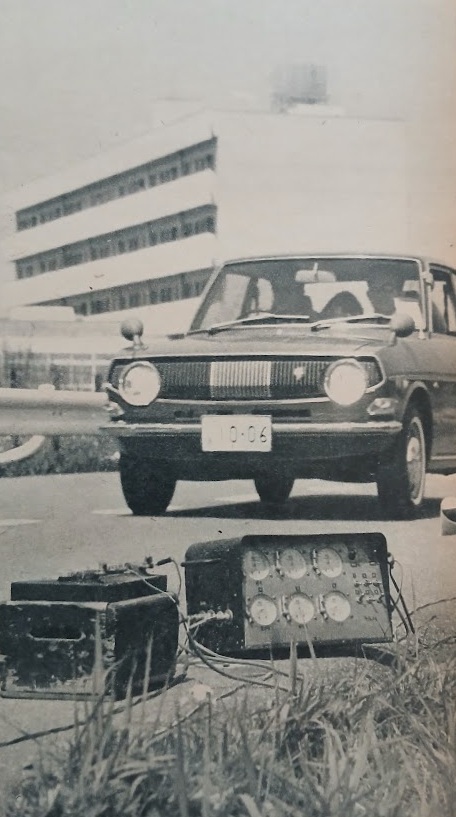
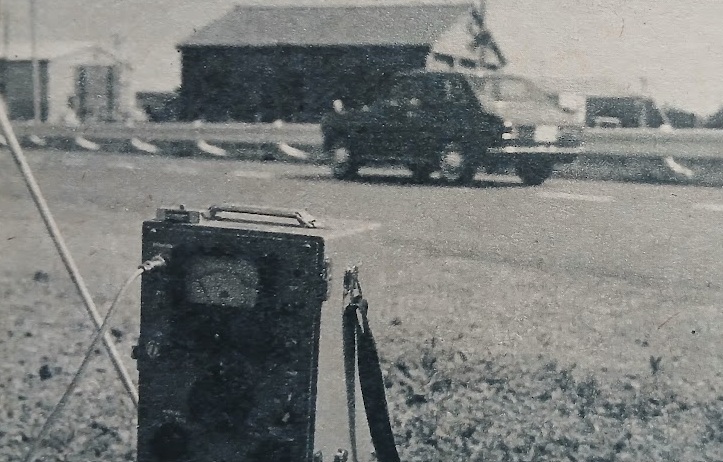
Postscript: Story Photos