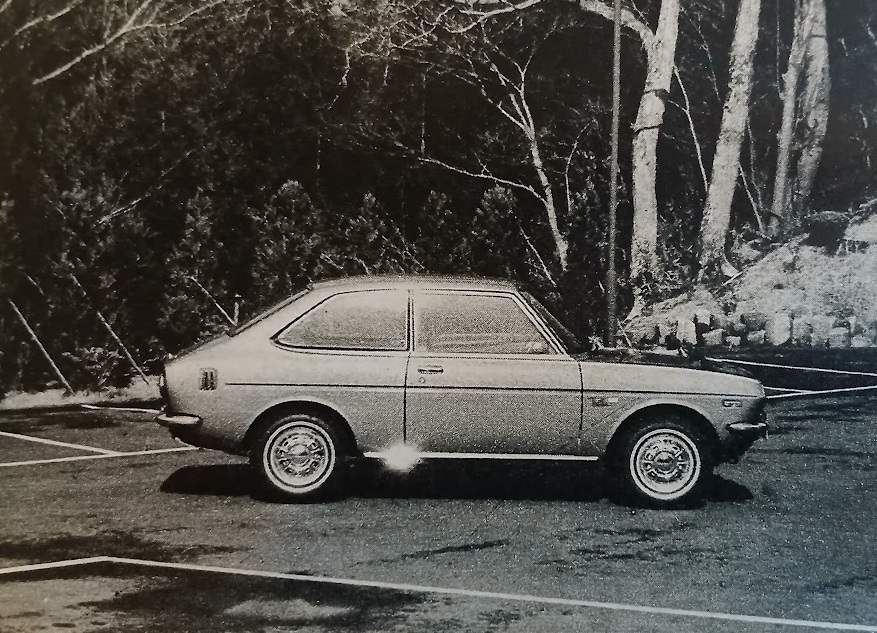
Toyota Publica 1200XL (1972)
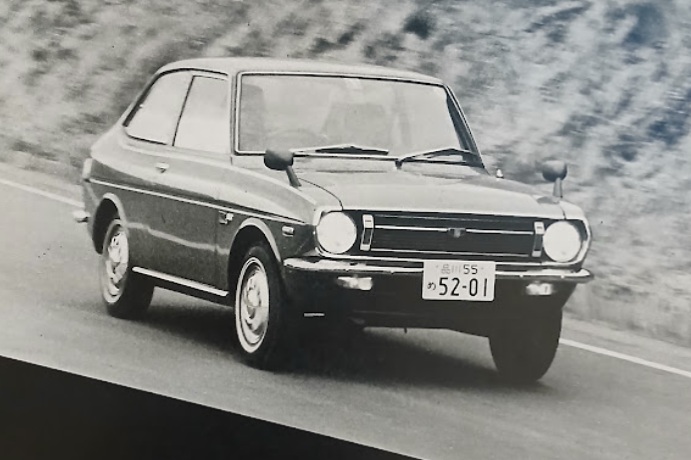
Publication: Motor Fan
Format: “Bubble Index” Road Test
Date: April 1972
Authors: Osamu Mochizuki, Katsuzo Kageyama, Shigeki Asaoka, Yasuhei Oguchi, Reiko Ikuuchi, Kensuke Ishizu
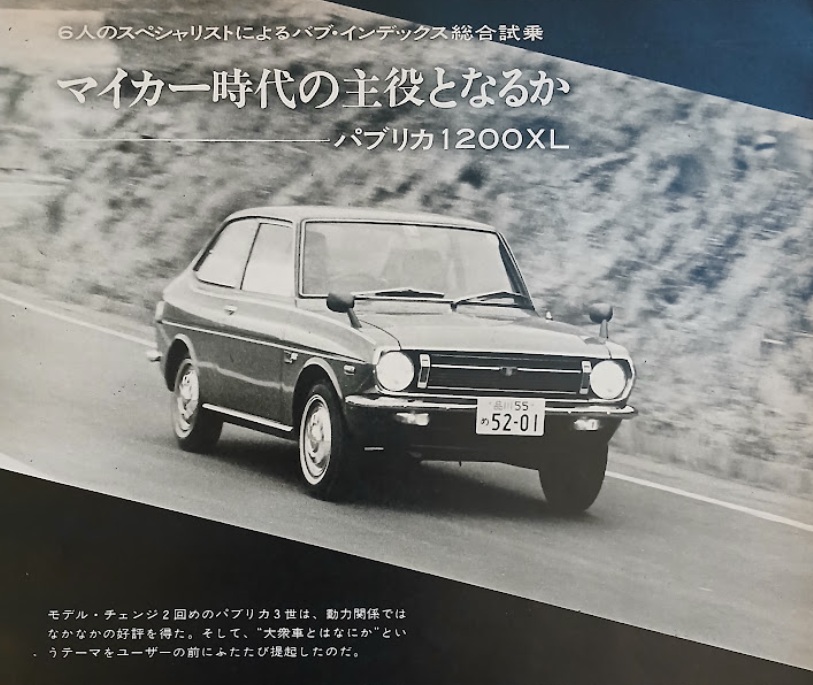
Will It Become the Leading Player of the “My Car” Age?
The third-generation Publica, now in its second model change, won considerable praise for its powertrain and performance. At the same time, it once again poses the question to users: “What should a mass-market car be?”
Questioning the Fundamentals of the Mass-Market Car
The Publica has undergone a full model change. Since its debut in 1961, this is its second, following the model change of 1969.
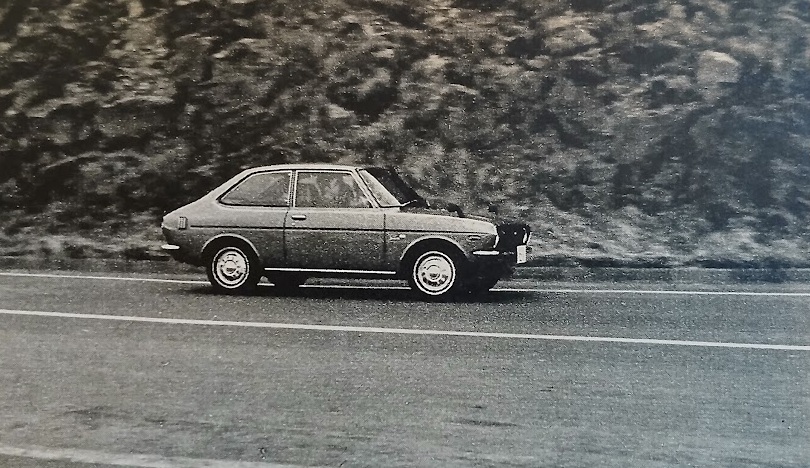
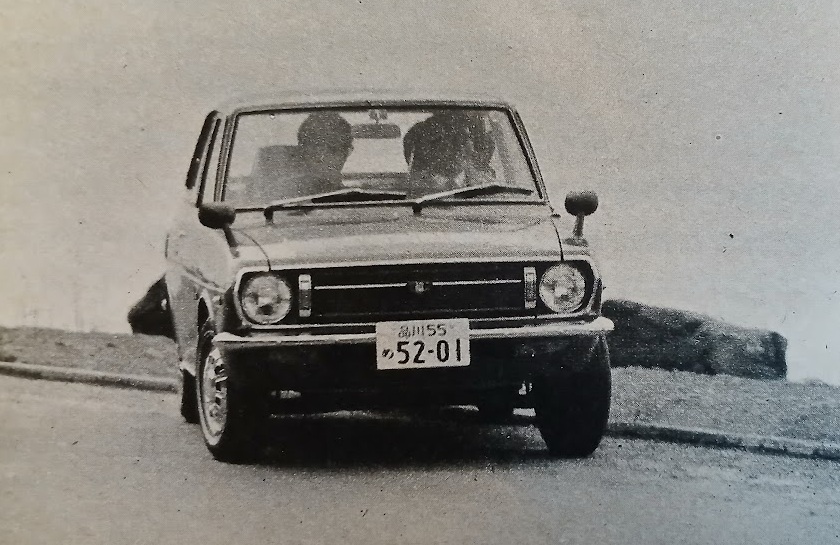
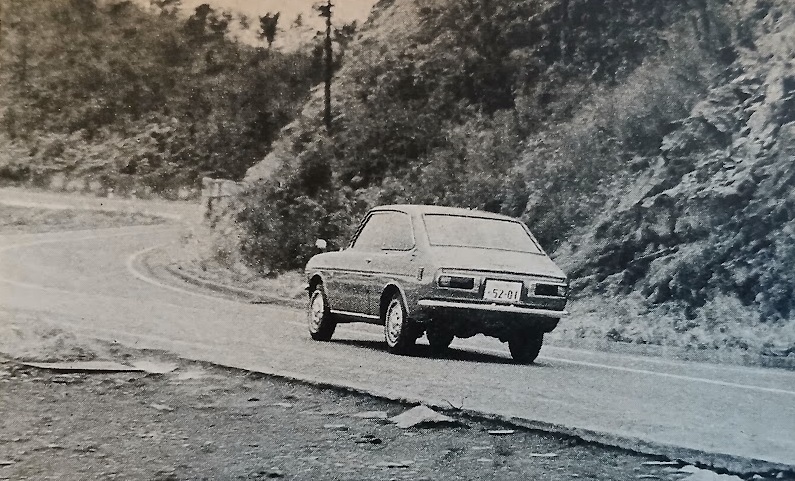
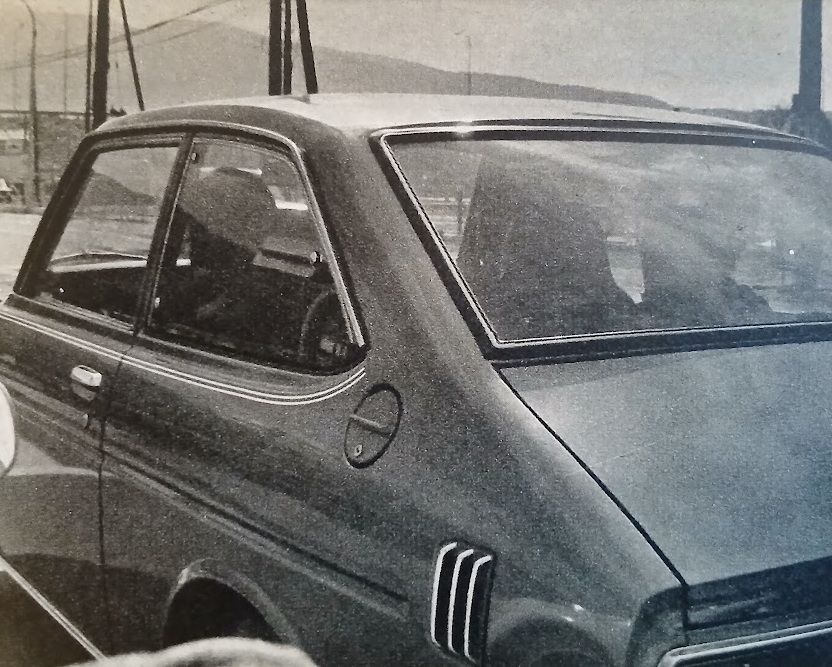
In 1969, however, virtually everything from the engine to the styling was changed or expanded, whereas this time the changes are limited mainly to styling. In overall character, the styling has moved away from the previous rounded, compact and practical look toward something slimmer, smarter and with a more playful feel.
Three engines are offered. In descending order of performance, they are the 3K-B (1166cc, 77ps), the 3K (1166cc, 68ps) and the 2K (993cc, 58ps). The 3K-series engines are used mainly in the “Young” series, while the 2K is fitted to the “Family” series.
The sole exception within the Family series is the 1200XL tested here, which is equipped with the 3K engine.
The two series can readily be distinguished at a glance by such details as radial tires (fitted to the Young series, but not the Family series), rectangular fog lamps (Young only), and the shape of the fender mirrors (sports mirrors on the Young series, conventional ones on the Family series).
As usual, our test group set out from our base at “Fantasy,” the drive-in on Tamagawa-dori near the Tokyo Interchange of the Tomei Expressway. Under the hazy winter sunlight, we drove the test car from the Tokyo Interchange along the Tomei to Gotemba, over the Otome Pass and onto the Hakone Turnpike, then back by way of the Otome Pass and the Gotemba Interchange to Tokyo.
At the meeting following the test, discussion began with our overall impressions of the Publica, before moving on to the broader question of just what constitutes the so-called mass-market car in the Publica class.
As for the driving impressions themselves, the general view was that “in terms of performance, handling, and stability, there is nothing in particular to talk about.”
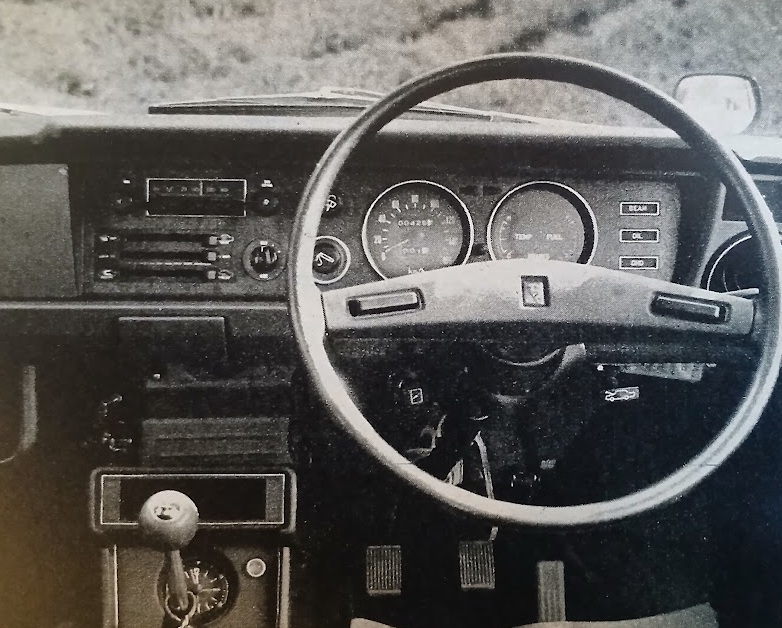
The interior, however, drew the same complaints of over-decoration that we have made of other cars. Although this is a mass-market car, its instruments and other equipment are so elaborate that they rival those of cars in the 2000cc class. Some felt that, for a car costing around 500,000 yen, it was almost too well equipped.
The discussion even extended to the concern, perhaps premature, of whether buyers should really be so pleased by the “magic” that gives a 500,000-yen car such a luxurious appearance.
For further details, we invite you to read the individual reports from each of our specialists beginning on the following pages.
Performance: An Ideal Family Car (Osamu Mochizuki)
The new Publica has been introduced with completely revised interior and exterior styling, but as far as the power unit is concerned, it is basically the same as before.
In the Young series, the main engine is the 77ps 3K-B, while the Family series uses two engines: the 68ps 1200cc 3K and the 58ps 1000cc 2K.
The 1200XL tested here is the top model in the Family series, and the only one fitted with the 1200cc engine. The other three models in the series—the Hi Deluxe, Deluxe, and Standard—are all 1000cc.
In terms of performance, to put it simply, the 1200XL has more than enough power for family use. Judging from this performance level, the Young series, one step up in terms of power, should provide the high performance expected of it, while the 1000cc models below should combine the motivation and economy appropriate to the Family series.
Even considering nothing more than performance within a single model range, Toyota’s seasoned skill in car design can be seen in the way it has created such a well-balanced system.
The 1200XL has undergone extensive changes in the body and has consequently gained some weight, ending up at 690kg. Even so, a vehicle weight under 700kg in a car of this size is itself evidence of good performance, and in practice the available 68ps is put to full use.
The power-to-weight ratio is 10.2kg/ps, a very good figure for a small-engined family car. By comparison, in the Corona Hardtop series, the 1600 has a figure of 11.3kg/ps and the 1700SL 9.3kg/ps, so the Publica compares favorably even with cars several classes above it.
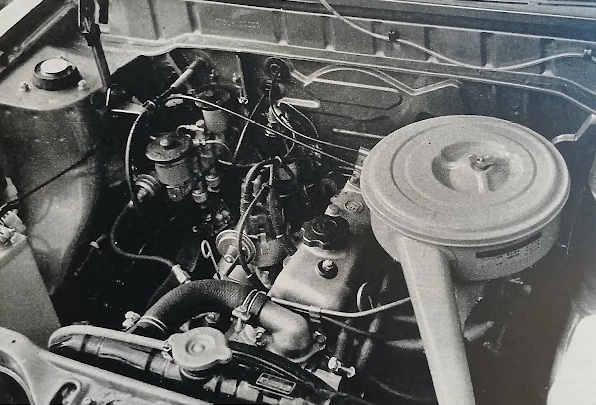
The 3K engine already has four years of service behind it and gives the impression of being a thoroughly matured design. It is extremely compact, weighing only 95kg itself—around 10kg less than other engines in its class. This makes a significant contribution to reducing overall vehicle weight.
Bore and stroke are 75 × 66mm, making it decidedly short-stroke. As a result, mean piston speed is a relatively unhurried 13.2m/sec.
Its main characteristics are strong mid-range torque and a smooth, free-revving nature. Whereas the 3K-B develops its maximum torque of 9.6kgm at 4600rpm, the 3K produces an almost identical 9.5kgm at only 3800rpm. That difference of 800rpm is significant.
In city driving, the 3K clearly has the advantage. Even with three adults aboard, the “no-snatch speed” in top gear—the lowest speed the engine can pull without knocking—is around 30km/h.
Performance at the upper end is also quite good, with acceleration still in reserve even beyond 120km/h. Overall running noise, including engine noise, does not become especially high, so neither does the strain on the driver.
Provided one does not mind the somewhat limited interior space, this could be called an ideal family car. The fact that a car like this can be bought for 510,000 yen certainly makes it seem that the age of personal car ownership has arrived.
“There is nothing particularly remarkable about it, but in fact perhaps it is precisely this ordinariness that makes it so well suited as a family car.” — Oguchi
Handling & Stability: A Distinctive Feel to the Steering (Katsuzo Kageyama)
My first impression upon sitting in the car was of its good visibility. There are few troublesome blind spots, not only in the front but also to the sides and rear. In many cars, the fender mirrors, particularly the one on the left, are difficult to see, but there is no such problem here. The view feels remarkably open and unobstructed.
In terms of ease of operation, the layout shows great attention to detail, and the shift lever and various switches are well placed and easy to use. In a car one is driving for the first time, it is often necessary after setting off to hunt around for the location of a switch, causing momentary confusion, but I experienced none of that in this car. It may seem like a small thing, but it is in details like these that one senses the experience accumulated through years of carmaking.
The interior makes good use of the available space and succeeds in providing a comfortable interior for such a small car. The right-front wheelhouse does make the area around the accelerator pedal somewhat cramped, and that may simply have to be accepted as inevitable in a small car. What I cannot understand, however, is the considerable difference in height between the accelerator and brake pedals.
One could say that anything stops being a problem once one gets used to it, and that may be true. But the fact that it was awkward at first means that it will remain awkward until one does get used to it. Since there is so little else to criticize, I cannot help feeling that something ought to be done about this point.
The first thing I noticed after driving away was that the steering had a distinctive feel of its own. I once heard that a certain manufacturer uses the informal term “N-buka” to describe a particular steering feel.
Apparently it means that “the steering feels buka, or loose, around neutral, making the straight-ahead position feel undefined.” As I drove along the expressway, I found myself thinking, “So this must be what they mean by ‘N-buka.’” The steering lacks feel around the neutral position, and as a result, it demands constant attention when driving straight ahead.
Yet when the wheel is turned in cornering, there is a solid, substantial feel that approaches being heavy. There is little friction in the steering system, which is a good point. When I tested its hands-off stability, however, I had the impression that its convergence was somewhat poor.
Perhaps because this is a Family-series model, the suspension seems quite soft. This is good for the ride, but when the car gets into a bouncing motion at high speed, it tends to feel unsettled. The Young series is probably given firmer suspension settings.
Performance is quite impressive. Even though the Family series is fitted with the milder engine, its response is remarkably lively. Luxurious equipment and excellent performance in what is still a mass-market car—these seem to be the core of its appeal.
“Perhaps it is about what one should expect considering the class of car, but if I could ask for more, I would like to see somewhat less phase lag in its handling response.” — Oguchi
“The handling and stability have improved considerably compared with past years.” — Mochizuki
Interior & Comfort: A Softer, Warmer Interior, Please (Shigeki Asaoka)
It has already been more than ten years since we first heard the name Publica. How quickly the time has passed.
Before the Publica appeared, there were still relatively few cars in Japan. The government and relevant ministries therefore encouraged the development of the automobile and related industries, with the aim of bringing the Japanese standard of living closer to that of Europe and America as quickly as possible, while promoting the concept of an inexpensive and economical “people’s car.”
Toyota stepped forward to build such a car, modeling it after the West German BMW 700—and the result was the Publica. Perhaps for that reason, the car they produced was unusually unconventional by Toyota’s standards, even adopting a 700cc air-cooled, horizontally opposed two-cylinder engine similar to that of the BMW.
Five years later, displacement was increased to 800cc, and three years after that came a complete model change, with styling closely resembling that of the popular Corolla.
At that stage, the original air-cooled two-cylinder engine still remained as one of the available versions, while new water-cooled inline four-cylinder engines of 1000cc and 1200cc were added. This year brought the second model change, and the air-cooled engine that had been there from the beginning finally disappeared, leaving a choice of two water-cooled engines, of 1000cc and 1200cc.
The car we tested was the XL of the Family series, with the 68ps water-cooled 1200cc engine. Although it has undergone a model change, the car’s overall character does not seem all that different from before, and it certainly did not give a strong impression of freshness as a new model. Nevertheless, it is an agreeable car that goes very well.
As can be said of most Japanese cars, this one seems somewhat over-decorated. Even so, the interior is among the better examples and comes together quite well overall.
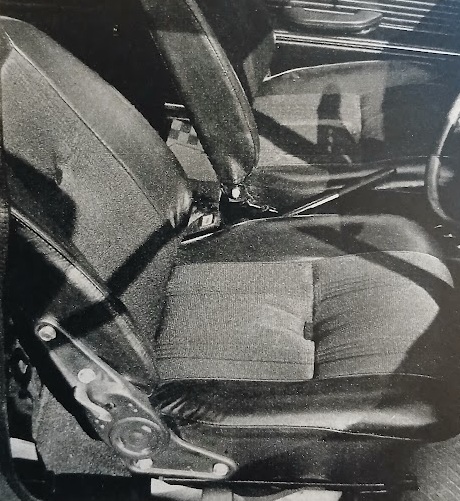
The upholstery and seats are unified in black leather. This, too, is probably a result of the recent fashion for sporting moods, but I am quite tired of getting into one car after another and having to drive in a tense, focused atmosphere surrounded by black.
With popular “owner-cars” like this, surely the manufacturers should be the ones educating users to appreciate the need for softer, warmer interiors. Buyers are fickle and habitually ask for whatever they do not have. Manufacturers ought to have the conviction to say a firm “no” to users’ unnecessary demands.
This car also has a heated rear-window defogger as standard equipment, while an air conditioner is also available as an option. But when everything is provided in this way, the sense of value attached to each individual item somehow becomes diluted, and one begins to take them for granted. The meaningless over-decoration of recent kei cars has diminished their very reason for being, but when this Publica, with an engine three or four times as large as that of a kei car, costs hardly any more, what more is there to say? If the Publica had placed greater emphasis on simplicity and rationality, as did the original model, it might have achieved even greater success by now. Then again, manufacturers themselves sowed the seeds of this over-decoration, so perhaps their true feeling now is that there is little they can do about it.
“It can certainly be called quiet.” — Kageyama
“It tends to pick up joints in the road surface.” — Oguchi
Safety: Careful Attention to Safety in Every Detail (Yasuhei Oguchi)
Up through the 800cc models, the Publica was an interesting series of cars that emphasized economy and pursued the essential functions to match. More recently, however, it has become more luxurious with each model change, and as a result has lost some of its uniqueness.
Perhaps the Japanese concept of product appeal has caused the old Publica philosophy to change, but it may simply be difficult to develop a truly “gutsy” car (that is, one of real substance). With the latest model having become more expensive, and the Young series now added with SR and S versions, the old slogan “Gutsy Publica,” which suited the earlier Publica so well, no longer seems fitting.
The 1200XL from the Family series that we tested is notable for the mellow driving feel and ease of use common to Toyota cars. It may be ideal as everyday transportation. At the same time, however, it is such an ordinary car that one is almost tempted to say its lack of any distinguishing features is itself its distinguishing feature.
In terms of safety, the overall standard has been raised. One particularly impressive point is that the control switches and knobs are easy to identify and positioned for easy use. The light switch can be grasped quite naturally simply by moving the right hand slightly forward from the steering wheel.
The knob for the four-way flashers alongside it has a small projection that gives it a different shape, so it can be distinguished from the light switch by touch, eliminating the danger of operating the wrong control. The less frequently used wiper control is on the left-hand side, while the heater, with a choice of fresh or recirculated air, uses pictograms to make its operation clear.
For a model bearing the name Family series, the thoroughness with which ease of operation has been pursued is commendable.
Accident-avoidance capability, the cornerstone of safety while driving, seems well balanced through a combination of mild handling and stability, appropriate acceleration, and a braking system incorporating an alarm-equipped tandem master cylinder and a P-valve to prevent rear-wheel lockup.
Taken individually, none of these features is especially unusual. But they have all been set at sensible levels without excess, and as a whole seem to increase the driver’s sense of security.
In addition, the electrically heated rear-window defogger has been carried over from the previous Publica, while Toyota’s patented collapsible steering wheel is now standard equipment. At a time when accidents involving stolen cars are common, the steering lock can also be regarded as a “safety” measure in the broader social sense.
Visibility is good both front and rear, and the upper edges of the high-back seats were not bothersome. To the sides, the fender mirrors are oval in the horizontal direction, providing a wide field of view; moreover, because the mirror surfaces have relatively little curvature, it is easy to judge the apparent distance of reflected objects.
“The brakes are soft.” — Kageyama
“The brake pads don’t seem to have bedded in yet.” — Mochizuki
Economy: Still an Economical Car (Reiko Ikuuchi)
The Tokyo price of the Publica 1200XL is 510,000 yen. Since the XL is a newly introduced model, no direct comparison can be made with the previous version.
Taking the basic sedan model as an example, however, the price has risen by 10,000 yen over the previous model. On this point, newspapers and other publications have reported the change under headlines that almost suggest the model change was simply an excuse for an opportunistic price increase. That bothers me somewhat.
The reason is that this model change has brought significant improvements. Not only has overall length increased by 50mm, but the bumpers and rear reflectors have also been enlarged, while a steering lock is now standard on every model. The overall impression is very much one of the car having moved up in class. Compared with the Publica as it was when first introduced ten years ago, the increase in stature is remarkable.
The Publica 1200XL tested here has 68ps, while the 1200ST has 77ps. Ten years ago, the Crown 1500 had 60ps and the Crown 1900 80ps. In other words, the Publica now has power comparable to that of the Crown of those days. Its maximum speed is significantly higher. Ten years ago, even the standard Crown cost 770,000-790,000 yen.
Still, pricing in this class is a delicate matter. Those setting the prices must have had a difficult task, and it is equally difficult for buyers to decide whether they are getting a bargain. Below this class, kei passenger cars are packed closely together, while immediately above it the 1200-1400cc popular class is equally crowded. The Publica’s price range overlaps both of these classes:
Kei cars (five manufacturers combined): 320,000–471,000 yen
Publica: 405,000–530,000 yen
Corolla: 438,500–654,000 yen
With this overlap in price, some buyers may think that rather than purchasing one of the cheaper Publicas, they might as well choose a kei car with lower running costs; while if they are going to buy a Publica, they might instead move up to a Corolla.
Yet the range has been cleverly arranged: the least expensive 1200cc Publica model, the 1200S, can be bought for almost exactly the same price as a top-grade kei car.
In this way, Toyota is seeking to capture buyers looking to move up from a kei car.
Meanwhile, for the price of the top model in the Publica Family series, one can buy only a Corolla two-door Deluxe, with the Hi Deluxe still above it. Some buyers may therefore decide that they would rather have the Publica.
Vehicle inspections for kei cars are scheduled to begin in October 1973. This will reduce their economic advantage accordingly, and it is certainly true that attention is turning to the economy of the Publica class, the smallest cars carrying 5-number registrations.
After two years of use, residual values are 27% for kei cars, 40% for the 1000cc class, 37% for the 1500cc class and 30% for the 2000cc class. The Publica class is the best of these. (Figures from the Japan Automobile Appraisal Association; data for the 1200cc class were not available.)
Overall, then, it must still be regarded as an economical car that offers a luxurious atmosphere at a relatively modest price.
“To get the same performance and equipment as this car fifteen years ago, you would have had to pay three times as much.” — Asaoka
Product Appeal: Where Is the “Selling Point”? (Kensuke Ishizu)
As civilization has advanced, a process of standardization has taken place in every field, from clothing, food and housing onward.
Before that came the age of what might be called hand-made things, where the objects around us and the environments in which people lived each had a certain individual character. But the new uniformity brought by modern civilization has little of that character; instead, mechanical straight lines and flat surfaces have become the elements which make up everything.
For a time, the beauty of these straight lines and flat surfaces was admired. But now that they have become ubiquitous, people are beginning to feel thoroughly tired of them.
People have had enough of the civilization they have created, and of the things that civilization now imposes upon them.
The same phenomenon can be seen in the world of fashion. One example is what is called “total fashion.” The idea is to coordinate everything from head to toe in a tone of one’s own choosing, and it is particularly popular among young people.
Young people today tend to resist it when a supplier provides everything as a complete package, from one to ten, and presents it at a fixed price.
The same is true of cars. Most of the cars on the market today are, generally speaking, over-decorated. There is something unsatisfactory about being presented with a price that includes all sorts of extras that are unnecessary simply for normal driving.
Today, one approach to selling is to offer the product in its original, basic form and allow consumers to choose whatever they wish to add. Furniture provides one example. A sofa may be sold bare, leaving the buyer free to choose whether to cover it in fabric or leather. This is called “nude furniture.”
The same approach is used in travel with various vacation “packs.” Only the round-trip route to a particular area and the fare are fixed, while at the destination a free-time system is used. Transportation and other expenses there are left to the traveler.
Couldn’t the same thing be done with the Publica? If cars in this class offer more or less the same performance, their advantages as products come down to price or appearance. Yet in both respects, the Publica and its rivals in this class are much of a muchness.
If that is the case, why not offer a low-priced “nude car,” equipped with only the bare necessities, and allow buyers to select optional equipment according to their own tastes?
I have written before in these pages about the idea of a “return to things”: that we have passed the age in which products should be sold on “mood,” and that they should instead be sold on their own intrinsic value. From that point of view, just what is the Publica’s “strong point”?
“It seems that the idea of ‘keeping a mass-market car simple and inexpensive’ does not actually work in practice.” — Kageyama
“More than its luxurious atmosphere, what strikes me first is that the Publica has lost its uniqueness.” — Oguchi
“The body styling has become much cleaner with the extended hood and the adoption of a semi-fastback shape.” — Mochizuki
How to Read the Bubble Index
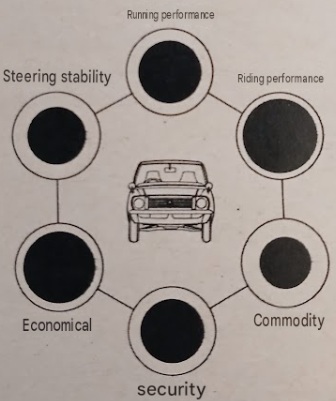
The aim of this comprehensive test series is to evaluate a car’s overall performance by using six key pillars as reference points: power performance, handling and stability, comfort and usability, safety, economy, and product appeal. The evaluation method is what we call a “bubble session:” a systems-engineering approach in which six specialists from different fields gather around a hexagonal table (the “bubble,” like a honeycomb) and exchange their views.
Each category is represented by a circle, with the shaded (black) portion indicating the evaluation score. When the size of these filled circles is roughly equal, the car can be said to be well balanced across all areas. When they vary significantly, the result is a car with a more distinctive, individual character.
Postscript: Story Photos