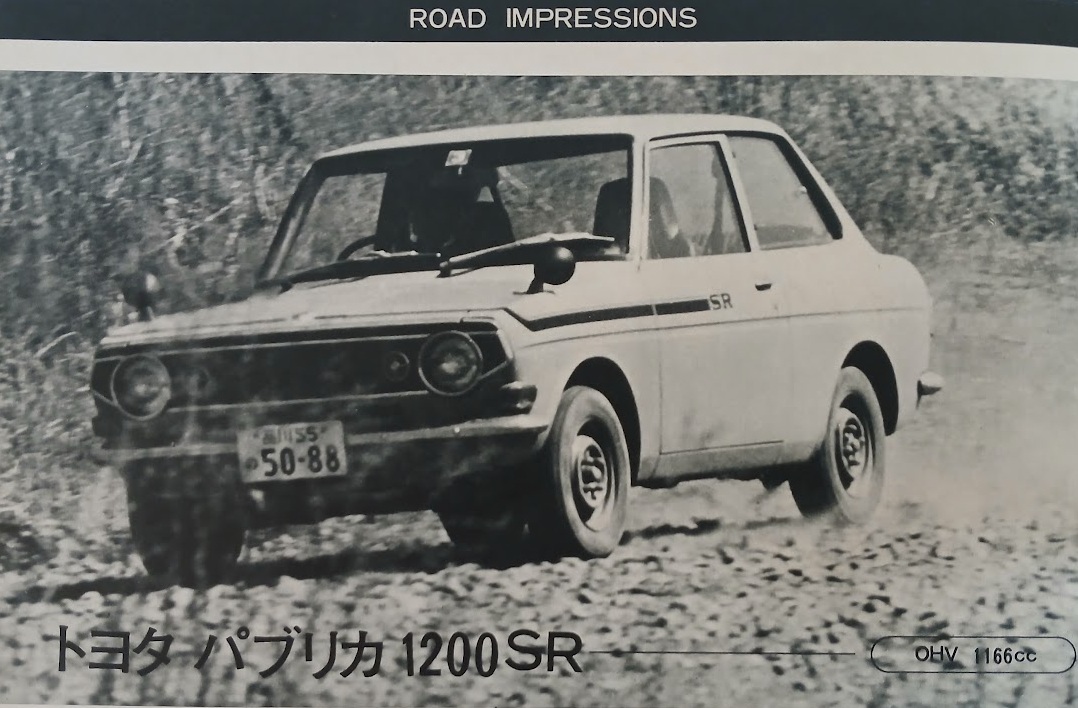
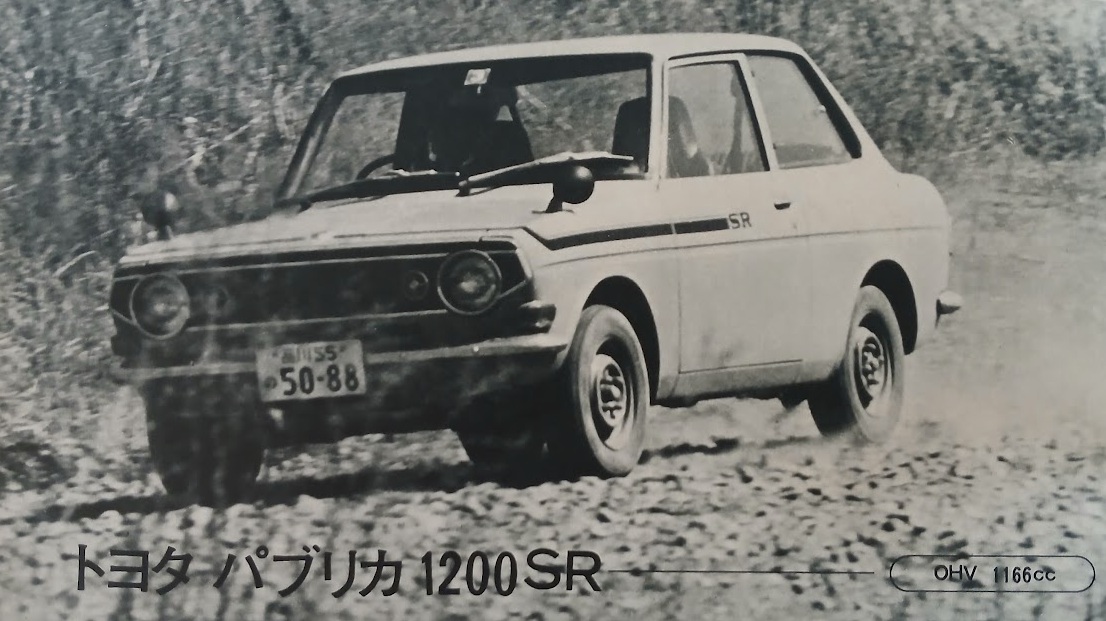
Toyota Publica 1200SR (1971)
Publication: Car Graphic
Format: Road Impression
Date: June 1971
Author: Shotaro Kobayashi
Road-testing the Toyota Publica 1200SR
Over the past six months, C/G has tested three versions each of the Publica and Sunny. This is partly because new models appear so frequently, but more importantly, because these least expensive offerings from the two major manufacturers—particularly their sporting models—provide the most performance at the lowest cost, and have won the support of a broad range of buyers (by no means limited to young people) as basic transportation for the enthusiast.
Limiting the discussion to the Publica, in C/G No. 112 we comparison-tested the previous 1200SL against the Sunny 1200GX, and in No. 113 we conducted a supplementary test of the improved 1200SL. This time we tested the 1200SR, announced on March 16, under a variety of road conditions, including at Yatabe.
The 1200SR is based on the SL, with simplified interior and exterior trim (no radio or cigarette lighter, black window frames, etc.), strengthened suspension, and 155SR-12 radial tires as standard equipment. It is a high-performance version of the Publica devoted entirely to fast driving.
The engine is unchanged from that of the SL, retaining its output of 77ps/6600rpm and 9.6kgm/4600rpm. (There is also a version with the compression ratio reduced from 10 to 9 so that regular gasoline can be used, producing 74ps/6600rpm and 9.5kgm/4600rpm.) Consequently, there is no change in performance.
The following chart compares the suspension specifications of the various Publica models.
| Front | Rear | ||||
|---|---|---|---|---|---|
| Spring constant | Damping, rebound / compression | Stabilizer diameter | Spring constant | Damping, rebound / compression | |
| 1200SR | 2.3kg/mm | 75kg / 27kg | 19mm | 2.1kg/mm | 90kg / 50kg |
| 1200SL | 1.9kg/mm | 60kg / 12kg | 16mm | 1.7kg/mm | 80kg / 40kg |
| 1200DX | 1.37kg/mm | 45kg / 12kg | 14mm | 1.5kg/mm | 70kg / 40kg |
The criticisms we made in our two previous tests of the Publica 1200SL came down to one thing: its handling was disproportionately poor relative to its excellent performance, and simply could not keep up with it. To begin with, the steering was imprecise, while cornering was greatly spoiled by excessive roll and strong understeer. The inside rear wheel would lift early and spin, preventing the power from being transmitted to the road.
Testing the SR this time, however, confirmed that these shortcomings have been substantially improved. The first thing one notices upon driving away is that the steering is unusually quick and precise for a Toyota. This is due to the combined effect of the stiffened suspension and radial tires (the test car was fitted with Bridgestone Radial 10s), and could not be achieved by either one alone.
Another major improvement is that the inside rear wheel no longer lifts early during cornering. Cornering speeds are consequently much higher, and the car can now be taken around corners in a stable attitude.
Moreover, ride comfort has not suffered greatly, and is better than that of European cars with similar suspension, such as the Ford Escort. With the inherent characteristics of a short wheelbase and firm springs, however, a certain amount of pronounced pitching over uneven surfaces is unavoidable.
The manufacturer apparently regards this car as intended for rallying, but in our view its suspension is just about ideal for everyday driving. When making a drag-style start to measure standing-start acceleration figures, there remains a tendency for the rear axle to tramp violently under the strong torque reaction.
This could probably be cured by fitting a simple torque rod.
Yatabe has a gravel-and-dirt test road resembling a rally course, so we used it to evaluate the 1200SR’s ability over rough roads. As might naturally be expected from its short wheelbase, light weight, live rear axle, and plentiful power, the trick on such surfaces is to use as high a gear and as little throttle as possible. Even then, maintaining a straight course takes concentration, even on the straights. For rallying and similar use, running with a full load would greatly improve stability on gravel roads, even at the expense of some acceleration.
Ground clearance is generous and suspension travel ample, allowing the car to be driven hard over rough ground without fear of grounding the underside or bottoming the suspension.
As for performance, there is absolutely nothing to complain about: it is quick. Despite its pushrod OHV design, the engine revs freely and smoothly to 7000rpm (beyond that, valve-gear surging prevents it from gaining so much as 1rpm more), and is relatively quiet. Partly because the overall gearing is low, acceleration—particularly in the low- and medium-speed ranges—is fast enough to outpace even a 2-liter GT. The standing 0-400m time was 18.03 seconds (the previous 1200SL tested in No. 115 recorded 18.4 seconds).
In maximum-speed testing at Yatabe, the average over the 1km straight was 150.6km/h, while the lap average on the 5.5km circuit was 148.9km/h (affected by winds averaging 5-6m/sec). Engine speed at maximum speed was approximately 6400rpm, while the optimistic speedometer indicated 159km/h. The catalog maximum speed, incidentally, is 160km/h (155km/h with the low-compression engine). The disc/drum brakes are unchanged from those of the 1200SL, and we need only say that their performance is fully adequate. One welcome improvement is that the previously excessive nose dive under hard braking has been markedly reduced.
Fuel consumption in suburban and central Tokyo driving, including the instrumented testing at Yatabe, was 10.4km/l.
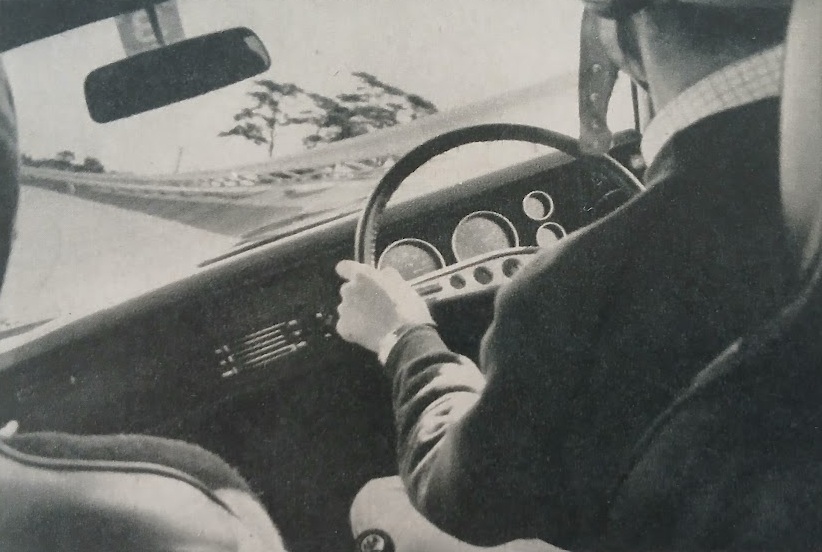
Inside, the differences from the SL include the omission of the radio, cigarette lighter, under-dash tray, console box, and similar items, while the floor is covered with practical vinyl mats. In addition to the leather-covered steering wheel, a lamp has been fitted to the right-side rear trim panel, which the navigator can use for reading a map.
In conclusion, rather than as the rally car its manufacturer intended, the Publica 1200SR is truly at its best as a commuter in the literal sense—a car ideally suited to darting nimbly through crowded city streets.
Postscript: Story Photos