Toyota Crown Hardtop Super Deluxe (1969)
Publication: Motor Fan
Format: Test Drive Report
Date: November 1969
Author: Shuichi Ema, Motor Fan Editorial Staff (uncredited)
A Refined Personal Car
As an “owner’s car,” the Crown Hardtop, the newest addition to the Crown series, is surely among the very finest. For this reason, we have invited a veteran with sixteen years of private car ownership experience to take the wheel this time.
Impressed by a Refined New Face
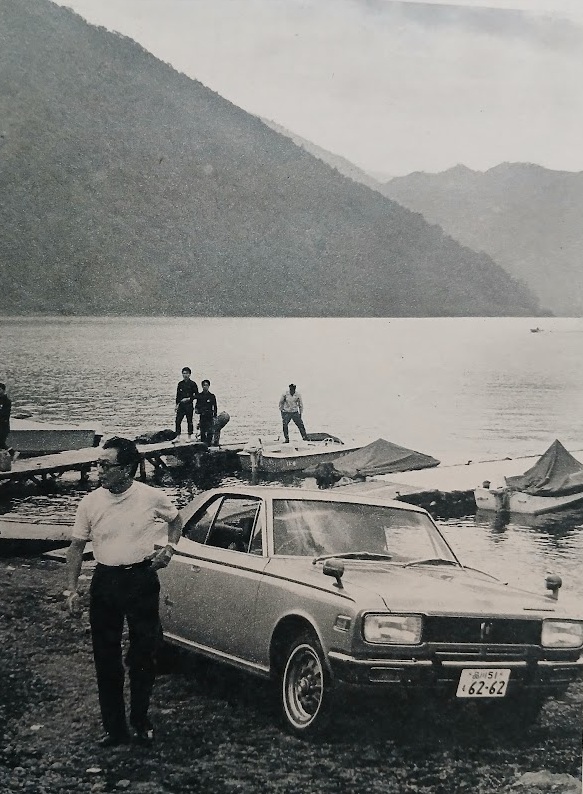
(Ema:) The day began with a brand-new silver-gray car arriving in front of my home garage: the newly released Toyota Crown Super Deluxe Hardtop.
I took my time walking slowly around the exterior. The most noticeable changes from the Crown sedan are in the headlights and front grille. The headlamp area has been tidied up and neatly organized, giving a cleaner impression overall. The front edges have a slightly darkened finish, serving as an accent and lending the nose a sharper, more tightened expression compared to the sedan.
The grille itself features a stylish lattice pattern. It may even be a little too stylish; one imagines it would take some effort to keep clean. Overall, the impression is of greater luxury and composure than before. The turn-signal lamps are now set beneath the bumper, and perhaps it is this detail that contributes to the front’s uncluttered look. In any case, the face has been thoroughly refined.
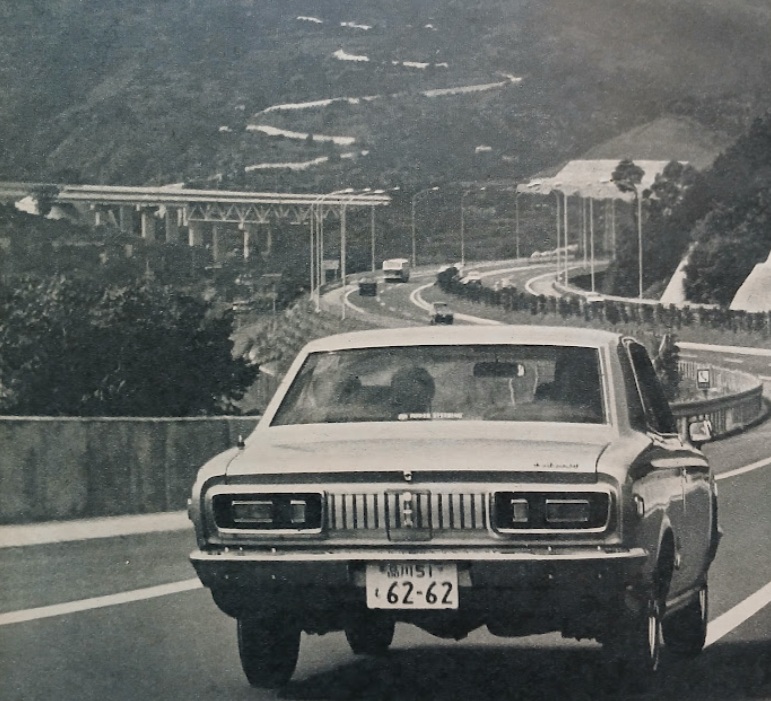
Moving to the rear, the tail lamps themselves remain unchanged from the sedan, but the previously blank expanse on either side of the fuel filler–something that had bothered me on that model–has now been addressed. Vertical striping has been added to fill the empty space.
Even so, since they were making changes, one cannot help feeling that perhaps they could have gone one step further.
Along the sides, the turn signal repeaters are now mounted forward on the flanks. Unlike the sedan, the front and side units are distinctly separate. This arrangement makes them easier to see from a car traveling alongside, a sensible improvement.
As for the seats, there is nothing particularly novel in their appearance, but their comfort is very much that of an adult’s car. The instruments, in both placement and shape, are easy to read, aided by the non-reflective glass.
The steering wheel is a three-spoke sporting type, with what is commonly called a “woodgrain” rim. This, I must confess, does not please me at all. I use a genuine Toyota wood-rim wheel in my own car, and the tactile impression is far superior.
Since this is one of the most often-touched parts of the car, it becomes difficult to ignore. The woodgrain wheel reminds me of the newly fashionable synthetic building materials of late, an imitation attempting to stand in for the real thing. It is a textbook case of “missing the final brushstroke.” Because it is molded with a realistic-looking pattern, the disappointment is all the greater. I resigned myself to wearing white gloves.
The ignition key is now of the same type as that used in the Corona Mark II. Turned fully to the left, it remotely opens the trunk lid. This is convenient, certainly, but if one is not careful, it is rather too easy to open the trunk by mistake. It might be safer if it took just a bit more deliberate pressure on the key to release it.
Now, on to the defining feature of this car: the standard power-assisted steering. While it is not quite a case of being able to turn with a single finger, it is genuinely light. For those of us who are advancing in years, this lightness is truly welcome. Even the once-forbidden practice of turning the wheel while stationary can now be done easily.
I will return to this point later, but I must emphasize it now: power steering paired with an imitation woodgrain rim! What a curious combination indeed.
The position of the 4-speed shift lever is also well judged, with reverse set to the left and forward. The feel through the knob struck me as pleasantly crisp–and, as it turns out, it is genuine wood. With that, we set off. The lever’s throw between gears is neither too long nor too short. That said, having gotten accustomed to driving a car with a torque-converter automatic, I found the work of depressing the clutch and shifting gears somewhat bothersome. This, however, was hardly the car’s fault.
We filled the tank at a gas station in Nozawa along Kanpachi, then made our way to the Tomei Expressway. The weather was clear, with only a light breeze–ideal conditions. From 40km/h we accelerated gradually, settling into a 100km/h cruise. Between 40-60km/h I felt a slight resistance through the accelerator, but as the speed climbed through 70, 80, and 90km/h, the sensation lightened. At 100km/h the engine was turning a smart 3500rpm, and was remarkably smooth, with almost no vibration perceptible. Through the toe of my right foot, I could clearly sense the ample reserve of power.
Okubo from the editorial department, who was seated beside me, chimed in, “The acceleration figures are almost exactly as the catalogue states.”
Leaving the tollgate, I attempted an overtaking maneuver. In what felt like an instant the tachometer swept to 5500rpm, precisely in line with the published performance claims. That came as something of a surprise. Acceleration around the 100km/h mark occurs without any sense of strain whatsoever. And thanks to the aforementioned power steering, scarcely any arm strength is required. One’s shoulders do not stiffen. The accelerator is light. The steering is light. There is almost nothing left to do.
“Where is the switch for the passing flasher?” I asked.
“Pull the indicator lever toward you,” Okubo replied. “It’s integrated.”
“So not everything is automatic, then,” I thought to myself. “Like the early windshield washers.” But after trying it, I found this arrangement more convenient. Clearly, someone thoughtful designed it.
A passing flasher has also been adopted on the Publica, but here there is no need to reach for a separate switch each time. When the moment calls for it, two or three flicks of the finger suffice. It is, in effect, a headlamp horn.
“Are they on?”
“Yes, they’re on. The ammeter needle moves.”
There’s an indicator lamp directly ahead, of course, but in daylight the violet hue is too faint to see clearly. Perhaps it is unavoidable, but for this reason I relied on the movement of the ammeter instead.
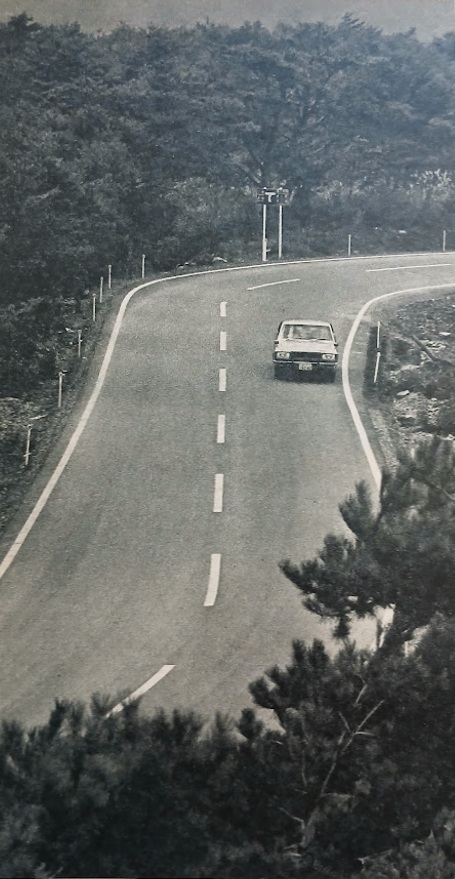
In any case, the road holding is excellent. Even the sharp curves at Ashigara are dispatched smoothly. On occasion, the accelerator offered so little resistance that I momentarily thought the car had slipped into neutral.
One thing began to trouble me as we drove: the blue-tinted sun visor strip at the top of the windshield. It is certainly stylish, but perhaps a shade too dark. It creates the impression of a slightly narrowed field of vision. My colleague in the passenger seat agreed.
Then there are the power windows. Even when fully closed, they seem to leave just the faintest gap. This results in an audible trace of wind noise. If one continues to hold the switch down, the seal tightens and the sound disappears–but the moment the switch is released, a slight whispering noise returns. This may simply be proof of how quiet the cabin is overall. Even so, one wonders whether there is still room for further improvement in the study of such power mechanisms.
We took a short rest at the Ashigara service area. There was not the slightest sign of overheating. Okubo, along with photographer Watanabe, who was also riding with us, remarked that although there was a touch of pitching from the suspension, there was almost no sense of body roll. High praise indeed. What surprised me most, however, was how little fatigue I felt. The good driving position no doubt played a part, but in any case the car was remarkably easy to drive.
From the Fuji interchange we joined National Route 139. Unusually, there was quite a lot of traffic, and I found myself making several overtaking maneuvers that required downshifting. Strong pull is available in second gear, but by comparison, third feels a little less willing to extend. Even on gentle inclines, acceleration can feel weak unless one drops down to second. Of course, this depends on driving technique, but speaking as an average middle-aged Japanese driver, I cannot say I was entirely satisfied with the overtaking acceleration. Then again, considering the car’s weight and the fact that we had three aboard, perhaps it is unreasonable to expect more.
On the other hand, at around 60km/h on ordinary roads, the car is so relaxed that one has the feeling a round of golf undertaken in such a state might see one’s score improve by three or four strokes. I pressed the cigarette lighter. After a long pause came a faint click.
“Slow, isn’t it?” I said.
“With this car,” came the reply, “you could take your time getting a lighter from your pocket and lighting it yourself.”
There is that much composure in its gait.
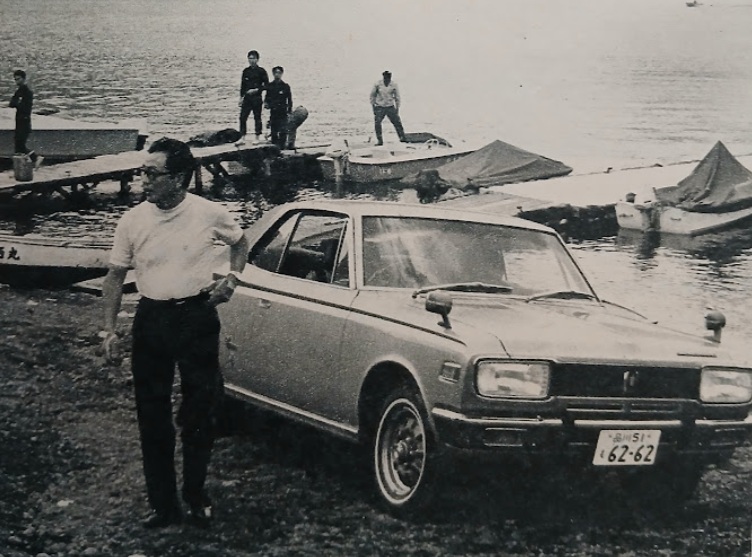
We descended to the lakeshore at Motosu for photography. It was our first encounter with truly rough road surfaces, but both tires and suspension absorbed the shocks well. Here again, the power steering proved its worth. Even when the body bounced, the steering wheel was never snatched from my hands. As we drove, I found myself thinking that this might not be a car aimed particularly at the young. Only at that point did I begin to understand, rather belatedly, why the editorial department had chosen me as a test driver. Crafty fellows.
In an open area by the lake we tried some light slalom maneuvers. The 1.5-ton body could be guided with surprising ease. Even on demanding mountain roads, its handling should prove entirely capable.
Impressive Braking Performance
Returning to National Route 139 toward Fujiyoshida, we tested the brakes on a straight stretch of industrial road near the Subaru Line. The stopping power exceeded the catalogue figures. Pedal effort was not excessive, and there was no sign of fading. This braking performance deserves particular praise. On a downhill straight, from 100km/h, the car came to a halt without tire squeal or the dreadful shuddering shrieks sometimes associated with hard braking. It stopped cleanly and squarely, inspiring complete confidence.
Perhaps this is due to the strong booster characteristics at the rear brakes, the slightly enlarged wheel cylinder diameter, and the improved front–rear balance afforded by the PCV system. In any case, there was none of the all-too-common sensation of rear-wheel lock. I might add that the handbrake, too, can be applied with reassuring lightness.
Leaving Kawaguchi as dusk began to settle over the lake, we joined the Chuo Expressway. The instrument lighting is bright and easy to read. Even the cigarette lighter includes a small green indicator lamp, a tasteful touch. As if on cue, rain began to fall, giving us an opportunity to test the wipers. When the windshield washer switch is pressed, the wipers operate in unison; after the spray stops, the wipers continue for two or three strokes before coming to rest. Previously, one had to spray first and then activate the wipers separately, but now it is accomplished in a single action. For clearing mud after rain, this is extremely convenient. The wiped area is wide, and the motor runs quietly.
With the windows closed and the blower motor engaged, a reasonable flow of air enters the cabin. The rear window did not fog up, so we did not have the opportunity to test the heated rear defogger. However, it is designed to switch off automatically after ten minutes, to prevent it from being left on by mistake. Naturally, there is also an on-off switch that activates it when pulled and turns it off when pushed in. This is a thoughtful touch, since such things are easily forgotten while driving.
Partway through the return drive, I handed over the wheel and settled into the passenger seat. With fresh eyes I surveyed the interior, admiring the generous seats and the distinctly mature atmosphere. Moving to the rear seat, I found it equally satisfactory. Then again, even the Corona Mark II offers comparable space, so perhaps that is only to be expected.
The plunger-type door locks are easy to use, but one should take care to carry a spare key separately; otherwise one may find oneself in serious difficulty. Older drivers, in particular–although perhaps this applies to me especially–tend to grow forgetful. One almost wishes for some form of constant reminder, though that may be asking too much. After all, the car seems to look most at home with middle-aged Japanese men and women aboard, both outwardly and in spirit.
From a safety standpoint, there is little to fault. The seat belts are substantial, and the parking lamps and four-way flasher switch function perfectly. One concern, however, lies under the hood. With the steering compressor installed, the further addition of an air-conditioning compressor would leave scarcely any room to get one’s hands in for inspection or servicing. It would be preferable if this area were arranged more neatly.
After returning, we discussed our impressions at length. All three of us agreed on one point: this is not a car for hard driving–despite the connotations of the “hardtop” name. Rather, it is best suited to relaxed touring, especially over long distances. At the same time, it possesses an ability to withstand fairly severe conditions, which makes it interesting in its own way. Yet considering its price and stature, it is not a car aimed at the young, but rather at the mature, mainstream adult. In any case, for my own part, if it should help improve my golf score, it is a car I would very much like to own.
– NET Television Production Bureau, Deputy Director
Postscript: Story Photos