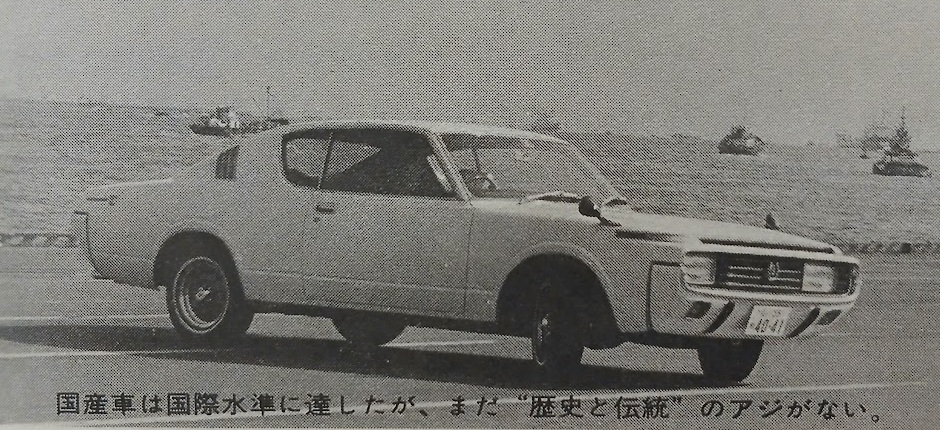
Toyota Crown Hardtop Super Deluxe vs Opel Rekord Coupe (1971)
Publication: Motor Fan
Format: Group Test
Date: May 1971
Author: Joji Obara
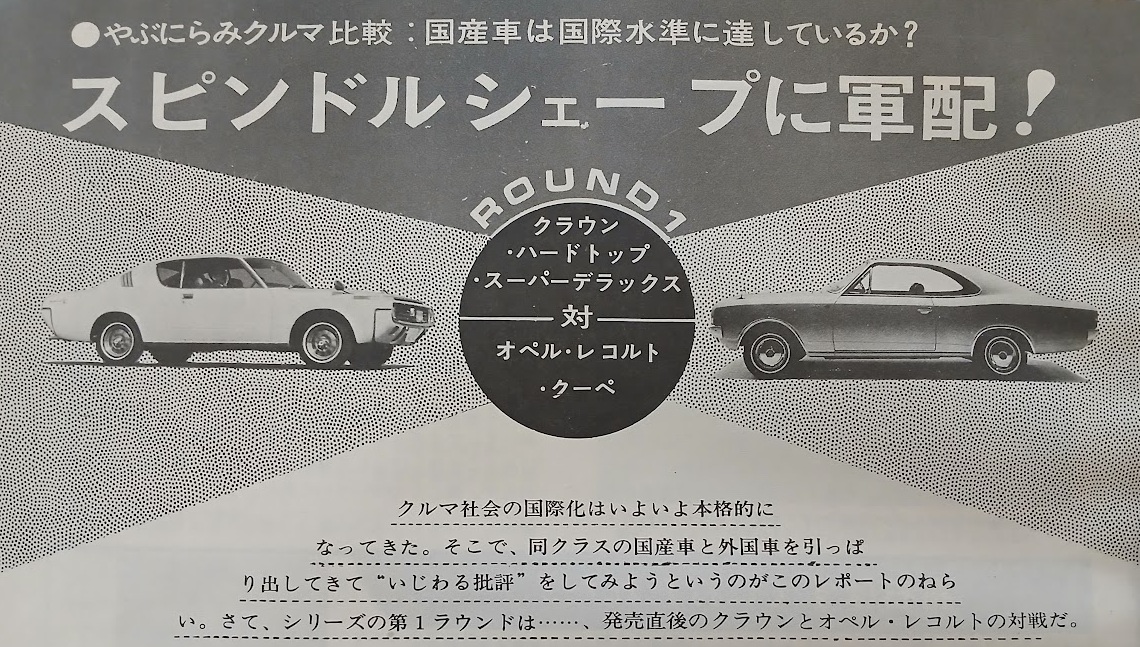
Have Japanese Cars Reached International Standards? Round 1: Crown Hardtop vs. Opel Rekord Coupe
The globalization of the automotive world is now in full swing. In this report, we’ve pulled together domestic and foreign cars of the same class for a little “deliberately tough showdown.” For the first round of the series, it’s a face-off between the freshly-released Crown and the Opel Rekord.
With the Growth of GNP
Amid staggering economic growth, Japan’s automotive industry has developed at a remarkable pace. And now, the wave of capital liberalization is approaching…
Lately, one phrase keeps popping up in conversation: “Japan’s GNP.” No, this isn’t a typo for the Japanese Grand Prix (N·GP). As you know, it refers to the Gross National Product. Whenever a minister brags about our country’s growth rate, the numbers are truly astonishing. Averaged over the 1960s, the figures are impressive across the board: America, the big brother, at 7.3%; the elder UK at 5.5%; West Germany, whom we often look to as a model, at 8.8%. But Japan? An eye-popping 16.6%, in another league altogether.
Everything in our country has ridden the wave of high growth, but nowhere has it been more remarkable than in the automotive sector. Not long ago, comparing Japanese cars with foreign makes was almost unthinkable—so presumptuous it would draw laughter. But today? One might almost feel embarrassed to be seen in a foreign car, so far has domestic development come.
Everything in Japan is growing fast, but nothing quite like the auto industry. Not long ago, comparing foreign cars to domestic ones would have been considered presumptuous enough to draw laughter. Now, the situation has flipped. Sometimes it even feels like driving a foreign car makes you stand out… and not in a good way.
To put it in perspective: the UK took 13 years to grow its passenger car output from 200,000 to 2 million units; West Germany, 9 years–but Japan? Only six.
West Germany, rising from similar postwar ashes, regards us with a fair degree of goodwill. The UK, on the other hand, seems to stew in envy, finding fault wherever it can. Even in industries where they quietly admit defeat–cars, cameras, electronics–the complaints are never-ending.
I remember meeting racing driver Toru Ikuzawa in London. He said plainly, “Japanese cars are better now. Especially the 2-liter sedans—they outperform British models in almost every respect. Space, comfort, styling–they’re nothing to be ashamed of.”
Indeed, domestic cars have improved dramatically. Year after year, new models have left us staring in surprise… though lately, the feeling is closer to “here we go again.” But have Japanese cars truly surpassed foreign ones in any meaningful sense? With defective vehicle scandals, mergers, and rumors of capital partnerships, the industry has its share of challenges.
So, we decided to compare a domestic car against a foreign counterpart, drive them back-to-back, and report our impressions honestly, without sugarcoating.
The question remains: have Japanese cars really grown in line with the GNP figures, or are they, as some quietly whisper, all show and little substance? And conversely, do foreign cars, long revered by Japanese buyers, genuinely possess the excellence we’ve imagined? Let’s examine this carefully, on the road.
The “Lookalike-Show” Old Crown
Styling: The recently redesigned Crown has the advantage of newness–but the Opel has its own universally appealing charm.
For the first round of our “Head-to-Head Car Comparison” series, we decided to line up the just-fully-redesigned Toyota Crown against West Germany’s representative family sedan, the Opel Rekord.
From each lineup, we picked what felt like the natural flagship: for Toyota, the sporty, personal-sedan Crown Hardtop Super Deluxe; for Opel, the equally sporty-feeling Rekord Coupe.
Both companies are highly attuned to trends and have a remarkable knack for crafting cars that appeal to the masses.
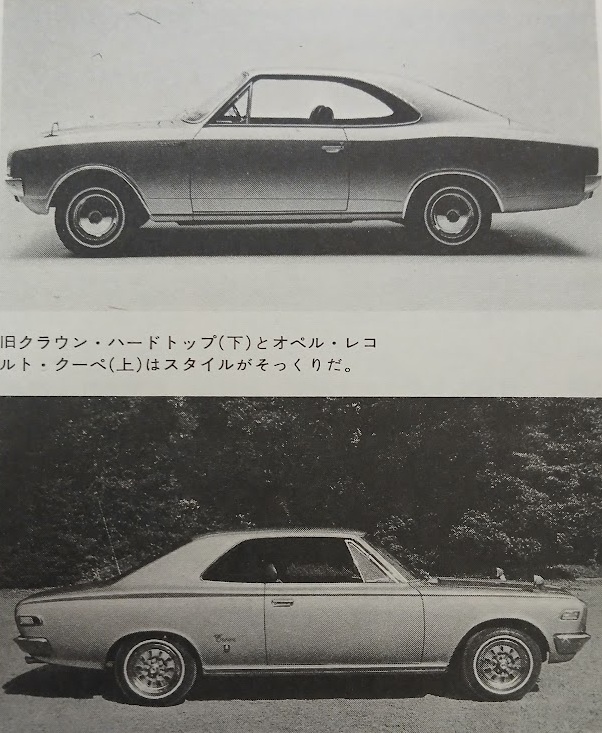
First, styling. One thing worth noting is that the pre-full-model-change Crown Hardtop looked so much like an Opel that it could have been sent on a “Lookalike Challenge” TV show. Frankly, we would have loved to compare the old Crown side by side with the Opel. That said, the new Crown’s freshness is undeniable–it has the clear advantage here.
The shift from notchback to flowing fastback lines has been underway for quite some time. Fastback styling emphasizes a smooth sweep from roof to rear, a motif seen on American cars through the 1930s, 40s, and 50s. By the 1960s, it became a sweeping trend, and its popularity hasn’t faded. Year by year, the lines sharpen further, evolving toward a look suited for the high-speed era.
The new Crown embraces these trends with a long-nose, short-deck silhouette dubbed the “spindle shape,” projecting a futuristic image. Yet the Opel’s styling carries its own compelling charm and has won fans worldwide.
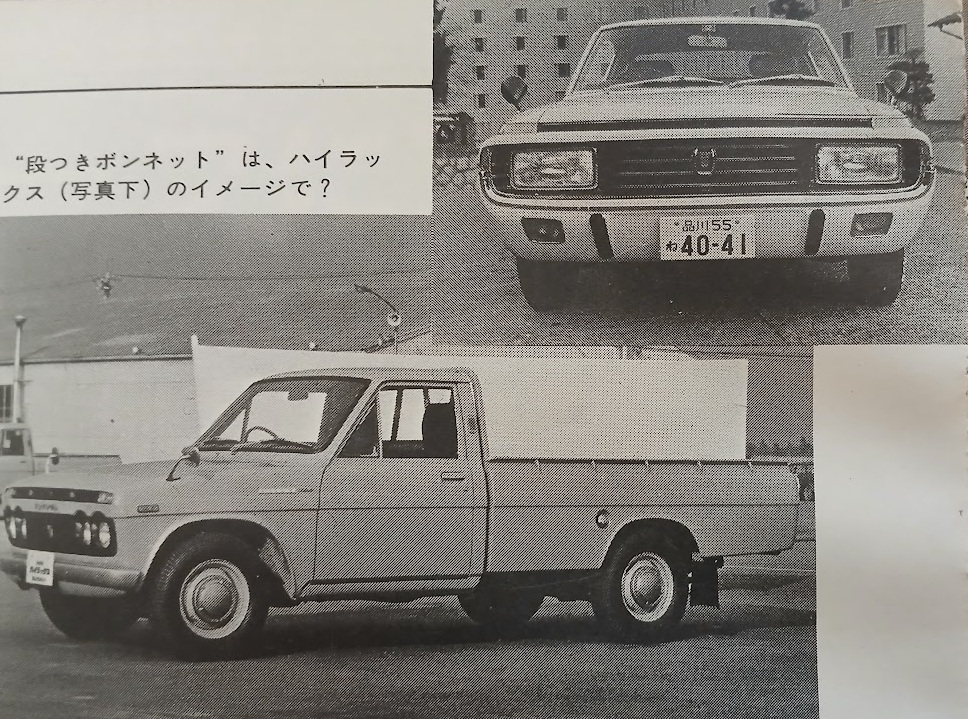
The Crown’s “stepped” hood introduces a fresh, bold feeling. The details–wheel design, rear-quarter window, even the side-marker lamps integrated into the hood step–are pleasing. If one must nitpick, the line from the rear quarter to the trunk evokes a Ford Mustang, especially the interior vent louvers on the quarter panel. That similarity is a little regrettable.
Also, when viewed from the front, the stepped hood recalls Toyota’s small truck, the Hilux. Not that anyone’s likely to shout, “How could you make a passenger car that looks like a Hilux?”–Toyota fans are unlikely to mind.
Meanwhile, Opel’s style, as mentioned, has universal appeal, with nothing to criticize. Placed next to the old Crown, the contrast is amusing. In today’s playful vernacular, it’s like saying, “This is the Opel, that’s the old Crown… ha, other way around!”
Opel Shows Its Rational Design
Interior: In terms of luxury, finish, and equipment, the Crown takes the lead. For ease of operation, comfort, and visibility, the Opel has a slight edge.
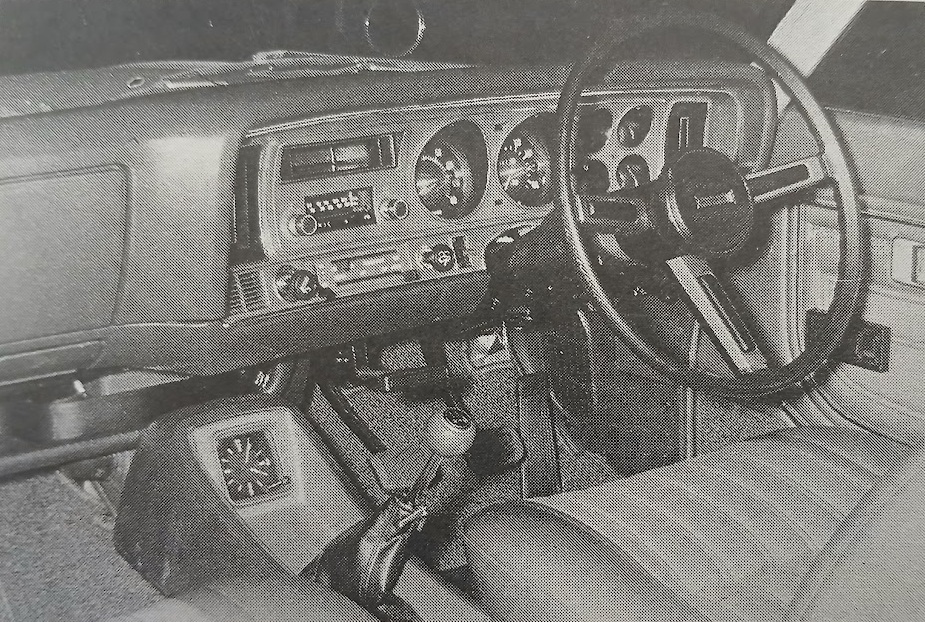
The Crown’s catalog proclaims, “a high-class hardtop with luxurious equipment,” and the new model is indeed lavish in its appointments. Every detail has been attended to. The instrument panel, for instance, is fitted with non-reflective black-faced gauges for speed, engine rpm, water temperature, amps, oil pressure, and fuel, all lined up in orderly fashion. Warning lamps are included, and notably, the fuel warning light illuminates when 10 liters still remain, a helpful feature for long highway drives. There is an FM-AM automatic tuning radio, vacuum-operated door locks, and even space for a car stereo (standard on the Super Deluxe). The materials used for the seats, roof, and door panels are of generally high quality and feature tasteful colors, and the attention to finishing details is careful and precise.
The seats themselves offer firm, supportive cushioning, yet for some reason, they don’t quite seem to cradle the body. The pedal layout is another minor flaw. To step on the brake, one must lift their foot up off the organ-style accelerator pedal before pressing down—a small but noticeable inconvenience.
Additionally, a tall driver may find their knees brushing against the steering wheel at this point. This is a consequence of the unusually high brake pedal position. Drivers attempting to execute the stylish heel-and-toe technique should be aware that this layout makes it virtually impossible.
Of course, as a luxurious and sporty personal sedan, such maneuvers are not expected–but even so, the arrangement left a subtle sense of incompleteness.
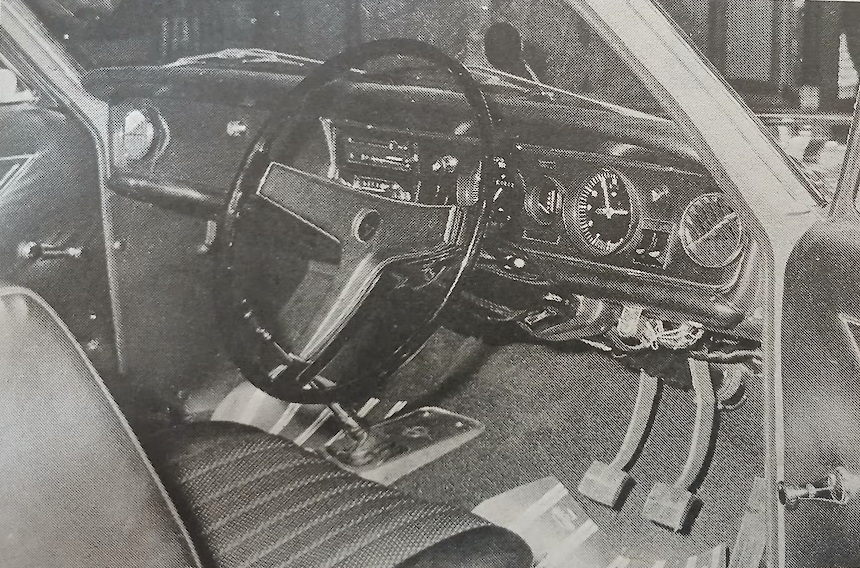
The Opel’s interior is minimalistic, yet from the perspective of foreign cars it is very well made, with a fully equipped instrument panel. Compared directly with the Crown, the latter risks appearing slightly over-decorated. Given a choice between the two, buyers would likely favor the Crown.
Yet when it comes to the instrument layout, West Germany’s rationalist approach is clear: no waste, highly functional, with all controls arranged conveniently at hand. The pedal arrangement is likewise superior. The driving position, especially during sustained high-speed travel, feels more comfortable in the Opel.
The seats are slightly firmer than the Crown’s. While the Crown’s seat materials appear more luxurious, the Opel’s seats can be expected to resist sagging better over long periods.
Safety padding is adequate in both vehicles. Sharp edges are minimized, switches and knobs use soft materials, and measures are in place to reduce injury in collisions.
Visibility is generally good in both, but the Opel has a slight advantage. The Crown’s driving position appears, at least in part, to have been designed with smaller, possibly female drivers in mind: the hip area sits unusually high, the pedals are positioned to be within reach of those with shorter legs, and someone of modest height can see over the steering column. A taller driver, however, may find their knees pressing against the wheel and their arms bending awkwardly to reach the controls. One’s line of sight can end up uncomfortably high, near the sun visor, creating a somewhat restricted view of the road.
In situations like this, you can lower the seat and recline the backrest, reaching out to grasp the wheel with arms straight. That way, you end up driving in a genuinely stylish pose. But what about drivers on the shorter side? Bring the seat down too far, and your feet can’t reach the pedals. Recline the backrest too much, and that doesn’t work either. So, the “short sportsman” ends up settling for the upright, ladylike driving position.
Compared with the Crown, the Opel’s cabin feels slightly more spacious. The interior dimensions don’t differ much, yet it feels roomier because the seat sits low and the headroom feels generous. Plus, your line of sight naturally lands near the center of the windshield, so the glass looks larger than it actually is.
Despite the lower eye point, the Opel makes it easy to gauge the car’s width and length, and you get a broad view of the front and rear.
The Crown, on the other hand, suffers from a sense of confinement overhead from the roof. Your line of sight is higher, which makes it easier to judge nearby objects, but on a straight highway, your gaze tilts downward, which can be tiring over time.
As Eizo Ikeda also noted in our April issue supplement, the Crown’s “stepped” hood also makes it tricky to judge the car’s width and length accurately.
Which Will Be “Eaten Up?”
Structure and Performance: Both cars are closely matched. Mechanically, the Crown has the edge; in outright performance, the Opel just barely comes out ahead.
Looking at the specifications, the Crown Super Deluxe we test-drove has a 1988cc engine producing 115ps (depending on the version, outputs of 105ps and 125ps are also available). The Opel Rekord, meanwhile, has a 1897cc engine with 102ps.
What stands out, however, is vehicle weight. Despite their similar size, the Opel is significantly lighter. This goes a long way toward explaining its slight performance advantage. Weight distribution is also more balanced in the Opel, whereas the Crown is decidedly front-heavy.
The Crown is equipped with power steering, and even under sustained cornering, the rear end resists breaking loose, giving it a stable, forgiving character well-suited to the average driver. That said, the steering response feels somewhat sluggish despite the power assist, with a noticeable tendency toward understeer.
The Opel leans only slightly toward understeer, but under hard acceleration in a sharp corner, the rear wheels begin to step outward. Steering response is crisp, and corrections are easy to make.
The Crown’s engine, perhaps due to the muffler or the routing of the exhaust, gives the impression–both in sound and feel–of being worked quite hard, yet a glance at the tachometer shows only around 2500rpm. The Opel is just the opposite: it never feels as though it’s working hard, yet it glides along briskly and easily. There’s a lightness to the way this West German car runs that makes it genuinely enjoyable.
The Crown’s ride reflects its more luxurious specification, delivering a correspondingly solid, weighty feel. Its suspension is softer and generally more agreeable, using a perimeter frame with a four-link rear axle–an approach long favored by Opel’s parent company, GM–so in that sense, Opel has had its own specialty turned back on it. The Opel’s setup is somewhat firmer, but overall, there’s no major difference in suspension performance between the two.
The Opel’s broad torque band and well-chosen gear ratios give it a stronger sense of acceleration than the Crown. This isn’t based on formal measurements, but rather on driving feel–though during our test, we found an unexpected witness to support the impression. While taking a break for photos, a patrol officer pulled up and remarked, “Toyota’s cars look good, and the interiors are nice, but the engine is a little slow to pick up revs…”
Now, as for the verdict between the Crown and the Opel: we’ve had our share of criticisms, but if asked to choose between the two, the answer would still be, “the Crown.” The Opel is certainly appealing, but even setting aside the high price of imported cars, the Crown comes out ahead when considering styling, engineering, and equipment as a whole.
In terms of styling, as mentioned earlier, the Crown’s advantage came mainly from it being the newer model. But Opel has its own fresh entry in the form of the Manta–their designs are far from outdated in general.
So for this first round of domestic-versus-foreign car comparisons, the decision goes to the Japanese model. That said, Toyota shouldn’t grow too comfortable before the new Rekord Coupe makes its appearance. As for those who want to “eat it up,” these may not be the words of the friendly witch in the well-known TV commercial–but rather the intent of foreign capital, quietly setting their sights on Japan’s auto industry…
Postscript: Story Photos