Toyota Crown Hardtop SL (1969)
Publication: Car Graphic
Format: Road Test
Date: February 1969
Author: “C/G Test Group” (uncredited)
Summary: Two-door coupe version of the Crown S. Rear seat comfort is not compromised, six-cylinder SOHC engine revs freely to 7000rpm or more, extremely quiet even at high speeds, conversation is possible at 120km/h, brakes are powerful but require excessive pressure, steering is heavy at low speeds, ride is generally good but pitches somewhat on poor roads.
Road testing the Toyota Crown Hardtop SL
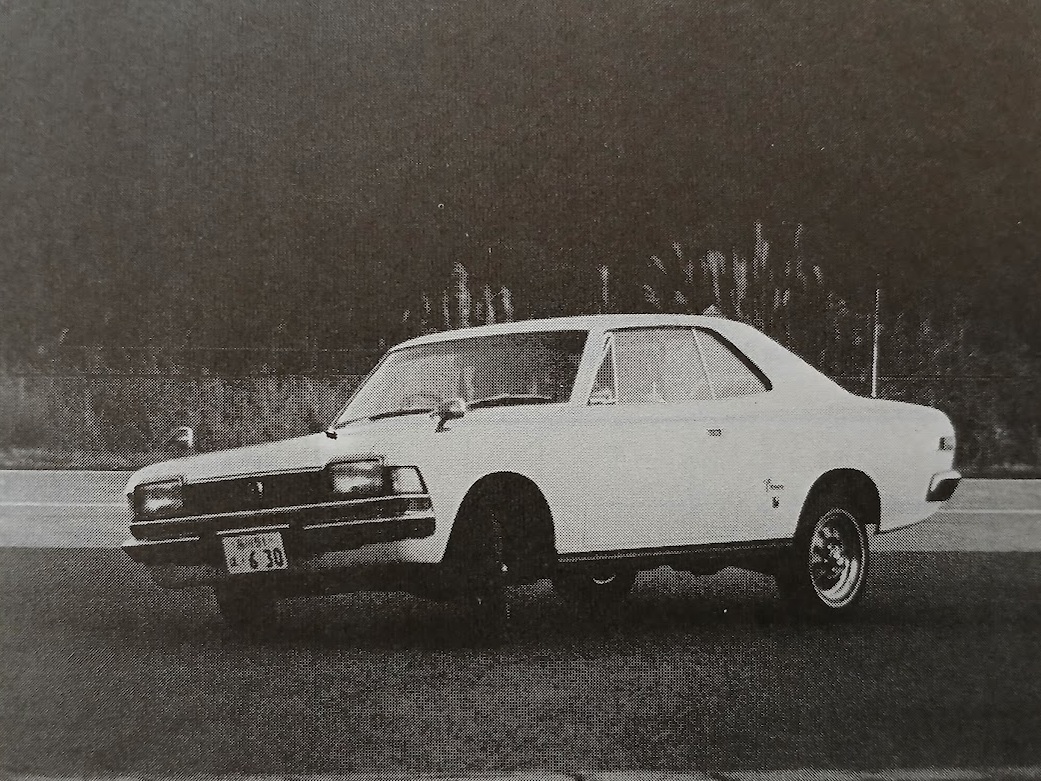
Recently, white Crown S sedans have become a common sight on the streets. More often than not, a mature driver who appears to be the car’s private owner is at the wheel. Toyota, ever quick to recognize an opportunity, introduced the Crown Hardtop on November 1, aimed primarily at just such mature sporting drivers and people of style. In Europe, most higher-priced six-cylinder sedans such as the Opel Commodore and Ford 20M RS are also available in coupe form, but among domestic 2-liter cars, the Crown is the first of its kind.
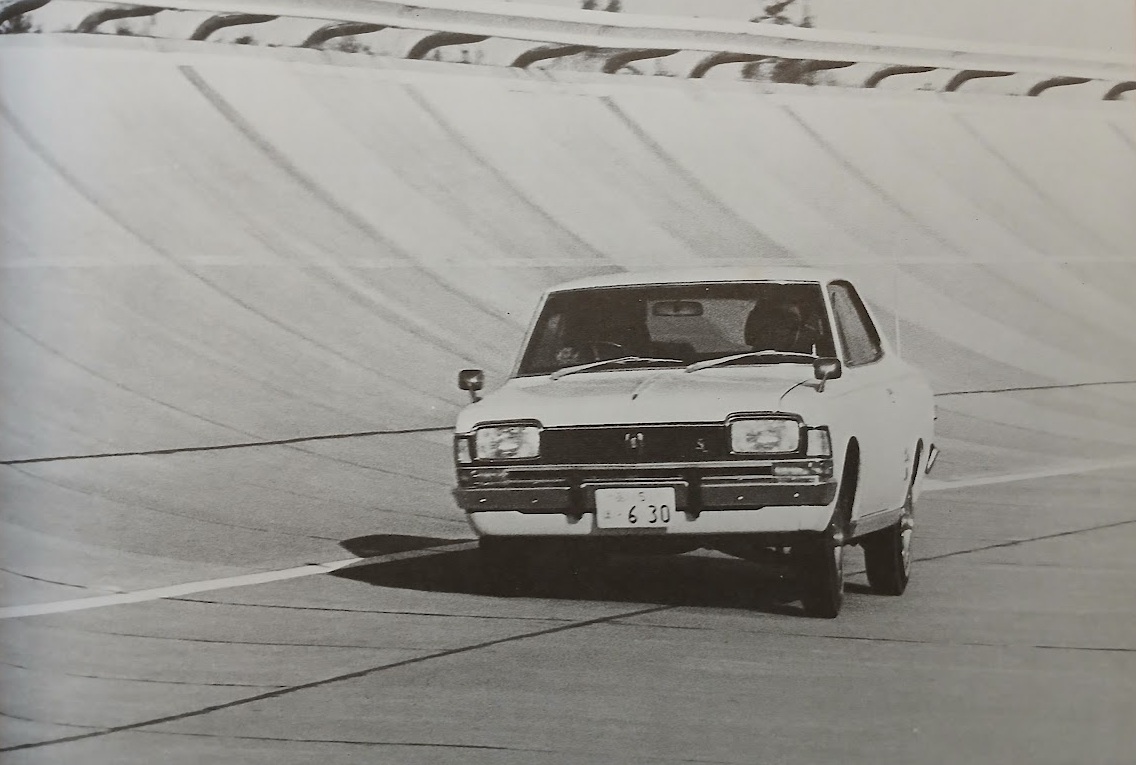
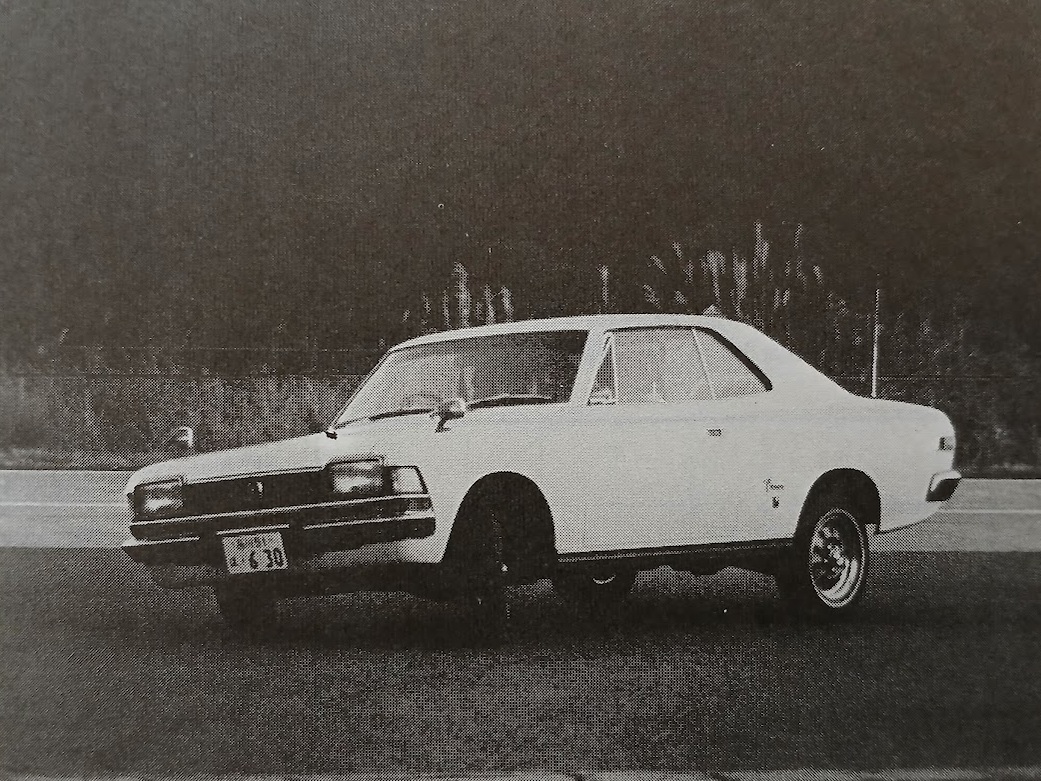
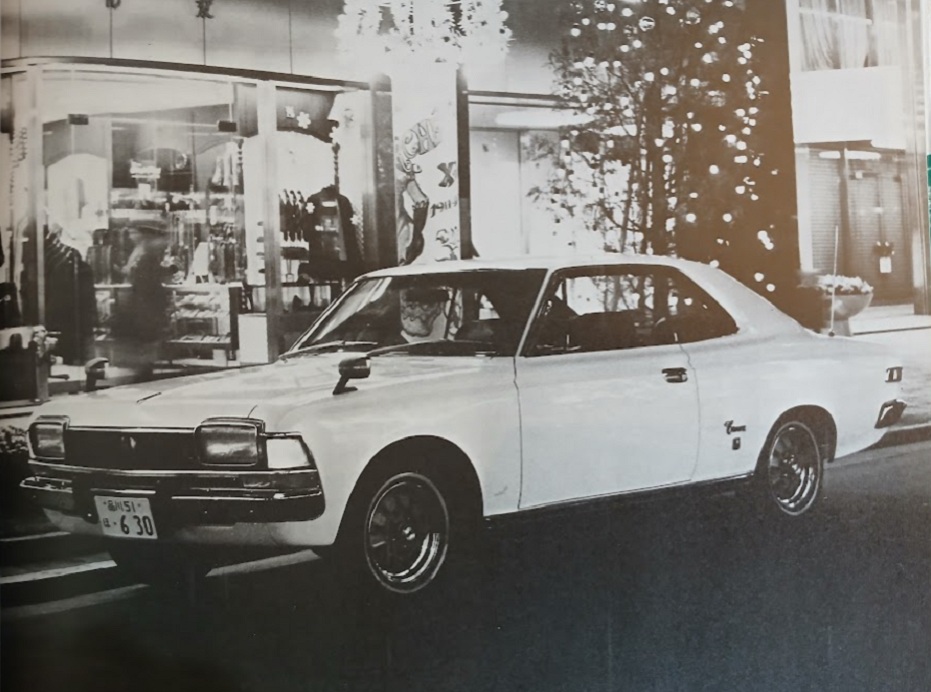
The Crown Hardtop combines the same perimeter-type frame as the sedan with a fashionable hardtop coupe body. Compared with the sedan, its roofline is 25mm lower and its overall length slightly shorter. The front-end styling also gives a distinctly different impression, with rectangular headlamps and large parking lamps that wrap around into the sides of the body. Two Hardtop models are offered, the standard version and the sporting SL. The SL is fitted with the same M-B engine as the Crown S (twin SU carburetors; output, 125ps/5800rpm). Its suspension is also firmer, and servo-assisted front disc brakes are standard. Two transmissions are available, a 4-speed floor-shift and 3-speed Toyoglide. The car we tested was the SL with the 4-speed manual gearbox (priced at 1,200,000 yen).
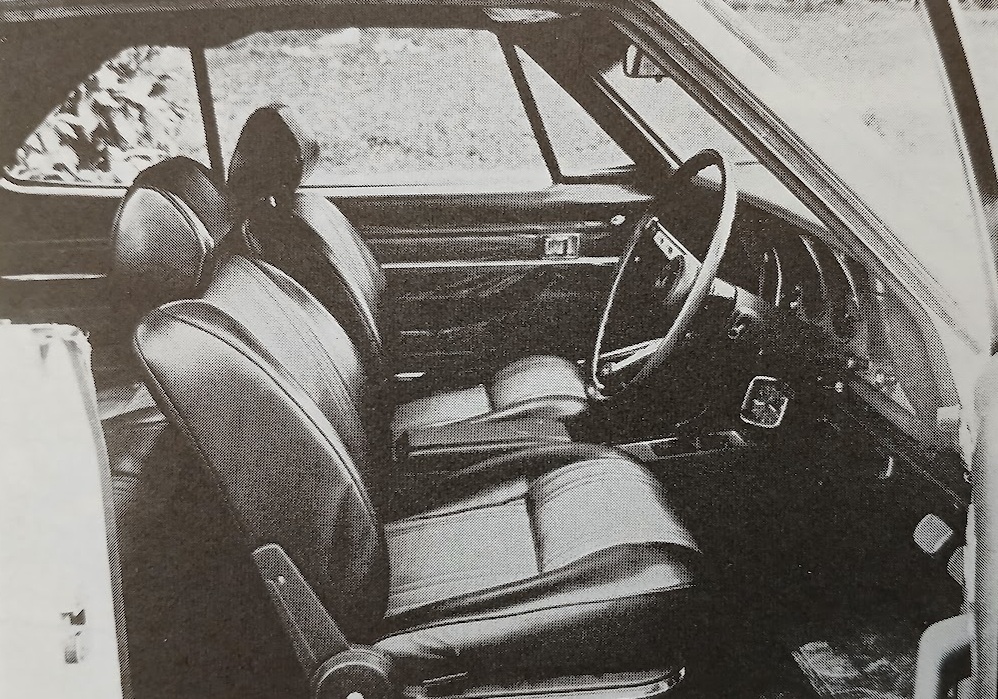
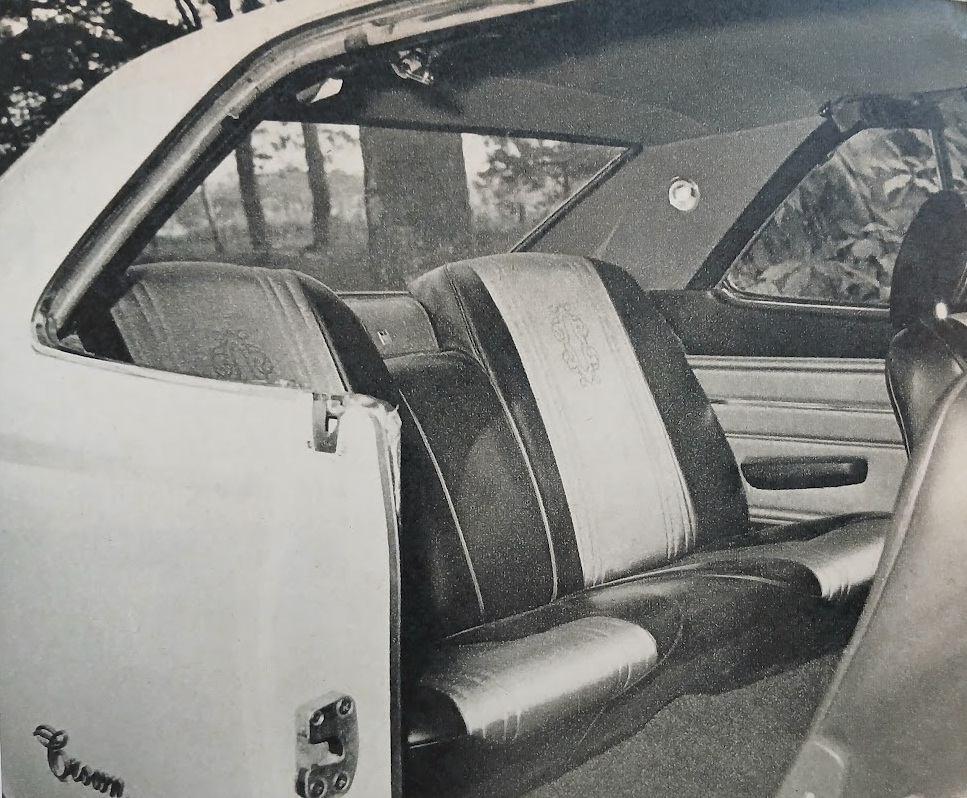
The impression of the interior is closer to that of a European car from a US-owned manufacturer than an American car itself. The trim is nearly equal to that of the Crown Super Deluxe and is genuinely luxurious, unified with a restrained good taste. The reclining front seats are more generously padded than those of the Crown S, and stand comparison with those of a Mercedes-Benz. From the neutral position, the backrests can be finely adjusted through two steps forward and no fewer than twenty steps rearward (each of 3°20′). The integral headrests can be adjusted through 110mm and even have a locking mechanism—an indication of the thorough attention to detail. It is also commendable that the owner’s manual (Toyota manuals are without exception helpful and well written) explains the proper use of the headrests in detail.
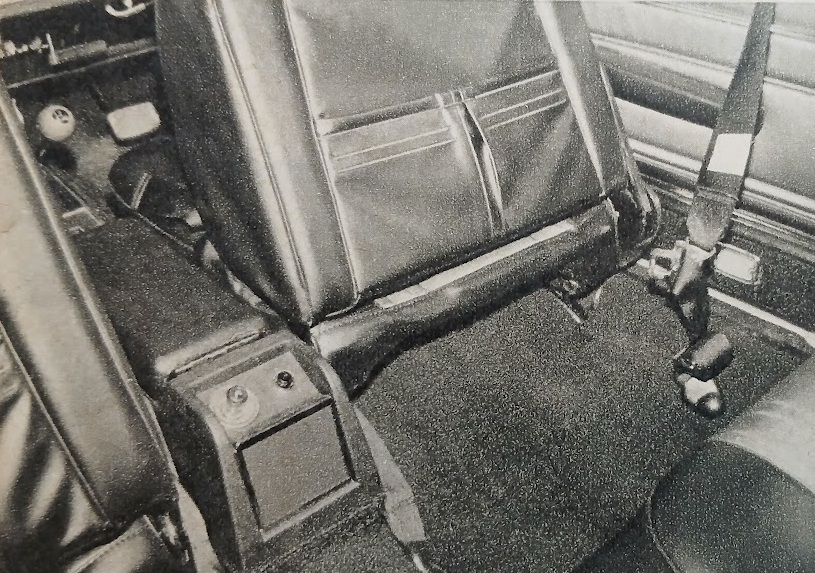
The standard three-point seat belts are of the retracting type, which makes them convenient when not in use. The return springs, however, are strong enough to put pressure on the abdomen, and on the long-distance, high-speed trips where the seat belts are needed most, one is tempted to take them off. Some foreign-made retracting belts stop at the length to which they have been pulled out, rather like a window blind, and we would like to see Toyota look into such an arrangement.
In dimensions, the interior is entirely up to international standards, with a sense of spaciousness in every direction. Even a large driver who has found every Japanese car up to now rather cramped should be able to drive this Crown Hardtop with ample room to stretch his arms and legs. The upper 10cm or so of the windshield is tinted to reduce glare, but at night it somewhat restricts the view up and forward (for example, when looking up at traffic lights). This may, however, merely be because we lack sufficient body weight. Gentlemen with slightly protruding bellies, such as those who might buy a Crown Hardtop, would presumably sink into the seat by just the right amount, so perhaps there is no problem after all.
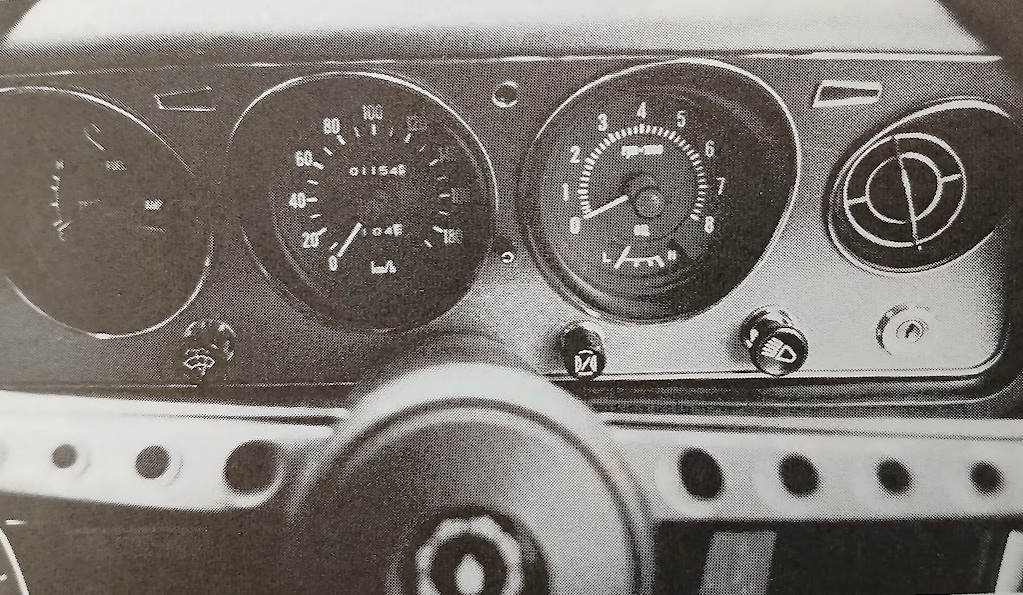
The dashboard is basically the same as that in the Crown S, with three large gauges, each no less than 15cm in diameter, arranged side by side. However, the positions of the rev counter and clock are reversed from those in the sedan, placing the rev counter directly in front of the driver. The gauges have white markings on a black background and are easy to read both day and night. The controls are generally well thought out and easy to use, except that the light and wiper switches on the dashboard (made of a soft material and flat in shape) are slightly too far away to reach from a comfortable driving position. The other exception is the lock on the left door. Because of the length of the door and the presence of the headrest, it is difficult to reach, and from the driver’s side, it is virtually impossible. Since Toyota has gone to the trouble of fitting power windows, we would like to see electromagnetic door locks like those on the Century, or at least to move the lock button to the side of the door as on the Corona Mark II. In virtually every other respect the car deserves full marks for safety design, so this one detail is the missing final touch.
In stylish coupes, rear-seat accommodation is often sacrificed for the sake of a beautiful roofline, but the Crown retains a degree of comfort comparable to that of the sedan. The Hardtop’s interior dimensions are only 60mm shorter in length and 15mm shorter in height compared to the sedan’s and there is ample headroom and legroom for long trips. The doors are extremely long, and with no center pillar, access to the rear seat is easy. On the other hand, these exceptionally long doors extend no less than 110cm when fully opened, so one must be careful of cars parked alongside. The doors are held open in two stages, but the checks feel somewhat weak for the doors’ weight.
If the character of the Crown Hardtop SL were to be summed up in a single phrase, it would be a scaled-down American sports coupe. This applies not only to its styling and size, but also to the way it behaves. As a luxurious coupe that emphasizes passenger comfort, and with 125ps propelling 1295kg, it lacks the sense of sheer power that is typical of American cars, but the atmosphere is very much there.
First and foremost, the six-cylinder SOHC engine is exceptionally quiet and smooth. At the moment it starts, the engine revs lightly with a whir, and the body gives a gentle sway in reaction to the torque, just like an American V8. Although the red zone on the rev counter begins at 6400rpm, the engine will sweep lightly and willingly past 7000rpm. Its balance is exceptional—one could almost say this is exactly how a seven-bearing six-cylinder ought to be. The 600–700rpm idle is so quiet that, on more than one occasion, we found ourselves blipping the throttle while waiting at traffic lights, simply to make sure the engine was actually still running.
In fact, after a cold start in the morning, unless it was given a good five minutes to warm up, it tended to stall at the first two or three traffic lights when the car came to a stop. Apparently, it is an engine that is not at its best after first waking up.
When we first took delivery of the car, it had covered only a little over 750km. We were told that the running-in had just been completed, but the engine still felt distinctly tight, and we could not help but feel uneasy at the prospect of subjecting it to maximum-speed tests at Yatabe. Nevertheless, it recorded an average lap speed of 168.65km/h around the 5.5km circuit, slightly better than the catalog value (165km/h). At this speed the engine was turning about 5950rpm, somewhat above the maximum output speed of 125ps/5800rpm, yet there was no sense of strain; on the contrary, it gave the impression of having plenty in reserve. We ran continuously at maximum speed for three laps, totaling about six minutes, and both the water temperature and oil pressure gauges (built into the rev counter directly in front of the driver, where they are easy to read) remained completely normal.
As already mentioned, 125ps in a car weighing 1295kg does not make it particularly powerful, but it has more than sufficient performance for its intended purpose.
0–400m is covered in 18.3 seconds, and 150km/h is reached within about 2km of the start. The noise level inside the car is remarkably low. At 120km/h it is still possible to listen to the radio simply by turning up the volume, and even at 140km/h conversation with one’s passenger remains possible. Apart from a powerful roar under hard acceleration, mechanical noise from the engine is well-suppressed even at high rpm, while road noise is also exceptionally well isolated. (The Crown’s separate chassis frame has an extremely advantageous effect in terms of noise control.)
For a driver accustomed to high speeds, 150km/h would be a perfectly practical cruising speed that could be easily sustained on the expressway if the law allowed it. The engine is turning only 5200rpm at that speed, fully 1200rpm below the red zone, while the general noise level (wind noise being the loudest) remains within tolerable limits even for long periods of time. Directional stability is outstanding, and the Crown will run as straight as an arrow just by resting one’s hands lightly on the steering wheel.
Our tests at Yatabe also showed that the Bridgestone 6.95-14-4PR tires fitted to the car coped well with sustained high-speed running. We initially set air pressure to 2.2kg/cm² front and 2.3kg/cm² rear, and even after maintaining 140-165km/h for approximately 60km their pressures had risen only to 2.6/2.7kg/cm², while the heat generated was little different from that of ordinary road use at normal pressures. In this sense, the driver of a Crown Hardtop SL can sink back into the comfortable seat and enjoy high-speed cruising without the slightest concern.
At the same time, this engine is exceptionally flexible, producing more than 15kgm of torque over a broad range from around 1500-5800rpm. In top gear it will accelerate very smoothly and quietly from 30km/h (just over 1000rpm) without a trace of knocking. Throttle response is particularly good between about 2500-5500rpm; rather than actually pressing the pedal, one need only rest the weight of one’s foot on it for the engine to respond sharply. In English, the expression “silky six” is used to describe a smooth six-cylinder engine, and this engine is surely worthy of such praise.
As noted earlier, when we first received the car, it had only been driven about 750km, and both the engine and gearshift were still quite stiff. When we tried the same car again some ten days later, however, it had accumulated about 2,000km, and the engine had thoroughly loosened up, feeling so much freer that it was almost like a different car. Our experience with the C/G Corona Mark II suggests that Toyota cars tend to be extremely tight in various respects when new, then loosen up quickly after some 1,500-2,000km. For this reason, it is fair to assume that when we recorded our performance figures at Yatabe, the car was not yet demonstrating its full capabilities.
Furthermore, we were told by a Toyota serviceman that the standard spark plugs (Denso W20EP) were prone to fouling during cold starts, but in our experience there was no sign of this whatsoever. For the tests at Yatabe, we used one-grade-colder W22EP plugs. We then forgot to change them back and continued using the car with them in ordinary Tokyo driving. Even so, we experienced no difficulty in starting or trouble from plug fouling, so in the end, Toyota’s concern appears to have been unfounded.
The Hardtop SL’s 4-speed floor-shift gearbox is the same as that of the Crown S. As evidence that its ratios are appropriately matched to the car’s power and weight, even with this flexible engine, it is difficult to start in second gear without slipping the clutch quite a bit. The practical maximum speeds in each gear are 45, 75 and 115km/h (each corresponding to 6000rpm). The synchromesh is extremely effective, the shift throws are short, and although the gearshift was initially stiff, it became much easier after 2,000km of driving.
The clutch is heavy by modern standards, but it engages very smoothly. Even in the hard starts of our acceleration tests, clean launches were possible with only a trace of clutch slip and wheelspin, and even after repeated hard starts, there was no sign of the clutch overheating. One reason such clean starts are possible is the firm location of the rear axle (the four-link rigid axle is located by radius arms, a Watt linkage, and a Panhard rod, with coil springs, of course), so there is no axle tramp even when the clutch is released abruptly.
The brakes are servo-assisted discs at the front and duo-servo drums at the rear. Everyone who drove the car was surprised at first by the unusually high pedal effort. Even normal braking in town (a deceleration of around 0.3-0.4g) requires more than 20kg of pedal pressure. The braking force itself is strong, producing a maximum of nearly 1g, but doing so requires close to 40kg. Once one gets used to it there is no particular problem, but these are certainly not the sort of brakes a lady in high heels would want to use. Apart from the high pedal effort, the brakes are fundamentally excellent. Their effect increases progressively with pedal pressure, and a proportioning valve for the rear brakes keeps the car stable even under emergency braking. Brake squeal, too, is virtually nonexistent. In our fade test—ten successive 0.5g stops from 100km/h at 1km intervals—pedal effort increased by only about 10% during the latter half of the test. Currently, such conditions of use are hardly ever encountered, but in the near future, as traffic on the Tomei Expressway increases, repeated sudden braking at speeds of over 100km/h may well become an everyday reality.
The steering is extremely heavy at parking speeds. It uses a variable ratio in an attempt to reduce steering effort, but since it only changes from 20.5:1 around the straight-ahead position to 23.6:1 near full lock, the difference is barely perceptible at the wheel. For a lady driver, the optional power steering would probably be a “must.” From lock to lock there are about 4.75 turns, taking into account the elastic free play, so the driver’s hands become quite busy when taking tight corners quickly.
While the steering is heavy at low speeds, it becomes lighter as speed rises. The basic handling characteristic is strong understeer, but increasing tire pressures to around 2kg/cm² significantly improves matters, without much adverse effect on ride comfort. The handling of recent Toyotas has improved considerably, and the Crown Hardtop is no exception. At high speeds the steering is quite accurate, and its responsiveness increases with speed. On winding urban expressways, once accustomed to it, one can thread this 1.4-ton car through traffic with much the same feeling as when driving a smaller car.
The ride can be summed up as exceptionally substantial and comfortable. Basically it is soft, with ample suspension travel. Small irregularities in the road surface are entirely absorbed by the suspension, and because of the excellent sound insulation, noise from the running gear is also very well-suppressed. However, over large bumps at high speed, the suspension bottoms quite easily, and when driving on a poorly surfaced paved road at around 80km/h, the body develops considerable pitching and rolling motions, to the point that passengers can begin to feel carsick. Considering the soft suspension and relatively large sprung weight, there is little body roll in corners. There is good reason for this: the car is fitted with a torsion stabilizer bar more than 20mm in diameter. The rigidity of the body itself is exceptionally high.
Fuel consumption naturally varies greatly depending on driving patterns. In normal use, we recorded an almost unbelievable 15.8km/l while driving at 40-50km/h on relatively uncrowded suburban roads. Driving on the expressway at the highest speeds permitted by law returned 10.7km/l, while the return trip to Tokyo from Yatabe over a heavily congested national highway gave 7.8km/l. The overall average for the 587km test distance was 6.4km/l. Premium gasoline is, of course, required, and the tank holds 60 liters.
The heating and ventilation system is very comprehensive. The heater, which can operate either with outside air or recirculated cabin air, serves as a powerful ventilator in summer. The blower has three speeds, and on its low setting is so quiet that it is almost inaudible. The heater controls are illuminated at night and resemble the windows of a miniature apartment building, an attractive effect. The one shortcoming of the system is that the vent outlets at either end of the dashboard share their ducting with the heater, making it impossible to achieve the ideal arrangement of warm air at the feet while cooling one’s face with fresh air.
Heavy rain fell during our test period, giving us a chance to test the effectiveness of the ventilation. If we opened the cowl vent and the cabin-vent louver for the rear window, the rear window remained free of fogging as long as we drove continuously. However, if we got stuck in traffic, it would eventually fog up again.
We later discovered that there is a separate rear window defogger for just such occasions, but its switch is hidden under the dashboard. The two-speed wipers sweep a wide area, but above 120km/h they begin to lift off the windshield and become almost useless.
Perhaps the most attractive feature of the interior is the AM/FM search-tuning radio. There are speakers at both the front and rear, and the balance between them can be adjusted freely—an excellent arrangement. To tell the truth, on one occasion, we took an extra lap around the “Tokyo Circuit” just to listen to the final movement of a concerto that had started on the way home.
The car we tested, the Hardtop SL with 4-speed floor shift, was the most “sporting” of the Hardtop range, but its heavy controls felt somewhat out of place in a car like this. Rather, this car would be best enjoyed in the standard, non-SL “gentleman’s specification,” equipped with torque-converter automatic transmission, power steering, and air conditioning (all optional), cruising along at leisure while listening to the stereo, which must surely have been its designers’ original intention.
Postscript: Story Photos