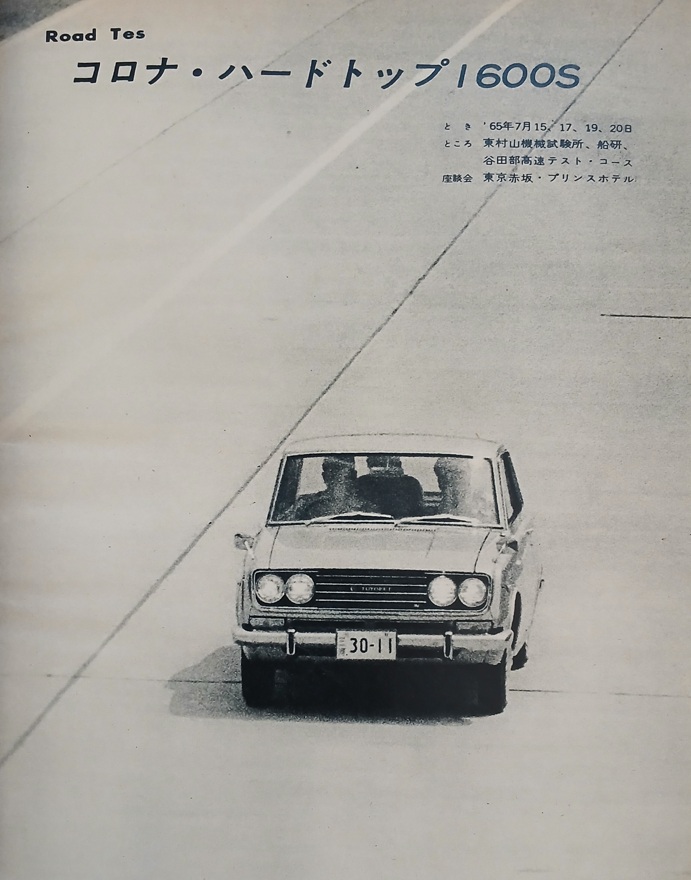
Toyota Corona Hardtop 1600S (1965)
Publication: Motor Fan
Format: Road Test
Date: September 1965
Authors (Roundtable): Atsushi Tajima, Susumu Tanaka, Kazuo Kumabe, Osamu Hirao, Michio Ibaraki, Isao Kawase, Mineo Yamamoto, Akira Kawahara, Kenji Higuchi, Atsushi Watari, Yasuhei Oguchi, Kenzaburo Ishikawa, Yoshio Akutsu, Motor Fan Editorial Staff (uncredited)
A Pillarless Hardtop
Magazine: We had an opportunity to test the Corona Hardtop immediately after it went on sale. Our test focused mainly on the 1600S, but it seems there are quite a few other variations, so let’s begin with an explanation from the manufacturer.
Tajima: The Corona Hardtop series consists of two-door hardtop coupes based on the four-door sedan. Compared with the sedan, the body has been changed considerably.
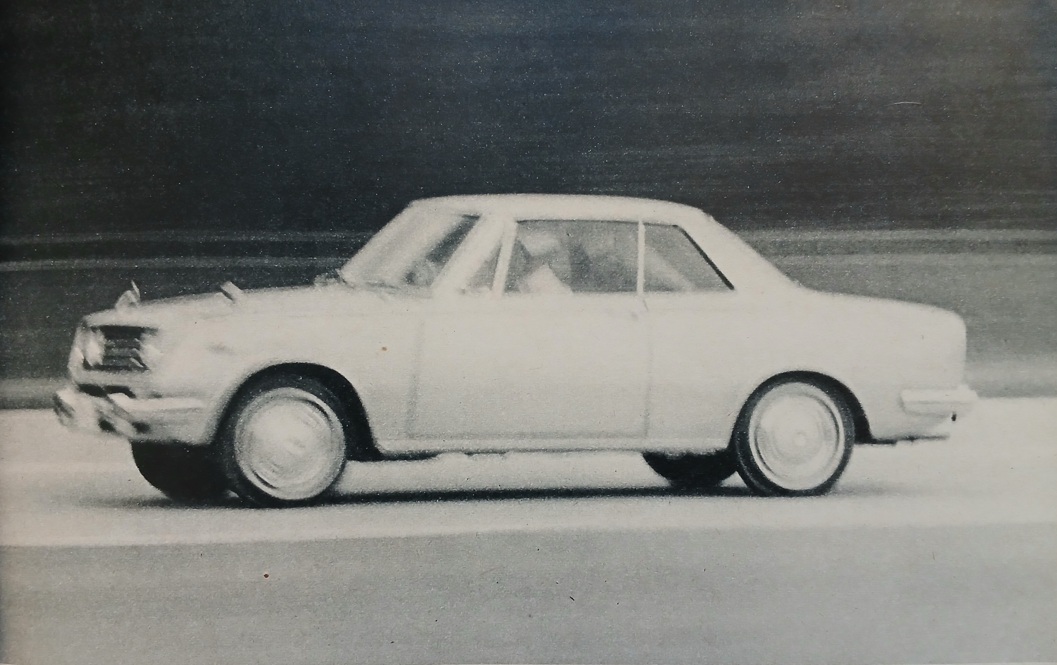
To describe these changes, below the beltline—that is, below the middle of the side of the body—the main difference is simply that it has two doors, and the floor section is the same as on the sedan. Above the beltline, however, the body has been changed to a coupe or hardtop form. The front and rear windows are consequently set at steeper angles, and since this is a hardtop, there is no center pillar. All of the side windows can also be lowered completely.
As for the interior equipment, on both the 1500 with the manual gearbox and the Toyoglide model, the area around the driver’s seat is the same as on the Deluxe sedan. The front seats are also the fully reclining separate seats offered as an option on the Deluxe sedan, fitted here as standard equipment. The 1600cc RF51 model, however, was designed with sporting driving in mind, so the gauges have been changed to easy-to-read pointer-type dials, and a tachometer has also been added. Since the rear seat was designed to suit the coupe style, it seats only two even though it is a bench seat. Fold down the backrest, however, and the rear-seat area becomes a luggage area. In other words, the layout has been changed to place the main emphasis on the front seats.
All of the variations correspond to models in the sedan range. The 1500 with the 3-speed gearbox (RT50) corresponds to the Deluxe sedan, the Toyoglide model (RT50C) to the Toyoglide-equipped sedan, and the 1600S (RT51) to the 1600S sedan.
A Car Aimed at the Owner-Driver
Magazine: What are the prices?
Tanaka: The cash retail price in Tokyo is 758,000 yen for the Corona Hardtop (RT50), 813,000 yen for the Toyoglide-equipped model (RT50C), and 848,000 yen for the Hardtop 1600S (RT51).
The RT51 is available with optional disc brakes at the front and leading-trailing drums at the rear, at an additional cost of 20,000 yen. Compared with a Deluxe sedan fitted with separate seats, therefore, the S costs 180,000 yen more, while the other models cost 90,000 yen more.
Magazine: What was the thinking behind providing a corresponding Hardtop model for each of the sedan versions?
Tajima: The four-door sedan of course sees some personal use, but we also have to consider family use, use as a company car, and various other purposes, so we provided a range of variations to suit the different preferences involved. The Hardtop, however, is a coupe, so naturally it places greater emphasis on personal use, with priority given to the front-seat occupants. However, not everyone who buys one will necessarily be interested in sporting driving. For that reason, the Hardtop series also includes a 3-speed model and a Toyoglide model. We have also made the rear seat spacious enough for people of average Japanese height to ride in reasonable comfort.
Magazine: What sort of production volume are you planning?
Tajima: Since the emphasis is on personal use, the interior appointments and styling are more luxurious, and the price is also higher, so we do not expect the same quantities as the sedan. Still, we have prepared a mass-production line and the necessary facilities. In terms of volume, we anticipate production at a fraction of the sedan’s level, with an initial plan of around 1,000 cars.
Tanaka: In terms of actual sales, we expect the 1500 with the manual gearbox (RT50) and the Toyoglide-equipped version (RT50C) to account for the majority. The Hardtop 1600S (RT51), however, is the highest-performance model in the entire Corona range, including the sedans, and since we regard it as a grand touring car, it is the model we have asked you to test this time.
Kumabe: What kind of warranty do you provide on the Hardtop series?
Tajima: The same as on other current Toyota models, of course. For one year or 20,000km, warranty claims will be handled without charge.
Hirao: If you equip this car with the air conditioner offered as an option on the sedan, how much does that add to the price?
Ibaraki: 145,000 yen. However, it cannot be equipped on the sporting 1600S.
Hardtop-Type Body
Magazine: Could you explain more specifically how this model corresponds to the 1600S sedan?
Hirao: The chassis and the larger 1600cc, 90ps engine are the same, I take it. And the disc brakes that are standard on the 1600S sedan are optional on this model, is that right?
Magazine: Then there are the distinctive features of the body construction…
Kawase: The main points were eliminating the center pillar and developing the window regulators that allow all the window glass to be lowered completely.
Kumabe: Is there a significant difference in the body’s resistance to deformation depending on whether the center pillar is there or not?
Kawase: Since the floor is shared with the sedan, removing the center pillar does have an effect. However, with some modifications to the rear quarter panels, we were able to obtain rigidity equal to that of the sedan. The rear quarter windows do not simply lower straight down; they lower by rotating through an arc. For this reason, a U-section guide rail runs from the rear quarter panel along this arc and connects directly to the wheel housing, where it also serves as a reinforcing member.
Tajima: We actually investigated the strength and rigidity of the center pillar on the sedan. From those studies, we had already concluded that rigidity roughly equal to that of the sedan could be obtained by slightly increasing the rigidity of the side members, reinforcing the lower portions of the front pillars so that they could withstand the shocks of the doors opening and closing, reinforcing the roof, and—as on this car—using the channels that guide the windows as structural reinforcement. Also, the results of actual durability testing with this Hardtop showed no difference from the sedan.
Yamamoto: We already knew that the bending moment carried by the center pillar was surprisingly small, but this is the first Japanese production car to do away with it, isn’t it? Even so, the additional reinforcement must inevitably make the car heavier.
Tajima: Actually, the body itself weighs almost exactly the same as the sedan’s. The 15kg increase in the quoted vehicle weight is due to the more luxurious equipment. And when we mention roof reinforcement, this is really only intended to keep the roof panel rigid. Also, simply as a result of adopting the coupe style, the roof area is smaller than on the sedan, and I think that alone contributes considerably to its rigidity.
As Quiet as the Sedan
Yamamoto: Still, until now, when we spoke of a hardtop in Japan, we only meant a car with a removable roof…
Tajima: Here we are using the term in the American sense, meaning a hardtop without a center pillar.
Kawahara: In America, around last year, passenger cars of this hardtop type sold something like 1.2 times as much as normal four-door sedans with center pillars. They’ve become the most popular type of car there.
Hirao: Of course, American cars are big, so even when they are made into hardtops like this, the rear seat doesn’t become cramped.
Tajima: But many American hardtops are simply four-door cars made into hardtops. Coupe-type hardtops like this car are relatively uncommon.
Hirao: Then there is the question of seating capacity. Under the Japanese regulations, I think only a little more width would be needed to make the rear seat a three-seater… Even if you don’t actually carry five people, I think being rated for five would be advantageous as a selling point.
Higuchi: In terms of the dimensions, another 10cm of seat width would make the rear seat a three-seater.
Hirao: For Japanese owner-drivers today, being able to say that a car can carry five people has a certain appeal.
Tajima: If there were enough demand, it’s not something we couldn’t consider.
Watari: Another thing: when the center pillar was removed, I expected the car to become noisier, but the noise level doesn’t seem to be any different from the sedan.
Tajima: Perhaps because of the effect of the passenger compartment, the noise peaks at the rear seat, for example, have actually been reduced. I think the space at the rear—or rather, the interior space itself—has a considerable effect.
Magazine: Then what did the noise measurements show?
Watari: It was raining very heavily when we took the measurements, and even after the rain stopped there were puddles on the road, so I think the actual noise level would be 2-3 phons lower than the measured figures. The results were 69 phons at 60km/h, 70 at 70km/h, 73 at 80km/h, 75 at 100km/h, and 77 at 110km/h on the A scale. These are 4-5 phons higher than for the Deluxe sedan, but I think the actual difference would be only about 1-2 phons.
Tajima: We have reduced the exhaust back pressure, so the exhaust note is louder than on the sedan.
Watari: Still, I wonder why the figure suddenly rises to 82 phons at 120km/h.
Ibaraki: Without the effect of the rain, I think it would be about the same as the 1600S sedan, or perhaps even slightly lower.
Watari: One possibility is that, because there is no center pillar, the rubber at the joint between the two pieces of glass creaks and produces noise.
Hirao: The sound of the rubber rubbing against the glass, you mean.
Watari: It might help to fit something on the inside of the rubber that would produce a softer sound. Still, the Deluxe sedan is the quietest car in this class, so even at these figures you could hardly call this car noisy.
Kawahara: With a hardtop, there are many occasions when you drive with both side windows all the way open. Even at 100km/h on the Meishin Expressway, the noise is not particularly bothersome, and the airflow strikes pleasantly just behind the driver’s head. In that respect, I can say that it is extremely comfortable.
Tajima: Also, when measured on the C scale, this car actually gives lower readings than the sedan. Since the coupe layout has reduced the volume of the passenger compartment, from the standpoint of the body itself, it seems that the Hardtop actually has an advantage over the sedan in terms of noise.
A Top Speed of 174km/h
Magazine: How about the ride?
Watari: The sprung-mass frequency is 1.1-1.2cps, which means about 70 bouncing cycles per minute, while the unsprung frequency is 1.7-1.8cps, giving about 100 pitching cycles per minute. So the ride isn’t particularly bad, while at the same time the car is capable of sporting driving.
Something else about the noise just occurred to me. The seat backrests seem to make noise when no one is sitting in them. If there is any play in the hinges, they will inevitably rattle. Of course, that isn’t something specific to this car…
Hirao: The same applies to the fit of the seat rails. If you want the seats to slide smoothly, you have to allow some play, and that sort of thing will also contribute to noise when no one is sitting in the seat.
Tajima: We used rubber at the rear-seat hinges to prevent them from making noise when the seat is secured in position.
Watari: Once a car becomes as quiet as this, even little things begin to catch the ear. I suppose it means that attention has to be paid to even the slightest amount of play.
Magazine: Now then, how about the performance?
Oguchi: I’ll begin with the 1600S equipped with the 3.700 final-drive ratio. We had three people on board along with the test instruments, for a total load of 213.7kg, which is roughly equivalent to the full rated load of four 55kg occupants. In standing-start acceleration, it covered 0-50m in 5.0 seconds, 0-200m in 11.6 seconds, and 0-400m in 18.1 seconds. In terms of time to speed, it accelerated from 0-60km/h in 5.6 seconds and 0-100km/h in 13.4 seconds.
In overtaking acceleration, starting from 30km/h in third, it reached 100km/h in 18.0 seconds, 120km/h in 24.8 seconds, and 130km/h in 29.2 seconds. Starting from 40km/h in top, the corresponding figures were 24.6 seconds to 100km/h, 34.4 seconds to 120km/h, and 47.6 seconds to 140km/h. We also conducted a maximum-speed test, and with three people plus the instruments—in other words, the equivalent of a full four-person load—the car recorded 174.3km/h.
According to the manufacturer’s published figures, the 0-400m acceleration time is 18.6 seconds and the maximum speed is given as 160km/h. Why were you so conservative with the published figures?
Yamamoto: At what engine speed did it record that maximum speed?
Oguchi: I think it was around 6000rpm.
Tajima: Even from the calculated figure of 29km/h per 1000rpm, 170km/h corresponds to almost exactly 6000rpm. That isn’t yet in the red zone, but still in the orange zone. However, the 1600S is also available with a 4.111 final-drive ratio, and considerations like that led us to give the maximum speed conservatively as 160km/h.
Cruising Speed Is Most Important
Yamamoto: The time it takes to reach maximum speed is another consideration.
Oguchi: We didn’t measure the time, but on the Yatabe course the car reaches its maximum within half a lap. And this isn’t just a momentary peak—it can maintain that speed for three or four laps, so it can fairly be considered a sustained maximum speed. There was also a crosswind of around 3m/s, which worked in the car’s favor on one bank and against it on the other. For that reason, I think this maximum-speed figure can be regarded as quite reliable.
Hirao: If you’re talking about a sustained speed of 174km/h, though, the tires start to become a concern.
Tajima: These aren’t ordinary tires. They’re low-section-height tires with a relatively flat cross-section, so I don’t think there is too much cause for concern in that respect.
Hirao: Even so, at those kinds of speeds, whether the tires are new or old can become a matter of life and death. That’s why I think catalogs from now on ought to state the practical maximum speed clearly, rather than quoting the sort of momentary maximum speed they have in the past. In that respect, I think Toyota is right to put the practical maximum speed up front in its published figure.
Kumabe: But the car actually did reach 174km/h, and it can maintain that speed to a certain extent. From the standpoint of its value as a selling point, I don’t see any reason to hold the figure down to 160km/h.
Tajima: When the opportunity arises, we’d like to consider whether to publish this data.
Oguchi: Next, with the 1600S (RT51) fitted with the 4.111 final-drive ratio, the acceleration figures improve still further: 0-400m takes 17.4 seconds with two people plus the instruments aboard. With the 1500cc three-speed Hardtop (RT50), carrying its full complement of four occupants, the 0-400m time was 19.4 seconds.
Magazine: How does a 0-400m time of 17.4 seconds compare with foreign cars?
Hirao: Among the foreign cars we’ve tested in Motor Fan, I think the Porsche 911 managed something like 17.1 seconds… Among Japanese cars, those that have recently broken the 18-second mark include the Prince 2000GT, Nissan Silvia, and Fairlady 1600.
Toyoglide for the 1600cc as Well…
Magazine: Since we did not conduct fuel-economy testing, could we have the manufacturer’s figures?
Ibaraki: In the Ministry of Transport certification test, the figures for the 1600S RT51 were 17.88km/l at 30km/h, 16.68km/l at 60km/h, 14.28km/l at 70km/h, 14.28km/l at 80km/h, 12.83km/l at 90km/h, and 11.76km/l at 100km/h. The running fuel-economy figure is the same as for the 1600S sedan (RT40S), at 16.72km/l.
Hirao: In any case, the performance is good. Up to now, Japanese cars have been said to be imbalanced in terms of weight and power by international standards, but around this level I think the balance is becoming quite satisfactory. Acceleration is ample, and with a practical maximum speed of 160km/h, there should be no shortage of performance for highway driving even when the Tomei Expressway is completed. I think it would be quite adequate for American-style highway driving as well. It’s economical, too… The question is the total weight in relation to the car’s size…
Ishikawa: The weight per unit of occupied area is 152kg/m². Compared with European cars, it does seem to be on the small side.
On the other hand, specific output per ton is high at 92ps/t, so it combines good acceleration with good fuel economy. I think it would be well received even if exported to markets like America.
Watari: We were talking about this the other day as well, but if you’re going to export the car to somewhere like America, where it would be used as a second car, I think the 1600cc engine is the one that ought to be offered with Toyoglide…
Hirao: In terms of engine performance, I’d rather see Toyoglide offered only with the 1600, rather than the 1500.
Kawahara: I suppose that’s because it’s said the Toyoglide model has poorer acceleration, but if you look at something like the 0-50m acceleration figure, it is actually rather good. In driving around Tokyo, the acceleration you need is the kind used in getting away from an intersection, and over a distance like that I think the Toyoglide might actually be better than the manual-transmission car.
Watari: If you compare them as driven by an unskilled driver, then yes, you could certainly say that the torque-converter car accelerates more smoothly.
Body Reinforcement That Added No Weight
Magazine: Next, let’s have the data from the Ship Research Institute…
Ishikawa: With the spare tire and tools on board, the measured weight was 993kg, 18kg heavier than the 975kg we obtained for the previous 1600S sedan. The quoted weight is also 15kg heavier, at 980kg. With two doors and a hardtop body, I had naturally expected it to be lighter…
Ibaraki: As mentioned earlier, the additional weight comes less from the reinforcement than from the more luxurious interior equipment. Also, the quoted weight of the 1600S RT40S is 980kg. That does not include the approximately 20kg for the spare tire and tools, so once those are added, this measured figure of 993kg is actually about 7kg lighter than the quoted weight.
Ishikawa: I see. So the quoted weight isn’t necessarily the lightest figure obtained. Next, the weight distribution is 548kg at the front, or 55%, and 445kg at the rear, or 45%. It changes hardly at all with one person aboard, while with a full load of four occupants it becomes approximately 50:50.
As for wheel alignment, the front wheels have slight negative camber, and the side-slip reading is -2 on the toe-out side. At the rear it is zero, with very little change under load. On cars such as the front-engined Austin Mini, toe-out is deliberately specified. Is that also the case here?
Tajima: The design is the same as on the sedan. At the front, we specify almost no camber or toe-in.
Hirao: Since the measurements were taken with a side-slip tester, perhaps the combination of toe-in and camber was out of specification. It must have been a case of misalignment.
Ishikawa: In the brake test, the front brakes begin to take effect at a pedal effort of 5kg, and the rear brakes at 6kg, so the front comes in slightly earlier. From that point up to 0.6g deceleration, the pedal spring rate is 1.8kg/mm, which is somewhat on the firm side. In terms of braking force, the duo-servo drums on all four wheels are very light to use, requiring a pedal effort of only 20kg for 0.6g deceleration, and there was no left-to-right imbalance. At a pedal effort of around 22-23kg, the brake-force distribution is 68:32, giving a high-speed-oriented balance with greater braking force at the more heavily loaded front wheels. The parking brake is also light, and the ratchet action is good.
There is one thing I would like to ask, though. This Hardtop is sporting in character as well as in appearance, and with a maximum speed of 174km/h (at Yatabe), its performance is high. What, then, was the thinking behind deliberately choosing duo-servo drums rather than fitting disc brakes as standard equipment?
Tajima: Disc brakes are standard equipment on the 1600S sedan, but perhaps because they were not used to the feel of discs, we had some customers who were involved in rear-end collisions. So, for this Hardtop, we made them optional and arranged things so that the car could be fitted with either type.
Kawahara: In actual sales, though, fully 99% of the cars are being ordered with disc brakes.
Tajima: Still, there is nothing inherently wrong with drums. Even American cars intended for high-speed driving mostly use duo-servo drums, so I don’t think they present any problem under present-day conditions in Japan. We also thought it would be better from the standpoint of individual preference to let the customer choose either type…
Ishikawa: I asked because I would think that with the duo-servo brakes, once you get above 150km/h, the required pedal effort would exceed 50kg and fade would become significant. They are also more prone to developing an imbalance between the left and right sides.
Watari: Even with drum brakes, I think that with enough development it should be possible to produce brakes with little left-to-right imbalance and good fade resistance, at lower cost than discs.
Ishikawa: This car doesn’t have a power servo. Why is that…?
Tajima: We do have one available for cases where the car is used in rallies and the like.
Hirao: If it’s only intended for competition use, I have some doubts about that.
The amount of assistance from a servo varies with engine vacuum, so when you’re trying to apply the brakes delicately, judging the braking force entirely through the feel in your foot, the servo can actually have disadvantages…
Light Operating Efforts Throughout
Ishikawa: The operating efforts are generally light, with relatively little variation from one control to another, which gives the car a good feel. Gearshift effort is 2-4kg; the clutch requires 7kg as it engages and 11-12kg to disengage. Accelerator effort is 2.5kg when maintaining a steady 50km/h, and only 4kg even when accelerating hard in third. As for the doors and windows, releasing the door lock from inside requires 4kg, operating the vent window 6kg, and raising or lowering the window glass 1-2kg. Another thing I liked was the seat-slide lock. It requires 4kg, yet is easy to release, and the seat backrest doesn’t return with excessive force. I thought the whole arrangement felt very good.
Higuchi: When sliding the seat forward, there is friction between the seat cushion and the driver’s backside, but it’s more convenient for the slide to be set at an angle, since that keeps it from simply sliding freely. I also thought that four turns from lock to lock for both the front and rear window regulators was a little too much.
Hirao: In Japan, there are times when you have to close the window quickly—for example, when passing another car on a muddy road in the rain—so I think the front windows ought to require fewer turns.
Higuchi: One other thing, though perhaps it’s just me: when getting out of the car, I sometimes caught my pants pocket on the door-lock control. Some recent cars have it located under the armrest, and that arrangement avoids the problem.
Reduced Roll Rate
Magazine: What were the results for handling and stability?
Akutsu: First, we measured the turning radius. It was 5.18m at the outside and 2.73m at the inside. Next, we examined the relationship between understeer or oversteer and steering effort while gradually increasing speed in a constant 15m radius turn. The car understeered right to the limit. At that point, the radius of curvature was 24-25m and the steering effort was 3.2kg, which I think are appropriate figures for a sporting car like this. The degree of understeer was also appropriate, and we were able to continue the test up to around 40km/h. The roll rate was 5.7°, about the same as that of a normal passenger car. Stationary steering effort was 12-13kg, which puts it among the lighter cars.
At low speeds, during the figure-eight test, steering effort on entering the turn was 6-7kg at a lateral acceleration of 0.25g, which I think is within a suitable range. At high speeds, in the slalom test, it was 2.2kg at a maximum lateral acceleration of 0.25g, again a good figure. The results were also well balanced between left and right.
Those were the results for this 1600S Hardtop, but if we look at the main figures from the four tests we have conducted on Corona models between 1960 and the present year, 1965, the roll rate has steadily declined from 8.5° to 7.4°, 6.3°, and now 5.7°, while the steering effort required to hold the car in a turn has increased from 1.3kg to 3.2kg. Steering effort in the slalom test has gone from 2.5kg to 3.0kg and then to 2.2kg. Looking at these changes, I was struck by how the character of the Corona has gradually evolved.
Magazine: Was there some structural change responsible for the improvement in roll rate? And how many turns is the steering from lock to lock?
Tajima: In view of this car’s intended purpose, we lowered the ride height by 45mm. The spring rates have also been changed, of course, but I think the increase in the diameter of the stabilizer bar has had a significant effect. The steering is 3.5 turns from lock to lock.
Reduced Blind Angles
Magazine: What did the visibility measurements show?
Yamamoto: Since one of the distinctive features of this car is the absence of a center pillar, our measurements concentrated on how much that improves the field of vision, and also, because of the coupe body, on rearward visibility and the field of view through the rear-view mirror.
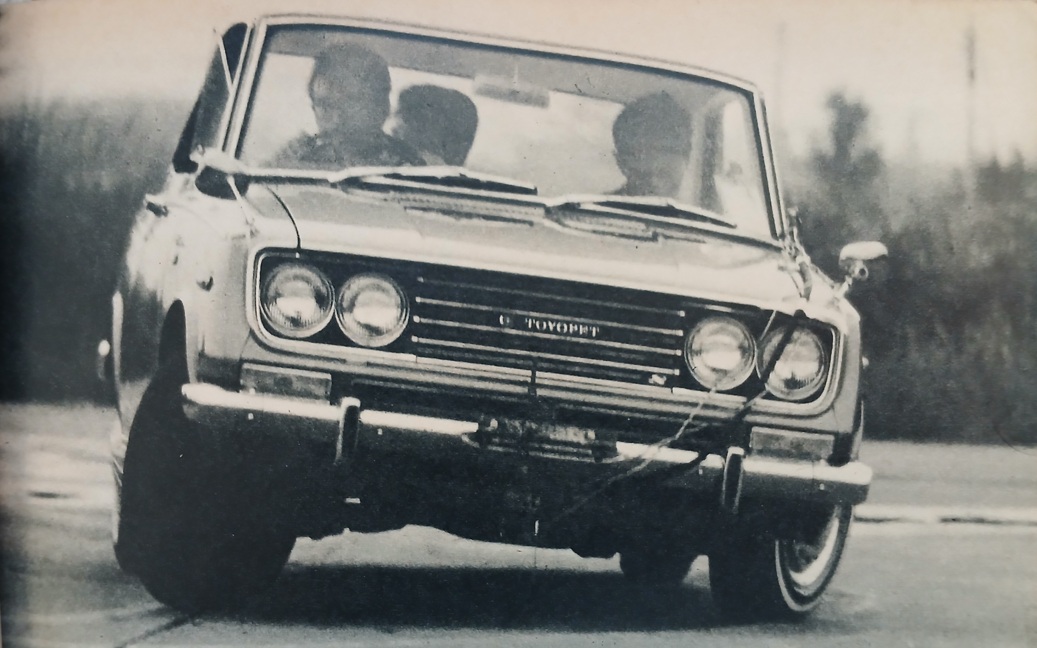
One thing we noticed about the operation of the wipers, as you can also see in the photographs, is that the right-hand wiper does not sweep all the way to the base of the right front pillar. Even so, the swept area extends through 71° in front of the seating position and 64° behind it.
The overall field of vision is very good because there is no center pillar. Expressed in terms of blind angles, the total blind area over the full 360° is 12-13%, a considerable improvement over the 16-17% figures we have measured previously.
Looking at the rearward field of view through the rear-view mirror, the mirror is not quite wide enough horizontally, so if you adjust it to cover the left side, you lose some of the view on the right. I thought a somewhat wider mirror would be desirable.
Tajima: From the reports we’ve received on cars exported overseas, we’ve heard that the rear-view mirror is considered very large and easy to see through. Making it any larger would also increase the blind area ahead, and I’m not sure it would be desirable from a design standpoint either…
Watari: Foreign cars certainly do have small mirrors. Japan is about the only place where rear-view mirrors are this large. The fact that Japanese cars generally need such large rear-view mirrors comes down to two things: the fender mirrors are little more than ornaments, and the Japanese vehicle regulations themselves are rather strange.
Tajima: The regulations require the left-hand fender mirror to provide a view 50m to the rear while also allowing the rear wheel to be seen. In addition to meeting those requirements, ours are designed to provide visibility to around 500m behind the car.
Yamamoto: In America, I believe the requirement is 200m, or 600 feet. After all, if you can see 200m behind you, you can practically see all the way to the horizon.
Watari: If that’s the range required, I don’t think the mirror necessarily has to be in its current position on the fender. It’s because of these pointless regulations that a perfectly useful fender mirror ends up being little more than an ornament.
The Rear Seat Also Serves as Luggage Space
Magazine: Next, how about the dimensions…?
Higuchi: As Japan’s first full-fledged hardtop, with no center pillar, I think this car satisfies many of the things an owner-driver wants from a personal car.
In terms of dimensions, compared with other Japanese cars it retains the Corona’s traditional “wide sedan” character and is quite wide, although it still seems narrow by European standards. The wheelbase and track are also somewhat on the larger side, but again they are narrower than those of comparable foreign cars. Although it has only two doors, the absence of a center pillar and the wide doors make access to the rear seat easy. However, since the doors open through the same angle as the sedan’s, when fully opened they project as much as 1040mm from the side of the car.
I don’t think there would be any practical inconvenience if the opening angle were reduced a little.
As for the interior dimensions, the front seats are roomier than in the sedan, although there is somewhat less fore-and-aft space in the rear. Even so, it is more spacious than a 2+2, and the rear passengers can sit quite comfortably. In particular, the ability to fold down the rear seat and use the area as luggage space is convenient for long-distance touring, and the operation itself is simple. I would, however, like to see straps provided to secure luggage. Also, this may be a matter of personal preference, but in Japan’s humid climate, leather-covered seats can become unbearable. I would like to see cloth upholstery offered, even if only as an option.
The driving position could be described as sporting, but if you position yourself with your arms extended fully to the steering wheel, some of the other controls, such as the floor-mounted gear lever, are a little too far away. There is also a rather large height difference between the brake and accelerator pedals, and they are spaced widely apart. I think this reflects the aim and character of the car: sporting in atmosphere, but with a rather American-style driving position, using a dished steering wheel that is easy to handle and returns well.
With the floor shift, I also thought the handbrake would be better placed in the center, to the driver’s left, rather than using the umbrella-handle type.
This is a minor point, but the reversing light is located below the bumper, so if it gets covered with mud there is a risk that it will stop being effective. I would like to see it moved above the bumper somehow.
Hirao: It’s too bad that the 1600S can’t be fitted with an air conditioner. You know, according to the FIA Sporting Code, “a GT is a car combining the highest performance with the highest comfort,” while “a touring car combines the greatest economy with the highest comfort.” (laughs) So even in a grand touring car, for the sake of that “highest comfort,” an air conditioner is something you’d certainly like to have.
A Cabin Air Outlet Would Be Desirable
Hirao: Another thing: the addition of secondary ventilation is convenient, but ideally it would be better to use a butterfly valve so that the amount of opening could be adjusted freely. Then you wouldn’t need a separate open-and-close knob either.
Higuchi: Since you’ve gone to the trouble of providing secondary ventilation, I would also have liked to see some provision for letting the air escape from the cabin.
Tajima: With Japanese road conditions, though, it is quite difficult to make a system that will keep out water and dust. That’s something we’re still studying now.
Higuchi: The instrumentation is very comprehensive, with just about everything provided, and I think users will appreciate the fact that they are all pointer-type gauges. However, I found it difficult to distinguish between the red and orange zones, so I think it would be better if those areas were color-coded in sectors. Otherwise, the instruments struck me as simple and easy to read.
This is something that applies to any car, but I found the chrome plating on the wipers extremely dazzling when it caught the light. I wonder if they couldn’t be finished in black somehow. The wipers themselves have been improved so that they don’t lift at all even at 140km/h, so it was only the chrome plating that bothered me.
Magazine: With that, thank you all very much.
Postscript: Story Photos