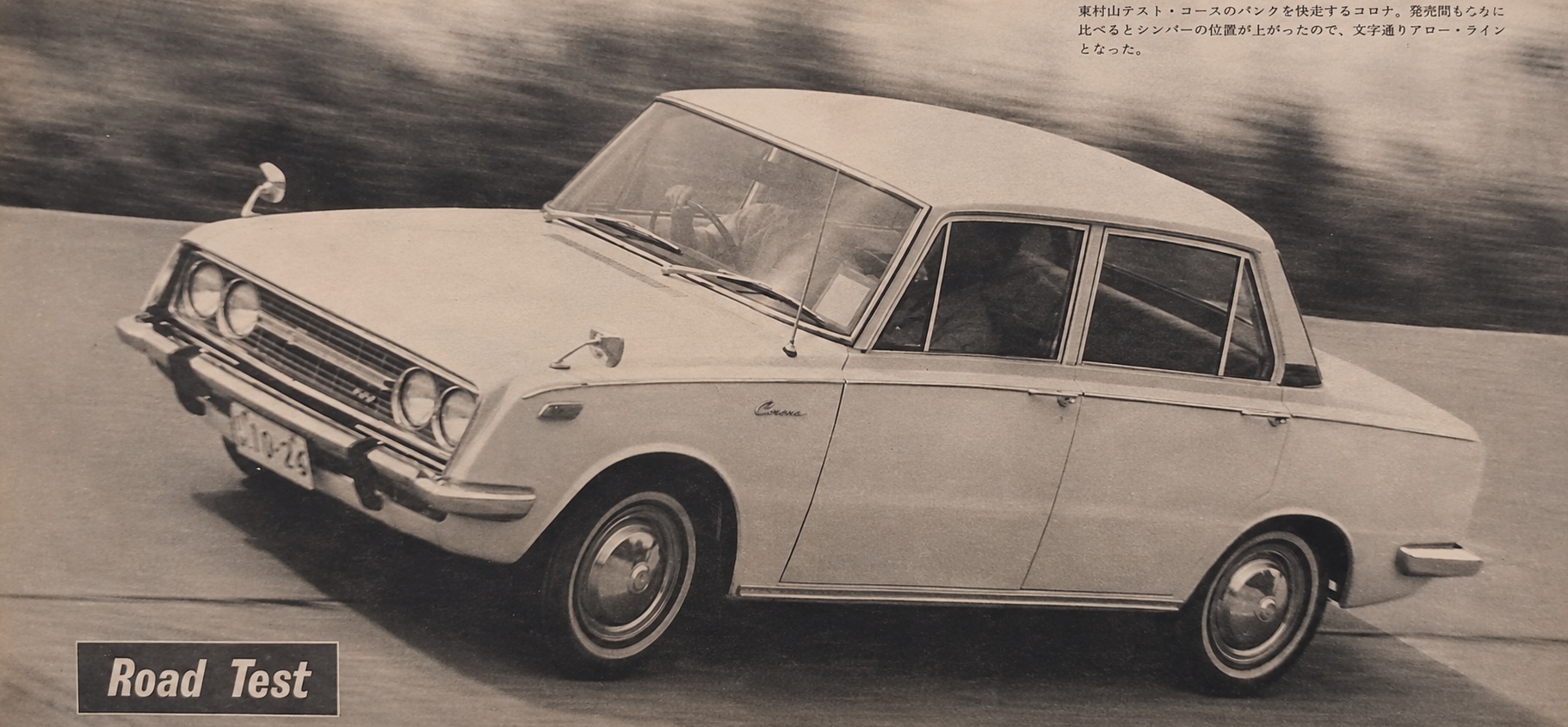
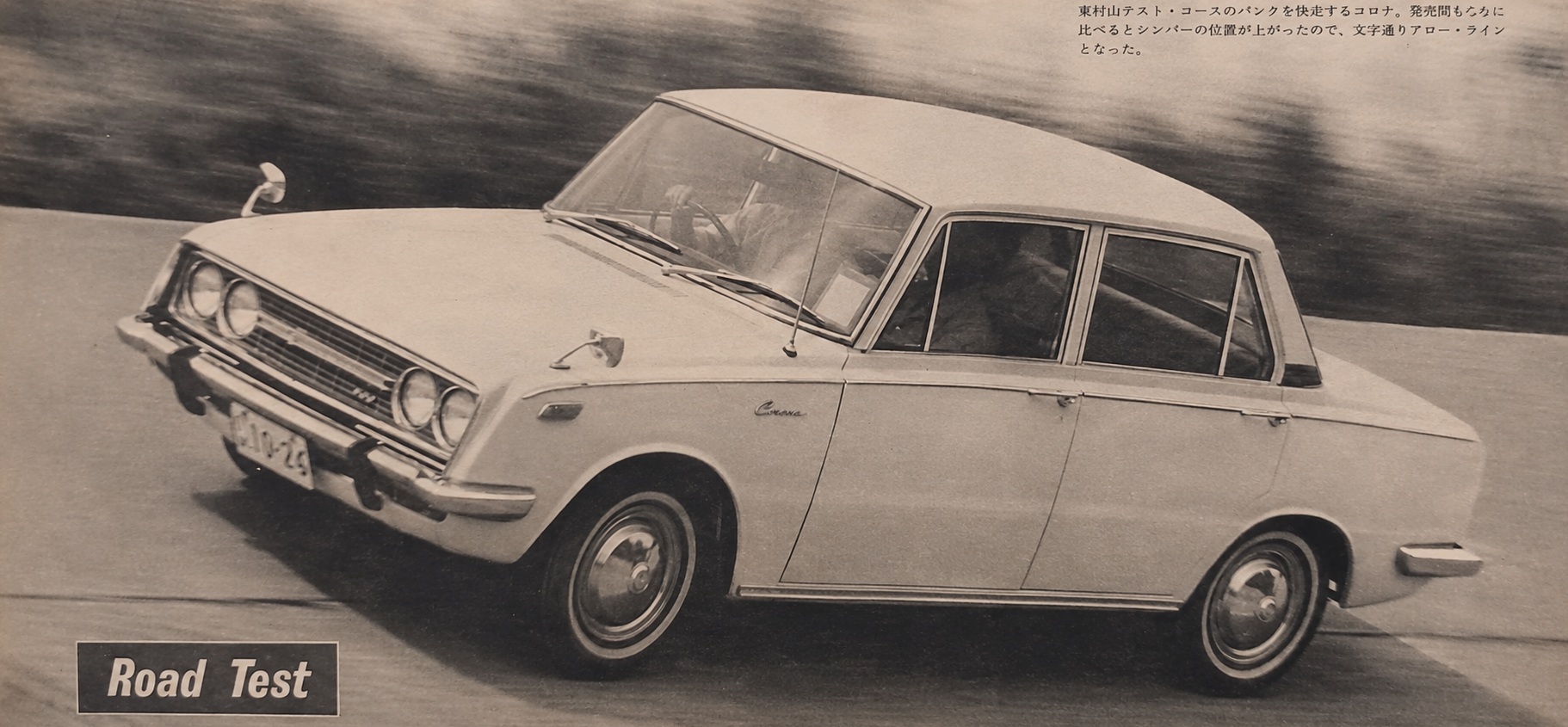
Toyota Corona 1600 Deluxe Golden Series (1968)
Publication: Motor Fan
Format: Road Test
Date: September 1968
Authors (Roundtable): Masuo Amano, Tsuneo Ando, Kazuo Kumabe, Kenji Higuchi, Osamu Hirao, Atsushi Watari, Masaichi Kondo, Mineo Yamamoto, Kenzaburo Ishikawa, Shunichi Mizutani, Akio Miyamoto, Yasuhei Oguchi, Taizo Tateishi, Minoru Onda, Motor Fan Editorial Staff (uncredited)
Emphasis on Improving Braking Performance
Magazine: First of all, could you give us an outline of the new Corona 1600?
Amano: The Corona was first introduced in 1957. That was the model commonly known as the Daruma Corona, which used the Crown’s running gear and, looking back on it now, was a rather crude effort. Then, in 1960, we introduced a new model under the name “New Corona.” In 1964, the Corona took on its present form with the model known as the RT40.
Thanks to the favorable reception it has received, this Corona has achieved cumulative production of one million units, set new export records, and won considerable praise overseas, particularly in America. In foreign reviews, the Corona has been described as “completely conventional”—a technically sound, well-balanced car, but, to put it less kindly, one without any particularly distinctive characteristics.
That may actually have been one of the reasons for its remarkable sales growth, but we felt that we ought to offer something outstanding in terms of the car’s capabilities as well. With the opening of expressways such as the Meishin, Tomei, and Chuo, it has become essential for passenger cars to be capable of meeting the demands of this new era of high-speed driving. For that reason, we decided to install in the Corona the new 1600cc overhead-camshaft engine that we had been developing for some time. This is the first time an OHC engine has been fitted to the Corona.
The essential requirements of a car are said to be that it should be capable of comfortable high-speed travel, be safe, and, when necessary, be able to stop within a short distance. With the new Corona, we therefore placed particular emphasis on improving braking performance and adopted disc brakes. Actually, we had been fitting Dunlop-type disc brakes to certain models for quite some time, but the brakes used on the new Corona are the so-called Girling type, developed through a technical partnership between Sumitomo Electric and Girling.
These brakes offer quite excellent performance. We initially fitted them to cars intended for Europe, where they were very well received. This is the first time we’ve adopted them for the domestic market. They’re standard equipment on certain models and optional on others, but as soon as production capacity permits, we intend to extend their use gradually to other models.
Magazine: Besides the disc brakes, it seems that considerable attention has been paid to safety in general in the Corona.
Amano: Safety has become one of the most important issues facing us today, so we’ve devoted a great deal of effort to it. Of course, all manufacturers are doing the same, but the Corona fully meets the American safety standards with the exception of two requirements: a dual-circuit braking system and a collapsible steering column. In addition, it has several safety features of its own. These safety improvements were introduced together in March of this year, before the present minor model change, and the cars have been on sale with them since then.
A Quiet OHC Engine Suited to High-Speed Driving
Magazine: I think the most distinctive feature of the new Corona 1600 is undoubtedly its OHC engine. Could you tell us a little about it?
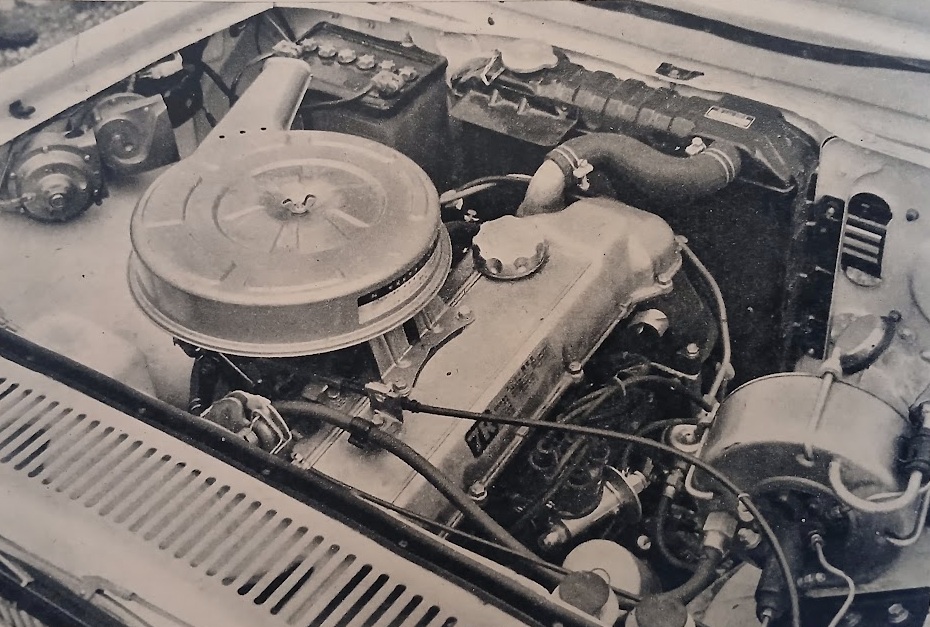
Ando: This is the engine we refer to internally as the 7R. We adopted the overhead-camshaft layout because we believe that opportunities for high-speed driving will become increasingly frequent, and that engine characteristics must be suited to these conditions. However, we weren’t concerned solely with high-speed performance. Through extensive prototype testing, we devoted considerable effort to finding ways of obtaining a flat power delivery from low to high engine speeds, and fortunately, I think we’ve achieved an engine that is extremely easy to use.
In particular, looking at the way cars are used today, such things as how the engine feels in extremely cold weather and its ability to maintain performance at high speeds have become increasingly important. We examined these matters thoroughly in close conjunction with the development of the car itself, and I believe we’ve arrived at a satisfactory result.
One of the main advantages of the OHC layout is its suitability for high-speed operation, but our design objectives also included reliability, quietness, and ease of maintenance. In today’s era of mass production, good manufacturing efficiency and the ability to produce large numbers of engines with consistent characteristics are equally important. Because we tried to satisfy all these requirements, some people have described the result as a rather ordinary engine. Still, we believe it is an exceptionally good engine for everyday use.
Magazine: What are its main mechanical features?
Ando: First of all, it’s a decidedly oversquare engine. The previous 1490cc unit had a bore and stroke of 78mm × 78mm, making it a square design, whereas the new 7R has dimensions of 86mm × 68.5mm.
The valve gear consists of a single overhead camshaft driven by a two-stage chain arrangement. It has specially shaped wedge-type combustion chambers with large valves occupying virtually the entire available space, an intake system designed for smooth gas flow, and a dual exhaust system that eliminates interference between exhaust pulses.
Another feature, not found on the previous Corona, is the use of Teflon oil seals on the valve-stem guides to prevent oil from entering the combustion chambers past the valve stems. This has greatly reduced oil consumption. We’ve also adopted the fluid-coupling cooling fan used on the Crown and other models, minimizing power loss and reducing noise at high speeds.
In addition, the carburetor incorporates a new mechanism called a reloader, which prevents the secondary throttle valve from opening while the automatic choke is operating. This eliminates poor engine running during warm-up and is particularly effective when starting the engine in winter.
An Entirely New, Easy-to-Use Engine
Magazine: Is this 7R engine a completely new design?
Ando: Yes. During development, we spent a great deal of time debating whether or not to use an aluminum cylinder head. Aluminum has various advantages, but it also has its drawbacks… Above all, the Corona has a reputation for being a very dependable car, so we felt that the engine, too, should avoid anything excessively novel. In the end, we settled on a cast-iron head.
The output is a rather modest 85ps/5500rpm. However, as you can see from the graph, we’ve concentrated on improving the engine’s characteristics over the range of speeds actually used in driving. During development, there was considerable discussion about whether we should raise the engine speed further to obtain more horsepower, but ultimately we arrived at the current configuration.
Magazine: So ease of use can also be regarded as one of the main characteristics of this engine.
Ando: That’s right. For a sportier engine, we’ve also developed the 7RB based on the 7R, and fitted it to the 1600S. In the 7RB, we’ve modified the piston crowns to raise the compression ratio to 9.5, and changed the intake manifold, carburetor, and other components. It develops 100ps/6200rpm. One of its advantages is that we can obtain higher performance without making extensive changes to the 7R’s components.
Kumabe: I certainly agree with the intention of producing an easy-to-use engine through sound, proven engineering.
Higuchi: I had assumed that this engine was based on Toyota’s previous 1900cc four-cylinder unit, with only a few modifications, but it’s actually an entirely new design. Even though it’s a new engine, there’s nothing about it that seems intended merely to attract attention through novelty. I think the policy of placing the greatest emphasis on ease of use is a very sound one.
Ando: The torque curve is also almost completely flat from around 2000rpm to 5000rpm.
Hirao: As you say, it’s important to have ample torque in the lower engine-speed range. By the way, what is the maximum permissible engine speed? Ideally, I’d like to see something around 7500rpm.
Ando: The officially stated figure is 8500rpm, I believe. In practice, though, it’s possible to run it up to around 6200rpm.
Higuchi: One thing that impressed me when I looked at this engine was how clean it was. There were no oil leaks or signs of seepage anywhere. Have you made any special improvements to the seals or something like that?
Ando: We’ve made almost no changes to the seals themselves. I think it’s more a matter of machining accuracy. The gasket materials and so forth haven’t changed very much.
Difficulties in Making Major Improvements to the Transmission
Magazine: The engine has been made more powerful, but what about the transmission?
Amano: It’s exactly the same as before. The Deluxe has a 3-speed all-synchromesh transmission, while the RT41-DK that you tested this time has a 4-speed all-synchromesh floor shift. There’s also the RT41-DC, which is fitted with Toyoglide. However, we’ve changed the clutch to the diaphragm-spring type.
Higuchi: My impression from the test drive was that the engine certainly has more power and torque, and feels stronger as a result. But the transmission still has the old Corona character, which was disappointing. Even within Toyota’s own range, the Corolla’s transmission has improved tremendously, so I would have liked to see the Corona’s improved this time as well. But then, if the transmission itself is unchanged, I suppose the feel of it isn’t going to change either…
Watari: That’s true. The transmission feels the same as ever. The shift action is still a little heavy. Of course, that may partly be because the car we tested was still brand-new.
Kondo: The car we drove hadn’t even covered 100km yet…
Watari: Even so, I think the shift action could be a little lighter.
Amano: Product quality has become much more consistent recently, so I don’t think there’s any question of variation between individual units.
Higuchi: In any case, the shift action in the latest Corolla is so good that I can’t help noticing the shortcomings of the Corona’s.
Amano: The Corolla’s engine and transmission were both designed entirely from scratch, so we were able to incorporate all the technical advances available to us at the time. By comparison, the Corona’s transmission is the same as the Crown’s, and has been in use for a very long time.
It’s difficult to make major changes to a unit like that partway through its production life. We’ve been making gradual improvements, but there are also questions of interchangeability and how to continue supplying replacement parts for the earlier versions.
Yamamoto: I think the question of gearshift feel is partly a matter of personal preference, so it’s difficult to make a general judgment. I thought the four forward gears were quite satisfactory. The shift action was positive, and I didn’t find the effort required unreasonable. Reverse gear, however, seemed a little difficult.
Hirao: Generally speaking, I think I’d like to see a little more effort devoted to improving transmissions. After all, it’s easier to make the synchromesh effective in smaller cars. There’s no reason why a car the size of the Corona should have a shift action that feels so clumsy. I’m sure the next version will be better.
Kumabe: Nevertheless, the Corona is one of Japan’s representative cars, and I think it gives the impression of being a remarkably well-developed machine.
Watari: Until now, the brakes have generally been regarded as the Corona’s greatest weakness. But with that problem fully corrected, I think the car is now properly equipped to meet the demands of the coming expressway era. Still, there are an awful lot of Coronas on the road with the old brakes.
Thorough Control of Brake Component Precision
Amano: We’ve been making gradual improvements to the brakes over the past several years, and they’ve become quite a bit better. As part of this effort, our engineers went to Europe and observed firsthand the severe braking conditions encountered there. They came back convinced that our existing brakes weren’t good enough, and we set about making various improvements.
Through these efforts, we came to realize how important the precision of the brake components was. So we’ve now established a new brake manufacturing company, with Toyota also participating. At this company, the manufacture of components requiring particularly high precision will be subjected to very strict control.
Ishikawa: Will all the brakes for Toyota cars be manufactured there?
Amano: That will be its main responsibility. It won’t be limited to the Corona; eventually, the company will manufacture brake components for our entire range.
Ishikawa: Will that include disc brakes and complete servo assemblies as well?
Amano: For drum brakes, it will manufacture only the shoes. The drums themselves will be made elsewhere. As for disc brakes, because of the licensing arrangements, we’ll obtain those from Sumitomo Electric… There are also patents covering the duo-servo type, and Akebono Brake holds the license for those, so Akebono is also participating in the new company.
Hirao: This applies to both brakes and linings, but I think that, generally speaking, many of the weaknesses of Japanese cars can be traced to the weakness of the component manufacturing industry. In a sense, won’t the future of the Japanese car depend on how rapidly technological progress can be achieved among the component manufacturers?
Ishikawa: How about this car’s brake linings? I would think they’re a rather important factor.
Amano: We use linings manufactured by Akebono, and we’ve experimented with various types, including those with different coefficients of friction and different materials. But we’ve gradually come to understand that it’s not just a question of the lining material. The shape of the shoe, the shape of its reinforcing ribs, and the precision of the components also have a large influence.
Miyamoto: When you talk about precision, do you mean the way the drum is manufactured, or the accuracy of the assembly?
Amano: The precision of the shoe itself. Even the finish on the inside of the drum makes a difference, depending on the direction of the honing marks. We’ve paid attention to details like that. In the past, we didn’t concern ourselves with such things, but it seems that they do affect the coefficient of friction.
Ishikawa: I think the front-to-rear braking force distribution is also quite an important question. Judging from Toyota’s approach in the past, there seems to have been a tendency not to give the front brakes too great a share of the braking force. However, when we examined the distribution on this car fitted with disc brakes, we found that it was about 7:3, with much more braking force at the front. I’d like to hear a little about your thinking on this point.
Amano: Yes, it’s certainly one consideration. On the new Corona, we’ve fitted a PCV (pressure control valve) in the hydraulic circuit to the rear brakes, specifically to prevent instability caused by rear-wheel lockup during hard braking. Above a pressure of around 30 atmospheres, the valve restricts the rise in pressure, giving a two-stage pressure characteristic.
The car you tested was fitted with front disc brakes, and with disc brakes in particular, a PCV is necessary because of the distribution of braking force between the front and rear wheels.
965kg with the 4-Speed Transmission
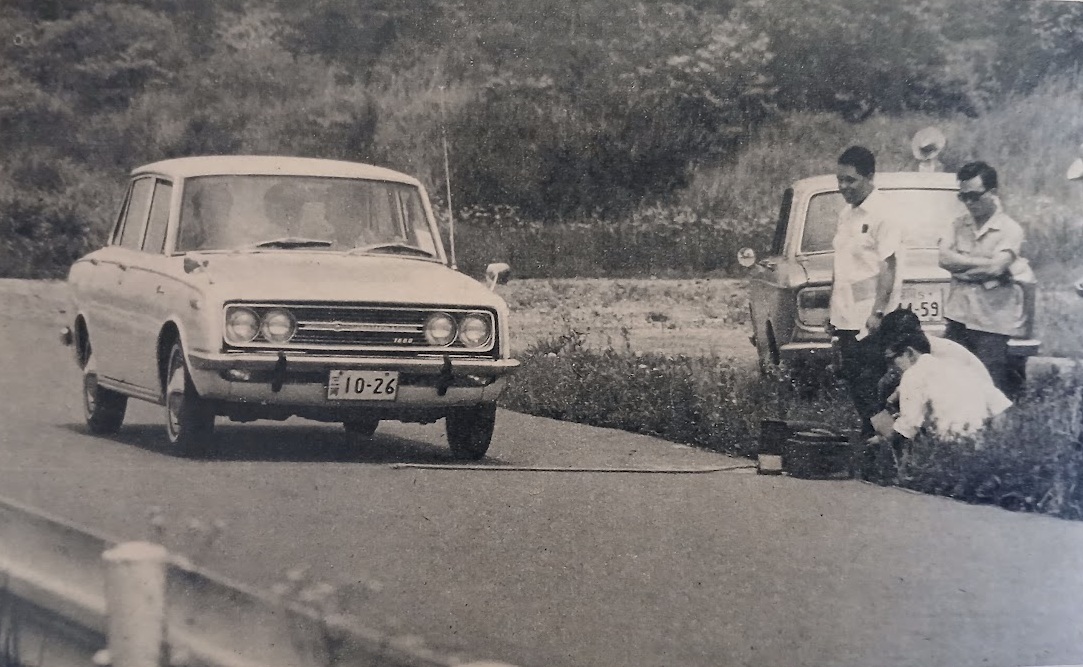
Magazine: Since we’ve been discussing the brakes, let’s hear the results of the weight, alignment, and braking measurements carried out at the Ship Research Institute.
Ishikawa: The car we tested this time was a Corona 1600 Deluxe fitted with disc brakes, and according to the catalog, its weight is 965kg, or 5kg more than the ordinary Deluxe.
Amano: That’s because it’s fitted with the 4-speed transmission.
Ishikawa: Our measurements at the Ship Research Institute gave a weight of 996kg, including the spare tire and tools. The weight distribution was 57% at the front and 43% at the rear with the car unloaded. With one or two occupants in the front seats, the percentage over the front axle decreases slightly, but the distribution remains much the same as when the car is empty. With a full load of five occupants, the distribution becomes 51:49, almost equal between front and rear.
The brakes are discs at the front and leading-trailing drums at the rear. This is the standard layout on recent European cars, and the Corona also has a brake booster. When we measured the initial pedal travel and effort required for the brakes to take effect, we found that the pedal effort was approximately 2kg and the travel about 30mm.
The pedal effort required to produce the equivalent of 0.6g deceleration was 19kg, which is very light. However, the pedal travel was about 85mm, giving a spring rate of 0.54kg/mm, a relatively low figure. This is less than half that of an ordinary braking system, so the pedal feels rather soft. As I mentioned earlier, the distribution of braking force is 7:3, with a fairly strong bias toward the front.
There was also virtually no imbalance between the left and right brakes, with braking forces well matched at both the front and rear wheels. The vacuum servo reaches its rest point at a pedal effort of around 17-18kg. In actual driving, with a higher vacuum available, that limit may rise somewhat, but it generally occurs at around 0.6g of deceleration. In other words, pressing the brake pedal harder beyond that point doesn’t produce any further increase in assistance.
Those were the results obtained with the brake tester, but when we conducted an actual road test from 50km/h within the grounds of the Ship Research Institute, the pedal effort required to produce 0.6g deceleration was slightly higher, at around 22-23kg.
Next, the parking brake. This uses an umbrella-handle-type lever and operates mechanically on the two rear wheels. The operating force required to produce 0.2g of deceleration—that is, a braking force equivalent to 20% of the vehicle’s total weight—is approximately 31kg, which is rather high. I suppose that’s partly unavoidable with a leading-trailing drum arrangement, but for a passenger car, I think the effort could be reduced somewhat.
With the ratchet engaged, the holding ability in the forward direction is relatively good, and the brake remains effective when the lever is pulled with a force of 30kg. In the reverse direction, however, it seems that the lever has to be pulled with a force of around 40kg before the car can be held on a one in five gradient. Overall, I think the parking brake could use a little more holding power.
Disc Brakes That Inspire Confidence
Magazine: How did everyone find the brakes in actual driving?
Higuchi: The brakes are certainly good. They give you a reassuring sense of security when driving. How much extra does it cost to fit the vacuum servo and disc brakes?
Mizutani: Another 20,000 yen.
Higuchi: That’s expensive. Couldn’t you manage it for about 5,000 yen? (laughs)
Watari: How much difference is there in cost between the duo-servo and leading-trailing types?
Amano: Apparently, there’s very little difference in manufacturing cost.
Watari: Even if they’re not necessarily disc brakes, I’d like to see improvements made to conventional brakes of that kind, so that they’re dependable and can be used with confidence. From the user’s standpoint, I don’t think the ordinary motorist is particularly concerned about the technical details of the brakes.
Higuchi: For example, there used to be quite a few enthusiasts who regarded a car fitted with twin SU carburetors as something rather special. Yet apparently there were even cases where such engines produced less power than the standard version. Even so, the owners assumed that having those carburetors meant the car was faster…
There used to be quite a number of enthusiasts like that. Recently, however, attitudes toward cars have changed, and fewer people attach such importance to those things.
Watari: In practice, I think there are plenty of people who never even open the engine hood.
Higuchi: That’s why, if you ask when the ordinary driver has an opportunity to use full engine power, it’s probably only when accelerating away from a tollgate on an expressway, maybe in a little contest to see who can get away first. Otherwise, in practice, there’s hardly any occasion to use full power.
Watari: Expressways aside, I think the time will come soon in Japan when there’ll be almost no opportunity to use top gear in city driving. Third gear will be enough. In that sense, perhaps we don’t need to worry quite so much about the brakes. I don’t particularly like using engine braking, but we’re increasingly being forced to rely on it. In town, I imagine we’ll mainly be using second and third gears in a 4-speed car.
Higuchi: I drive a 4-speed car myself, and one reason is that I can make good use of engine braking in second and third gears.
Ishikawa: That additional 20,000 yen we mentioned earlier covers all three items: the disc brakes, vacuum servo, and PCV. Presumably, as production volumes increase, there’s a possibility that the price will come down quite a bit.
Miyamoto: But even if 20,000 yen seems expensive, a single rear-end collision would cost you a great deal more than that… (laughs) Looked at that way, it’s cheap enough. Devices like the PCV were once fitted to aircraft. I think it’s very encouraging that this kind of equipment is now finding its way into cars for the general public.
The Need for Disc Brakes and the Question of Price
Hirao: When driving under conditions that require frequent braking, I think whether or not a car has power-assisted brakes becomes a fairly important consideration.
If you take into account the reduction in the driver’s mental and physical strain, there’s certainly an argument that 20,000 yen is a small price to pay. However, I doubt whether there are many roads in Japan where such conditions are encountered.
Magazine: One problem often mentioned with disc brakes is squealing at low speeds.
Ishikawa: We encountered almost none of that with this car. Perhaps it’s becoming a thing of the past.
Amano: With the Dunlop-type brakes we fitted to the Crown, there were some instances of squealing in the early days. These brakes are of a different type, and their construction is also different. The pads are inclined slightly in a trailing direction relative to the disc by means of shims. I think that may be why they don’t squeal.
Ishikawa: In that case, conversely, there must be a slight servo effect when braking in reverse.
Amano: I think you could say that.
Miyamoto: In that case, once the Tomei and Meishin expressways are fully open, these brakes should become very attractive.
Watari: After all, it’s on mountain roads that disc brakes really come into their own. On expressways, I wouldn’t think there would be much need for braking.
Amano: The Meishin is mostly straight, but the new Tomei has quite a few curves. At the current limit of 100km/h, that’s no great problem, but at 150km/h, you’d have to use the brakes quite frequently.
Suppose you wanted to get back to Tokyo from Osaka in a hurry at night. You’d be driving continuously at fairly high speeds, and you’d inevitably have to brake for the curves. With ordinary drum brakes, there would be the possibility of fade. Under those circumstances, disc brakes would really be necessary.
Higuchi: Even at low speeds, disc brakes give very consistent braking performance. Whether it’s the first application of the brakes after taking the car out in the morning, or after driving around all day, the braking effect remains the same. That gives you a reassuring sense of confidence.
Watari: There’s no doubt that disc brakes are better. But I think the question is how to strike a balance between their necessity and their price, and where the compromise should be made. As a selling point, they certainly have their value.
Third Gear Can Be Held Comfortably to 100km/h
Magazine: Next, let’s hear the results of the performance tests conducted by Professor Hirao’s laboratory at the University of Tokyo’s Institute of Industrial Science.
Oguchi: Here are the results of our tests. As usual, the test load consisted of three occupants plus measuring equipment, weighing a total of 187.5kg. The test car’s odometer showed 9,500km, so I think it was in just about ideal condition.
First, standing-start acceleration. In terms of time to distance, the car covered 0-50m in 5.0 seconds, 0-100m in 7.6 seconds, 0-200m in 11.8 seconds, and 0-400m in 18.5 seconds. Looking at time to speed, it accelerated from 0-60km/h in 5.0 seconds, 0-80km/h in 8.6 seconds, and 0-100km/h in 13.4 seconds.
Next, since the car was fitted with a 4-speed transmission, we conducted two passing-acceleration tests: one starting at 30km/h in third gear, and the other at 40km/h in fourth. From 30km/h in third, the car reached 60km/h in 7.0 seconds, 80km/h in 11.7 seconds, 100km/h in 17.3 seconds, and 110km/h in 20.8 seconds. In fourth gear, starting at 40km/h, it reached 60km/h in 7.4 seconds, 80km/h in 14.6 seconds, 100km/h in 23.0 seconds, and 110km/h in 28.6 seconds.
Magazine: A 0-400m time of 18.5 seconds is a good figure for an ordinary sedan in the 1600cc class. How far can you hold third gear?
Oguchi: You can comfortably take it to around 100km/h.
Amano: According to the performance curves, if you take third gear to around 5800rpm, you’ll be doing approximately 110km/h.
Kondo: This engine develops quite a lot of torque at low speeds, producing 10kgm even at 1000rpm. That corresponds to a road speed of a little over 20km/h in top gear, so I think you could describe it as a very flexible engine.
Oguchi: Yes, it makes the car very easy to drive. The design objective of making the engine easy to use certainly seems to have been achieved.
Amano: We’ve been told that even when accelerating from around 20km/h in top gear, the engine is relatively quiet, without much wind-up. European cars in this class have considerable difficulty pulling from even 30km/h in top gear. On the other hand, their high-speed performance is very good.
Oguchi: When you look at Coronas on the road, you see many women driving them. It’s often said that women don’t particularly like changing gears and prefer to stay in the same gear as long as possible. Is that something you take into account when designing the car…?
Amano: It’s certainly a car that appeals to women drivers. Apparently, women are more beautiful when they’re driving a Corona. (laughs)
Magazine: Next, let’s turn to the noise and vibration measurements from Professor Watari’s laboratory.
Very Low Interior and Exterior Noise Levels
Tateishi: As usual, we measured the natural frequencies of the suspension by driving the car over an obstacle. The sprung-mass frequencies were 1.3cps at the front and 1.4cps at the rear, while the unsprung-mass frequencies were 13cps at the front and 14cps at the rear.
Next, we measured interior and exterior noise levels. Interior noise was measured in top gear, starting at 40km/h. The readings were 61 phons at 40km/h, 66 phons at 60km/h, 72 phons at 80km/h, 73 phons at 100km/h, and 78 phons at 120km/h.
Exterior noise was measured according to the JIS procedure. The test conditions were steady-speed running and full-throttle acceleration in second gear at 50km/h. The reading during steady-speed running over the measured section was 65.5 phons, while full-throttle acceleration from 50km/h produced 75 phons on the A scale.
Watari: The interior noise curve is quite good, without any pronounced peaks. I seem to remember that the previous Corona had one slight peak, but since only the engine has changed, while the gearbox and other components remain the same, the figures don’t appear to differ greatly from those of the earlier car.
The Corona has always sold partly on its reputation for quietness, so with this model change, ideally I would have liked to see another reduction of about 2 phons. Even so, it’s still one of the quieter cars on the road today.
Yamamoto: The heater fan makes a tremendous amount of noise. Perhaps it’s because everything else is so quiet, but that sound really stands out.
Watari: The interior noise level really is very low. I almost think they could have allowed a little more of the noise to escape outside. (laughs)
Higuchi: Doesn’t the engine sound a little bit higher-pitched than before? It may not show up on the noise meter, but that’s the impression I get when listening to it. I wonder what’s responsible.
Watari: Since it doesn’t have an aluminum cylinder head, it should have an advantage in that respect, but…
Ideally, I’d like to see the interior noise held to 60 phons at 40km/h and no more than 75 phons at 120km/h. At those levels, you can converse normally inside the car even when traveling at high speed. In a noisy car, long-distance driving inevitably becomes tiring.
Safety Equipment Improved Throughout
Oguchi: In taxis and similar cars, you sometimes hear a clunk from beneath the floor when starting off, probably somewhere around the differential. I’d always assumed that taxis developed such noises because they were driven roughly, but during this test we heard a similar sound when starting off. Isn’t there some way of eliminating it?
Amano: That noise comes from the engagement of the splines. During assembly, the splined components are fitted together without regard to their relative positions, but because of manufacturing tolerances, it’s very difficult to ensure that every combination meshes perfectly and transmits power smoothly. If the parts happen to engage in a slightly unfavorable position, you get that sort of noise.
The sound comes mainly from the front yoke of the differential, or seems to originate inside the differential itself, so we call it differential clunk, and it’s something we’re working on. The only real way to eliminate it is through greater manufacturing precision. We’ve also tried giving the splines a slight lead, introducing a small amount of twist, and various other measures, but we haven’t yet succeeded in eliminating the noise from every car.
Magazine: Next, could we hear about the dimensional measurements carried out by Professor Higuchi’s laboratory?
Onda: We last measured the Corona’s body when we tested the car four years ago. Naturally, the dimensions of the current car are exactly the same as they were then. However, it now has disc brakes and improved safety equipment.
The detailed figures are shown in the accompanying diagrams, but what’s remarkable is that Toyota has kept the same original dimensions, and they remain entirely satisfactory even today. Indeed, other manufacturers have used the Corona as a benchmark when determining the dimensions of their own cars. I think the figures are exceptionally good for this class.
Recently, however, some cars have appeared with considerably more interior space, and by comparison the Corona seems a little smaller.
Still, with a million sales behind it, Toyota presumably considers these dimensions entirely adequate, and I think that judgment is reasonable.
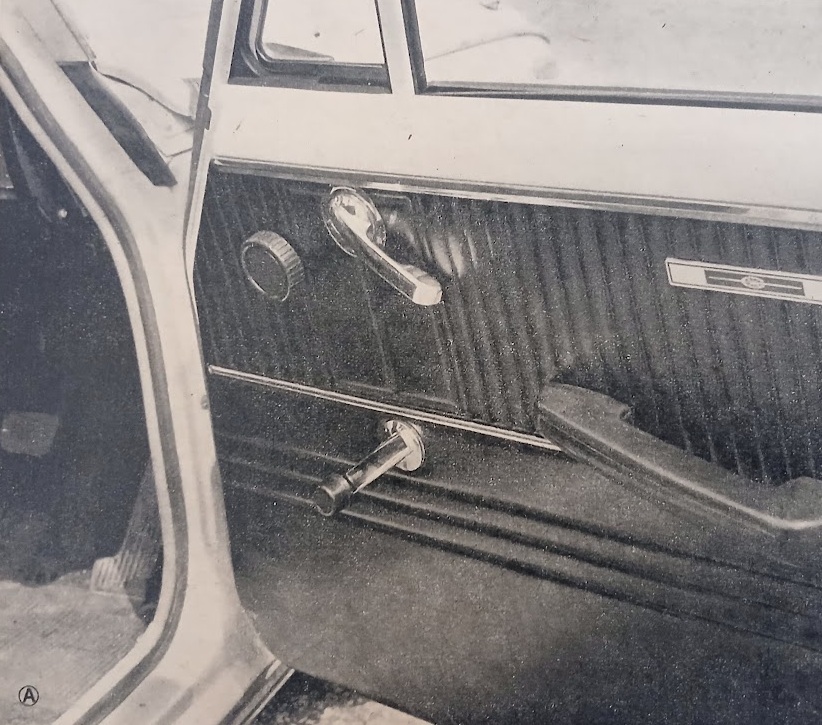
One significant change is the method of opening and closing the triangular vent windows. The conventional lever has been replaced by a round knob that must be turned. Presumably this was done with safety in mind, but I found it very awkward to use.
Dial-Operated Vent Windows Are Safer, But…
Watari: How far do the triangular vent windows open? If they stop at about a right angle, it can be enough to make you cry on a hot day.
Higuchi: When I’m driving on a gravel road or in the rain, and an oncoming car or dump truck approaches, I usually hurry to close the vent window. But with this round dial arrangement, you can’t close it quickly, which I think is a major inconvenience.
Watari: How many turns does it take to open the window all the way?
Amano: On the Crown, you have to turn the knob more than 20 times, about 30° with each movement. The Corona requires somewhat fewer movements, taking a little over 10 to open fully.
Watari: I suppose it’s because of the American safety standards, but I wish something could be done about it.
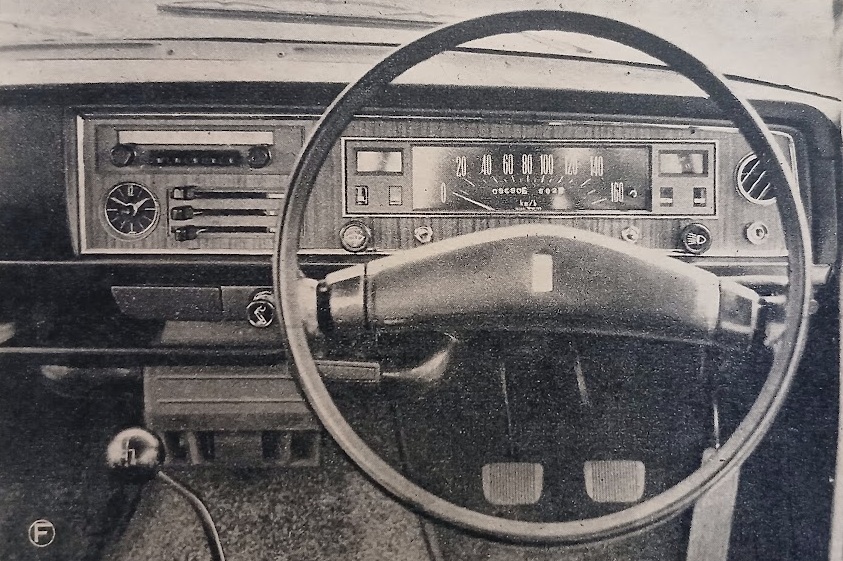
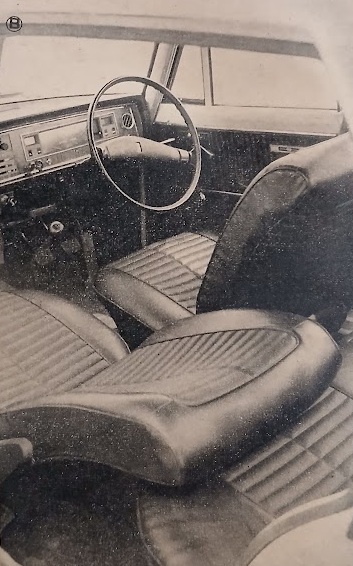
Magazine: The shape of the floor-shift lever is still the same as before.
Onda: Well, the gearbox itself is the same, so unless that is changed…
Higuchi: With the lever shaped like that, I would think women drivers would be rather put off by the floor shift.
Onda: But if you fit an accessory console over it, it looks quite attractive. Apparently, though, it costs around 20,000 yen.
Magazine: What about safety?
Higuchi: As we’ve already discussed, safety has been improved considerably. As you know, at the Higuchi Laboratory we’ve prepared a safety checklist based on the American safety standards, with some modifications to reflect Japanese conditions.
The checklist consists of 30 items, each scored on a five-point scale. An excellent result receives five points, an average one three points, and something we’d like to see corrected immediately receives one point. With 30 items, the maximum possible score is therefore 150 points. When we evaluated this car, it received a total of 120 points, equivalent to exactly 80 out of 100.
The previous Corona scored 109 points, so this represents a significant improvement. To give some specific examples, the door handles and window regulators have been redesigned, the rearview mirror mounting has been weakened so that it will break away under impact, anti-glare treatment has been applied around the dashboard, and the shape of the horn ring has been changed. From the standpoint of safety, these are clear advances over the previous model.
Other 1500cc cars in the same class generally score around 70 or 75 out of 100, so by comparison, this Corona can be regarded as having a high standard of safety. Looking through the entire checklist, I was pleased to see that every item received at least three points, with not a single item scoring only one or two.
An Ever More Refined Bestseller
Yamamoto: One thing I noticed in terms of safety was that a grab handle is provided above the front passenger’s window, as well as sturdy grab handles in the rear seat. These are a great help to passengers. The driver can hold on to the steering wheel, but passengers have nothing to brace themselves with. Even when riding in a taxi through Tokyo, it can be rather unnerving without something to hold on to.
Watari: Those handles are good. There are two kinds of grab handles: ones you can grip firmly and ones that you can merely hang on to. They really need to be sturdy.
Hirao: The parking brake is of the umbrella-handle type, but with a floor shift, I think a conventional lever would be much easier to use. From the standpoint of safety, too, I’m not particularly fond of the umbrella-handle arrangement, since there’s a possibility of striking your knee against it.
I suppose Toyota would say that they want to use the same arrangement as on the column-shift models, but having gone to the trouble of fitting a floor shift, I think it’s rather strange to insist that the parking brake must remain the same on both versions.
I’d like to see more consideration given to the convenience of the driver.
Magazine: In any case, the Corona has remained a bestseller for a remarkably long time. Just how many have been produced?
Mizutani: Cumulative Corona production passed the one-million mark last November. More than 500,000 of those should have been produced since the introduction of the current model in 1964. We’re still producing around 30,000 cars a month across the series, so I expect that figure will continue to grow.
Magazine: Exports also seem to be doing very well.
Mizutani: Since around March or April of this year, we’ve been exporting more than 10,000 passenger cars a month. The Corona also seems to be very popular overseas. At present, knock-down assembly is taking place in countries including Australia, South Korea, Malaysia, and South Africa.
Magazine: There are quite a number of models in the Corona range now. What are the prices?
Mizutani: The least expensive is the Corona 1350 at 530,000 yen, while the most expensive is the Corona 1600S Hardtop at 803,000 yen. There’s also the GT at 960,000 yen. The 1600 we tested this time, with the 4-speed floor shift, costs 684,000 yen.
Magazine: Finally, perhaps Professor Kumabe could give us his concluding impressions.
Kumabe: Above all, the Corona is something of a representative Japanese car. I think it deserves a special place in the history of Japanese passenger cars. There can hardly be another car that has been studied so thoroughly by competing manufacturers. In its early days, it certainly had its share of shortcomings, but these have now been improved, and this car seems to have been refined to an even higher degree.
Magazine: Thank you all very much for your time.
Postscript: Story Photos