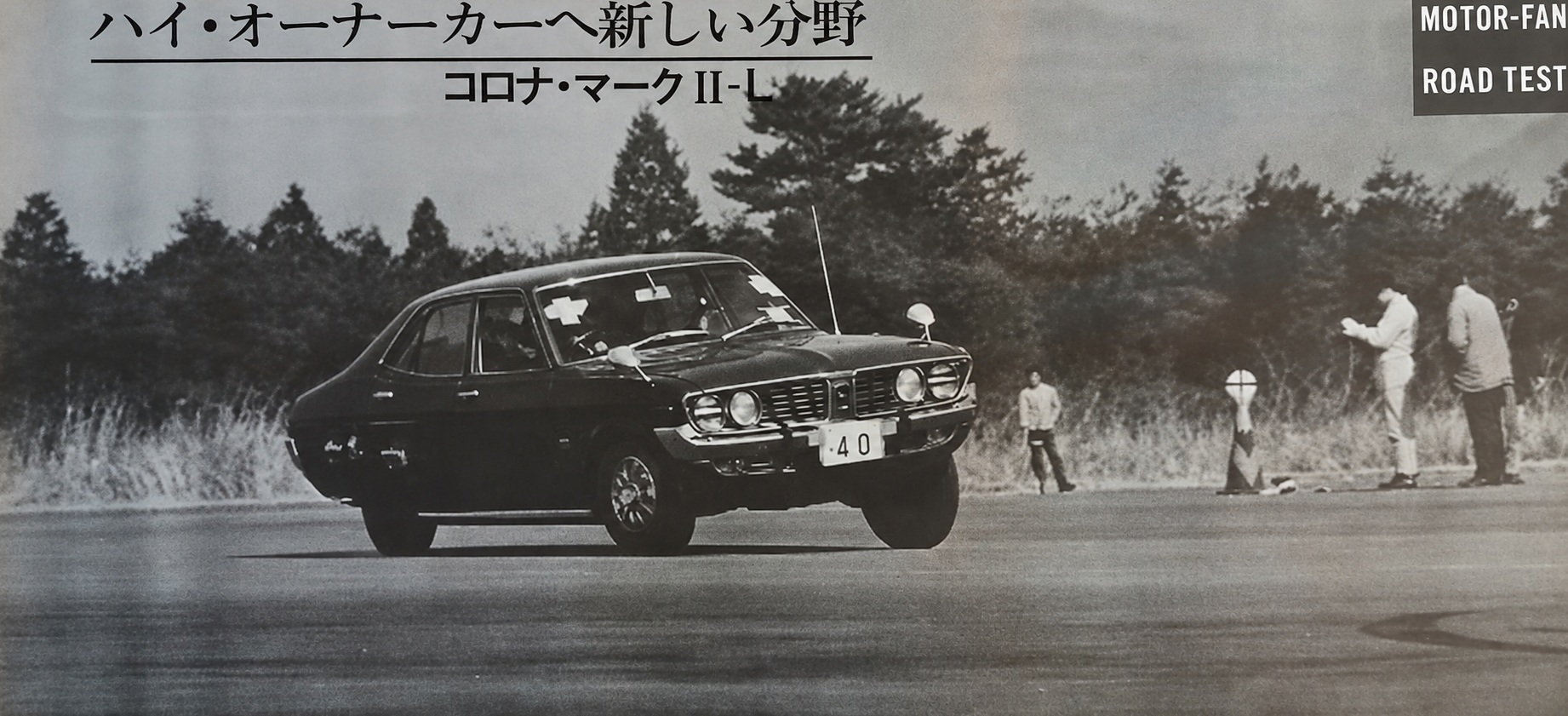
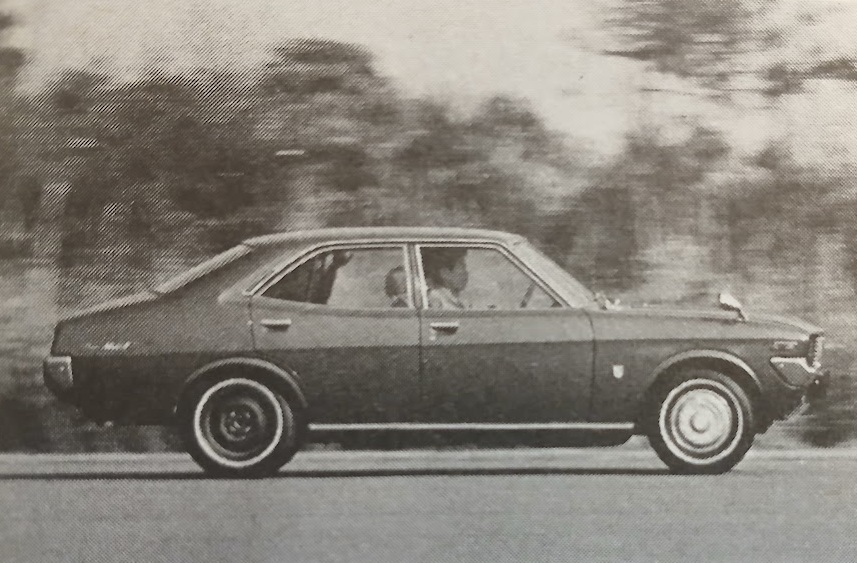
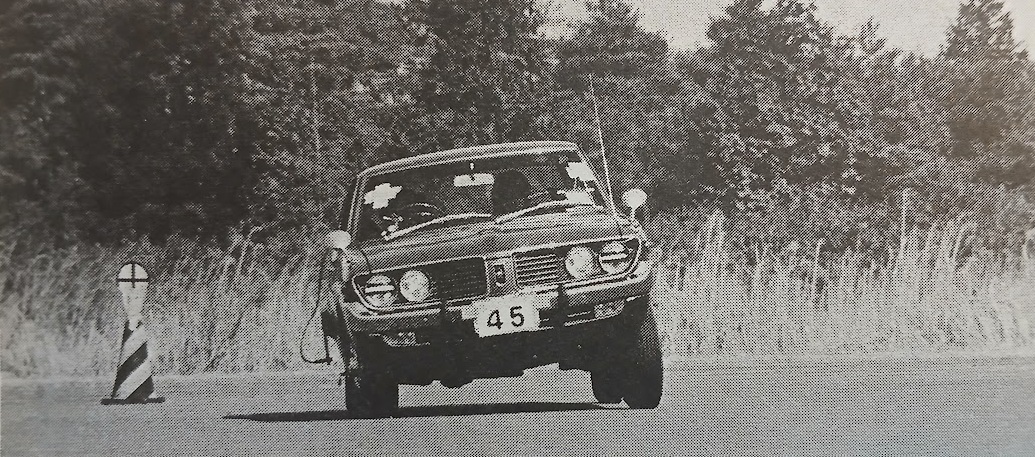
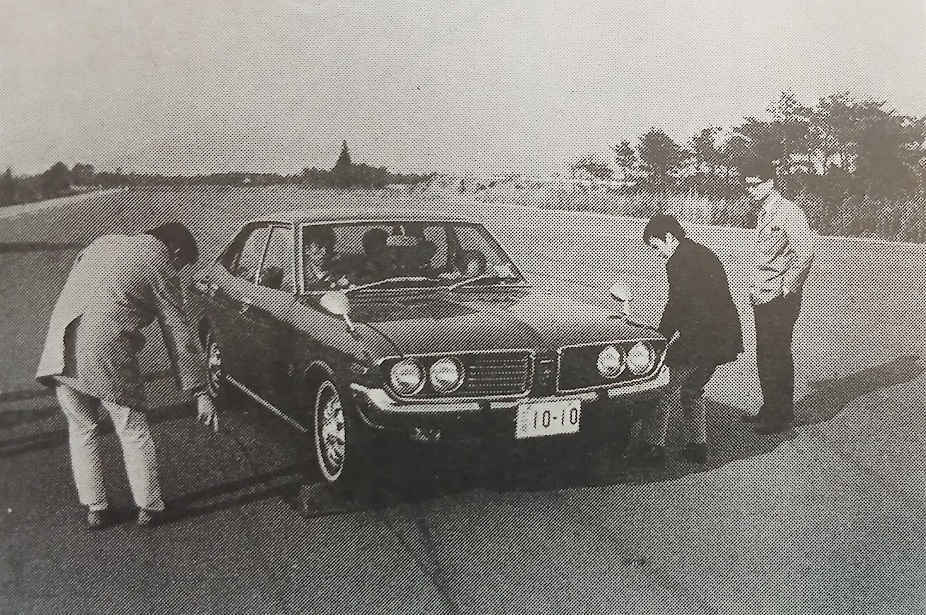
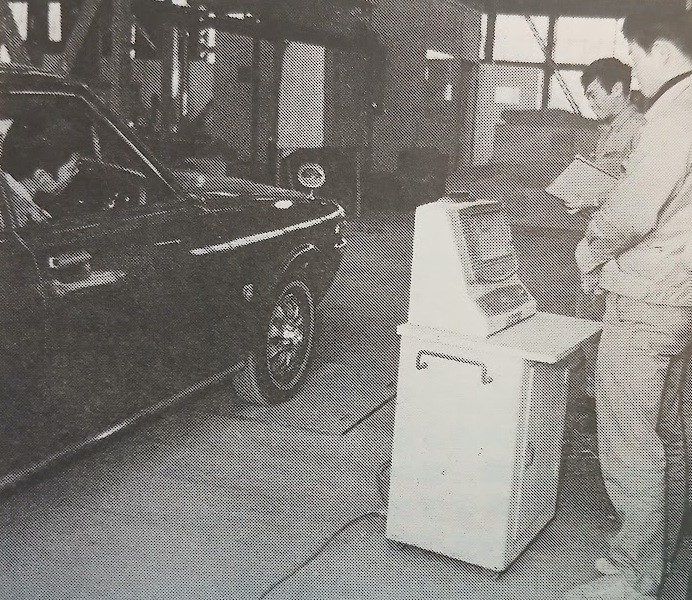
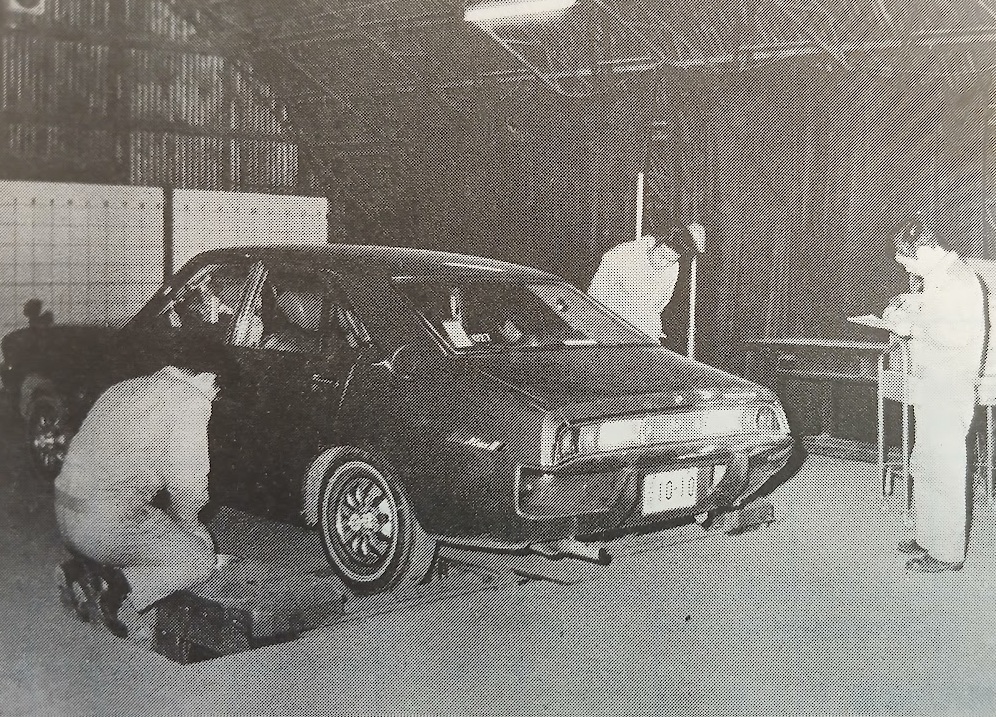
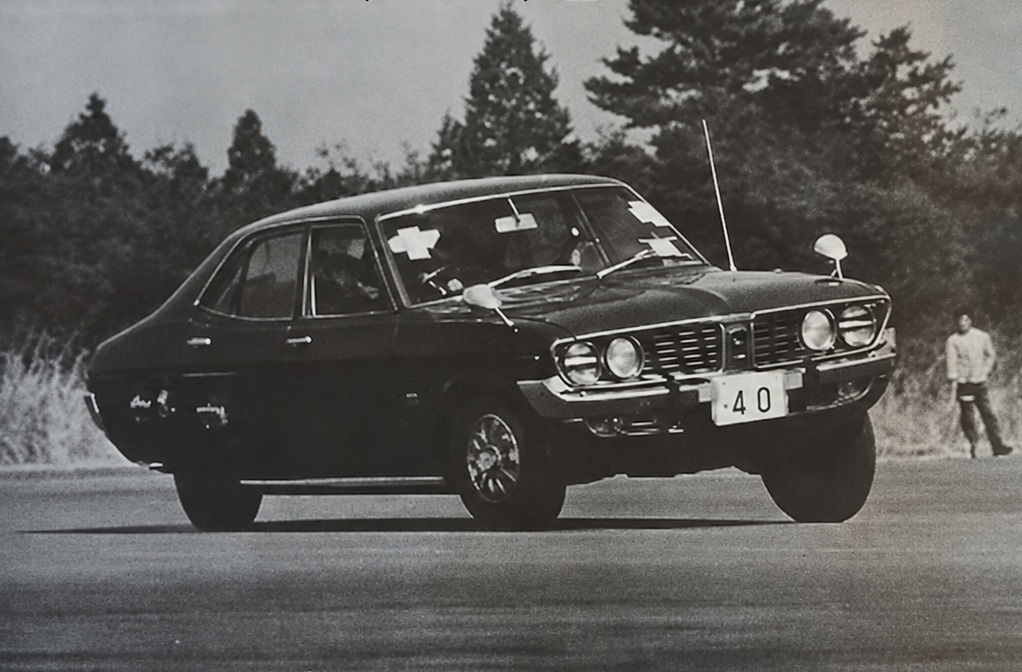
Toyota Corona Mark II L (1972)
Publication: Motor Fan
Format: Road Test
Date: May 1972
Authors (Roundtable): Ichiro Akiyama, Osamu Hirao, Yasuhei Oguchi, Noburo Matsumoto, Katsuzo Kageyama, Kenji Higuchi, Masaomi Yoshii, Tadashi Koizumi, Akio Numazawa, Hiroshi Hoshijima, Kunitaka Furutani, Hiroshi Okazaki, Masahide Sano, Taizo Tateishi, Kenzaburo Ishikawa, Minoru Onda, Motor Fan Editorial Staff (uncredited)
Emphasis on High Grade and Reliability
Magazine: First, could you tell us about the aims behind the development of the new Mark II?
Akiyama: Broadly speaking, there were five.
The first was to establish a clear position for the Mark II within the small-car class. We introduced the Mark II in September 1968, but competition in the compact-car class has been intense, with more and more similar cars appearing on the market. Even within Toyota’s own lineup there is the Corona, and the Mark II’s position had gradually become less distinct. At the same time, demand in the compact-car market has been tending increasingly toward more upmarket cars, so our aim was to transform the Mark II into a high-grade personal car.
The second was a thorough pursuit of reliability.
The third was to achieve harmony with the rapidly changing social environment. We believe we made genuine efforts in this area, but it is an extremely difficult problem, and I think there are still quite a few respects in which we can say we have not done enough.
The fourth was improved performance and functionality.
And the fifth was to improve the overall feel of the car—including vibration and noise—as well as its handling and stability.
To explain these aims more specifically, on the first point, we wanted the interior and exterior to retain a sense of refinement, while being luxurious yet at the same time stylish. We also brought together high-grade functional components, our aim being to produce a genuinely distinctive car of a high standard.
As for the second point, reliability, this naturally applies to the engine, but we have also increased the strength of components such as the steering knuckles, while in the braking system the booster has been increased from 6 inches to 7.5 inches.
We also paid considerable attention to the electrical wiring and piping. For example, the clamps securing the pipes are molded pieces, firmly fastened with bolts.
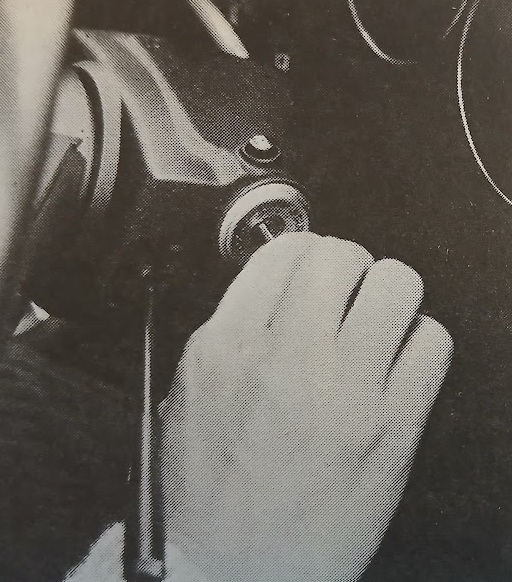
As for adapting the car to the social environment, the third point, this includes such matters as safety, pollution control, and ease of driving. In safety, we made full use of the measures already available while also trying some new ideas. One is the ignition key with a safety lock. While this may not happen very often, it prevents the driver from removing the key while the car is moving and thereby locking the steering. The key cannot be removed unless a button is pressed, so the steering cannot be locked inadvertently.
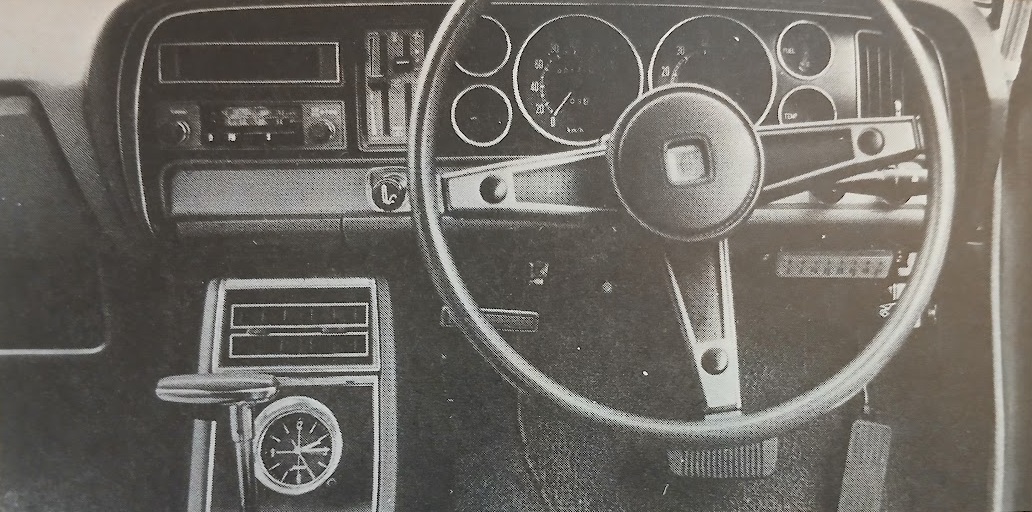
We have also fitted a seat-belt warning lamp to the instrument panel. Since the lamp would otherwise stay on whenever the belts were not being worn, we arranged for it to go out when the parking brake is released.
On the pollution side, one of our basic considerations was the move to unleaded gasoline, so the engines were designed around the use of regular gasoline. The sporting models, however, are also available in high-octane specification. Following the same thinking, measures were also taken with the valve seats to make them suitable for unleaded fuel.
With regard to “easy driving” as well, there is a growing desire to make driving easier and more effortless, as can be seen in the growing popularity of automatic transmissions. In addition, we made available as options power steering, which is still unusual in this class (on the six-cylinder models), and Auto Drive (on the four-cylinder GL and GSL, and the six-cylinder models).
As for the fourth objective, improved performance and functionality, we fitted a 2000cc six-cylinder engine, while the existing 1900cc four-cylinder engine was also bored out to 2000cc for improved performance. The four-cylinder DOHC GSS is fitted with a newly developed Porsche-type 5-speed transmission.
Among the more unusual features is what we call the “Afterglow” headlamp system, which leaves the headlamps illuminated for a short time after you get out of the car in a dark place. If you pull the turn-signal lever toward you and close the door, the headlamps remain on for approximately 20 seconds.
For the fifth objective, improved feel, we changed the rear suspension to a 4-link system. At the front, the same double-wishbone arrangement as before is retained.
To reduce vibration and noise, we adopted a propeller shaft incorporating vibration-isolating rubber. We also attached the seat-belt anchors directly to the seat frames so that the feel of the belts does not change when the seats are moved.
Those, then, were our main goals with the new Mark II.
Magazine: So by making the car one size larger, you have also made the distinction between it and the Corona clearer?
Akiyama: That was part of it. The Mark II started out as the Corona’s big brother, but the younger brother has grown, so it became necessary for the big brother to grow a little as well. Looking beyond Toyota’s own range, the number of customers seeking a higher-grade car has increased, so we wanted to establish the Mark II clearly at a level that would meet that demand.
Magazine: There is a different image associated with a 2-liter Mark II than with the established 2-liter-class cars such as the Crown and Cedric, isn’t there?
Akiyama: Yes, they have different characters. I don’t know how accurate this is, but I think of the Crown as a car for someone who has already made a name for himself and achieved success. We see the Mark II as a car for someone who is still right in the thick of things, working hard and making his way.
Hirao: A Crown can be difficult to fit into the garage, so there are people who want something one size smaller. At the same time, they want Crown-class equipment such as power steering. I assume that was also one of the groups you were aiming at.
Magazine: The Corona image seems to have disappeared. Was that something you deliberately set out to do?
Akiyama: Since we did want to make a clear distinction between the two, I think that is certainly the case.
Rather than being called the “Corona Mark II,” it is generally referred to simply as the “Mark II.” That seems to be how it is known in America as well.
Oguchi: In terms of the car’s class and standing, it no longer feels like a Mark II version of the Corona. It has moved considerably upmarket and, if anything, feels closer to the Crown. The Crown is fine for older people or as a company car, but it doesn’t quite appeal to someone who wants to own and enjoy a car himself. My impression is that the Mark II has been upgraded with that sort of customer in mind.
A Six-Cylinder Engine as Well
Magazine: You are fitting the same six-cylinder engine as the Crown. Does it fit as it is, without requiring any major changes?
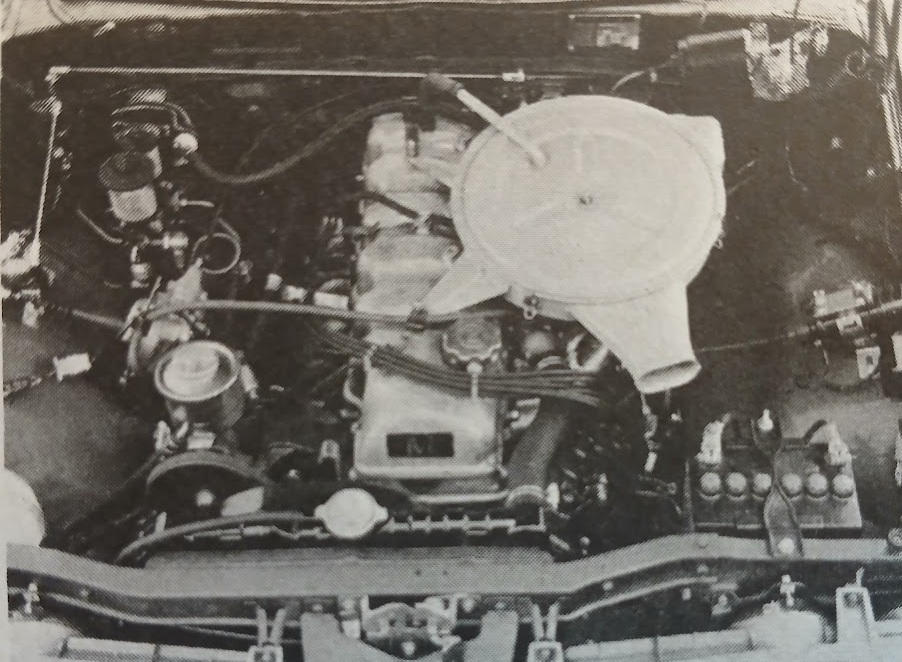
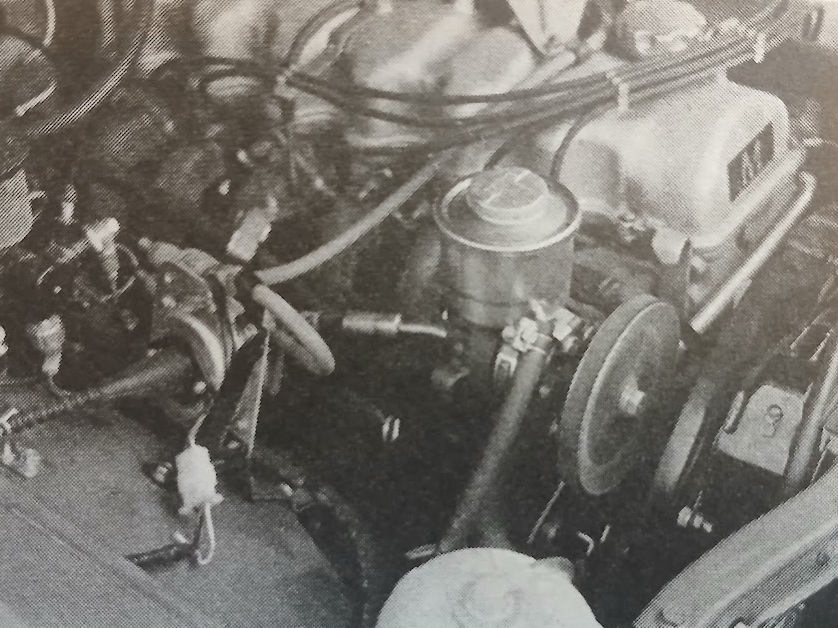
Akiyama: Because of the difference in the size of the cars, we have made some modifications. Specifically, the intake manifold and air cleaner have been moved inward toward the center, making the engine about 30mm narrower than in the Crown.
The engine itself is almost the same, but with the character of the Mark II in mind, we improved its high-speed performance and also made some revisions to fuel economy and acceleration. This involved modifications to the intake and exhaust systems, the intake manifold, the cylinder head, and other areas, with the carburetor matched accordingly.
Magazine: Is the Mark II the only model in which measures have been taken at the valve seats for unleaded gasoline?
Matsumoto: I think there may still be some sporting versions of other models that are exceptions, but for the most part I believe we are using valve seats suitable for unleaded gasoline.
Akiyama: This is also part of our effort to achieve harmony with the social environment….
Magazine: Leaving aside the L-series models, prices have remained unchanged, so in that respect you could say the new Mark II offers very good value.
Oguchi: I think so. And it has more of a sense of aspiration than the Crown. Around this 2000cc class, there is a sort of empty pocket in the market—a conspicuous gap with very little in it. In that respect, I think this may be a segment that will grow from here on.
Kageyama: There are quite a few interesting features on it, too. The Afterglow headlamp system is quite an elaborate idea, but even if they’re only supposed to stay on for about 20 seconds, I’d be too nervous to go into the house until I’d made sure they really did turn off. (laughs)
Higuchi: You don’t have to use that, do you?
Akiyama: If you want them to turn off immediately, as in an ordinary car, you can do that too. At first you may wonder whether they really are going to go out, but after using the system a few times, you soon get used to it.
Hirao: I found Auto Drive makes things easier on the expressway.
Yoshii: Once you try Auto Drive, you really become aware of just how hard your right foot is working to constantly operate the accelerator.
Higuchi: I had thought, “the accelerator pedal isn’t such a burden, is it?” But when I took my foot off it and rested it on the floor, I was surprised at just how much easier it was.
Hirao: The only thing is, you need to leave plenty of distance between yourself and the car ahead. Making things easier means that your level of readiness drops by that much as well.
Magazine: As another safety measure, you have ESC—electronic skid control.
Yoshii: Yes. It’s effective on icy roads in places like Hokkaido, and allows you to apply the brakes with confidence.
Magazine: How much does it cost?
Koizumi: 70,000 yen. My understanding is that it is being introduced progressively, beginning in the regions where it is considered necessary.
Hirao: I certainly think safety devices are a good thing. But ideally, I think the best kind is one that is simply there without calling attention to itself, and saves you when the need arises.
Akiyama: Perhaps so.
Hirao: In the interest of preventing danger, things have been arranged so that the button has to be pressed before the key can be removed, to prevent the steering from being locked while the car is moving. But I don’t imagine that situation would arise very often in the first place. And even if it did, if someone intended to remove the key, the basic action would simply become “press the button and then pull,” so I don’t think it does very much to prevent it. Suppose, for example, the key could not be removed until the speedometer had returned to zero. With that sort of automatic safeguard, you could prevent it positively.
Numazawa: There are various ways of looking at it. As far as certainty and absolute effectiveness are concerned, I think you’re quite right. But we do expect it to have some effect by introducing an additional step into the operation.
Oguchi: When you drive this car, it certainly makes you aware that removing the key while the car is moving is dangerous. There is an educational effect in making people ask why it has been designed this way.
Hirao: It may have that effect.
Numazawa: We debated the matter quite a bit ourselves. Leaving aside the fundamental question, we concluded that this was about the appropriate point of compromise.
Oguchi: On the styling, I have the feeling that the front and rear designs of the sedan don’t quite match. With the hardtop, though, I think the line running from the rear window into the trunk is more beautiful than anything we’ve seen before. It seems like an extremely difficult shape—a three-dimensional curve, you might call it. Was that done with a computer?
Akiyama: Yes. We did use one.
Higuchi: But the original line was drawn by a human being. The computer refined it.
Akiyama: Basically, yes.
Hoshijima: I prefer the sedan myself. Maybe that’s because the styling of the previous model wasn’t very good.
A Useful Third Gear
Magazine: Could we have the performance-test results?
Furutani: In the standing-start acceleration test, the L sedan covered 0-50m in 4.8 seconds, 0-100m in 7.3 seconds, 0-200m in 11.3 seconds, and 0-400m in 17.6 seconds. In terms of speed against elapsed time, it recorded 0-20km/h in 1.2 seconds, 0-40km/h in 3.0 seconds, 0-60km/h in 5.1 seconds, 0-80km/h in 7.9 seconds, 0-100km/h in 11.9 seconds, and 0-120km/h in 17.1 seconds. Because of the limitations of the test course, we did not conduct a maximum-speed test.
In the passing-acceleration test from 30km/h in third gear, my impression was that the gear ratio was well chosen, giving good initial response and continuing to pull well as speed increased.
Magazine: Aren’t the gear ratios rather short overall?
Furutani: Yes. But you can pull to 45km/h in first gear, 80km/h in second, and 120km/h in third, so I don’t think they’re all that short.
Hirao: My feeling is that it ought to pull to around 90km/h in second.
Furutani: It seems that third makes up for that to a large extent by covering a fairly wide range.
Hirao: I thought maybe the final-drive ratio could be made a little lower numerically, but for Japan this may be about right.
Magazine: The GSS has a 5-speed transmission with Porsche synchromesh. What did you think of that one?
Higuchi: A Porsche is rear-engined, whereas the Mark II GSS has a front engine and rear-wheel drive, so naturally the feel is different.
Okazaki: There’s nothing in particular to say about the synchromesh itself, but with the driving position of a Japanese sports car, the shift throws are on the long side and the effort is heavy. For a Japanese driver using a car like this regularly, I think it lacks crispness and a sense of quick, responsive operation. The clutch has a fairly long stroke as well, and it’s heavy. Taken together, these things seem to deprive the car of a sporting feel.
Hoshijima: The feel is quite different from that of the original Porsche system.
Magazine: Could we have the fuel-economy test results?
Sano: In the constant-speed fuel-economy test, we recorded 14.5km/l at 40km/h and 14.0km/l at 60km/h, with a peak between them at 50km/h of 14.7km/l. Beyond that, the figure was 12.0km/l at 80km/h, 9.6km/l at 100km/h, and 7.0km/l at 120km/h. In the simulated-operation fuel-economy test, the figures were 8.3km/l with the indicated speed set at 40km/h and 6.7km/l at an indicated 60km/h.
The constant-speed fuel economy was somewhat lower than I had expected considering the car’s weight, but as speed increases, the fall-off does appear to be relatively gradual.
Hoshijima: As for overall fuel economy, we got 7.8km/l when driving the GSS, and 7.35km/l with the four-cylinder GL automatic. So I would say a figure around this level for the six-cylinder L is reasonable.
Magazine: So driven poorly, it would be around 6km/l, and driven well, around 8km/l. Is there any possibility of introducing fuel injection?
Akiyama: Naturally, that is the direction things are moving, so we are doing a great deal of research in that area.
Magazine: Could we have the vibration and noise results?
Tateishi: The sprung-mass natural frequency was 1.3Hz at the front seat and 1.4Hz at the rear seat. The unsprung natural frequency was 13.0Hz at both the front and rear wheels.
Interior noise was 59 phons at 40km/h, 62 phons at 60km/h, 68 phons at 80km/h, 71 phons at 100km/h, and 75 phons at 120km/h. Exterior noise, measured at a steady 50km/h in 2nd, was 71 phons, and under acceleration it was 78 phons.
As for vibration, the sprung-mass natural frequencies are not particularly on the soft side. The damping is also somewhat high at the front wheels, and especially so at the rear. From this, I would judge that this is intended as a car for more active drivers, unlike the Crown.
As for interior noise, perhaps reflecting the fact that the Mark II has moved up in class, the results were extremely good. They are just below the lower boundary of Motor Fan’s comparison zone. Looking at the noise characteristics, there is a slight peak around 70–80km/h, but overall the figures are good.
Exterior noise also produced good results, just as with interior noise. Even under acceleration it remains below 80 phons, so we judge that its contribution to noise pollution is relatively small.
Magazine: It’s extremely quiet up to 60km/h, and then the level rises a little.
Tateishi: That’s right. There is a slight peak in that region on the C-weighted characteristic as well, so I think it may be mechanical in origin.
A Rather Large Steering Gear Ratio
Magazine: The test car was fitted with the optional power steering. Could we have the handling and stability results?
Kageyama: The practical minimum turning radius was 5.5m at the outside and 2.96m at the inside. Those are typical figures for a car with a wheelbase of this length.
The overall steering ratio remained almost linear up to a steering angle of 400°, and gave a rather large figure of 20.7.
Hirao: How many turns is it from lock to lock? About the same as the Crown?
Numazawa: About four turns. The Crown takes a few more turns.
Kageyama: With the car stationary, the power steering reaches saturation at an effort of about 4kg, which is about the same as the Crown. That’s a little on the heavy side for power steering.
The roll rate was 5.5°. There are a lot of sporting cars these days, and compared with those the amount of roll seems rather large, but against the types of car with which the Mark II should properly be compared, I would call it about average.
As for the understeer/oversteer characteristics, understeer was fairly strong up to a lateral acceleration of about 0.4g. Above 0.4g, the degree of understeer increased rapidly. I imagine the tire characteristics have a considerable influence here.
The effort required to hold steering angle does increase as lateral acceleration rises, but only very slightly. Consequently, the change felt through the hands was not particularly pronounced. The effort reaches saturation relatively early, and even at its heaviest—when cornering at 0.4–0.5g—it is 1.6kg. Here again, that is on the heavy side for power steering.
Higuchi: I think relatively heavy power steering is better for people moving up from a lower class of car.
Yoshii: Until power steering becomes a little more widespread, we think about this degree of assistance is preferable.
Hoshijima: Yes, it is heavy. But with power steering, surely four turns from lock to lock is simply too many. Even American cars are around three turns.
Numazawa: There are various approaches to power steering, but this uses the same mechanism as the Crown. In terms of feel, I would say it isn’t designed simply to make the steering easy; rather, the hydraulic system responds fairly directly to steering input and transmits it to the tires.
As for the number of turns, the Citroën SM has only two turns from lock to lock. But I do have some doubts as to whether that is really within the range that an ordinary driver can comfortably control.
Hirao: The steering ratio of the Citroën SM is just under 10:1, isn’t it? This is the way I look at it. In an emergency, an untrained person can turn the steering wheel about 120° on a moment’s notice. That’s about the average amount a person can turn it decisively when trying to avoid an obstacle. With a steering ratio of 10:1, that gives a road-wheel angle of about 12°. That is close to the point at which the tires develop their maximum side force, so the maximum yawing moment can be produced instantaneously. In that sense, the car’s avoidance capability should be at its maximum. If we consider only the ability to avoid an obstacle suddenly, then for those reasons I think a steering ratio of around 10:1 is desirable.
Hoshijima: I had always thought that once you got used to a car, even sudden avoidance maneuvers would be no problem. But with this Mark II….
Numazawa: Cars such as the Vega and Gremlin have more than five turns from lock to lock, don’t they? But considered as a whole, I think cars like that still work perfectly well as products.
Hirao: If you place the emphasis on stability, then in one sense you do end up with something like that. But if you place the emphasis on avoidance characteristics, you arrive at a steering ratio of 10:1. What can satisfy both requirements is variable steering.
Magazine: Power steering is optional, so the standard nonpower steering is heavier. Is that why you’ve chosen a large steering ratio, to make it lighter?
Numazawa: The power steering has a ratio of 19.29. The manual steering has a variable ratio of 20-23.5, with the ratio around the center set at about 20, roughly the same as the power steering.
Okazaki: Of all the Mark II variations, I liked this power steering best. The reason is that with the manual steering, no matter how hard I tried, I was always behind the car. Somehow it simply wouldn’t follow the line I was expecting. It was a very strange experience. (laughs)
Hirao: I wonder why. I could understand it if that happened with the power steering.
Oguchi: I drove the manual-steering car as well, and I could never quite get myself and the car in harmony. I felt there was quite a lot of phase lag, and in fact I had been meaning to ask what everyone else thought about it. Another thing is that when you turn the wheel, it doesn’t return promptly. You have to return it yourself.
Hoshijima: The return isn’t positive.
Numazawa: For the manual steering, we’ve taken various measurements ourselves, and compared with other Japanese cars, our view is that although this steering ratio is close to the upper limit, it is still acceptable.
Hirao: I don’t think it’s a question of steering ratio. I think it’s a matter of rigidity in the steering system, or of solid friction.
Hoshijima: The return is extremely slow. When you turn the wheel and then let go of it, it feels as though the car would just go on describing the same circle.
Oguchi: That’s not at high speed, but at very low speeds when a large steering angle is being used. I noticed it too, and my feeling was that this was quite different from the cars we’re accustomed to.
Hirao: With a large steering ratio, self-return becomes extremely important.
Four-Link Rear Suspension
Magazine: Does the combination of wishbones at the front and a four-link rear suspension tend to produce increasing understeer as lateral acceleration rises? The Celica is like that too, isn’t it?
Hoshijima: It does feel as though the understeer is fairly strong. With the previous model, if you eased off the accelerator partway through a corner, there was a feeling that the understeer would stop increasing. This time, I initially thought it might be because of the longer wheelbase, but there doesn’t seem to be any such change—the understeer seems to remain strong.
Numazawa: As for the degree of understeer, our own assessment within the company is that it is about average, or perhaps slightly on the strong side.
Hoshijima: It’s quite good on rough roads.
Okazaki: The rear-end grip is extremely good. You can clearly feel that the rear tires are really gripping the road.
Magazine: What did you think of the limited-slip differential on the GSS?
Okazaki: This is a subjective impression, but if the car runs a little wide on the exit of a corner of around 30-40m radius and you apply the power, the limited-slip bites sharply at about that point. Then the tail can slide sideways very easily. And with that steering, the countersteer ends up coming in too late.
Hoshijima: Exactly. It feels like you can’t get the countersteer wound on in time.
Okazaki: With a car fitted with a limited-slip differential, if it’s going to be driven by an ordinary driver, the steering really needs to be quick. Otherwise I think it’s a problem—and it can be dangerous.
Magazine: Could we have the results from the Traffic Safety Research Institute?
Ishikawa: Curb weight, including the spare tire and tools, was 1,168kg, with a front-to-rear distribution of 57:43. With the full load of five occupants, the distribution was 51:49.
The alignment figures were rather unusual by recent standards, with fairly pronounced camber and toe-in.
The brakes are a servo-assisted disc/leading-trailing drum arrangement, with a PCV fitted to the rear brakes. The front brakes begin to operate at a pedal effort of 3kg and the rears at 5kg, so the fronts come in first. Pedal effort for 0.6g deceleration was approximately 12kg on the test bench and 14kg on the road. The PCV begins to operate from a pedal effort of 10kg, but the increase in rear-wheel braking force from that point is only very slight.
The outstanding characteristic of these brakes is that their effect is extremely strong—or, to put it another way, that the gain is high. As for the parking brake, a force of 25kg was required to obtain a braking force equivalent to 20% of the vehicle’s gross weight, so its effectiveness appears to be rather poor.
Magazine: The brakes are extremely light, aren’t they?
Ishikawa: I imagine the increase in booster size to 7.5 inches has something to do with that.
Magazine: Maybe drivers are gradually losing their strength. (laughs)
Oguchi: I felt this was very good with the automatic. When you’re stopped, you only have to rest your foot lightly on the pedal to prevent the car from creeping. And when you do apply the brakes, the low level of pedal effort matches the gain of the handling as well.
Magazine: With brakes this light, rear-wheel skid becomes a concern. How effective is the PCV?
Oguchi: I tried braking quite hard, but it remained absolutely stable right to the end.
Magazine: We didn’t take any visibility measurements this time, but did any of you notice anything in that respect?
Hoshijima: I think it would be better if you could see a little more of the road ahead. Compared with the previous model, the driving position has been moved rearward, and it’s lower as well.
Meanwhile, the height of the hood hasn’t changed very much. In fact, on the six-cylinder model it has become longer. It looks good at first glance, but in terms of forward visibility the conditions are worse.
Okazaki: What bothered me more was that it was rather difficult to judge the width of the car. Perhaps that’s because of the rounded fenders. I didn’t get the impression that forward visibility itself was particularly poor.
Priorities in the Placement of Controls and Equipment
Magazine: Could we have the dimensional measurement results?
Onda: The car we measured was the L automatic. Since the fuel tank is now behind the rear seat, the dimensions of the trunk have become smaller. There has been no dimensional change in the driving position, although the seat itself is lower. However, the seat slide rails are set at a fairly steep angle, so the idea seems to be that shorter drivers should move the seat farther forward.
As for the reach to the various switches, if we judge it by the same standard as ideas like the safety-lock ignition key, the switches are extremely far away when the seat belt is fastened. Several require a reach of more than 700mm—the heater, radio and ashtray, and particularly such frequently used controls as the wipers and ventilator.
Another point is the parking brake. Because it has to be pushed in so far to release it, the measured reach is such that it can barely be returned all the way. We haven’t made much of an issue of figures like this for some time now, but if safety is to be taken more seriously, this is a figure that has to be regarded as a problem.
As for the gauges, although this is a torque-converter automatic, it has a tachometer. I suppose this is a matter of product appeal, but it means a gauge that isn’t used is placed right in the center, while controls such as the wiper switch are pushed farther away. In that sense, I had the impression that there are more gauges intended to be seen than gauges that one actually needs to look at.
The seat-belt and parking-brake warning lamps overlap in their operation: unless the parking brake is applied, neither one lights. On the other hand, there is no ignition or oil-pressure warning lamp. There is an oil-pressure gauge, but unless the parking brake is applied and the ignition switched on, there is no warning indication. I had the impression that not enough thought had been given to the warning system in relation to the position of the ignition key.
Higuchi: If the engine stops, everything goes out even though the key is still inserted.
If you’re going to design the car for the sort of person who needs that lock button, then the question is why not to carry the idea through that far. It’s a matter of consistency.
Hirao: If you’re going to provide warnings, you should first decide what deserves the highest priority, establish an order of importance, and then provide them starting from the top. If you’re going to be thoroughly consistent from the standpoint of safety….
Hoshijima: I think it would be very useful if, in place of the tachometer, there were an automatic-transmission indicator showing P-R-N-D-2.
Hirao: I agree. When you go with a floor selector, why does the indicator have to be down on the floor as well? It’s quite difficult to see. I’d like it placed somewhere more visible.
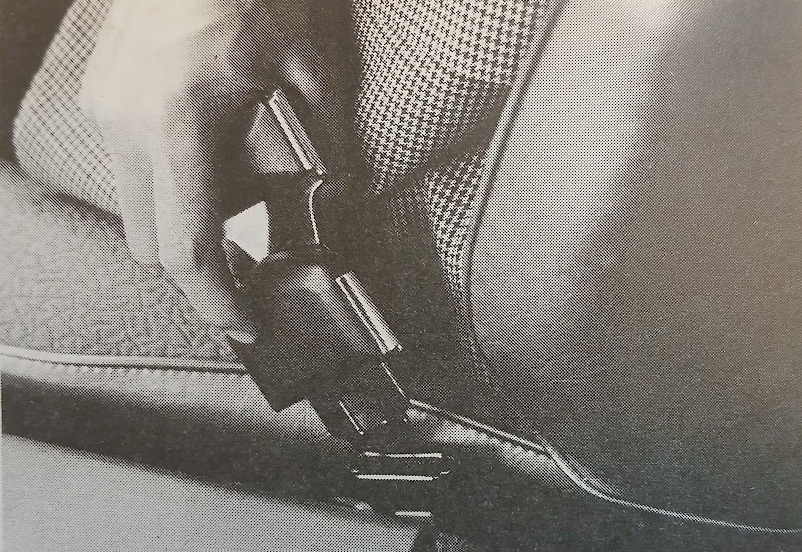
Oguchi: This is the first Japanese car to have a seat belt that clicks into a buckle on the center side, isn’t it?
Kageyama: Volvo does it that way too, doesn’t it? I thought it was very good.
Oguchi: The only thing is that with the three-point belt, it feels as though the belt presses against the side of your neck. Couldn’t the shoulder belt be taken from the seatback?
Akiyama: There are various regulations governing the location of the anchors, and we’re trying to find the best position within those limits. I think there is still a lot more work to be done.
Hirao: There would probably be a question of strength as well.
Magazine: What are your sales plans?
Koizumi: For the domestic market, the immediate plan is 10,000 cars per month, rising to 15,000 per month at the peak. For exports, the immediate target is 8,000 per month, of which 4,000 will go to the United States.
Hirao: What proportion will be automatics?
Akiyama: In America, about 65%, but domestically it will be just under 20% at most. The proportion does appear to be gradually increasing.
Magazine: Thank you all very much.
Postscript: Story Photos