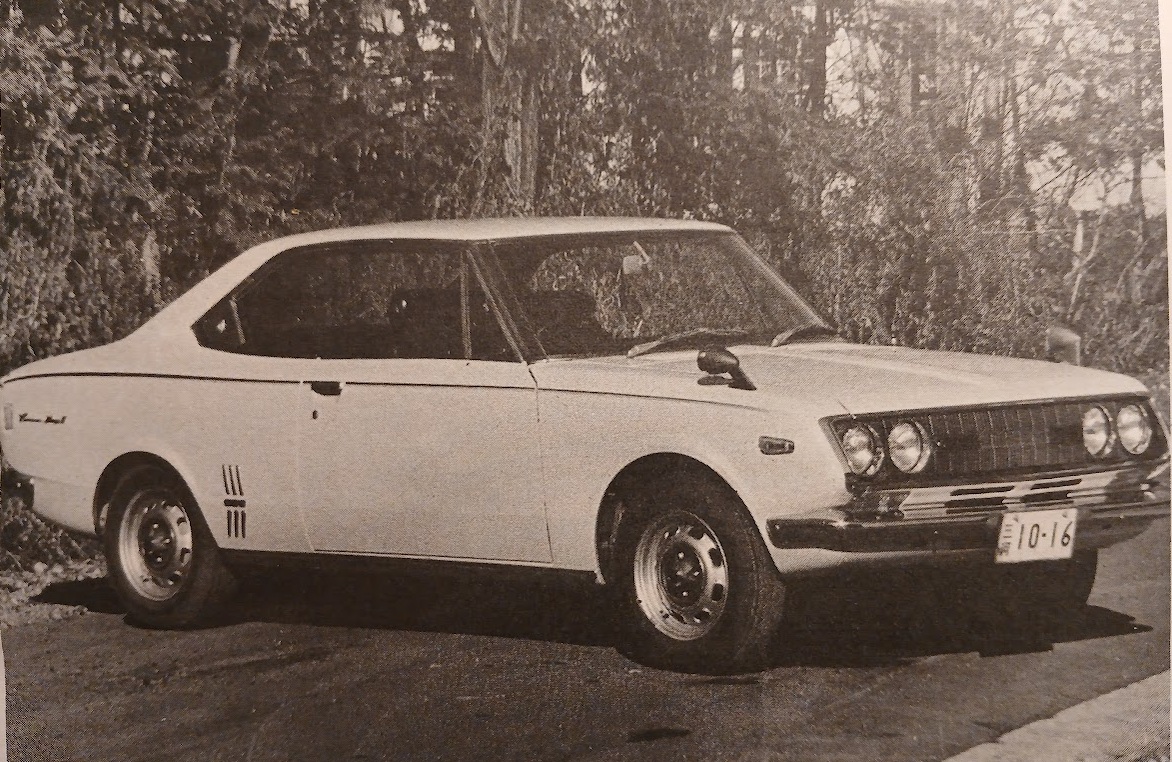
Toyota Corona Mark II GSS (1970)
Publication: Motor Fan
Format: Road Test
Date: February 1970
Authors (Roundtable): Masuo Amano, Atsushi Watari, Jun Sakakibara, Mineo Yamamoto, Hiroshi Okazaki, Kunitaka Furutani, Taizo Tateishi, Zo Doi, Kenji Higuchi, Kenzaburo Ishikawa, Yasuhei Oguchi, Toshihide Hirata, Minoru Onda, Mamoru Okubo, Motor Fan Editorial Staff (uncredited)
The Definitive Mark II
Magazine: First, could you tell us about the aims behind the GSS, and the character of the car?
Amano: It was about this time last year (1968) that we introduced the Mark II, and in the space of a year we’ve sold roughly 200,000 units. The Mark II comes in a wide range of variations, but this model was developed as something like the final, definitive version of the line—a car that would offer the highest level of performance.
The name “GSS” may be a bit presumptuous, but it stands for Grand Super Sports. The base hardtop 1900 SL tends to emphasize luxury, whereas with this car we’ve placed a bit more emphasis on sportiness over outright luxury. So it’s slightly different from the usual GT concept–it’s not just about being hot and driven fast all the time, but rather a car that can be driven comfortably in everyday conditions, at 40-50km/h around town. We’ve set it up so that it’s easy for anyone to drive, including women.
At the same time, we’ve built in the potential to achieve strong results in racing and rallying, so all the necessary fundamentals are there. With the right options, it can be made into quite a serious performance car as well.
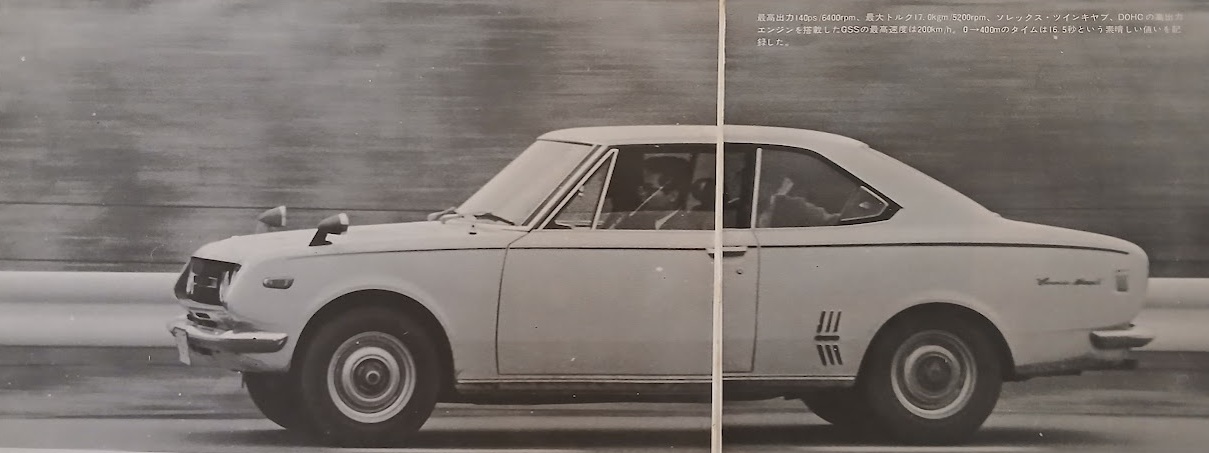
As for the overall specification, the engine is newly developed. The transmission is an improved version of the unit used in the Toyota 1600GT. The differential is a larger 7-inch limited-slip type. The suspension is basically shared with the Mark II series, but with stiffer springs. The brakes have larger discs to suit high-speed driving, and the tires have been increased to 14 inches. Top speed is 200km/h, the highest in the Mark II range. That gives you a general sense of the car’s character.
Watari: The idea that anyone can drive it, but that it can also be “hot” when you want to enjoy some spirited driving, is a good one–but looking at it the other way, it feels like there ought to be a torque-converter automatic version as well. And this may be asking a bit much, but I’d also like to see power steering…
Amano: We’re aiming at a fairly broad market, so we have to keep costs down. Power steering is still quite expensive.
Watari: With this type of car, the optional equipment tends to lean heavily toward the sporting side, but it might be worth offering luxury-oriented options as well–like a torque converter and power steering.
Magazine: The transmission is shared with the 2000GT, isn’t it?
Sakakibara: Yes, it is. The 2000GT received a minor update in August, at which time the transmission’s servo capacity was increased, and we’ve used essentially the same unit here.
Magazine: In that case, it’s not that the 2000GT’s torque-converter transmission couldn’t be fitted, then?
Sakakibara: Well–it’s not that it couldn’t. (laughs)
Well-Matched Power and Transmission
Magazine: You mentioned keeping the price down, but compared with cars in the same class–like the Skyline 2000GT-R and the Bellett GT-R–it seems like you must have had quite a struggle on the pricing side.
Amano: Whenever we set out to develop a car, we have to balance four factors: quality, quantity, cost, and time. It’s no good if it’s excellent but too expensive. It’s no good if it requires craftsmanship that makes it impossible to produce in volume. And it’s no good if it takes five or ten years to complete. Among those, cost carries a particularly large weight. We calculate the cost of each individual component and make adjustments here and there to bring everything into line. We thought we might be able to keep it around one million yen, but in the end it came out to 1,055,000 yen.
Magazine: Is the engine simply a modified version of the Mark II 1900 SL unit, with a different head?
Sakakibara: The only parts shared with the base engine are the crankshaft and the cylinder block. The biggest change is the cylinder head–we changed it to aluminum for improved cooling, and adopted a DOHC layout to allow larger valve ports. It’s fitted with twin Solex carburetors, with a compression ratio of 9.7, producing a maximum torque of 17.0kgm at 5200rpm, and a maximum output of 140ps at 6400rpm.
The maximum allowable engine speed is 6800rpm, and the power band is roughly from 2500rpm upward, though it is still usable from around 1500rpm. Our aim was to extend the high-speed performance as far as possible without sacrificing low-end torque compared to the 1900 SL, and the result is an engine that can pull all the way to 200km/h. Fuel economy is also relatively good.
Magazine: You’ve managed to gain at the top end without losing torque, but given the high engine speeds and output, the torque curve is both high and quite flat–was there any particular trick to achieving that?
Sakakibara: It was really a matter of trial and error, and technically quite difficult. In the end, the biggest factor was valve timing–finding the absolute limit. After that, we worked on the combustion chamber. It’s really the combination of the two.
Magazine: How high can it be revved?
Sakakibara: For practical use, we guarantee it up to 6800rpm. Beyond that, it becomes a question of material fatigue–so at 7000rpm it might last a certain number of hours, at 8000rpm only a matter of seconds. Ultimately, all the various components of the engine have inertia, and that imposes limits in different ways: rocker arm behavior, valve lifter “float,” damping of the valve stems, the strength of the connecting rods and their bolts, and even resonance in the crankshaft. There’s a whole series of constraints that come into play one after another. Usually, the rocker arms are what determine the limit. When you go to a double overhead cam and lighten the valvetrain, the next weak point appears, and you have to address each one in turn.
Watari: Being able to use third gear up to around 130km/h is excellent. In city driving, third is about all you need.
Sakakibara: We set first gear slightly on the low side, and made the ratios from second upward closer together. That was done with city driving and mountain roads in mind.
Yamamoto: With a 5-speed, there’s a tendency to think it has to be used in a sporty way.
Sakakibara: You can use it just like a normal 4-speed car. Then, on the highway, you shift into over-top. It’s not that you have to use all five gears. We’d like people to use it naturally.
Watari: That’s something driving schools ought to be teaching as well.
Okazaki: Compared with the 1600GT, the power and transmission are very well matched. It’s extremely easy to use.
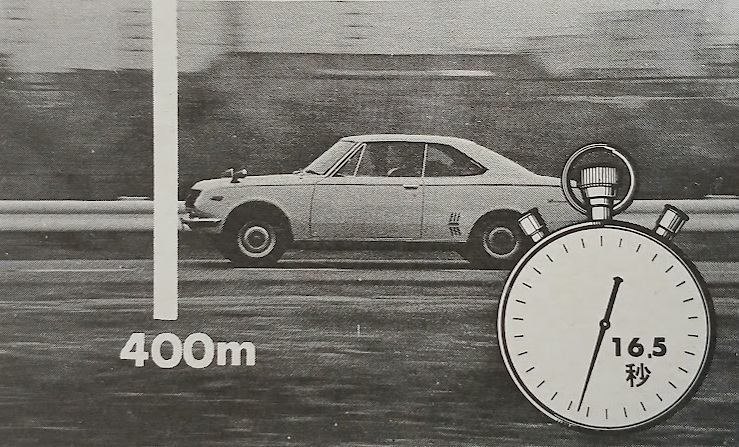
0–400m in 16.5 Seconds
Magazine: How about the suspension?
Sakakibara: With the 1600GT, the setup was aimed more toward circuit use, but for this car we worked with a rally-oriented image in mind. In numerical terms, the springs are about 10% stiffer than the 1900 SL, and the stabilizer is roughly 15% stiffer as well. As for the dampers, it depends on how the car is to be driven, so we offer these as options–we have a separate setup prepared for circuit use.
Also, the addition of a torque rod has had a positive effect on handling and stability.
Magazine: You mention a rally-oriented suspension–how do you see the difference between a rigid axle and an independent setup in that context?
Sakakibara: There are various considerations when it comes to whether independent suspension is preferable, but in our case, we feel that a Hotchkiss-type layout with a torque rod works well as a suspension system for a front-engine, rear-drive car.
Watari: There are many different layouts, but when you weigh the advantages and disadvantages, the orthodox approach may seem unremarkable, yet it’s often the most sensible solution. That said, spring rates depend on where you set your priorities–if the focus is on rally use, then perhaps it would also be worth offering, as an option, a softer setup better suited to city driving.
Magazine: How about the performance?
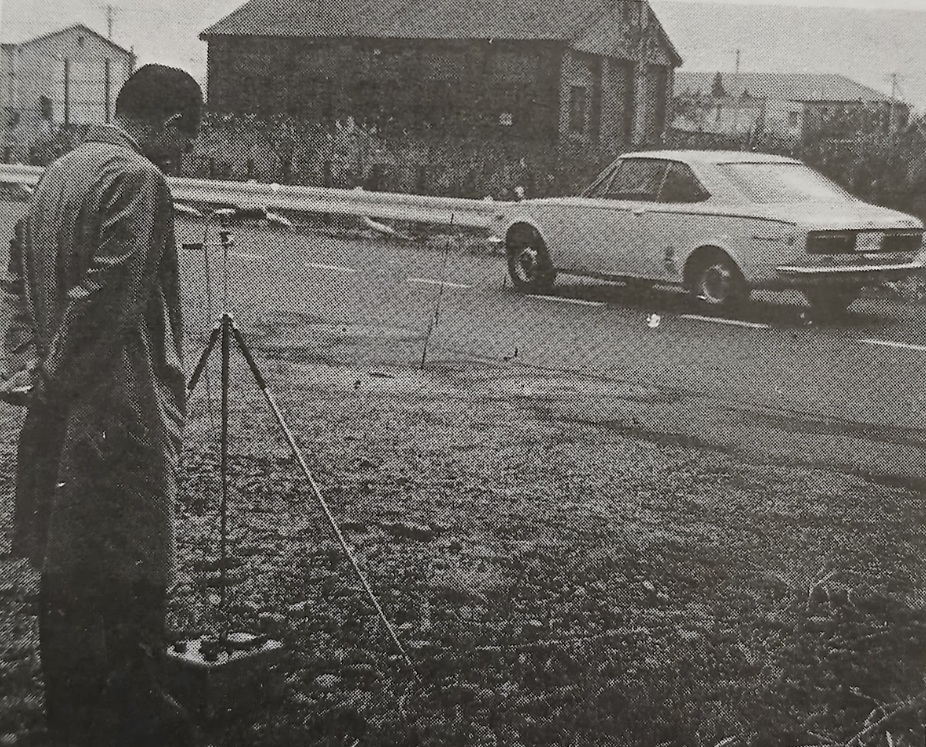
Furutani: For acceleration, the times were 0-100m in 6.8 seconds, 0-200m in 10.5 seconds, and 0-400m in 16.5 seconds.
Magazine: The response feels very good.
Okazaki: Compared with the 1600GT, vibration has been greatly reduced, and the overall smoothness has improved. The engine itself is easier to handle, in the sense that even an average driver can get in and drive it without much effort. At the same time, if someone with proper technique gets behind the wheel, it can deliver very strong performance. I think it strikes a good balance between those two sides of its character.
That said, this isn’t exactly about performance figures, but under hard acceleration from a standing start, the rear axle “hop” is noticeable. Are the dampers a bit too soft?
Sakakibara: Part of that is due to the short torque rod. We’ve addressed vibration issues at high speed, but as a result, the rear section of the two-piece propeller shaft has become shorter, and under power it can be affected slightly, producing some noise. If you start off more gently, it’s not an issue.
Magazine: The performance is almost so strong that it feels like it could be dangerous for an inexperienced driver.
Okazaki: You could certainly find yourself entering a corner at a higher speed than expected. There’s very little sense of speed, and it feels like it reaches its top speed remarkably quickly.
Watari: That’s why I’d rather manufacturers didn’t boast simply that a car can reach 200km/h. Instead, they should say that it can maintain, say, 120km/h even on a fairly steep incline. To do that requires a good deal of reserve power–so naturally, on level ground it can reach 200km/h.
What matters is being able to hold a steady speed, whether on an uphill grade or flat highway. Even in a strong headwind, it should be able to maintain a consistent 100km/h–that’s the important thing. Figures like 0-50m or 0-400m are really just substitutes for expressing that.
And there should also be emphasis on how easily and enjoyably it can overtake another car while cruising at 100km/h.
Magazine: Can it sustain 200km/h continuously?
Sakakibara: If there were a road where that were possible, it would manage without issue.
In the catalog, 200km/h corresponds to 6800rpm, but in practice, under those conditions tire pressures are higher, and centrifugal force causes the tires to expand slightly, increasing their effective diameter. So in reality, it can reach 200km/h at around 6150rpm.
Heavier Steering at Low Speeds
Magazine: How about ride comfort?
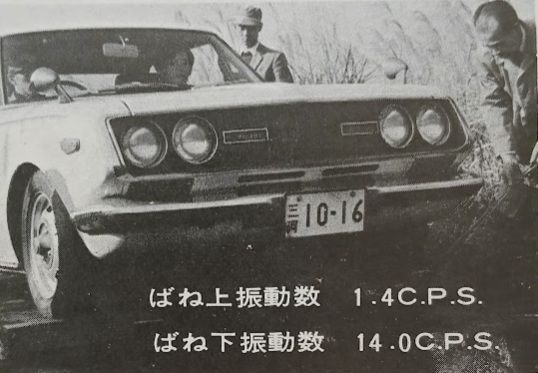
Tateishi: Compared with the 1900 SL, the suspension’s natural frequency is higher–as you’d expect, since the spring rates have been increased–so it’s a bit stiffer. Interior noise levels are almost the same as the 1900 SL. Exterior noise is slightly higher.
Sakakibara: Were the interior noise measurements taken in overdrive?
Tateishi: No, in fourth gear.
Sakakibara: Our in-house data shows that using overdrive reduces it by about 3-4 phons. Engine speed drops by roughly 15%, so that’s to be expected.
Magazine: How about handling and stability?
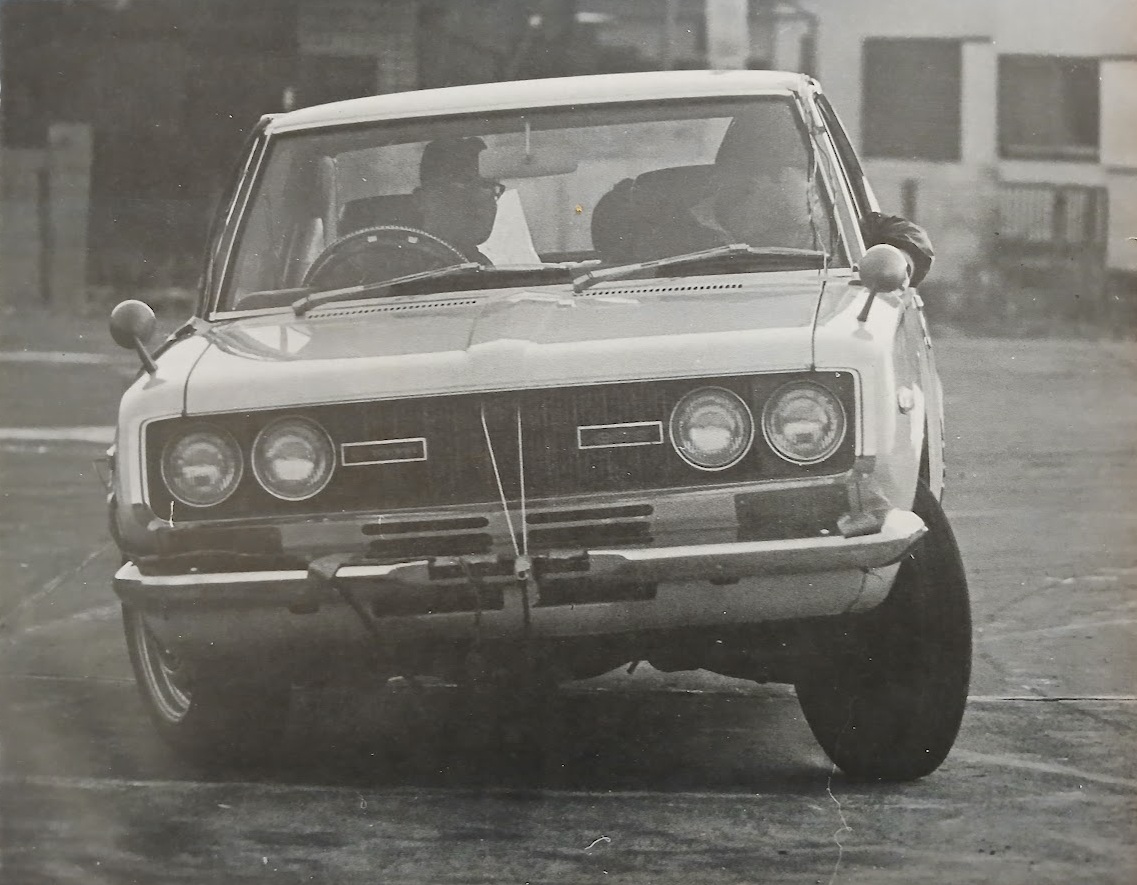
Doi: In the understeer/oversteer test, at V² = 100 m²/s², the curvature ratio R/R₀ was 1.4, where it peaked before transitioning into oversteer. At that point, speed was 36km/h, and steering effort reached a maximum of 3kg–right at the moment it switched into oversteer.
Roll angle was 4.6° with three occupants. As for stationary steering effort, turning to the left, it was 10kg at 90°, 15kg at 180°, and around 15kg beyond that. Turning right, it was 8kg at 90°, 12kg at 180°, and over 15kg past 270°. Overall, it feels a bit heavy at a standstill.
In low-speed cornering, with a lateral acceleration of 0.25g, steering effort was 7.5kg entering the curves and 1.7kg on exit. In the high-speed slalom, at the same 0.25g, steering effort was 3.5kg to the right and 2.5kg to the left. In 0-400m testing, both first and second gears produced an acceleration force of about 0.6g.
For hands-off straight-line stability, with a 0.3g lateral input, damping averaged about 0.205, with a period of 0.89 seconds.
Magazine: How strong is the understeer?
Doi: It’s about average–perhaps slightly on the stronger side.
Magazine: The transition to oversteer seems to come a bit early.
Doi: It did feel slightly early during testing, though the road surface was damp at the point where slip began. There weren’t any puddles, but…
Higuchi: That was around 40km/h in second gear, with a radius of about 20m.
Doi: Yes, the transition occurred at a radius of 21m. Speed variation during the test was appropriate.
Magazine: What about the steering? Power steering was mentioned earlier.
Watari: Speaking in general terms–in a car of this size, it’s better to have power steering than not. Particularly for older drivers. (laughs)
Magazine: And the steering gear ratio?
Sakakibara: It’s variable, from 19.5 to 21.5. A quicker ratio is available as an option.
Doi: Compared with others in the same class, low-speed steering effort is on the heavy side–even slightly heavier than the 1900 SL.
Sakakibara: That’s partly due to widening the track for stability, and also the tires.
Yamamoto: It would feel quite different on radials.
Sakakibara: Cornering characteristics would change, too. With cross-ply tires, the slip builds progressively, but radials hold on much longer–then let go more abruptly once you reach the limit. Which is better really depends on the driver’s skill.
Okazaki: Leaving aside the weight of the steering, I found the response a bit lacking.
Brakes with the Character of Discs
Magazine: How about the weight and braking data?
Ishikawa: Weight distribution is 598kg front, 490kg rear, so the balance is about 55:45. The alignment has fairly strong toe-in and camber at the front.
The brakes are discs at the front, leading/trailing Alfin drums at the rear, with a vacuum servo and PCV fitted. In bench testing, 0.6g deceleration required a pedal effort of 18kg, which is quite light–but in road testing from 50km/h, it went up to around 26-27kg.
The front and rear brake forces are well balanced.
The control valve starts to operate at about 300kg of braking force, with pedal effort around 15kg–that is, right around the level needed for 0.6g deceleration. The servo rest point is about 20kg.
Operating efforts elsewhere are fairly light. The gear lever is light. The clutch feels a bit heavy when you actually press it, but the measured values are 11.5kg to disengage and 9.0-9.3kg to engage, which are not particularly heavy.
Magazine: How did the brakes feel?
Furutani: The feel is good. Some servo-assisted discs end up feeling a bit like twin-leading drum systems, but these still feel like proper disc brakes. They demonstrate the good points of discs.
Rather than the stopping distance being long or short, what stands out is how solid the pedal feels. Of course, “feel” is not something you can fully rely on, but compared with previous Toyota brakes, there is clearly something different about it.
Sakakibara: With the improvement in performance, the brakes have been made quite large for this class–essentially on the same level as those used in the Crown class. That extra capacity is probably what you’re feeling.
We placed particular emphasis on high-speed braking, designing it to be usable from around 100km/h up to 130km/h. Because of that, the friction coefficient is slightly lower, but in return stability has improved.
Ishikawa: In that respect, matching the braking performance to the engine performance like this was the correct approach. It used to be common to increase power but leave everything else more or less unchanged.
Easy-to-Use Seatbelts
Magazine: How about the visibility results?
Hirata: The overall field of view, expressed in solid angle terms, comes to 2.6 steradians. I think that’s a fairly typical figure.
Magazine: And the interior?
Onda: The body is almost the same as the 1900 SL. The main change is the larger 14-inch tires, and the corresponding slightly enlarged wheel-arch cutouts. But once you move inside, things change quite a bit. The seats in particular are completely different.
They are said to be taken from the 2000GT, but what I noticed was that the front seat cushion height is 300mm–about sedan level–so it sits fairly high. Normally in this kind of car you’d expect it to be lower.
There is a center console, and the position of some switches and levers is also different from the SL. But once you fasten the seatbelt, the heater and lighting switches end up being about 700-800mm away, so the reach is slightly on the long side.
The pedal layout looks like it’s aimed at enthusiastic drivers–the accelerator and brake are placed close together, and the height difference is only about 20mm.
Higuchi: Is that for heel-and-toe?
Sakakibara: Yes, we’ve set it more or less at a point where heel-and-toe is still possible. At first we made it very easy to do heel-and-toe, but when we actually drove it on the Tomei Expressway, we found that it caused sore ankles. (laughs)
Higuchi: From a safety standpoint, it looks like attention has been paid to making the seatbelt easy to use. Also, the door lock–on previous cars it was hard to reach, but this one is much more accessible.
If I had to make a request, I think it might be better placed near the inside door handle. Or perhaps on the inner side of the armrest. That way it would be even easier to operate.
Okazaki: I have one request as well. The steering wheel is leather-wrapped, but it has this rather hard, almost “cordovan-like” surface. I’d prefer something a bit softer and more supple.
Also, about the horn–while the shape may be good from a safety standpoint, there are often situations where you need to sound the horn while steering through a corner. With this layout, you have to reach in and hit the center, which is a bit inconvenient…
Amano: The idea was, if we put it in the center, there’s no confusion about where to press–you always know it’s the middle. That’s why we placed it there.
Surprisingly Good Fuel Economy
Magazine: How about fuel consumption? Earlier you mentioned it was surprisingly good…
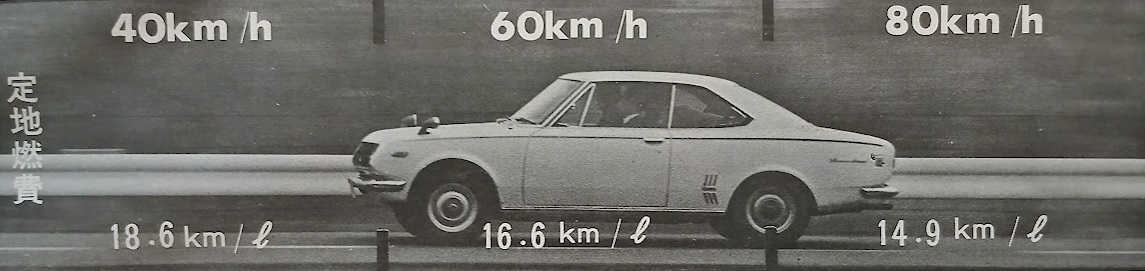
Oguchi: For a car of this type, it may not make much sense to talk about fuel economy in absolute terms, but we did measure it. We initially thought it might struggle with the model-driving consumption test, but in the end, at a target speed of 40km/h, the result was 8.7km/l at an average speed of 21.9km/h, and at a target speed of 60km/h, it was 7.5km/l at an average of 25.2km/h.
Given that this car produces a fair amount of power, and with the carburetion setup as it is, we expected fuel economy to be quite poor. But surprisingly, that wasn’t the case. When we plotted it against vehicle weight per liter, the values ended up quite close to those of an ordinary sedan.
Sakakibara: The measurements were done in fourth gear, right? On the Tomei Expressway, using overdrive, the figures would be a little better than those just mentioned.
Watari: What kind of figure did you get on the way here?
Sakakibara: Around 12km/l.
Magazine: People buying this kind of car probably don’t worry too much about fuel economy, do they?
Oguchi: That’s right. And then once they’ve actually bought it, they find it’s better than expected.
Sakakibara: Still, with this carburetion setup, if you want to use fuel, it will use it–there’s no limit to that.
Magazine: This car will likely be used quite often for racing and rallying. How about tuning potential?
Sakakibara: It might be better to explain that to customers after they’ve bought the car. (laughs) It depends on the situation, and even in terms of how high you can safely raise the revs, it really comes down to the driver.
Oguchi: When you put it like that, it feels like I understand, but also like I don’t… (laughs)
Sakakibara: One driver will say this stabilizer is better, another will prefer a different one. Even brake feel comes down to individual preference like that.
Oguchi: If the engine output were increased by 20-30%, would the rest of the powertrain be left as it is?
Sakakibara: It depends on how it’s used, but we do offer optional units for the clutch. The differential can also be varied depending on the driver or the course.
Magazine: What is the production volume for the GSS within the Mark II series?
Okubo: For now, about 200 to 300 units per month. We do intend to increase that somewhat in the future.
Magazine: What about export potential?
Okubo: I really couldn’t say.
Higuchi: I don’t think many countries mass-produce cars of this type. Even 200-300 units seems like a significant number. I think cars like this could certainly find a market in places like the United States. The only real issue is the service system.
Okubo: In the current situation, we can’t even keep up with orders. The 1600GT has been running at about 200 units per month, and at its peak it reached around 270. So we expect this will be at least that level, if not higher.
Magazine: Thank you very much.
Postscript: Story Photos