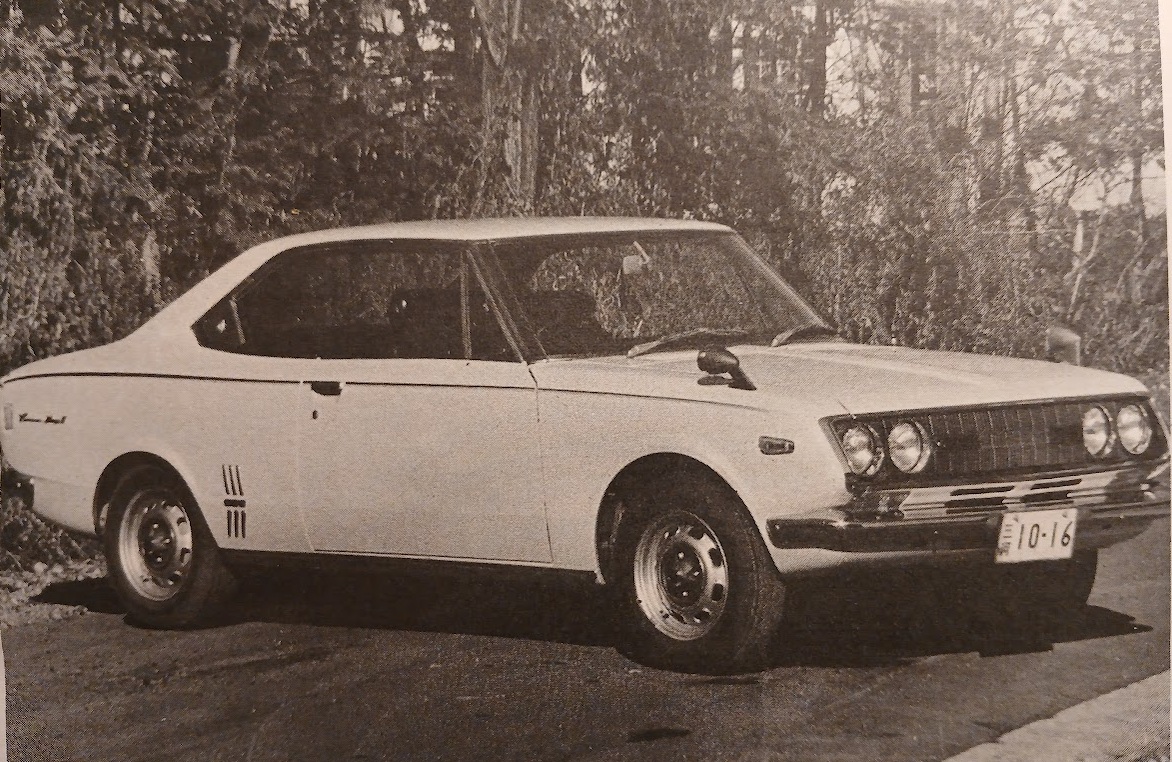
Toyota Corona Mark II GSS (1970)
Publication: Motor Fan
Format: Road Test
Date: February 1970
Authors (Roundtable): Masuo Amano, Atsushi Watari, Jun Sakakibara, Mineo Yamamoto, Hiroshi Okazaki, Kunitaka Furutani, Taizo Tateishi, Zo Doi, Kenji Higuchi, Kenzaburo Ishikawa, Yasuhei Oguchi, Toshihide Hirata, Minoru Onda, Mamoru Okubo, Motor Fan Editorial Staff (uncredited)
Definitive Edition of the Mark II
Magazine: First, please tell us about the aims of the GSS and the characteristics of the car.
Amano: The Mark II was released around this time last year (1968), and we sold about 200,000 units in the first year. There are many variations of the Mark II, but this one is the final, definitive version, and we developed it with the aim of creating a car that boasted the highest performance.
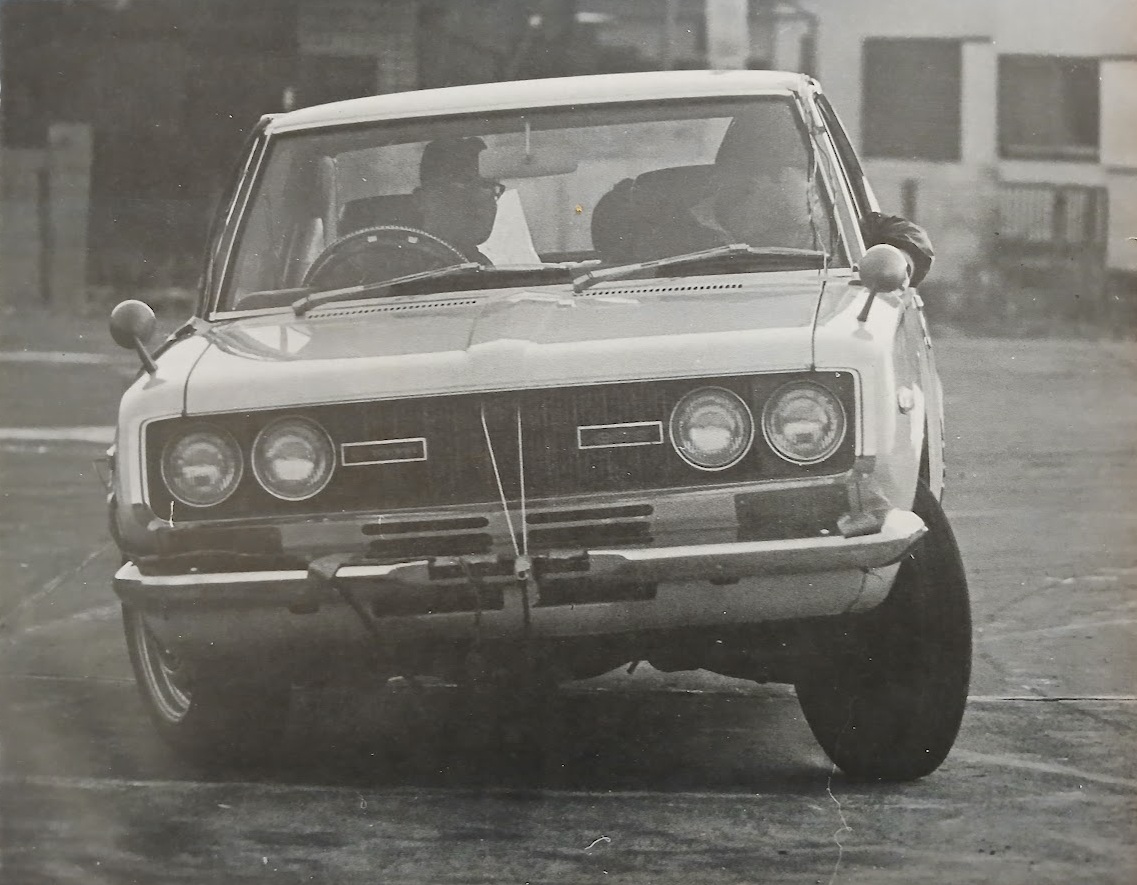
We may have been a bit presumptuous with the name, but it stands for Grand Super Sports. The 1900SL Hardtop emphasizes luxury, but this car emphasizes sportiness over luxury. So, it’s a little different from the concept of a GT; it’s not a hot car meant to be driven only on the highway, but one that can also be driven at 40-50km/h around town. It’s made to be suitable for women to drive. However, it also has all the qualities needed to achieve great results in races and rallies, and we’ve also ensured that it can be made into a very hot car by adding options.
In terms of general features, the engine is a newly developed design. The transmission is an improved version of the Toyota 1600GT’s. The limited-slip differential is one size larger at seven inches. The suspension is basically the same as the rest of the Mark II series, but the springs are stronger. The brakes have larger-diameter front discs to accommodate high speeds, and the tires are also larger at 14 inches. The top speed is 200km/h, the highest in the Mark II series. This is the character and outline of the car.
Watari: It’s great that anyone can drive it and that you can push it hard when you want to have some sporty fun, but on the other hand, I think it would be better to offer a torque converter automatic. Also, although it might be a bit extravagant, I feel like I’d like power steering.
Amano: We have a wide target audience, so we have to keep the price within reason. Power steering is expensive.
Watari: With this type of car, the options tend to be biased towards the sports side, but I still think it would be good to offer these items as luxury options.
Magazine: Isn’t the transmission also the same as the 2000GT?
Sakakibara: Yes, that’s right. The 2000GT underwent a minor change in August, and the transmission servo capacity was increased at that time, and we are using almost the same thing in the GSS.
Magazine: So, does this mean that the 2000GT torque converter is not available?
Sakakibara: I never miss it myself. (laughs)
Well-Matched Power and Transmission
Magazine: You mentioned that you kept the price down, but it seems like you put significant effort into this compared to the Skyline 2000GT-R and Bellett 1600GTR in the same class.
Amano: When we’re developing a car, we look at the balance between quality, quantity, cost, and time. We can’t release anything less than a good-quality product, but it can’t be too expensive. It can’t be something so specialized that it can’t be made in large quantities. And it can’t be something that takes five or ten years to bring to market. Of these, cost carries a huge weight. We calculate how much each part costs, juggling here and there to make ends meet. We thought it would cost around 1 million yen, but it ended up being 1,055,000 yen.
Magazine: Is the engine just a Mark II 1900SL engine with a different head?
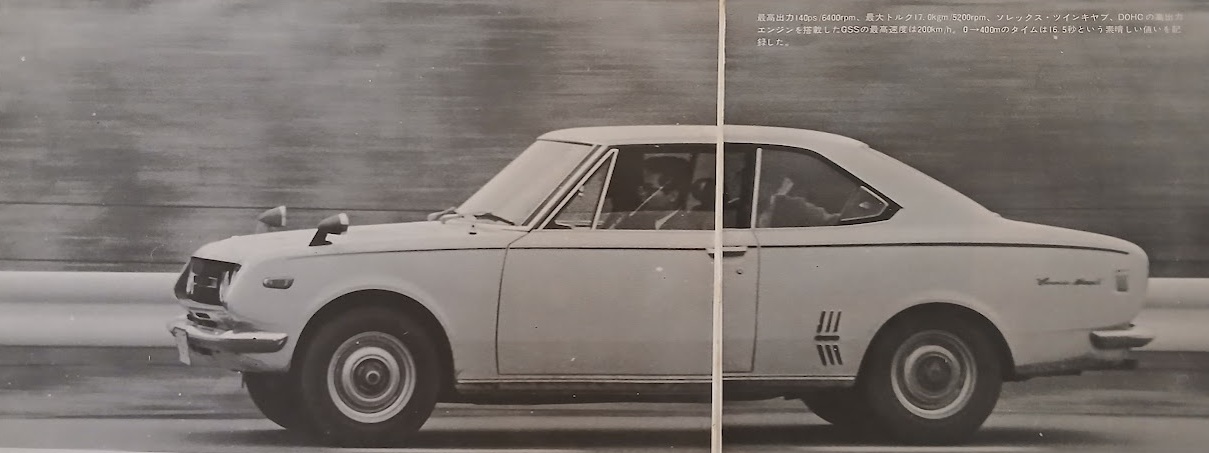
Sakakibara: Actually, the only things that are the same as the base engine are the crankshaft and cylinder block. The biggest change is the cylinder head, which is now made of aluminum for better cooling and has a DOHC design that allows for larger valve ports. It also has two Solex carbs, a compression ratio of 9.7, a maximum torque of 17.0kgm/5200rpm, and a maximum output of 140ps/6400rpm.
The maximum rotational speed is 6800rpm, and the powerband is generally above 2500rpm, but it can also be used at 1500rpm. By extending the high-speed range as much as possible without reducing the low-speed torque compared to the 1900SL, the engine can pull the car up to 200km/h. Also, the fuel economy is relatively good.
Magazine: You say you’ve increased the range without reducing the torque, but given that it has such high rotational speeds and horsepower, is there any secret to why the torque curve is so flat and high?
Sakakibara: It was trial and error. It was technically very difficult, but the most effective thing was valve timing. We found the limit and then adjusted the combustion chamber to fit.
Magazine: How high can the revolutions go?
Sakakibara: For continuous use, it is recommended to keep it to 6800rpm. At that speed, we can guarantee it forever, but beyond that, it’s a matter of material fatigue failure, so it becomes a matter of hours at 7000rpm, or seconds at 8000rpm. Ultimately, the various components of the engine have inertia, and various issues limit rotation. There is one constraint after another, such as the rocker arms, valve lifter movement, valve stem damping, connecting rod strength, connecting rod bolt strength, and crankshaft resonance. Normally, the rocker arms are the deciding factor. If you use a double camshaft and lighten the rockers, the next bottleneck will appear, and you have to eliminate them one by one.
Watari: It’s great that you can go up to 130km/h in third gear. In Tokyo, you can use only up to third gear.
Sakakibara: The gear ratio is slightly low in first gear, and the ratios become close from second gear and above. First was made low out of consideration for driving on city streets and mountain roads.
Yamamoto: When you hear “5-speed,” it sounds like you have to use it in a sporty way.
Sakakibara: In normal driving, you can use it just like a 4-speed car. Then, on the highway, you can put it in the overdrive gear. You can use all five gears, but you don’t have to. I would like people to use it according to their actual needs.
Watari: We need to teach this kind of thing at driving school as well.
Okazaki: Compared to the 1600GT, the power and transmission are well matched. It’s very easy to drive.
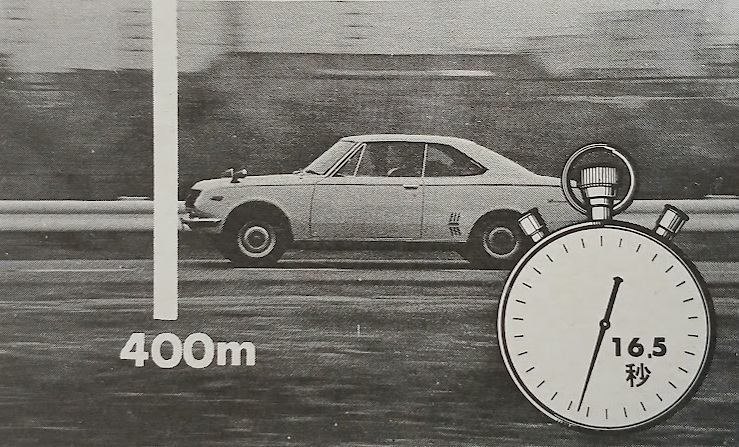
0-400m in 16.5 Seconds
Magazine: What about the suspension?
Sakakibara: In the case of the 1600GT, we focused on a suspension system that was more suited to the circuit, but with this car we had the idea of tailoring it to rallies.
In numerical terms, we made the springs about 10% stronger than those of the 1900SL, and the stabilizers are about 15% stiffer. For shock absorbers, the need varies depending on driving style, so these are available as an option, with settings prepared for the circuit. Also, the addition of a torque rod has an effect on handling stability.
Magazine: Regarding the different types of suspension systems, which is more in line with the rally image, a rigid axle or independent suspension?
Sakakibara: Generally speaking, it would be better to make it independent. There are various issues as to whether it is a good idea or not for a specific car, but in our case, we think that attaching a torque rod to the conventional Hotchkiss drive type is a good option for a front engine/rear drive vehicle.
Watari: There are many different types of suspension, and when you consider the pros and cons, the conventional type may seem ordinary, but I think it’s the smartest way to go. However, the spring constant depends on your target, and if you’re focused on rallies, it would be nice to have an option with a slightly lower spring constant for city use.
Magazine: How was the performance?
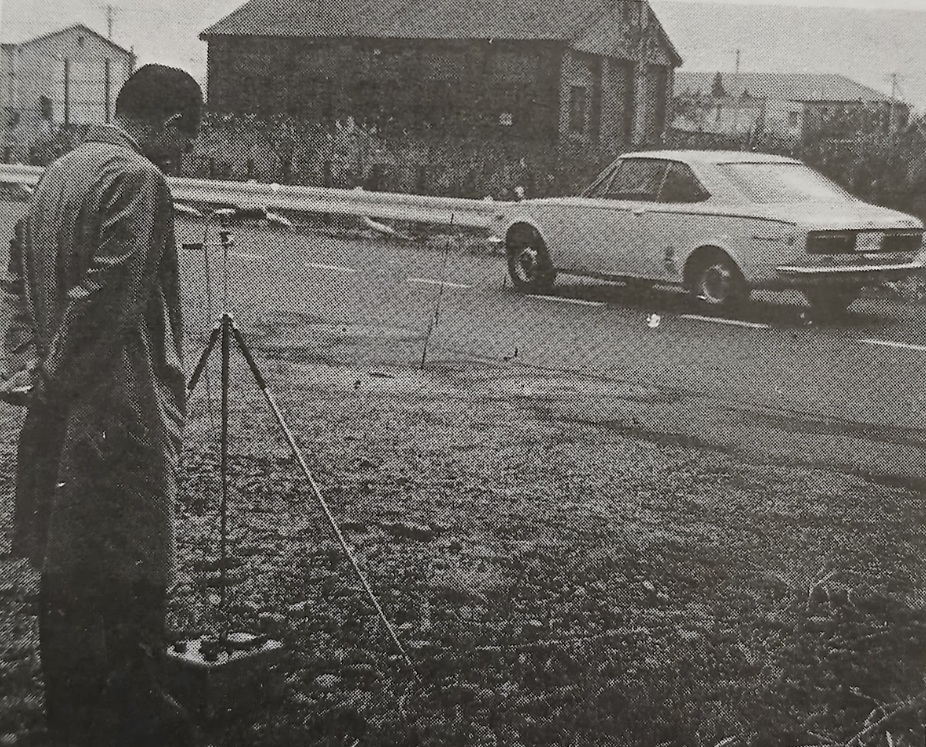
Furutani: The standing-start acceleration times were 6.8 seconds for 0-100m, 10.5 seconds for 0-200m, and 16.5 seconds for 0-400m.
Magazine: The response seems to be very good.
Okazaki: Compared to the 1600GT, the vibration has been greatly reduced, making it much smoother. The engine itself is easy to handle, and I think even the average person can drive it without much difficulty. Also, if someone with a decent level of skill drives it, it can be extremely “hot.” I think the combination of these two characteristics strikes a good compromise.
However, and this is not about power performance, but when accelerating suddenly, the rear axle tends to “jump” a little. Is it because of weak damping?
Sakakibara: This is partly because the torque rod is short, and partly because we solved the problem of vibration at high speeds by making the rear shaft of the two-part propeller shaft shorter, and as a result, it gets swung around by the power and makes a bit of a disturbance. If you launch it gently, this doesn’t happen.
Magazine: The power performance is so good that it feels like it might be dangerous for amateurs to use.
Okazaki: It’s entirely possible that the car will reach speeds that the driver didn’t expect going into a corner. It feels like the car reaches high speeds very quickly, without giving you much of a sense of how fast it’s going.
Watari: In other words, it’s better not to boast that it can reach 200km/h. What I want the manufacturer to say instead is, for example, that you can run at 120km/h even on a steep gradient. To make that possible, you need extra horsepower, so on flat ground you can reach 200km/h. So, it should be said that, on the highway, it can maintain a constant speed whether on an uphill slope or on flat ground. I think that’s what’s important in the real world, being able to run at a constant 100km/h no matter what the gradient or headwind. Numbers like 0-50m or 0-400m are a good substitute for that.
I also think it’s important to express how fun it can be to overtake the car in front of you when you’re driving at 100km/h.
Magazine: Can it drive continuously at 200km/h?
Sakakibara: If there is a course that allows it, then yes, it can. The catalogue states that the rotation speed at 200km/h is 6800rpm, but with the bias-ply tires, the tire diameter increases as they expand due to centrifugal force, so the car will reach 200km/h at 6150rpm.
Slightly Heavy Steering Effort at Low Speeds
Magazine: How is the ride?
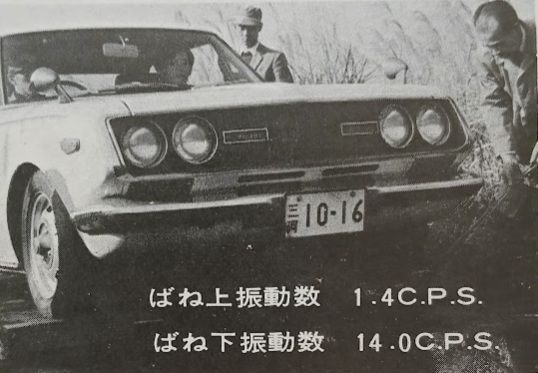
Tateishi: Compared to the 1900SL, the vibration frequency has been increased, making it firmer. The interior noise level is almost the same as the 1900SL.
Sakakibara: Was the interior noise measured in overdrive fifth?
Tateishi: No, it was in fourth gear.
Sakakibara: According to internal data, when using overdrive, the sound level drops by three to four phons. It reduces engine speed by approximately 15%.
Magazine: How did you rate the handling and stability?
Doi: In the understeer/oversteer measurements, the R/Ro radius of curvature when V² = 100m²/S² is 1.4, and oversteer begins at this point. The speed at that time was 36km/h, and the maximum steering force was 3kg, with the largest occuring when switching to oversteer. The roll rate was 4.6° with three people on board. Steering force when turning the wheel while stationary was 10kg at 90°, 15kg at 180°, and 15kg thereafter. For right turns, it was 8kg at 90°, 12kg at 180°, and over 15kg at 270° or more. The steering when stationary felt a little heavy. The steering force at low speeds was 7.5kg when entering a curve with a centripital acceleration of 0.25g, and 1.7kg when exiting. In slalom driving, with a maximum lateral acceleration of 0.25g, the steering force was 3.5kg on the right and 2.5kg on the left. When accelerating from 0-400m, the acceleration was 0.6g in both second and third gears. In the hands-off stability test, the input was a lateral acceleration of 0.3g, and the damping was approximately 0.205 on average with a cycle of 0.89 seconds.
Magazine: The degree of understeer is…
Doi: Well, it’s average or slightly strong.
Magazine: Where is the point at which it changes into oversteer? It seems a little early.
Doi: While I was testing, I thought it was a little early when I felt it start to slide, but the road surface was wet at that time. It was not so wet that there were any puddles on the road, though.
Higuchi: In second gear, it’s at about 40km/h, and when the radius is about 20m.
Doi: Yes, the curvature is 21m when it switches to oversteer. I think the speed fluctuations were appropriate.
Magazine: What about the steering? We talked about power steering earlier.
Watari: Well, just as a general rule, in a car like this, it’s better to have power steering than not to have it. It’s necessary for the elderly. (laughs)
Magazine: What is the steering gear ratio?
Sakakibara: It’s variable, from 19.5 to 21.5. Smaller gear ratios are available as an option.
Doi: The steering effort at low speeds feels a little heavy compared to other cars in the same class, and even a little heavy compared to the 1900SL.
Sakakibara: It has to do with the tires, because the tread has been widened to improve stability.
Yamamoto: It would be an even greater difference with radial tires.
Sakakibara: The cornering performance is different. However, with cross-plies, the tires slide gradually, while radial tires are quite sticky, but once you exceed the limit, they slide all at once. Which is better depends on the driver’s skill level.
Okazaki: Aside from the weight of the steering, I was fairly satisfied with the response.
Brakes With the Benefits of Discs
Magazine: What do you think of the weight and brake-related data?
Ishikawa: Weight distribution was 598kg in the front and 490kg in the rear, a 55:45 ratio. The front suspension had a strong toe-in and camber.
The brakes are discs in the front and Alfin drums in the rear, leading and trailing, with vacuum servos and a proportioning control valve. In bench tests, the pedal force for 0.6g deceleration was light at 18kg, but at 50km/h on the road, the pedal force for 0.6g was 26-27g.
The braking force was well balanced between the front and the rear. The operating point of the control valve is 300kg, and the pedal force is about 15kg, which corresponds to almost 0.6g deceleration. The rest point of the servo is at about 20kg.
The operating force of each part is light for the shift lever. The clutch felt heavy when I actually stepped on it, but the measured force was 11.5lg to disengage and 9.0-9.3kg to engage, which was not too strong.
Magazine: How do the brakes feel?
Furutani: The feeling is good. There are disc brakes with a strong servo feeling and others with a dual-leading feel, but I think these are good brakes that exhibit all the good qualities of discs.
Oguchi: Besides the length of the braking distance, the feeling when you step on the pedal is very solid. It’s just a feeling, so you can’t easily define it, but the braking feels different from that of mainstream Toyota cars.
Sakakibara: Along with the improved power performance, the brakes are large for the class, equivalent to those used in the Crown class. That’s probably what makes it so powerful.
We focused on high-speed braking in particular, so that it can be used between speeds of 100km/h and 130km/h. As a result, the friction coefficient has dropped slightly, but in return, stability seems to have increased.
Ishikawa: In that respect, it’s great that the design matches power performance with braking performance. It’s common for cars to be powered up but not tweaked at all to handle it.
Easy-to-Use Seat Belt
Magazine: What about the visibility?
Hirata: The total visible range, expressed in solid angle, is 2.6 steridians, which I think is a normal value.
Magazine: How about the interior design?
Onda: The body is almost the same as the 1900SL, other than the larger 14 inch wheels and wider tire tread, but the interior has changed quite a bit, and the seats in particular are completely different. They’re from the 2000GT, but what I noticed is that the front edge of the seat is 300mm, the same size as a sedan, and quite high. Usually, the seating position in this type of car is lower, but…
There is a center console and the positions of the switches and levers are different from the SL, and when you fasten your seat belt the heater and light switches are about a 700-800mm reach away, which is a bit far.
The pedal layout seems to be the type preferred by street racers, with the accelerator and brake pedals close together and only a 20mm difference in pedal height.
Higuchi: Is that for heel-and-toe?
Sakakibara: We designed it up to the limit of what we can do for heel-and-toe. At first, we designed it with a layout that was very comfortable for heel-and-toe, but when I ran it continuously on the Tomei Expressway, it hurt my ankles. (laughs)
Higuchi: From a safety standpoint, it seems that the seatbelt has been designed to be easy to use. Also, while the door lock is difficult to reach in the normal Mark II, this one is easier to reach. If I were to be greedy, I think it would be better to install it near the inside door handle, or maybe on the inside of the armrest, where it would be very easy to lock.
Okazaki: I have one request. The steering wheel is covered in leather which feels tightly-stretched and hard like cordovan, and I’d like it to be a little softer. And the horn, although its shape may be good for safety, it can be difficult to reach when turning around corners. I often have to press the horn while the steering wheel is turned. At that time, I feel like it’s a bit of a reach to press the center of the pad.
Amano: The idea was that if it’s in the middle, you’ll never get confused about where to press, so that’s why we installed it there.
Surprisingly Good Fuel Economy
Magazine: How is the fuel economy? You mentioned earlier that it’s surprisingly good…
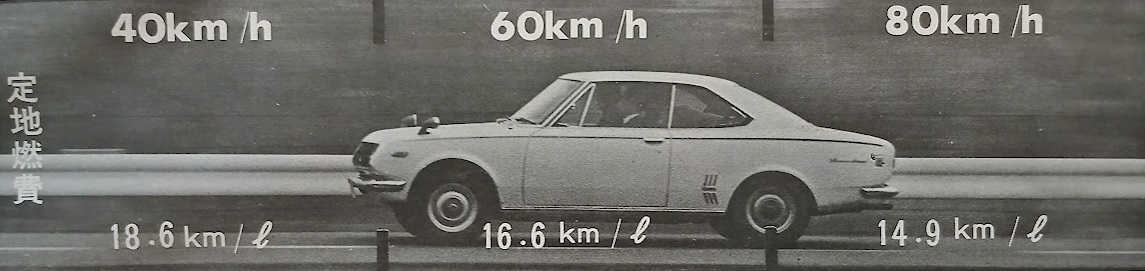
Higuchi: I’m not sure how relevant it is to estimate fuel economy in this type of car, but I measured it anyway. I thought it would be impossible to get a model fuel economy run, but the average fuel economy was 8.7km/l at an average speed of 21.9km/h in a simulated 40km/h zone, and 7.5km/l at an average 25.2km/h in a 60km/h zone.
The car is powerful and has twin carbs, so I expected the fuel economy to be quite poor, but surprisingly, that wasn’t the case. When I plotted the results against the vehicle weight per liter, I found that the values were comparable to those of a normal sedan.
Sakakibara: The measurements were also taken in fourth gear. When driving on the Tomei Expressway, the figures were a little better than these figures when using overdrive fifth gear.
Watari: What figures did you get?
Sakakibara: It was about 12km/l.
Magazine: To be honest, we think that people who drive cars in this class don’t really care about fuel economy. What will probably happen is, after they’ve bought it, they’ll find it to be surprisingly good.
Sakakibara: However, if you want to feed this twin-carburetor gasoline, it can take as much as you want.
Magazine: I think there will be many opportunities for this car to compete in races and rallies, but what are the possibilities for tuning it up?
Sakakibara: I think would be better for us to explain the options to the customer after they arrive. (laughs) There are various individual cases, and the extent to which you can increase the engine revolutions, for example, depends on the skill of the driver.
Oguchi: When you say that, I kind of understand what you mean, but I don’t really understand. (laughs)
Sakakibara: One driver might say that this stabilizer is good, while another driver might prefer this one, and there are all kinds of preferences when it comes to things like brake feel as well…
Oguchi: If the engine is made 20% or 30% more powerful, can the rest of the powertrain remain the same?
Sakakibara: It depends on how you’re going to use it, but there are options for things like the clutch. The differential can also be selected for the driver and the course.
Magazine: Of the overall Mark II series production, how many will be GSSs?
Okubo: Currently, it’s 200 to 300 units per month. We are hoping to increase this number in the future.
Magazine: Are you considering the possibility of exports?
Okubo: We don’t know.
Higuchi: I don’t think there are many countries mass-producing this type of car. I think 200 to 300 units per month is a lot. I think this kind of car could make a big impact in places like America, for example. The only problem is the service network.
Okubo: As it is, we can’t keep up with orders. The 1600GT sold about 200 units per month on average, and its best month was about 270, so I think we’ll at least be able to sell more than that.
Magazine: Thank you all very much.
Postscript: Story Photos