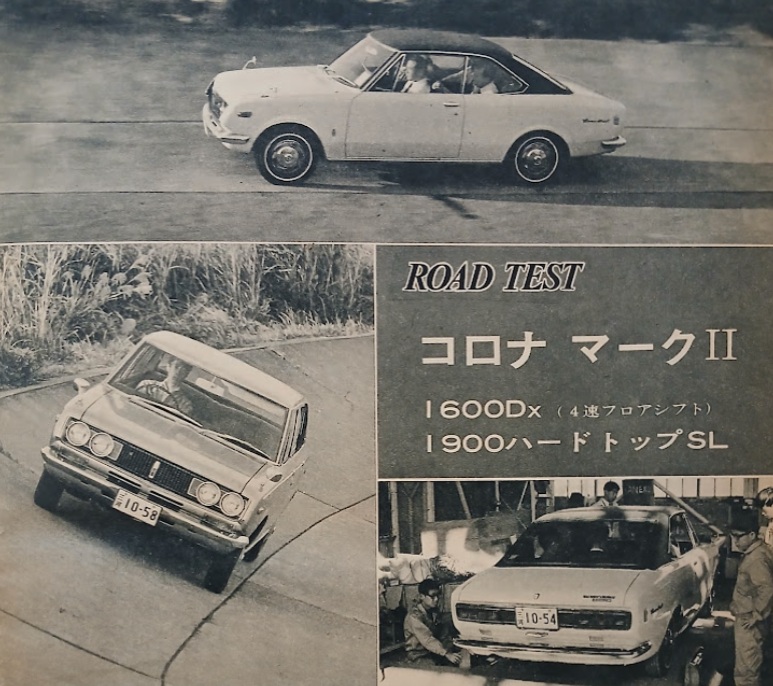
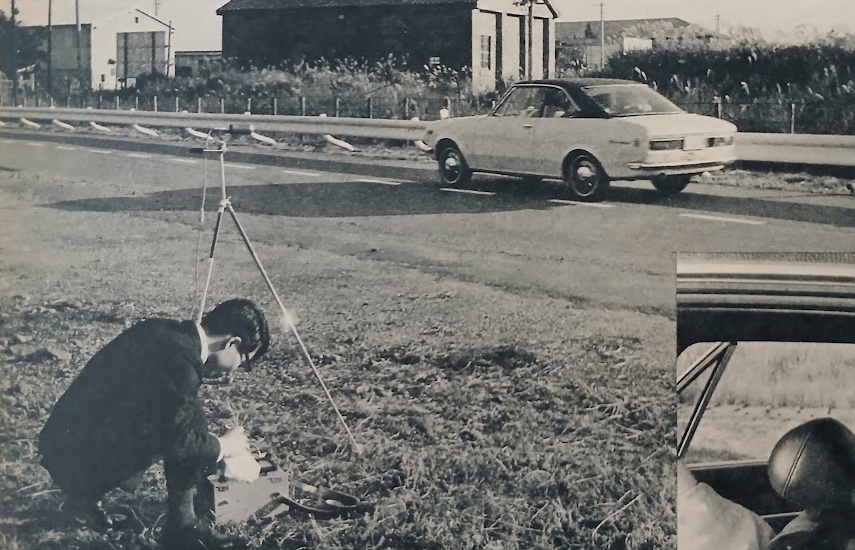
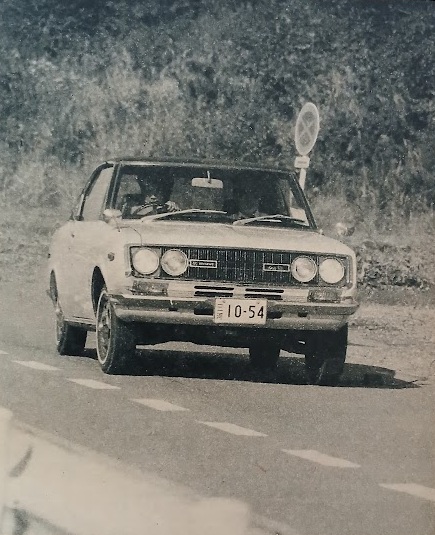
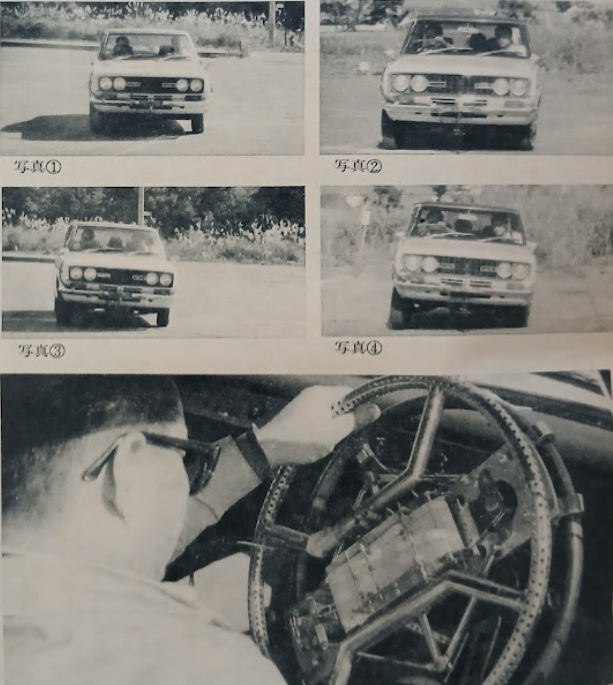
Toyota Corona Mark II 1600 Deluxe and 1900 Hardtop SL (1969)
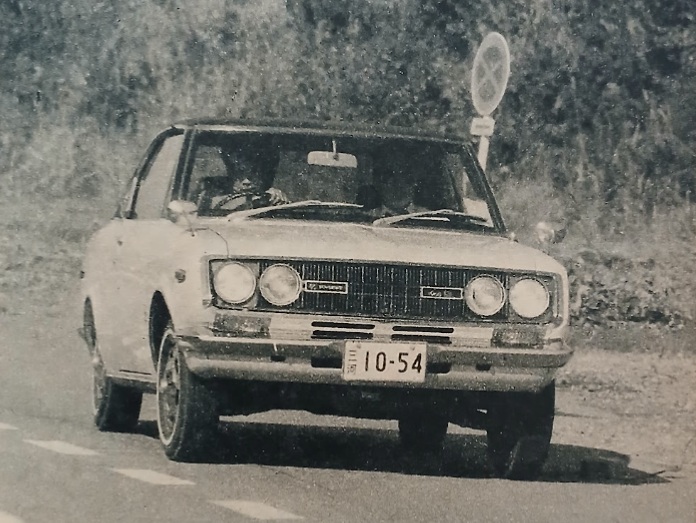
Publication: Motor Fan
Format: Road Test
Date: January 1969
Authors (Roundtable): Masuo Amano, Kenji Higuchi, Kazuo Kumabe, Osamu Hiaro, Atsushi Watari, Hiroshi Hoshijima, Akio Miyamoto, Jun Sakakibara, Teruyuki Komatsu, Yasunori Nakaoka, Nobuo Shibata, Kenzaburo Ishikawa, Taizo Tateishi, Yoshio Akutsu, Toshihide Hirata, Minoru Onda, Motor Fan Editorial Staff (uncredited)
A Car That Can Compete Internationally
Magazine: To get started, could you tell us about the development process of the Corona Mark II and the aims behind it?
Amano: The first Corona, the model commonly known as the “Daruma,” was released in 1957. After that, it underwent two full model changes, in 1960 and 1964, bringing us to the present version.
From around 1964, we became increasingly active in exports, and in particular we began to achieve considerable success with large-volume exports to the United States. As people in various parts of the world drove the car and we listened to their opinions, there were comments that, because of differences in physique, the interior could be made somewhat more spacious.
Mechanically as well, although the Corona was regarded as a good, well-balanced car, we began thinking about how to further improve its functional performance. Out of these considerations, the concept for this model was born. That was around 1965.
Magazine: In overseas markets, then, is the Corona considered somewhat cramped?
Amano: In America, we do not hear that complaint very often. In Europe, however, it seems that the rear seats are used more frequently. In such cases, when the front occupants slide their seats fully rearward, there are requests for more rear-seat space. When compared with similarly-priced cars such as the Cortina, it is said that the Corona is somewhat smaller.
Thus, the central theme of development became not only styling, but also improving room and comfort. At the same time, we sought to enhance functional performance. Furthermore, as American safety standards were becoming considerably stricter, we placed emphasis on meeting these requirements from the earliest planning stage. The result of that effort is the Corona Mark II.
Higuchi: How does this car relate to the existing Corona, and what are the origins of the name, “Mark II?”
Amano: The Corona has knock-down production facilities in other countries, including Australia and Korea, and its styling has been very well received both domestically and overseas. It would be a waste to discontinue it entirely. Therefore, we decided to freshen the existing Corona with a minor change, and position this as its larger, senior counterpart–hence the name Corona Mark II.
In Japan, I believe this is the first time the designation “Mark II” has been used in this way, but in Europe and America the term is commonplace. We would like it to be understood as a car that is within the Corona lineage, but advanced one step further.
Magazine: In what specific ways does it differ from the existing Corona?
Amano: In terms of available body styles, there are sedan and hardtop versions, as before, but this time we have introduced a station wagon. These three are the passenger-car models. In addition, there are three commercial variants: the single-cab pickup, double-cab pickup, and van.
The sedan is the mainstay model. The hardtop has been given a somewhat bolder styling treatment, incorporating the recently popular “Coke-bottle” line, though we were careful not to make it excessive. We also made a conscious effort to increase the distinction between the sedan and hardtop compared to the previous model.
As for the van and wagon, we significantly differentiated the rear styling. We worked hard to create an image that would immediately identify the wagon at a glance. I believe the result has turned out rather well.
Efforts Toward Improved Accommodation
Magazine: You mentioned placing emphasis on room and comfort. Could you reveal something of the process behind that?
Amano: In the past, the stylists would first decide the exterior form, and afterward the interior would be arranged as best as possible within that framework. In such cases, if opinions differed between styling and accommodation, the styling side might prevail.
For the Mark II, however, we first created a full-scale wooden interior mock-up. If the styling department requested revisions, the matter was discussed from that starting point. Because of this approach, I believe we were able to secure a relatively spacious interior for a car of this overall size.
As for design, we paid attention to aligning it with the sensibilities of today’s younger people. In particular, we worked hard to clarify the distinctions between the sport-oriented models and the standard sedan, as well as between the hardtop and sedan body styles.
Magazine: You mentioned that, in terms of safety, it complies fully with American standards.
Amano: Yes, that is one aspect. In addition, the fundamental body structure has been designed so that the front and rear sections can deform comparatively more easily than the cabin, allowing them to help absorb energy in the event of a collision.
Under American standards there are 21 regulated items. By carrying over the previous Corona’s specifications, 19 of those were already satisfied. To that we have added the remaining two items, and beyond that we have incorporated various further considerations.
Turning next to function: for the engine, we are using the 1591cc SOHC unit from the Golden Series Corona introduced in the spring of 1968, with certain improvements. From a product standpoint, the primary emphasis remains on this 1.6-liter engine. The 1900 engine that you have also tested is based on the 1.6-liter unit, but with the stroke extended by 11.5mm, bringing displacement to 1858cc.
The SL version is specially tuned, with the aim of providing performance appropriate to the highest-grade model in the Corona series. “SL” signifies not only sportiness, but also a high level of equipment. Accordingly, it includes features such as power windows, a rear window defogger, armrests, a steering lock device, an energy-absorbing steering column, and a dual-circuit braking system. The inclusion of these comprehensive safety measures is something we take pride in.
Kumabe: It has changed quite a bit from the standard Corona. To take such bold steps and yet improve it so much is impressive.
Hirao: It’s been called the Corona’s “big brother,” but to me it feels more like an older sister. (laughs) The lines have become rather feminine. Because of that femininity, I suspect it will appeal to men. On the other hand, I have heard some young women say the lines seem softened, and that the previous Corona was cleaner and more crisp.
Watari: My impression is that with the Mark II, the so-called arrow line has become genuinely cleaner. Whether the new lines are feminine or not, I can’t say, but they have become very beautiful, especially at the rear.
Amano: Indeed, the flowing line at the rear of the hardtop was an area where we devoted considerable effort from a design standpoint. We were also concerned whether it could be pressed successfully, but it turned out almost exactly as we had originally envisioned. When one contemplates it carefully, however, it does give something of an impression of human shapeliness. (laughs)
Hirao: To me, it feels less like a Corona Mark II and more like a Corolla Mark II. In terms of shape, it seems like a Corolla that has grown larger.
A Body That Retains the Corona Character
Hoshijima: I agree. The Corona had a sharp character before, but this mixes that sharpness with the rounded flavor of the Corolla, giving a strong overall impression. In terms of attractiveness, the hardtop really stands out compared with the Mark II four-door sedan.
Magazine: In bringing together the sedan’s styling, what aspects proved most difficult? For example, the provision of the air duct behind the rear side glass?
Amano: Fundamentally, it was a question of how to refine the Arrow Line theme. The previous Corona received considerable comment regarding its front-end treatment. At the same time, since this was to be positioned as the Corona’s senior counterpart, we did not wish to depart too far from the established Corona lineage. We also expended considerable effort on the treatment of the rear lamps.
Hirao: The sedan is a semi-fastback, so it does somewhat resemble the Corolla in that regard.
Amano: That may be so.
Miyamoto: The nose is shaped something like a shogi piece, but that makes forward visibility quite good. In addition, high-grade models such as the 1900SL use a recirculating-ball steering system with a variable ratio, which will make it easier for women to drive–and, of course, for men as well. Even when I first drove it, it gave a familiar impression, like a car I’d known for a long time. In terms of performance, I believe it has a character that will be entirely satisfying for expressway driving.
Magazine: Returning to design, the front grille is now made of resin. Presumably this involved considerations for both weight reduction and styling?
Amano: Previously we used die-cast components. These are well suited to producing a deeply sculpted appearance, but we moved to pressed parts for their lighter weight and lower cost. However, pressed parts tend to appear flat and make it difficult to achieve depth. For last year’s Crown, we therefore adopted resin, and we decided to follow the same direction with the Corona Mark II.
Recently the quality of resin materials has improved, so we took the step of using it more throughly. The grille on the Corona Mark II is larger than that of the Crown–approximately 1m 35cm across–and reaching the point where this was practical required extensive testing.
Sakakibara: We conducted full-scale tests regarding expansion and contraction, resistance to twisting, and whether it might become prone to cracking over time. For this purpose, we built dedicated testing equipment, and in the end it was sufficiently durable.
Higuchi: With some model changes, the character of the car is altered so completely that existing customers become confused. In extreme cases, they may even abandon the model altogether. With the Mark II, however, you have handled that skillfully. It seems that previous Corona owners can move to it without resistance.
That said, from a styling standpoint, the sedan may make younger drivers hesitate a bit. They will likely choose the hardtop.
Magazine: Regarding the press dies, presumably none of the previous Corona’s tooling was reused, and that everything is new?
Amano: Yes, of course.
Improved Effective Engine Output
Miyamoto: Regarding the plastic grille, is it not possible to make it more elastic, like rubber, so that it won’t break even in minor collisions?
Sakakibara: Even the current material does not break easily. There are materials like you describe, but under direct sunlight, the surface can reach temperatures of around 100°C, and they can deform, so in practice they become a bit problematic.
Hirao: I suppose the radiator contributes a fair amount of heat as well.
Sakakibara: Yes. Creating a material that can withstand that heat, resist cold, and yet not break on impact is still difficult, though perhaps possible in the future.
Amano: When we first used resin for the grille, we were concerned about stones chipping it. We conducted a test with two cars running on gravel–one leading, one following–and the grille withstood it without any problems.
Magazine: Let’s move on to the engines. You mentioned that the 1600 in this car differs somewhat from that in the Golden Series?
Amano: Yes. We made small changes to the intake and exhaust manifolds, the camshaft, and the carburetor. This was possible because the Mark II’s body is wider than the Corona’s, so the engine could also be slightly wider.
In assembly, the body is suspended and the engine is lifted from below. The side members define the maximum engine width–if the engine is too wide, it won’t fit. With the side members widened by about 50mm, we were able to lengthen the manifolds slightly and make small adjustments to the carburetor. While the rated power remains at 85ps, these changes improve the engine’s effective output.
Magazine: And the 1900 engine?
Sakakibara: In consideration of the production line and mass-production efficiency, we wanted as much commonality with the 1600 engine as possible. We minimized dedicated components and increased the stroke by 11.5mm to 80mm. Along with changes to the combustion chamber and intake and exhaust systems, this produces a maximum output of 100ps at 5500rpm.
Magazine: What about the 1900SL? How does it differ mechanically?
Sakakibara: Mechanically it’s mostly the same, but for the sports model, we fitted SU carburetors to improve efficiency. This is called the 8R-B engine, delivering a peak output of 110ps at 6000rpm and maximum torque of 15.5kgm at 4000rpm.
Magazine: So the Mark II offers two basic engines, the 1600 and the 1900. Could you explain the intended purpose of each and their relationship?
Meeting a Diverse Range of Demand
Amano: The main focus is on the 1600, which we expect to sell in high volume. As sales increase, however, customer demand will naturally diversify, so it makes sense to offer a variety of engines. Opel, for example, offers multiple engines within the same body.
Some have suggested that because other manufacturers recently introduced 1800 engines, we hurried to release a 1900 in response. But engine development takes three to three-and-a-half years, so this kind of sudden change is simply not possible.
While preparing the 1600 for release in the Golden Series, we developed the 1900 engine in parallel. In fact, anyone who examined that engine’s bore and stroke figures (86mm × 68.5mm) might have predicted that a longer-stroke version would eventually appear.
Higuchi: This isn’t your first oversquare engine, though, is it?
Amano: The Corolla was somewhat oversquare as well.
Watari: In terms of exports, you are planning to send the 1900 to America and the 1600 to Europe, correct?
Miyamoto: What is the price difference between the top-of-the-line model and the least expensive in the series?
Komatsu: The 1900 Hardtop SL is the most expensive at 848,000 yen. The test car had the optional leather top, so its price came to 860,000 yen. The 1600 Deluxe sedan is a more mainstream model at 634,000 yen.
Nakaoka: The least expensive is the Standard at 564,000 yen. For comparison, the 1500cc Corona series starts at 504,000 yen.
Magazine: We received a note from Professor Kondo asking the manufacturer about the following: “It seems that the Mark II’s suspension is designed to reduce roll without compromising ride comfort, by softening the suspension and raising the roll axis. This seems different from the design philosophy of the Crown series. Could you explain the reasoning behind this?”
Design Philosophy Varies by Engineer
Amano: When different engineers are responsible for a vehicle, their approaches naturally differ. Each team more or less goes its own way, advancing its designs on the basis of market research into what that model’s customers want. The Crown, Corona, and Corolla teams each possess a keen sense of competition, and each strives in its own direction. (laughs)
Hirao: Drivers accustomed to cars with little body roll may feel uneasy in one that rolls more, and the reverse is true as well. When you’re used to a car that leans with you through a corner, a flatter, low-roll car can make the cornering forces feel almost as though they’re straining your head and neck. Ultimately, it becomes a matter of customer preference, I think.
Magazine: Regarding engine details, the Crown uses a cross-flow combustion chamber, while this engine has a wedge-shaped chamber. How does that choice affect performance?
Amano: I believe we’ve moved past the era where horsepower was pursued simply by raising engine speeds. When we examine actual driving conditions, we find that engines are only run above 4000rpm a few percent of the time. A hemispherical chamber is efficient at high speed, but a well-proven wedge-shaped head is sufficient in practical terms. Accordingly, we used a cast-iron cylinder head and tuned the engine to be fairly mild-mannered. Of course, the 1900SL is a sporting model, and is tuned to deliver a full 110ps.
Hirao: The 1900SL’s maximum engine speed is 6200rpm, correct?
Sakakibara: Maximum output is at 6000rpm. The absolute momentary limit is 7000rpm, with a practical maximum around 6500rpm.
Hirao: If the engine is over-revved, which component tends to run into trouble first?
Amano: It would probably be the valve gear; most likely the rocker arms, which have the greatest movement. We could increase their rigidity, of course, but that would also add weight.
Hirao: And the connecting rod bearings, are they safe?
Amano: Yes, they hold up to about 7500–7600rpm.
Magazine: Now, let’s present the performance test results measured by the Hirao Laboratory.
0-400m (1900SL): 17.6 seconds
Shibata: Let me begin with the 1600 Sedan Deluxe. The test weight was 1,205.5 kg. From a standing start, the acceleration times were 0-200m in 11.4 seconds and 0-400m in 18.2 seconds. Expressed in terms of time to speed, the results were 0-40km/h in 2.9 seconds, 0-60km/h in 5.2 seconds, 0-80km/h in 8.8 seconds, and 0-100km/h in 13.2 seconds.
For overtaking acceleration, starting from 30km/h in third gear, it accelerated to 60km/h in 8.6 seconds, 80 km/h in 13.1 seconds, and 100km/h in 18.9 seconds. Starting from 40 km/h in top gear, it reached 60km/h in 6.9 seconds, 80km/h in 13.5 seconds, and 100km/h in 20.3 seconds.
Next, we conducted the same tests with the 1900 Hardtop SL. The standing-start acceleration times were 0-200m in 11.2 seconds and 0-400m in 17.6 seconds. Expressed in time to speed, the results were 0-40km/h in 2.9 seconds, 0-60km/h in 4.9 seconds, 0-80km/h in 7.8 seconds, and 0-100km/h in 12.2 seconds.
For overtaking acceleration from 30km/h in third gear, it reached 60km/h in 8.4 seconds, 80km/h in 12.6 seconds, and 100km/h in 17.5 seconds. From 40km/h in top gear, it reached 60km/h in 4.4 seconds, 80km/h in 8.3 seconds, and 100km/h in 12.4 seconds.
Magazine: It seems the conditions at the test course were not ideal this time, and there was quite a lot of wheelspin at the start. Having driven both cars, how would you describe the difference–particularly the 1900’s sense of power?
Hirao: The 1900 is quite different. It definitely gives a greater feeling of strength.
Magazine: Even with the same engine, does air resistance vary much between the sedan and hardtop?
Sakakibara: Almost the same. Though the test car had a leather top, which may have slightly increased resistance.
Amano: For the 1900SL, I really would have liked to try to see if it could actually hit 175km/h.
Watari: There’s no chance of that on the Murayama course; you’d need to go to Yatabe. And you can’t use public roads. (laughs)
Hirao: And on the Tomei, with the inclines, you couldn’t take precise measurements anyway. (laughs)
The Substantial SL Character
Hoshijima: Comparing the 1900SL with a similarly capable 2-liter GT, the 2-liter is faster, of course. But the 1900SL gives the driver the feeling that he’s really making it go fast. (laughs) Even the atmosphere of the interior contributes to that feeling.
Functionally, the main difference between the 1600 and 1900 is the clutch. The 1900SL feels much sportier. The accelerator pedal, however, feels rather heavy, and that takes away from the perceived responsiveness.
Higuchi: The old 1600S reacted immediately with just a slight press, which I used to think was Toyota’s characteristic feel, but now it’s changed. (laughs)
Ishikawa: When we actually measured the operation effort, it isn’t especially heavy.
Hirao: Maybe the pedal stroke is longer?
Hoshijima: For women drivers, the heavy accelerator might make them feel something like, “I don’t think I can manage this.”
Miyamoto: The 1900SL’s is indeed heavier.
Amano: We believe a slightly heavier pedal that snaps back reliably is safer. The twin carburetors also naturally make it somewhat heavier. But if we wanted to make it lighter, that would not be difficult.
Hoshijima: The 1900SL uses a coil-spring clutch, while the 1600 uses a diaphragm type. This is for sporty driving, correct?
Amano: That too–but also in terms of strength, since the engine’s output is greater, the conventional clutch spring simply wouldn’t hold up…
Ishikawa: That explains the higher operation force. It takes 15.5kg to disengage. Usually, anything above 11kg starts to feel heavy. Engagement required 9.5kg.
Higuchi: We didn’t test the torque-converter cars here, but with the 1900, the 3-speed torque converter setup is genuinely enjoyable to drive. You can actually use it in quite a sporty way, which is nice.
Miyamoto: In city driving, my impression was that the 1600 was easier to handle. With the 1900, you have to pay a bit more attention to the throttle…
Oguchi: With the 1900, maybe because of the carburetors, you can feel a kind of step during acceleration. When you try to glide along, at a certain point it suddenly gains speed with a surge.
Watari: Using 30km/h as the starting speed for the overtaking acceleration test is a bit too slow, don’t you think?
Higuchi: Well, in actual city driving, aren’t they often accelerating hard from 30 or 40km/h? Usually with the engine lugging away. (laughs)
Real-World Fuel Economy Around 10km/l
Magazine: Beginning with this issue, we’ve decided to revive our fuel economy test in a slightly revised form, and figures were recorded for the Mark II. Please present the results.
Oguchi: In the past, we occasionally measured constant-speed fuel economy, but we felt a more thorough approach was needed, one that included acceleration and deceleration, when the engine is under load. So we created a standardized urban driving pattern incorporating target speeds, stops, and starts. We call this the “model operating fuel economy,” and we conducted our measurements accordingly.
For the 1900SL, constant-speed fuel consumption was 17.3km/l at 40km/h, 16.5km/l at 60km/h, 14.0km/l at 80km/h, and 9.5km/l at 100km/h.
Using the model test pattern on the Murayama test course, we set up four 400m sections. From a standing start, the car is accelerated up to 40 km/h, then held at constant speed, decelerated to a stop, and held for 30 seconds to simulate a traffic signal. We then start again and, at the next signal, stop for 15 seconds. This cycle is repeated twice, and the measured value is taken over the total distance. Acceleration and deceleration are controlled at 0.3g.
With a target speed of 40km/h, the fuel economy was 10.6km/l at an average speed of 22.0km/h. When the target speed was 60km/h, fuel economy was 8.3km/l and the average speed was 25km/h.
For comparison, the 1600 Deluxe returned constant-speed fuel economy figures of 19.5km/l at 40km/h, 17.3km/l at 60km/h, 14.7km/l at 80km/h, and 12.0km/l at 100km/h. In the model operational test, when the target speed was 40km/h, it returned 10.8km/l at an average speed of 22.6km/h, and when the target speed was 60km/h, the figures were 8.5km/l and 25.8km/h.
Hirao: How did you decide on 400m as the distance from start to stop?
Oguchi: We based it on real-world observations of signal waiting times in the city.
Watari: Within that 400m section, how long is spent accelerating versus driving at a constant speed?
Oguchi: We use an accelerometer to hold acceleration to 0.3 g. Acceleration takes 6.5 seconds, braking 15 seconds, and about 30 seconds are spent at constant speed. Strictly speaking, the average speed figures should be consistent between tests, but since a human is driving, there are inevitably slight variations in acceleration. However, they remain within a range that does not affect fuel consumption.
Hirao: Around 10km/l at 40km/h seems realistic.
Oguchi: I believe these figures should serve as a guideline for real-world driving in this car. If an owner-driver can only obtain results far worse than these, it would be fair to say either the car is poorly maintained, the driving is rough, or perhaps the driver is simply not very skilled. For that reason, we designate a single driver for these tests and make every effort to use acceleration techniques and gear shifts appropriate to each car, so that the figures can serve as a proper benchmark.
Watari: I used to think that in ordinary use, city fuel economy amounted to about 60% of the steady-speed figure. But with today’s traffic, perhaps that ratio needs to be reconsidered. At least from these results, it does seem to come out to roughly 60%…
1900SL Suspension Is Firmer
Magazine: Let’s move on to the vibration and noise results from the Watari laboratory.
Tateishi: Starting with vibration, the 1600 Deluxe shows a sprung natural frequency of 1.35cps at the front and 1.3cps at the rear, rear upper-suspension 1.3 cps, and an unsprung natural frequency of 13.5cps at both the front and rear.
For the 1900SL, the sprung natural frequency is 1.3cps at the front and 1.5cps at the rear, and the unsprung frequency is 12.0cps at the front and 13.0cps at the rear.
Regarding noise, interior sound levels for the 1600 Deluxe are 64 phons at 40km/h, 68 phons at 60km/h, 70 phons at 80km/h, 75 phons at 100km/h, and 77 phons at 120km/h.
Exterior noise, measured according to the JIS method, is 72.5 phons in second gear at a steady 50km/h, and 79 phons when accelerating from 50km/h.
For the 1900SL, interior noise was 65 phons at 40km/h, 68 phons at 60km/h, 71 phons at 80km/h, 75 phons at 100km/h, and 82 phons at 120km/h. Exterior noise in second gear was 70 phons at a steady 50km/h, and 80 phons when accelerating from 50km/h.
Aside from the 1900SL’s rear suspension frequency being slightly on the high side, I think the values are generally good. One might also say that the 1600 Deluxe shows slightly high noise levels in steady-speed running.
Watari: The 1900SL has a stiffer spring rate, correct?
Higuchi: Yes, only the 1900 has the firmer settings.
Watari: Being a sports-type, stiffening it slightly poses no problem, but compared with previous Toyotas it does feel somewhat firmer. Of course, the roads themselves may have changed as well.
Hirao: Regarding noise, does the longer-stroke 1900 engine vibrate more due to greater centrifugal force?
Amano: At the same road speed, the 1900’s engine speed is actually lower, though piston speed is about the same.
Watari: From a vibration standpoint, it’s a car with a completely different character. The springs are different, and engine speeds differ as well. As for the 1600, it can be said to be one of the better cars we’ve measured in this class.
Magazine: Next, let’s cover the results for weight, brakes, and other measurements conducted at the Ship Research Institute.
Ishikawa: Starting with weight, the 1600 Deluxe came to 1,016kg with spare, tools, and a full tank of fuel. The weight distribution was 569kg front, 447kg rear, a front-heavy 56:44 ratio. Interestingly, the car is 15kg heavier when measured at the front right wheel than the front left. Even with full load of five passengers on board, the front remains heavier.
As for the 1900SL, the overall weight is 1,055kg, with a front-to-rear ratio of 55.5:45.5, so the front-seat position is slightly behind the center of gravity. With five passengers on board, the ratio hardly changes.
Wheel alignment is nearly the same for both the 1900SL and 1600. Camber and toe-in are very slight, and these hardly change under load.
High-Quality Brake System
Magazine: How were the brakes?
Ishikawa: The models tested, both the 1600 and 1900, use the same system: Girling-type disc brakes at the front and leading/trailing drum brakes at the rear. They are equipped with a master back vacuum servo, and the rear wheels incorporate a PCV (pressure control valve) to prevent lock-up.
Initial braking effect begins at about 2kg of pedal effort, with a pedal stroke of approximately 22mm. The rear brakes begin to take effect at around 4kg of pedal force. The power assist remains effective up to about 25-30 kg of pedal effort. The PCV begins to operate at roughly 0.5 g of deceleration.
Brake distribution is biased heavily toward the front. Even in bench testing, the front wheels locked at 0.8g deceleration while the rear wheels were still turning.
The parking brake is a walking-stick type. To obtain 0.2g of braking force requires 33 kg of operating effort (when driving forward). The ratchet action felt somewhat weak. As for general control operating efforts, aside from the clutch being slightly heavy, all values were within the normal range.
Magazine: What were the results of the Kondo laboratory’s handling and stability tests?
Akutsu: We took measurements only on the 1900 Hardtop SL. For the understeer/oversteer test, we recorded up to 0.64g lateral acceleration, and it remained in understeer throughout. Steering effort at that point was 3.2 kg. Roll angle with three passengers plus instrumentation was about 4.1°, which is quite small.
Stationary steering effort near 360° of steering angle averaged 13kg. In the slalom test, steering effort at 0.25g lateral acceleration was about 2kg. The free-release directional stability test was conducted up to 110km/h, and the car converged without any sense of instability.
Hoshijima: Some competitors have adopted independent rear suspension. Why has Toyota not pursued its development–or rather, why has it not been adopted for this car?
Amano: That system indeed has merits, but it also has drawbacks. For a high-volume model like the Corona, any new system adopted must be an unqualified success. Moreover, our existing suspension already has very good characteristics, so we cannot simply discard it. Even with this suspension, we are confident that this car’s handling does not fall short of other vehicles.
Miyamoto: Regarding the issue of exhaust gas purification, what measures are being taken?
Amano: We are not doing anything particularly special; rather, the engine itself is designed so that CO emissions remain within standards. We gave thorough consideration to improving exhaust distribution, and by carefully matching it with the carburetor, we have resolved the issue.
Hirao: So by improving distribution, power increases and exhaust characteristics improve as well?
Proof of a “Durable Car!"
Amano: Yes. When we recently carried out a rapid round-the-world run with this car, those who rode in it said the engine was almost absurdly durable and simply would not fail. Even running continuously at speeds of around 160km/h, there were no troubles at all. To be honest, we ourselves were somewhat anxious, but aside from a punctured tire and a blown fuse, we were told there was not a single problem of consequence. Hearing this has greatly strengthened our confidence.
Kumabe: One cannot help but feel that this Mark II represents a major triumph for passenger-car technology in Japan.
Magazine: Next, please present the results of the visibility measurements.
Hirata: We placed a dummy in the driver’s seat, positioned a fisheye lens at the eye point to photograph the view, and calculated the visible field.
For the 1600Dx, the visible range through the windshield is 68.5-79.5° horizontally. The rear window range is 48-53.5°; and the wiper sweep covers 50.5°. The forward field of view feels relatively limited, but this is because the rearview mirror sits almost exactly in the driver’s horizontal line of sight. If that obstruction is excluded, visibility increases by about 20-25°.
The total blind area measures 87-78°, the two figures reflecting the difference between the seat being positioned fully forward and fully back. The rearview mirror provides approximately 29° of lateral coverage, corresponding to about 67% of the rear window field.
Turning to the 1900SL, the visible range through the windshield is almost unchanged from the 1600 sedan. The view through the rear window, however, is larger at 53-57°. The wiper sweep is nearly the same. The rearview mirror offers 3-4° greater visibility. After all, the SL is a car meant to run fast–so perhaps it is desirable to see police motorcycles as early as possible. (laughs)
Magazine: Next, we would like to hear the dimensional data from the Higuchi Laboratory.
Onda: As mentioned at the beginning, the Mark II was designed with interior livability as a priority, and indeed there are very few concerns in this regard.
Regarding the 1900 SL, it seems the idea was to give it a sporting character not by changing the fundamental dimensions, but by allowing it to be used either in a sporty or a more sedate manner within the available range of adjustment.
Worthy of special note is that the seat not only slides fore and aft and allows the seatback angle to be adjusted, but can also be adjusted vertically. The passenger seat uses a walk-in mechanism. However, the anchor for the three-point seatbelt is located above the rear seat armrest, and I felt it would be better if it were made less obtrusive.
The interior of the test car was the power-equipped specification, so there were no particular difficulties. Even the triangular vent window was impressive, designed with safety in mind and featuring a distinctive lever that makes it easy to lock.
It may be a small point, but aren’t the instrument lights a little too dim?
Hirao: Rather than being dim, perhaps it feels that way because the gauge markings are so thin.
Amano: Instead of making them overly bright, we set them this way so as not to tire the eyes during long-distance driving.
Onda: The brightness is adjustable, but some feel that at its brightest setting it could still be a bit brighter.
Magazine: Are there any comments regarding the exterior?
Onda: Compared with the previous Corona, the major dimensional change is in how the hood is mounted–it now opens much wider.
As for reach to the controls and related aspects on the sedan, we found almost nothing that could be considered problematic.
Enhanced Safety
Magazine: Next, we would like to ask Professor Higuchi about the safety aspects he examined.
Higuchi: Compared with the previous Corona, it has certainly improved, as Mr. Amano mentioned. We used the Higuchi Laboratory checklist, which is based on US safety standards, but with Japanese considerations added, and rated each aspect of safety on a five-point scale. Out of a possible 100 points, this car scored 85, whereas the previous Corona scored 80.
Both the SL and the sedan received almost identical scores. The issue of the three-point belt anchor has already been mentioned, but in addition to that, I felt the belt tends to slip off the shoulder and can be somewhat awkward to use until one becomes accustomed to it.
Hirao: If the belt comes too close to the head, there is also the danger that in an accident it could injure the neck.
Higuchi: Regarding maintenance, up to now Toyota cars required periodic greasing of the suspension, whereas many other manufacturers had already moved in the direction of easier-care designs. With the Mark II, however, engine oil changes are at 5,000km intervals, major engine servicing at 10,000km, and chassis servicing at 20,000km or even 40,000km. In that sense, the more troublesome aspects have been largely eliminated.
The SL, because it uses SU carburetors, does require attention to the suction-piston damper oil, but that is probably unavoidable as part of achieving higher performance.
Magazine: As this model is expected to become Toyota’s highest-volume production car, we would like to ask a little about production plans and initial sales performance. The plan is for 40,000 units per month for the series–
Nakaoka: Yes, the target is 40,000 units per month across the series, or roughly 500,000 units annually. In terms of production scale, that would place it among the five largest in the world.
Higuchi: Does the figure of 40,000 include the conventional Corona and other models as well? What is the breakdown?
Nakaoka: Yes. About 70 percent is the Mark II, and the remaining 30 percent is the Corona 1500.
Ishikawa: I heard that October registrations reached around 17,000 units.
Nakaoka: Yes, that figure is for the passenger car models alone, and it was a new record. Of course, there is the effect of a new model launch, but we are very pleased that it has sold so well.
Of that total, about 3,700 units were the previous Corona (1500), which accounts for roughly 22 percent. As is typical at launch, demand has been concentrated on the 1900 and particularly the Hardtop SL. However, we regard the 1500 model as an important vehicle that fills the gap between the Corolla 1100cc and the Mark II 1600cc and 1900cc models. It also serves as something of a bridgehead against competing models in the lower class, and there is considerable demand for commercial use as well.
Magazine: We understand the 1500 is still being exported?
Nakaoka: Yes. The American market requires the 1900, but in other markets we are continuing with the 1500. We plan to begin full-scale exports of the Mark II around March or April, proceeding with both lines.
Amano: Setting a record in the very month of release is quite rare. For that reason, we have been asking dealers whether there are any issues of concern, but aside from very minor points, the car’s reputation has generally been favorable.
Magazine: Thank you very much for your time.
Postscript: Story Photos