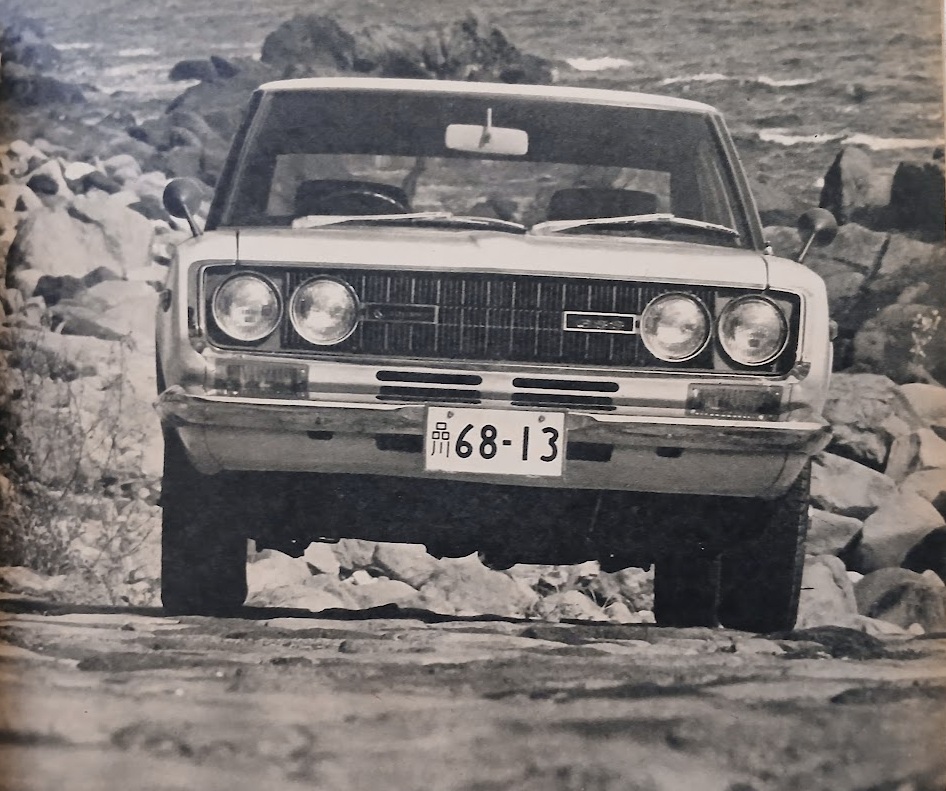
Toyota Corona Mark II GSS (1970)
Publication: Motor Fan
Format: Road Impressions
Date: December 1969
Authors: Yoshimasa Sugawara, Motor Fan Editorial Staff (uncredited)
Yoshimasa Sugawara’s Test Drive
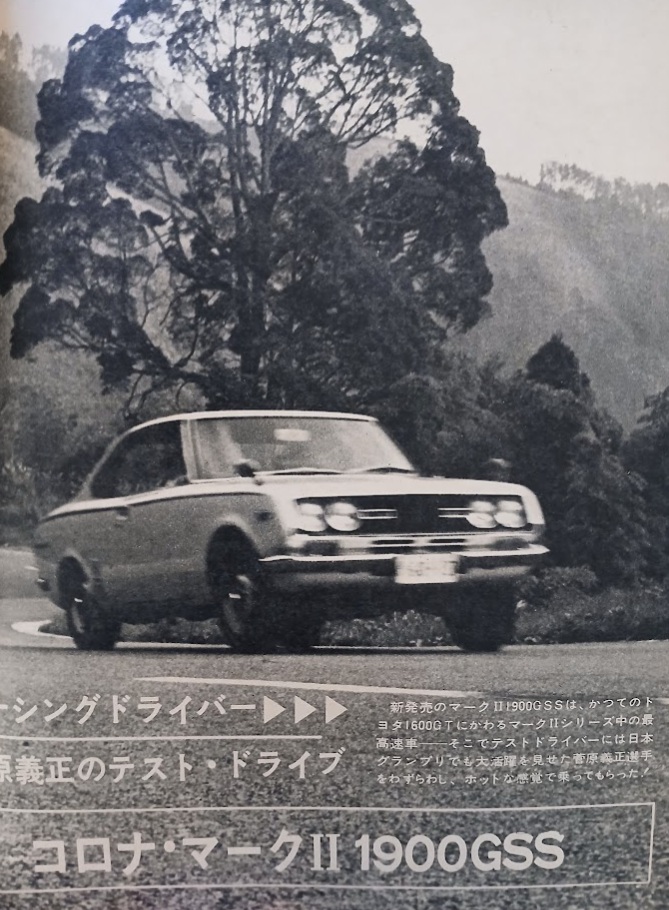
The newly released Mark II 1900 GSS is the fastest car in the Mark II series, and the successor to the Toyota 1600GT. For the test drive, we enlisted Yoshimasa Sugawara, who has made a name for himself at the Japanese Grand Prix, to give his impressions from the perspective of all-out performance.
Profile of the Author, Yoshimasa Sugawara
Yoshimasa Sugawara was the winner of the Touring Sedan Race, Class II, at the 1969 Japanese Grand Prix on October 10. He is currently active in racing at Fuji and Suzuka using a Morris Mini Cooper S. A keen entrepreneur, he runs a commercial company that uses racing cars for promotion.
Born in 1941 (28 years old) in Otaru, Hokkaido, his hobby away from work is skiing—but he says automobile racing is his greatest passion.
The Corona Mark II GSS—Long Awaited by Sports Enthusiasts
The Corona Mark II GSS, intended not only for racing and rallying but also for enjoying spirited high-speed touring, went on sale September 30. To test its true capabilities, we asked Sugawara to undertake 250km of hard driving, from Tokyo to Manazuru via the Third Keihin Expressway, on to Yugawara, then Hakone, and finally back via the Tomei Expressway to Tokyo.
Interior Comparable to a 2000GT
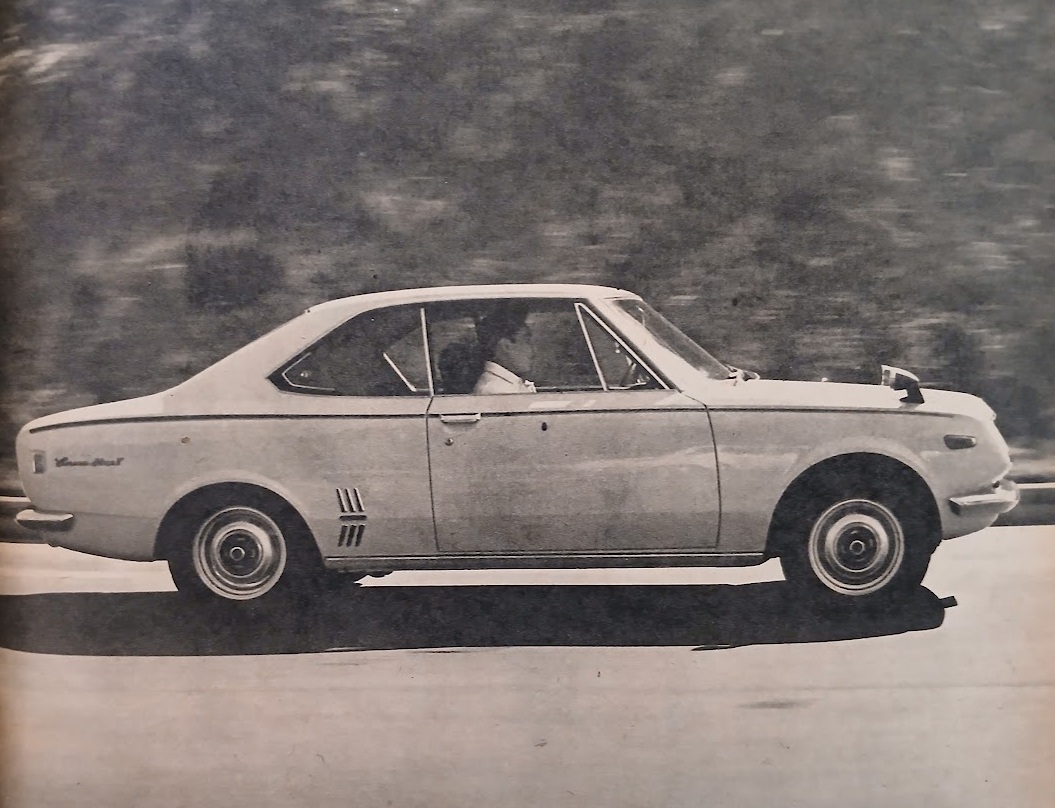
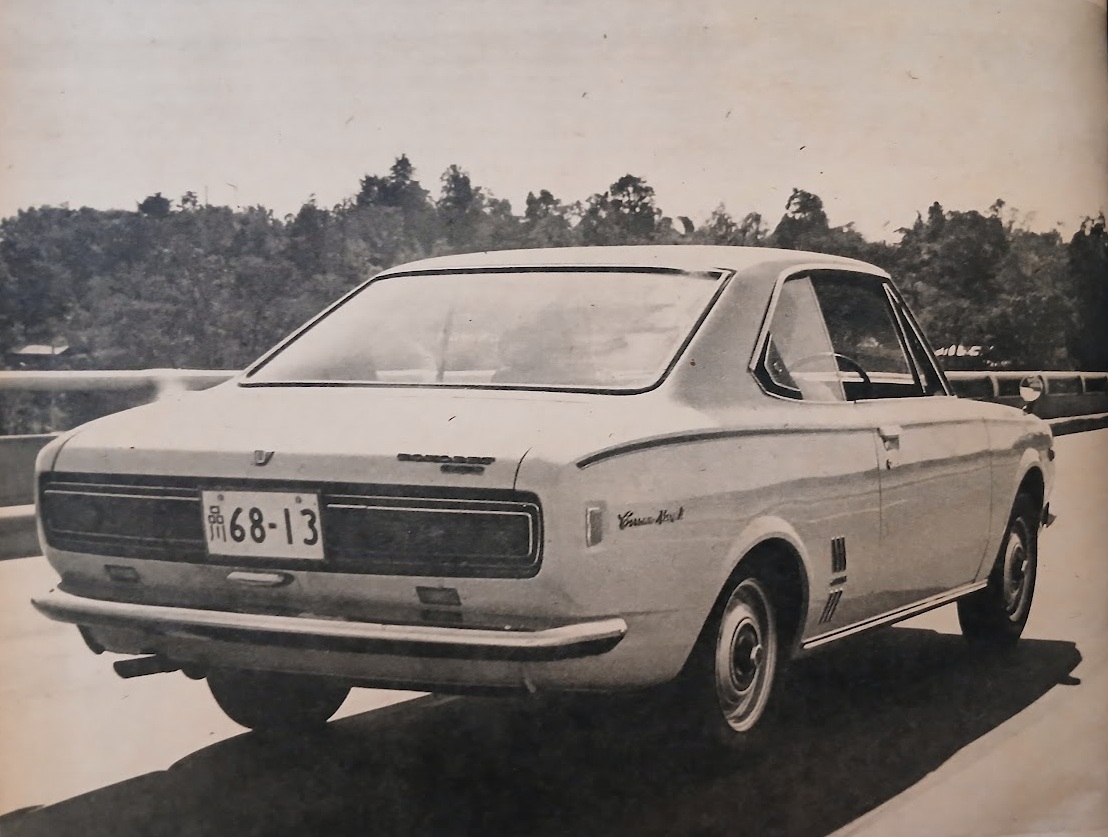
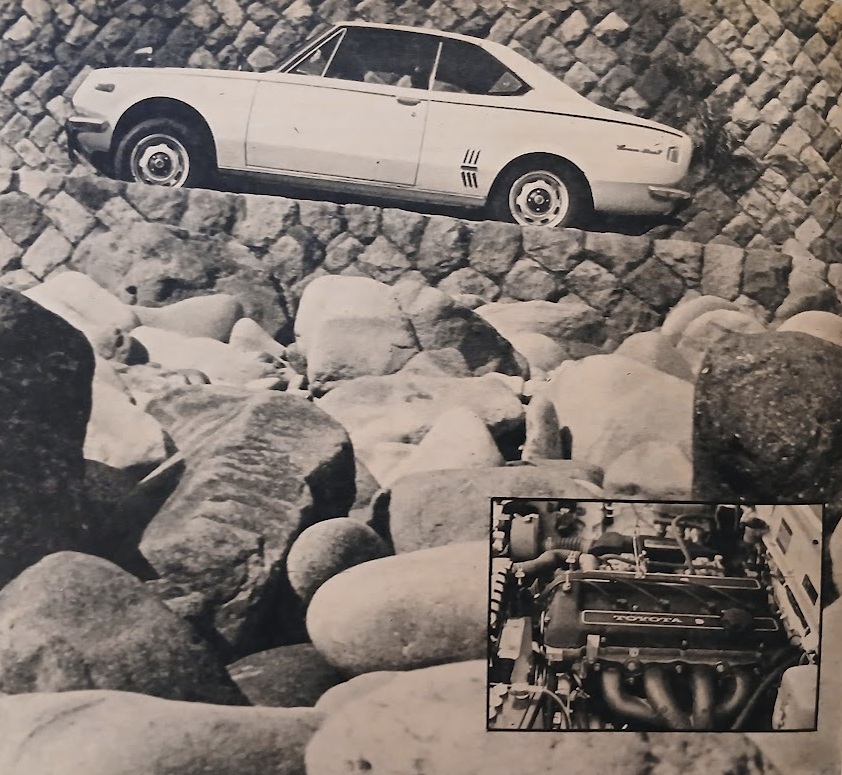
Sugawara: My first acquaintance with this bold-looking car was in front of the Toyota Motor Sales office building in Kudan, Tokyo. The body is essentially the same as that of the Mark II hardtop, but two thin stripes running from front to rear enhance its sporty appearance. The sporty arrow-shaped trim on the sides, symbolizing the powerful 140ps engine, is a fresh design touch. The GSS-specific wheels, with small hubcaps that mimic capless wheels, also evoke the impression of a sharp, sleek “wolf in sheep’s clothing.”
The engine, called the 10R type, has the same 1858cc displacement as the existing Mark II 1900SL, with short-stroke cylinder dimensions of 86mm × 80mm. However, the cam mechanism adopts a DOHC system descended from the same lineage as that of the Toyota 2000GT and Toyota 1600GT.
The compression ratio has been raised from the SL’s 9.0 to 9.7, making it a highly tuned engine. Output is 140ps at 6400rpm, and maximum torque is 17.0kgm at 5200rpm, making it exceptionally strong for this class.
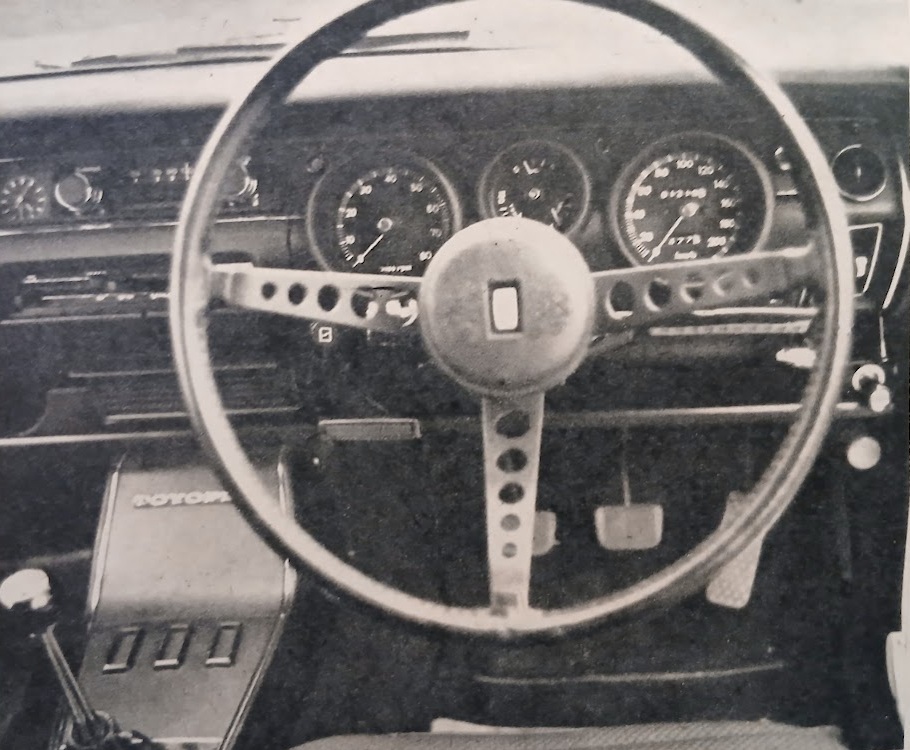
Inside, the cabin trim is unified in all-black, and the bucket seats fit the body snugly, another feature inherited from the Toyota 2000GT. The steering wheel is wrapped in black leather, rare for a mass-produced car. The speedometer is calibrated up to 210km/h, and to its left is a tachometer, with the redline starting at 7000rpm and extending to 8000rpm. Between the two main gauges sits a combination meter with water temperature, fuel, and oil pressure gauges. These instruments are adjustable for brightness. The 5-speed shifter, the black center console it emerges from, and other interior details make the cabin strongly reminiscent of the 2000GT.
After checking the headlights and horn, I started the engine and set off. My first impression was that the suspension felt quite stiff. However, surprisingly, even when driving over rough road surfaces, there was no discomfort at all. This seems to be thanks to the effective oil dampers, the vibration-dispersing body, and the damping effect of the seats themselves.
Low-Speed Performance
Sugawara: The powerful engine performs surprisingly well in slow city driving. Even in short bursts in dense traffic, rapid acceleration is undramatic, responding smoothly to the driver’s inputs. As an experiment, I shifted into fifth gear in city driving, and even at 40km/h, the car maintained speed without fuss. What was unexpected was that when I pressed the accelerator, it could also accelerate slowly from that speed.
The engine’s flexibility at low speeds was so impressive that I began to wonder if it could truly reach the 200km/h top speed listed in the catalog.
Conversely, pulling second gear up to 5500rpm unleashed such fierce acceleration that it seemed almost unkind to the Bridgestone Super Speed radial tires. The servo-assisted disc/drum brakes avoided the sponginess that discs sometimes exhibit in city driving. Thanks to the firm suspension setup, nose dive is minimal, making it easy to handle even for beginners.
Magazine: With the weather remaining bright and sunny, we finally cleared the traffic and entered the Third Keihin Expressway from Setagaya. As expected, a machine like this really shows its strengths on the highway. At this point, Sugawara finally smiled, happy to press the accelerator without holding back.
Sugawara: At 80km/h in fifth gear, the tachometer reads a relaxed 2500rpm. The body, which emphasizes Toyota’s Arrow Line design, slips through the air quietly, with no wind noise at all.
Testing in-gear acceleration from 80km/h to 100km/h, the measured times were about 6 seconds in fifth gear, 4.9 seconds in fourth gear, and only 3.5 seconds in third gear.
Cars traveling alongside seemed surprised at the acceleration, but since this was a brand-new car with only 1,000km on the odometer, I limited my speed to just 100km/h, although it pained me to do so.
The Advantage of Precise Shifting
Sugawara: The shift feel of the 5-speed gearbox is unlike that of the Porsche synchro type found on Nissan cars. Throws are short, and engagements are crisp. The gear ratios are 3.074 / 1.838 / 1.256 / 1.00 / 0.856. The standard final drive ratio is 4.375, with 4.625 and 4.875 available as options.
Compared with the gear ratios of the old 1600GT, which shared its transmission with the Toyota 2000GT, the GSS’s gearbox is a closer-ratio setup, making it easier to use.
One feature I especially liked is the safety mechanism that makes it impossible to shift into reverse during normal operation. Reverse is located below fifth gear, but you must push the lever downward before shifting into the gate; therefore, you cannot accidentally damage the reverse gear by mis-shifting. In racing, drivers unfamiliar with 5-speed transmissions sometimes try to downshift from fifth to fourth and end up catching reverse, but this arrangement prevents that.
Although the car’s 1,050kg weight is by no means light, what I felt from behind the wheel was that it actually drives like a much lighter machine.
From my recollection of driving the previous 1600GT, the GSS feels far more agile, almost effortless by comparison.
Magazine: We drove from the Manazuru Peninsula onto the Yugawara Toll Road, where we had Sugawara put the car’s cornering to the test on steep uphill sections. As you’d expect from an active racing driver, his technique is precise, and it was amazing how he could immediately grasp the steering characteristics and draw out the machine’s full potential.
Sugawara: With just a little extra pressure on the accelerator, the limited-slip differential kicks in, producing sharp acceleration while the inside tire bites hard, chirping as it fights for grip. At this level, you could enter the car in a gymkhana event completely stock. It also feels perfectly suited for hill climbs and rallies, or other sports events held on public roads.
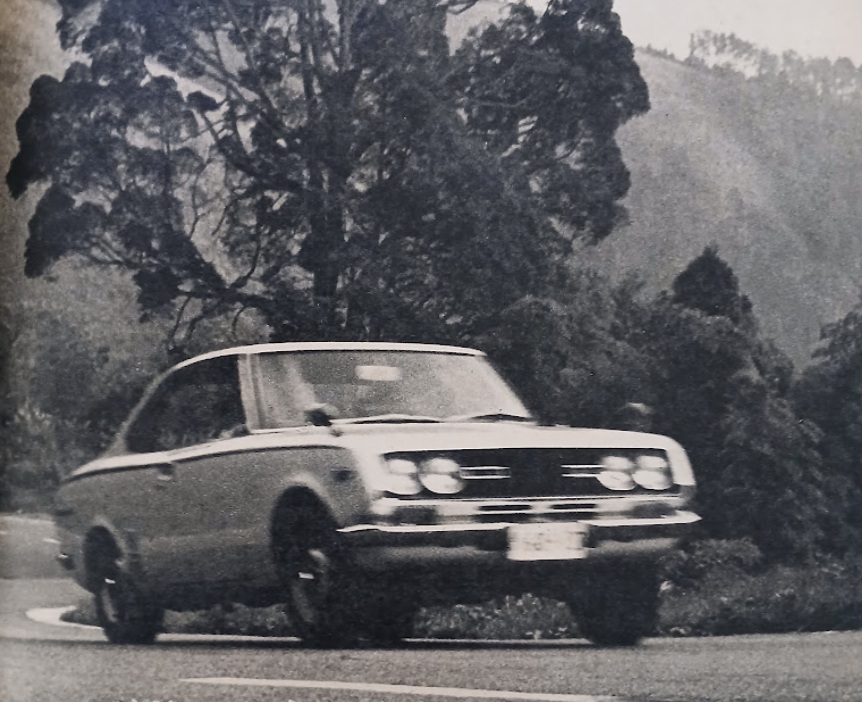
In the hill-climb test, even when pushing the speed fairly hard, the steering characteristics remained neutral, but once past the limit it shifted into oversteer, and the rear end would start to slide out. Once accustomed to it, you can apply counter-steer, hold the slide, and maintain your speed without killing momentum, but if your hands are too slow on the wheel, it will lead to a spin. Thanks to the suspension’s low roll rate, the car’s handling in mountain roads deserves genuine praise.
The only real disappointments are the lack of a footrest and the fact that the rear suspension remains an overly orthodox leaf-rigid-axle type. Of course, even on loose gravel corners, the limited-slip differential shows its strength and provides sharp, satisfying traction, but still…
The 140ps output is transmitted to the rear wheels through a three-joint propeller shaft with a center bearing, which keeps vibration low even at high speeds. A torque rod is also fitted to prevent the strong torque reaction from winding up the rear axle.
A Character Born from Racing
Sugawara: The torque rod helps suppress weaving and axle tramp during hard launches, and it also seems effective at controlling the reaction forces during sudden braking.
The brake master cylinder is a tandem type, meaning that even if one brake line were to fail, the system would not become completely inoperative. The brake fluid capacity is also surprisingly large, which may offer an advantage in terms of slower fluid loss. Of course, the rear wheels are equipped with a pressure-control valve to prevent lockup.
One of this car’s strengths is that these high-speed safety features were not added hastily. Instead, they are the result of long-term, repeated testing and extensive development before becoming production equipment. The engine’s “younger brother,” the 1600cc DOHC 9R (the one used in the 1600GT), began its racing career three years ago, in March 1966, under the name Corona RTX. In July 1967, at the Suzuka 12-hour race, the late Yukio Fukuzawa and others took first and second place, proving the engine’s durability.
Later, in this year’s JAF Grand Prix, the 1600GT competed in a fierce dead heat with the Skyline 2000GT-R, demonstrating power that made the 400cc displacement difference hardly noticeable. It is reassuring to know that the reserve strength at high speeds created through such accumulated real-world experience has now been carried over into the 1900cc engine.
Magazine: After finishing the tests in Yugawara, we passed through Hakone, continued over Otome Pass, and entered the Tomei Expressway from the Gotemba interchange. Although we were now in a position to test the race-bred high power of the machine, the fact remained that this was still a public road, so we refrained from running at high speed for long periods and performed only a brief full-throttle test. At the Ashigara service area, we checked tire pressure, oil, water, and other essentials before setting off.
The 200km/h Mark Comes Easily
Sugawara: As mentioned earlier, the engine’s flexibility at low speeds had made me wonder whether it could truly reach the catalog top speed of 200km/h. But accelerating in fourth gear up to 6000rpm, then shifting into fifth, the speedometer needle rose to 200km/h with surprising ease. The sensation of acceleration throughout was exceptionally smooth, and the stability was likewise excellent. Running in fifth gear at 170km/h, with the engine turning 5000rpm, the atmosphere in the cabin remained calm. With the windows fully closed, cabin ventilation was excellent, and even when opening the quarter windows, there was no unpleasant wind noise, which was a delight.
I always race in a Mini Cooper S, and while driving the GSS, the thought suddenly crossed my mind of those moments on the circuit when, even as I’m desperately flooring the accelerator, some incredibly fast machine blasts effortlessly past me. I wondered if yet another car capable of doing that has just been born, and the idea gave me a quiet feeling of satisfaction.
Surely this car will be highly tuned and widely successful, not only by the factory team but also by private teams.
Considering the performance and equipment it offers, the price of 1,050,000 yen (Tokyo, dealer delivery) is not unreasonable when compared with competing models from other manufacturers in the 1600cc to 2000cc class.
Not only for motorsport-style driving, but also for highway touring, the car can be fitted with a wealth of available options—vinyl leather roof, rear-window defogger, power windows, air conditioning, and more—creating a luxurious, high-speed touring machine that no foreign car in this price class can hope to compete with. I feel that, fully equipped, it would become a top-level car, unique even by international standards.
Magazine: At this point, Sugawara-san was so impressed with the car that you could say he was utterly smitten with it. So, we decided to have a little fun with him and asked him to find some faults.
Sugawara: In terms of mechanical aspects, cabin atmosphere, ease of driving, power, everything that defines a GT car, this machine is first-class, so finding flaws is actually quite difficult. One thing that bothered me was an unusual noise coming from the brake-pedal area. Upon inspection, the return spring was rubbing against something. The squeak each time the pedal was pressed was quite annoying. Another point was that the gear whine from the transmission was relatively loud. Because the isolation from outside noise is so good, the gear noise seems louder by comparison.
A Car That Chooses Its Driver
Sugawara: Although one could call this a race-bred engine (even if the 1900cc version is relatively new, its mechanism clearly inherits the bloodline of the 1600GT), the powerband is wide, and it feels like it will be easy to handle even for beginners. This seems to be a characteristic shared with the Toyota 2000GT and 1600GT as well. But in a way, that very quality can also create a certain danger.
Because it can so easily produce extremely high speeds, 200km/h and beyond, the question becomes: how well can the driver truly manage such high performance?
For someone who cannot discipline themselves to keep the speed within their abilities, the car may be something of a coffin on wheels. Buyers must thoroughly drill this into their heads, otherwise, they will not only put themselves, but others, in great danger.
One must make an effort to become the kind of sophisticated driver who matches a high-class car with high-class technique. It’s the sort of machine that makes you constantly remind yourself, “I’d better show some self-restraint…” every time you take the wheel.
Magazine: Naturally, this machine is not intended for users who are concerned with details like fuel economy. Still, for reference, we measured consumption on the return trip, much of which was at high speed, using the full-tank method. The course was from Ashigara Interchange onto the Tomei Expressway, plus some city driving in Tokyo, for a total of 103km, and the route was relatively flat.
Surprisingly good fuel economy
Sugawara: When we topped up the tank at the finish point in front of the Toyota Motor Sales office, it took only 11 liters. Thinking, “Huh, it didn’t drink that much gas,” we ran the numbers and calculated a fuel-consumption rate of 9.36km/l. This figure surprised not only me, but also the editorial staff. It was that good.
Looking at previous data gathered with the same “don’t worry about the gas, just drive” style, the Skyline 2000GT-R returned 4.97km/l, and the Bellett 1600GTR, 8.93km/l. Compared with cars like those, isn’t this almost too good? That was the sort of question that came up.
Of course, thinking it over, the credit seems to go to the 5-speed gearbox. On the return leg where we measured consumption, we were mostly cruising in fifth, the overdrive top gear. With the gear ratio dropping engine revs by about 15% compared with fourth, it’s no wonder you can get this kind of fuel economy.
In any case, even in a GT car, it’s always better from the user’s point of view if running costs can be kept down as much as possible.
It’s not widely known that a 5-speed gearbox leads to economical driving, beyond simply giving the engine more extension at high speeds—but I felt this could become one of the car’s selling points.
In all, it was a short drive at only about 250km, but as I looked at the data and matched it with the sensations I’d had behind the wheel, I found myself thinking: if I were to add one more car to my garage, I’d absolutely want it to be this one.
Postscript: Story Photos