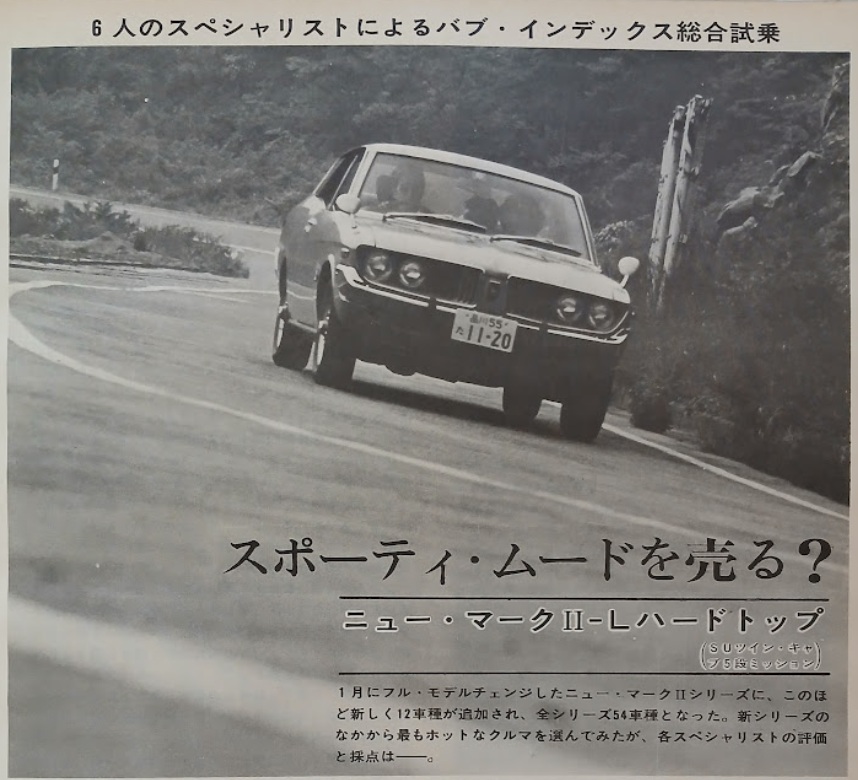
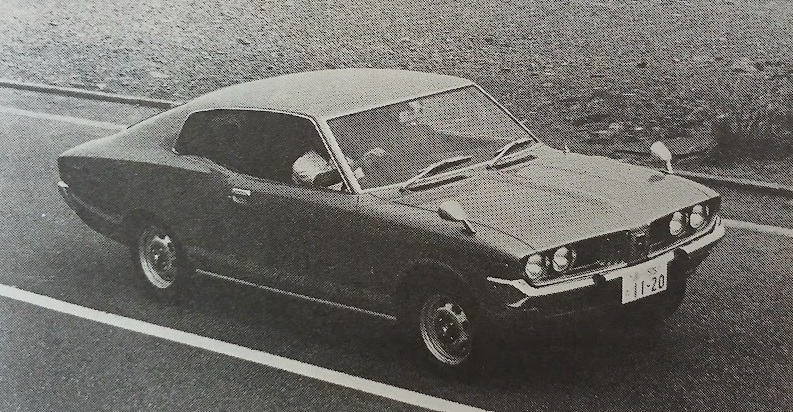
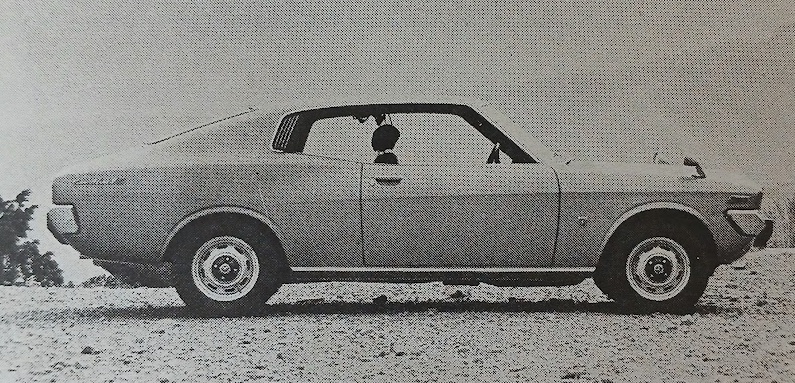
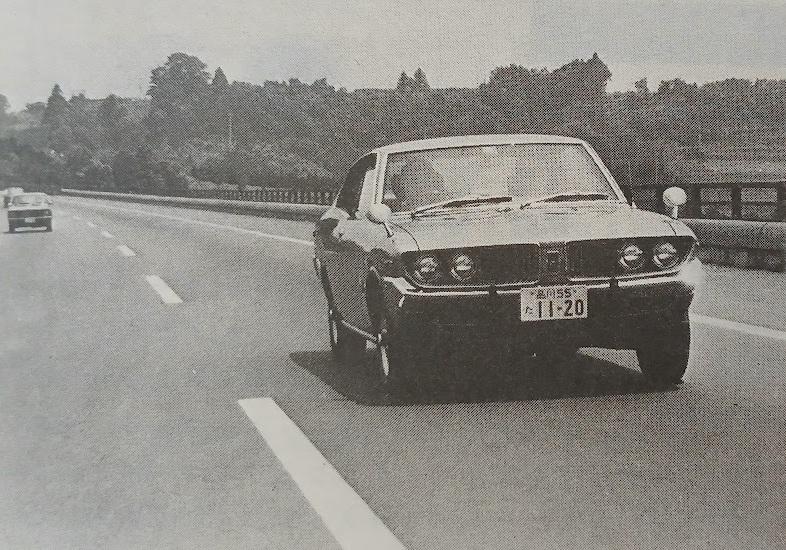
Toyota Corona Mark II Hardtop L (1972)
Publication: Motor Fan
Format: “Bubble Index” Road Test
Date: September 1972
Authors: Osamu Mochizuki, Katsuzo Kageyama, Tadao Suzuki, Yasuhei Oguchi, Reiko Ikuuchi, Kensuke Ishizu
Selling the Sporting Mood?
Twelve new models have recently been added to the new Mark II range, which underwent a full model change in January, bringing the lineup to a total of 54 variants.
From among the additions to the range, we selected what appeared to be the most exciting model for evaluation, with SU twin carburetors and a 5-speed transmission. How did it fare in the eyes of our panel of specialists, and what scores did it earn? The results were as follows.
Quiet and Comfortable, But…
As readers will already know, Toyota introduced a complete redesign of the Mark II on January 29.
Five months later, on June 26, Toyota expanded the New Mark II-L lineup with a new luxury personal car powered by the 1988cc M-B six-cylinder OHC engine, equipped with SU-type twin carburetors and a Porsche-type 5-speed transmission.
The new additions comprise six models across the sedan and hardtop ranges. Including regular-fuel versions, the total comes to 12 variants, bringing the New Mark II series to an astonishing 54 models in all.
Recently, New Mark IIs have become increasingly common on the streets of Tokyo and the surrounding prefectures. According to figures supplied by Toyota Auto Sales’ public relations department, 64,430 passenger cars had already been sold by the end of June.
The introduction of these new models appears to have been accompanied by an even more aggressive advertising campaign. On July 3, while conducting this test of the New Mark II-L Hardtop, we happened to hear a radio advertisement for the car while cruising along the Tomei Expressway.
In a deep, emphatic voice, the announcer proclaimed:
“Six cylinders! Twin carburetors! Five speeds!”
Then, over a musical backing:
“The much-anticipated six-cylinder, twin-carburetor, 5-speed New Mark II is here at last!”
And finally:
“The New Mark II really moves. Isn’t it great!”
At the time, our speed was 100km/h, yet we could hear the advertisement clearly enough. That was no doubt due to the smoothness of the six-cylinder engine. Vibration was minimal, mechanical and wind noise were subdued, and the car was cruising along in remarkable quiet and comfort.
Comfortable though it was, the New Mark II-L Hardtop did not deliver the sort of sporting character one might expect from its catalog specifications. Rather, it felt more like a refined owner’s car designed for relaxed touring.
As usual, the panel reconvened afterward at the Fantasy Drive-In, our customary start-and-finish base, to compare impressions. There, one theme emerged almost unanimously among the specialists: a lack of confidence in the car’s handling characteristics.
“When I first got behind the wheel, I thought it might have power steering.”
“The steering feels heavy in city driving, yet it isn’t particularly responsive.”
“It took me some time to judge how much steering input was required, and exactly when to unwind the wheel, to place the car where I wanted.”
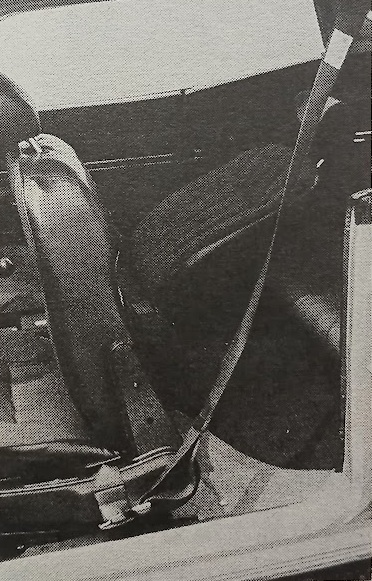
Another point raised by virtually everyone concerned the three-point seatbelt.
“The shoulder mounting point is positioned too far rearward, so the belt runs directly across the neck.”
“In a serious accident, that could mean a neck injury.”
“It’s advertised as a one-action seatbelt, but that one action is not easy, whether fastening or releasing it.”
There was also considerable discussion of the merits of the 5-speed transmission and the revised suspension, among other topics, but for those details readers are referred to the individual reports that follow.
One final note: for this test, Shigeki Asaoka, our regular contributor for comfort and accommodation evaluations, was away on a trip to Europe. Substituting for him was Motor Fan staff writer Tadao Suzuki.
Performance: A Successful Emphasis on Stability (Osamu Mochizuki)
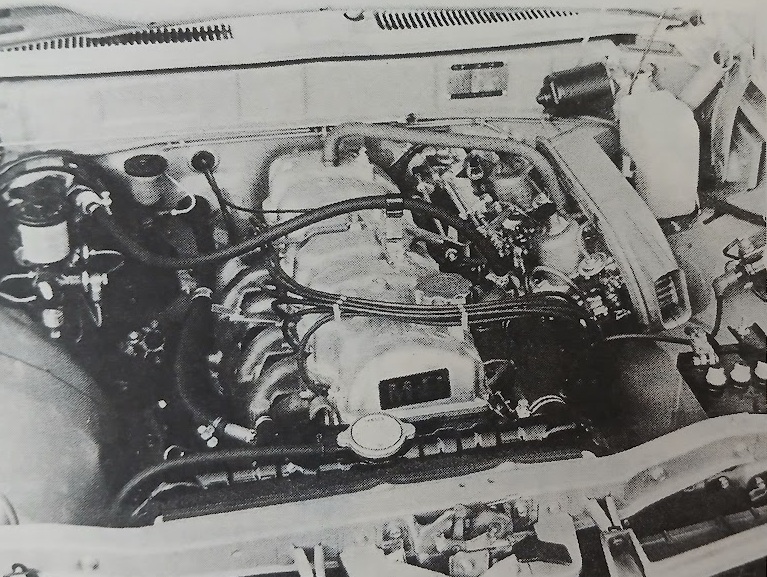
With the addition of Toyota’s 125ps inline-six OHC engine to the Mark II-L series, the evolution of the model’s engine lineup appears, for the moment at least, to have reached its peak.
Known as the M-B engine, this sporting powerplant was originally developed for the 1965 Crown S and has now accumulated more than six years of service. Its published output and torque figures remain unchanged from the time of its introduction: 125ps/5800rpm and 16.5kgm/3800rpm.
The Mark II-L Hardtop equipped with the 5-speed transmission weighs 1,140kg. With an output of 125ps, its power-to-weight ratio is approximately 9.1kg/ps. This places it on roughly equal footing with cars such as the Sprinter 1400SL, where the ratio is 9.2kg/ps. In practice, however, the comparison reveals a difference in character: the Mark II is somewhat superior in high-speed acceleration, while its response at low and medium speeds is somewhat less lively.
That, perhaps, is only appropriate for a car of this size and class. Its character is fundamentally a restrained one.
The test car was virtually brand new, having covered just 458km when testing began. As a result, the engine was still insufficiently run-in, and its willingness to rev was still somewhat constrained. Perhaps for that reason, mechanical noise increased noticeably above 4000rpm, making it difficult to justify keeping the accelerator down much further.
The torque curve is quite flat, and viewed from that perspective, the necessity of a 5-speed gearbox is not entirely obvious. Comparing the overall top-gear ratios of the 4-speed and 5-speed versions yields figures of 4.111 and 3.909 respectively. The taller fifth gear therefore offers quieter and slightly more economical cruising on the highway.
And indeed, at speeds around 100km/h, the car is exceptionally quiet. Mechanical noise is subdued, exhaust noise is similarly well suppressed, and within this speed range the Mark II fully delivers the atmosphere one expects of an upscale car.
The Porsche-type 5-speed gearbox leaves something to be desired from a sporting standpoint. Shift effort is heavy, and the lever’s travel is relatively long.
The shift action itself is firm, yet even quick gear changes produce no gear clash whatsoever, demonstrating the advantage of the Porsche-type synchronizers.
The servo-assisted brakes are equally well judged. Braking response rises progressively with pedal effort, inspiring confidence at both high and low speeds and providing stopping power in keeping with the car’s performance.
In virtually every driving situation, the 5-speed Mark II-L Hardtop demonstrates excellent stability, suggesting that the engineers’ emphasis on this area has paid dividends.
One example is its outstanding straight-line stability above 120km/h. Body roll in corners is reasonably well contained, while pitching over uneven surfaces is minimal and quickly damped out.
There is, admittedly, a certain degree of sluggishness in some aspects of its behavior. Considering the size and role of the car, however, the decision to place stability ahead of agility must be judged a success.
“There’s plenty of power, but the car is fairly heavy, so it doesn’t feel especially nimble.” —Kageyama
“Whatever one may say about its low- and medium-speed response, its high-speed acceleration is excellent.” —Oguchi
“I have some doubts about the pairing of this engine with the 5-speed transmission.” —Suzuki
Handling and Stability: Excellent Straight-Line and Hands-Off Stability (Katsuzo Kageyama)
In a car of this size, the cabin naturally feels spacious and relaxed. There is plenty of room in every direction, and nothing about the dimensions feels restrictive. One complaint, however: once the three-point seatbelt is fastened, some of the controls become difficult to reach.
The accelerator pedal is on the heavy side, perhaps as a result of the twin carburetors. But since the clutch pedal is similarly heavy, so the overall driving feel is consistent rather than awkward.
The Porsche-type 5-speed gearbox has a generally satisfying action, but first gear and reverse proved troublesome. Perhaps because the transmission was still new, both were reluctant to engage. In the city, I frequently found myself pulling away in second gear, while selecting reverse often required considerable effort. This, however, is unlikely to be representative of the gearbox in its fully broken-in state.
The combination of a relatively long wheelbase and wide, low-profile radial tires appears to have paid dividends. On the road, the car displays excellent straight-line stability, something that becomes particularly evident on the expressway. Its hands-off stability is equally impressive. Above all, the Mark II feels remarkably settled. Predictably, it also exhibits a pronounced tendency toward understeer.
Toyota describes the suspension as a “firmer suspension” in its catalog, and it is true that expansion joints and pavement seams are transmitted rather clearly to the occupants. But “firmer” is a relative term, referring to other Mark II models. By absolute standards, this is not an especially firm suspension. It remains unmistakably an L-series setup, with ride comfort as the primary objective. Nor would I describe body roll as particularly well-restrained.
The first thing that struck me after setting off was the steering.
In fact, I turned to my passenger and asked, “This doesn’t have power steering, does it?”
The steering ratio appears to be quite high, and as the wheel is turned there is very little sense of effort building through the rim. More accurately, there is little change in effort. If the steering were simply light, the driver could compensate by adjusting his inputs. Instead, it has a vague, floating feeling, almost as though one were stirring a vat of oil. The result is a distinctly unsettling lack of confidence.
The car’s excellent straight-line stability on the expressway goes a long way toward masking this trait. During overtaking maneuvers, however, the lack of steering feel becomes more noticeable. On winding roads, when one starts increasing the pace and turning the steering from side to side, the sensation becomes more pronounced still.
There is a clear mismatch between the car’s sporting credentials–twin carburetors and a 5-speed transmission–and the character of its steering. Yet the contradiction disappears if one views the Mark II for what it really is: a luxury personal car aimed at the well-heeled middle-aged gentleman who wants to enjoy just a touch of sporting flavor as part of the package.
“Its high-speed road holding was outstanding.” —Oguchi
“Don’t rely on the tires to disguise the problem–improve the steering itself.” —Suzuki
Comfort and Accommodation: A Refined Owner’s Car (Tadao Suzuki)
Even within the Mark II range–which Toyota promotes as a high-grade owner’s car–the L Series occupies a special position. It combines the smoothness and quiet operation of a six-cylinder OHC engine with SU-type twin carburetors for increased output, a Porsche-type 5-speed transmission, and a firmer suspension setup.
On paper, that specification inevitably conjures images of a “wolf in sheep’s clothing” in the mold of the twin-cam GSS or Toyota’s earlier 1600GT. To be honest, that was exactly what I expected before setting off, and I looked forward to it.
The reality proved rather different.
The twin-carburetor engine does produce more power, but its throttle response is far from what one would call sporting, and its eagerness begins to taper off relatively early in the rev range. Perhaps I felt this more keenly because I was expecting something genuinely exciting.
What has not been lost, however, is the inherent smoothness and quietness of the six-cylinder engine. Vibration and engine noise are both exceptionally well suppressed.
Which raises a question: does this engine really require a 5-speed transmission? And if so, does it need to be a close-ratio setup?
Certainly, the servo-synchronized Porsche-type transmission has a distinctive feel. But that does not necessarily mean buyers of a high-grade owner’s car are clamoring for the “Porsche-type experience” of a 5-speed gearbox.
Then there is the steering. Its vague, indistinct feel takes some getting used to. With a steering ratio varying from 20.0:1 to 23.5:1, it can hardly be described as contributing to a sporting atmosphere.
Toyota describes the suspension of the 5-speed model as being specially tuned to firmer settings, yet the ride quality is surprisingly good.
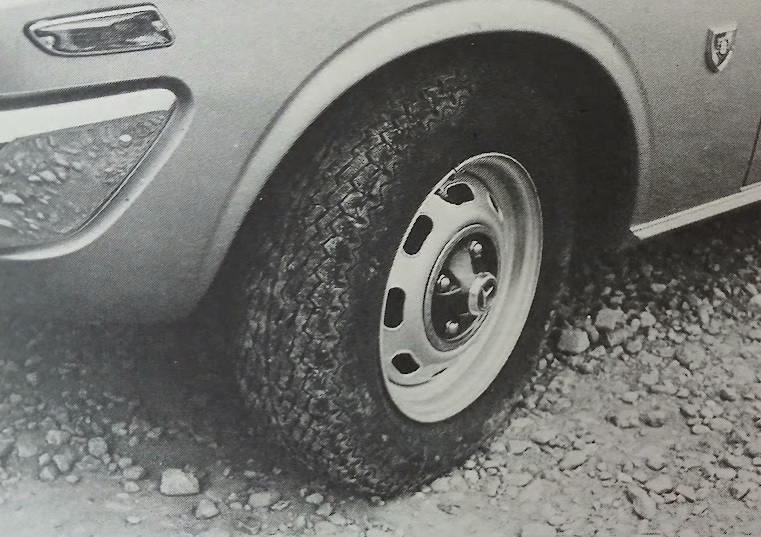
Our test car was equipped with the optional 185/70HR-14 wide radial tires, but there was little of the harshness one might expect. Only small surface imperfections and minor road irregularities were transmitted with any noticeable sharpness.
As for the interior, the front seats leave little to complain about in a car of this class. The dashboard and seat materials are entirely in keeping with the standards expected of the L Series.
The rear cabin is similarly accommodating. Apart from the inevitable reduction in headroom that comes with the hardtop body style, comfort for two occupants is assured. The nominal three-across seating capacity is questionable, however, as there is very little support for the center occupant.
Wind noise is unobtrusive at legal speeds, while high-speed cruising is quiet and free of vibration. If one were to make a request, it would be this: given the engine’s ample power reserve, an air conditioner would suit the character of the car far better than a 5-speed transmission.
Drivers expecting a “wolf” based on the specifications are likely to come away disappointed. The essence of the Mark II remains that of a luxury car–a robust and thoroughly agreeable “sheep” with which to live.
“An automatic transmission would suit this car’s gentle character far better than a five-speed gearbox.” —Kageyama
“The atmosphere of the interior is one of the car’s greatest strengths.” —Oguchi
“I wish manufacturers would move beyond imitation trim and decoration.” —Ishizu
“The quality of the cabin finish is consistently good throughout.” —Mochizuki
Safety: The Seatbelt Mounting Needs Attention (Yasuhei Oguchi)
The effect of the wide radial tires is substantial.
The Mark II series has always struck me as somewhat vague–or perhaps merely slow to respond–in its handling characteristics. Equipped with wide radial tires, however, this test car conveyed a much stronger sense of being “settled” and secure on the road.
The relationship between safety and handling stability is a complicated one. A car’s character can change dramatically depending on whether the emphasis is placed on handling agility or on stability. The Mark II series appears to lean toward the latter philosophy.
Is the first requirement of safety a highly responsive chassis that improves a driver’s ability to avoid hazards in an emergency? Or should greater priority be given to stability–the car’s ability to recover and settle itself when disturbed by outside influences? The answer is not an easy one. Ideally a car would excel at both, but reality seldom accommodates this.
Handling characteristics are particularly difficult to evaluate because they are so closely intertwined with human control inputs. Leaving theoretical arguments aside, one aspect of this car’s behavior kept drawing my attention throughout the test: the apparent gain of the steering seemed to change depending on the road being driven.
That may sound like a strange observation, but what I mean is this: when negotiating tight turns in city traffic, or when driving enthusiastically along a winding mountain road, it was not immediately obvious how much steering lock was required, or at precisely what point the wheel should be unwound, to place the car on the intended line.
Yet on the expressway, small steering inputs, crosswinds, or even minor disturbances introduced through movements of the driver’s hands could produce a noticeable lateral movement of the car.
Part of this sensation may be attributable to the large variations in the variable-ratio steering, combined with the increased cornering power of the tires. Whatever the cause, there is little doubt that the car’s ability to evade obstacles at medium and high speeds is considerably improved.
The heated rear window deserves particular praise. Because the heating elements extend all the way to the lower edge of the glass, rearward visibility in the damp, fog-prone conditions of the rainy season is noticeably improved.
Heated rear windows have become increasingly common recently, making nighttime reversing much easier than before. Even so, some cars still leave a band of condensation along the lower edge of the glass.
The test car avoids this problem by extending the heating elements all the way down. It is a small detail, but one that becomes greatly appreciated when needed.
The seatbelt, on the other hand, was an irreconcilable problem.
The shoulder anchor is mounted too far to the rear, causing the belt to run directly across the neck. This applied even to occupants around 1.7m tall. Had the system been left as a simple two-point belt, it would at least have restrained the hips effectively. As it is, not one member of the test group felt inclined to use the shoulder belt at all.
“The speedometer error is excessive.” —Mochizuki
“The steering characteristics leave some doubt about the car’s ability to avoid a sudden hazard.” —Suzuki
Economy: The Prestige and Presence of a Six-Figure Price Tag (Reiko Ikuuchi)
The Tokyo list price of the Mark II-L Hardtop tested here (twin carburetors, 5-speed transmission, floor shift) is 1,002,000 yen–a seven-figure sum that places it firmly in the ranks of the premium domestic cars.
Our test car was fitted with the optional wide radial tires. Specifying these at purchase adds 30,200 yen over the standard tires, bringing the total price of the example tested to 1,032,200 yen.
Readers should bear this in mind when considering the comments in the sections on handling and stability. For the purposes of this discussion of economy, however, it is best to consider the standard list price.
As for that seven-figure price tag, one suspects it will be accepted more readily than might once have been the case. Increasing numbers of buyers are now seeking compact luxury cars, and the Mark II-L offers a persuasive combination: stylish appearance, generous accommodation, and sporting character carried almost to the practical limits of a touring car. In that sense, it has the dignity and presence one expects of a car in this price bracket.
Its principal rivals are the Skyline 2000GTX Hardtop (with 5-speed floor shift), at 1,013,000 yen, and the Laurel 2000SGX Hardtop (5-speed floor shift), at 1,050,000 yen.
All are powered by 2-liter six-cylinder OHC engines and equipped with twin carburetors and 5-speed floor-shift transmissions.
Although somewhat different in character as a two-seater, the Fairlady Z-L with 5-speed floor shift, priced at 1,080,000 yen, must surely also be regarded as a competitor of sorts.
The Laurel costs nearly 50,000 yen more than the Mark II, but it offers an additional 5ps, a 5km/h advantage in top speed, and a car stereo as standard equipment (a 32,200-yen option on the Mark II). Taking these factors into account, the prices are not so far apart in real terms.
At this level of the market, however, buyers are often influenced less by modest differences in price than by atmosphere and image.
Fuel consumption figures for the three test sections were as follows: Section1, 8.9km/l; Section 2, 7.3km/l; and Section 3, 9.3km/l.
One might have hoped for something closer to 10km/l on the expressway sections, but what is more striking is how little difference there is between Sections 1 and 3 and Section 2. The gap between expressway running and the winding, mountainous second section was surprisingly small.
In previous tests conducted over the same route, fuel consumption on Section 2 has at times reached nearly twice the rate recorded on the highway sections. The Mark II’s comparatively good showing on the curves and grades is likely attributable to the 5-speed transmission. When the driver makes full use of the gearbox and keeps the ratios well matched to the conditions, fuel economy should naturally improve.
Toyota’s own catalog figures support this conclusion. The 4-speed version is rated at 15.5km/l, while the 5-speed model is rated at 16.0km/l.
That said, a driver who is careless about gear selection would almost certainly negate any advantage the extra ratio provides.
Routine maintenance costs are also slightly higher for the twin-carburetor engine. According to figures supplied by Tokyo Toyopet, adjustment of the twin-carburetor setup costs 4,300 yen, compared with 3,800 yen for the single-carburetor version–a difference of 500 yen.
“If you buy this car expecting the performance suggested by its specifications, you may come away disappointed.” —Suzuki
Product Appeal: A Car That Aims to Satisfy Every Need (Kensuke Ishizu)
This may not reflect particularly well on me, but the other day I was pulled over by an unmarked police car on the Tomei Expressway. I was clocked at 31km/h over the limit, earned a 30-day license suspension, and paid a substantial fine.
The cause was a failed overtaking maneuver. Traffic was flowing at between 100-120km/h. I intended to pass two or three cars, but the line of traffic turned out to be longer than expected, and when I pressed the accelerator a little harder, I got caught.
There is a reason for telling this story. A truly good automobile today must excel both at high-speed expressway cruising–around 100km/h–and at low- and medium-speed driving in city traffic. Without both qualities, it cannot be considered a superior product.
In that respect, the test car was entirely satisfactory on the highway.
In city driving, however, its responses felt rather sluggish. More than once I found myself thinking, “After all, this car does weigh 1,140kg.”
Still, if this sort of character is what the mainstream Toyota buyer likes, there is little point in outsiders complaining about it.
If I were to summarize the car in a single phrase, I would call it a personal car built on a philosophy of “one car for everything”–a car intended to satisfy every need in a single package.
Of course, satisfaction means different things to different people. For some it is spacious comfort; for others it is speed, even at the expense of practicality. For still others it is absolute reliability and long service life.
Whatever the priority, the Mark II-L has the ability to satisfy the desires of the affluent owner. Within this class and category, it gives the impression of having carried the concept almost as far as it can go.
For that reason, I have rated it highly.
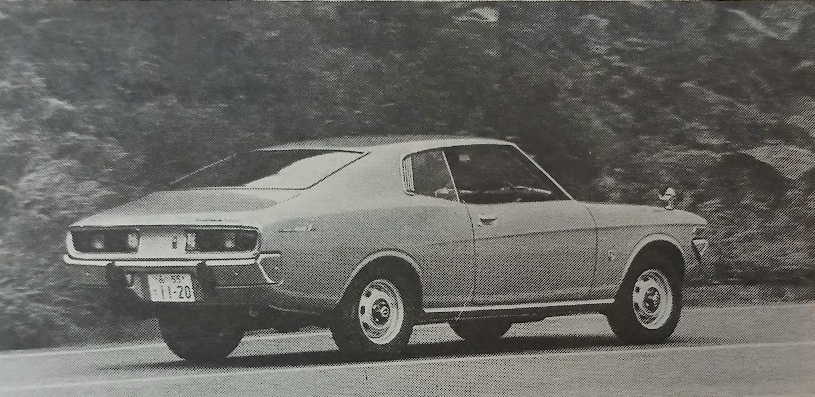
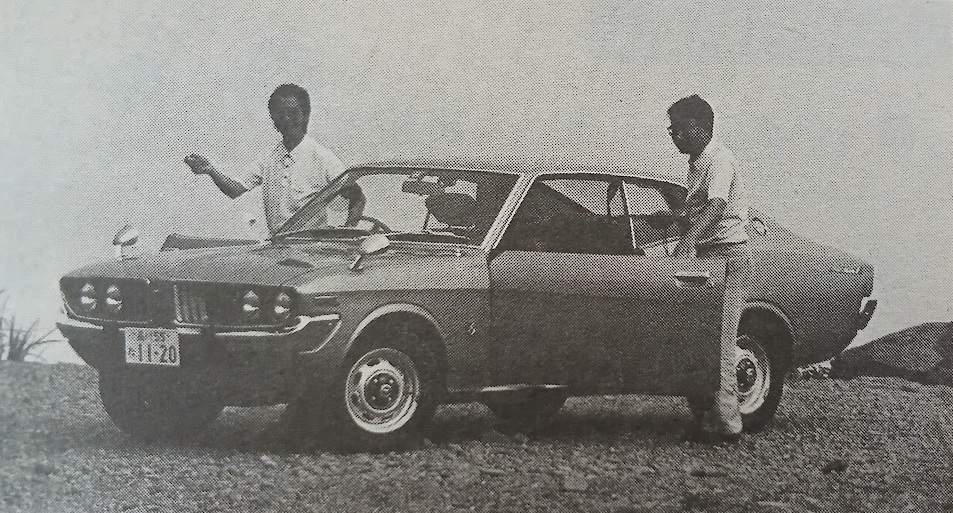
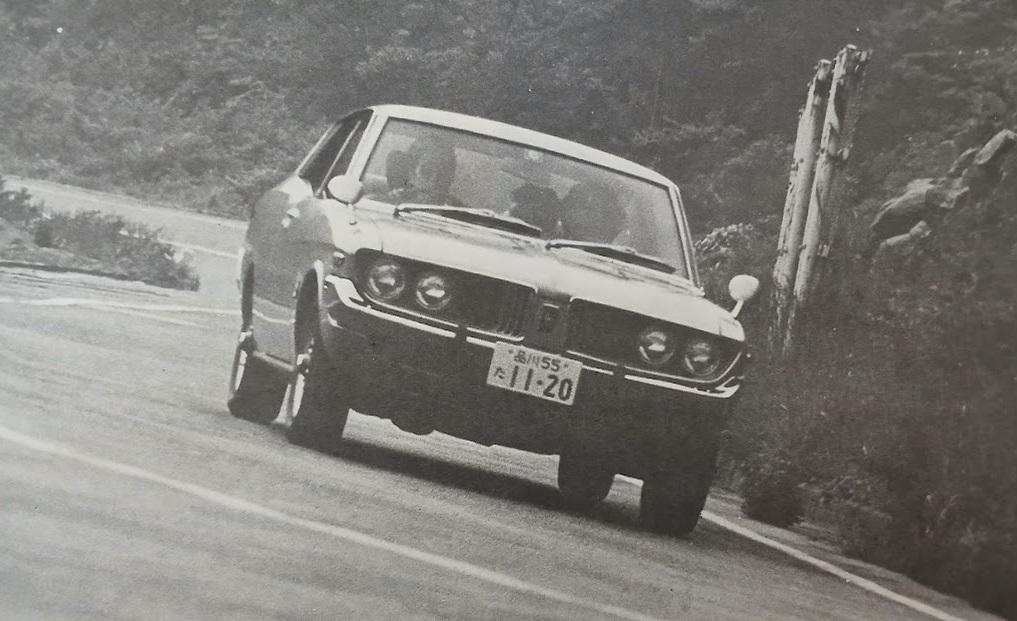
The bold fastback profile is attractive, and the character line running along the bodyside is beautifully executed. The paint color is also excellent. Our test car was finished in Moonlight Lavender Metallic, and one senses that Japanese manufacturers have at last matured to the point of paying serious attention to color.
I have many opportunities to speak with Toyota’s designers, and I am always impressed by the freshness of their thinking and the sophistication of their ideas. When it comes to exterior colors, Japanese cars may soon surpass their foreign rivals.
Interior colors, however, still lag behind.
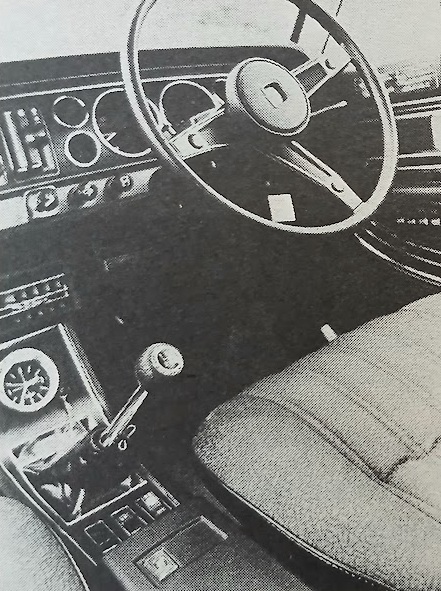
Speaking of interiors, why is there still such an obsession with imitation materials? Why must so many manufacturers rely on faux leather and imitation woodgrain to create an impression of luxury? The Mark II-L, despite costing more than one million yen, is no exception.
Although I have given the car a high overall evaluation, this is one area where I remain dissatisfied.
The center console feels flimsy and flexes at the slightest touch, while the woodgrain finish on the steering wheel looks cheap. If Toyota owners genuinely like such things, then perhaps there is nothing more to be said. But to my mind, creating a veneer of luxury through imitation materials reflects the sensibilities of a bygone era.
A genuinely fine product is not defined merely by appearances.
“The power windows are convenient, but their operation feels a little slow.” —Kageyama
“It’s the kind of car I’d like to own at least once.” —Oguchi
“The way Toyota has blended a touch of sportiness into a luxury car is particularly well judged.” —Suzuki
How to Read the Bubble Index
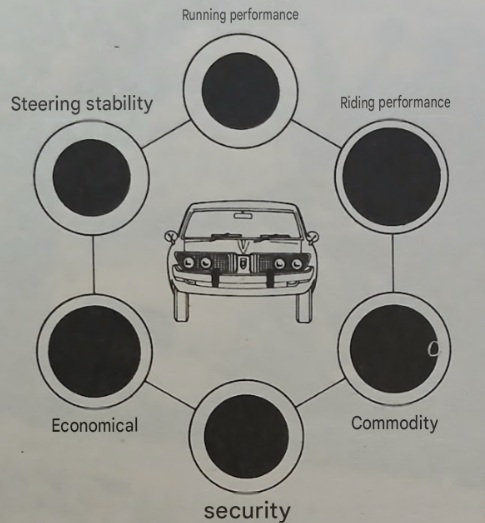
The purpose of this comprehensive road test is to evaluate a car’s overall capabilities through six principal categories: performance, handling and stability, comfort and accommodation, safety, economy, and product appeal.
The evaluation method is what we call the “Bubble Session.” Borrowing an approach from systems engineering, six specialists from different fields gather around a hexagonal table–the “bubble” referring to a honeycomb cell–and discuss the car from their respective viewpoints.
The black circles shown within the six evaluation fields indicate the rating assigned in each category. A car whose circles are relatively equal in size may be regarded as a well-balanced design, whereas one with larger disparities can be said to have a stronger individual character.
Postscript: Story Photos