Toyota Corona Mark II 1900 Hardtop SL (1968)
Publication: Car Graphic
Format: Road Test
Date: December 1968
Author: “C/G Test Group” (uncredited)
Summary: Stylish yet practical two-door four-seater. Powerful engine and excellent 4-speed gearbox. Servo-assisted disc brakes are exceptionally powerful. Excellent seats. Firm but comfortable ride. Ideal heating and ventilation system. Controls somewhat heavy.
Road testing the Toyota Corona Mark II 1900SL Hardtop
At the same time that the Corona Mark II was introduced, Car Graphic purchased a Corona Mark II 1900SL Hardtop and began our customary long-term practical test. Having now covered 2,000km, we present our first test report.
Among the Corona Mark II’s extensive lineup of eight models and 48 variations, the version chosen by the C/G editorial staff for testing was the 1900 Hardtop SL (RT72-S). This is both the highest-performance model and, at 848,000 yen, the most expensive.
For most people, the most enjoyable part of buying a new car is deciding on the body color and weighing the various optional extras. However, we are not permitted such luxuries. As usual, we had to get the car as quickly as possible, complete the running-in period day and night, carry out our instrumented testing at the Yatabe High-Speed Test Course, and at the same time put it into everyday service under every conceivable operating condition—all in order to complete an accurate test report before the deadline for the next issue. (The life of an automotive journalist is not quite as easy as our readers might imagine!)
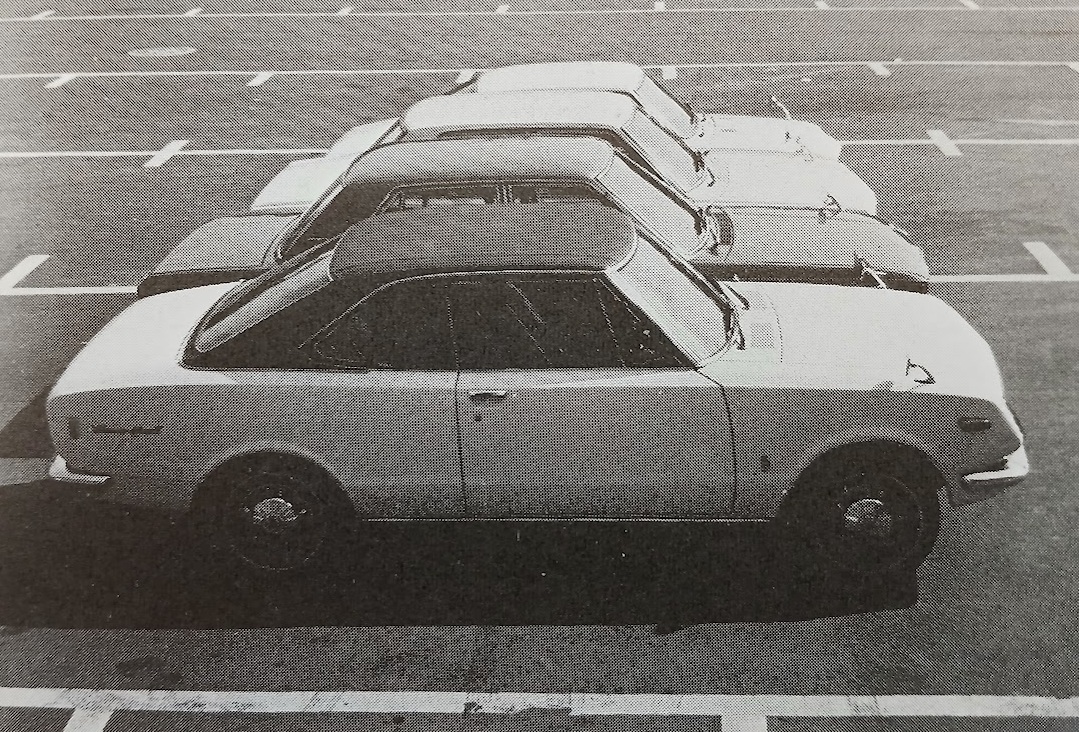
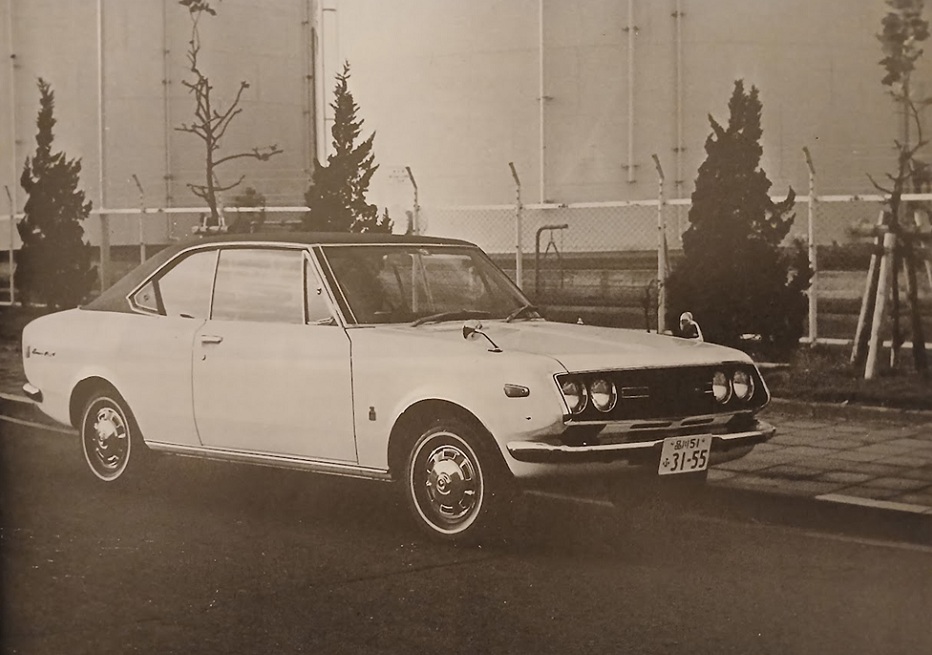
Our preference among the four available body colors was Yellow Topaz, a pale yellow with a distinctly German flavor. Unfortunately, none of the first batch delivered to Tokyo Toyopet was finished in that color, so we had no choice but to settle for White Moonstone, a rather cold fluorescent white. To make matters worse, the test car was fitted with the fashionable vinyl roof, as the photographs show. (A 12,000-yen option, and certainly not to our taste. It spoils what is otherwise the most attractive feature of the Corona Hardtop: the subtle flow of the roofline into the tail. We did later discover one advantage, however—it eliminates the need to wax the expansive roof.)
To state our conclusion at the outset, the 1900 Hardtop SL surpasses every Corona sporting model we have previously tested—the 1600GT4, GT5, and 1600S—in every respect, including performance, ride comfort, handling, accommodation, and safety. In fact, it may deserve to be called the finest passenger car Toyota has yet produced.
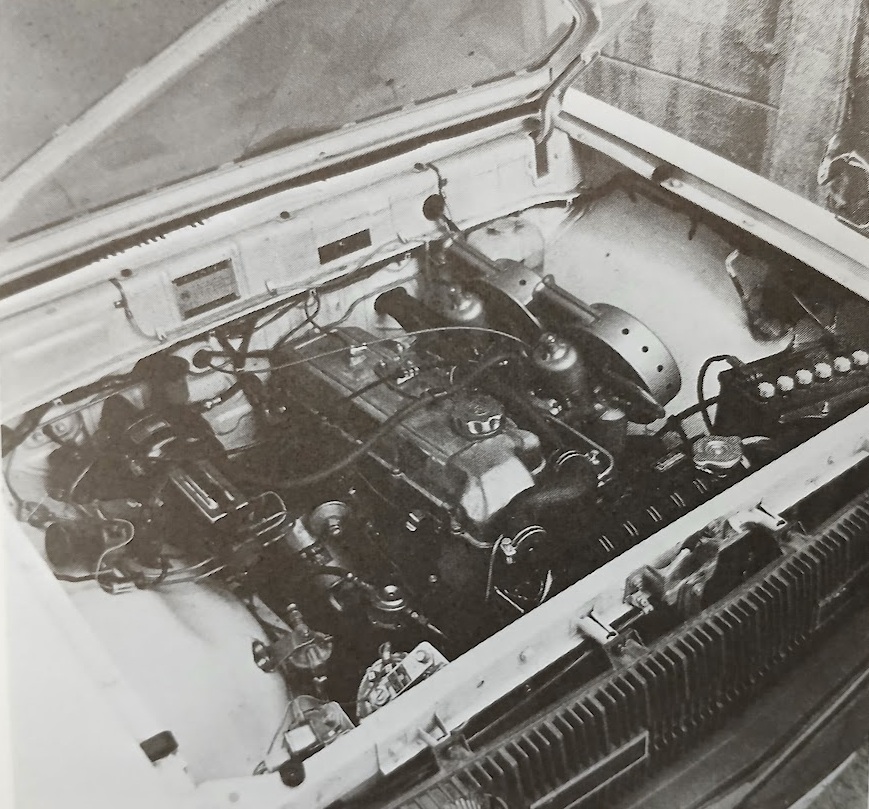
Compared with its predecessor, the Mark II Hardtop’s styling could almost be described as feminine. Once behind the wheel, however, its character proves to be decidedly masculine. Recent Toyota sporting models have become unexpectedly solid and substantial, with firmer ride quality and heavier controls, and this is especially true of the Mark II. Its new SOHC 1858cc engine (8R-B) is a longer-stroke version of the previous 1591cc 7R, and with twin SU carburetors produces 110ps/6000rpm and 15.5kgm/4000rpm. What strikes one immediately after setting off is not only the engine’s exceptional sense of power, but also how ideally the gear ratios—and their spacing—match the engine’s output and the car’s weight, making the transition from one gear to the next exceptionally smooth. Taken to the start of the red zone at 6500rpm, each gear extends easily to approximately 50, 90, and 135km/h.
The Mark II 1900SL’s performance is outstanding for a practical four-to-five-passenger car weighing one metric ton. It covered 0-400m in 17.9 seconds carrying a load almost equivalent to four occupants. At the Yatabe test course it recorded a maximum speed of 170.1km/h over the 1km course (one direction) and averaged 169.0km/h around the 5.5km circuit. From a standing start it reaches 150km/h within one kilometer and attains its maximum speed of 170km/h within two. Even then, the engine is turning only about 5900rpm—some 600rpm below the start of the red zone.
We maintained maximum speed for five consecutive laps, approximately ten minutes, during which both water temperature and oil pressure remained entirely normal, and the engine never gave the slightest impression of being strained. Directional stability at maximum speed inspired complete confidence; with only a light touch on the steering wheel, the car tracked as straight as an arrow. (Fortunately, wind conditions were favorable that day, with only a light breeze of 2-5m/sec.) The test car was fitted with Bridgestone 6.45-13 4PR low-profile tires. Starting with an inflation pressure of 2.0kg/cm², they had risen to 2.5kg/cm² after ten minutes at maximum speed. Heat buildup was very slight, but anyone intending to drive at sustained high speeds would be well advised to specify the optional 165SR-13 radial tires.
The SOHC engine and fully synchronized 4-speed gearbox are the Mark II Corona’s greatest attractions—quite the opposite of the previous OHV Corona, where they were among its least appealing features. From its 700rpm idle to a maximum of 7000rpm, the engine responds crisply to the throttle with barely a trace of vibration. One of its greatest virtues is that it develops more than 90% of its maximum torque throughout a broad range from 2000-5500rpm. Combined with its generous absolute torque, this flexibility makes the car remarkably easy to drive, allowing crowded city streets to be negotiated almost entirely in third and top gear.
The engine’s remarkable flexibility is demonstrated most clearly in its overtaking-acceleration figures. The time required to accelerate by each 20km/h increment in top gear—from 30-50km/h all the way to 90-110km/h—falls consistently between 5.5 and 5.8 seconds. Although the 1900SL is easy to drive even in city traffic, its true forte is high-speed highway cruising. Above 2000rpm, its throttle response in top gear is sharper than third gear in most 2-liter cars. At 100km/h the engine is turning approximately 3500rpm, close to the point of maximum torque, and a firm press of the accelerator provides enough acceleration to overtake a line of three buses all at once.
Throughout our 2,000km test the engine remained in excellent condition regardless of how it was treated. Cold starts on winter mornings were immediate with the choke pulled out, and the car could be driven away at once without complaint. Until it reached full operating temperature, however, it would occasionally stall at the first two or three traffic lights. Mechanical engine noise remains low even at high engine speeds, but it is unfortunate that a resonance from the exhaust system fills the cabin at around 3000-4000rpm.
The gearbox is identical to that of the 1600S, with the same gear ratios. Its shift quality ranks among the very best—not only by Toyota standards, but by any reasonable measure. Our test car initially suffered from difficult gear engagements, but this proved to be nothing more than excessive free play in the clutch pedal. Once adjusted, shifting became much lighter. The synchronizers are exceptionally effective, refusing to protest even during full-throttle gear changes.
Like the 1600GT, the clutch uses a coil-spring design. Its relatively short travel is commendable, allowing it to be operated without lifting one’s heel from the floor. Pedal effort, however, is fairly heavy, and engagement is somewhat abrupt. The throttle, too, is initially stiff as it begins to open, so smooth starts in city traffic demand rather delicate footwork—though not to the same degree as a Mini Cooper S. During racing starts the rear axle is also prone to axle tramp (violent rear-axle hop caused by the sudden application of torque), so that smooth, rapid getaways require considerable skill. One would very much like to see the addition of a torque rod like that fitted to the 1600GT.
Fuel economy is surprisingly good for a 1900cc engine equipped with twin SU carburetors. During a 500km round trip to Nagano, undertaken as part of the running-in process, the car returned 10.4km/l, the best figure we have recorded to date: Even when used for short trips in city traffic, it seldom falls below 7km/l. As of now, the overall average for the car’s total test distance of 2,061km is 8.22km/l.
The brakes are one of the Mark II 1900SL’s best features. They use servo-assisted front discs and rear drums, together with a PCV (Pressure Control Valve) in the rear hydraulic circuit to prevent premature rear-wheel lock-up. Effort is light, pedal travel is short, and braking builds progressively to tremendous effect. The PCV works remarkably well; even under emergency braking approaching 0.95g, the rear wheels never lock, and the car comes to a stop with complete stability. Nose dive is exceptionally slight.
As usual, we carried out our fade test by making ten successive 0.5g stops from 100km/h. Pedal effort increased only slightly, from 20kg to 24kg. The braking system is also divided into separate front and rear hydraulic circuits. If a fluid leak develops in either one, a warning lamp illuminates and at least half of the braking capacity is retained. The handbrake is powerful enough to stall the engine if one accidentally attempts to drive away with it applied. It is, however, still the umbrella type beneath the dashboard, making it difficult to reach when wearing the three-point seat belt.
For a car with such a conventional suspension, its handling is remarkably good. The steering requires 3.5 turns from lock to lock and uses a variable ratio, changing from 19.5:1 near the straight-ahead position to 21.5:1 near full lock. The elastic free play that has been characteristic of Toyota steering for many years has been reduced to nearly nothing in the Mark II, and the steering system as a whole feels commendably rigid. Steering effort while parking is quite heavy by today’s standards, but once under way it becomes entirely normal, and at higher speeds its moderate weight is actually welcome. The steering ratio keeps the driver’s hands a little busy in tight corners, but caster action is strong, and the wheel snaps back to center as soon as the driver’s grip is relaxed.
As one would expect from its 52.5/47.5 weight distribution even when fully laden, the handling balance is moderately understeering. Once the driver gets used to turning in with a slightly large initial steering input, response is good and the car proves surprisingly accurate. Body roll is very slight. In overall character, its handling is reminiscent of an American sports sedan. It lacks the delicacy of the more sophisticated European suspension designs, but there will be many drivers who prefer its straightforward, robust character.
On smooth roads, the Bridgestone 6.45-13 low-profile tires produce fairly strong understeer at the recommended pressure of 1.6kg/cm², and squeal easily in corners. Raising the pressure to 2.0kg/cm² greatly increases cornering power, but in corners with uneven surfaces they become prone to skipping across the road, while ride comfort also suffers. It is under such conditions that one becomes keenly aware of the limitations of a live rear axle. Wet-road grip is also less than ideal. The tread surface is quite hard, picking up cat’s-eye reflectors with a sharp kotsu-kotsu, though it copes well with railroad tracks and wander is rarely a problem.
The ride is fairly firm, but it has a reassuring sense of solidity. The suspension is clearly tuned for high-speed driving. At lower speeds it feels somewhat rough, yet becomes progressively smoother as speed increases. It is especially impressive over washboard surfaces, which it traverses with remarkable composure at speed.
Ride comfort differs considerably between the front and rear seats. Up front, the deeply contoured seats make the car exceptionally comfortable over almost any road surface. In the rear, however, vertical body motion is almost constant, even on paved roads. Rear-seat headroom is perfectly adequate in static terms, but dynamically it appears less so. On several occasions, when crossing large undulations at speed, rear-seat passengers were tossed upward and bumped their heads against the roof.
Body rigidity is exceptionally high for a pillarless hardtop, and road noise is very well isolated from the cabin.
Turning next to the interior, the Mark II feels a size larger than the previous Corona. This is reflected in its actual dimensions: the wheelbase has been increased by 90mm, overall length by 170mm, and overall width by 55mm. Externally, it is approximately the same size as the Laurel. Once inside, the impression of space is even greater. At shoulder height across the front seats, for example, the adoption of curved side glass has increased cabin width by as much as 60mm.
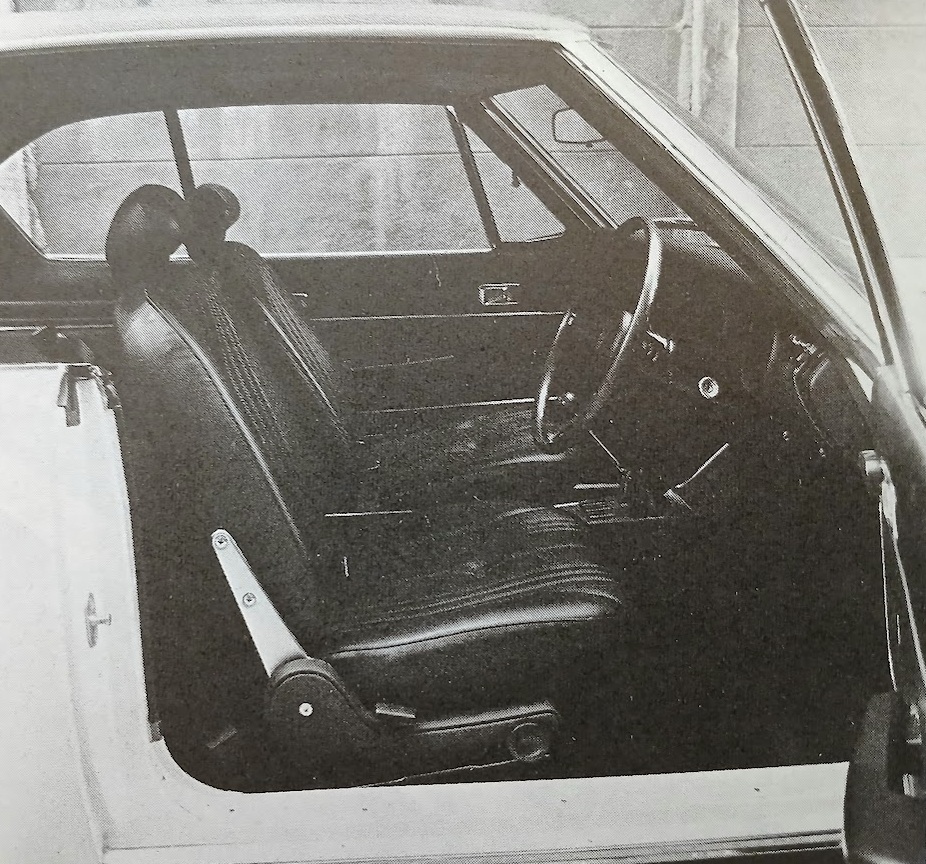
It is only recently that genuinely good seats have begun to appear in Japanese cars, and the Corona Mark II is an excellent example. Our C/G Corona is upholstered entirely in black vinyl (cloth trim is also available), but both the shape and size of the seats are close to ideal. The seats in previous Corona sporting models—particularly the 1600GT—were oddly flat and tended to position the driver unnecessarily low. Both shortcomings have been largely corrected. The cushions are thicker and more resilient, while the backrests are shaped to wrap comfortably around the torso, providing markedly improved lateral support. The slightly higher seating position greatly improves the forward view.
The seat tracks are inclined upward toward the front, and the seat itself is equipped with a mechanism that raises its front edge by approximately 20mm around a pivot at the rear. As a result, even a woman of smaller stature can adopt an entirely natural driving position.
Height-adjustable head restraints are fitted to the front seats. While this is no doubt for reasons of effectiveness, they are very hard, and are not particularly comfortable for sleeping during a journey with the backrest reclined. Three-point seat belts are fitted as standard in the front, while the rear seats are equipped with two two-point belts. The front belts are inertia-reel type, but their retractor springs are so strong that they press tightly against the abdomen, and the general opinion was that they could not be worn comfortably for long periods.
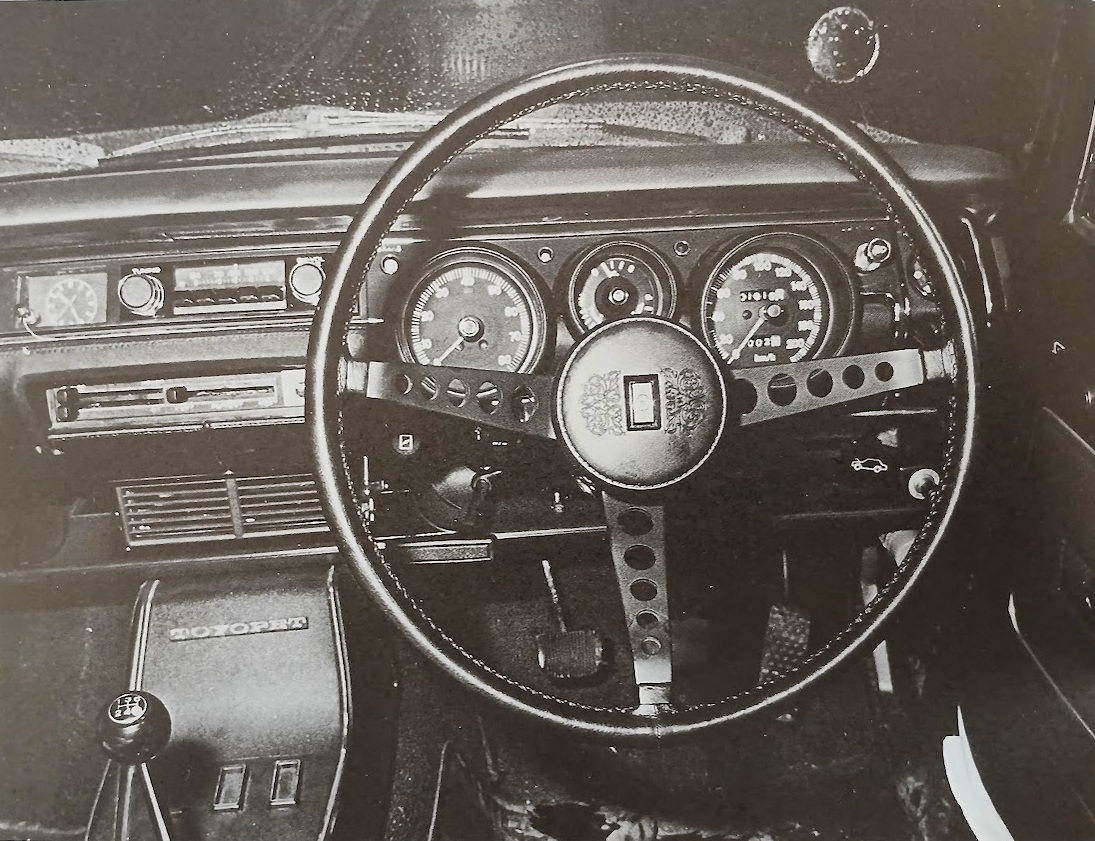
Apart from the seat height, the relative positions of the steering wheel, pedals, and gear lever differ little from those of the previous Corona 1600S, and in general they are easy to use. Unlike the 1600S, the gear lever—falling naturally to the driver’s left hand from the dished three-spoke steering wheel—is straight and sturdy. The pedal spacing remains rather wide and is less than ideally suited to heel-and-toe technique, but the pedals are positioned and angled so they can be operated with the driver’s heel remaining on the floor.
Thorough attention has been paid to interior safety. There are no dangerous exposed metal projections anywhere in the cabin. With the exception of the woodgrain steering wheel, shift knob, and center console, the interior is finished entirely in matte black. It makes a decidedly luxurious impression, and the standard of workmanship is exceptionally high.
The instrument panel differs considerably from that of the previous Corona. The tachometer and speedometer have switched positions, while fuel level, oil pressure, and water temperature are grouped in a single gauge between them. The instrument lenses (plastic, in this case) are convex to reduce reflections, and each is deeply recessed beneath a padded hood. Reflections are effectively eliminated both day and night, although the illumination (with brightness adjustable by rheostat) is a little too dim.
Some of the controls, however, have become less convenient through an almost excessive focus on safety. The headlight switch, for example, is mounted deep in the dashboard, making it difficult to reach from a natural driving position. The stalk on the right side of the steering column controls only the headlamp beam, so when stopped at an intersection it is impossible to flash the headlights without reaching across to the dashboard switch each time. The windshield wipers and washer are operated by a button on the left side of the steering column. The idea itself is sound, but the button’s position behind the steering wheel makes it awkward to use. An ideal system would be one like that of the Mazda Cosmo and Rotary Coupe, where a single control operates the wipers, washer, turn signals, and headlamps.
The combined ignition switch and steering lock is also located on the steering column for safety. However, when the key is turned to the “on” position, light entering through the windshield sometimes reflects off it in such a way that, for an instant, it looks as if a warning lamp has come on. This occurs, for example, when passing beneath the mercury-vapor lamps in a dark tunnel. This problem could easily be prevented by fitting the key with a rubber cover, as Mercedes-Benz does, or simply giving it a matte finish.
Power windows are standard equipment on the 1900 Hardtop SL, with their switches located on the center console. Power windows are certainly convenient once one gets used to them, but in an emergency they can occasionally cause a moment’s hesitation. This is especially true because they operate only when the ignition is switched on. During our 2,000km test, the fuse blew on three occasions, leaving the windows inoperative.
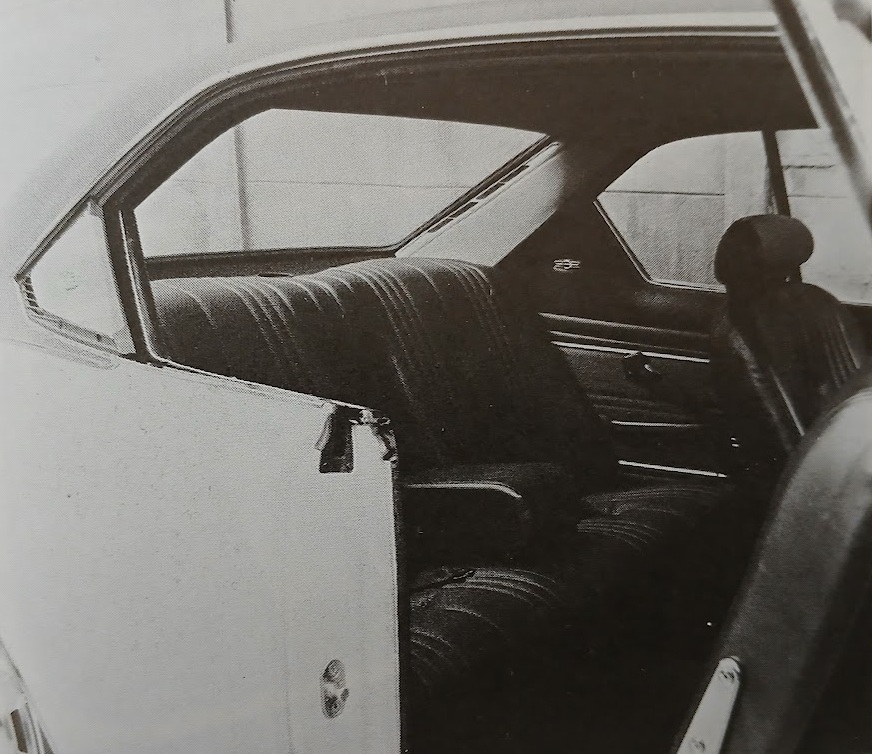
The greatest improvement in the Mark II’s interior is in rear-seat accommodation, where the 90mm increase in wheelbase is reflected directly in the amount of space. The previous Hardtop suffered from inadequate rear-seat legroom and, however generously one looked at it, was little more than a 2+2. The Mark II, by contrast, is a genuine four/five-seater. The cushions are deeper, the backrest reclines at a natural angle, and two adults can travel in complete comfort, while three can be accommodated without much inconvenience. In character, it is closer to a two-door sedan than to a coupe.
Because of the Mark II’s fashionable Coke-bottle styling, the beltline is relatively high, while the blanked-off rear-quarter panels—which also serve as air outlets—provide rear-seat passengers with a sense of privacy and security. There is a folding armrest in the center of the rear seat, and the rear-quarter panels are covered with soft padding. Even parents with two mischievous children can travel with complete peace of mind, as long as they are strapped into the standard seat belts.
The heating and ventilation system is exceptionally comprehensive. The heater, which allows either fresh-air intake or cabin recirculation, is extremely powerful and distributes warm air evenly even to the rear seat. The blower has three speeds, and on its highest setting blows like a typhoon. Temperature adjustment is responsive, and the controls are easy to operate. In summer, the same system is equally effective for providing fresh-air ventilation.
There are also four fresh-air vents, independent of the heater, located at the outer ends of the dashboard. Each is fitted with its own directional control, and they prove effective at speeds above about 40km/h. Beneath the rear window is a dedicated rear-window defogger, operated by a switch on the console. Throughout our test period we encountered rain on almost a daily basis, yet even with four people aboard, using both the front and rear defoggers kept the windows consistently clear. The ideal combination of warm feet and cool air to the face can be achieved with ease in the Mark II Corona.
Another welcome feature is the provision of numerous storage spaces throughout the cabin. The glovebox is a useful size and is fitted not only with an interior lamp but also with a power socket for an inspection lamp or similar accessory. Beneath the dashboard, a shelf in front of both the driver and passenger is large enough to hold a document case. Most useful of all is the long, narrow compartment in the center console, which is large enough for even a small camera. Behind the front seat backrests are generous map pockets that will hold several issues of Car Graphic.
In previous Coronas, the spare tire occupied the trunk floor, greatly reducing the available luggage space. In the Mark II it has been relocated to a well beneath the floor. As is typical of Toyota, the jack and tool kit are both comprehensive and of excellent quality. The inclusion of a can of touch-up paint for minor body repairs is a thoughtful touch.
Earlier Coronas required lubrication at numerous grease points throughout the suspension, but the Mark II has eliminated the need for chassis lubrication altogether.
Postscript: Story Photos