Toyota Corona Mark II Hardtop GSS (1972)
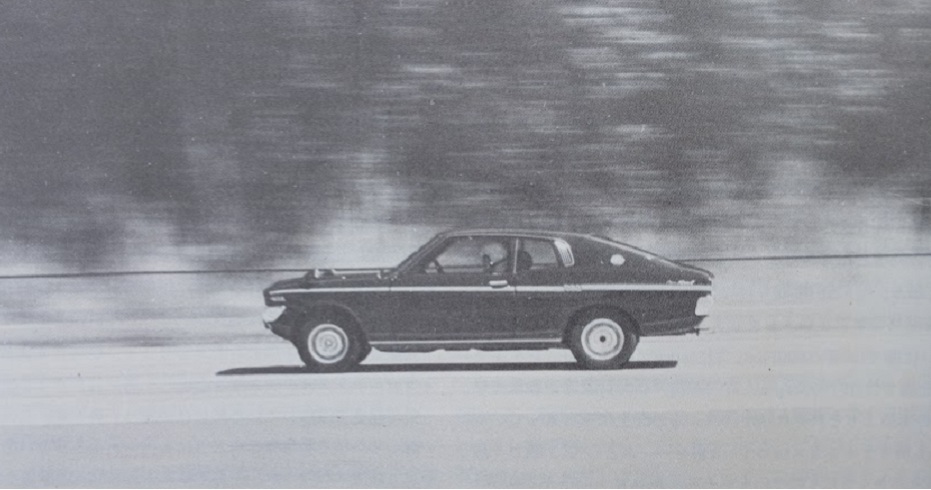
Publication: Car Graphic
Format: Road Impression
Date: June 1972
Author: “C/G Test Group” (uncredited)
Road testing the Toyota Corona Mark II Hardtop GSS
In the April issue we published a report on the Corona Mark II 2000 GSS covering brief performance measurements at the Murayama Test Course along with handling tests on the winding roads of Okutama. This time we brought the car to the Yatabe Test Course to measure its maximum speed and its standing-start acceleration over both time and distance. We also brought three other cars to Yatabe: the BMW 2002tii, Toyota Corolla Levin 1600, and Mazda Capella GS-II. As a result, four cars in the “190km/h catalog top speed” class ended up gathered there together.
Of the four, the Mark II GSS boasts the highest engine output, but at the same time it carries the handicap of pulling along the largest body and the greatest weight.
Comparing the main specifications of the GSS—the hottest version of the Mark II, powered by a DOHC four-cylinder engine—with those of the previous Mark II GSS, we find the following:
| Displacement | Output | Torque | Weight | Ps/kg | |
|---|---|---|---|---|---|
| New | 1968cc | 145ps/6400rpm | 18.0kgm/5200rpm | 1105kg | 7.62ks/ps |
| Old | 1858cc | 140ps/6400rpm | 17.0kgm/5200rpm | 1050kg | 7.50kg/ps |
As the figures show, the new model is slightly inferior to its predecessor in terms of power-to-weight ratio.
At the same time, there is little difference between the ratios of the fully synchronized 5-speed gearbox (new: 3.055–1.879–1.296–1.000–0.858; old: 3.074–1.838–1.256–1.000–0.856). Both cars’ limited-slip differentials also share the same 4.375 final-drive ratio, and tire size remains unchanged at 165HR-14 (our test car was fitted with Bridgestone Radial 20 tires). It is therefore fair to say that the overall gearing of the two models is virtually identical.
Our test car was the same high-compression (9.4:1) premium-fuel example featured in the April issue, with a catalog top speed of 195km/h. (The regular-fuel version, with its lower 8.5:1 compression ratio, produces 140ps/6400rpm and 17.2kgm/5200rpm, with a claimed top speed of 190km/h.)
The results of giving the Mark II 2000 GSS a full workout at Yatabe were, unfortunately, disappointing. Its performance fell well short of the catalog figures.
Starting with maximum speed: if each gear is taken to the 7000rpm red line, the optimistic speedometer indicates 60km/h in first, 100km/h in second, and 150km/h in third. Yet even at full throttle in direct fourth gear, the tachometer would climb no higher than 6500rpm (with the speedometer indicating 180km/h). Shifting into fifth actually produced a higher speed. In fifth, the engine briefly reached 6000rpm, and the speedometer needle climbed to 192km/h. (Since the calculated speed at 6000rpm in fifth is 177km/h, the speedometer was reading just under 10% high.)
In the end, our stopwatch measurements showed averages of only 175.18km/h over the 1km straight and 172.02km/h over the 5.5km circuit. (By comparison, the previous 1900 GSS recorded 184.70km/h over the 5.5km course in C/G’s January 1970 test.) This twin-cam engine appears to lose power once past its 6400rpm power peak, and in practice felt strongest at around 6000rpm.
By the time we got to testing the Mark II, the wind had become much stronger, reaching as much as 14m/sec. Since these figures were at the tail end of the four cars tested that day, they should perhaps be considered with some allowance for the headwind.
Standing-start acceleration was likewise the slowest of the four. The clutch slip noted in our April report had been corrected, so that handicap was no longer present. Even so, taking each of the lower three gears to 7000rpm produced best times of 0-400m in 17.0 seconds and 0-1000m in 32.0 seconds. (The previous GSS recorded 16.6 and 29.9 seconds respectively.) The passenger-car-like clutch, with its smooth engagement but rather leisurely take-up, along with the floor-mounted shift lever’s fairly long stroke, must surely have contributed to the disappointing acceleration times.
While power falls away at the top end, like many Japanese high-performance engines, low-speed performance is good. If one is so inclined, it will accelerate smoothly and confidently from just under 50km/h in fourth gear (approximately 1600rpm), or from just under 60km/h in fifth (approximately 1800rpm).
As for the handling, our impressions from the April issue were simply confirmed. The steering is reasonably precise, but heavy and busy, while the car also displays a tendency toward final oversteer that arrives relatively early. The conclusion, therefore, remains unchanged: this is not a car whose handling is well suited to fast driving on winding roads.
One further point became apparent during the test in the strong winds. Despite its considerable weight, the Mark II is not especially resistant to crosswinds. Its large body is blown noticeably off course—if not quite as suddenly as in a lighter car. To make matters worse, the Mark II’s steering is not quick enough to correct such deviations in an instant.
Finally, fuel consumption worked out to 6.37km/l during our full-throttle testing at Yatabe and in heavy traffic on National Route 6, and 6.15km/l over a combination of Route 6 and city driving in Tokyo. Premium-grade fuel was, of course, used throughout.
To put it bluntly, one could argue that there is no real need for a twin-cam GSS version in the large and heavy Mark II range. Those looking for genuine sports-car performance already have the Corolla Levin, while those wanting a little more style have the Celica GT. Nor does the Mark II have the uncompromising character of the Skyline GT-R. If its purpose is simply to compete with the SOHC Skyline GT, then the Mark II GSL—with its SOHC engine and twin SU carburetors—is surely already sufficient.
Only those who have fallen in love with the Mark II’s styling, and who cannot be satisfied unless opening the hood reveals Toyota’s crackle-finished twin-cam engine, are likely to find it worth spending 1,150,000 yen on this car.