Toyota Corona Mark II Hardtop GSS (1972)
Publication: Car Graphic
Format: Road Impression
Date: April 1972
Author: “C/G Test Group” (uncredited)
Road testing the Toyota Corona Mark II Hardtop GSS
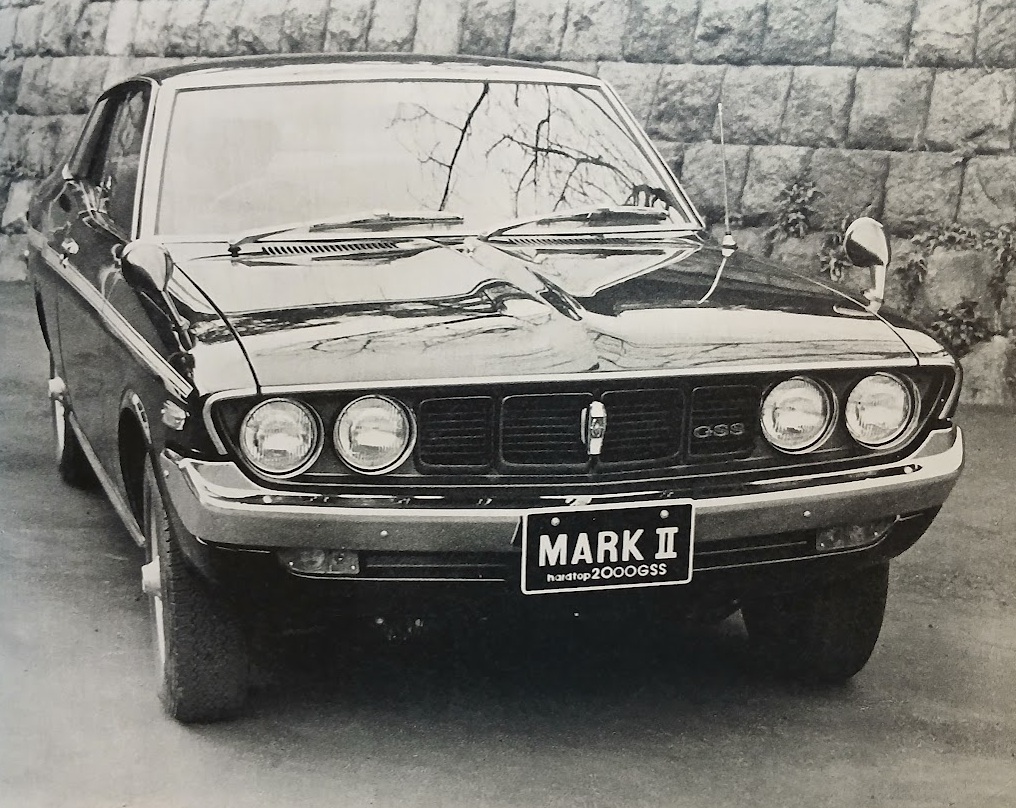
The hottest version of the Mark II lineup, the Hardtop GSS equipped with the DOHC engine and 5-speed gearbox, has grown to 1968cc as part of the full model change. The increase in output, however, is modest, rising only from the previous 140ps/6400rpm to 145ps/6400rpm. Torque, on the other hand, has increased by 1.0kgm to 18.0kgm/5200rpm. As before, this high-compression (9.4:1) version is intended for premium-grade gasoline, but a regular-fuel specification (8.5:1) has now been added to the range. Its output and torque are 140ps/6400rpm and 17.2kgm/4800rpm respectively. Our test car was the high-compression 145ps version, finished in Metallic Dark Green, one of six available body colors.
Anyone familiar with the previous GSS will immediately notice the improved feel of the new 5-speed gearbox. It is an entirely new design equipped with Porsche-type servo synchromesh. Whereas the old transmission could feel somewhat awkward in operation, the new one shifts much more smoothly. Our test car had covered only about 1,000km, so there was still a slight resistance in its action, but it should become lighter with use. The fore-and-aft movement of the gear lever is, however, longer than before.
The DOHC engine, in 1.9-liter form, has long enjoyed a reputation for being smooth and free-revving, and the new 2-liter version gives much the same impression. From its steady 700-800rpm idle, response is excellent whenever the throttle is opened. It pulls cleanly all the way to the 7000rpm redline without any noticeable resonance along the way. Low- and mid-range torque are also entirely adequate. Even in town, where speeds rarely exceed 60km/h, the engine pulls smoothly while using up to fourth gear. Fourth gear corresponds to about 1500rpm at 40km/h, yet the engine will accelerate cleanly from that speed. The clutch is by no means heavy, and even frequent use in city traffic presents no problems.
Real power, however, does not begin to arrive until around 2500rpm, and once past 3000rpm the engine suddenly comes “on the cam” with the feeling of a true sports engine.
Time constraints did not allow a longer outing this time, so we began by measuring the standing-start 0-400m acceleration at the Murayama Test Course. There, it soon became apparent that the clutch was not biting firmly enough, tending to slip whenever full power was applied. Judging from our experience with the previous GSS, this appears to have been a fault specific to our test car. In any case, because the clutch could not be fully engaged above 3000rpm, the 0-400m time fell short of expectations, recording only 17.2 seconds. C/G’s previous test of the earlier GSS recorded 16.6 seconds. Since the new 2-liter GSS has virtually the same power-to-weight ratio and slightly greater torque, it should in fact be capable of a somewhat quicker time. (Tire diameter and final-drive ratio remain unchanged, while the ratios of the new 5-speed gearbox are slightly shorter overall.)
The steering of the Mark II sports models has always been remarkably heavy by modern standards. In exchange for outstanding straight-line stability, it demands considerable effort not only at low speeds but also at high speeds. In this GSS the effect is particularly pronounced, to the extent that one wonders whether parking might be a challenge for a lady with slender arms. Moreover, the steering, which was already relatively low-geared, has had its ratio reduced still further, varying from 20.0:1-23.5:1 (compared with 19.5:1-21.5:1 previously). This should, however, be considered in light of the car’s tight 5.0m turning circle (5.4m measured to the bumpers), despite the wheelbase having been extended by 75mm to 2585mm.
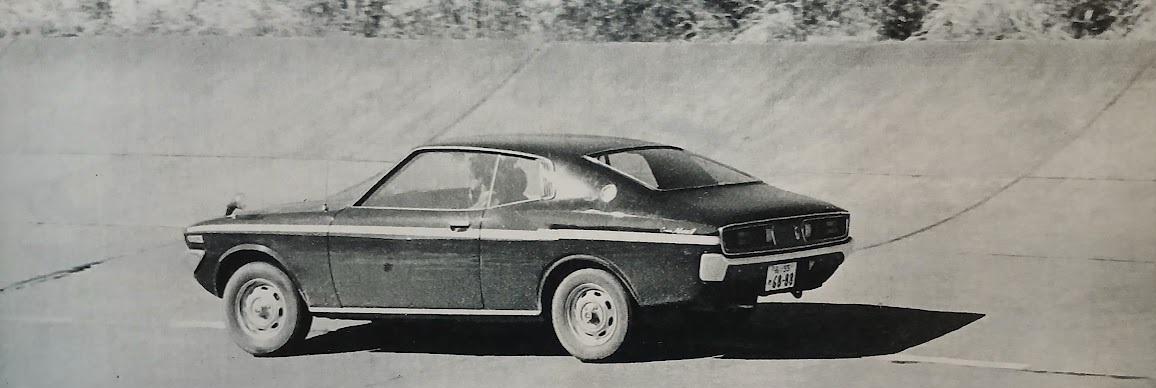
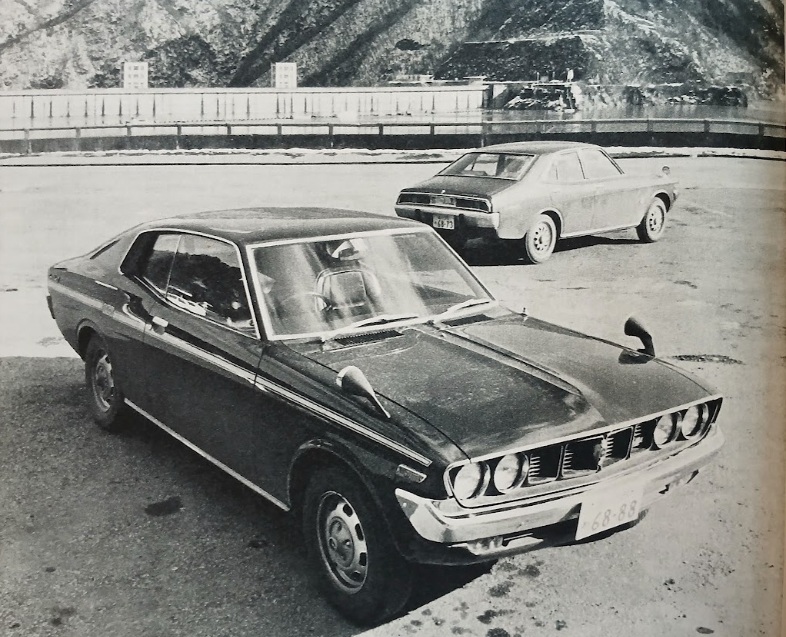
What became apparent during the skidpad testing at Murayama, and later while pressing on along the winding road to Lake Okutama, was that rear-wheel grip is remarkably poor. The rear suspension has been completely redesigned, now using essentially the same layout as the Celica and Carina, with coil springs and a four-link arrangement located by a Panhard rod. Body roll through corners is about average, yet for some reason the inside rear wheel loses grip very early, making the rear end prone to breakaway.
The GSS comes standard with a limited-slip differential, so one would expect wheelspin to be difficult to induce. Yet whether in steady-state cornering on the skidpad, or when applying power in third gear through medium-speed bends that could comfortably be taken at 60-70km/h, the tail would–to put it in rather extreme terms–suddenly slide as though the car were on ice. Needless to say, the tendency is more pronounced on wet roads, but the same basic characteristic remains, though to a lesser degree, on dry roads as well.
Initial cornering attitude is one of fairly pronounced understeer, but for the reasons already described, the car abruptly changes to oversteer before any significant cornering forces have built up. This tendency is similar to that of the Capella (in standard form with 4.5J rims and 165SR-13 tires), which uses fundamentally the same rear suspension layout, but in the GSS it is much more pronounced, and occurs at lower speeds.
Our test car was fitted with 5J rims and Bridgestone RD20 165HR-14 tires, and part of the blame must be attributed to their poor adhesion on wet surfaces. More fundamentally, however, 165-section tires are simply inadequate for a car of this weight (1,105kg) and performance potential. At the very least it deserves 175s, and ideally 185s. Among Bridgestone’s radial tires, the RD150 175HR-14 fitted as standard to the Fairlady 240Z would be our choice.
As already mentioned, the steering is exceptionally heavy. Coupled with its low overall ratio of 4.5 turns lock to lock, it becomes extremely busy when correcting a rear-end breakaway or threading a succession of high-speed S-bends. Apart from this, however, the steering system is highly rigid and accurate, transmitting road feel faithfully.
Unlike the other Mark II models, the GSS uses threaded bushes at the upper wishbone pivots. As a result, every irregularity in the road surface is faithfully transmitted through the steering, though never to a degree that becomes objectionable. Indeed, after driving the GSS, one almost feels something is lacking when returning to a car that filters out such communication.
The brakes are excellent. The front discs have been increased in diameter (from 200mm to 218mm), and the pads also appear to differ from those fitted to the other Mark II models. Pedal effort is somewhat higher, particularly when cold, but braking performance remains consistently stable. Nose dive under hard braking is very well controlled.
One further point became apparent when we drove on the Murayama rough-road course—a surface resembling a roadway paved with concrete bars 7 to 8cm high, laid at 10cm intervals—at 60km/h. Both the body structure and suspension proved exceptionally tough. Combined with generous suspension travel and well-controlled damping, the GSS would provide an outstanding basis for a rally car.
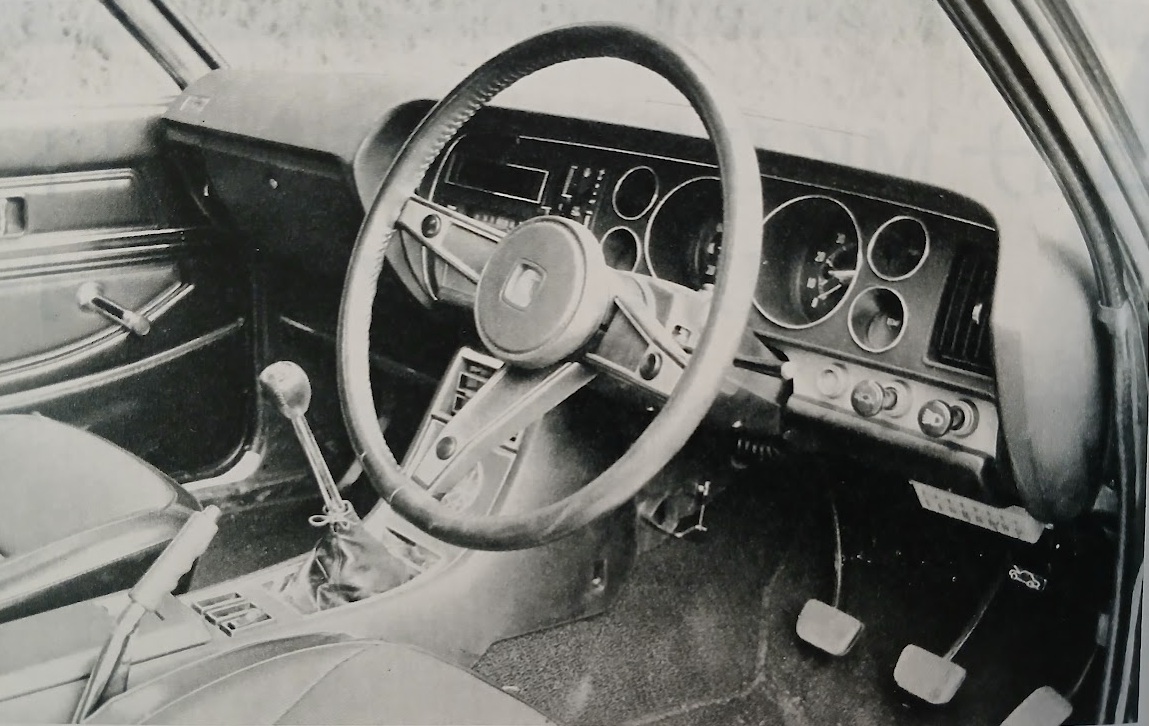
There is little space left to discuss the interior and accommodation in detail. Since the GSS already had an excellent interior layout, there was little reason for an extensive redesign, and the previous arrangement has been largely retained. One small but significant improvement is that the horn switch has been moved from the center of the steering wheel to three buttons mounted on the spokes, allowing it to be operated with the thumbs while keeping both hands on the rim.
Rear-seat legroom has been increased further, giving accommodation approaching that of a sedan. Side visibility, however, is restricted by the large rear quarter panels. The cushion over the transmission tunnel is also relatively thick, so seating three passengers in the rear presents no particular difficulty.
Fuel consumption over 345km—including one commute from the suburbs to the city, testing at Murayama, and a round trip to Lake Okutama—amounted to 48.4 liters, for an average of 7.12km/l. The fuel tank holds 60 liters. The Tokyo price is 1,050,000 yen, an increase of 72,000 yen over the previous model.
Postscript: Story Photos