Toyota Corona Mark II Hardtop GSS (1972)
Publication: Car Graphic
Format: Road Impression
Date: April 1972
Author: “C/G Test Group” (uncredited)
Road testing the Toyota Corona Mark II Hardtop GSS
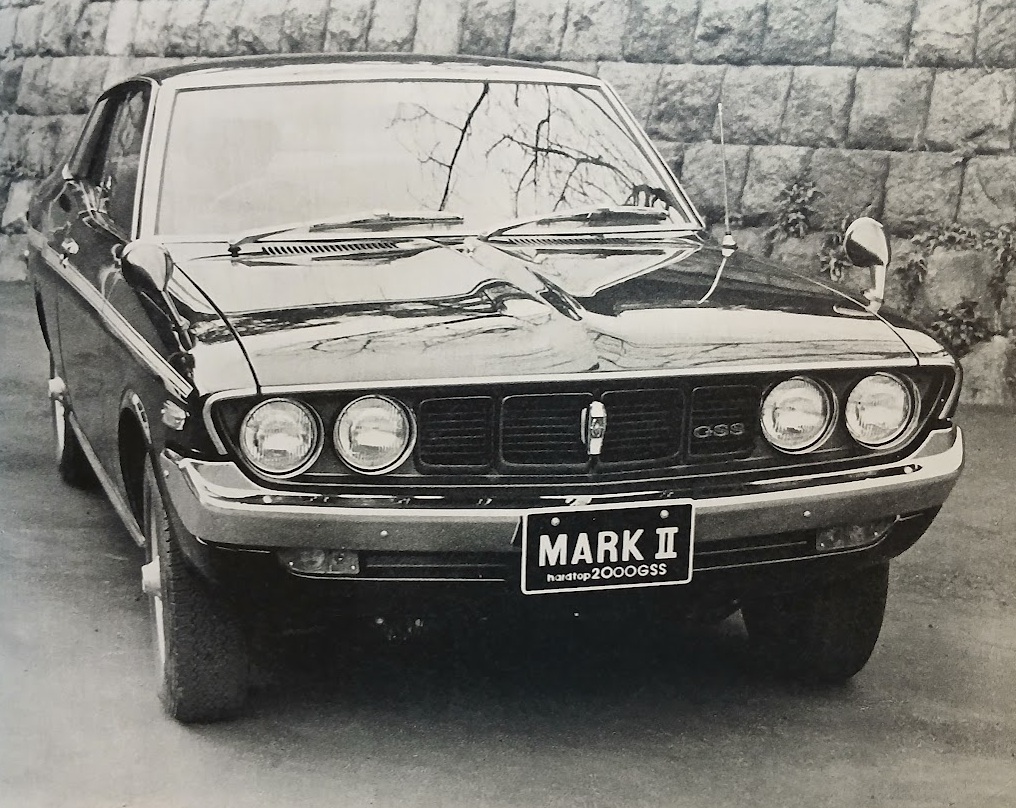
The hottest model of the new Mark II series, the GSS Hardtop with DOHC engine and 5-speed gearbox, has received an increase in engine displacement along with the rest of the series, in this case from 1858cc to 1968cc. However, the corresponding power gain is slight, from 140ps/6400rpm to 145ps/6400rpm. Torque, on the other hand, has increased a full kgm to 18.0kgm/5200rpm. As in the previous GSS, the engine is a high-compression (9.4) unit that uses high-octane fuel, but a new regular-gasoline (8.5) model is also available. Power and torque figures for the regular-gasoline model are 140ps/6400rpm and 17.2kgm/4800rpm. Our test car was the 145ps high-compression model, painted a metallic dark green, one of six colors available.
Those familiar with the previous GSS will immediately notice the improved feel of the 5-speed gearbox. This is a completely new unit equipped with Porsche-type servo synchronizers. The previous model’s shifter was a little awkward to operate, but the new model shifts much more smoothly. The test car was still a new car with about 1,000km on the odometer, so there was still some resistance in the linkage, but it should become lighter with more use. However, the lever’s forward-and-backward stroke is longer than before.
The 1.9-liter DOHC in the previous GSS was well-known for its smooth revving and powerful performance, and this 2.0-liter model makes a similar impression. From the 700-800rpm idle on up, stepping on the gas always produces excellent throttle response. It revs up to 7000rpm, where the redline begins, without any noticeable resonances throughout the range. Low- and mid-range torque are ample, allowing smooth driving at city speeds below 60km/h even in fourth gear. 40km/h in fourth gear corresponds to about 1500rpm, but it will accelerate smoothly even from this speed. The clutch is not heavy at all, so frequent use around town is not a problem. Power really starts to build from around 2500rpm, and above 3000rpm, it suddenly comes “on the cam” like a sports engine.
This time, our instrumented testing was limited to measuring 0-400m acceleration on the Murayama test course. It became immediately apparent that the test car’s clutch wasn’t biting well, and it slipped easily when full power was applied. Based on our experience with the old GSS, this was likely a malfunction specific to the test car. Since we couldn’t engage the clutch with more than 3000rpm on the tachometer, the 0-400m time was slower than expected at 17.2 seconds. The previous GSS’s time was 16.6 seconds in C/G testing, and the 2.0-liter GSS, with its only slightly inferior power-to-weight ratio and slightly higher torque, should be a bit quicker (the tire diameter and final drive are unchanged, and the new model’s 5-speed gearbox ratios are slightly shorter).
The steering of the Mark II Corona sports models up to now has been consistently heavy, with excellent straight-line stability, while also feeling quite precise at both high and low speeds. This all remains true of the new GSS, especially its heaviness, which is now at the point where parking might be a real challenge for a woman with slender arms. What’s more, the already low-geared variable steering ratio has been further slowed, if only a little, to 20.0-23.5 (compared to the previous model’s 19.5-21.5). This was likely in consideration of the tight 5.0m turning radius (5.4m including the bumpers), which is notable given the 75mm increase in wheelbase (to 2585mm).
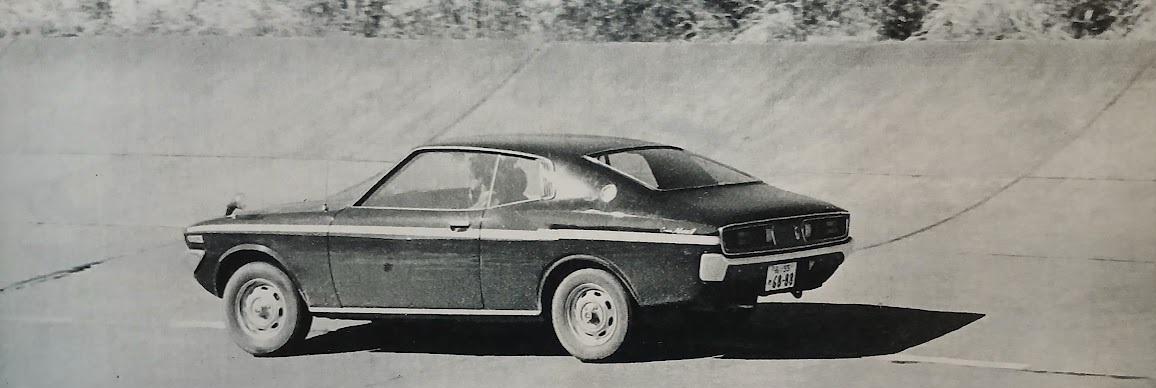
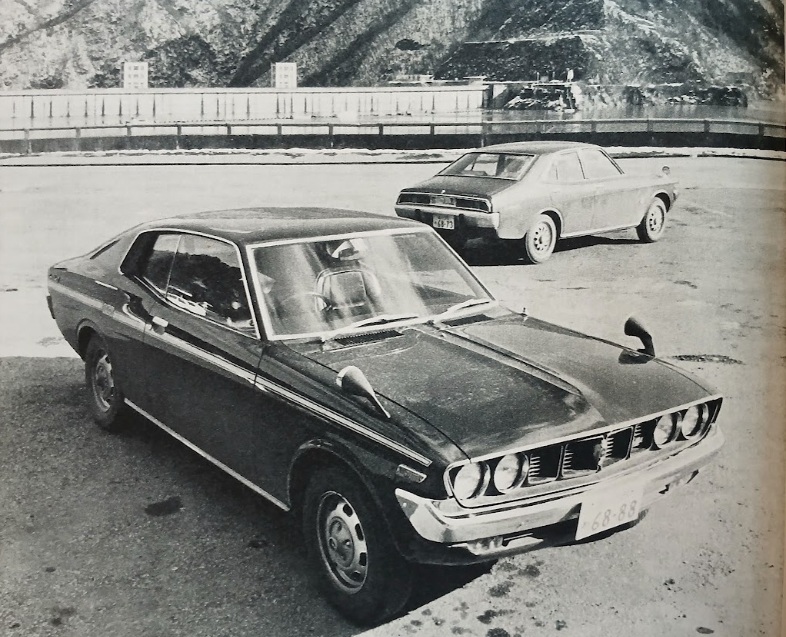
What became immediately clear during the skidpad test at Murayama, and later on the winding road to Lake Okutama, was that the GSS’s rear wheels had very little grip. The new rear suspension is a complete change from the previous leaf-sprung rigid axle layout, and is basically the same as that in the Celica and Carina, with the axle located by four links, coil springs and a Panhard rod. Roll in corners is about average, but for some reason the inside rear wheel loses grip easily, making the rear prone to early breakaway.
The GSS comes standard with a limited slip differential, so inducing wheelspin should be difficult. However, when turning steadily around a skidpad, or when applying power in third gear in the middle of a mid-speed corner at 60-70km/h, the tail slides almost as if the car were on ice, to put it in extreme terms. The sliding is obviously more severe on wet roads, but the basic tendency is the same, albeit to a lesser degree, on dry surfaces: coming into a corner, the chassis initially understeers quite strongly, but as mentioned above, changes quickly to oversteer before any significant cornering force can build up. This tendency is similar to the Capella (with standard 4.5J rims and 165SR-13 tires), which has essentially the same rear suspension layout, but breakaway is more abrupt in the GSS and occurs at a lower speed.
The test car was equipped with 5J rims and Bridgestone RD20 165HR-14 tires, and part of the blame can be placed on the tires’ poor adhesion, especially on wet roads. Furthermore, for a car of this weight (1,105kg) and performance potential, 165-width tires are insufficient; 175s at least, and ideally 185s, would be desirable. Among Bridgestone’s radials, the RD150 175HR-14 tires that come standard on the Nissan Fairlady Z are a good candidate.
As mentioned earlier, the steering is unusually heavy, and with a four-and-a-half-turn lock-to-lock ratio that keeps the driver’s hands busy, it is extremely difficult to correct rear breakaway when it occurs, or to string together a series of S-bends and exit at high speed. Aside from this, the steering system is rigid, precise, and conveys road feel accurately. Unlike other Mark II Coronas, the GSS uses threaded bushings for the upper wishbone pins. This means that road irregularities are transmitted to the hands, but not to a degree that is bothersome. After driving the GSS, we felt uneasy switching into other cars that don’t communicate as well.
The brakes are very good, with larger diameter front discs (increased from 200mm to 218mm). The pads appear to be different from those on other Mark IIs, and although the pedal pressure is heavy, especially when cold, the braking effect is always consistent and progressive. There is notably little nose dive under hard braking. A 60km/h run on Murayama’s rough-road test section (a surface with 7-8cm high concrete bars laid 10cm apart) revealed that the body and suspension are exceptionally strong. Combined with the ample wheel travel and well-damped suspension, the GSS would make an ideal basis for a rally car.
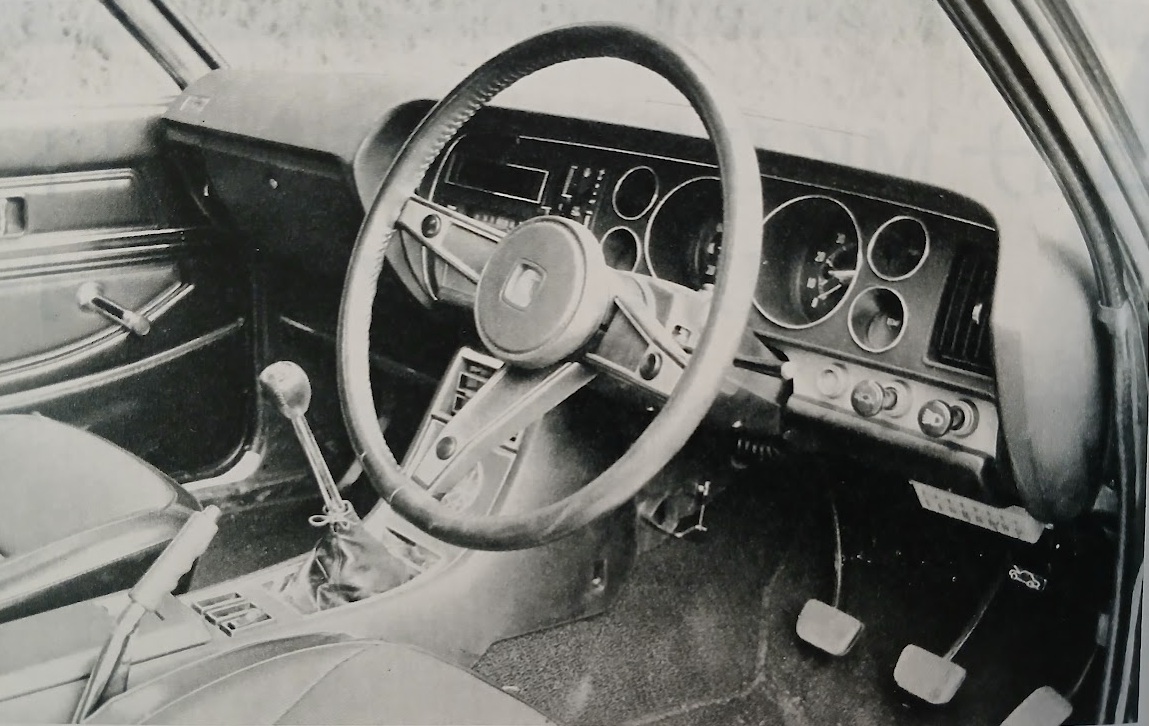
There’s little space left to go into detail about the interior and passenger comfort. An interior as well-designed as the original GSS’s didn’t need any major changes, so the layout remains largely the same. One small but important improvement is that the horn button has changed from the center pad of the steering wheel to three buttons on the spokes, allowing the driver to sound the horn with the thumbs while still holding the rim. Back-seat passengers enjoy increased legroom, which makes the rear cabin feel almost sedan-like, although visibility to the sides is limited by the large pillars. The seat cushioning over the transmission tunnel is also relatively thick, making it possible for three passengers to sit in the back without difficulty.
Fuel consumption was 48.4 liters over a distance of 345km, which included a commute from the suburbs to the city center, the Murayama test, and a round trip to Lake Okutama, for an average of 7.12km/l (the tank holds 60 liters). The price is 1.15 million yen (delivered to Tokyo), a 72,000 yen increase over the previous GSS.
Postscript: Story Photos