Toyota Corona Mark II Hardtop GSL (1973)
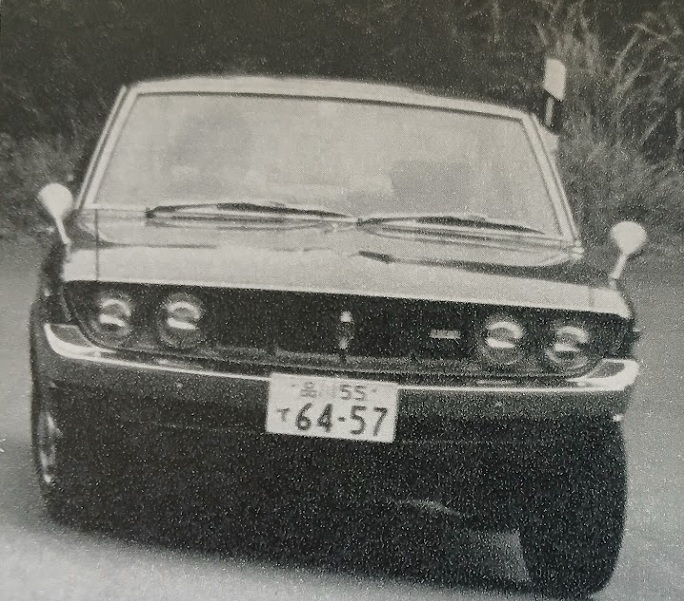
Publication: Car Graphic
Format: Road Impressions
Date: December 1973
Author: “C/G Test Group” (uncredited)
Road testing the Toyota Corona Mark II Hardtop GSL
Toyota’s upper-middle-class Corona Mark II underwent a full model change only at the end of January, but two additional variants have since joined the range. One is the six-cylinder model equipped with twin SU carburetors (Road Impression in the October issue); the other is the GSL fitted with EFI (“Electronic Fuel Injection,” a Bosch-manufactured electronically controlled fuel-injection system).
With EFI, output and torque increase from the regular-fuel GSL’s 115ps/6000rpm and 16.0kgm/4000rpm to 125ps/5600rpm and 17.0kgm/4000rpm. Even so, it seems likely that the main reason for adopting EFI was not so much the increase in power as the improvement of exhaust-emissions control.
The EFI is available in both GSL sedan and hardtop form. The engine is a 2-liter four-cylinder, paired exclusively with a floor-mounted 4-speed gearbox. It is designed to run on regular gasoline, with no premium-fuel version offered. In Tokyo, the EFI commands a premium of 51,000 yen over the standard GSL, bringing the prices to 871,000 yen for the sedan and 938,000 yen for the hardtop.
For this test we borrowed the Hardtop EFI and took it to Yatabe’s high-speed proving ground together with the Audi 100 Coupe S (reported in our November issue), where we conducted a limited series of acceleration and maximum-speed measurements.
Just as the EFI brochure promises, the engine’s starting characteristics are excellent. Under all conditions it fires immediately, and even when completely cold it settles quickly into a steady 1300rpm idle. Within only a few minutes the idle speed naturally drops to its normal 1000rpm, and the car will pull away without the slightest hesitation. This somewhat high cold-idle speed remained consistently stable throughout our test, and we never experienced the tendency—often encountered with Bosch fuel injection—for the idle speed to remain high after sustained high-speed driving.
Engine response is neither noticeably better nor worse than that of the carbureted version, but in terms of outright power the EFI clearly has the advantage. Although it fell short of its catalog top speed of 175km/h, it briefly reached an actual 172km/h (with the aid of a moderately strong tailwind). It averaged 169.8km/h over the 1km straight and 166.1km/h around the circuit—figures approaching those of the GSS we tested in the June issue (175.18km/h over the 1km straight and 172.02km/h around the circuit).
The catalog claims a 0-400m time of 17.1 seconds, better than the regular-fuel GSL Hardtop’s 17.5 seconds, but on this occasion the best we could manage was 17.75 seconds.
The engine begins to lose power once past 6000rpm, so there is little point in extending it all the way to the 6500rpm red line. For reference, the maximum speeds at 6500rpm in each gear are 52km/h in first, 91km/h in second, and 136km/h in third.
Conversely, low-speed torque proved less impressive than we had expected, with the practical minimum speed in fourth gear being well above 40km/h. The standing-start and overtaking-acceleration figures are given below.
| Acceleration (speed) | Acceleration (distance) | Overtaking | 3rd gear | 4th gear | ||
|---|---|---|---|---|---|---|
| 0 – 40km/h | 2.7s | 0 – 50m | 4.9s | 40 – 80km/h | 7.7s | 13.0s |
| 0 – 60km/h | 5.5s | 0 – 100m | 7.4s | 60 – 100km/h | 7.8s | 13.1s |
| 0 – 80km/h | 8.8s | 0 – 200m | 11.5s | 80 – 120km/h | 9.6s | 12.3s |
| 0 – 100km/h | 13.0s | 0 – 400m | 17.75s | |||
| 0 – 120km/h | 18.3s | 0 – 1000m | 32.9s | |||
| 0 – 140km/h | 27.9s | |||||
The engine is certainly among the more powerful 2-liter four-cylinders available, but the overriding impression is that of “a 10-year-old Volvo.” Simply put, it lacks much of the refinement that has come to characterize today’s European compact cars.
The variable-ratio steering feels both heavy and curiously insubstantial at low speeds, as though one were trying to grab hold of a cloud. On the expressway it provides outstanding straight-line stability, but because the car still exhibits pronounced understeer, steering effort increases steadily as cornering speeds rise. Even so, provided the driver has sufficient strength, the EFI engine’s added power allows the car to be driven along winding roads quite vigorously. High-speed cruising is another of its strong points. At 100km/h the engine is turning only 3500rpm in fourth gear, making even 140km/h entirely practical. Noise levels are by no means exceptionally low, but they change very little regardless of speed.
Nor is there much evidence of change in the controls. The clutch has a long travel and is by no means light. The brake pedal also sits too high for proper heel-and-toe operation, while the light and wiper switches remain mounted on the dashboard, as they seemingly have for ages. The driver’s power-window switch, fitted as standard equipment, occupies exactly the spot where one’s knee ought to brace the body during cornering, making accidental operation almost unavoidable. (The power windows themselves are also rather slow, and continue to coast another 2-3cm even after the switch is released.)
One particularly commendable feature of the interior is its excellent ventilation. Even with the windows fully closed, switching on the fan produces a remarkably strong flow of fresh air. The speedometer is also relatively accurate, reading only 1-2km/h above actual speed throughout the range from 30-130km/h.
Fuel consumption averaged 8.7km/l over approximately 300km of driving that included the Tomei Expressway between Tokyo and Gotemba as well as spirited running through Hakone and Izu. This was slightly worse than the accompanying Audi 100 Coupe S, which returned 8.8km/l, but the ability to run on regular gasoline can at least be counted as an economic advantage. Even so, it is doubtful that economy would be the deciding factor in choosing this EFI model from among the Mark II range.