Toyota Corolla Sprinter (1968)
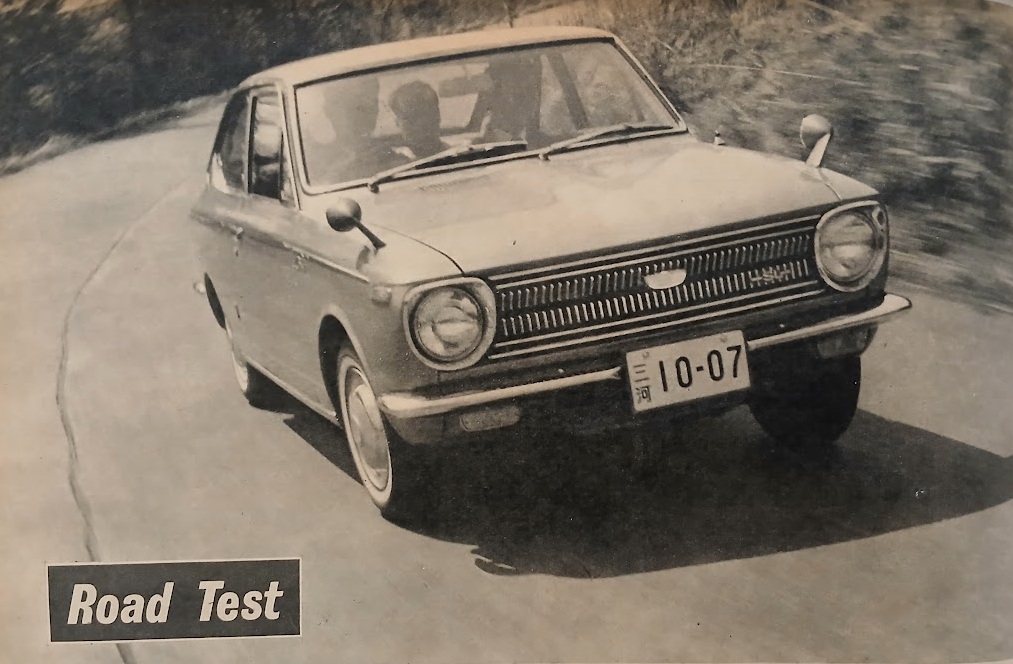
Publication: Motor Fan
Format: Road Test
Date: July 1968
Authors (Roundtable): Shiro Sasaki, Osamu Hirao, Kazuo Kumabe, Hiroshi Hoshijima, Kenji Higuchi, Kenjiro Okada, Kenzaburo Ishikawa, Kazuo Kubota, Yasuhei Oguchi, Taizo Tateishi, Akio Miyamoto, Toshihide Hirata, Minoru Onda, Junichi Okumura, Motor Fan Editorial Staff (uncredited)
Aiming for a Middle Ground Between Sedan and Sports Car
Magazine: First, could you tell us about the aims behind the Corolla Sprinter?
Sasaki: The Corolla sedan was launched in the autumn of 1966, so it has now been about a year and a half since its introduction. Initially it was offered only as a two-door, but since then we’ve expanded the lineup with four-door versions, torque-converter automatic equipped models, and vans, steadily broadening the range.
This spring, we also carried out improvements to the sedan line with a focus on safety, and added items such as a column shift and vibration-damping rubber for the shift lever. In addition to these refinements, we have now introduced a new variation in the Corolla family: the Sprinter.
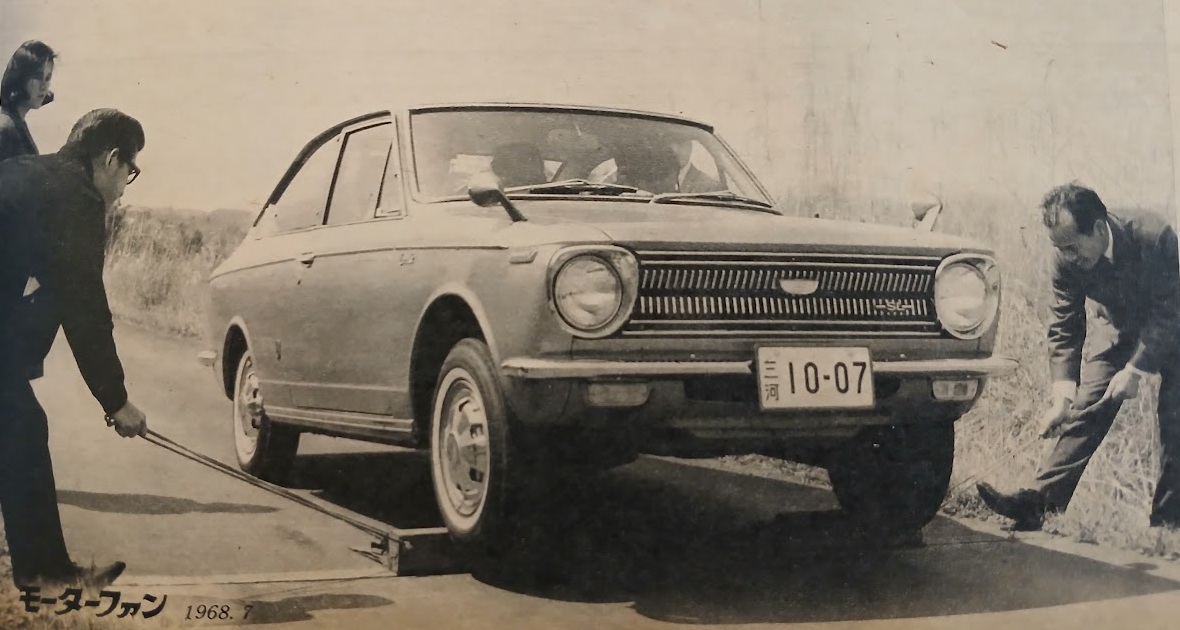
This model is essentially the same as the one shown at last year’s Tokyo Motor Show. If the current Corolla sedan can be described as a semi-fastback, then this is a full fastback. It has what one might call a coupe-style silhouette, although we do not regard it as a coupe. Rather, we intend it to be used the same way as a four-passenger sedan.
For that reason, overall height has been reduced by 35mm compared to the sedan, but by lowering the seating position we have ensured adequate headroom. In particular, we have taken care not to compromise rear seat comfort, and have maintained a full five-passenger layout.
The car tested here was equipped with a floor shift, but as with the sedans, the production Sprinter will also be available with a column shift, as well as torque converter versions.
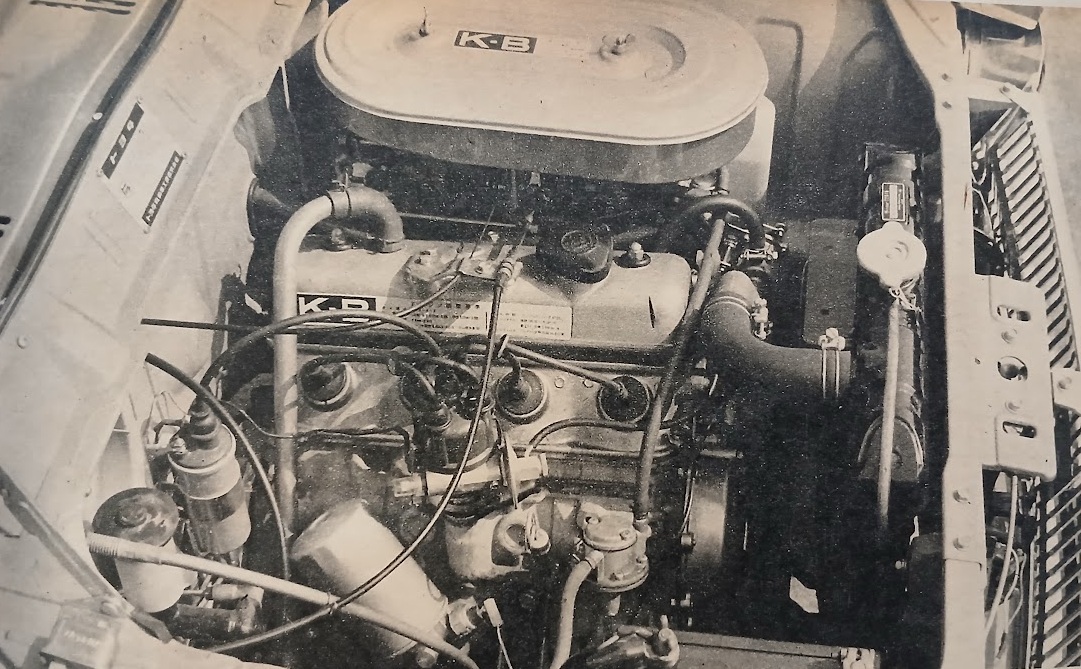
The test car is the SL specification. SL stands for “Sporty and Luxury.” In this version, the engine is based on the existing K-type unit, but has been revised with twin carburetors and a dual exhaust system, raising output to 73ps and top speed to 160km/h.
Front disc brakes are fitted, and a tachometer is included as standard equipment.
Looking at global trends, we believe that sporty cars are becoming increasingly popular. However, true sports cars are expensive and tend to have limited practical use. If, instead, one were to create something positioned between a sedan and a sports car–in other words, a sporty interpretation of a sedan–it should be possible to keep costs down. We also expect this kind of market to continue growing.
With that in mind, what we have created in the Corolla series is this Sprinter SL.
A Fastback Intended to Be Enjoyed by a Wide Range of Users
Magazine: This car drew a lot of attention at last autumn’s Motor Show as well. There’s even a view that this fastback body is actually the original Corolla design, and that the Corolla sedan is a derivative of it–in other words, that this form existed from the beginning…
Sasaki: I don’t think it’s correct to say that the Sprinter was the original. At the design stage, we explored a variety of body shapes, and this fastback was certainly one of them. There was considerable internal discussion at the time, but in terms of a mass-market car intended for a broad range of users, we questioned whether a pure fastback would really be appropriate. In the end, we adopted the semi-fastback form that was announced two years ago.
That said, the Sprinter concept itself already existed at that time.
Magazine: By adopting a fastback shape, are there any functional disadvantages, such as reduced trunk space or poorer visibility?
Sasaki: When speaking of coupes in the strict sense, this usually refers to a 2+2 layout with reduced dimensions. However, the Sprinter is not a coupe; it is intended to function as a sedan. Our thinking is that this is not a second car, but a primary car for everyday use.
For that reason, we have taken care to ensure rear seat comfort. If you look at the dimensions, you will see that it can comfortably accommodate two adults in the rear.
Hirao: So compared to the standard Corolla, the rear seat has been compromised, but only slightly?
Sasaki: Yes, that’s right. The rear seat has been moved slightly forward.
Kumabe: With this kind of styling, how is aerodynamic performance? It should be better than the standard model, shouldn’t it?
Sasaki: We can’t say precisely, but I believe drag has been reduced by around 5%. The sedan has a top speed of 140km/h, whereas the standard Sprinter, with the same engine, reaches 145km/h–an increase of 5km/h. I think this reflects the reduced air resistance. In addition, the windshield angle has been made slightly steeper.
Magazine: By how much?
Sasaki: The lower edge of the glass remains in the same position, but the roofline has been lowered by about 30mm…
Problem Areas Still Concentrated Toward the Rear of the Body
Magazine: From a styling standpoint, in terms of what most people would call “attractive,” the general opinion seems to be that this Sprinter is better-looking than the sedan…
Hoshijima: Well, there’s been talk of a so-called “coupe boom,” but as was mentioned earlier, this Sprinter isn’t a coupe in the usual sense–it doesn’t have folding rear seats or a continuous space between the rear seat and luggage compartment. In that sense, it’s simply a sedan with this kind of body style. I think that’s probably the best way to understand it.
Magazine: In that case, maybe the better-looking model is the only one anyone will want?
Hirao: No, compared with the Corolla sedan, the Sprinter does make things a little tighter in the rear seat.
Higuchi: In America, cars like this were called “coupes” about 15 years ago. From a body-style classification standpoint, I suppose this is a coupe. But what is called a coupe in Japan today tends to mean a sporty car with practically no usable rear seating. If you interpret the Sprinter in that modern Japanese sense, then it is not a coupe.
Hirao: So if the Sprinter sells better, then even if the standard sedan sells less, that would still be acceptable, wouldn’t it? (laughs)
Hoshijima: The type of design where the rear seat and trunk are connected is disliked by quite a few users, because it allows luggage to be seen from the outside. There’s also the theft prevention aspect.
Hirao: But from a safety point of view, even if there is a partition there, it’s basically like cardboard. I don’t think it makes much difference in terms of safety whether it exists or not.
In fact, I once saw a frontal collision test where tools and the spare tire from the trunk broke through the partition and flew into the passenger compartment. It made me realize that tools really have to be secured properly.
Hoshijima: This car carries the fuel tank behind the rear seat, doesn’t it? So if you try to make it into a “Japanese-style coupe,” the position of the tank becomes an issue.
Sasaki: Without a partition behind the rear shelf of the rear seat, luggage from the trunk could come forward, so I think a barrier is necessary for occupant safety. In addition, the location of the Corolla’s fuel tank is actually a very safe one in the event of a rear-end collision, as it helps prevent fuel leakage.
Hirao: Another point–this is slightly different–is that I think portable plastic fuel containers are quite dangerous as well.
In a rear-end collision, they will almost certainly catch fire. And in that case, I suspect the partition would actually allow the fire to spread into the cabin.
An Engine Designed from Extensive Customer Requirements
Magazine: At the Motor Show, this car was displayed as the Corolla Fastback, wasn’t it? So where does the name “Sprinter” come from?
Sasaki: There isn’t any particularly elaborate reason. We simply chose the name “Sprinter” from the image of a car that runs with a good, sharp response.
Okada: Perhaps it also carries the meaning of “running faster,” which is the ultimate objective of a car.
Magazine: Normally, a tuned engine is expected to gain about 20% more power, but this is a production engine that achieves more than a 20% increase over the base unit. What accounts for that?
Ishikawa: There are many so-called “street-tuned” cars that are not necessarily built for racing, but are simply tuned for spirited driving in urban use. I wonder how far those actually go in terms of modification.
Sasaki: As far as what is done through the dealer network, there appear to be various modifications, but I’m not familiar with the details.
Basically, the SL version uses the K-B type engine, but with a higher compression ratio and increased maximum engine speed. It also uses twin carburetors and a dual exhaust system, among other changes. Through these measures, the overall performance level has been raised.
Ishikawa: It certainly feels more usable than many privately tuned street cars.
Hoshijima: Of course, when it comes to cars prepared for racing, it seems there are versions of the Corolla with outputs in the 90-100ps range or even higher.
Hirao: But in exchange, low-speed drivability is completely sacrificed, so they cannot really be used in normal traffic.
Ishikawa: This one can still run comfortably even at around 20km/h.
Sasaki: I would say 20km/h is probably about the lower limit, but it does cover quite a broad range of low-speed operation.
Okada: Ideally, we would prefer that such low-speed operation is not necessary at all.
From the beginning, the SL engine program had extremely ambitious objectives. Based on the Corolla’s K-type engine, the aim was to achieve performance that would be unmatched in its class, while also ensuring reliability and durability. At the same time, it had to be a sporty car that anyone could drive without difficulty, and it also had to be inexpensive. We believe we have, to a considerable extent, met those goals.
The carburetors are twin units, derived in part from the standard K-type system but modified. The cylinder head and intake manifold have also been redesigned to allow as much air as possible to be drawn in, with the objective of increasing output through improved breathing efficiency.
Kubota: What kind of fuel does it use?
Okada: High-octane fuel. The compression ratio is 10:1.
Struggling with Air Cleaner Noise
Magazine: Can you really get this much of a power increase just by raising the compression ratio and going to twin carburetors?
Hirao: Or maybe it just means the original K-type engine was tuned on the conservative side.
Sasaki: That’s right. It’s already been about a year and a half since its release, and during that time we’ve been able to raise the technical potential of the engine. In addition, the performance of the K-type engine was originally announced on the conservative side…
Hirao: So in other words, it wasn’t exactly “overstated,” then. (laughs)
Hoshijima: Along with the power increase, there also seem to be noticeable differences in vibration and noise characteristics. I don’t have any data, but it feels different.
Okada: The maximum engine speed has also been raised by about 600rpm…
The area where we had the most difficulty in terms of noise was the air cleaner. When you connect the two carburetors, you end up with separate ducts on both sides, and depending on their placement, you can get swirl effects that reduce efficiency.
We would ideally like to position the ducts in the optimal location, but packaging constraints made that difficult. In the end, we draw air from a single point toward the front, and then split it via ducts to both carburetors.
The resulting sound quality may be somewhat different from the standard K-type engine, but in terms of overall noise level, we don’t think it is especially loud.
Hirao: At higher engine speeds, it does seem a bit noisy–I tried pulling it in first gear all the way to the start of the red zone at 6500rpm.
Magazine: Just increasing the peak power speed by 600rpm already results in a noticeable gain in performance, doesn’t it?
Okada: As I mentioned earlier, the carburetors are conventional downdraft types, but by using two of them and redesigning the air cleaner and intake manifold to reduce intake resistance, we believe we have achieved a significant improvement.
Hirao: If maximum torque is shifted higher and engine speed is increased by about 10%, power goes up by roughly 20%. And since torque itself has also increased by about 10%, that makes sense.
Okada: The camshaft was also repeatedly prototyped, including valve timing and profile, with the aim of covering everything from low to high engine speeds. We eventually arrived at the current configuration.
In that sense, compared with the K-type engine, peak torque occurs at a higher engine speed, but overall torque is higher across the range. We also deliberately aimed to keep as much low-end torque as possible.
Adequate Margin in Crankshaft Strength
Magazine: With the increase in engine speed, were components such as the clutch and crankshaft also revised?
Okada: The crankshaft itself has not changed much. As I mentioned earlier, this kind of variation was already anticipated in the original design stage, so there is sufficient margin in crankshaft strength and rigidity. In other words, increasing engine speed and the resulting rise in inertial forces do not create any particular problems.
However, the main bearings do become more heavily loaded at higher speeds, so we have changed from conventional lead Babbitt metal to Kelmet (a copper-lead sintered alloy). In addition, a lead overlay plating is applied to improve initial running-in characteristics.
As for the clutch, since engine torque has increased, we have strengthened the clutch springs to raise its torque capacity.
Higuchi: In the specification sheet, I notice that the fuel consumption per horsepower-hour drops quite significantly around 3000rpm.
That’s roughly the speed range used in normal driving. So I assume that by fitting twin carburetors and increasing power output, there must have been considerable concern about fuel consumption.
Okada: With a higher compression ratio, in theory, fuel efficiency should improve. In addition, a single carburetor system always involves compromises–it must satisfy both low-speed and high-speed operation at the same time, which makes tuning difficult.
With the twin-carburetor setup, special care was taken particularly in the transition from the slow-speed circuit to the main circuit.
Higuchi: Even with two carburetors, they’re still linked together, aren’t they? I had assumed they might be functioning more independently…
Okada: If you look at the intake manifold, you will see that they are connected by a balance tube. We carried out a considerable amount of prototyping on the position and dimensions of this tube, and in the end we settled on the current diameter and location. That also plays an important role in the overall behavior.
Higuchi: What about actual fuel consumption in service?
Sasaki: With the K-type engine equipped with a single carburetor, we achieve about 22km/l at an average speed of 51km/h. With this SL engine, the figure is about 21km/l. In both cases, the engine is running at around 2500rpm.
So if the car is operated mainly in the 2500-3000rpm range, fuel consumption remains quite favorable.
Somewhat Heavy Accelerator Pedal Feel
Hirao: Was the accelerator pedal made as heavy as it is deliberately? Or is it simply because of the twin carburetors?
Hoshijima: I don’t think that’s the reason. Even in cars like the Toyota 1600GT, the pedal feels heavier than you would normally expect. It may be that a slightly heavier feel is being considered desirable.
Hirao: I get that impression as well.
Sasaki: It’s not only the accelerator–we have been studying the weight of various control systems as a whole. However, this is not intended to be a full-fledged high-speed sports engine, so we did not set out to make it especially heavy. That said, with twin carburetors, the number of return springs is nearly doubled, so compared with a single-carburetor system, it does end up being somewhat heavier.
Hirao: In that case, I think the accelerator should still be made a bit lighter. I’d very much like to see further efforts in that direction.
When it’s this heavy, I feel it negatively affects the sense of acceleration.
Hoshijima: It also gives the impression that engine response is not quite as sharp as it should be.
Sasaki: When we drove it on the Meishin Expressway ourselves, we did not feel it was particularly heavy…
This is not meant as an excuse, but in a small car there are many constraints. In order to improve comfort around the footwell, the dashboard must be moved forward. Because of limitations in wheelbase and overall width, we are inevitably forced to make compromises around the pedal layout and wheel housing area. Under those conditions, we cannot increase the pedal leverage ratio very much.
Hirao: A shorter pedal stroke, however, is one factor that can improve the sensation of acceleration.
But heaviness is clearly a negative factor. So if you want better acceleration feel, I think you should shorten the stroke, and at the same time make the effort to reduce the load appropriately.
Ishikawa: In our measurements, the accelerator pedal effort is about 2.5kg at full acceleration, and around 1kg when cruising steadily at 50km/h. So in reality, it is not particularly heavy. I suspect that compared with the car you drove earlier today, Professor Hirao, there may have been some variation in feel.
Okada: In normal driving, it is roughly the same as the Corolla. It only becomes slightly heavier when the pedal is pressed fully during acceleration.
Acceleration You Can Feel Clearly
Magazine: Now then, please present the performance test data from Professor Hirao’s laboratory.
Oguchi: First, regarding standing-start acceleration–the test conditions were a load of three occupants plus instruments, totaling 184kg. The odometer reading of the test vehicle was 8,500km.
In terms of distance versus time, it recorded 0-50m in 4.5 seconds, 0-100m in 7.1 seconds, 0-200m in 11.0 seconds, and 0-400m in 17.5 seconds.
In terms of speed versus time, 0-60km/h took 5.2 seconds, 0-80km/h was 8.2 seconds, 0-100km/h was 11.6 seconds, and 0-120km/h took 18.6 seconds. By around the 400m mark, the speed is approximately 120km/h.
For overtaking acceleration, tests were conducted from 30km/h in third gear and 40km/h in top gear. Although the initial response felt slightly subdued for this class of vehicle, we conducted the tests using the same method for comparison with previous models.
From 30km/h in third gear, it took 6.4 seconds to reach 60km/h and 14.6 seconds to reach 100km/h. From 40km/h in top gear, it took 6.2 seconds to reach 60km/h and 19.4 seconds to reach 100km/h.
Magazine: It clearly has very strong acceleration. What was your impression when driving it, particularly in relation to the accelerator feel?
Hirao: I didn’t feel it was particularly sharp. The accelerator is simply a bit too heavy.
Oguchi: On the test course, however, it is very good. You can feel the difference clearly while driving.
What do the certification test results show?
Sasaki: For 0–400m, with five occupants, the result was 18.1 seconds. In our internal testing, with two occupants, it was 17.5 seconds.
Kubota: How does it compare with other cars?
Oguchi: The Corolla sedan records 19.4 seconds for 0–400m, so there is about a 2-second difference. A 2-second gain over 400m is a very significant improvement. Generally speaking, if a car can do 0-50m in under 5 seconds, it is considered to have strong initial acceleration. This car does it in 4.5 seconds, so its launch performance is outstanding.
One reason for this may be that the driver conducting the test was very skilled and had a strong understanding of the car’s characteristics–particularly in terms of shift timing, how to raise engine speed, and especially how to manage engine speed at launch in relation to carburetor behavior. The driver gradually increased engine speed, waited until combustion stabilized, and then accelerated decisively, producing an excellent launch.
Magazine: Earlier there was some discussion about noise. We see rubber has been used in the shift lever assembly. Does that have an effect?
Sasaki: This is not limited to the Sprinter; all Corolla models use rubber elements here. The aim is to prevent transmission gear noise and shift-related sliding noise from being transmitted into the cabin.
Magazine: Does it make a noticeable difference?
Sasaki: In terms of noise transmitted into the cabin, there is a fairly clear difference.
Hirao: I think it’s quite effective. The stiffness you feel when you grip the lever, and the vibration transmitted through it, both have a significant influence on the quality of the shift feel.
Vibrations and Noise Levels Essentially the Same as the Sedan
Magazine: Now, please present the vibration and noise measurement results from the Watari Research Laboratory.
Tateishi: In the vibration test over the obstacle plate, the sprung-mass natural frequency at the front was 1.4cps, and the unsprung mass 13.4cps. At the rear, the sprung-mass frequency was 1.3cps and the unsprung mass 12.0cps.
Next, regarding noise. Interior noise was measured in top gear from 40km/h up to 120km/h. The results were 63 phons at 40km/h, 67 phons at 60km/h, 71 phons at 80km/h, 75 phons at 100km/h, and 79 phons at 120km/h.
Exterior noise was measured in accordance with the JIS method, under two conditions: steady running at 50km/h in second gear, and acceleration from 50km/h in second gear. Testing was conducted on a dry asphalt surface at the Murayama test course, with background noise at 52 phons. The results were an average of 71.5 phons for steady running, and 87 phons for acceleration.
Compared with the Corolla sedan, the sprung-mass vibration frequency is about 0.1 cps lower, but in terms of ride comfort there is no real difference.
Interior noise is slightly higher–by about 1 phon in the lower-frequency range. This may be due to the 10% increase in engine output and corresponding rise in engine speed.
As for exterior noise, Toyota’s traditional approach is to let sound escape outward, and the result here is 87 phons. For this class, I would say it’s a more or less acceptable figure.
Magazine: Is the spring stiffness the same as the sedan?
Sasaki: Yes, exactly the same as the sedan. The tires are also identical.
Since vehicle weight is also almost the same, it is natural that the values are identical to the Corolla. However, 87 phons of exterior noise does seem somewhat high. Our internal data is in the 70-80 phon range.
Magazine: In terms of interior noise, is this on the high side for a sedan?
Tateishi: To summarize, I think it is a good result. In the so-called “standard zone” for passenger cars, it runs slightly below the midpoint and rises in a fairly straight line.
Hoshijima: Of course, for a given vehicle speed, the engine rpm is exactly the same as the Corolla since the gear ratios and everything else are identical. The only difference is a slightly higher compression ratio.
Hirao: Is the muffler the same?
Okada: Yes, it is the same. However, the front exhaust assembly is a dual system. On the Corolla, the section before the pre-muffler is a single pipe, so in that sense there is a difference, but the muffler itself has not been changed.
No Particular Concern with Crosswinds
Hirao: One more point is that, because of the carburetor change, the sound coming from the carburetors themselves has also changed.
Okada: Yes, that’s correct. The air cleaner also functions to some extent as a silencer, but as I mentioned earlier, there are constraints related to installation layout as well as performance requirements, so I think the sound quality itself has changed.
Hoshijima: The Corolla is very easy to recognize in places like underground parking garages. It has a very distinctive sound.
Hirao: Or perhaps it’s more a matter of sound quality. Even Mercedes cars tend to have relatively high exterior noise levels. Or maybe it feels that way because the interior is so quiet.
Tateishi: In Tokyo, there seems to be a move toward tightening exterior noise regulations to the same level as the UK. If noise levels are too high, it could become an issue.
Hirao: Still, as long as trucks and buses are running around, it’s probably no problem (laughs).
Tateishi: According to Tokyo’s measurement data, only about 30% of trucks and buses actually pass the JIS noise standards.
Magazine: The steering and suspension systems are also the same as the Corolla, correct? But since this is now a fastback, how is its sensitivity to crosswinds?
Hirao: Small cars are generally somewhat vulnerable to crosswinds, but I wonder about the Sprinter. If anything, it might be one of the more weaker ones (laughs).
Sasaki: I don’t think crosswinds are really a major issue.
Shortly after launch, I went to Canada, where I drove it at fairly high speeds. Compared with foreign 1100cc and 1200cc class cars, I didn’t find it to be particularly unstable.
Very Easy Gear Changes
Hirao: Generally, with the center of gravity biased a bit to the rear, I’d expect it not to be too bad. Is it any different from the sedan in that respect?
Sasaki: The center of gravity relevant to crosswind sensitivity is a little different, but in the Sprinter’s case, it’s a bit further rearward.
Hirao: In that case, it should be a bit better than the sedan, especially since the roof is lower.
Hoshijima: The thing I noticed most was that, perhaps because the clutch spring is stronger, gear changes are much easier compared with the Corolla.
Sasaki: For the clutch, we have widened the engagement range compared with previous units. I think that may be contributing to that feeling.
Hoshijima: Another thing that was very good is the brakes. It’s not just that the front has been changed from drums to discs–they are simply much better overall. The previous setup felt similar to the Publica’s, and for the Corolla’s level of performance, it was frankly a bit inadequate.
Sasaki: As you say, the previous drum brakes were the same size as those on the Publica, but that does not necessarily mean braking performance was poor. In simple terms, the actual stopping distances weren’t very different. However, the way the brakes responded–the relationship between pedal force and deceleration, the initial bite, and the build-up of braking force–was not as strong as in the Publica.
In short, because the vehicle is heavier, the initial rise in braking force was not as sharp. That is part of it. Also, for reasons we are not entirely sure of, the current Corolla’s drum brakes respond somewhat more like disc brakes…
Higuchi: I think it’s really a matter of feel, similar to the accelerator pedal we discussed earlier. It isn’t a matter of, “at what g do you stop from how many km/h.”
Carefully Studied Brake Distribution
Magazine: Since we’re on the subject of brakes, let’s look at the data measured by the Funaken Institute…
Ishikawa: Starting with vehicle weight, with spare tire, tools, and a nearly empty fuel tank, it came to 725kg. The distribution is 195kg at the front left wheel, 216kg at the front right, 161kg at the rear left, and 153kg at the rear right, giving a front-to-rear weight distribution of 56.7% to 43.3%. This does not change when one or two occupants are in the front seats. With five occupants, it becomes slightly heavier at the rear, but not to the extent of the Corolla, at roughly 49.5% to 50.5%.
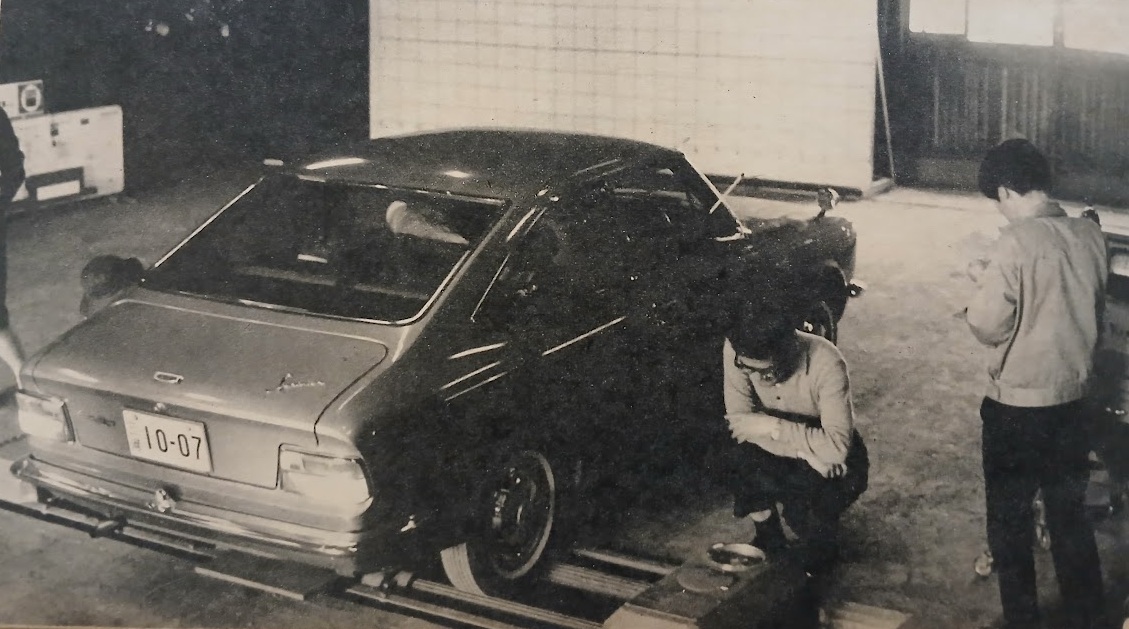
As for wheel alignment, since the suspension itself has not changed, measurements taken with a side-slip tester are identical to the Corolla. The front wheels have a fairly significant amount of toe-in and camber. The rear wheels are nearly vertical, and both ends show side slip during forward motion.
When reversing, the front wheels generate slip on the outer side. There is no significant difference between a single-occupant load and the full load condition with five occupants.
Regarding the brakes, the front uses discs, while the rear uses a leading-trailing drum system. There is no servo assistance. The disc brakes are a Bendix single-piston type. The pedal spring constant related to braking feel is almost the same as the Corolla, although overall brake effort is slightly higher. The initial pedal force required is also slightly higher, at around 1kg. This is typical for disc brakes. Pedal travel at this point is about 15mm.
In bench testing, the pedal force required to achieve 0.6g deceleration is 28kg. However, in actual driving with four occupants, braking from around 50km/h, the pedal force for 0.6g is closer to 20kg–noticeably lighter than the test bench figure.
Brake force distribution is heavily front-biased at initial application, but around 0.6g it stabilizes at roughly 60:40 front to rear, so it is not particularly front-heavy. As expected with disc brakes, almost no left-right imbalance was observed.
Hirao: With this kind of distribution, doesn’t rear-wheel lock become a concern? To give a general example, on a gentle downhill with a slippery surface, if you apply light braking around 0.2-0.3g to control speed, rear lock can occur quite easily. Has that been taken into account?
Sasaki: As designed, the brake distribution is set at approximately 65% front. Of course, road conditions will affect this, but we have given considerable internal attention to brake balance. As mentioned earlier regarding weight distribution, the front seats are positioned almost at the center of the wheelbase. Therefore, even with one or two occupants in the front, the longitudinal weight distribution of passengers does not shift significantly.
Rear Visibility Not Inferior to a Sedan
Magazine: How was the feel of the discs in low-speed braking?
Miyamoto: The braking feel was very good. They did not lock up, and the modulation is smooth and pleasant.
Ishikawa: In actual use, pedal effort for 0.6g deceleration is around 20kg, so it is quite light. And there is no sudden, unexpected “bite” where the brakes grab abruptly.
Miyamoto: Is the brake hydraulic system dual-circuit?
Sasaki: No, it isn’t. For export models to the United States, we adopt a dual-circuit system to comply with safety regulations, but not on this domestic version.
Miyamoto: With expressways such as the Tomei and Chuo now open in Japan, it would be better if such systems were introduced on domestic models first.
Ishikawa: Next is the parking brake. At 0.2g, the operating force in reverse is 18kg, so it is very effective. As for control efforts: gear shifting requires about 1-2kg for each gear; the clutch requires 9kg to disengage and 6kg to engage. The accelerator pedal has a stroke of 37mm, with a full-throttle effort of 4.5kg, about 2.5kg under acceleration, and 1kg at a steady 50km/h.
Other operating forces are as follows: door release, 2.5kg; window operation 1kg; quarter window 1.5-2kg; seat slide lock release 2kg; and recliner lock release 3kg. The parking brake lever, when fully applied with 40kg of effort, travels about 170mm, which is somewhat long.
Magazine: How about visibility?
Hirata: We used a wide-angle fisheye lens for measurement. In this test, the height from the ground to the eyepoint was 115cm with the seat slid fully forward, and 114.5cm with the seat fully rearward.
As usual, measurements were taken from the driver’s eyepoint. The horizontal distance from the windshield to the lens cap at the eyepoint was 45cm in the forward seat position and 60cm in the rearward position, with the seatback recline set at one notch, representing a normal driving posture.
The visible range through the front window was 102-88° horizontally, and 24-20° vertically. The rear window range was 53-59° horizontally, and 11-13° vertically. The wiper sweep angle was 76-65°.
The total blind area in the horizontal plane, including the eyepoint, was 55-59°, of which 21-16° is toward the front.
These values are slightly larger than the Corolla, likely due to the lower seating position. Expressed in solid angles, the front window accounts for 0.57-0.44 steradians, and the wiper sweep covers 0.38-0.28 steradians, meaning roughly 67-64% of the area is cleared.
Rear visibility via the interior mirror is very wide. With the left edge of the mirror aligned to the left edge of the rear window, about 76% of the rear window area can be seen.
Because the rearview mirror lies directly in the line of sight, the dead angle may be slightly larger than ideal.
Magazine: Has rear visibility been somewhat worsened by the fastback design?
Hirata: No, not really. However, compared with the Corolla, the visible range in the vertical field of view has shifted slightly.
Hirao: Does that mean visibility to distant objects has improved?
Hirata: Yes, that’s right.
Magazine: It seems you had to overcome some difficulty with rear visibility in this design.
Sasaki: Once you adopt a fastback-style body, even if you enlarge the window as much as possible, rear visibility inevitably becomes worse. In addition, the roof is lower and the seat position is also lower, so conditions are inherently less favorable.
For that reason, we put considerable effort into ensuring that the ground area visible through the lower edge of the rear window begins as close to the vehicle as possible. For a car of this type, I believe rear visibility is actually quite good.
Some Compromise in Rear Seat Dimensions
Magazine: Now, please present the dimensional measurement results.
Onda: In terms of the exterior, most dimensions influenced by styling–such as height, window proportions, and the inclination of the front and rear glass–are not significantly different from the Corolla.
In the end, however, because the overall height has been reduced and the rear section made more constricted, there has been a degree of compromise in interior space. Compared to the Corolla, with the same external size, the area available for occupants has been reduced by about 100mm. This applies to the front seats as well, but the effect is particularly noticeable in the rear seats.
It gives the impression that, in choosing a car, one is effectively deciding between styling appeal and rear legroom.
Another point is that when the front seatback is reclined, it lines up with the rear seatback, forming a continuous surface.
As for reach from the driver’s seat, the dashboard has been moved about 20-30mm closer than in the sedan, and the steering wheel has also been slightly brought forward.
Magazine: How did the seats feel?
Hoshijima: I felt that the seat cushion length was slightly shorter than in the Corolla, although I understand the actual dimensions are the same. The seat shape itself is improved. The sides of the seatback have been given more pronounced bolstering, and the center section uses what appears to be foam-backed vinyl leather–which I think would be quite comfortable in summer.
Magazine: How about pedal layout and instrumentation?
Hoshijima: The pedal layout is good–there is adequate foot space on the left side. The gauges are also easy to read.
Another thing I liked was the wood-grain steering wheel. It really doesn’t look like synthetic resin at all, and there are no visible seams.
Magazine: The shift knob and dashboard fascia use the same material, correct?
Higuchi: Yes. However, I personally felt the dashboard could be made to look a little more like real wood.
Tateishi: The Century made extensive use of real wood, so at first we assumed this car was using genuine wood as well… (laughs).
Ishikawa: Some enthusiasts will say, “Wait, so it’s just wood-grain pattern?” and be a bit disappointed (laughs).
Sasaki: For mass production, real wood would be quite expensive, so I think wood-grain finish is about the limit in this case.
Hirao: Actually, this might be better–it doesn’t warp or change over time like real wood (laughs).
Careful Attention to Safety in Small Details
Higuchi: With real wood, there’s also the matter of how it conducts heat when you grip it–in that sense, it’s very nice. In any case, this car seems to have a fairly refined character.
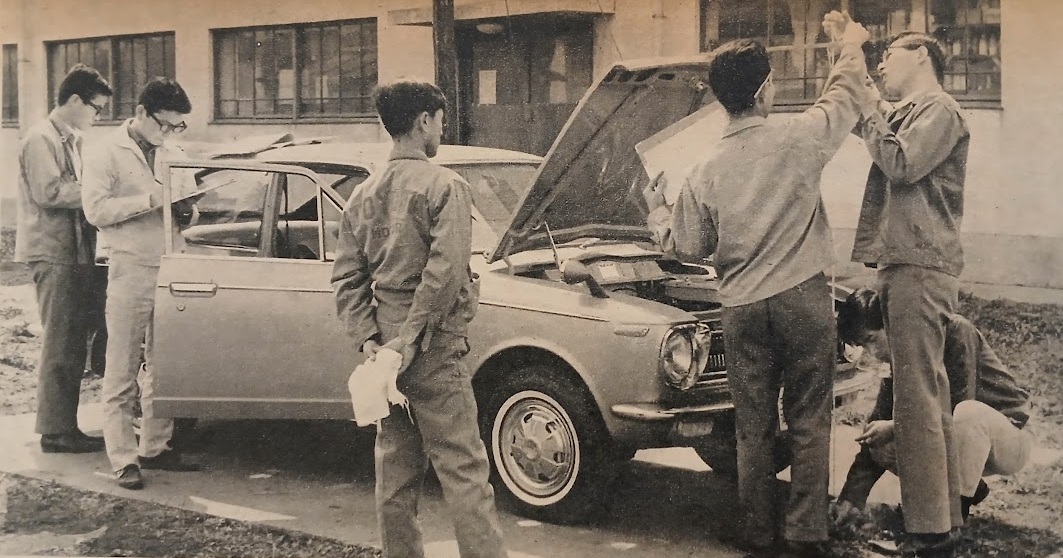
Next, regarding safety and maintenance: I understand quite a lot of work was done on safety, and as expected, compared with the previous Corolla tests, it has improved in various areas.
That said, with a two-point seat belt, there is still the issue that in sudden braking the head can strike the dashboard. For a small car in particular, this must have been a difficult point. I see that a sort of extended hood-like pad has been added to the top of the dashboard. I imagine a fair amount of testing went into that solution. In practice, this kind of approach should produce good results.
In smaller details as well, ideas have been adopted that were first seen in models like the Crown and Corona–such as making the rearview mirror detach in an impact, recessing the interior door handles, and designing switches and knobs to be soft and set deep into the surface. All of this attention to secondary safety seems quite thorough, and overall the safety level appears to have been raised.
Sasaki: In terms of head impact protection, we believe the safety pad is sufficient. Of course, that does reduce the numerical interior dimensions listed in the catalog, but the priority here has been safety.
We’ve also taken care with safety in a number of other areas. One example is the fuse system. Compared with before, the number of circuits has been increased, and the headlights have been split left and right. That way, even if a fuse blows, you don’t lose all forward illumination at once.
Hirao: How about the durability of that fuse box?
Sasaki: On that point, as with the Corolla, the fuse box is mounted under the instrument panel inside the cabin, so it’s not exposed to water. We consider its durability more than adequate.
Strong Expectations for Exports
Higuchi: On maintenance as well, after the initial 1,000km service, inspections are essentially carried out at 5,000km intervals. Oil changes every 5,000km; items like filters, fan belts, and the distributor at 10,000km; and then a major service at 30,000km.
At 30,000km, in typical use, that’s already more than two years of driving, so in practice most users will probably sell the car before ever reaching that level of maintenance.
Miyamoto: There are hand grips for the rear seat passengers, but it might also be useful to have one for the front passenger seat as well–maybe integrated into the crash pad section of the dashboard.
Magazine: Finally, we understand that the Sprinter is being developed with exports very much in mind. Could you tell us about the production and export plans?
Okumura: We’re starting production at around 3,000-4,000 units per month, and plan to bring that up to 6,000-7,000 units by the end of the year.
As for exports, the exact ratio is hard to say at this point. The Corolla alone is already being exported at a rate of about 2,000 units per month.
Magazine: From a sales standpoint, which do you think will sell better, the Corolla sedan or the Sprinter?
Okumura: The current Corolla is selling around 12,000-13,000 units per month. Against that, the Sprinter is planned at roughly 5,000-6,000 units, so I would expect about half.
That said, it’s still hard to say how things will develop going forward.
Magazine: The test car was finished in a bright metallic blue color; a rather unusual tone, almost in line with current “psychedelic” fashion trends.
Okumura: Until now, metallic finishes weren’t used in this class, but since this model is positioned slightly higher than the Corolla, we decided to introduce them. There are two metallic color variations.
Magazine: What colors sell best overall?
Okumura: For the current Corolla, about 50% are white, 20% red, and the remaining colors make up about 30%.
Magazine: With that, we’ll conclude here. Thank you very much.
Postscript: Story Photos