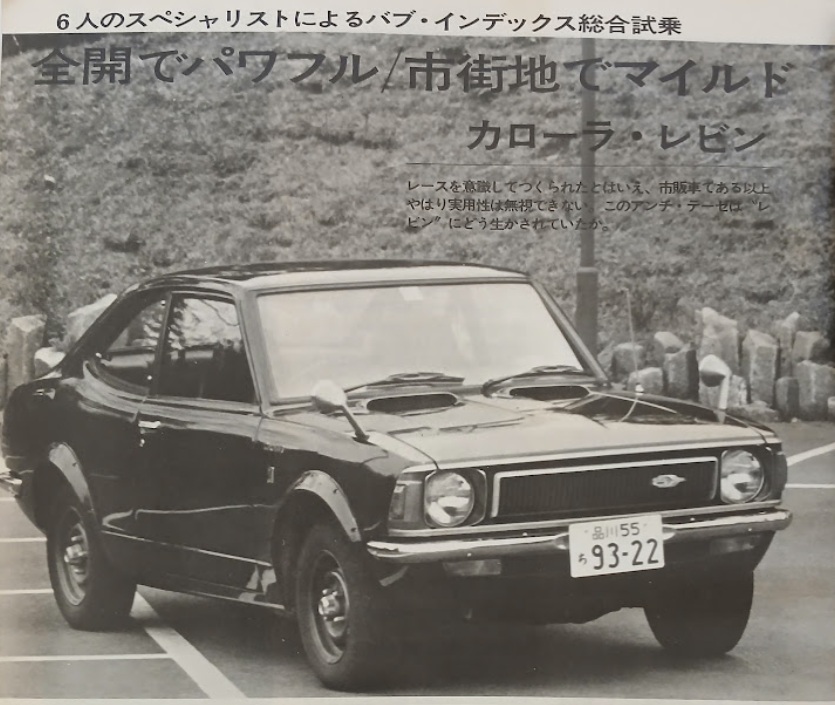
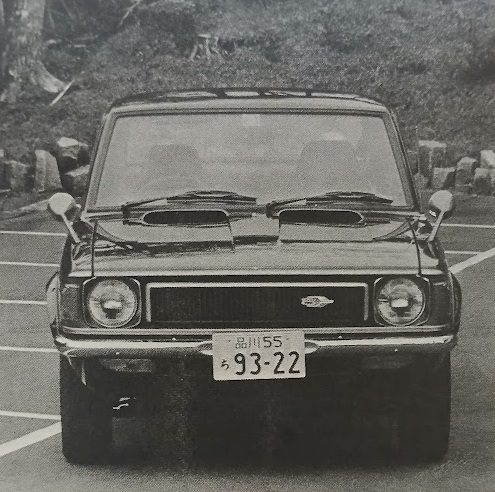
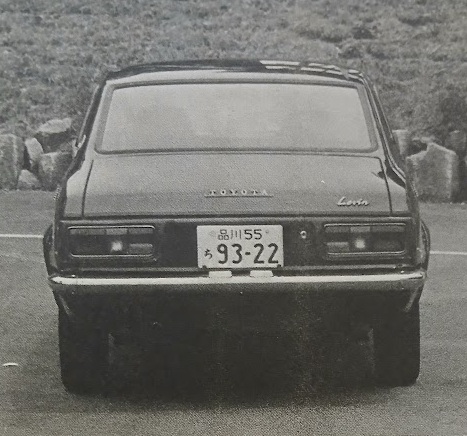
Toyota Corolla Levin (1972)
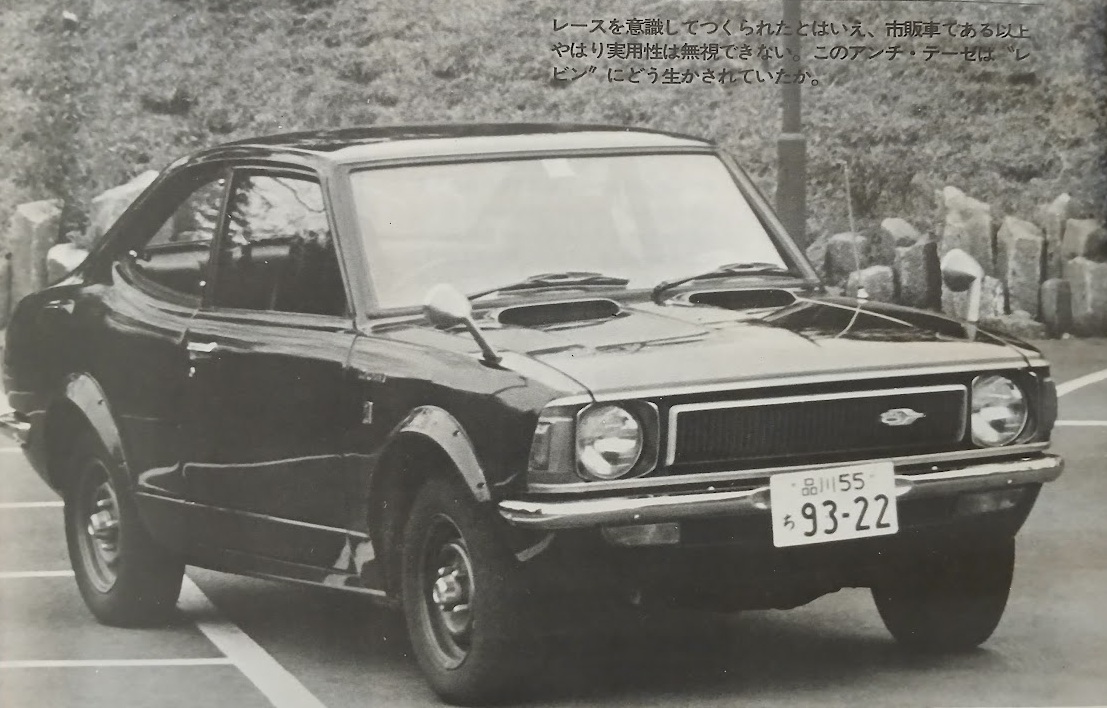
Publication: Motor Fan
Format: “Bubble Index” Road Test
Date: July 1972
Author: Osamu Mochizuki, Katsuzo Kageyama, Shigeki Asaoka, Yasuhei Oguchi, Reiko Ikuuchi, Kensuke Ishizu, Motor Fan Editorial Staff (uncredited)
Powerful at Full Throttle, Yet Mild Around Town
Though it may be designed with competition in mind, the Levin is still a production car, and practicality cannot simply be ignored. How successfully does the Levin reconcile these seemingly opposing demands?
Difficult Questions of Evaluation
Toyota introduced the Corolla Levin and Sprinter Trueno on March 14, both powered by the 115ps, 1600cc DOHC 2T-G engine.
Needless to say, this is the same engine used in the highest-performance version of the Celica and Carina, the GT. Maximum output is rated at 115ps in all applications, though it is produced at 6000rpm in the Celica and Carina and at 6400rpm in the Levin and Trueno. Peak torque is identical at 14.5kgm/5200rpm.
Equipped with this 2T-G engine, this month’s test car–the Levin–is a decidedly hot model, with a claimed top speed of 190km/h and a 0-400m time of 16.3 seconds with five occupants aboard. Given its limited production target of 500 units per month and the pairing of this engine with the Corolla body shell, it seems clear that competition use was very much on Toyota’s mind when the car was developed.
As a result, the six specialists approached this month’s test with an unusual degree of anticipation. It is not often that a car this overtly performance-oriented appears in these pages.
As always, the test group departed from our usual base–the Fantasy Drive-In near the Tomei Expressway’s Tokyo IC–and followed the usual route: Tokyo IC, Gotemba IC, Otome Pass, the Hakone Turnpike, back through Otome Pass, and then onto the Tomei for the return run to Tokyo.
The post-drive discussion revealed a curious split in opinion regarding the Levin. Not that one participant praised it while another condemned it. Rather, each specialist found themselves arriving at two very different conclusions depending on the standpoint from which the car was judged.
Take Asaoka, for example:
“It’s difficult to evaluate. If one judges it as a car for motorsport, it deserves full marks. If one judges it as an ordinary touring car, the verdict is almost the exact opposite.”
The Levin’s character proved distinctive enough to spark considerable debate. Should it be evaluated according to the same standards applied to ordinary passenger cars, or should it be judged in light of its intended purpose as a competition-oriented machine?
For that reason, the reports that follow do not attempt to impose a single common standard. Instead, each specialist presents their assessment from their own perspective.
Perhaps because it was conceived with competition in mind, every control is heavy–the steering, brakes, clutch, and even the accelerator pedal. When driven flat out, however, the car is consistently lively and forceful. In the hill-climb test it recorded a time of 39.2 seconds, establishing a new record for this series and surpassing the previous best of 40.7 seconds set by the Fairlady Z-L.
On the other hand, torque in the 2000-3000rpm range is surprisingly modest, and low-speed response is not especially strong. To be sure, it remains superior to that of an ordinary sedan, but not by the margin one might expect.
Taken as a whole, the Levin can perhaps best be summarized this way: powerful when driven at full throttle, yet surprisingly mild in everyday city traffic.
For a fuller picture, we invite readers to continue on to the individual reports from each of our six specialists.
Performance: A Tame Panther (Osamu Mochizuki)
A car with a personality as distinctive as the Levin’s is not easy to evaluate. Change the point of view, and the verdict can change dramatically.
According to Toyota’s press materials, the Levin and Trueno are high-performance versions of the Corolla and Sprinter, powered by the 1600cc DOHC 2T-G engine. Planned production is just 500 units per month. Judging from those numbers alone, it seems fair to conclude that Toyota has aimed the car at a limited group of enthusiasts whose primary interest is spirited driving.
A 1600cc, 115ps engine installed in a lightweight body originally designed for the 1200cc class ought to evoke more than the familiar image of a “wolf in sheep’s clothing.” Something closer to a panther would seem appropriate. Yet this particular panther proves surprisingly docile and easy to handle.
Looking solely at the numbers, the Levin’s performance is beyond reproach. It sprints from 0-100km/h in well under 11 seconds, and continues on to around 170km/h with impressive urgency. In other words, whenever the throttle is held wide open, the car feels thoroughly alive. Its power-to-weight ratio of 7.4kg/ps is put to full use.
Once attention shifts to its mid-range characteristics, however, the more subdued side of its personality begins to emerge.
A glance at the torque curve reveals a pronounced drop-off below 3000rpm.
Whether that trait is interpreted as easy drivability or as a lack of responsiveness becomes the central question in assessing the car. The effect is most noticeable in the ranges of 40-55km/h in third gear and 50-80km/h in fourth–precisely the speeds most frequently encountered in everyday city driving.
There is no question that the Levin is dramatically quicker than an ordinary family sedan. Yet neither does it deliver the sort of overwhelming surge of acceleration one might expect from its specifications.
The 2T-G engine has long enjoyed a reputation for combining high output with exceptional smoothness. In the context of a genuine high-performance machine, however, that very smoothness seems to rob it of a certain degree of excitement.
Steering effort is heavy–comparable to that of a racing car. The clutch pedal requires considerable force, and the brakes demand a firm push before they deliver their full effect. The suspension, too, has been stiffened to a degree that approaches the practical limits for a road-going car.
The result is a sports model with a decidedly Spartan character. Yet despite its weighty controls and firm chassis, its responses and handling remain surprisingly mild.
Young enthusiasts interested in serious sporting driving are unlikely to be troubled by the heaviness or stiffness. If anything, I suspect they would welcome it. Even so, speaking purely from my own perspective, I cannot help feeling that the Levin might have benefited from a little more sharpness in its responses–a little more spice to bring out its full flavor.
“The racing crowd and their admirers will be thrilled by the engine’s hot-blooded character; middle-aged drivers will be stunned by the firmness of the suspension.” — Kageyama
“It reminded me of the kind of acceleration that cars used to have a few years ago.” — Oguchi
Handling and Stability: Suspension Tuning Pays Dividends (Katsuzo Kageyama)
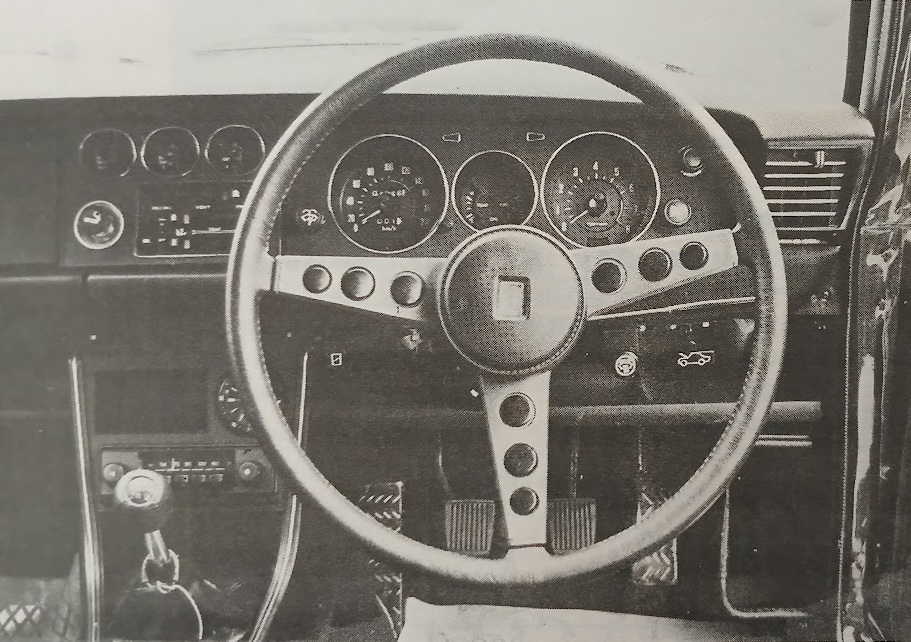
The first thing that caught my attention upon climbing aboard was a box mounted to the right of the accelerator pedal, described as a “foot support.” According to the catalog, the driver can brace the side of the right foot against it to hold the foot in position for delicate throttle control, while the box itself also serves as a small storage compartment.
Maybe there is genuine demand for such a feature, but there is also no denying that it makes the footwell more cramped. While we’re on the subject, there is also a footrest for the left foot. Its presence is welcome enough, but the height difference between it and the clutch pedal is too great, and the footrest itself is rather narrow, limiting its usefulness.
Adjust the seat so that the steering wheel is a comfortable reach away, and there is suddenly too much room for the legs. My arms and legs are shorter than average, yet this was still the result. One cannot help wondering how such a situation came about.
The switches are positioned quite far away. Once the three-point seatbelt is fastened, operating them becomes difficult.
Since the cabin dimensions are carried over directly from the standard Corolla, it is not especially accommodating for something intended to be a sporting car.
The clutch is heavy. The accelerator pedal is very heavy. The latter is probably unavoidable given the carburetor setup, and owners drawn to a car like this are unlikely to complain, so it can hardly be considered a serious fault.
The steering also has a fair amount of free play. As the wheel is turned, however, there comes a point where the play disappears and steering effort increases sharply. One expects a serious sporting car to have heavy steering, but for a car this small, the effort required is genuinely surprising.
Even so, because the steering, pedals, and controls are all consistently heavy, the car feels balanced rather than awkward. To be perfectly honest, though, the effort required is enough to become tiring in ordinary city driving.
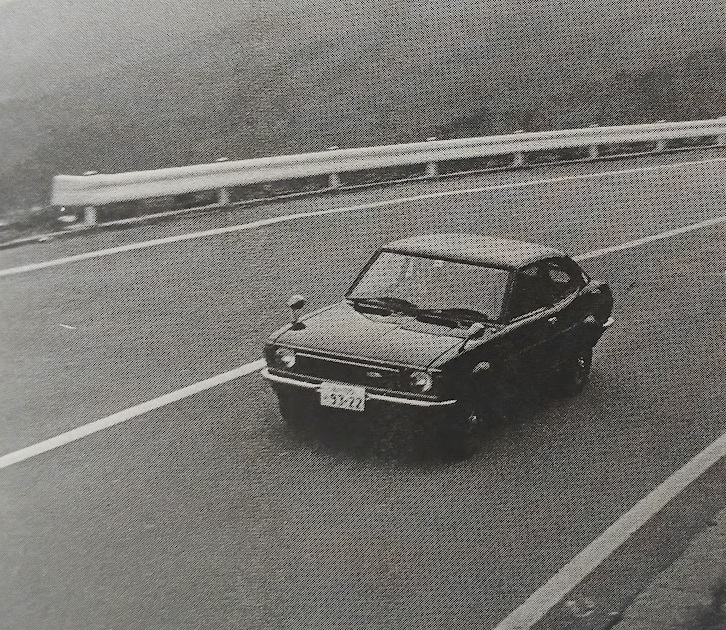
Both front and rear spring rates are quite high, and the dampers exert firm control. As a result, body roll remains modest even in high-speed cornering, and the car never feels unsettled during rapid changes of direction. Response to steering inputs is excellent. Straight-line stability is good, and hands-off stability is equally impressive.
There is little doubt that these admirable handling characteristics owe much to the stiff suspension tuning and the adoption of ultra-low-profile high-speed radial tires.
The price paid, however, is in ride comfort. Long journeys, even on paved roads, leave the occupants distinctly fatigued.
In short, the Levin is a car with a strong and highly focused character, one whose priorities are centered on performance, handling, and stability. Even within the category of handling and stability, it is not the sort of all-rounder that tries to please everyone. It has a distinct personality of its own.
In an era increasingly populated by well-behaved, honor-student-type cars, the Levin stands out from the crowd.
“The steering is heavy, no question about it. But it’s lively.” — Oguchi
“Straight-line stability has improved dramatically, but the trade-off is excessive understeer.” — Mochizuki
Comfort and Practicality: A Car for a Specific Driver and a Specific Purpose (Shigeki Asaoka)
Lately, manufacturers have been investing an extraordinary amount of effort in touring-car racing, and Toyota has now brought to market an unusually hot machine clearly focused on competition use.
This is the Corolla Levin / Sprinter Trueno. Aside from their names, the two cars are virtually identical. The distinction appears to exist solely so that they can be sold through Toyota’s separate Corolla and Sprinter dealer networks.
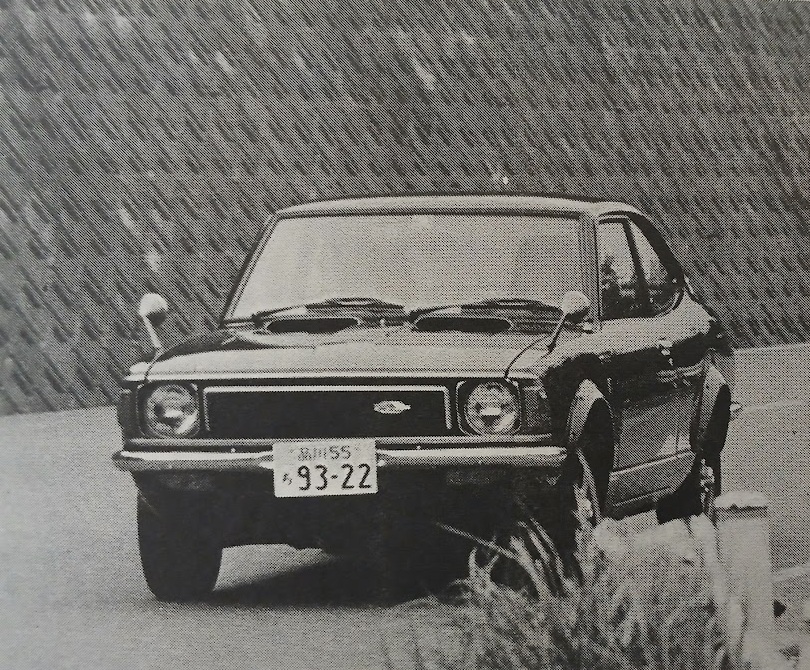
The styling is overtly aggressive. The standard FRP overfenders are attached with exposed rivets, giving the car an unmistakably purposeful appearance. There is little in the way of decorative trim. One curious detail, however, is that the Levin is somehow 20mm shorter overall than the Trueno and weighs 10kg less.
Inside, the cabin is finished entirely in black and stripped down to the essentials, creating a thoroughly sporting atmosphere. Every instrument one might need is present. That said, I cannot help feeling that the layout and design of the gauges deserve further consideration.
A car built for sporting use should allow its instruments to be read at a glance. The oddly elongated oval gauges are primarily for visual effect and not especially functional. The simple, no-nonsense round dials found in racing cars would be far more appropriate.
Controls are simply positioned, with the headlight switch on the right side of the dashboard and the wiper switch on the left, but once the three-point seatbelt is fastened, reaching them is about as easy as trying to grab a box of sweets from a high shelf. The car is also equipped with a racing-style footrest as standard, but because it sits too low, its practical value is limited. Raising it closer to pedal height would make it much more useful.
The seats are the now-fashionable high-back type with integrated headrests. They offer excellent support, though they are somewhat firm.
Speaking of firmness, the stiffness of the suspension came as a genuine surprise. It is so firm that one suspects the car could be entered in a touring-car race exactly as it is. For ordinary road use, however, it is best suited to those with particularly strong stomachs.
The steering is equally remarkable. My arms, now apparently considered rather feeble by modern standards, found extended driving to be strenuous exercise. Combined with the rock-hard suspension, the Levin manages to punish its driver in much the same way as the sports cars of a bygone era, despite its closed bodywork.
This reminds me of the Alfa Romeo TI Super, which was once sold as a homologation model for touring-car racing. Even that car’s suspension was not as stiff as the Levin’s.
Because the Levin is so clearly designed with competition in mind, it is something of an anomaly in this test series. Scoring it is exceedingly difficult. Evaluated as a machine for motorsport, it deserves full marks. Evaluated as an ordinary touring car, the verdict would be almost exactly the opposite.
Yet given the nature of this series, I have no choice but to evaluate it as a regular production car, and the resulting score is inevitably rather low. That should not be taken to mean that it is a bad car. Rather, it is a car built for a very specific kind of user and a very specific purpose–which makes judging it a difficult task.
“The cabin noise and poor ride comfort make it clear that this is not a car intended for the general public.” — Kageyama
“The seats offer the best lateral support in this class.” — Oguchi
“The mechanical and exhaust noise could stand to be reduced somewhat.” — Mochizuki
“The suspended accelerator pedal makes heel-and-toe downshifts easy and enjoyable.” — Ikuuchi
Safety: Demanding Steering Characteristics (Yasuhei Oguchi)
There is something faintly awkward about discussing the safety of a car like this.
After all, the Levin–named after a lightning bolt and powered by a 1600cc DOHC engine–is the sporting flagship of the Corolla range. To judge it by the ordinary yardsticks of automotive safety risks missing the point entirely. That is especially true given the strong impression that the car was conceived with homologation competition in mind.
Yet that does not absolve us from the task. If we focus specifically on those aspects that affect safety during hard driving, there are several points worth mentioning, particularly in cornering behavior.
The Levin offers excellent road-holding, and it is easy to become overconfident and charge into a tight bend more aggressively than intended. Once that happens, however, gathering the car up again proves more difficult than expected. Likewise, power-slide control cannot be described as particularly forgiving. Part of this may stem from the front-heavy weight distribution, but the sheer heaviness of the steering appears to play a major role.
Drivers who instinctively control the car through steering effort–the force required at the wheel–may find it easier to adapt than those who rely primarily on steering angle as their reference. The latter seem more likely to struggle with this car’s behavior.
The reason is straightforward. A power slide demands constant and very subtle corrections. Whenever there is a discrepancy between the car’s anticipated response and its actual movement, the driver must compensate. If the steering itself imposes a large workload during those corrections, psychological tension naturally increases as well.
Of course, this is largely a matter of familiarity rather than right or wrong. Even so, until one becomes familiar with the Levin’s reactions, I would advise some restraint in exploiting its considerable power while cornering. At least until a certain level of skill has been acquired.
In rally-style rough-road driving, one might wish for a little more development. Putting aside spring rates, increasing the damping somewhat could potentially improve road-holding even further.
In ordinary driving, however, a rather different picture emerges.
On highways, where the car is travelling straight and steering inputs remain gentle, the ample performance reserve combines with excellent stability to make for remarkably relaxed progress. The controls are undeniably heavy, and mechanical noise remains pronounced, but owners attracted to this kind of car may not regard either as a serious drawback.
The Levin feels entirely at ease on the expressway.
The brakes also inspire confidence. Even under full braking, the proportioning valve prevents the rear wheels from locking, and fade seems unlikely under normal use. A dual-circuit braking system, operating independently on the front and rear wheels, is also fitted.
There is little here that could be described as particularly novel, but overall the Levin appears to offer a high degree of active safety.
“The brakes feel a little weak, which is unsettling.” — Ikuuchi
“To get real stopping power, you have to stand on the brake pedal.” — Mochizuki
Economy: An Affordable DOHC Car (Reiko Ikuuchi)
The Toyota Corolla Levin tested here carried a Tokyo delivered price of 813,000 yen. Naturally, it sits at the top of the Corolla range. At the same time, it is also the most expensive model in a lineup generally regarded as an economy-car series.
At 813,000 yen, one could also buy a mid-sized car. A Cedric or Gloria starts at 774,000 yen, while a Crown begins at 782,000 yen. Even the six-cylinder 2000cc Crown can be purchased for 822,000 yen.
Viewed in that light, the Levin seems remarkably expensive. In reality, however, such comparisons are not especially meaningful. No buyer is likely to find themselves choosing between a standard Crown and a Levin, nor do the two cars offer remotely the same sort of appeal.
The Levin is not a car for those shopping according to strict economic considerations. It is a car for people who value the attraction of a DOHC engine above all else.
Let us instead compare it with other 1600cc DOHC twin-carburetor models:
Carina 1600GT: 818,000 yen
Celica 1600GT: 875,000 yen
Bellett 1600GTR: 1,110,000 yen
Galant GTO MR: 1,125,000 yen
Isuzu 117 Coupe: 1,670,000 yen
The Carina and Celica, which share the same engine as the Levin, occupy much the same price bracket in the 800,000-yen range. Beyond those, however, prices rise sharply.
The comparison is admittedly imperfect, but the arrival of the Levin nevertheless represents something important. For young enthusiasts seeking a genuinely high-performance 1600cc DOHC car, such performance has suddenly become available at a relatively accessible price.
Until now, the most expensive Corolla had been the 1400 Coupe SL, priced at 659,000 yen. The Levin costs 154,000 yen more.
That additional cost buys an increase in output from 95 to 115 horsepower, a rise in top speed from 170km/h to an estimated 190km/h, and an improvement in 0-400m from 16.8 to 16.4 seconds. The driveline and suspension have also been strengthened accordingly.
Fuel consumption figures recorded over Section 1, 2, and 3 of the test route were 11.4km/l, 8.6km/l, and 11.1km/l respectively.
For comparison, the Isuzu 117 Coupe EC (1600cc), previously tested in this series, returned 9.9km/l, 8.8km/l, and 11.1km/l over the same sections. The Levin’s figures are somewhat better, though once vehicle weight and other factors are considered, the difference is not dramatic.
Running costs are another matter. Compared with an ordinary Corolla, the Levin moves into the over-1.5-liter tax bracket, increasing annual road tax from 21,000 yen to 24,000 yen.
In addition, maintenance costs for the DOHC engine are roughly twice those of other Corolla models. That is unavoidable, however, given the nature of the engine.
“A DOHC engine and 115ps do not come cheaply.” — Oguchi
Product Appeal: A Car for a Particular Buyer (Kensuke Ishizu)
To move from Point A to Point B: this was the original, simple purpose of the automobile.
In America, where modern industrial civilization and the automotive industry grew up side by side, the philosophy behind the automobile has traditionally been direct and uncomplicated. Embellishment is largely rejected.
A large car with a large engine—so long as it moves safely, that is enough. Such a straightforward way of thinking is reflected directly in the cars themselves. Of course, it was also supported by abundant natural resources.
A few days ago I spent four or five days in Hawaii on business. Even there, despite being part of America, I noticed far more subcompact cars than large-displacement ones. Among them, the Ford Pinto seemed especially common. (Editor’s note: The Pinto was featured in this test series in the December 1970 issue.)
Its uncomplicated interior, adequate performance (a 2.0-liter, 100-horsepower engine), and ease of use appear to have made it a considerable success.
The Corolla Levin tested this month uses the same 1600cc DOHC engine found in the Celica.
Why did Toyota do this?
I honestly do not know.
The heavy steering, the heavy pedals, the power output that at times feels excessive—I simply cannot warm to this sort of car.
Suppose, for example, that you brought a Levin to Hawaii and parked it beside a Pinto. Setting price aside for the moment and judging them purely as automobiles, I suspect the Pinto would emerge the winner.
If the purpose of a car is to transport its occupants safely and quickly from Point A to Point B, then the Levin strikes me as overpowered, overdecorated, and overly demanding of its driver.
Personally, I think the Celica engine would have been better left where it was. As for styling, I would choose the Celica as well. Compared with the Pinto, it would hardly suffer by comparison. I do not believe there was any compelling need to transplant this engine into the Corolla, nor do I find the resulting Levin particularly attractive as an automobile.
The key to understanding the Levin lies in its production volume: just 550 units per month.
That tells us Toyota is aiming at a very specific group of buyers.
If that is the case, however, why does a car intended for circuit driving need a radio, a console box, or a cigarette lighter?
Even in racing, the objective is still moving from Point A to Point B—albeit under the condition that it be accomplished more quickly.
In any event, the Japanese way of thinking about automobiles still seems eager to please everyone at once. There remains something not yet fully mature about it.
“This is a car built for racing, above all else…” — Kageyama
“A car for a select few owners. Its purpose is simply to run.” — Oguchi
“The exterior is refreshingly simple and appealing.” — Mochizuki
How to Read the Bubble Index
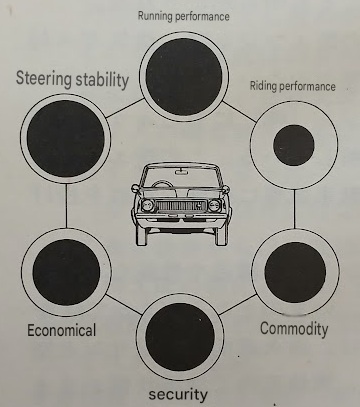
The purpose of this comprehensive road test is to evaluate a car’s overall capabilities through six principal categories: performance, handling and stability, comfort and accommodation, safety, economy, and product appeal.
The evaluation method is what we call the “Bubble Session.” Borrowing an approach from systems engineering, six specialists from different fields gather around a hexagonal table–the “bubble” referring to a honeycomb cell–and discuss the car from their respective viewpoints.
The black circles shown within the six evaluation fields indicate the rating assigned in each category. A car whose circles are relatively equal in size may be regarded as a well-balanced design, whereas one with larger disparities can be said to have a stronger individual character.
Postscript: Story Photos