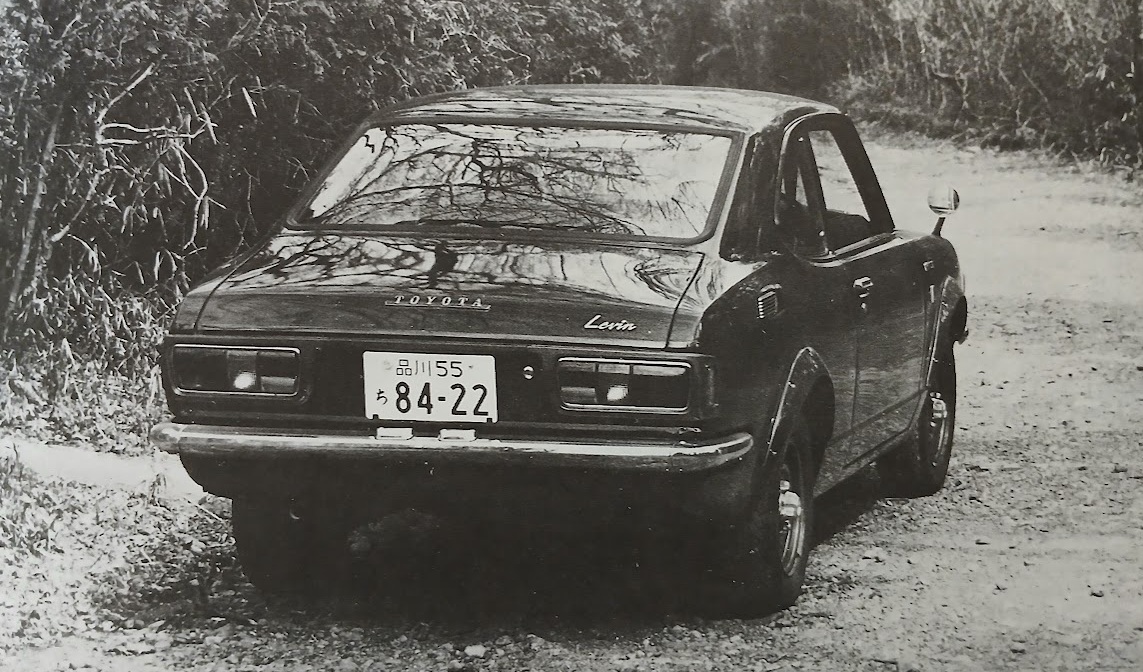
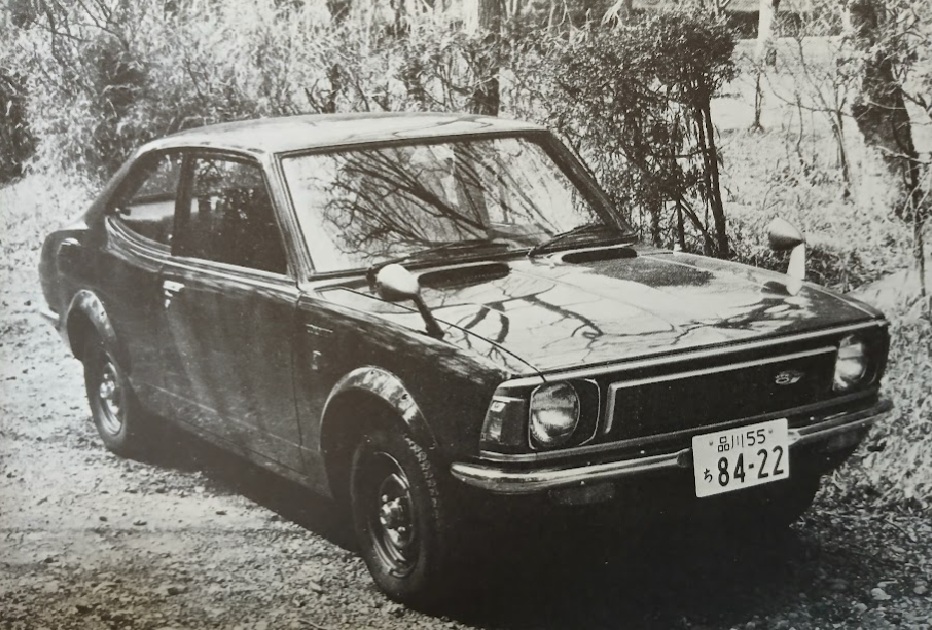
Toyota Corolla Levin (1972)
Publication: Car Graphic
Format: Road Test
Date: June 1972
Author: “C/G Test Group” (uncredited)
Summary: A “fun car” with the 1.6-liter DOHC engine from the Celica/Carina GT mounted in a Corolla body. It is powerful, flexible, and has an excellent gearbox, but is slightly low-geared overall. Ride and cabin usability are sufficient despite the reinforced suspension. Handling is excellent thanks to the 175-width tires, but fuel economy is poor and the noise level is high.
Road testing the Toyota Corolla Levin 1600
When speaking of practical passenger cars in Japan, the Toyota Corolla is invariably one of the first names to be mentioned. This is not simply a matter of production and sales volume; in terms of its concept and equipment as well, it has consistently led the market as a product of the country’s largest manufacturer. For better or worse, it exerts an overwhelming influence on its competitors, and can fairly be said to qualify as a representative example of the domestic car.
Accordingly, the range of models that make up the series is extraordinarily broad. Through a virtually endless combination of body shells, engines, gearboxes, brakes, and an almost bewildering array of accessories, the lineup spans a wide price range–from 438,500 yen (for the 1200 Standard two-door sedan) to 644,000 yen (for the 1400 Coupe SR)–and even when considering only the basic variations, there are over a dozen distinct models.
In addition, the Toyota Sprinter series, which was originally introduced as one of the Corolla’s variations before becoming a separate model, offers almost the same range. Taken together, it is hardly an exaggeration to say that within this class, virtually every conceivable user requirement can be met by some model within the series.
Naturally, specifications aimed at enthusiasts are also included. Up to now, these have centered around the 1200 and 1400 SL models (each available as a coupe and sedan), with the Coupe SR–equipped with a 5-speed gearbox and a strengthened suspension–standing at the top of the range in performance and price. These models have enjoyed considerable popularity in the market, offering a high standard of performance, ease of driving, reasonably well-balanced (if not especially outstanding) handling and comfort, and an equipment level that may be called generous for their price. Moreover, fully tuned works machines based on these models have recently been a consistently strong presence in domestic touring car racing.
However, there are always those who take a different view. A certain group of enthusiasts–who regard themselves as more serious, or perhaps more “genuine”–tend to favor cars such as the Nissan Skyline GT-R, Isuzu Bellett GTR, Toyota Corona Mark II GSS, and Mitsubishi Galant GTO MR, choosing them largely on the strength of their specifications, even if they are not especially practical or economical choices. In terms of sales numbers, these cars are in the minority, but their role as image leaders within their respective series gives them considerable promotional value, creating the impression that all models in the lineup share the character of these “super sports” machines.
Toyota, ever attentive to such matters, could hardly ignore this approach for one of its most important model lines. So, in March of this year, it introduced a version of the Corolla liberally seasoned with “hot sauce” under the name Toyota Corolla Levin. Its twin in the Sprinter line is known as the Toyota Sprinter Trueno.
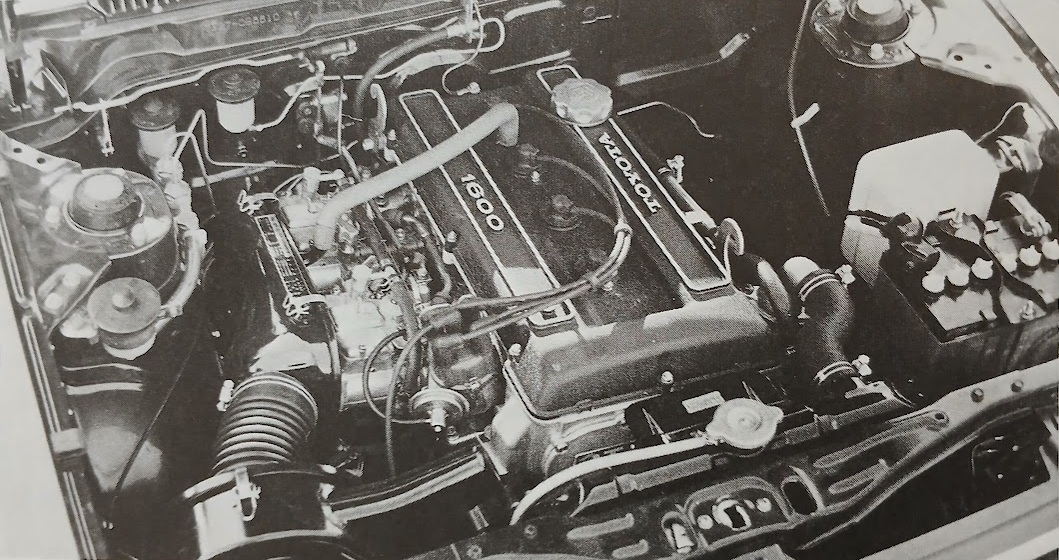
The outline of the specifications is extremely appealing. Into the compact body of the Toyota Corolla has been installed the 1.6-liter DOHC 115ps engine from the Toyota Celica / Toyota Carina GT, paired with a 5-speed floor-shift gearbox.
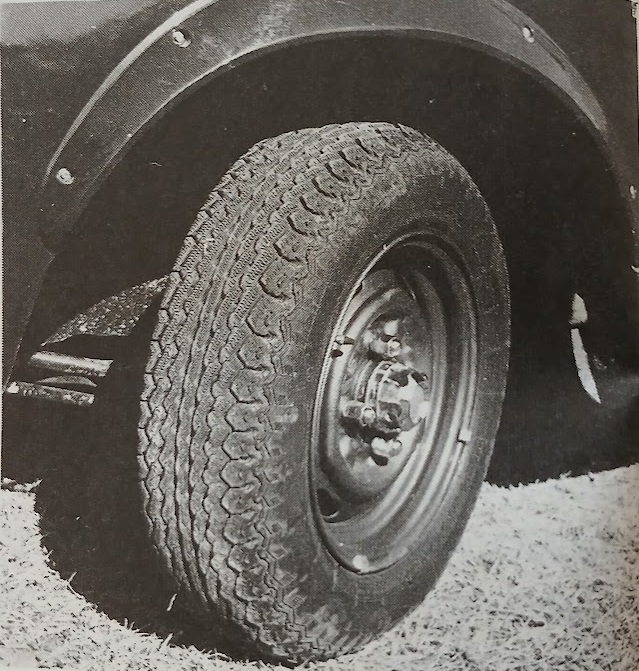
The suspension remains fundamentally that of the Corolla, but both springs and dampers have been significantly reinforced. The wheels are widened to 5J×13–one inch wider than standard–and are fitted with 175/70 HR13 tires, an unusually generous size for a domestic compact car. The stabilizer bar has been increased from 19mm to 21mm in diameter, and the steering gear ratio is quickened from the standard 18.2 to 16.1.
Visually, all ornamentation has been stripped away, with the most distinctive feature being the overfenders required to accommodate the wider tires. A specification like this leaves little to complain about.
For us at C/G, where driving performance takes precedence above all else, the only course of action was to take it promptly to Yatabe for testing. The test car, finished in a deep army green (a subdued orange is also available), was equipped with a number of optional items, including a 25,000-yen limited-slip differential, as well as a radio, rear window defroster, passenger-side footrest, and clock.
The 2T-G 1.6-liter DOHC unit shared with the Celica / Carina GT proves to be as impressive as its specifications suggest. Even on a cold early-morning start, there is no need to pull the choke. A light blip of the throttle to feed fuel through the twin Solex 40PHH3 carburetors is enough to bring it to life with a resounding bark. Once underway, it shows almost no hesitation, pulling strongly in every gear.
Warm-up is not quick if the engine is not placed under load, but once warm it settles into a steady idle at around 900rpm. On the move, the first impression is simply the sheer abundance of power. With a body some 85kg lighter than the Celica and 90kg lighter than the Carina, combined with distinctly low overall gearing, the tachometer needle in the lower four gears sweeps up to the 7000rpm limit (yellow zone from 6500rpm) almost instantaneously–and, if one is not careful, will readily surge past it, eager to climb further.
At 7000rpm, the approximate maximum speeds in each gear are 50km/h in first, 90km/h in second, 130km/h in third, and 177km/h in fourth (it can still reach the rev limit in this gear, as expected). Throttle response is extremely sharp regardless of engine speed, but once past around 5000rpm–near the peak of the torque curve–the engine takes on the unmistakable character of a high-performance twin-cam unit. Accompanied by a distinctly metallic “power roar,” it comes fully on the cam and delivers explosive acceleration that continues right through to the top end.
At the same time, it is equally noteworthy that the engine produces over 80% of its maximum torque (11.6kgm) across a remarkably wide range, from just over 2000rpm to around 6800rpm. Combined with the car’s light weight and gearing, this gives it an unusual degree of flexibility at very low speeds, exhibiting a tenacious, almost rubber-band-like quality. As an example, the overtaking acceleration times in third gear–from 20–60km/h, 40–80km/h, 60–100km/h, and 80–120km/h–all fall within the six-second range. Even from as low as 1300rpm (30km/h) in fourth gear or 1500rpm (40km/h) in fifth, the car will accelerate smoothly–albeit gradually–without any trace of detonation, clearly illustrating the breadth of its effective power band.
By successfully combining what would ordinarily be opposite qualities–strong punch at high engine speeds and ample flexibility at low revs (which, as will be discussed later, is partly due to factors beyond the engine itself)–the overall performance is truly outstanding.
A strong crosswind significantly affected top-speed testing, limiting the maximum to 182.2km/h over the flying kilometer–somewhat below the catalog’s “estimated” figure of 190km/h. However, the acceleration figures tell a different story. In the 0–400m test, the car recorded an average of 16.05 seconds in both directions, and with even a slight tailwind, this improved to 15.9 seconds, comfortably surpassing the manufacturer’s stated figure of 16.3 seconds. These results were achieved while strictly observing the rev limit, with all upshifts made at 7000rpm. Under more favorable conditions, it is reasonable to assume that the top speed would have been somewhat higher.
Compared with other domestic sporting cars tested by C/G at Yatabe, aside from the Fairlady 240ZG (which has a 2.4-liter six-cylinder), the Levin is behind the Skyline GT-R in top speed (182.2km/h vs 185.6km/h) and 0-100km/h acceleration (9.6 vs 9.4 seconds), and cannot match the maximum speed of the Capella Rotary (187.5km/h). In all other respects, the Levin’s outstanding speed potential is at an exceptionally high level.
Placed within the limits of 1.6 liters and a price of 810,000 yen, there is no car that can approach it in terms of performance.
The main shortcomings of this engine lie in noise and vibration. It is not especially rough, nor is there any pronounced resonance at specific engine speeds, yet a high-frequency vibration generated by the engine is constantly transmitted throughout the body. This phenomenon is not present–or at most only very slight–in the Celica and Carina, suggesting that a relatively hard type of mounting rubber has been used here. This becomes evident even at a standstill: when the throttle is blipped, the body gives a noticeable shudder, typical of a high-output car. In short, the relationship between engine and body feels somewhat rigid.
For the same reason, and compounded by the limited effectiveness of the soundproofing in areas such as the rear bulkhead and floor, noise levels are also high. A certain amount of mechanical noise is always present across the rev range, and from around 4000rpm upward, the exhaust system generates a pronounced resonant boom that lingers within the cabin. This appears to be a problem that could be addressed relatively easily–for example, by increasing the thickness of the exhaust pipe or silencer walls.
The clutch is shared with the Celica GT. Pedal travel is moderate, effort is light, and engagement is smooth. On the test car, the pedal’s free play was slightly too small–this made the bite point a bit too high, making it easy to overdo the throttle when starting off. Even so, after repeated 0-60 acceleration, we detected no changes in pedal behavior nor any hint of slip.
The 5-speed fully synchronized gearbox (ratios: 3.587, 2.022 / 1.384 / 1.000 / 0.861) is identical to those in the Celica, Carina, and Corolla SR/SL, and is one of the car’s strong points. It uses the standard H-pattern, with fifth gear tucked at the upper right and reverse forward and to the left. Shift feel, throw length, synchromesh capacity, and the spacing between gears (1.774 / 1.461 / 1.384 / 1.162) are all well matched to the engine. Compared to Toyota gearboxes of a decade ago, which were widely criticized, this represents a genuine leap forward. After the 4-speed unit in the Sunny 1200, this is arguably among the best domestic gearboxes we have experienced. On the test car, the only quirk was a noticeable whine under engine braking in second.
In the Levin, this gearbox is paired with a 4.30 final drive (hypoid bevel type). Judging from the power and torque curves, vehicle weight, and tire size, this ratio is probably a bit too low. Still, it clearly contributes to the car’s exceptionally brisk launch and the engine’s impressive midrange pull.
Comparing this setup to other technically compatible Toyota final-drive sets, if one were to swap the Levin’s low-geared final drive for the 3.90 unit from the Celica/Carina (available with gearboxes other than the 5-speed), this hypothetical gearing would remain easy to handle, thanks to the car’s ample torque and light weight. In fact, the sightly higher maximum speeds in each gear would be a welcome improvement. It is hard to imagine anyone wanting to drive this type of car at 40km/h in fifth gear. It would be ideal, therefore, to allow users to choose from among the other existing final drives, if only as an option.
Shifting from fourth to fifth requires pushing against a return spring, but this is done naturally without excessive effort or movement. The downshift from fifth to fourth works just as smoothly. Thanks to the engine’s abundant torque, the upper three gears are all fully usable even in city traffic, and on the highway, fifth itself is enough for confident overtaking. Since fifth is an indirect drive, gear noise is a potential concern–but in practice, it is mostly drowned out by the sound of the engine. At 100km/h, the engine turns roughly 4100rpm in fourth and about 3500rpm in fifth, and tire noise is barely noticeable.
Handling is exceptionally good–in a word, “exhilarating.” The combination of copious power, a suitably stiffened suspension, and wide tires produces a character that is somewhat old-school–but precisely because of that, it allows for textbook sports-car driving under all conditions.
Comparing the chassis changes to the previous top-spec SR model, the Levin’s front and rear spring constants are much higher at 2.65kg/2.5kg, compared with the SR’s 2.2kg/2.2kg, and the compression/extension force of the front and rear dampers are 30kg/105kg and 60kg/80kg, compared with the SR’s 55kg/78kg and 30kg/72kg. The reasons for reducing the front dampers’ compression damping from 55 kg to 30 kg are unclear, but aside from that, everything else has been significantly stiffened.
The tires, sized 175/70 HR13, are mounted on 5J rims, whereas the SR uses 155-width tires on 4J×13 rims. In an environment where many “sporty” cars are given only superficial upgrades, it is commendable that the engineers combined this body with such generously sized tires. On the test car, these were Sumitomo-made Dunlop SP Sport Deluxe 70s, and as will be discussed later, the Levin’s handling owes a great deal to these tires.
As with other Corolla models, the driving position is excellent. The Levin-specific semi-bucket seats, which make extensive use of rubber springs and expanded urethane, provide a slightly lower seating position than before, allowing drivers of all builds to adopt a natural posture, with arms and legs comfortably extended. The relative positions of the shift lever and handbrake are also well judged. The throttle pedal, unique to this model, uses a suspended steel design similar to that of the Mark II GSS. Its shape is well suited to heel-and-toe operation, but as is common across the Corolla series, all three pedals are generally set rather high, making it difficult to operate them without lifting one’s heel from the floor.
A sturdy footrest to the left of the clutch pedal is provided as standard. The test car was also fitted with an optional “foot support” to brace the driver’s right ankle (which can also be used as a storage compartment), as well as two footrests on the passenger side. All of these prove highly effective when driving quickly on winding roads.
Directly ahead of the driver are two large dials: a tachometer on the right, scaled to 8000rpm, and a speedometer on the left, reading up to 200km/h and incorporating both an odometer and a trip counter. Between them is a combined water temperature and fuel gauge. These instruments are easy to read day or night, and are unobstructed by the steering wheel.
The light and wiper switches, however, have not been improved. Because they are mounted on the instrument panel, they are difficult to reach once the three-point seatbelt is fastened, and their small knobs make them awkward to use. Moreover, being positioned on either side of the steering wheel, they require the driver to use both hands separately. This is about as inconvenient a layout as one could imagine, and deserves serious reconsideration.
The three small gauges in the center of the dashboard display current, oil temperature, and oil pressure. After two or three laps at maximum speed at Yatabe, the oil temperature gauge exceeded its 130°C limit, while oil pressure dropped to 2kg/cm². Under normal conditions, oil pressure is around 4.5kg/cm², with oil temperature in the range of 80 to 95°C.
Compared to the standard steering ratio of 18.2 (3.5 turns lock-to-lock), the Levin’s steering has been quickened to 16.1 (2.8 turns). However, because the increased tire width reduces the available steering angle, it does not feel especially quick in practice. Even so, the steering offers sufficiently firm feedback for high-speed driving, and the wheel is not uncomfortably heavy except at very low speeds.
When traveling straight ahead, however, there is about 4-5cm of elastic play around the center position. Since the car is not particularly resistant to crosswinds, this characteristic demands a certain amount of extra attention on the highway.
In normal driving, cornering is characterized by consistent and fairly strong understeer. The front tires begin to squeal relatively early, but there is a considerable margin of grip, so there is no need for exaggerated steering inputs. Because the caster action is quite strong, it is important to keep a firm grasp on the steering wheel.
Like the other sporting Corollas, the Levin is at its best on roads made up of a succession of medium-speed corners that can be taken at 70–100km/h. Here, shifting between third and fourth gears as desired, it is possible to maintain a steady throttle and push through the curves with confidence. The pronounced understeer means that, beyond the apex, the car’s line tends to run slightly wide, but easing slightly off the throttle allows the nose to tuck in naturally—just as expected of a front-heavy car (58.5% front, 41.5% rear). Thanks to the ample reserve power, these adjustments can be made effortlessly.
However, the Levin reveals its true character, and is at its most engaging, in tight corners taken with a more forceful approach. Entering under repeated heel-and-toe downshifts, and turning in with a large steering angle in second gear, one can then apply the throttle decisively at the apex. At that point, the tail begins to slide, very smoothly and progressively. Unlike the sudden breakaway sometimes encountered in other Corollas, this behavior is extremely easy to control, and with nothing more than small movements of the right foot, the car’s direction can be chosen freely. At the same time, the steering is unwound, and once the car is aimed straight at the next corner, exiting is a simple matter of flooring the throttle.
The fact that all of these actions can be carried out smoothly in quick succession is perhaps the Levin’s greatest strength. In a standard Corolla, taking the same corner in this way would cause the inside rear wheel to lift and spin, causing a sudden loss of momentum. In the Levin, the combination of reduced body roll from the thicker stabilizer and the well-calibrated limited-slip differential keeps the car composed. How a Levin would behave without these components is an intriguing question.
What is particularly noteworthy is that, despite the suspension’s clear focus on handling, there is very little of the ride harshness one might expect. It is true that the ride is firm, and this is evident in the relatively low specified tire pressures of 1.5kg/cm² at all four wheels (presumably made possible by the generous tire size; during testing, we used 1.6kg/cm²). Even so, when it encounters a bump, body motion is neatly controlled within a single vertical movement. Thanks to the strong damping, occupants seldom have the feeling of being tossed about in their seats.
Fine irregularities such as coarse road surfaces, concrete expansion joints, and raised “cat’s eyes” lane markers are faithfully transmitted, but the excellent seats absorb these so well that they are more often heard than felt. The overall impression is remarkably flat, as if one were driving a much heavier car.
For a rigid leaf-sprung layout with relatively stiff spring rates and a comparatively light load, there is unusually little rear-axle hop. Even during standing-start acceleration tests at Yatabe, the rear suspension did not permit axle tramp. Because of this, it seems likely that slightly higher tire pressures would have little adverse effect on ride comfort. It should therefore be possible to raise the pressure at the front as a practical adjustment to reduce understeer.
The brakes, with discs at the front and leading-trailing drums at the rear, benefit from an increase of 2.2mm in the front wheel cylinder diameter compared to the SR, and provide sufficient stopping power for the Levin’s performance.
In the fade-resistance test–consisting of ten repeated cycles of full acceleration from rest to 100km/h followed by 0.5g braking–pedal effort rose from 28kg on the first stop to 39kg by the ninth, after which it remained roughly constant. As no smoke or abnormal odor was observed, braking performance can be considered stable. That said, as these results indicate, the system requires relatively high pedal effort overall. In our road test of the SR, we described its brakes as being “at the limit of usability without servo assistance,” but in the Levin, some form of power assist is clearly necessary. It should be provided, even if only as an option.
Pedal feel itself is excellent. Not only is there a precise proportional relationship between pedal effort and braking effect (0.46g deceleration at 20kg, 0.83g at 40kg), but changes in vehicle attitude under heavy braking are also minimal, allowing the driver to apply the brakes with confidence at all times. The combined effect of the proportioning control valve and tire grip also effectively suppresses rear-wheel lock.
One point requiring attention is the cap for the tandem master cylinder’s reservoir. This is made of thin rubber and is insufficiently secure, and can easily come loose if brushed by a tool or similar object, so that the car might be driven away without the driver noticing. We experienced this ourselves during pit work at Yatabe.
Fuel consumption is very high. Even in proportion to the car’s high performance, the constant-speed fuel economy figures are poor. In actual driving, when the Levin is driven as intended, consumption worsens further–likely because the accelerator pump has been set to deliver a relatively large volume in the interest of throttle response. Over the course of our test, including the round trip from Tokyo to Yatabe and high-speed testing there, the average was 6.9km/l. In city driving it returned 6.7km/l, while a day spent enjoying the mountain roads of Izu and Hakone via the Tomei Expressway yielded 7.1km/l. Overall, the amount of premium fuel consumed was considerable. With a 45-liter fuel tank, practical range is no more than about 250km.
Given the nature of the car, this may not be a primary concern, but slightly taller gearing would likely improve economy to some extent. A regular-fuel version of the same series is also available, with only a 5ps reduction in output.
With its compact body and powerful DOHC engine, the Corolla Levin may fairly be described as Japan’s answer to the Escort RS (the TC having now been discontinued). Compared to detuned racing sedans like the RS, however, the Levin is arguably superior in the way it combines handling, accommodation, performance, and flexibility. In that sense, despite its coupe body style, it is best understood as a “fun car” that exists purely for the enjoyment of driving.
Its base price of 813,000 yen is not inexpensive, and once practical options such as the limited-slip differential are added, the total can easily surpass the cost of a Celica GT. Even so, the appeal of being able to legally enjoy a road-going “racer” is hard to resist.
Postscript: Story Photos