Toyota Corolla Levin and Levin J vs Mitsubishi Colt Galant FTO 1600GSR and 1400SL-5 (1973)
Publication: Auto Sport
Format: Group Test
Date: June 1973
Author: Auto Test Editorial Staff (uncredited)
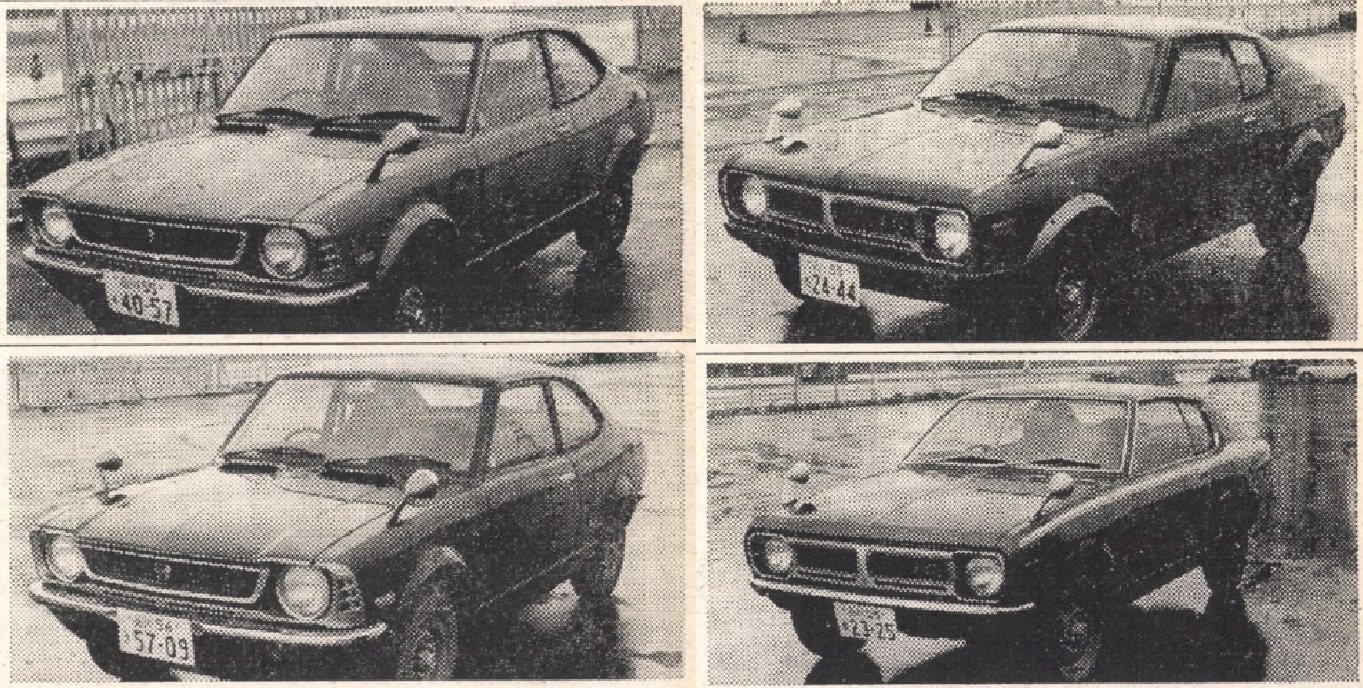
Editors’ Comprehensive (?) Test Drive: Corolla Levin and Levin J vs. Galant FTO 1600GSR and 1400SL-5
The car slides on at an angle, refusing to straighten. The guardrail closes in like an arrow…
The second editorial test session, held in the rain at Tsukuba, turned into something resembling a spin exhibition. Faces drained of color, sweat creeping in, legs trembling, we pressed on–telling ourselves that this, too, was valuable experience–as we fought to keep the cars under control.
So what, then, did each machine reveal in the midst of it all?
Has the World Changed!?
For the second instalment of our editorial test drive series, we set our sights on the 1.6-liter class. The mainstay models from each manufacturer tend to sit in the 1.2-1.4-liter range–the so-called “mass-market class.” Their model lines typically combine strong everyday usability with sporty variants that add a touch of performance character.
However, within this broad model strategy and the careful introduction of more upmarket aspirations, a new kind of “super model” has emerged in the mass-market class.
These hot versions take a 1.6-liter class engine and install it into a 1.2-1.4 liter class body. Of course, they are quick. Among the many classes spanning everything from 360cc kei cars to 2-liter saloons, it is arguably this 1.6-liter class that now represents the highest degree of outright sportiness.
Of course, the idea of fitting a larger engine into a lighter body is nothing new. But the way this approach is now being applied has clearly changed the meaning of what a “hot version” represents.
At this point, it is worth taking a closer look at what these latest hot versions really are.
The engines used are generally relatively lightweight, compact four-cylinder 1.6-liter units, spanning OHV, SOHC, and DOHC layouts. In each case, these are engines originally developed for other model ranges–essentially “borrowed” units. And they are, without exception, mass-produced engines in a fairly standard state of tune. They are not highly stressed racing-derived units producing extreme outputs. Even in town driving that relies heavily on low-to-mid range torque, they remain perfectly tractable.
Carburation systems are equally conventional. Aside from DOHC engines equipped with twin-choke Solex carburetors, most use two-stage downdraft twin carburetors, while simpler versions make do with a single carburetor. Basically, there is little here to distinguish them from ordinary family sedans.
The bodies, while described as “lightweight,” are simply light in the sense that they belong to the 1.2-1.4 liter class. They are not specially lightened. However, suspension settings are made considerably firmer to match the stronger output, improving overall stability and control.
In terms of appearance and interior, some models deliberately omit radios and other accessories in order to create a racing-special atmosphere. Interiors are often finished in all-black. Externally, the most notable feature is the use of extremely wide 70-profile radial tires, often combined with FRP overfenders fitted purely to emphasize their visual presence.
Looking at these elements in isolation, the latest hot models are in fact rather ordinary. They do little more than change the conventional pairing of engine and chassis. The wide tires, overfenders, and firm suspension are simply part of the “seasoning” that underlines their “hot model” identity.
However, that does not mean we should underestimate the performance of these models. What must be understood is that we are not dealing with specially pared-down lightweight bodies carrying highly tuned engines, and suspensions designed to fully accept even highly advanced driving techniques. In other words, we must recognize that the era of the Spartan sports car has already come to an end.
Levin’s Performance Stands Apart
The vehicles selected for our editorial test drive were the Corolla Levin, the Levin J, the Galant FTO 1400SL-5, and the Galant FTO 1600GSR. Naturally, as in previous comparisons, there was no shortage of other candidates, but we ultimately narrowed the field to these four.
Let us first examine the performance characteristics of the four cars.
Starting with maximum output figures (all on high-octane gasoline): Levin, 115ps/6400rpm; Levin J, 105ps/6000rpm; FTO 1600GSR, 110ps/6700rpm; FTO 1400SL-5, 92ps/6300rpm.
Torque figures are: Levin, 14.5kgm/5200rpm; Levin J, 14.0kgm/4200rpm; FTO 1600GSR, 14.2kgm/4800rpm; FTO 1400SL-5, 12.5kgm/4000rpm.
Output per liter: Levin, 72.42ps/l; Levin J, 66.12ps/l; FTO 1600GSR, 68.88ps/l; FTO 1400SL-5, 63.93ps/l.
And power-to-weight ratio: Levin, 7.43kg/ps; Levin J, 8.05kg/ps; FTO 1600GSR, 7.95kg/ps; FTO 1400SL-5, 9.24kg/ps.
As one would expect, the Levin–being the only model equipped with a DOHC engine–boasts the strongest overall performance. The FTO 1600GSR, fitted with a SOHC engine and two-stage twin carburetors, comes in only 5ps below the Levin. However, its body weight is roughly 20kg heavier, affecting its power-to-weight ratio. That said, the FTO 1600GSR holds a clear advantage in its adoption of a limited-slip differential.
In terms of tires, the Levin, Levin J, and FTO 1600GSR all adopt a wide-stance setup, using 175/70HR-13 radial tires on 5J rims. Only the FTO 1400SL-5 differs, using 6.15-13-4PR bias-ply tires mounted on narrow 4J rims.
The suspension type is identical for all four models: MacPherson struts at the front and a leaf-sprung rigid axle at the rear. In this respect, they are fundamentally the same in architecture. The distinctions lie in the relationship between spring rates and damping characteristics.
In terms of detailed specifications, for the Levin and Levin J (which share identical settings), the front coil springs are as follows: free length, 318.1mm; wire diameter, 12.5mm; effective coil count, 5.45; spring rate, 2.65kg/mm.
Front damper settings are: damping rate, 0.3m/s; extension, 105kg; compression, 30kg; maximum stroke, 637.7mm; minimum stroke, 445.7mm.
Rear leaf spring figures are: leaf count, 4; span, 1150mm; spring rate, 2.5kg/mm.
Rear damper settings are: damping rate, 0.3m/s; extension: 85kg; compression, 60kg; maximum stroke, 568mm; minimum stroke, 338mm.
Meanwhile, corresponding figures for the FTO 1600GSR (and FTO 1400SL-5) are, for the front springs: free length, 320mm (342.5mm); wire diameter, 12mm; effective coil count, 4.27 (4.75); spring rate, 2.14kg/mm (1.91kg/mm).
For the front dampers: damping rate, 0.3m/s; extension, 50kg (27kg); compression, 30kg (18kg); maximum stroke, 629mm (644mm); minimum stroke, 442mm.
For the rear leaf springs: leaf count, 2; span, 1,150mm, spring rate 2.28kg/mm (2.12kg/mm).
And rear dampers: damping rate, 0.3m/s; extension, 70kg (45kg); compression, 43kg (30kg); maximum stroke, 528mm (558mm); minimum stroke, 318mm (333mm).
At this point, it could be said that the differences in character between the Levin / Levin J and the FTO 1600GSR / 1400SL-5 are already becoming apparent.
One Spin After Another — And Faces Turn Pale
On April 27, a light spring rain had been falling since early morning, blanketing both central Tokyo and the plains of Ibaraki under a thick layer of low clouds.
Under these conditions, the four cars, running nose-to-tail, passed through the gates of Tsukuba Circuit. Although the rain had just begun to ease, the clouds still hung low overhead.
Final checks were carried out–engine oil and tire pressures. All four cars were set to 2.5kg/cm² front and rear. This prompted concern from some–“Isn’t that a little high? Once we’re running, pressures could rise to around 2.8kg/cm²”–but in the end, it was decided to run 2.5kg/cm² in the interest of achieving higher cornering force.
All four cars entered the course at once. The surface was still completely wet.
As speeds gradually increased and the cars entered their second lap, spins began almost immediately at the first corner. One after another, the cars slewed sideways and slid off into the infield. Over the next five laps or so, each car managed to experience a spin at nearly every corner–thoroughly, and without exception.
We found that these spins and excessive slides could be classified into three types.
First, the rear brakes on both Galant FTOs locked far too easily, causing an immediate loss of directional stability. This was clearly a symptom of improper adjustment, and was responsible for many of the spins occurring on corner entry. On the wet surface, the effect appeared instantaneously, leaving almost no opportunity for correction.
Second, instability arose during the approach to the apex. Poor judgement of the cornering line combined with rough throttle control–entering too tightly from the inside, encountering stronger-than-expected understeer, then applying additional steering input or abrupt throttle changes–would cause the tail to step out.
Third, at corner exit, careless application of full throttle or failure to unwind the steering promptly resulted in a more gradual but unavoidable rear-end slide.
To make matters worse, cars that spun and ran wide onto the infield kicked up mud which spread across the track surface, creating extremely poor conditions.
Cars following behind quickly lost confidence, and the pace dropped sharply.
Fortunately, the clouds soon began to break. Sunlight filtered through, and the circuit gradually started to dry.
Now, it was time to put the Corolla Levin to the test in earnest.
The Levin is equipped with the same 2T-G DOHC engine as the Celica GT, with twin Solex dual-choke carburetors. For a DOHC engine, its response is not exceptionally sharp, but power holds steady from 3000-7000rpm with no sign of falling away. In particular, the surge of acceleration between 4000-6000rpm is satisfyingly strong.
At low speeds, it is also remarkably flexible. In fact, it can be handled much like an ordinary single-carburetor engine. Even in fourth gear, 1500rpm is not out of the question…
However, the noise level rises rapidly beyond 4000rpm, reaching a peak above 6000rpm. This consists of not only the high-pitched exhaust note, but a combination of various mechanical noises from the engine itself.
Even so, watching from trackside, there is no doubt that the Levin’s high-pitched sounds are the most exciting of the group.
The high-back seats do not provide particularly strong support against lateral g. Still, with the help of the footrest and seatbelt, the driver’s body is reasonably well held in place. The steering wheel is large in diameter, which is not ideal for quick, precise inputs.
The steering gear ratio is 16:1, placing it among the higher-geared types for a passenger car. However, initial response from the straight-ahead position is not especially sharp. On the other hand, kickback is minimal, and there is little variation in steering effort.
Lock-to-lock is about three turns, and with relatively small maximum wheel angles—36°30’ on the inside and 31°40’ on the outside—the steering does not give the impression of being especially high-geared.
In terms of handling, the Levin shows a pronounced tendency toward understeer. This is particularly noticeable in tight-radius corners, where strong understeer proves difficult to overcome. On the high-grip surface of the circuit, even when sufficient throttle is applied, it tends to only produce wheelspin at the inside rear, without effectively transmitting the drive needed to settle the car’s cornering attitude. On lower-grip surfaces, such as ordinary public roads, this tendency would likely be much less pronounced.
Ironically, when the track was still wet earlier, the car displayed smoother cornering with only mild understeer.
At higher speeds, such as through the 90R, breakaway begins to appear, and the car transitions into mild oversteer. However, these slides happen quickly, making them difficult to control.
The suspension is quite stiff. In city driving, it faithfully picks up surface irregularities, and by ordinary standards, ride comfort is rather poor. However, the damping has been increased to match the springs, so the car’s posture during circuit driving is by no means unsatisfactory.
That said, the inside rear wheel lifts quite easily. It would seem that further reinforcement of rear stabilization, or the adoption of a limited-slip differential, may be necessary.
The non-servo brakes offer a pleasing pedal effort. The rear axle does not exhibit wind-up even under hard acceleration, but under full braking it showed a slight tendency to hop.
Well-Balanced Levin J
The Levin J takes the Levin’s chassis and body, and combines it with the 1.6-liter OHV 2T engine, newly added to the Corolla series as part of the latest expansion of the lineup.
Within this newly established 1600cc Corolla class, there is, as before, the SR model, which features strengthened running gear and simplified equipment, and for those who want something more thoroughly performance-focused, the “Super Stock” Levin. In that sense, the Levin J is somewhat of an in-between model, lacking a clear identity from a performance standpoint. Seen another way, however, this is exactly the kind of car that emerges from Toyota’s method of building out a model range.
The T-series engines–the T type (1400cc OHV), 2T type (1600cc OHV), and 2T-G type (1600cc DOHC)–all share a common block, as their names suggest. Until now, the Corolla has used the T engine, while the Levin alone received the 2T-G. Given this, it is almost curious that the 2T had not been adopted earlier. Since these engines can be interchanged without altering their mounts, it is only natural that the Levin should now be fitted with the 2T.
For younger buyers, even though the price is 40,000 yen higher than the 1600SR despite sharing the same OHV layout, the Levin J–with its overfenders and body identical to the Levin–may well hold greater appeal.
Still, when driven back-to-back with the Levin, the 80,000 yen price difference is clearly felt.
The all-black interior, the six-gauge instrument panel that even includes an oil temperature gauge, the firm high-back seats, and the three-spoke leather-wrapped style steering wheel—these are all shared with the Levin. In other words, in appearance and equipment, it is essentially a Levin. But the moment the key is turned, the difference between Levin and Levin J becomes immediately apparent. Beneath the driver’s right foot, the powerful pulse of the DOHC engine is no longer present.
The transmission, of course, is the same 5-speed unit as the Levin. Because the overall gearing is set quite low, the sense of acceleration is excellent. However, as is also true of the Levin, first and second gears are set too low, even taking the final drive into account. As a result, in 0-100km/h acceleration, even the Levin J is able to outperform the FTO 1600GSR–by nearly two seconds, despite the latter’s superior catalog figures. The difference in 0-100km/h times between the Levin and Levin J can clearly be attributed to the difference in top-end torque between DOHC and OHV.
In any case, while these low gear ratios produce impressive acceleration in 0-100km/h runs, they inevitably cause wheelspin when exiting corners on the circuit. As a result, power cannot be transmitted effectively, and the driver is forced to work harder. Furthermore, the Levin and Levin J share exactly the same suspension settings, and whether due to excessive stiffness or insufficient stroke, the inside rear wheel lifts easily, further exaggerating this tendency.
Compared with the Levin, the Levin J exhibits a milder degree of understeer. This is likely due to a more favorable front-to-rear weight balance resulting from the difference in engine weight.
The brakes on the Levin J are equipped with a master back servo, and the clutch (compared with the Levin) requires less effort. This lighter, more responsive feeling extends throughout the entire car, and in terms of the matching of power and chassis, there are aspects in which it may even feel superior to the Levin.
In any case, for drivers of our level, there is no doubt that on the circuit the Levin J can be driven far more easily than the Levin.
The Maverick of the Galant Line: FTO 1600GSR
The Galant FTO 1600GSR comes equipped as standard with a limited-slip differential. For that reason, on a technical course like Tsukuba–where corner exit speed has a direct effect on lap times–we had high expectations for this car, perhaps more than any of the others in this test, even in completely standard form.
The engine, though SOHC, is fitted with twin carburetors and produces 110ps, just 5ps shy of the Levin. This 1.6-liter Saturn engine is carried over from the Galant 16L series, and already has a strong reputation for its willingness to rev. At the same time, thanks to its long-stroke design, it offers ample flexibility in the low- to mid-speed range.
The running gear is reinforced, with wide 175/70-13 radial tires mounted on 5J rims. Combined with the garnish-type overfenders fitted to cover these wide tires, the overall appearance carries a distinctly purposeful, competition-oriented atmosphere–more than enough to attract our interest.
However, within the Galant series, the FTO GSR has a rather unusual character. This became apparent the moment we put it into motion. As noted in our previous test of the Galant GTO 2000GSR, Galant models generally exhibit neutral handling characteristics. The FTO, however, does not follow this pattern. The Levin adheres to an “80-point” philosophy–in other words, a car designed to suit the widest range of drivers–and yet stands out as somewhat unconventional within the Corolla lineup. The FTO 1600GSR, on the other hand, has a far more unbalanced character, to the point where it is hard to believe it shares the same lineage as the rest of the Galant series.
The FTO inherits its suspension from its larger sibling, the GTO. As a result, the tread is quite wide relative to its wheelbase. In terms of dynamic performance, this should be advantageous. However, having also inherited the engine characteristics of its larger sibling, the FTO has taken on something of a “mischievous” personality.
Off the line, the combination of abundant power and relatively light body weight leads to pronounced rear axle wind-up, and power is not cleanly transmitted to the road surface. This is a tendency seen before in cars such as the Skyline GT (S54B), one of the early examples of this type of car. It would seem that the leaf-sprung rigid rear axle requires the addition of torque rods to keep it under control.
Under heavy braking on corner entry, the load transfer causes significant changes in attitude, and if pushed too far, the car can easily spin. The limited-slip differential, for drivers not accustomed to its behavior, can actually contribute to this tendency in some cases.
Particularly under the wet conditions of this test, factors such as excessive steering input, delayed correction, and over-application of throttle combined to produce more spins in this car than in any of the others, at nearly every corner.
However, seen from another perspective, this simply reflects the car’s high level of sporting character. To extract its performance, it demands a correspondingly higher level of driving technique.
In contrast, the FTO 1400SL-5, which we tested alongside it, offers a more subdued engine and suspension. Even so, it proved quite enjoyable on the circuit. This can be attributed to its more balanced overall character, which helps to compensate for less refined driving technique.
Both the 1600 and 1400 models are equipped with servo-assisted brakes–discs at the front and drums at the rear. However, as with the GTO 2000, braking response on the circuit feels somewhat overassisted, making delicate control difficult and introducing a degree of psychological unease during corner approach. As mentioned earlier, the test car also suffered from poor brake adjustment, which undoubtedly contributed to the frequency of spins.
The suspension on the GSR is set fairly stiff, but compared with the Levin, both spring rates and damping force are somewhat lower, and body roll is more pronounced. However, this allows the tires to maintain better contact with the road surface, and combined with the effect of the limited-slip differential, the car accelerates out of hairpins far more easily than the Levin.
The steering uses a small 380mm wheel with a thick rim, and with the addition of a tilt mechanism, it’s easy to find an ideal driving position. The variable-ratio steering, ranging from 15.5 to 18.1, consistently delivers moderate effort with a sharp edge to its response–among production passenger cars, it feels close to the best available.
The transmission is the same 5-speed unit used across the Galant range. The ratios themselves are fairly standard–not overly low, like the Levin’s–and generally easy to work with. However, the synchros aren’t especially strong, and under the sustained abuse of circuit driving they began to protest.
In 0-100km/h acceleration, the taller gearing combined with a drop-off in power near the rev limit held the best time to 12.2 seconds. Even during these runs, there was frequent gear noise, and on occasion it would even jump out of gear.
Lap times recorded for reference also fell short of expectations. But this likely reflects the car’s character–unlike other Galants, its handling is not especially forgiving, and it demands a certain level of driver skill.
Perhaps the most important takeaway from this test was the realization that “a car doesn’t run on power alone.” Driving the FTO 1600 GSR and the Corolla Levin–the so-called “super stock” models–made it clear just how critical overall balance is.
To be honest, these cars were simply operating at too high a level for drivers of our ability to fully exploit.
Watching the test cars spin again and again at various points around the circuit, Editor-in-Chief Usui must have been quietly on edge back in the pits. When the test finally concluded–miraculously without a single car damaged–you could sense his relief. Letting out a long breath, he murmured to no one in particular, “Well… at least we got through it.”