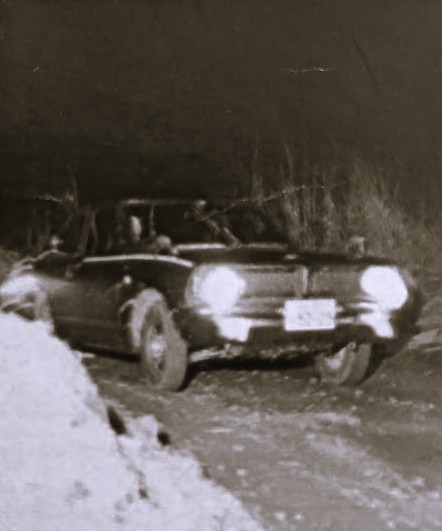
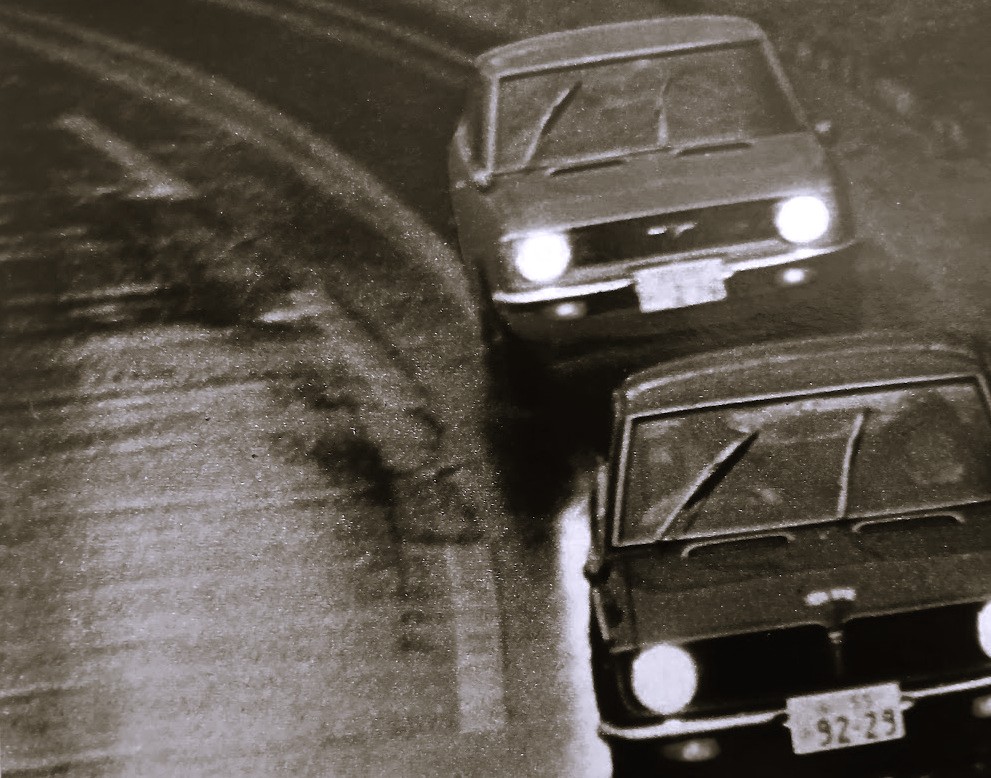
Toyota Corolla 1400SR, Sprinter 1400SR, and Publica 1200SR (1971)
Publication: Motor Fan
Format: Test Drive Report
Date: June 1971
Author: Hiroshi Okazaki, Harukuni Takahashi, Motor Fan Editorial Staff (uncredited)
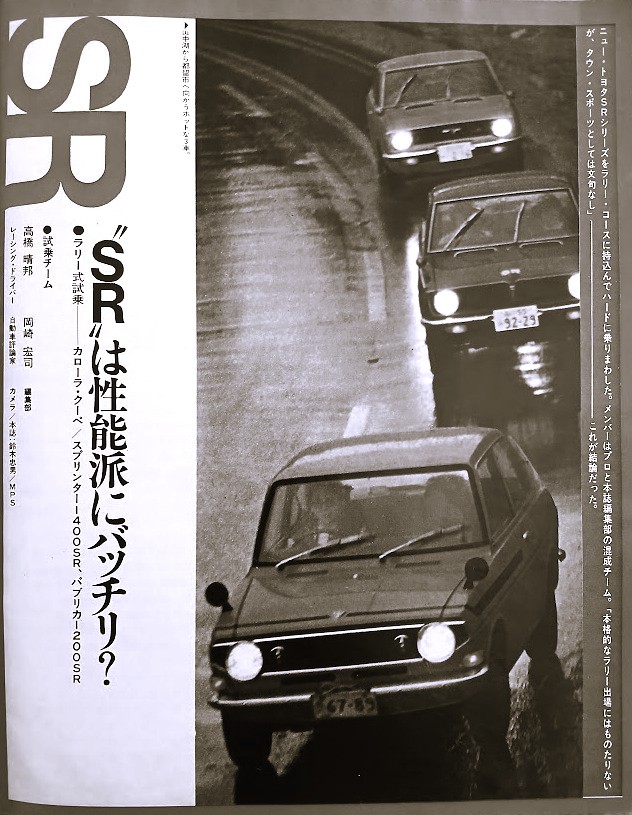
Does the “SR” Hit the Mark for the Performance-Minded?
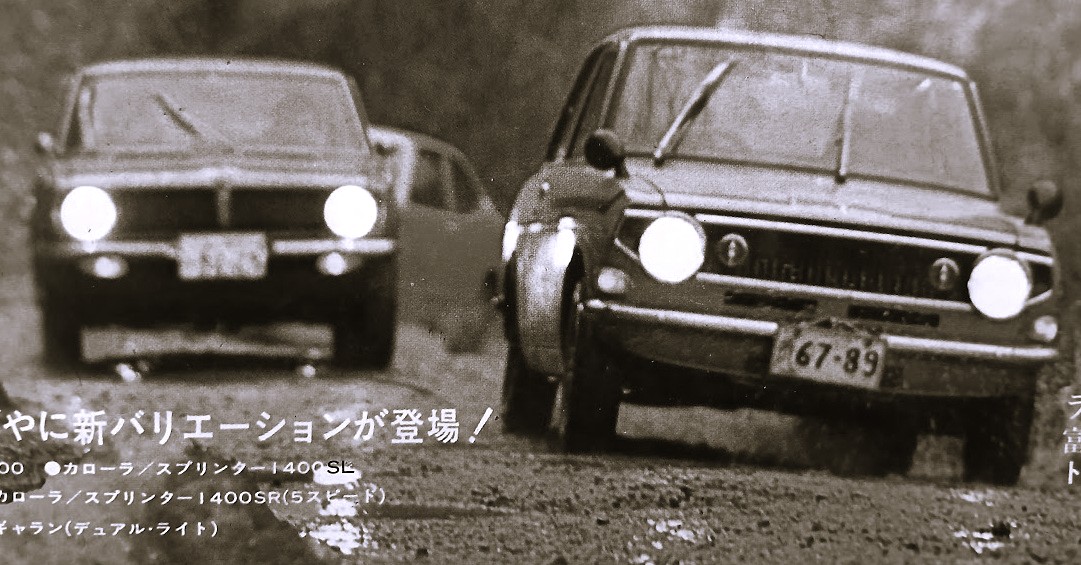
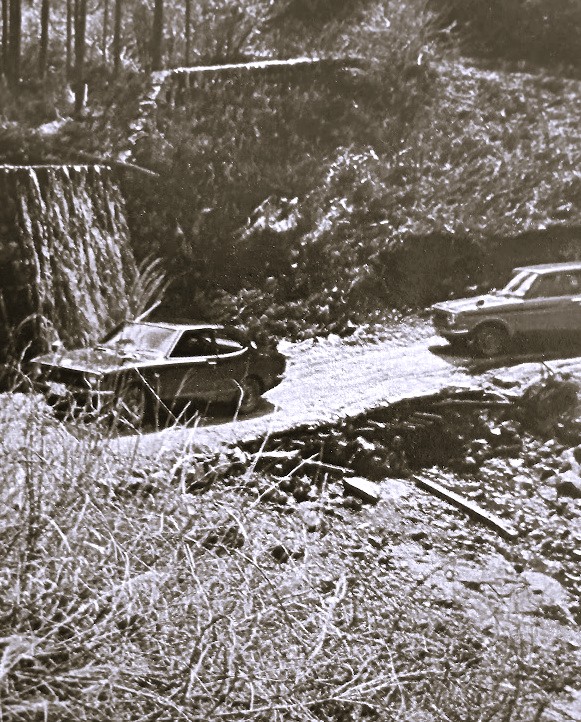
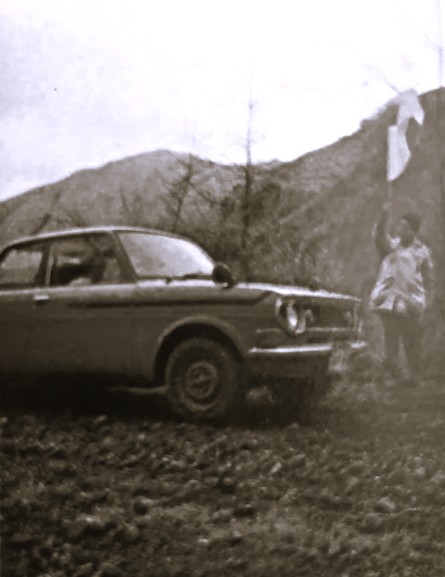
We took Toyota’s new SR series out onto a rally course and drove the cars hard. Our team (appearing as “A,” “B,” “C,” and “D”) was a mix of professional drivers and members of the Motor Fan editorial staff. “Not quite enough for serious rally competition, but hard to fault as a ’town sport’"—that was our conclusion.
Handling: Good Enough for Intermediate-Level Rallying
The biggest difference between the SR and SL is in the suspension. Both spring rates and damper settings have been uprated, while 155SR-13 radial tires are standard equipment.
Rally cars are normally set up with somewhat higher ground clearance, but the SR goes in the opposite direction. At 150mm, it is 20mm lower than the 1200 series and 5mm lower even than the 1400SL.
Although the “SR” designation stands for “Sports Rally,” that is ultimately only a name. The suspension settings appear to have been developed primarily for paved roads, where the car will spend most of its time. In Tokyo, both the Corolla Coupe and Sprinter cost 659,000 yen in SL form, while the SR is priced at 644,000 yen.
A: The suspension is certainly firmer, and the steering response has improved, but I don’t think the cornering performance is dramatically better than the SL’s. The damper rates also seem a little weak for an “SR.”
D: If you consider it as a rally specification, this suspension isn’t quite enough. The spring rates are about right, but the dampers are too weak. As it is, the springs seem to overpower the dampers.
I suppose it’s a compromise that was reached after considering ride comfort, durability and various other factors, but if possible I’d like to see the damper rates raised a little more—particularly at the front…
A: I agree. Driving hard over rough dirt, I bottomed the front suspension twice. Bottoming is something that has to be eliminated, from the standpoint of handling and durability as well as occupant fatigue.
C: But among the people who buy this car, those intending to tackle serious rallies will probably make up only a small percentage. The great majority will use it as a “town sport.” In that sense, isn’t this about the right compromise?
D: Exactly. As a town sport, there’s nothing to complain about.
A: The handling characteristics are mild understeer on pavement, becoming somewhat stronger understeer on dirt. The reverse point into oversteer clearly comes at a higher limit than in the SL, and when the car does go into reverse steer, it is easier to control.
C: I was also left with a strong impression that it’s an easy car to handle.
D: The steering is about 3.3 turns lock to lock, but ideally I’d like less than three. On dirt, being able to apply opposite lock quickly is an important part of controlling the car…. I’d also like a little less play in the steering. That can be adjusted by the owner, of course, so it can be set to suit individual preference….
B: The ride is clearly firmer than the SL’s, but young people who enjoy sporting cars will probably prefer it that way.
D: It was fitted with Bridgestone Radial 10s, but this isn’t a tire for dirt. It’s intended for paved roads. Although the car is called an SR, I think we can take this as another indication that the basic design philosophy is centered on paved-road use.
A: If we judge it in terms of rallying, as the name suggests, there are various shortcomings. But considered simply as a production sporting model, I think they’ve come pretty close to the mark.
D: I agree. Anyone seriously entering rallies would hardly compete with a production car completely as it came from the factory anyway.
But for an intermediate-level rally without special stages, it has enough ability to be quite competitive with little more than a change of tires. In that sense, giving the production model the name “SR” certainly doesn’t promise more than the car can deliver.
Exterior and Interior: Stripping Away the Unnecessary to Improve Performance
The SR is basically the same as the SL series, but its exterior and interior have been given a more sporting atmosphere.
From the outside, it can immediately be distinguished by the “SR” emblem at the front edge of the hood, the broad tape stripe along the body sides, and the wheels without hubcaps.
Inside, almost everything is finished in black, while items such as the radio and console box have been made optional, outwardly emphasizing the car’s functional character.
The exterior and interior treatment clearly gives the impression of a car aimed squarely at younger buyers.
A: Compared with the SL and other models, the differences in appearance are only slight, but they do a good job of giving it the atmosphere of a sporting car. I think it will appeal to young people.
B: The Sprinter SR we tested had a green body, and the yellow of the SR emblem on the front and the side stripes really suited it.
C: Everywhere we went, it attracted a lot of attention from young people. I suppose that proves there’s something about it that really strikes a chord with them.
D: Still, wouldn’t it be better to make the flashy stripes and SR emblem optional? There are plenty of people over thirty who also want a more serious sporting car with things like firmer suspension. As standard, wouldn’t the SR badges on the body side and rear end be enough?
C: Now that you mention it, some people might feel a little self-conscious about those stripes and that showy SR emblem on the nose.
A: If I remember correctly, they’re just adhesive tape, so if you don’t like them you should be able to peel them off.
D: If you did it while the car was still new, before the paint had faded at all from the sun, they probably wouldn’t leave any trace.
C: Those stripes are also available as parts, so if you don’t like where they’re positioned, you could peel off the originals, buy another set and put them wherever you like.
There’s nothing wrong with expressing your own individuality that way.
B: The hubcapless wheels are great. The chrome-plated wheel nuts and center ornaments look good too.
A: The interior is finished entirely in black, and it certainly has the atmosphere of a sporting car.
B: But isn’t the fashion for black interiors already beginning to fade?
D: Black looks purposeful and has a sporting character, but it also makes the interior feel smaller. Sometimes it can even feel a bit oppressive. Personally, I’m not very fond of it.
A: The driving position is good. There’s nothing objectionable about the shape of the seats either. For a small car, there’s also a reasonable amount of space for the left foot….
D: But in something like an SR, I’d like to see at least a footrest for the left foot. There’s certainly enough room to fit a narrow one.
A: The steering wheel is wrapped in vinyl leather, but both its rim thickness and diameter are just right. It feels better in the hands than some poorly executed genuine-leather wheels.
B: There are genuine leather-wrapped wheels with a very poor feel, after all.
D: The pedal layout just about deserves a passing grade, but heel-and-toe work can’t be called particularly easy.
For a car sold on its sporting character, that is an area that needs reconsideration.
C: As for the instrument panel, the layout gives the speedometer precedence over the tachometer. In this type of car, I’d rather see the tachometer given priority. I’d also like oil-temperature and oil-pressure gauges.
B: With the three-point belt fastened, neither the wiper nor light switches can be reached. The positioning of switches in Toyota cars has always bothered me a little, and I wish they would do something about it.
A: The radio and rear defogger are optional, but both are actually necessities in a rally car. The radio in particular is indispensable for checking the time signals.
D: According to the manufacturer, the radio was made optional so that the customer could choose between push-button and automatic-search types…. But I can’t help thinking it’s just a way of lowering the base price.
Engine, Transmission, Brakes: What Does the New 5-Speed Gearbox Offer?
The Corolla/Sprinter SR engine displaces 1407cc. It is a four-cylinder OHV unit with a crossflow cylinder head and twin 2-barrel carburetors. With a compression ratio of 9.6:1, it develops a maximum output of 95ps/6000rpm and maximum torque of 12.3kgm/4000rpm.
The transmission is a fully synchronized 5-speed, the same unit used in the Celica and Carina. Its ratios are those of the 4-speed Corolla 1400 with a 0.861 fifth gear added, but the final-drive ratio has been lowered from the 4-speed’s 4.111 to 4.375. The 0-400m time is 16.8 seconds, and the car is capable of a brisk 170km/h maximum speed.
The brakes are single-cylinder discs at the front and leading-trailing drums at the rear. A PCV device is fitted to the rear hydraulic circuit to prevent premature rear-wheel lockup.
A: This engine is good at low and medium speeds, but its pickup at high revs leaves something to be desired. That may partly be because the car is new, but it just doesn’t want to rev at the top end. The red zone is normally set about 500-1000rpm below the allowable rev limit. I’d at least like an engine to rev smoothly up to the point where the red zone begins.
The SR’s red zone starts at 6500rpm, but from around 5500 the “pickup” suddenly falls away. It’s hardly the sort of engine you expect in a sporting car.
C: For a twin-carb engine, the pickup isn’t very good.
D: In a word, it feels heavy as it revs. It’s a noisy engine, too.
A: As far as engine noise is concerned, I think it’s about average for this class. You certainly couldn’t call it quiet, though….
With an engine having these characteristics, the 4-speed gearbox, with more speed available in first and second gear, might actually be a better match.
D: The ratios through fourth gear are the same, with an overdrive fifth added, but the final drive has been lowered from the 4-speed’s 4.111 to 4.375. It gets away from a standstill slightly better than the 4-speed, and in ordinary driving fourth and fifth can be used from fairly low speeds. On hills, too, third is quite usable. But for a sporting car—and particularly with rallying on mountain roads in mind—there isn’t enough speed range in the frequently used first and second gears.
If you take the engine to 6000rpm, you get about 40km/h in first and 70km/h in second. For rallying, I’d like those figures to be more like 50 and 90km/h, respectively.
B: Can the final drive be changed?
D: The 4.111 used with the 4-speed doesn’t seem to be offered as an option. But the parts are available for the 4-speed, so anyone who genuinely intends to rally this car could buy the 4.111 final-drive parts and change it over.
C: To select reverse, you have to pull the shift lever upward. It’s a little awkward until you get used to it, but I don’t think it would be a problem once you do.
A: There’s nothing to complain about in the ease or certainty of the shift. And I thought the pull-up arrangement for reverse was actually quite good.
B: The brakes are stable and give you confidence to press hard, but I didn’t think their effectiveness was particularly strong.
A: The heavy pedal effort at low speeds bothered me a little. If possible, I’d like a booster.
D: A relatively small-capacity booster with good response would be fine, but if it made the braking feel indirect or introduced any time lag, I’d rather do without one. If it were up to me, I’d do without the servo and use something like a larger brake pedal instead.
Publica 1200 SR: A Spicy Little “Town Sport”
The Publica SR is a model that further improves on the SL’s driving capabilities while dispensing with equipment such as the radio, cigarette lighter and floor carpeting. The improvement in performance lies principally in the running gear, including firmer suspension and radial tires as standard equipment.
In Tokyo, the SR costs 480,000 yen, 15,000 yen less than the SL at 495,000 yen. In other words, the character—and the value—of this car lies in eliminating the unnecessary while improving its functional qualities.
The engine, transmission and brakes are the same as those of the SL.
Externally, the SR is distinguished from the SL by its broad side stripes, the SR emblem on the trunk lid, blacked-out front treatment and special wheel rims. The interior is basically the same as the SL’s, the principal differences being the absence of a console box and the leather-wrapped steering wheel.
D: This is a car that puts function first.
B: I like the fact that it isn’t over-decorated.
C: It may be small, but it has a real bite to it. You get that impression particularly strongly when you’re behind the wheel.
A: If possible, I’d like the steering wheel to be a little more upright. One of the Publica’s weak points is its high center of gravity, and to help compensate for that I’d like them to reconsider the seat position and the position and angle of the steering wheel.
D: I suppose the current arrangement is intended to preserve space in the rear seat.
C: You don’t get a particularly sporting driving position, but somehow I find it quite agreeable. You might say it’s a position that anyone can feel at home with.
B: I have some reservations about the switch layout. It’s not good to have the light and hazard switches positioned so close together, and at night the wiper switch is extremely difficult to find. This is something I definitely want them to correct.
A: The steering wheel is leather-wrapped, but it’s really hardly more than a toy covered in cheap leather. The vinyl-leather wrapping on the Corolla’s wheel is far better.
C: The engine really does rev well. The K-series engine in this Publica feels much better than the T-series engine in the Corolla 1400.
A: It pulls extremely well at high revs. It’s a good engine.
B: It feels like an engine you can count on. Compared with the Corolla, it just keeps pulling strongly.
D: Put the Corolla’s 5-speed behind this engine and I bet you’d have an exceptionally quick car.
A: It does seem a little weak at pulling from low revs. Coming out of a tight corner, for example, there’s quite a difference between using some clutch slip and not using it.
C: The rear axle hop under hard acceleration isn’t good, either.
A: The basic handling characteristic is mild understeer, but the reverse point isn’t particularly high, and the transition into oversteer is quite sudden. Considering the light rear end and short wheelbase, some of this may be unavoidable, but even so, rear-end grip is weak.
D: On dirt it’s easy to make the car slide, so under conditions where absolute speeds are low and there’s a succession of tight corners, I think it could actually be quite fast.
A: On dirt, the fact that it reaches the reverse point easily at low speeds makes it suitable, in one sense, as a beginner’s car. It would still be dangerous in places where there’s more than enough power, of course, but on an uphill section where the car is relatively underpowered, you should be able to practice sliding without too much risk. The price makes it ideal as a beginner’s car as well….
D: For charging over rough roads, I’d still like somewhat higher damper rates. The front in particular feels a little weak in compression.
C: On paved roads it rolls, but it seemed to hold the road quite well.
D: I don’t particularly like the way it rolls, though. Rather than building up an amount of roll appropriate to the cornering force, it feels as though it goes straight to full roll the moment you enter a corner.
A: With this kind of roll characteristic and the high center of gravity, a sudden steering input on a high-grip surface can easily cause the inside wheels to lift.
B: So our conclusion seems to be that, for a sporting car, we’d like to see the suspension taken one step further.
Final Thoughts
A: Taking price, performance, and exterior and interior treatment together, the Corolla/Sprinter and Publica SRs are clearly cars aimed at younger drivers.
B: The Publica in particular is attractive because its price is low for the performance it offers.
A: The Corolla/Sprinter SR is just right for someone who uses their car mainly for recreation and enjoys driving for its own sake. I think it also has the makings of a good basis for a rally car.
The Publica, being inexpensive enough to use without worrying too much about it, is well suited to someone who wants to learn the various techniques of driving on rough roads.
C: Kits for serious racing or rally cars are readily available, but there are no sports kits intended for cars driven on the street. Until now, tuning a car as a town sport has been difficult. The SR—particularly the Corolla/Sprinter—is a welcome car for anyone who wants high performance in a town sport.
D: Sporting models up to now have tended to focus simply on increasing engine power while leaving the running gear much the same as on the standard car. In that sense, you could say this is the first true “town sport” to appear. In its way, isn’t that something of an epoch-making development?
C: I’m sure the appearance of the SR will prompt other manufacturers to introduce serious sporting models with uprated running gear as well. For young enthusiasts, this could turn out to be an interesting year.
Postscript: Story Photos