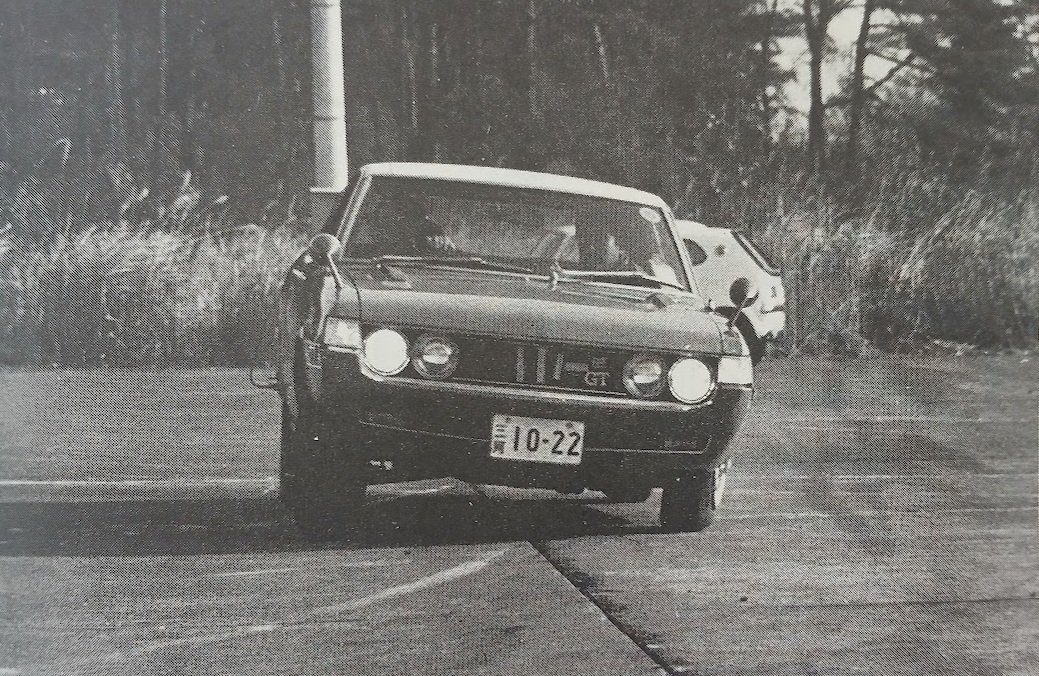
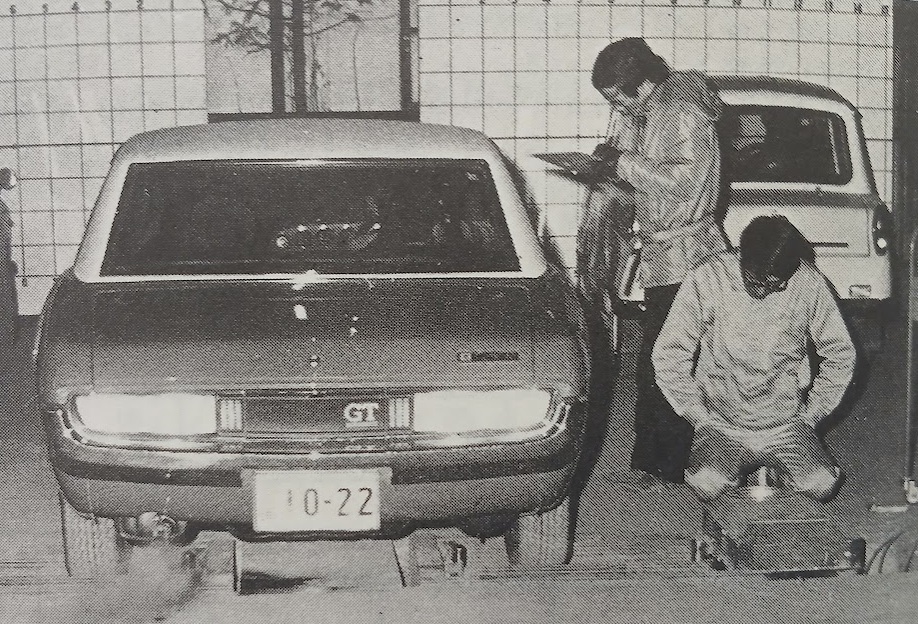
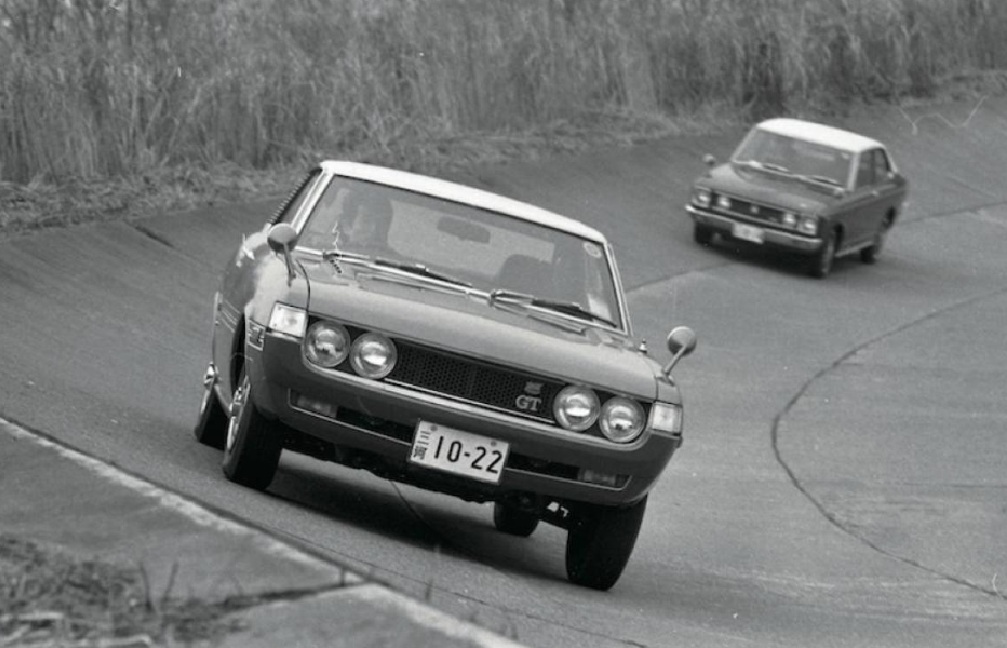
Toyota Celica 1600GT and Toyota Carina 1600ST (1971)
Publication: Motor Fan
Format: Road Test
Date: March 1971
Author: Katsuhiko Nishida, Kenji Higuchi, Yasuhei Oguchi, Hiroshi Okazaki, Atsushi Watari, Akira Miyagawa, Kiyoshi Matsumura, Kunitaka Furitani, Masahide Sano, Hiroshi Hoshijima, Tadashi Nishiyama, Katsumi Kageyama, Yasu Saito, Kenzaburo Ishikawa, Akio Numazawa, Toshihide Hirata, Kiyoki Higuchi, Motor Fan Editorial Department (uncredited)
Aiming for “People First”
Magazine: To begin with, could you tell us about the aims and general outline behind the development of the Carina and Celica?
Nishida: The Carina is a car intended to cover as broad a range as possible between the compact-car class and the mass-market-car class. If you think of our model line as a tree, there are branches such as the Century, Crown, Corona, Corolla, and Publica–but we felt there could be room for another branch among them, and that is how the Carina was developed. The Carina is, at its core, a sporting family sedan. The Celica, while sharing certain engines and components, is an entirely different kind of car–what you would call a “specialty car.”
In development, we set out five principal objectives.
- High performance, yet easy to use, with responses that faithfully follow the driver’s intentions.
- Durability and long service life, with good economy.
- Thorough consideration for safety–not only in the things you can see, but in the finer details as well, aiming at real, substantive safety. For example, wiring and piping have been treated with particular care.
- Careful attention to meeting the demands of sustained high-speed driving. With this in mind, we developed a new 5-speed transmission to reduce driver fatigue, and have adopted it across as many models as possible. At the same time, we placed emphasis on low-speed torque, so that the car can also cope well with urban driving.
- In keeping with the age of diversification, we prepared two-door and four-door bodies, a range of engines and transmissions, and a wide selection of options, so as to meet a variety of needs. Rather than the manufacturer presenting a fixed specification, the idea is for the user to assemble a car to their own taste. Even the enjoyment of the “shopping” process was taken into account–in short, we pursued a “people first” approach throughout.
As for the transmission, it was developed to be light, compact, and economical. The synchronizers have been strengthened, and the direct shift action lightened. Internally, needle roller bearings are used. The suspension employs MacPherson struts at the front, and a four-link arrangement with a lateral rod at the rear, reducing unsprung weight and friction. Particular attention was given to increasing rigidity in the suspension and its mounting points, contributing to handling and stability; rear coil springs were adopted to enlarge the luggage space and lower the center of gravity. The aim was an overall balance of effects, with special emphasis placed on high-speed stability and controllability.
The brakes are discs at the front and leading-trailing drums at the rear, with a large booster and a proportioning valve.
As for the Carina’s body, the basic thinking follows much the same lines as the Corona.
The Celica, on the other hand, was developed as an entirely new shape. Particular emphasis was placed on securing adequate body dimensions, and despite its low overall height, we believe it offers comparatively sufficient interior space.
Matsumura: The demands placed on engines have become increasingly severe lately. High-speed running is now a necessity, but at the same time, slow, stop-and-go driving remains common, and exhaust emissions must also be addressed. Accordingly, following the development objectives just outlined, our first aim was ease of use–not only at high speed, but in practical everyday conditions, and with a high degree of reliability against all forms of trouble. To that end, we carried out testing specifically to improve reliability, including low and high temperatures, with real-world vehicle testing in locations with those conditions.
Quietness was another requirement, and we worked to eliminate peak noises across the entire speed range. We addressed such factors as bending vibrations in the powerplant at high engine speeds, intake noise, and reflected noise in the valve system one by one.
With regard to exhaust emissions, and looking ahead, we considered not only CO but also hydrocarbons and NOx, and aimed to incorporate this thinking into the basic design of the present engine. Accordingly, attention was paid not only to air-fuel ratio in the carburetor, but also to fuel atomization, as well as the shapes of the combustion chamber and the intake and exhaust systems. As for fuel consumption and oil consumption, we believe they are entirely acceptable for this class.
Magazine: Doesn’t the Carina overlap somewhat with the Corolla, Corona, and Corona Mark II?
Nishida: I think there are some differences in vehicle class. Within the intermediate range between compact and mass-market cars, it might be said to lean somewhat toward the compact-car side. And in terms of thinking and overall feeling, it may be good for us to offer something with a slightly different character.
Magazine: So, is it roughly between the Corolla and Corona?
Nishida: Yes, that’s about right.
Higuchi: From a buyer’s standpoint, looking at the price, it seems to be almost the same as the Corona.
Magazine: From the perspective of a full model lineup, how does that work?
Nishida: To put it in somewhat extreme terms, it’s similar to GM having both Pontiac and Buick.
Magazine: So there’s also the matter of sales channels.
Nishida: Exactly.
Magazine: The Celica stands apart, of course, but what is meant by the term “specialty car?”
Nishida: In the original sense, it refers to something specially prepared for the individual user, outside the usual price framework. And beyond that, a certain novelty–or forward-looking character–is also one of the conditions of a specialty car.
Can You Really Choose the Car You Want?
Magazine: The “Full Choice” ordering system–would that be one of the conditions of a specialty car?
Nishida: I would think so, yes.
Magazine: We’ve heard it amounts to something like ten million combinations.
Nishida: Well, the number itself doesn’t have much meaning, but if you include differences in color, it would come to something on that order.
Magazine: How does the system actually work?
Nishida: Up to now, for example, when a customer ordered an SL model, the appearance and content were fixed for that SL grade, and there was no scope for choice within it. This time, we have broken things down into components–body, engine, interior, and so on–and created combinations that allow free selection. That is the major difference.
Magazine: When a user actually makes a selection, how is it handled at the factory? We assume a computer is involved…
Nishida: Normally, fully completed cars are built in advance, but in this case we prepare the individual components up to the point just before final selection. Then, the required combination is assembled as directed by the computer. For example, the body is handled using a new method called the Gate-Line System.
Higuchi: From the user’s point of view, that’s very appealing. From the manufacturing side, however, unless a fair degree of commonality is maintained–seats, steering, interior components–there would be little advantage. If you look at cars from GM, for instance, the differences are largely in the radiator grille, fenders, and tail lamps, yet the overall impression changes considerably. This car seems to be doing something similar to a certain extent. It was quite evident in the interior–how about in the body?
Nishida: The body may appear entirely different, but in fact a considerable number of parts are shared.
Higuchi: For example, the doors are the same dimensions across the Corona line, but by changing the styling accents, each version gives a completely different impression. In this sense, parts-sharing is not a matter of disguising things, but of producing something of good quality at reasonable cost. With too many variations, unless serviceability is carefully considered, it can become a disadvantage.
Nishida: Those points are fully taken into account in the overall product planning.
Magazine: In practice, we imagine there won’t be ten million actual orders, and things will settle into a few typical combinations. We suppose that, too, can be anticipated by computer. (laughs)
Nishida: After a month or so, one can understand user preferences from the previous month’s trends, so that is certainly possible. The point is that we have a system capable of producing those ten million variations at any time.
Oguchi: From the factory side, producing ten million variations may be manageable, but it would be more difficult on the sales side. With that many possibilities, it becomes impossible for the human mind to organize them. From the buyer’s standpoint as well, couldn’t there be confusion–too many choices, and no clear sense of which to select?
Higuchi: I would want to see sample combinations, along with a detailed price list.
Nishida: That has been prepared in booklet form.
Higuchi: So it’s possible to have, let’s say, a standard body with twin carburetors, a 3-speed transmission, and disc brakes?
Okazaki: In practice, you can’t combine functional components quite so freely. When you try it with the “carputer,” the combination I’d personally like–a low-priced body, DOHC engine, rear defogger, high-grade tires–doesn’t work. In the end, it becomes an expensive car. (laughs)
You also end up with things you don’t need, like a clock–and if, say, you don’t want a radio but do want a heater, you’re forced into buying the deluxe interior.
Watari: However cleverly it’s presented, it’s still like a bear in a cage at the zoo–you can walk around all you like, but you’re still inside the cage. (laughs)
Magazine: Is this “carputer” available at all dealers?
Nishida: It’s currently being tested at five dealers in the Nagoya area.
Okazaki: It’s fun to use. In the end, though, one tends to choose the “recommended” specification. That can be delivered in about four days, whereas a fully personalized order takes about a month… (laughs)
Nishida: At first that may be the case, but once things settle down, even a “custom” car should be deliverable in around ten days.
Oguchi: Can individual components be selected freely?
Nishida: The powertrain is treated as a unit. Once the engine and transmission are decided, the driveline and axle are matched accordingly.
Miyagawa: Also, the DOHC engine is limited to the GT specification.
Oguchi: So it’s not a matter of selecting individual parts, but is it possible to choose by performance characteristics? For instance, prioritizing ride comfort and fuel economy, while accepting moderate performance…
Nishida: At present, no.
Oguchi: It would be desirable if that became possible in future, though there may be conflicting requirements.
Miyagawa: For the time being, we have established a system for selecting components. If possible, we would like to take it further. However, if the powertrains were subdivided too finely, each variation would require separate approval from the Ministry of Transport.
Higuchi: If you told the Ministry there were ten million variations, that would be quite something. (laughs)
Watari: It would be easier if users could just bring in their own specifications… (laughs)
Daring to Choose OHV
Magazine: Regarding the engine, is there any commonality with the Century?
Matsumura: In the Carina and Celica series, the 1400cc engine is offered in one version, and the 1600cc in three versions. That doesn’t mean we simply borrowed heads, pistons, or connecting rods from existing engines. Rather, we approached the new series as a unified group, giving the engines some variety while still keeping production efficiency in mind.
Magazine: Worldwide, OHC engines are becoming more common. Why, then, deliberately choose OHV…?
Matsumura: OHC is certainly fashionable these days, but we felt that even without adopting OHC, we could achieve the same functional results. With a single OHC, there can be a certain amount of strain on the combustion chamber. By paying particular attention, we found that even an OHV engine can reach the necessary engine speeds to meet modern requirements. For this 1600cc engine, the maximum allowable speed is 6500rpm. For higher performance beyond that, we turn to DOHC.
Higuchi: In the past, OHC was more expensive, but today I don’t think you can say one is definitively more costly than the other. For example, with this engine, the use of double rocker arms increases the parts count, so a single OHC might even be cheaper in some cases.
Nishida: The point is, we achieve the same functionality as OHC, with reliability and good serviceability.
Magazine: How about quietness?
Matsumura: At high speed, OHV is naturally noisier. That’s why we worked carefully, tuning each part in noise tests to bring it down.
Magazine: Wouldn’t an OHC be easier to use at low speeds?
Matsumura: It isn’t that straightforward. Once the engine is installed in the car, it really comes down to design and how everything is put together.
Magazine: We understand the Celica had two competing design teams. How did that work?
Nishida: For that car, as with others, multiple proposals were developed, and the final choice was selected from among them.
Miyagawa: Usually, a design is constrained by overall size and engine layout. With the Celica, our so-called Advance Group was involved, which allowed the design to take a more leading role than usual. Still, I wouldn’t call it a competition in the strict sense.
Oguchi: When I first saw photos of the Celica, I thought it looked a bit like “Keroyon,” but the actual car gives a completely different impression, in a good way.
Watari: The side view is the best angle for the Celica. The Carina’s rear styling isn’t really to my taste, though…
Higuchi: The rear is reminiscent of older American cars, isn’t it?
Magazine: The Carina looks quite slender.
Higuchi: It’s not over-decorated; there’s a European sensibility to it.
Magazine: Between the Carina and Celica, which would you say is better?
Higuchi: That depends on how it’s going to be used. The Carina is easygoing, comfortable for everyday use. In the Celica, on the other hand, you have to pay a bit more attention to your outfit…
An “Honest Car”
Magazine: Let’s have the results of the performance tests, please.
Furutani: In 0-400m acceleration, the Carina ST recorded 17.1 seconds, while the Celica GT did it in 16.1 seconds.
As for overtaking acceleration, up to around 100km/h the Carina actually has the edge, in both third and fourth gears. At higher speeds, though, the Celica begins to pull away.
Oguchi: That would be where aerodynamic drag starts to come into play, wouldn’t it?
Nishida: Yes, I think so.
Watari: Even so, in town the Celica felt easier to drive.
Magazine: The transmission and final drive are the same in both cars, aren’t they?
Miyagawa: The difference comes down to engine characteristics and weight. And aerodynamics as well–the Celica sits about 75mm lower than the Carina, and with that shape, there’s a noticeable difference in drag.
Matsumura: At lower engine speeds there isn’t much difference between them, but the Carina’s 2T-B engine seems to have slightly better, more sustained torque. That said, the carburetion differs–the Carina ST uses twin downdrafts, while the Celica GT has twin Solexes. The sharper response of the Solex setup probably contributes to the better feel in city driving.
Oguchi: Particularly with the Celica, when I got in and drove it for the first time, I felt that it responded in a very natural, “honest” way. It almost made me feel like my driving had improved.
Watari: Even though the suspension and steering are basically the same, the overall feel is quite different.
Nishida: The spring rates differ slightly, but in both cars, even if you push fairly hard, it remains easy to gather things up again.
Magazine: How were the fuel economy results?
Sano: In the model-driving test, at a target speed of 40km/h, the Celica GT returned 9.8km/l, and the Carina ST 11.5km/l. At a target speed of 60km/h, the figures were 8.9 and 10.0km/l, respectively.
For steady-speed consumption, the Celica GT actually does better at 80km/h than at 30km/h–that is, it’s more of a high-speed type. The Carina ST is better at low to medium speeds, but the curves cross over from about 80km/h.
Magazine: Those are good results. Were these taken in fifth gear?
Sano: Yes, both the steady-speed and model-cycle figures included fifth.
Magazine: So in effect, that’s like having a relatively tall final drive.
Sano: With a final drive of 4.111, if the overdrive top were taken as a direct 1.000, it would work out to about 3.463.
Magazine: Can you drive in fifth at 40km/h?
Sano: With the Carina, it was said to be possible down to about 20km/h.
Hoshijima: The 5-speed is clearly one of the car’s selling points. It’s certainly good for economy, and it’s quiet, as well as being light and compact. But the shift feel is perhaps a bit too notchy. It lacks a certain smoothness.
Magazine: Are the shift throws long?
Hoshijima: Not especially–no more so than, say, the Corolla.
Also, I felt the Carina was the quieter of the two, but there was a slight resonant noise during deceleration. The Celica didn’t have that at all.
Magazine: What did the noise measurements show?
Nishiyama: We took measurements on a Carina Super Deluxe. Interior noise levels were 63 phons at 40km/h, 68 at 60km/h, 72 at 80km/h, 75 at 100km/h, and 80 at 120km/h, all in fourth gear.
Exterior noise was 72 phons at steady speed, and 79 under acceleration.
As for suspension vibration frequencies, the sprung mass was in the 1.35-1.40Hz range, and the unsprung mass about 11.5Hz.
Watari: I wouldn’t say the cabin is especially quiet. With an overdrive top gear, it ought to be quieter still–there may be a peak somewhere.
Nishiyama: On the A-scale it’s nearly linear, but on the C-scale there are peaks around 50 and 70km/h.
Watari: One thing I’d comment on is the Celica’s exhaust note. With all the talk of noise pollution these days, a sports car that slips by quietly has a certain appeal.
Kageyama: That deceleration noise Hoshijima mentioned–I noticed it as well. On the Carina, that is.
Higuchi: In the past, if a car was noisy, people would simply add soundproofing material here and there. But as design has progressed, cars have become quieter overall. On the other hand, with the increased use of hard plastics in the interior, you sometimes get noises when the body twists.
Watari: Around the inside of the doors, or the seats, for example.
Higuchi: Yes—the Carina uses harder materials on the inside of the doors, while the Celica uses softer ones.
Nishida: The Celica also adopts a new molded headliner.
Watari: Perhaps it’ll quiet down a bit once summer comes. (laughs)
Unusual Handling for a Toyota
Magazine: Let’s move on to the results for handling and stability.
Saito: The tests were conducted with the Celica GT. Starting with the practical minimum turning radius, it came out at 5.225 meters–quite a tight figure, second only to the Galant GTO and Capri 1600.
At a standstill, steering effort is on the heavy side, with a maximum of 20kg to the left and 19kg to the right.
As for understeer and oversteer characteristics, it shows a moderate degree of understeer at medium speeds, which eases off at higher speeds. At a V² of 100, the R/Ro value is about 1.28.
The roll angle is around 4°, which is slightly on the high side by current standards.
Both the steering effort and the effort to hold it in a turn are fairly heavy. In a 0.5Hz slalom, the effort per degree of steering angle is somewhat high, while the yaw rate per steering angle is also on the higher side–in other words, the steering gain is relatively large.
Hands-off stability was tested up to 120km/h, and in general the car shows well-behaved convergence back to a straight path. One notable point is that the oscillation period is rather short, at about 0.8 seconds.
Watari: The Celica’s steering feels heavier than the Carina’s.
Nishida: That’s intentional–we didn’t want to make it too light.
Watari: Are the tires different from the Carina’s?
Nishida: Yes. The Celica uses 165H-13-4 tires, while the Carina’s are 6.45-13-4.
Ishikawa: What about alignment differences?
Numazawa: The basic geometry is almost identical, but the Celica uses gas-filled shock absorbers.
Higuchi: For a Toyota, not only the styling but also the steering feel is rather different. Was that deliberate?
Oguchi: In terms of feel, there’s quite a noticeable difference between the Celica and Carina. The tires must play a part, but the dampers as well, I imagine.
Nishida: The height of the center of gravity is different too.
Oguchi: In particular, the Celica’s steering response and rigidity don’t feel very “Toyota-like,” and the rear follows through very nicely.
Numazawa: From the initial planning stage, we did intend to give it something of that character.
Oguchi: It feels close to neutral, and very pleasant through corners.
Magazine: You say it doesn’t feel like a typical Toyota–was that mild understeer part of the design target?
Nishida: Personally, that’s the direction I had in mind.
Numazawa: I think a tendency toward neutral handling is becoming the general trend.
Watari: I wonder if they changed the rear suspension to suit European preferences?
Okazaki: Before the road test, I had a chance to run it on a circuit. When you really increase the speed, the understeer actually becomes stronger–the front starts to push quite early. Rather than holding that understeer all the way through, I think a gentler transition toward oversteer might be preferable.
Oguchi: You might be able to adjust that with tire pressures…
Numazawa: From a safety standpoint, we feel it’s better to retain a certain degree of understeer.
Magazine: Could we have the figures for weight, alignment, and braking?
Ishikawa: The Celica GT weighs 971kg. Its front/rear weight distribution is 57:43, slightly more front-heavy than the Carina ST’s 56:44.
With changes in passenger load, the Carina’s distribution remains almost unchanged, whereas in the Celica the front load decreases. In other words, the seating position in the Celica GT lies somewhat behind the center of gravity.
As for alignment, the Celica has slightly greater front toe-in and less camber, while the Carina uses a moderate camber setting. At the rear, the Celica is nearly zero toe-in with some negative camber, whereas the Carina has toe-out and essentially zero camber. These values don’t change much with additional passengers.
Regarding braking, at 0.6g deceleration, the pedal effort is 27.5kg for the Celica and 26kg for the Carina–virtually the same. The servo’s rest point is around 25kg.
In the road test, pedal effort when decelerating from 50km/h was slightly lower than in bench testing–about 25kg for the Celica at 0.6g deceleration. The Carina showed some variation, but was around 20kg.
Since the road surface was wet, we tried applying about 50kg of pedal force to see how the proportioning valve would behave. It didn’t feel like the wheels locked, but the rear stepped out to the side quite noticeably. Looking at the data, we realized that there was a left-right imbalance.
Front-to-rear brake force distribution, at around 25kg pedal effort, is 55:45 front to rear. This is a relatively low load on the front. The parking brake was very effective.
Magazine: That front bias in braking seems a little low.
Ishikawa: Yes, that’s been typical of Toyota. I suppose the idea is to preserve as much steering control as possible.
Magazine: And the braking feel?
Ishikawa: In terms of feel, it’s quite good. Even with the imbalance we noted, their effectiveness is impressive–that left a strong impression.
Relaxing Front Seats—Celica
Magazine: Let’s hear the results on visibility.
Hirata: For the Celica GT, the forward field of view measures 1.39 steradians, of which the wiper sweep covers 0.379 steradians, about 63% of the windshield. The rearward field of view is 1.2 steradians. The interior mirror provides a total of 0.107 steradians, which gives a very good rearward view.
For the Carina, the forward field of view is 1.5 steradians, with a wiper-swept area of 0.411 steradians—about 74% of the windshield. The rearward field is 1.3 steradians, and the rearview mirror covers about 69% of the rear window area.
As a comparison with data from previous tests, total visibility generally falls in the range of about 2.2 to 3.2 steradians, so the Celica and Carina, at around 2.5 to 2.6, can be considered quite typical figures.
Magazine: How do the two compare with each other?
Hirata: At 2.6 versus 2.58, there’s very little difference.
Magazine: And in terms of the feel while actually driving?
Hoshijima: From the driver’s standpoint, they do feel rather different. If I were driving alone, I’d prefer the Celica. But if we’re speaking strictly in terms of visibility, it’s harder to say.
Magazine: Visually, the Carina gives a brighter impression inside.
Hoshijima: Taken as a whole, though, the impression from the Celica’s driver seat is the more agreeable. One point I noticed was that the interior mirror is a little small.
Also, whereas Toyota dashboards have traditionally had a rather luxurious feel, the Carina seems to have lost that somewhat. That may simply be because other cars have caught up, but in that sense, I’d like to see the Celica take a further step—something that really captures the imagination of younger drivers.
Magazine: Let’s have the data from the Higuchi laboratory.
Higuchi: To begin with the Carina: it was said to aim at a position between the Corona and Corolla, but in terms of dimensions it is quite close to the Corona. Overall length is 35mm shorter than the Corona, and 90mm longer than the Corolla. Width is the same as the Corona, and the wheelbase differs by only 5mm.
Interior length is also almost identical to the Corona, again within 5mm. Around the instrument panel, it resembles the Corona, while the seats seem closer in character to those of the Corolla.
The shift lever stroke is 65-70mm in the shift plane and 40-50mm in the select plane, so there isn’t much difference between the two. It might be better if the select movement were slightly shorter. The main issue is engaging reverse–once you’re used to it, it’s fine, but if you simply push it toward the gate in the usual way, it doesn’t go in easily.
As for the Celica, its width is 1600mm, making it wider than the Corona. For a specialty car like this, where there are typically only one or two occupants, overall length is less critical, and in that sense the dimensions are appropriate.
The interior is naturally centered on the front seats, and it would feel cramped with five passengers aboard for any length of time. The front seats have a sliding range of 160mm, and the distance from the center slide position to the pedals is 925mm. With the figure for domestic cars generally being around 850mm, this allows drivers of almost any size to find a comfortable position.
Because of the body’s relatively tall “hips” at the rear, rearward visibility at an angle when parking is slightly restricted, though this is largely a matter of familiarity.
The trunk in both cars carries the spare tire upright on the right-hand side. The fuel tank is located beneath the trunk floor, leaving ample luggage space.
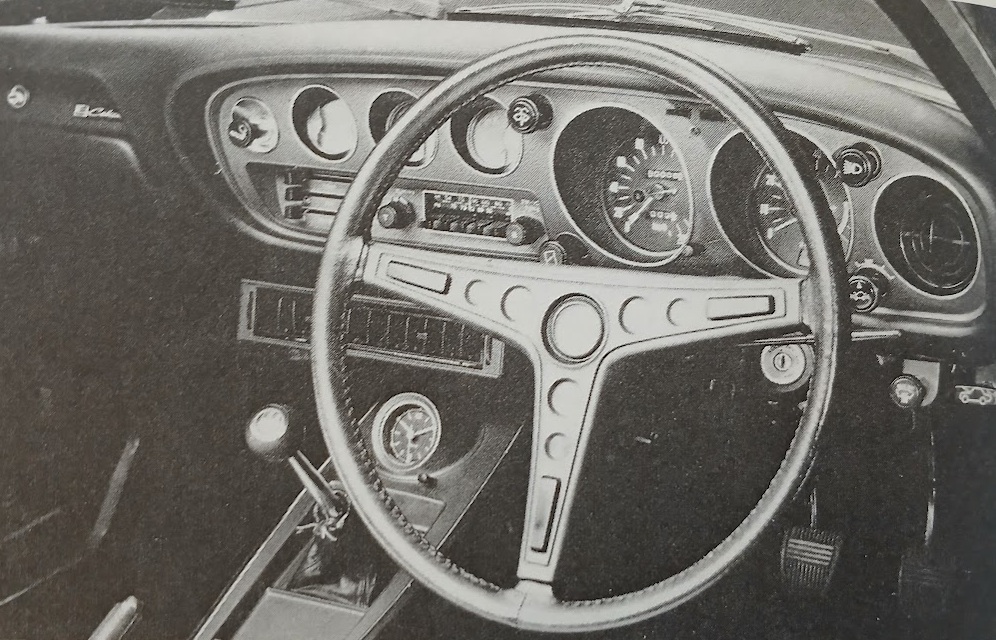
The instrument cluster is fully equipped–tachometer, water temperature, ammeter, oil pressure, and fuel gauge–giving a very complete impression.
In terms of safety, the Carina ST scores 90 out of 100, while the Celica, with slightly higher marks in interior-related items, scores 92. Both figures are comparable to those of 2-liter-class hardtops.
Magazine: About engaging reverse gear…
Hoshijima: Once you learn the technique, it’s no problem. If you pull the lever slightly toward you as you shift, it goes in easily enough.
Magazine: Finally, could you tell us about production plans?
Higuchi (Kiyoki, Toyota Motor Sales): For December of 1970, we expect around 7,500 units of the Carina and about 3,000 of the Celica. For the 1971 fiscal year, the plan is roughly 15,000 Carinas and 10,000 Celicas.
Magazine: And exports?
Higuchi: Nothing definite yet, but we expect to begin around spring, at a rate of 5,000 to 6,000 units, mainly for the US market.
Magazine: Thank you all very much.
Postscript: Story Photos