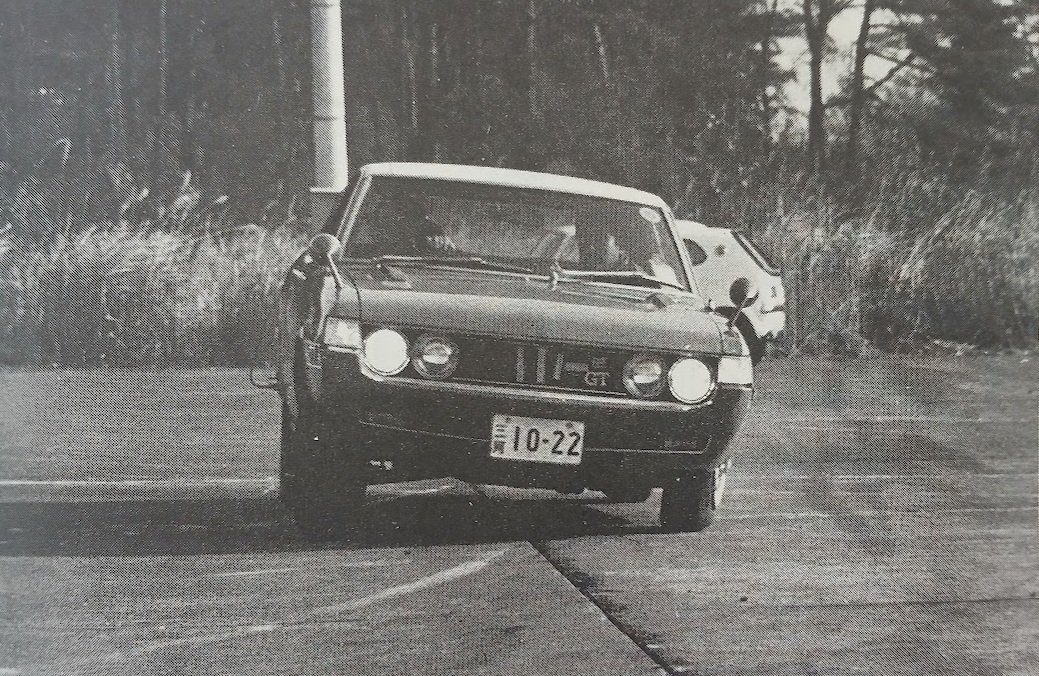
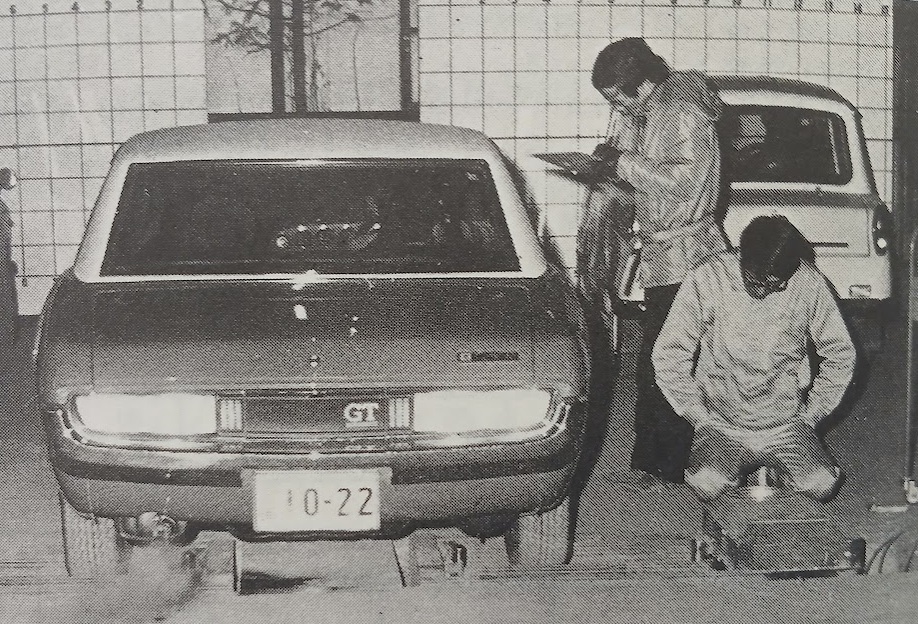
Toyota Celica 1600GT and Toyota Carina 1600ST (1971)
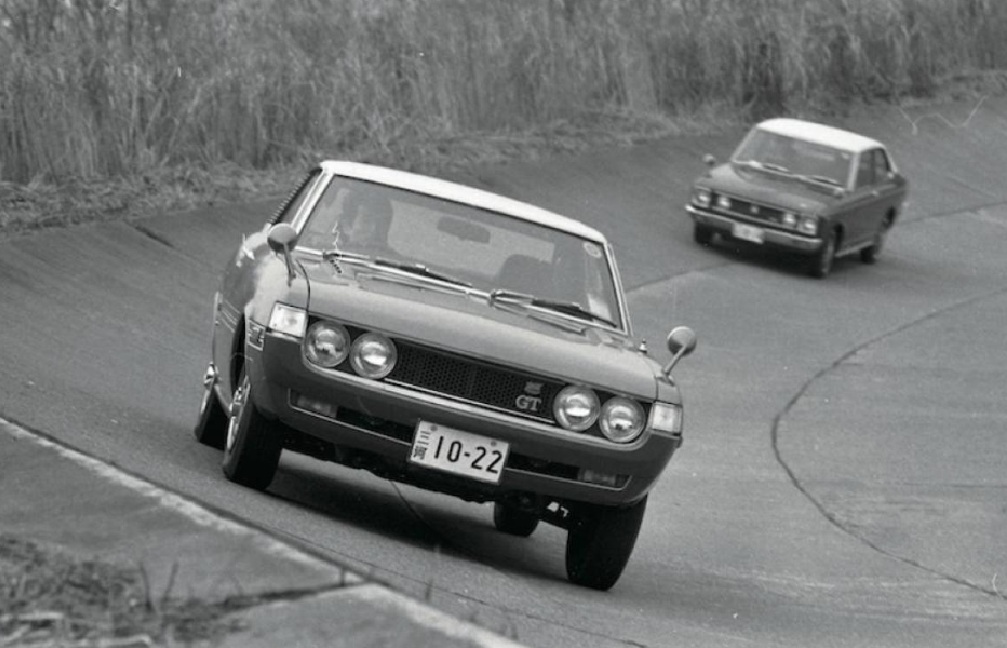
Publication: Motor Fan
Format: Road Test
Date: March 1971
Author: Katsuhiko Nishida, Kenji Higuchi, Yasuhei Oguchi, Hiroshi Okazaki, Atsushi Watari, Akira Miyagawa, Kiyoshi Matsumura, Kunitaka Furitani, Masahide Sano, Hiroshi Hoshijima, Tadashi Nishiyama, Katsumi Kageyama, Yasu Saito, Kenzaburo Ishikawa, Akio Numazawa, Toshihide Hirata, Kiyoki Higuchi, Motor Fan Editorial Department (uncredited)
The Aim Is to Put People First
Magazine: First, please tell us about the development goals and outline of the Carina and Celica.
Nishida: The Carina is a car that aims to fill as wide a space as possible between compact cars and mass-market cars. If we liken the Toyota lineup to a tree, there are various branches such as the Century, Crown, Corona, Corolla, and Publica, but we thought it would be nice to have one more branch within that, so we developed the Carina. The Carina is a sporty family sedan, and although the Celica shares the same engines and some components, it is a completely different car from the Carina, a so-called “specialty car.”
We set five goals for development.
- High performance, easy to drive, and responsive to the driver’s intentions.
- Strong, long-lasting, and economical.
- Sufficient consideration for safety. In other words, we paid attention to even the smallest details and made every effort to ensure practical safety, not just the appearance of safety. For example, we took strict measures in the design of the wiring and piping.
- We took sufficient measures to meet the demands of continuous high-speed driving. To this end, we developed a new 5-speed transmission to prevent passenger fatigue, and we are using it in as many car models as possible. At the same time, we emphasized the low-speed torque of the engine so that it can also handle low-speed driving in cities.
- In order to meet the needs of this age of user diversification, we have prepared 2-door, 4-door, several types of engines, transmissions, and a wide range of options. The direction we are moving in is for manufacturers not to make pre-prescribed cars, but to assemble cars that meet the user’s preferences. We aimed to thoroughly adopt a “people-first” approach, taking into consideration aspects such as the fun of shopping.
As for the transmission, we developed it to be lightweight, compact, and low-cost. We made the synchro stronger and made it lighter by using a direct shift. Needle roller bearings are used inside. The suspension uses MacPherson struts in the front and a 4-link system with lateral rods in the rear to reduce unsprung weight and friction. In particular, the rigidity of the suspension was increased to contribute to maneuverability and stability, and coil springs were used at the rear to enlarge the trunk space and lower the center of gravity. We placed particular emphasis on maneuverability and stability at high speeds.
The brakes are discs at the front and leading/trailing drums at the rear, with a large booster and a proportioning control valve.
The ideas behind the body engineering are roughly the same as the Corona.
The Celica was developed using completely new and different shapes and forms. We placed particular emphasis on making the body dimensions large enough for comfort, and I believe that we have managed to provide a relatively sufficient amount of space despite the low overall height.
Matsumura: The requirements for engines have become much more demanding recently. While high-speed driving is now expected, there are still plenty of slow driving conditions, and exhaust gas countermeasures must also be taken. Therefore, in accordance with the development objectives mentioned earlier, our first goal was to make the engine easy to use. In other words, we wanted it to be practical, versatile, and reliable against all kinds of trouble, not just focused on high-speed driving. For this reason, we carried out testing specifically to improve reliability. Reliability was confirmed under environmental conditions of low and high temperatures, including actual on-site vehicle testing in locations with those conditions.
It also had to be quiet, so we worked to eliminate peak noises across the entire rpm range, eliminating the sources of noise one by one, such as the bending vibration of the power plant at high rpm, noises from the intake system, reflected sounds from the valve system, etc.
As for exhaust gas measures, we had to consider not only CO, but also hydrocarbons and NOx in consideration of future regulations, so we aimed to incorporate that forward thinking into the current engine’s basic design. For that reason, we paid attention to optimizing the fuel injection conditions as well as the air-fuel ratio for the carburetor, and also to the shape of the intake and exhaust system including the combustion chamber. We think the resulting fuel economy and oil consumption are not embarrassing for this class.
Magazine: We think the Carina will overlap with the Corolla, Corona, and Corona Mark II.
Nishida: I think the class of the car is a little different. However, it does occupy the middle ground between a compact car and a mass-market car, so it may be said to be a little closer to the compact car class. Also, in terms of the way of thinking and feeling it represents, I think it’s good for us to offer something a little different.
Magazine: Is it somewhere between a Corolla and a Corona?
Nishida: That’s about right.
Higuchi: Looking at the price, it seems almost the same as the Corona, from a buyer’s perspective.
Magazine: We wonder what will happen, sales-wise, from the perspective of the full Toyota model line.
Nishida: To put it in extreme terms, GM has Pontiac and Buick for different users within similar vehicle categories.
Magazine: There’s also the issue of the sales network.
Nishida: That’s right.
Magazine: The Celica is in a class of its own, but what does it mean to be a “specialty car?”
Nishida: I think the original meaning is something that is specially tailored to the user’s preferences, outside of restrictions on price. I also think that novelty, or advanced technology, is one of the requirements for a specialty car.
Can You Choose Your Favorite Car?
Magazine: Does the “Full Choice” system meet the criteria for a specialty car?
Nishida: I think it’s one important aspect.
Magazine: The press materials say there will be 10 million different variations.
Nishida: Well, the number itself doesn’t mean much, but if you include different colors, for example, I think it would be around 10 million different types.
Magazine: What kind of system is it?
Nishida: Up until now, for example, when you ordered a model called “SL,” it had the appearance and equipment specified for the SL, and you couldn’t make choices within that. This time, we’ve broken it down into components such as the body, engine, and interior, and created combinations that you can freely choose from. The big difference is in the production process.
Magazine: When a user actually makes their choice, how does the factory handle it? It’s done using computers, right?
Nishida: Usually, we build a finished car in advance, but in this case, we prepare the materials up to the point of selection, and then assemble them as soon as they are needed, combining them as instructed by the orders coming through the computer system. For example, the body is made using a new method called the Gate Line System.
Higuchi: In that sense, it’s very good from the user’s point of view. However, from the standpoint of the manufacturer, there are cases where there is no benefit unless there is a great deal of commonality, for example, the seats, steering wheel, and interior. If you look at cars from the various divisions of GM, the only things that are different are the radiator grille, fenders, and taillights, but they each have their own image. It seems to me that this car is also doing something like that, to some extent. The shared interior parts are obvious, but what about the body?
Nishida: The bodies look completely different, but in fact they share a considerable number of parts.
Higuchi: For example, the Corona’s doors have the same dimensions for the different body styles, but by changing the accent lines, it gives a completely different impression. In this sense, parts-sharing should be thought of not as something that is deceptive, but as a way for manufacturers to make products that are both cheaper and of good quality. Of course, if there are too many variations, it can actually be a negative if you don’t give careful consideration to the serviceability of all of them.
Nishida: We think carefully about such things and create comprehensive plans when planning new products.
Magazine: In reality, there won’t be orders for 10 million different types, and I think it will be narrowed down to a few popular combinations. That kind of forecast can also be done by computer. (laughs)
Nishida: After a month, you can understand the preferences of users from the previous month’s trends, so that’s possible. But this means that a system is in place to make 10 million different kinds at any time, if and when it is ordered.
Oguchi: I think the factory can build the 10 million types well with this system, but I think it will be more difficult to sell them. If there are 10 million configurations, it will be impossible for a human mind to organize them all. Also, from the perspective of the buyer, don’t you think there will be confusion about what the differences are, that there are too many choices, and you don’t know how to decide?
Higuchi: I would want to see some sample combinations and a detailed price list.
Nishida: That was published in a booklet.
Higuchi: So it’s possible to have, let’s say, a standard body with twin carbs, a 3-speed transmission, and disc brakes?
Okazaki: So you can’t combine the functional parts as freely as that. When I tried it with the “Carputer” system, the combination I personally wanted, with a standard body, DOHC engine, rear defogger, and high-speed tires, didn’t work. In the end, it ended up being an expensive car. (Laughs) It came with a clock and other unwanted items, and if you don’t want a radio, but you do want a heater, you end up having to buy the version with the deluxe interior.
Watari: No matter how cleverly you might explain what you want, it’s like a bear in a cage at the zoo. No matter how hard you try, you’re still inside the cage. (Laughs)
Magazine: Is “Carputer” available at every dealer?
Nishida: We’re running a test case at five dealers in the Nagoya area.
Okazaki: It’s fun. You end up wanting to buy the “recommended product.” The recommended product will usually arrive in about four days, but if you order by “preference,” it takes about a month… (laughs)
Nishida: Although things like that will happen at first, once things get on track, we will be able to deliver the car of your choice in around ten days.
Oguchi: Can I choose each individual part?
Nishida: The buyer can choose what we call a “power plant.” So once the engine and transmission are chosen, the drivetrain and axle are selected accordingly.
Miyagawa: To give another example, DOHC is only available in GT spec.
Oguchi: Can you choose based on the desired performance characteristics, rather than individual parts? For example, you might want to prioritize ride comfort, or fuel efficiency, or good power performance…
Nishida: Not at the moment.
Oguchi: It would be nice to be able to do that in the future. It may seem contradictory, but…
Miyagawa: For now, we have a system in place that allows the selection of parts. We would like to create a system like you describe if we have the time. But if we were to separate the power-related choices into smaller parts, we would have to submit notifications for each combination to the Ministry of Transport, one by one.
Higuchi: It would be a big problem if you told the Ministry of Transport there were 10 million different types. (Laughs)
Watari: It would be great if users could submit their own settings…
Dare to Choose OHV
Magazine: Does the engine have anything in common with the design approach taken for the Century?
Matsumura: For the Carina/Celica series, there is one 1400cc engine and three 1600cc engines. These engines have a high degree of interchangeability, so rather than using existing heads, pistons, or connecting rods, we are adding variety to the new series by treating these engines as one group, while considering productivity.
Magazine: There are many OHC engines around the world these days, so why did you choose an OHV engine?…
Matsumura: OHC is the trend, but we are going against that trend, and we believe that we can produce something that offers the functional benefits of OHC without taking the OHC shape. In other words, with a single OHC, there is a certain amount of strain on the combustion chamber that we wanted to avoid. We were particularly conscious of this, and even with an OHV, we were able to obtain a rotation speed that is sufficient to meet current demands. It’s a 1600cc engine with an allowable rotation speed of 6500rpm, and for anything beyond that, we have a DOHC.
Higuchi: I think OHCs used to be more expensive, but I think it’s hard to say which is more expensive now. If you use double rocker arms, like this engine does, the number of parts increases, so I think a single OHC might actually be cheaper.
Nishida: It’s an engine with the same functions as a DOHC, but it’s also reliable and easy to service.
Magazine: What about quietness?
Matsumura: OHVs are noisier on the highway, so we eliminated those noises one by one through noise tests.
Magazine: I think OHC is easier to use at low speeds.
Matsumura: It’s hard to say. Whether it works well when installed in a car is a question of how it’s put together and the design.
Magazine: We understand that there were two internal teams competing to design the Celica…
Nishida: That’s not only the case for the Celica. Our teams come up with various ideas, and the designs that go into production are chosen from among them.
Miyagawa: Usually, we start with a certain size, or a certain engine displacement, and aim for a design within those parameters. In the case of the Celica, the Advanced Design Team was involved, and the design took the lead from the beginning, which was different from the normal process. But it wasn’t a case of competition.
Oguchi: When I first saw a photo of the Celica, it looked a bit like a Kero-yon, but the production car is completely different, which is great.
Watari: The Celica looks best from the side. I don’t really like the rear view of the Carina though…
Higuchi: The back looks like an old American car.
Magazine: The Carina looks narrow.
Higuchi: It’s not overly decorative. It has a European feel to it.
Magazine: Which looks better, the Carina or the Celica?
Higuchi: It depends on what you’re looking for. You can drive a Carina casually, but with the Celica you have to think about what outfit you’re going to wear…
“Simple Car”
Magazine: Please tell us the results of the power performance tests.
Furutani: The 0-400m acceleration time was 17.1 seconds for the Carina ST and 16.1 seconds for the Celica GT. In terms of overtaking acceleration, up to around 100km/h, the Carina’s response is better in third and fourth gear. At higher speeds, the Celica pulls ahead.
Oguchi: I think its lower air resistance comes into play.
Nishida: I think so.
Watari: But the Celica was easier to drive in urban areas.
Magazine: It’s interesting, because the transmission and final drive ratio are the same in both cars.
Miyagawa: It’s the difference in engine performance and weight. And also air resistance. The Celica is about 75mm lower than the Carina, and it has that styling. So the air resistance characteristics are quite different.
Matsumura: At low engine speeds, their performance is roughly similar, but the Carina’s 2T-B engine seems to have slightly better steady-state torque. However, the Carina ST has twin downdraft carburetors, while the Celica GT has twin Solex carburetors, so perhaps the Solex’s better response translates to a better feeling in urban areas.
Oguchi: The Celica in particular ran smoothly even when I was driving it for the first time. It almost gave me the illusion that I had become a better driver.
Watari: Even though the suspension and steering are the same, the feeling was quite different between the two cars.
Nishida: The spring rates are a little different, but what they have in common is that even if the driver does something drastic, I think you can easily make corrections.
Magazine: How were the results of the fuel economy tests?
Sano: In simulated city driving in a 40km/h speed limit zone, the practical fuel economy was 9.8km/l for the Celica GT and 11.5km/l for the Carina ST, and in a simulated 60km/h zone, their fuel economy was 8.9km/l and 10.0km/l, respectively.
In top gear, the Celica GT’s constant-speed fuel economy is better at 80km/h than at 30km/h. In other words, it’s a high-speed model. The Carina ST’s constant-speed economy is better than the Celica GT’s at low and medium speeds, but their fuel efficiency curves cross at 80km/h, and then the Carina falls behind.
Magazine: Those are good results. Did both cars have 5-speed transmissions?
Sano: Both were 5-speeds, in both the constant-speed and practical tests.
Magazine: That means the final drive ratio is high.
Sano: The final drive ratio is 4.111, so to put it another way, if the overdrive fifth gear was a direct 1.000, the final drive would equate to about 3.463.
Magazine: Can you run at 40km/h in fifth gear?
Sano: The Carina seems fine down to about 20km/h.
Hoshijima: The 5-speed is a more of a “selling point.” It’s certainly economical, quiet, lightweight, and compact, but the shifting felt too stiff and clunky, which was a bit off-putting.
Magazine: Are the gear lever strokes large?
Hoshijima: They’re not that large compared to a Corolla or something like that.
I thought the Carina was the quieter of the two cars overall, but there was a little bit of resonant noise when decelerating. The Celica didn’t make that noise at all.
Magazine: What were the measured results in the noise and vibration tests?
Nishiyama: We took measurements on a Carina Super Deluxe. We didn’t test the Celica. The interior noise was 63 phons at 40km/h, 68 phons at 60km/h, 72 phons at 80km/h, 75 phons at 100km/h, and 80 phons at 120km/h. All of these measurements were taken in fourth gear. The exterior noise was 72 phons when driving at a steady speed, and 79 phons when accelerating.
The measured vibration frequencies were 1.35 to 1.40Hz for the sprung vibration, and 11.5Hz for unsprung vibration.
Watari: The interior noise levels aren’t particularly quiet. I think it would have been quieter if the measurements had been taken in overdrive fifth gear. There must be peaks in the rpm range somewhere.
Nishiyama: The results in the dBA scale form an almost straight line as speeds increase, but in the dBC scale, peaks appear around 50km/h and 70km/h.
Watari: I do have one complaint about the Celica, and that is the sound of its muffler. Although there has been a lot of complaining about noise pollution recently, I agree that a quiet, smooth running sports car is cooler.
Kageyama: I also noticed the sound when decelerating that Hoshijima mentioned. Only in the Carina, though.
Higuchi: In the past, designers would put a “blanket” between the noise sources and the cabin to absorb sounds that were too loud, but technology has improved since then, and now mechanical noise levels are generally quieter. However, when hard plastics are used for the interior, etc., noise is generated when the body twists.
Watari: For example, the materials for the interior door panels and the trim around the seats.
Higuchi: The interior door panels of the Carina are hard, and those of the Celica are soft.
Nishida: The Celica uses a new material called molded resin.
Watari: I wonder if it will be a little quieter when summer comes. (laughs)
Unparalleled Maneuverability For a Toyota Vehicle
Magazine: Please tell us the results of the maneuverability and stability tests.
Saito: These tests were conducted with a Celica GT. First of all, the practical minimum turning radius is 5.23m, which is the third smallest turning radius we have measured after the Mitsubishi Galant GTO and Ford Capri 1600.
The steering is quite heavy. When the car was stationary, the turning effort reached a maximum of 19-20kg.
In the understeer/oversteer test, understeer was moderate at medium speeds, and weakened at high speeds, with an R/Ro of about 1.28.
The roll rate was 4°, which is a bit high for a modern car.
The steering force remained quite heavy whether entering curves, holding a steady steering angle, or exiting curves, and it was also a little heavy when driving through a slalom course at 0.5 Hz. In the same slalom, the yaw rate per steering angle was on the high side, meaning that the steering gain at turn-in is large; in other words, it’s responsive.
We performed free-release stability tests up to a maximum of 120km/h, and it generally converged smoothly. What is notable is that the convergence cycle was on the short side, at about 0.8 seconds.
Watari: The Celica’s steering is heavier than that of the Carina.
Nishida: Actually, we intentionally did not make it lighter.
Watari: Are the tires different from those on the Carina?
Nishida: The Celica’s are 165HR-13 radials, while the Carina’s are 6.45-13-4PR bias-ply, so they are different.
Ishikawa: What is the difference in alignment?
Numazawa: They’re almost the same. The geometry is almost the same, but the Celica uses gas-charged shock absorbers.
Higuchi: For a Toyota car, not only is the Celica’s styling different, but its steering feels different too. Did you do anything special to it?
Oguchi: The feeling is quite different between the Celica and the Carina. It must be because of the tires. I wonder if the shocks make a difference, too.
Nishida: The height of the center of gravity is also different.
Oguchi: In particular, the Celica’s steering has a response and rigidity that is not typical of Toyota, and the rear suspension also tracks very well.
Numazawa: Right from the very beginning of the planning stages, we had decided to give it a stronger sense of that kind of feeling.
Oguchi: It feels close to neutral, and corners well.
Magazine: You say it’s not typical of Toyota cars, but was the reduced understeer a conscious part of the design?
Nishida: Personally, I think my opinion has moved in that direction.
Numazawa: I think that being close to neutral is the recent trend.
Watari: Did you design the rear suspension with Europe in mind?
Okazaki: Before the road test, I had a chance to drive on the circuit, and when I increased the speed considerably, the understeer became stronger. The front end started to slide out immediately. I think it would be better for the car to gradually reverse into oversteer, rather than understeering all the way.
Oguchi: If you adjust the tire pressure…
Numazawa: From a safety standpoint, I think it’s better for the understeer to be slightly stronger.
Magazine: Please provide us with the data on weight, alignment, and braking.
Ishikawa: The weight of the Celica GT is 971kg. The front-to-rear weight distribution of the Celica is 57:43, which is slightly heavier at the front than the Carina ST’s 56:44. The weight distribution of the Carina ST hardly changes with the number of passengers aboard, but the weight of the Celica reduces at the front. Therefore, the seating position of the Celica GT is behind the center of gravity.
In terms of alignment, the Celica has a slightly large toe-in at the front and a small camber. The Carina has medium camber. At the rear, the Celica has almost zero toe-in and negative camber. The Carina has toe-out and zero camber. There is not much change depending on the number of occupants.
The brake pedal force for 0.6g deceleration is almost the same for both cars, 27.5kg for the Celica and 26kg for the Carina. In stops from 50km/h in the road test, the pedal force was less than in the bench test, with the Celica requiring 25kg for 0.6g deceleration and the Carina varying slightly, but still around 20kg.
The road surface was wet during testing, and I wondered how effective the proportioning valve would be, so I applied the brakes at about 50kg of force. I didn’t feel the brakes lock up, but the rear end was really swaying side-to-side. Looking at the data, I later realized that the brakes were unbalanced left-to-right. The front-to-rear brake force distribution is about 55:45.
Magazine: It seems that the front wheels do a smaller proportion of the braking than normal.
Ishikawa: Yes, Toyota cars are still like that today. I think they want to preserve as much steering ability as possible…
Magazine: What do you think of the brake feel?
Ishikawa: I think it’s good, but I was more impressed that it was so effective with such an imbalance.
Spacious Front Seats in Celica
Magazine: Please tell us the results of the field of vision tests.
Hirata: The forward visibility range of the Celica GT is 1.39 steradians, and the wipers clear about 63% of the windshield. The rear visibility range is 1.2 steradians. The rearview mirror has a total of 0.107 steradians, which is very good. The Carina has a forward visibility range of 1.5 steradians, and the wipers clear about 74% of the front window. The rear visibility range is 1.3 steradians.
Comparing these results to the data we have collected for other cars, where the total visibility has ranged from 2.2 to 3.2 steradians, the Celica/Carina’s 2.5 to 2.6 steradians is a normal value.
Magazine: How do the Celica and Carina compare to each other? From their appearance, you would expect the data to be quite different.
Hirata: The total fields of view are 2.6 and 2.58, so about the same, I guess.
Magazine: I wonder how it feels to the driver.
Hoshijima: It’s true that they feel quite different to the driver, and if I’m driving alone, I prefer the Celica. However, I’m not sure about the visibility.
Magazine: From what I can see, the Carina seems brighter inside.
Hoshijima: Overall, the Celica felt better from the driver’s seat. One thing that bothered me was that the rearview mirror was a little small. Also, the design of the instrument panel in previous Toyota cars was very luxurious, but when I look at the Carina, especially, that feeling is gone. This may be because other cars have improved, but in that sense, I would like to see it take another step forward to captivate young drivers like the Celica.
Magazine: Please give us some data on exterior and interior dimensions from the Higuchi Lab.
Higuchi: First of all, the Carina is said to be aimed somewhere between the Corona and the Corolla, but the dimensions are close to the Corona. Its overall length is 35mm shorter than the Corona, but 90mm longer than the Corolla. The width is the same as the Corona. In particular, the wheelbase is only 5mm shorter than the Corona. The interior is almost the same length as the Corona, with a difference of 5mm.
The instrument panel is similar to the Corona, but the seating area seems more similar to the Corolla. The shift lever throws are 65-70mm going into each gear and 40-50mm across the crossbar, so there is not much difference. I think the horizontal movements across the crossbar could be a little narrower. The problem is when you put it into reverse, you have to lift the gearlever upwards. It’s fine once you get used to it, but is difficult at first.
The Celica is 1600mm wide, which is wider than the Corona. In these specialty cars, there are usually only one or two people on board, so I don’t think the overall length is very important, and in that sense, it has the dimensions of a specialty car. The interior is naturally centered around the front seats, so it’s cramped for the full five-person capacity for long periods of time. The front seats slide 160mm, and the distance from the center seat position to the pedals is 925mm. The standard for domestic cars is about 850mm, so anyone should be able find a driving position they like. The Celica has a high waistline with raised “hips,” so it’s a little hard to see diagonally behind you when parking, but I think it’s a matter of getting used to it.
The trunks of both models have a spare tire stacked vertically on the right side. The gas tank is at the bottom of the trunk, and the trunk room is spacious enough.
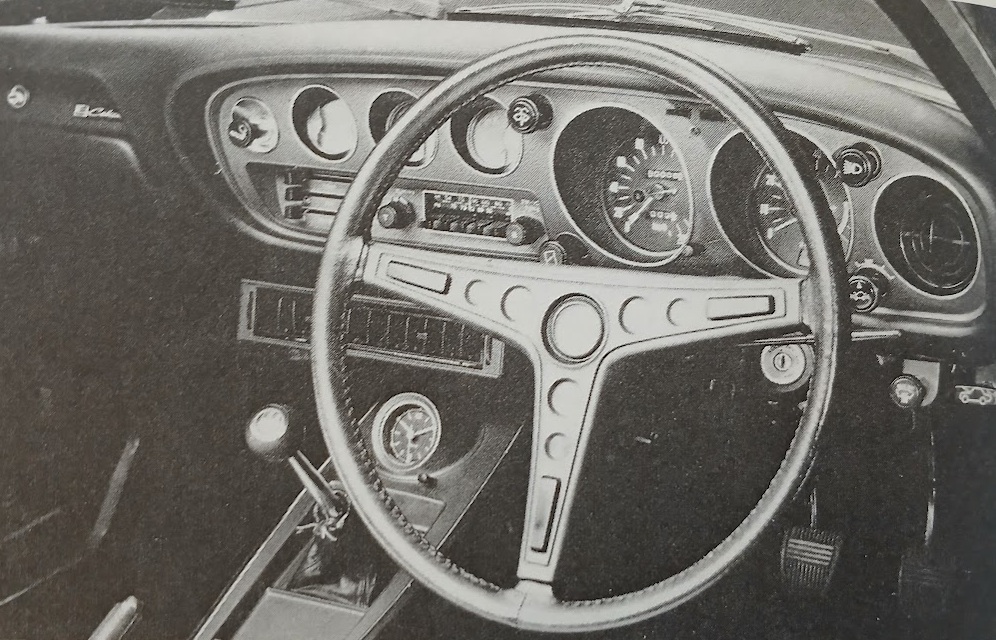
The instrument panel area is very well-equipped, with a tachometer, water temperature, current, oil pressure, and fuel gauge all included.
In terms of safety, the Carina ST received 90 points out of 100. The Celica’s interior received a higher score than the Carina, with 92 points. The scores are roughly similar to those of a 2-liter class hardtop.
Magazine: As for putting it into reverse…
Hoshijima: All you need to do is remember the technique. It’s easy if you just pull the lever a little bit towards you.
Magazine: Finally, please tell us about your production plans.
Higuchi (Kiyoki, Toyota Motor Sales): In December 1970, we expect sales of the Carina to be about 7,500 units, and sales of the Celica to be about 3,000 units. In fiscal year 1971, we plan to produce 15,000 Carinas and 10,000 Celicas.
Magazine: What about exports?
Higuchi: It’s not clear yet, but we think we’ll start with 5,000 to 6,000 units in the spring. Mainly for America.
Magazine: That’s all for now…
Postscript: Story Photos