Toyota Celica 1600GT vs. Mitsubishi Colt Galant GTO MR (1970)
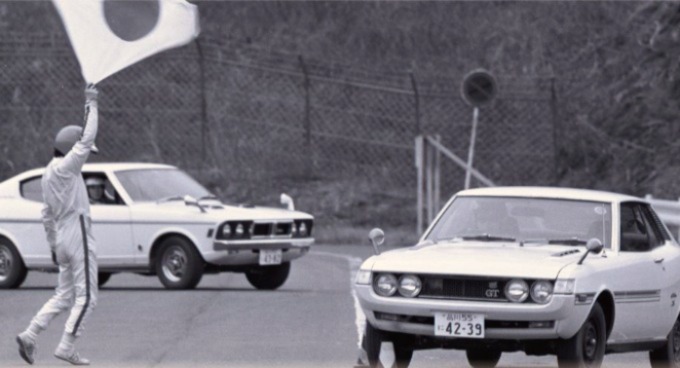
Publication: Motor Fan
Format: Group Test
Date: November 1970
Author: Yutaka Kazato, Hiroshi Okazaki, Yoshimasa Sugawara, Motor Fan Editorial Staff (uncredited)
At Fuji Speedway, racing driver Hiroshi Kazato, car commentator Hiroshi Okazaki, and Yoshimasa Sugawara, president of Racing Management Co. Ltd.–now also known as the “Motor Fan Fresh Trio”–gathered to drive the latest 1.6-liter DOHC specialty cars. The two cars on offer were the Mitsubishi Galant GTO and the Toyota Celica 1600GT.
Three drivers, two cars. All wearing white suits and red stripes. As it happened, the GTO MR and Celica 1600GT unexpectedly appeared before the Fresh Trio outfitted in the same colors, and the discussion of specialty cars immediately began.
Styling
Sugawara: Considering the road conditions in Japan and the problem of garage space, a car of this size is ideal.
Kazato: Yes, this is about the right size. The current 2-liter class is too big.
Okazaki: Looking at these two cars, up until now, Japanese-made cars, even if they were called “GT” or “SS,” tended to try to be too broad in their appeal, and their characters became blurred, so that they were cars that were not focused on anything. However, these two cars are different.
Sugawara: In that sense, these cars have pioneered a new genre among domestically produced cars.
Okazaki: That’s right. But while they are highly focused, they are not completely uncompromising. All the essentials are there.
Sugawara: Right. Even if the back seat is small, a seating capacity of 4 to 5 people is still necessary in most cases, and even if it is a car with a strong sporty character, it is impossible to focus only on maneuverability and making it hot to drive.
Kazato: There are certainly compromises in that respect. Personally, I think that if I’m buying a sports car, I want one that thoroughly pursues the qualities of a sports car, but not to the exception of everything else.
Okazaki: When it comes to mass production, any car needs to make compromises. Even as a car enthusiast, I can’t help but accept compromise. But even though the GTO and Celica make compromises in small areas, they still have a clear personality.
Sugawara: There is certainly a strong sense of prioritizing style, the front seats, and performance.
Kazato: From our perspective as enthusiasts, it’s a perfectly reasonable balance. I have no complaints about the basic approach. If there’s anything you don’t like, you can just improve it yourself.
Okazaki: For example, the compromise between handling and ride comfort can be significantly changed by using a sports kit or changing the tires and wheels.
On the Highway
The GTO and Celica set off from Tokyo at dusk, heading for Hakone, drawing many looks from passersby and other cars. The Fresh Trio took turns at the wheel, speeding down the Tomei Expressway, the two low white specialty cars weaving through the traffic on the highway like water striders. We arrived at our lodging in Hakone much earlier than planned.
Sugawara: I think the Celica is ahead of the Galant in terms of styling. But I think they both managed to come up with a unique style within similar dimensions.
Kazato: Looking at the dimensions, the height is the same for both at 1310mm. The width is also nearly the same, with the Celica being only 20mm wider. However, the Celica appears much lower and wider.
Sugawara: That’s right. The Galant looks awfully narrow. If it were just a little wider it would be great.
Okazaki: Both have styling that has been thoroughly studied from an aerodynamic perspective. In particular, the smooth flow of the roof edge achieved by the Galant’s fastback roofline, the side glass with a 50-inch radius (approximately 1250mm), and the tail spoiler configuration must have a significant aerodynamic effect. Also, when it comes to lift at high speeds, I think the Galant is one step ahead. After all, it’s a car with a top speed of nearly 200km/h, so while reducing air resistance is of course important, the lift factor cannot be overlooked.
Kazato: Considering the level of domestically produced cars up to now, these are both at a very high level aerodynamically.
Okazaki: To achieve high performance with small engines, I think that the pursuit of aerodynamics will escalate even more in the future for Japanese cars. The reason why American cars have such large engines, but their acceleration at high speeds and top speeds are not as good as you would expect, is because of their large bodies, which are at a disadvantage aerodynamically.
Sugawara: Comparing the styling of these two cars, the Galant has a much more youthful feel. It suits people in their twenties. The Celica has a wider age range. It seems like it can appeal to people from their twenties to their late thirties.
Kazato: The Galant has a “hot” image, and even looking at the interior, there is a strong impression that the Galant is a car for young people.
Sugawara: The Galant has more gauges, but the console-mounted oil temperature and oil pressure gauges and the dash-mounted fuel gauge and ammeter should be in the opposite positions.
Okazaki: It was probably done that way for productivity reasons. The GTO MI doesn’t have oil temperature or pressure gauges, only the MII and MR have them. So I think they placed them on the console with the intention of adding them as a feature on higher grade models. Anyway, it’s okay to have a lot of gauges. I just want them to be where they should be. On the other hand, the layout of the switches is better on the Galant. The Celica’s design is cluttered and operability is not good.
Sugawara: Now that you mention it, the switches on the Celica are hard to use. With the lighting and wiper knobs on the dash, you can’t just instinctively reach for them.
Kazato: It’s fine to have the gauges surrounding the driver, but having so many of them is nerve-wracking. I know I shouldn’t get distracted by them, but I can’t help looking at them.
Sugawara: The gauges are a selling point, and young people will be happy with it. But it feels like a step back in time. The Galant in particular feels a bit over the top.
Okazaki: The comfort of the front seats in both cars is impeccable. The seat positions are low, providing a comfortable driving position.
Sugawara: Because of the relationship between the window height and the seat position, it feels like you are sitting lower in the Celica, so your whole body is enveloped inside the car. However, it seems like the forward visibility is not as good as the Galant’s.
Kazato: Those who drive with a straight-arm style will hardly be able to see the bonnet. Of course, for those who drive in a straight-arm style, it doesn’t really matter whether the bonnet is visible or not. But they do tend to try to look a little further ahead. Those who sit up in a “handle-holding” driving style will probably feel uneasy until they get used to it.
Sugawara: The seats in both cars are well made.
Okazaki: The rear seats are certainly tighter than those of previous coupes and hardtops, but both cars are practical enough that two adults can sit without feeling too cramped. It’s a “plus two” kind of arrangement, but I think it’s fine.
Speedway Testing
We got up at 8:00am and headed to Fuji Speedway. After checking the oil and tires, we started with the slalom test. A 100m section of track was lined with pylons spaced 10m apart, and we drove through them as fast as we could.
Sugawara: The front suspension is a strut type for both cars. The rear suspension of the Celica is a four-link rigid axle with coils, while that of the Galant is a leaf rigid type, but the Galant’s settings are hotter.
Kazato: The Galant is crisp and the steering response is excellent. The Celica has better tires than the Galant’s 165SRs, but the Galant still has better handling.
Okazaki: The roll rate is also better than the Celica. The Galant’s suspension settings emphasize its sportiness. The Celica also has good handling compared to other Toyota cars, which generally have a “dull” feel, but it’s not as thorough as the Galant.
Kazato: Although it has the sharpest handling among Toyota cars, it’s still not enough for a sporty car equipped with a DOHC engine. Even in the slalom, the Celica’s steering was much busier than that of the Galant.
Okazaki: The best time through the slalom was 11.5 seconds for the Galant, and 12.0 seconds for the Celica, which is a considerable difference. Judging from the feeling, this difference seems reasonable.
Next was the 0-400m acceleration test. However, perhaps because of the poor condition of the road surface, our times were not as good as we expected.
Okazaki: Both engines are DOHC with twin Solex carburetors. The power difference is 10ps, with the Galant at 125ps and the Celica at 115ps, but the torque is exactly the same at 14.5kgm.
Sugawara: The Galant has good acceleration and is fun to drive. The higher the rpm, the stronger the impression becomes. It feels like more than a 10ps difference.
Okazaki: I think the powerful feeling of the Galant’s engine comes from its long stroke.
Sugawara: I think the feeling of the Galant is more likely to satisfy users’ expectations of DOHC. Generally, people tend to look for a hot feeling from DOHC rather than smoothness or quietness.
Kazato: The best time from 0-400m was exactly the same for both cars, 16.8 seconds. But taking the average of all runs, the Galant was much better. I didn’t feel much difference in the feeling, but the transmission and clutch of the Galant may be easier to use.
Next was a 4.3km race around the course in a counterclockwise direction. The three drivers put on their racing suits and helmets and immediately took to the course. This time, the times were better than expected.
Kazato: With a car of this performance level, it can be quite fun driving on the track even in stock condition.
Sugawara: Yes, it was fun. But the differential of the Celica started making strange noises right away, and the oil temperature of the Galant rose so quickly that we couldn’t continue driving, which was unfortunate. I wish we could have stayed on the track a little longer.
Kazato: The engine of the Galant wasn’t quite run in properly yet. After driving at full throttle for about two laps, the needle on the oil temperature gauge suddenly exceeded the limit.
Okazaki: In the 0-400m race, the difference in power performance was not so clear, but it was obvious on the circuit run. The Galant was quicker out of corners and was also undoubtedly faster on straights.
Sugawara: I was surprised when Okazaki-san closed in behind me in the final corner and easily passed me on the straight. It was not like being overtaken by a car with a difference of only 10ps. The Galant’s power performance was clearly superior.
Okazaki: The Galant also has better cornering performance. It has a slight understeer and the drift angle can be controlled freely. The speed in the 100R corner was also faster. In terms of handling, the Galant is much better.
Kazato: When driving at around town speeds, the Celica has little understeer and the steering is light and comfortable, but as you increase the speed, the understeer gets stronger. Grip at the rear is strong, so you can’t get power oversteer, which makes it very difficult to drive.
Sugawara: However, I felt that the Galant’s tendency to power oversteer in corners was a little too strong.
Kazato: That’s definitely a tendency.
Okazaki: Yes, I felt uneasy with the Galant’s turning ability. It may be because the BS radial tires are a little weak… but if you put on stronger tires it should be a little better.
Kazato: There is a difference of about four seconds between the lap times of the Galant and Celica, but I think this is a reasonable result given the difference in power performance and maneuverability.
Sugawara: In terms of brakes, the Celica has a stronger servo effect and is easier to use around town, but on the circuit the Galant has stronger stopping power and is more stable.
Okazaki: The Galant also has less load transfer during braking. This is another factor that increases stability during sudden braking. Also, the tires and wheels are 4.5J on both cars, but for drivers who prioritize maneuverability, I would recommend changing to 5-5.5J wheels.
Flat Out on Rough Roads
The final test was on a rough road. The cars kicked up a lot of dirt, with ferocious countersteering attacks. There’s a racer’s saying that goes, “take a corner like a sideways jump,” and that’s literally what the three drivers did.
Kazato: The Celica is better in the rough. Stability is good, and while the Galant is not bad either, it requires delicate control. The Galant is more sporty, but the generally insensitive Celica is probably better in this environment.
Sugawara: With a skilled driver behind the wheel, the Galant will probably be faster even on rough surfaces. But when it lets go, it gives little warning at the start of the slide and then slides abruptly, so it’s not really suited to amateurs.
Okazaki: It’s true that the Galant has a sharper breakaway to its slides than the Celica, but it can also recover more quickly.
Sugawara: With the Galant, I can usually correct it with one stab of countersteer, but with the Celica it’s more difficult.
Kazato: The Celica is superior in that it is easier to grasp the limits as they approach. However, the Galant is better at recovering once the limits are exceeded.
Okazaki: In other words, the Galant is more suited to professionals, and the Celica is more suited to amateurs.
Kazato: Anyway, whether on pavement or dirt, the Galant is much more sporty. The Galant is definitely the one for young people. On the other hand, if you want to enjoy touring, the Celica is more relaxed.
Okazaki: I guess that’s the conclusion. Anyway, the Celica is 850,000 yen and the Galant is 1,125,000 yen, so there’s a difference of 250,000 yen, and that difference is a bit steep.
Kazato: That’s a big deal. If you spend 250,000 yen on a Celica, you can make it a pretty good car…
Sugawara: Moreover, the Celica, despite being 250,000 yen cheaper, has power windows and an FM radio. Common sense tells us the prices should be the other way around. I guess the price difference is due to the difference in engine cost, but it’s hard to accept. It’s 250,000 yen for a 10ps difference. That’s too expensive no matter how you look at it.