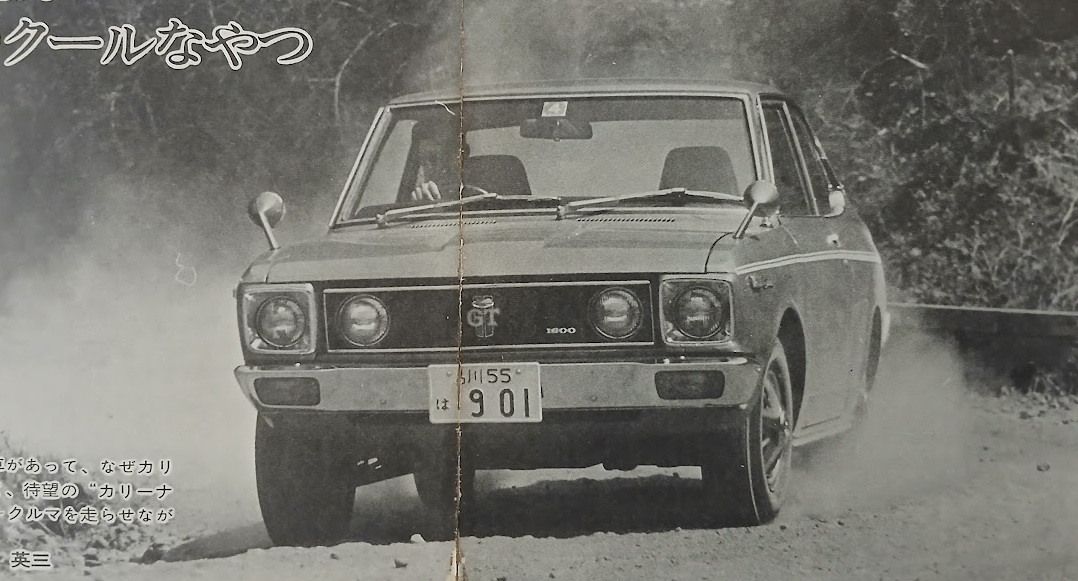
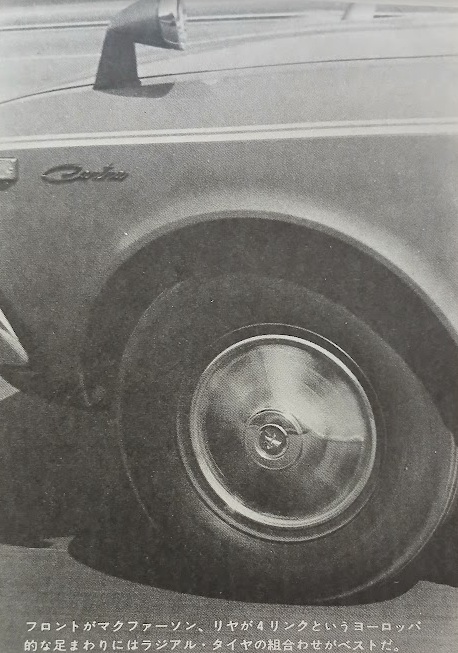
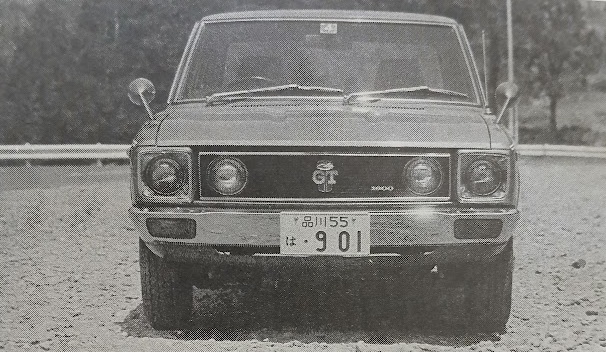
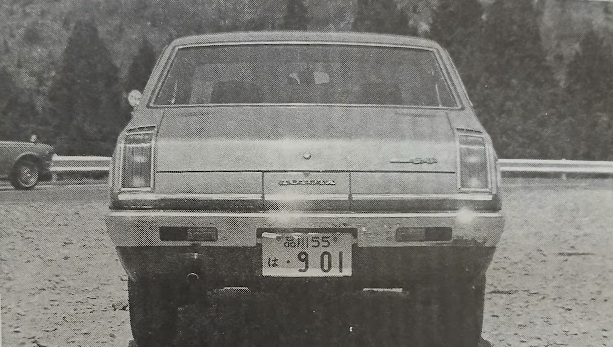
Toyota Carina 1600GT (1971)
Publication: Motor Fan
Format: Test Drive Report
Date: July 1971
Author: Eiizo Ikeda
The Cool One in “Mermaid Blue”
If the Celica already offered a 1600cc DOHC-powered model, then why had there been no equivalent version of the Carina? And why has the long-awaited “Carina GT” finally appeared now?
While driving the car, we explored the background behind these questions.
The Composition of the Carina 1600GT
Under its “full-line policy” slogan, Toyota’s recent new-model strategy has been advancing at a pace virtually without precedent anywhere in the global automobile industry.
Even after choosing a car in the belief that it represents the best possible choice, an even more enticing new model seems to appear almost immediately afterward. For the ordinary buyer–someone who makes the serious commitment of saying, “I’ll keep this car for the next two years”–the result is a kind of “luxury problem” not unlike that of consumer electronics.
Among the most representative examples of this phenomenon is the Carina 1600GT. By test-driving it, I hoped to explore something of the circumstances surrounding this situation.
The Secrets of the Body Structure
Common floorpan and suspension assembly (shared by Celica and Carina) + Two-door side panels and body structure (Carina-specific) + Engine: 2T-G 1600 DOHC = Carina GT.
The formula described above represents the kind of modular production method that has become the standard practice among modern automobile manufacturers.
At first glance it may appear simple enough, but to make such combinations possible on a true mass-production basis, the factory itself must have been designed from the outset around that philosophy. Moreover, unless a corresponding supply structure exists for the various engine combinations, a manufacturer may unveil a new model only to find itself buried under back orders the moment customers rush in.
Until now, the conventional pattern in the Japanese industry has been to begin with a four-door sedan as the basic model, then create variations such as Standard or Deluxe chiefly through differences in trim and equipment. Hardtops and station wagons within the same series were often produced in entirely separate body plants. In other words, the more body-style variations a single series acquired, the more fragmented and duplicated the production facilities became.
American manufacturers, however, had long approached matters differently. Using a common floorpan, they were capable–in some cases–of producing as many as thirty distinct models from the same basic structure.
At a time when body variations were far more numerous than anything commonly seen in Japan, buyers could choose among convertibles, pickups, business coupes, and true coupes intended for only two or three passengers. Engine selection, meanwhile, was one of the traditional specialties of the American industry, where performance and economy alike were treated as matters for the customer’s own choosing.
Even though Japanese manufacturers had begun offering greater numbers of model variations, the reality behind the scenes was often rather inefficient. Expanding the range generally meant multiplying production facilities, while low-volume models might require stopping a four-door production line altogether in order to run a batch of two-doors through the same plant. Which system was preferable depended ultimately upon the speed and scale of market demand.
In this respect, the new Celica/Carina factory was designed from the outset with enough flexibility to “change its mind halfway through”–that is, to accommodate future model changes with relative ease.
What is not widely known is that the long-nosed, sporting Celica and the comparatively orthodox compact Carina pass down the exact same welding line at the exact same time. Just as with the initial body assembly itself, side panels are welded onto a common floor structure from either side. Fit Celica panels, and the result becomes a Celica; attach the two-door or four-door panels of the Carina, and from that moment onward the car becomes a Carina instead.
The real significance of this sort of production facility lies in the extraordinary freedom it offers. No longer constrained by the traditional concepts of “minor changes” or “facelifts,” manufacturers can produce virtually any body style they wish, so long as the attachment points remain common. Conceive a third set of panels, and the result might become a sports car–or even a convertible. And naturally, such a body could easily be perceived by the public as an entirely new model.
This, then, is the latent potential contained within the Celica/Carina program. Behind Toyota’s remarkable ability, as a mass-production manufacturer, to respond with such agility and speed lay this kind of preparation from the very beginning.
The Secrets of the Mechanical Layout
Now let us turn the discussion around and examine the mechanical side of the matter.
Again, expressed as a formula:
Celica 1600GT 2T-G engine + Common floorpan + Carina two-door side panels = Carina GT.
From the standpoint of mechanical design, the process is straightforward enough: take the common floor-unit originally prepared for the Celica 1600GT–with its DOHC engine already engineered into the package–and fit it with the body of the Carina two-door. Almost as if by sleight of hand, a Carina 1600GT is born.
In practice, this technique functions through computerized production control. Once the computer issues the assembly instructions, the commands are distributed automatically throughout the entire production line, and when the process is complete, what emerges is a Carina 1600GT.
(It might be a bad joke, but if one were to overlook an error in the computer’s instructions, it might even be possible to produce a car with a two-door body on the right side and a four-door body on the left. A Carina on the left and a Celica on the right would be taking the idea a bit too far…)
Viewed in conventional terms, one might say simply that Toyota added the Celica 1600GT’s engine to part of the Carina’s broad model range. But in the case of the Carina GT, the reality is rather different.
More accurately, it is a case of clothing an existing mechanism in a different skin–quite literally, “a wolf dressed in sheep’s clothing.”
The old notion of “mounting an engine onto a chassis” can, in this instance, already be considered obsolete. From this point forward, one may expect to see increasing numbers of new models created through precisely this sort of trickery. When chassis and body become essentially one and the same, a mere “change of clothes” will itself come to signify a new model. And in terms of both performance and function, the meaning of the car will depend entirely upon what sort of clothing it has been made to wear.
Why the “GT” Appeared Only Now
Why, then, was the Carina GT not introduced at the same time as the original Celica/Carina launch? That too is an interesting question.
As most people naturally understood it, the Celica began life as a car with a sporty image, while the Carina was positioned as a family-use sedan. Accordingly, when the two models were first announced, hardly anyone questioned the absence of a GT version in the Carina lineup.
It was the Celica–marketed as a specialty car–that required a broad range of power-unit variations. At that stage, the Celica appeared to be a highly flexible machine offering buyers an unusual degree of freedom in choosing the specification that suited them.
Yet a visit to the factory makes one thing immediately clear: Toyota had simply chosen not to combine that engine with the Carina body. Every mechanical component used in the Celica could just as easily be fitted to the Carina as well. After all, they were fundamentally the same car to begin with.
Naturally, this way of thinking only gained momentum afterward, once the company’s sales strategy became apparent. It was only inevitable that voices would soon begin calling for “a GT version of the Carina, too.”
At first, the Celica’s sporty image made a high-performance variant practically indispensable. But once both models had established themselves successfully in the marketplace, there was no longer much reason to maintain such a sharp distinction between them.
Voices from the Street
During the test drive, I took the opportunity to gather a few opinions from the public.
First, I spoke with one salesman from the Toyopet dealer network, which handles the Carina.
“What do you think of the introduction of the Carina GT?”
“Oh, we welcome it wholeheartedly. Customers who favor the Carina almost always bring up the Celica and ask for a high-performance version. For buyers moving up from something like the old 1600GTs, it’s really just the right size and price.”
On the other hand, one representative customer offered the following view:
“When the Celica and Carina first appeared, I thought they seemed just about ideal. But when it actually came time to make a decision, I found myself hesitating again. Considering practical uses like work or leisure, the Celica feels just a little too flashy. And yet, I still want a compact GT with sharp, purposeful performance. In that sense, the Carina GT strikes me as something like a sports car for ordinary adults.”
These two opinions seem to align rather neatly with the true aim behind the Carina 1600GT’s introduction.
The Celica GT captured the hearts of younger buyers so completely that, if anything, it ended up alienating more mature customers.
That is often the nature of the sporty sedan. Many people are drawn precisely to the appeal of “a wolf in sheep’s clothing.” Among buyers who have already graduated from overtly aggressive performance cars, there is a renewed appreciation for high-performance machines that appear restrained at first glance.
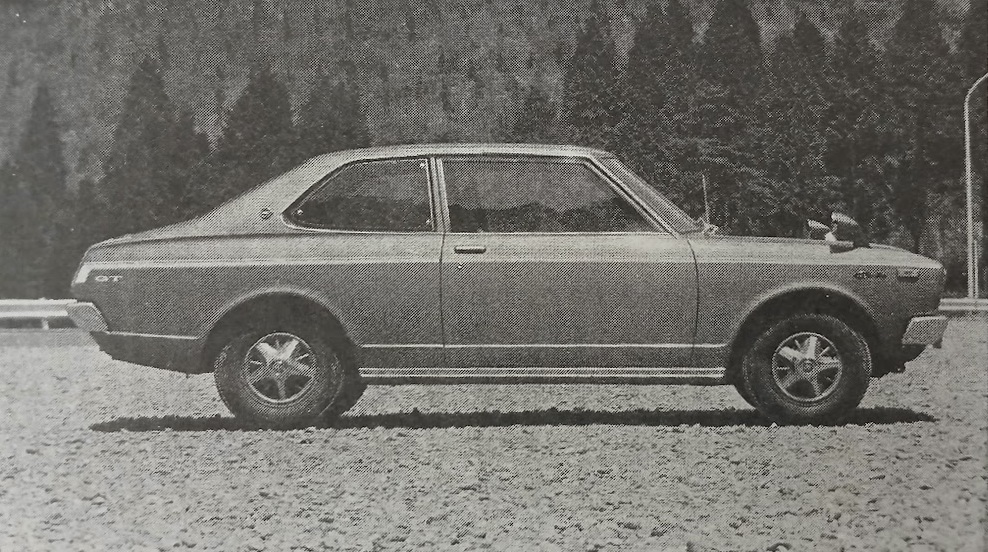
As a matter of fact, throughout my own test drive, I found the side stripes and “GT” emblems on the Carina faintly embarrassing.
For the sort of buyer likely to purchase a Carina GT, such childish ornamentation is unnecessary. As Gordini once understood, it would be preferable if such things were offered, at the very least, only as post-purchase options. The mature character embodied by cars like the Skyline 2000GT–which currently enjoys overwhelming popularity–demonstrates this clearly enough. If the Skyline GT wore stripes down its flanks, it would probably lose half its appeal.
The same can be said of the body style itself.
Having gone to the trouble of offering an affordable GT aimed at adults, one cannot help wondering why Toyota did not make the basic model a four-door. Since it is not a hardtop, the two-door sedan currently occupies a rather awkward middle ground and lacks much real charm. At the very least, few people spending more than 800,000 yen are likely to want a car whose rear side windows are all but fixed shut.
In that sense, if the Carina is truly to serve as a “GT for adults,” then it is only natural that it should take the form of a four-door GT.
Indeed, it could very well be the answer to the question of why someone would choose a Carina GT instead of simply buying a Celica GT.
The desire to drive something different from everyone else’s car may escalate endlessly, but in the end, the point of compromise tends to arrive at a fairly restrained car endowed with high performance.
When that ideal is satisfied neither by the Corolla nor by the Corona Hardtop, the presently absent Carina four-door GT emerges as an extremely attractive proposition for mature buyers.
If Toyota were to build such a car, it would amount to a pairing not unlike Alfa Romeo’s GT and Berlina models.
To remain stubbornly attached to this half-hearted two-door format is to risk squandering what is otherwise an excellent idea.
If Only There Were a Four-Door “GT”…
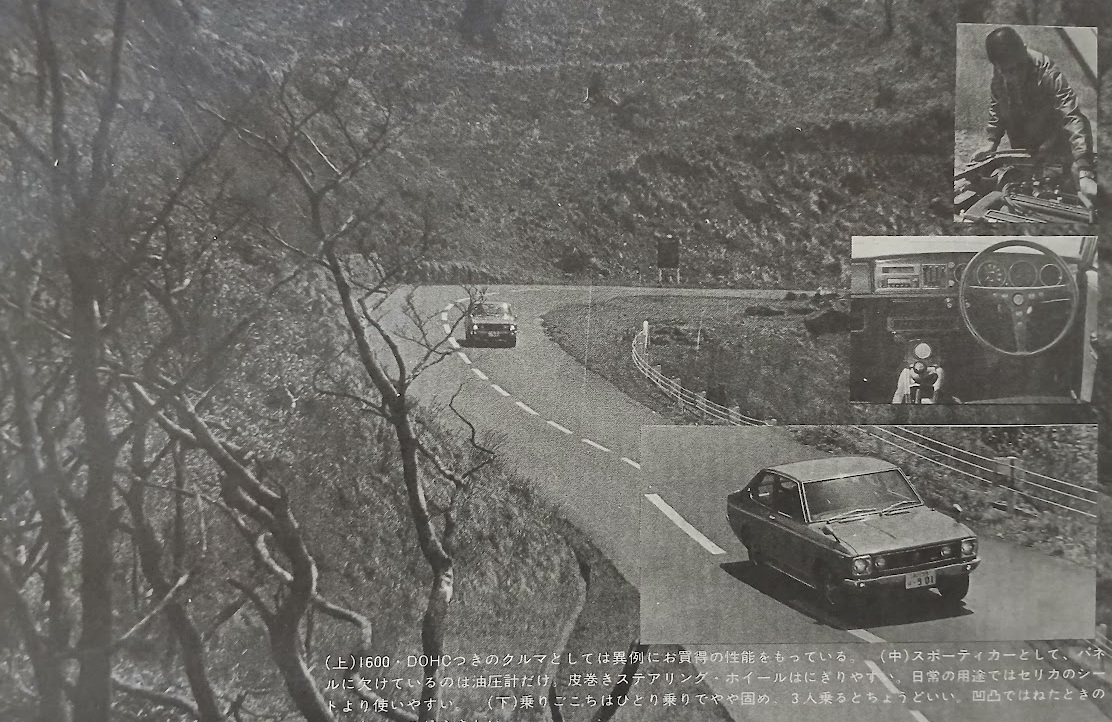
The test car was finished in a light blue body color described as “Mermaid Blue”–bright, certainly, but by no means flashy.
Whether in city traffic, on the highway, or among tourist areas, it attracted remarkably little attention. In other words, unless they drew close, no one realized that it was in fact a high-performance car powered by a 115ps DOHC engine.
And yet, compared with the feeling one gets behind the wheel of the former top-grade Carina 1600ST, the difference here lay first and foremost in the driver’s own sense of psychological superiority.
That quiet confidence of “Mine is something different” is immensely satisfying to the driver.
The 5-speed gearbox itself is unchanged from the ST, so in that respect there is nothing fundamentally new. One might imagine that pairing it with a 115ps DOHC engine producing 14.5kgm of torque would result in a hot-blooded machine. In reality, however, the sensation is better described as a cool, mature kind of reserve performance.
This is one of the characteristic qualities of Toyota’s DOHC cars: rather than feeling peaky or temperamental, their ample torque instead translates into practical ease of use. As a result, even the 5-speed gearbox can be operated with a certain casualness.
And when acceleration is desired, one squeeze of the throttle delivers a seemingly endless surge of speed.
Sudden lurches or shrieking tire noises under acceleration are simply unnecessary for a car like this to feel fast.
The Carina 1600GT is not merely a sportier version of the standard Carina created through mechanical upgrades alone.
In that sense, it may well be the only truly “cool customer” in its class.
Postscript: Story Photos