Toyota Carina 1600GT (1971)
Publication: Car Graphic
Format: Road Test
Date: July 1971
Author: “C/G Test Group” (uncredited)
Summary: A family sports car combining the two-door Carina ST body with a 1.6-liter DOHC engine. Excellent 5-speed gearbox. The engine is flexible enough to use fifth gear from 60km/h, making it well-suited even to low-speed driving in the city. Impressive fade resistance from disc/drum brakes. Handling is at a high standard even on cross-ply tires. Well-balanced engine and chassis. Good passenger accommodation and interior equipment. Fuel economy is rather poor.
Road testing the Toyota Carina 1600GT
Toyota’s product planning has always shown a remarkably keen sense of timing, consistently reading market trends with precision and staying one step ahead of its rivals. This is especially apparent when it comes to sporting cars. When the Celica and Carina first appeared, there was much discussion in the Car Graphic editorial office about how desirable it would be to have a Carina sedan fitted with the Celica GT’s DOHC 1.6-liter engine. Evidently similar sentiments were widespread among enthusiasts, because Toyota has now introduced exactly such a specification in the form of the Carina 1600GT, released on April 5.
The price is 818,000 yen for delivery in Tokyo, placing it neatly between the previous top-of-the-line Carina model, the 1600ST (OHV 1588cc with 5-speed gearbox, 720,000 yen), and the Celica GT itself at 875,000 yen.
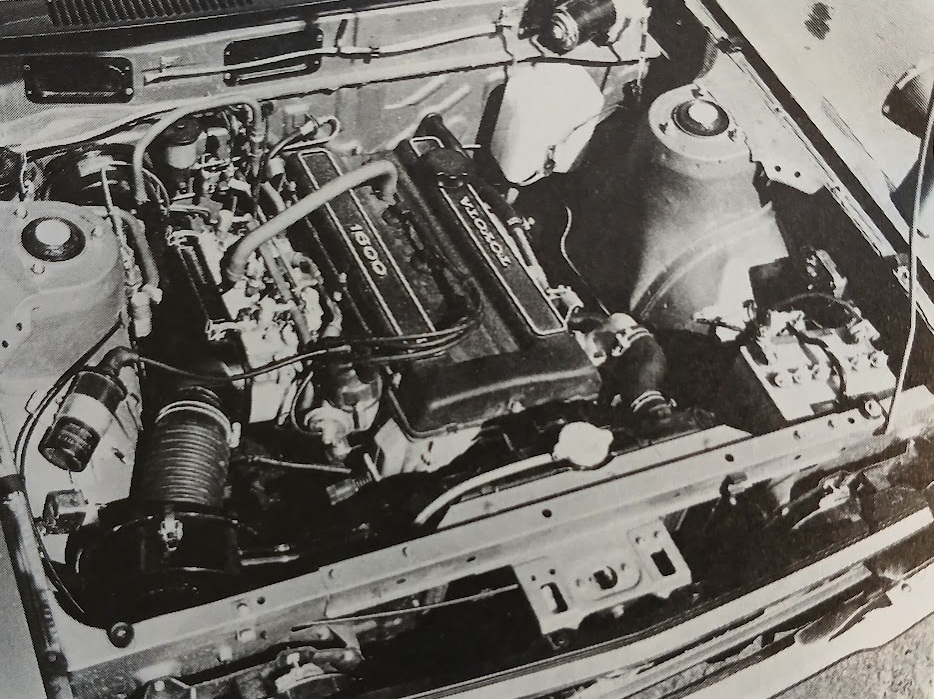
The Carina 1600GT (TA12-MQ) combines the two-door body of the Carina 1600ST with essentially the entire Celica GT powertrain: the DOHC 1588cc 2T-G engine producing 115ps at 6400rpm, a 5-speed gearbox, and a rear axle with a 4.11 final-drive ratio. There is no four-door version–at least for the time being. Tires are likewise shared with the Celica GT, with 6.45H-13-4PR low-profile tires mounted on 4.5Jx13 rims as standard equipment, while 165HR-13 radials are optional.
The suspension, too, has been reinforced to match the increase in performance. The spring constants are 1.9kg/mm front, 2.2kg/mm rear (compared to the ST’s 1.6kg/mm front, 1.7kg/mm rear), and the damping force is 90kg extension/30kg compression front, 105kg/42kg rear (compared to the ST’s 90kg/30kg front, 80kg/34kg rear). The Carina GT’s suspension is in fact set slightly firmer than that of the Celica GT (spring constants, 1.7kg/1.7kg, damping force, 90kg/30kg front, 80kg/40kg rear). The stabilizer bar has also been strengthened, with its diameter increased from the standard Carina’s 21mm to 23mm.
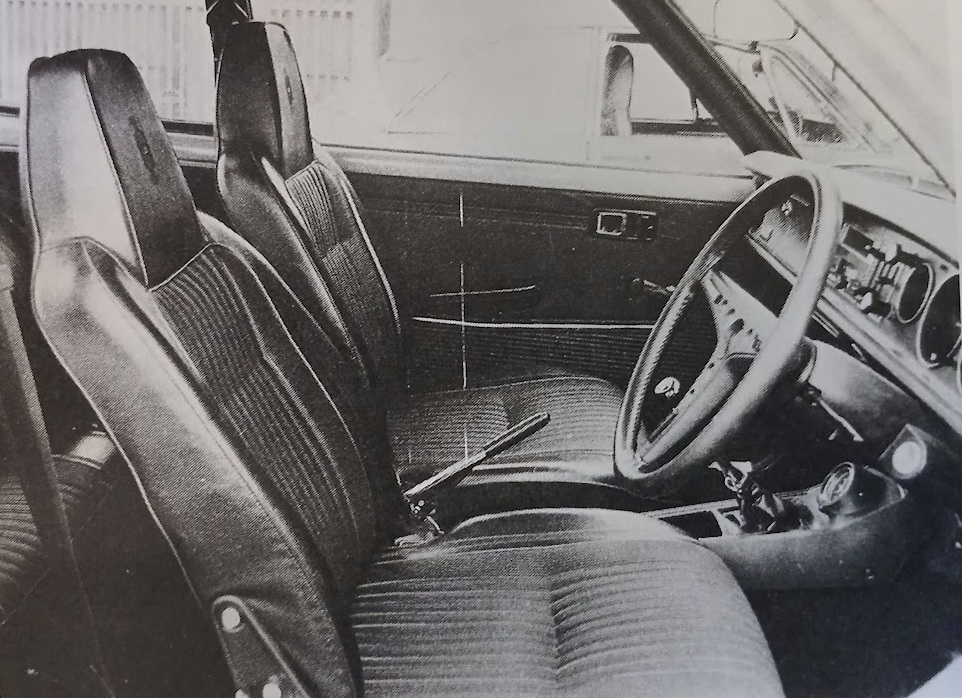
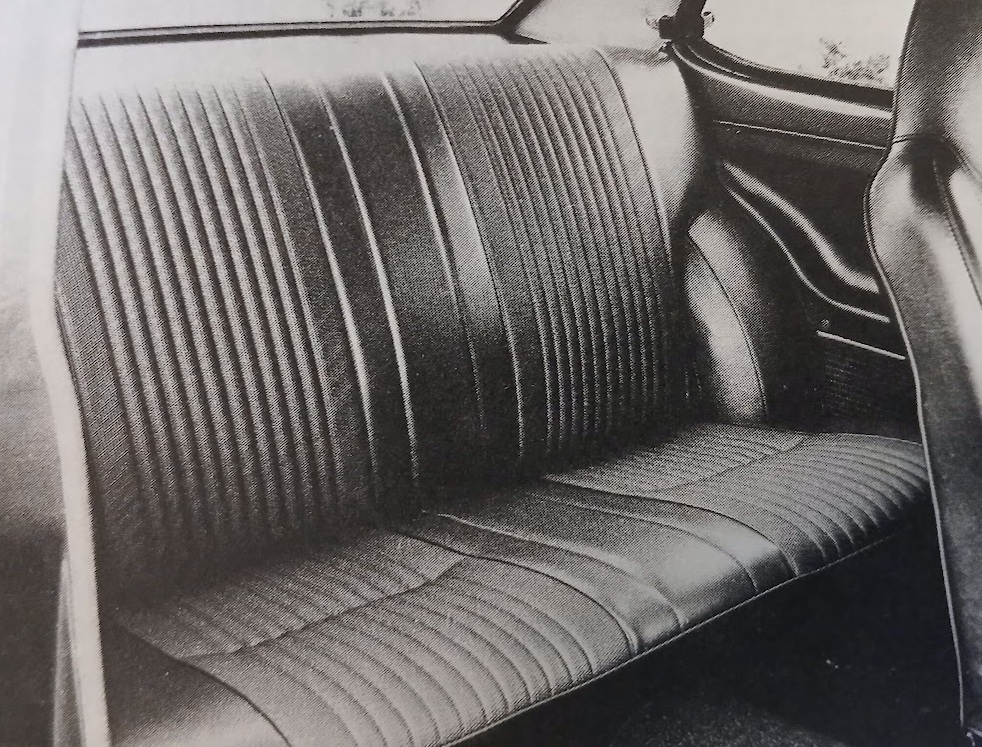
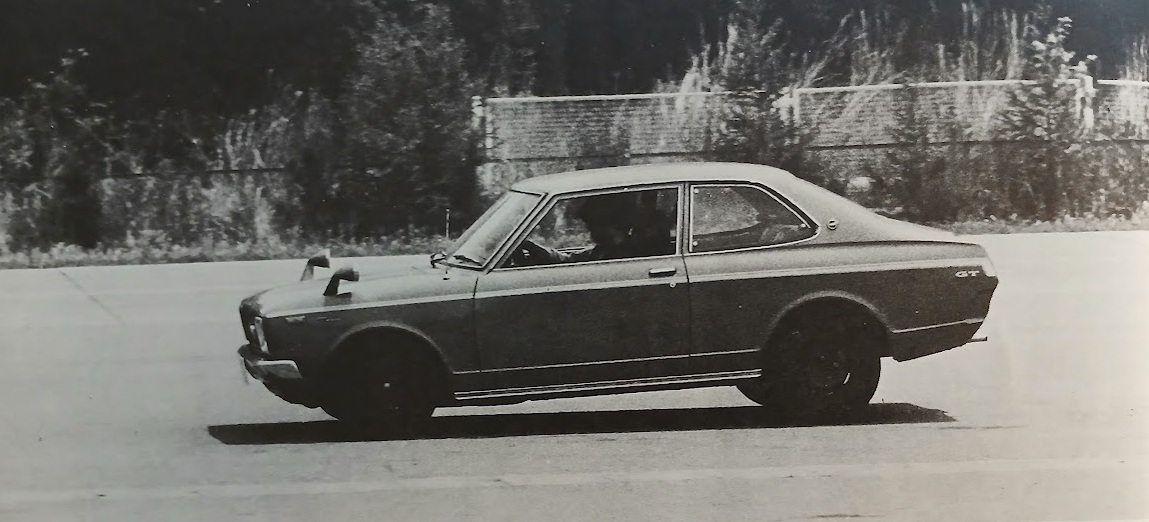
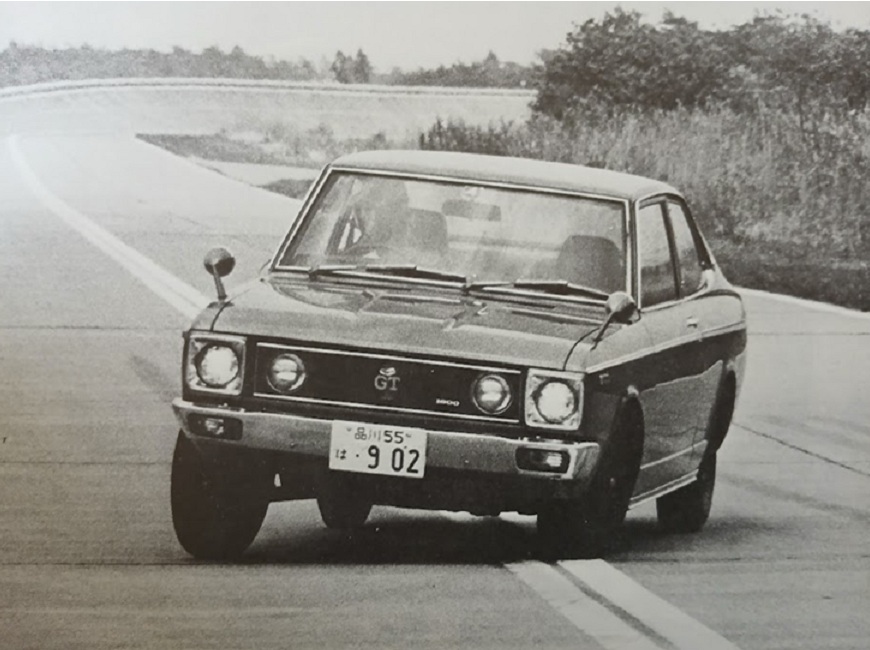
Externally, the GT can easily be distinguished from the ordinary Carina by details such as the black-painted front grille, GT badging, and the tape stripes running along the bodysides. The windshield, previously made from partially reinforced 5mm glass, has been replaced with laminated glass of 6.3mm thickness. Inside, the cabin is finished entirely in black, the biggest change being the adoption of the same knitted-vinyl seat fabric used in the Celica GT–a mesh-like material woven from nylon core threads wrapped in vinyl tape.
As a result of these revisions, vehicle weight has increased by 35kg over the Carina ST two-door (910kg), bringing the total to 945kg. This is due mainly to the heavier engine and strengthened powertrain components–the OHV 1.6-liter unit weighs 140kg, compared with 152kg for the DOHC version. Weight distribution has also shifted slightly, from 56.6/43.4 to 57.6/42.4, increasing the front-heavy weight bias.
The Celica/Carina range is offered with an impressively wide selection of optional equipment, and among the more significant items is a limited-slip differential, available beginning in May. We had hoped to test a car so equipped, but as no example could be arranged, the test car was fitted with the standard differential.
The Carina GT is offered in four body colors: red, metallic blue, metallic gold, and green. Our test car was finished in a vivid metallic blue. When we tested the OHV 1.6-liter Carina ST, we praised not only its above-average performance, backed by a 5-speed gearbox with well-chosen ratios, but also handling that could legitimately be compared with cars such as the Alfa Romeo and Fiat 124S. With an additional 10ps, the performance of the 1600GT is more impressive still.
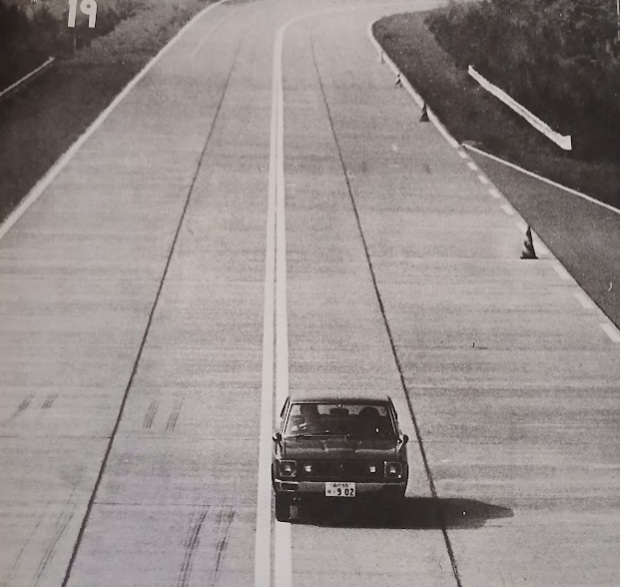
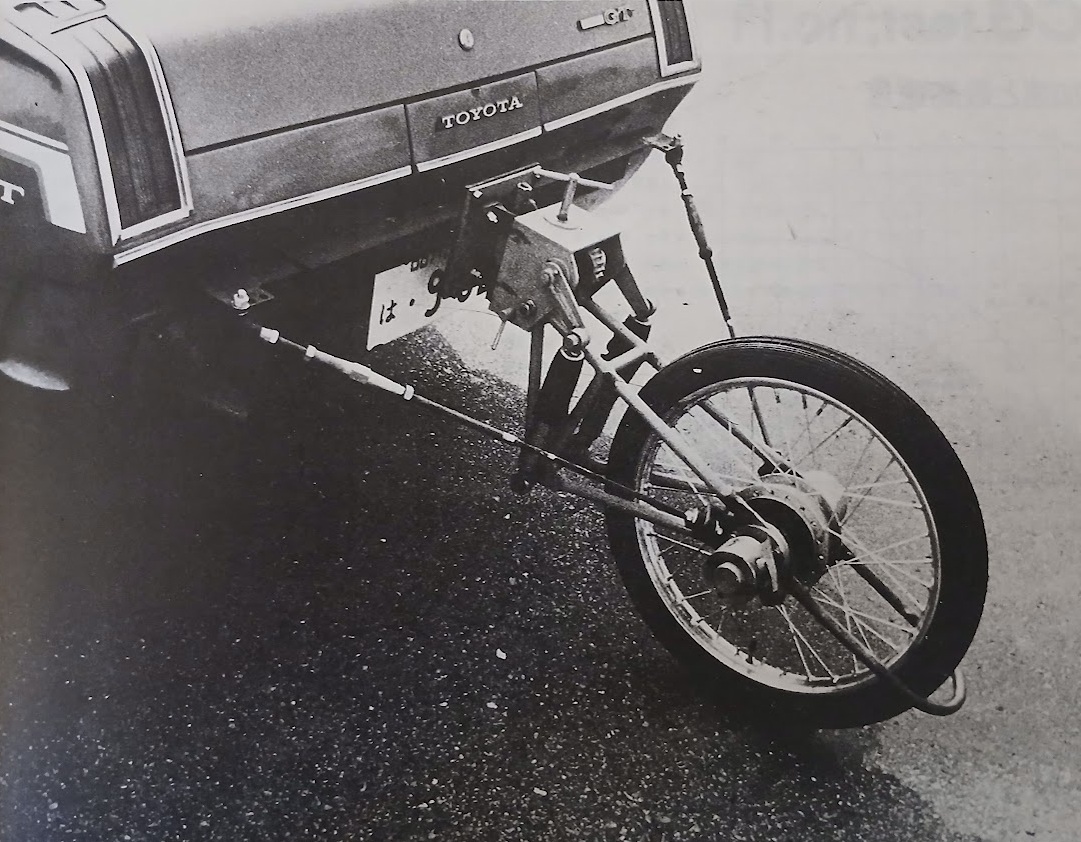
At Yatabe, the top-speed tests produced an average of 175.43km/h over the 1km straight and 173.07km/h over the 5.5km circuit. This is remarkably close to the result previously recorded by the Celica GT–176.78km/h–despite that car combining the same engine with a smaller frontal area, a more aerodynamic body, and a slightly lower weight at 940kg.
At maximum speed, the engine was turning 5500rpm in fifth gear, whereas the Celica GT achieved its top speed at 5900rpm, also in fifth. Since the gearing of the two cars is identical, the difference in engine speed can reasonably be attributed to the effective rolling radius of the tires. The earlier Celica GT was fitted with 165HR-13 radials, whereas the Carina GT wore Bridgestone’s newly introduced Super Speed 5 6.45H-13 cross-ply tires.
As is well known, radials show very little increase in effective radius under centrifugal force, whereas cross-ply tires can expand by nearly 8% at maximum speed. This was further confirmed during our speedometer error measurements: at lower speeds the indicated speed was noticeably optimistic, but the discrepancy diminished gradually as speed increased, disappearing entirely at 160km/h.
For a cross-ply tire, this Bridgestone displayed notably high tread rigidity and excellent uniformity, demonstrated by the presence of only small high-frequency vibrations from the chassis even while running at maximum speed.
The tachometer marks the yellow zone from 6500, with the red zone at 7000rpm. From a quiet idle of roughly 800rpm, the engine responds instantly and crisply to the throttle, and in the lower gears the needle climbs to 7000rpm with ease. Power is more than sufficient by any reasonable standard, and even in direct fourth gear the engine will pull strongly to 170km/h (6250rpm).
Throughout the range the engine remains exceptionally smooth, while DOHC valvegear noise is very subdued. It is only regrettable that between 3000 and 4000rpm–right where the engine begins to come on the cam–resonance from the exhaust system becomes rather pronounced and intrusive to the ear.
Maximum speed is, particularly on the roads of this country, an entirely unrealistic figure—interesting only on paper. What matters in actual use is performance in the low- and medium-speed range up to around 120km/h, and in this respect the Carina GT proves even more usable than the ST.
Although it is a DOHC engine, the intake ports have been somewhat restricted and the intake ducts lengthened in order to exploit the inertia effect of the intake charge, sacrificing a small degree of high-speed performance in exchange for stronger low- and mid-range characteristics. As a result, torque does not fall away at lower engine speeds, and the engine displays remarkable flexibility.
Accordingly, the 5-speed gearbox—much like that of an Alfa Romeo—allows the upper three gears to be used interchangeably according to mood and circumstance, even at comparatively modest speeds below 100km/h. The upper three ratios are closely spaced, and because the engine pulls so willingly, their operating ranges overlap considerably.
For example, the 60-100km/h acceleration often encountered in ordinary driving can be managed perfectly comfortably while remaining in overdrive fifth, provided there is no particular hurry, taking 17.0 seconds. Shift down to fourth and the figure falls to 12.8 seconds; drop to third and 100km/h arrives in only 8.2 seconds.
Gearshifts themselves are light and positive, though the synchromesh is not entirely foolproof. Even on this test car, which had only covered some 1,800km, hurried shifts provoked gear noise easily.
Fifth gear can be engaged from as low as 60km/h if desired, and above 3000rpm response is surprisingly good. One might therefore imagine the ratio to be rather low, but in fact this is not the case: the speed per 1000rpm is 26.3km/h in fourth and 30.6km/h in fifth. These figures are actually slightly higher than those of the Alfa Romeo 1600 Super, whose corresponding figures are 24.1km/h and 30.4km/h.
Even so, acceleration is very nearly on a par with the Alfa, covering 0-400m in 17.0 seconds and 0-1000m in 32.1 seconds. This is only slightly inferior to the figures we previously recorded for the Celica GT itself–16.8 seconds and 32.0 seconds.
With such generous reserves of power, the Carina GT is exceptionally easy to drive not only on the highway but also in crowded city traffic. First gear is used almost exclusively for moving off–starts in second are also entirely effortless–while second allows speeds barely above walking pace, and fourth can be used from 40km/h upward. The clutch is light, and both throttle action and engine response are smooth and progressive, so even the constant shifting required in urban driving never becomes tiresome.
High performance, however, does not come without a cost. Fuel consumption varies greatly depending on driving style, but no matter how it is driven, the Carina GT can hardly be described as economical. In our case, even while cruising at a steady 60km/h along National Route 6 from Tokyo to Yatabe under comparatively favorable traffic conditions, the car returned only 8.69km/l. Including the hillclimb at Mount Tsukuba and the testing at Yatabe, the average over 289km fell to 6.58km/l, while the overall average for the entire test was 7.02km/l.
Naturally, the test car was run on high-octane fuel, but there is also a 110ps version available–the TA12-MQR fitted with the 2T-GR engine–which lowers compression ratio from 9.8 to 8.8 in order to permit the use of regular gasoline. Fuel-tank capacity, incidentally, is 50 liters.
The handling cannot be called truly outstanding, but within the current Toyota range–still entirely based on fairly conventional live rear axle layouts–it is certainly among the best, and the chassis is well balanced against the 115ps output.
According to the suspension data shown earlier, the Carina GT ought to feel firmer than the Celica GT, but in practice the difference is barely noticeable. The first Carina ST we drove immediately after the model’s introduction struck us as unusually stiffly sprung for a Toyota, though this now appears to have been largely the result of friction in the various new components. Subsequent examples of both the Celica and Carina have consistently displayed appropriate ride comfort over all types of road surfaces.
That initial Carina ST, aided by the combination of stiff springs and Bridgestone Radial 10 tires, gave an impression of extremely quick steering response. By contrast, the GT fitted with these Bridgestone Super Speed 5 6.45H-13-4PR tires feels much more like an ordinary European car in character.
The steering ratio is 18.1:1, and the 3.5 turns from lock to lock–with a turning radius of 4.8m (5.2m overall)–make for steering that is decidedly responsive. Steering effort, meanwhile, remains appropriately weighted regardless of speed.
Despite the distinctly nose-heavy 57.6/42.4 weight distribution, understeer is never excessive, and the car displays very straightforward, natural handling characteristics. In fast corners, the car initially settles into mild understeer accompanied by a fair degree of roll, but if power is maintained in an appropriate gear the tail begins to slide with remarkable smoothness, allowing the car to exit on a beautifully clean line.
The Bridgestone Super Speed 5 is a cross-ply tire with high lateral rigidity, broadly similar in character to the Dunlop Grand Speed 1, and its grip–at least on dry surfaces–is very impressive. Steering response is not quite as sharp as that of a radial tire, but kickback over uneven road surfaces is almost entirely absent, and road noise is low. As already noted, it is fully capable of sustained high speeds, and taken as a whole it may actually be better suited than a radial for the average user.
Ride quality may be best described as appropriate. Unlike an Alfa Romeo, it is not excessively firm at low speeds, and even after long hours over the broken pavement common in Tokyo, the car remains surprisingly untiring. There is, however, one weakness worth mentioning: on washboard-pattern gravel roads with fine corrugations, the unsprung masses set up a resonant vibration at relatively low speeds around 40km/h. The phenomenon would likely disappear at higher speeds, but on loose gravel such speeds are hazardous because braking effectiveness deteriorates sharply, making it necessary to slow down instead. This tendency is often encountered in cars equipped with MacPherson strut front suspension, but it is particularly noticeable in the Carina GT.
Braking performance, on the other hand, is entirely adequate for the Carina GT’s capabilities. The front brakes employ 184mm Bendix F-type discs, while the rear uses 228mm leading-trailing drums, together with a vacuum servo of 2.6 boost ratio and a proportioning valve to maintain front-to-rear balance.
Pedal effort is well judged, and braking remains powerful and stable from low to high speeds. In order to evaluate fade resistance, Car Graphic conducts what we refer to as the “0-100-0” test: the car is accelerated to 100km/h, followed by a hard stop corresponding to approximately 0.5g deceleration; immediately upon stopping, we repeat full acceleration back to 100km/h, followed again by 0.5g braking. This cycle is carried out ten consecutive times.
Naturally, total elapsed time for the 0-100-0 sequence varies from car to car, and high-performance cars with stronger acceleration subject their brakes to more frequent use in this test. However, because faster cars are also more likely to place heavy demands on their brakes in real-world driving, we consider this method entirely rational.
The Carina GT began the test with a pedal effort of 18kg; on the second and third runs this actually fell to 16kg, as disc brakes tend to perform best once the pads have reached proper operating temperature. After that, pedal effort increased only slightly, reaching no more than 20.5kg even on the tenth stop. Since braking behavior remained completely smooth from start to finish, these brakes must be judged exceptionally resistant to fade.
The handbrake, conveniently positioned beside the seat, thoughtfully includes an adjustment screw allowing cable free play to be corrected from inside the cabin. Both front and rear brakes are self-adjusting, and if hydraulic pressure in the master cylinder falls below the specified level for any reason, a warning lamp illuminates on the dashboard–a safety feature we would very much like to see adopted more widely by other manufacturers as well.
The interior is almost identical to that of the existing Carina ST. The main difference is the seat upholstery, with its woven ventilated vinyl-cord fabric. In dimensions, shape, and feel, the seats are entirely appropriate, and when used together with the standard three-point seatbelts they hold the body securely in place. For drivers inclined toward spirited driving on mountain roads, however, one could still wish for a proper left footrest.
Interior equipment is exceptionally complete, and virtually everything one could need is fitted as standard. The heater and ventilation system in particular is excellent. In summer, ample cool air enters through the footwell outlets and the vents at both ends of the dashboard while the car is in motion, while the 3-speed blower provides effective forced ventilation even at a stop. The optional air conditioner is mounted centrally beneath the dashboard ashtray, so unlike the usual under-dash installations it does not intrude on passenger space. Naturally, the rear window is also fitted with an electric defogger.
The Carina GT is a genuine four-to-five-seat family sporting car: easy to use in city traffic, yet fully capable of sustained high-speed running. At 818,000 yen, this “Japanese Alfa Romeo 1600 Super” can fairly be called the “best value for money” in its class.
Postscript: Story Photos