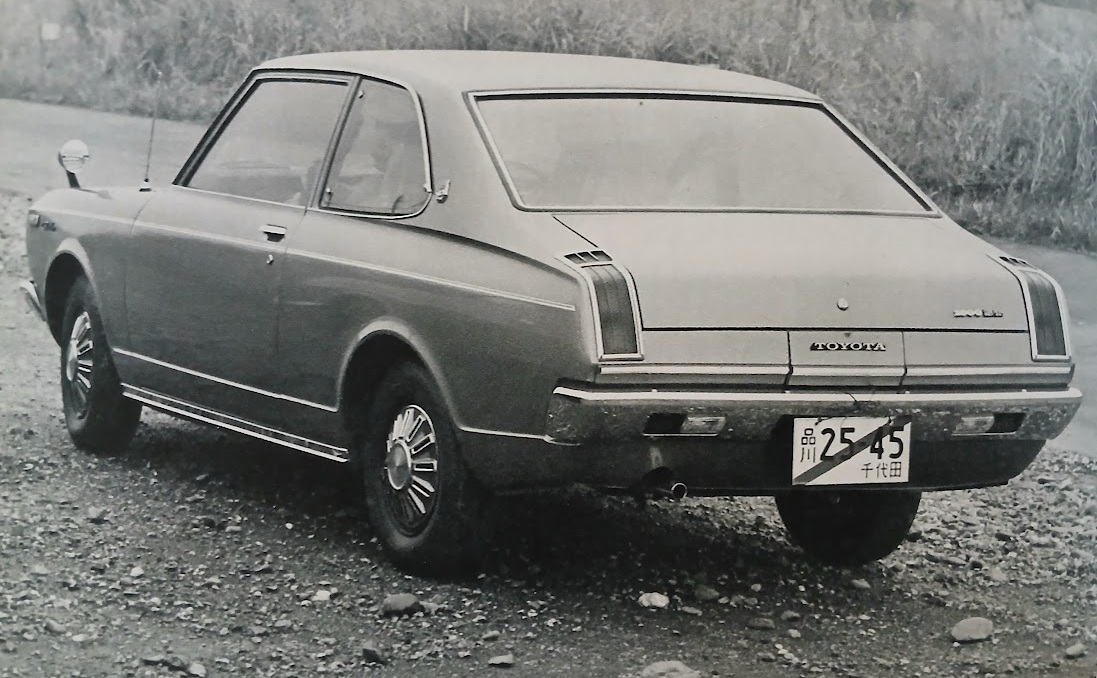
Toyota Carina 1600ST (1971)
Publication: Car Graphic
Format: Road Test
Date: January 1971
Author: “C/G Test Group” (uncredited)
Road testing the Toyota Carina 1600ST
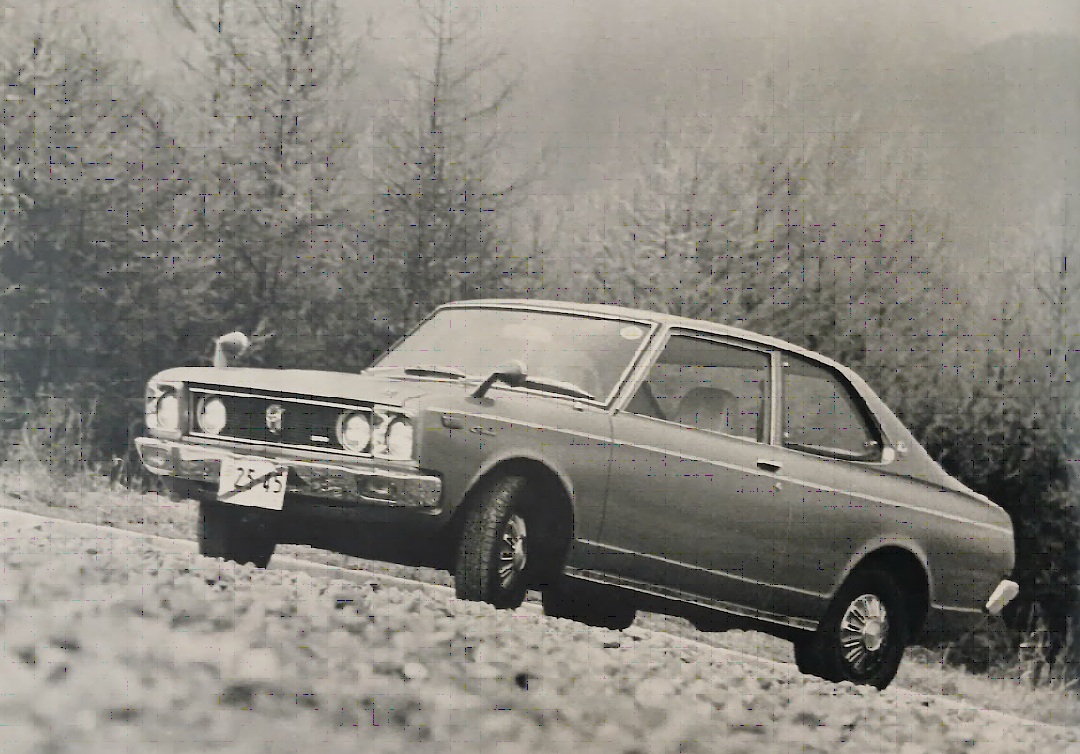
The Toyota Carina (named after the constellation Carina) was first shown to the public at the Tokyo Motor Show in the fall of 1970, and went on sale on December 1. It is a semi-fastback five-seat sedan closer in exterior dimensions to the Corona 1500/1700 than to the Corolla. Three engines are offered: the 1407cc OHV unit shared with the Corolla 1400, with a crossflow cylinder head and an output of 86ps; a 1588cc version created by enlarging the bore, producing 100ps; and a twin-carburetor version of the latter developing 105ps. There is also a wide choice of transmissions: a 3-speed column shift, a 4-speed floor shift, and, on the 1600cc models, even a 5-speed. This is one of the Carina’s major attractions. The suspension is unlike that of any previous model. At the front is a conventional MacPherson-strut arrangement, while the rear uses a layout basically similar to that of the Crown, with a rigid axle located by four links and a Panhard rod and supported by coil springs. Both two- and four-door bodies are available, with prices ranging from 509,000 yen for the 1400 Standard with 3-speed column shift to 720,000 yen for the four-door 1600ST with twin carburetors and 5-speed.
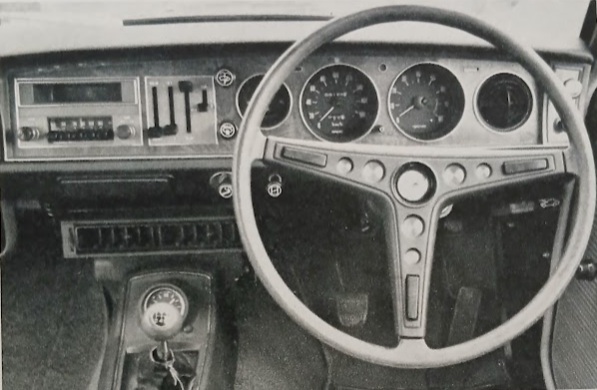
For our brief road impression of approximately 300km, including some basic measurements at the Murayama test course, we chose the highest-performance model in the Carina range, the 1600 ST (Sport Touring) two-door with five-speed gearbox (TA12-MS, priced at 700,000 yen). A glance at the specifications reveals nothing particularly noteworthy apart from the 5-speed gearbox, and seeing the actual car, one could only admire, as always, the almost unbelievable thoroughness of the interior finish for a car at this price, and the completeness of its equipment. But then comes the surprise. The pleasant discovery, felt immediately upon driving away, was that the Carina exhibits a quality we had sought but not found in any previous Toyota. Put simply, the Carina speaks to its driver in the same idiom as a good European sports sedan.
To begin with, the driving position is close to ideal. The high-back seats, upholstered in ventilated vinyl, have just the right degree of firmness and support the body at the right points. The steering wheel is of just the right size and angle, and the relative positions of the wheel, gear lever and pedals suit this author’s physique perfectly, at least; visibility is also excellent. The standard three-point seat belts are retractable, and each has a pocket or hook for storing the belt when not in use.
(On cars without these, one often finds that when they finally decide to use the belts, an inconsiderate rear-seat passenger has been stepping on them.)
What we noticed immediately on turning the first street corner was that the steering felt unusually positive for a Toyota. It is not especially sharp, but the steering system as a whole is highly rigid. A common failing of every previous Toyota (and the great majority of Japanese cars) is the sluggish response when first turning the wheel away from the straight-ahead position, almost as though one were twisting rubber. That alone would be enough for this writer to lose any interest in buying a car. In the Carina, however, it is entirely absent. I should mention that the test car was fitted with optional Bridgestone Radial 10 165SR-13 tires, which, as we shall see later, contributed greatly to the handling.
Even at low speeds in Tokyo on our way to the Murayama test course, it was apparent that the 1.6-liter 105ps OHV engine was extremely powerful and had unusually strong pulling power at low speeds. Of course, there was no opportunity to use the overdrive fifth gear there, but in direct fourth the car would run smoothly even at 30km/h (about 1100rpm), and from 1500rpm it would accelerate easily. It was only at Murayama, when we first used full power through all the gears, that we discovered how smoothly this engine–despite being completely new–would rev right up to the red zone above 6500rpm, and how exceptionally well balanced it was. Mechanical noise is low, but it is unfortunate that there is a resonance in the exhaust system at around 2500-3000rpm. It seems like the sort of problem that could be solved quite simply, either by increasing the thickness of the tailpipe or altering its body-mounting bracket.
One of the Carina’s major attractions is its excellent 5-speed gearbox. Its ratios are closely spaced, similar to those of a good European sports sedan such as the Alfa 1300GT. (Incidentally, when I interviewed the Carina’s chief engineer, Mr. Nishida, at a later date, I got the impression that he was quite an Alfa enthusiast.) The overall gearing is well chosen for the car’s 910kg weight, output of 105ps/6000rpm and torque of 14.0kgm/4200rpm. If the engine is taken to the 6500rpm red zone, it pulls easily to approximately 48, 85 and 124km/h in first, second and third gears respectively (all calculated figures; the very optimistic speedometer indicates about 52, 90 and 130km/h), handing over smoothly to the next gear each time.
Acceleration is very quick. At Murayama we recorded 0-400m in 17.9 seconds, using the first three gears. That was only our third run, and we were not yet fully used to the car, but unfortunately, immediately afterward the clutch stopped disengaging altogether, forcing us to suspend the test temporarily. Investigation showed that all the fluid had leaked from the clutch slave cylinder. We towed the car to a nearby dealer with the C/G Capella that had accompanied us, where inspection revealed that the air-bleed valve had worked loose. After refilling the fluid and bleeding the system, we were able to continue the test. The gearshift is light, positive and pleasant to use, although the synchromesh cannot be described as exceptionally powerful.
The unexpected clutch trouble cost us a great deal of time, and it was after 1:30pm by the time we resumed the test. With only five hours remaining before the car was due to be returned that evening, we decided to put them to good use on a high-speed touring run by way of the Chuo Expressway, Lake Kawaguchi, Hakone, Odawara, Atsugi, and the Tomei Expressway.
Once cruising at high speed on the Chuo Expressway, we were immediately struck by the good response in the higher gears and by how unusually high-geared the Carina is for a 1600cc. Engine response is extremely good over a broad range from about 2000-5500rpm (50-150km/h) in fourth, reacting immediately to the throttle. The overdrive fifth gear can be engaged above 60km/h, and response becomes quite good above 3000rpm. This might suggest that the gearing is relatively short, but quite the opposite is true: fourth gives 26.3km/h per 1000rpm, while fifth gives 30.5km/h. This is actually slightly taller gearing than the Alfa 1600S (109ps, 1020kg), which gives 24.1 and 30.4km/h per 1000rpm in fourth and fifth, respectively. The fact that the Carina’s engine can pull its body, which can hardly be called light, with such ease in these relatively tall fourth and fifth ratios is evidence of excellent torque characteristics.
A true 100km/h (the speedometer reads about 6% high) corresponds to about 3800rpm in fourth gear, and at this speed the exhaust-system resonance has disappeared, making for remarkably quiet cruising. Shift up to fifth and the rev counter drops to about 3300rpm, making things quieter still. With an overdrive top gear, the reduction in engine noise is often canceled out by increased gear noise (the old Toyota 1600GT was a conspicuous example), but in the Carina gear noise is well suppressed in all ratios.
The catalog maximum speed is 175km/h, corresponding by calculation to 5700rpm in fifth. This figure, however, is probably just that—a calculated value, or perhaps a figure recorded under “laboratory” conditions. From our experience that day, the actual maximum appears to be around 170km/h, and it seems likely that this could be reached in either fourth or fifth gear.
If this Carina were taken to Europe, one could quite naturally use fourth gear up to around 150km/h (which it reaches quite easily) then shift into fifth to reduce engine speed for cruising, dropping back to fourth whenever more urge was needed for overtaking or regaining speed while climbing hills. Used in this way, it would surely be capable of holding its own, or better, against a BMW 1600TI or an Alfa 1300.
The noise level at high speeds is exceptionally low, due to both the excellent balance of the driveline and the unusually low level of wind noise around the windows (most of what can be heard is the sound of air being drawn out of the cabin). Straight-line stability is outstanding (there was almost no wind during our test), and the steering wheel only needs to be held lightly.
The Carina’s underpinnings, with the Bridgestone Radial 10 tires fitted, also feel unusually taut for a Toyota. For a purely Japanese family saloon, the suspension is exceptionally “firm”—once again, rather Alfa-like. Yet it is by no means harsh; both bouncing and pitching are well controlled, giving a ride that is firm but comfortable. The Bridgestone Radial 10 is one of the harder Japanese radial tires, and even on the Carina they pick up some road-surface irregularities. However, the fact that these can be heard, but not felt as kickback through the steering wheel, is evidence that plenty of compliance has been built into the suspension.
By the time we had descended from Lake Yamanaka over the Kagosaka Pass to Gotemba, and reached the drive-in where we usually make a pit stop during tests for a cup of Russian-style tea, the early winter dusk was already closing in, and a cold rain had even begun to fall. On the climb to Otome Pass, we were able to experience something of the Carina’s cornering ability. The combination of the well-located rear axle—with coil springs, four links and a Panhard rod—and the Bridgestone Radial 10 tires provides such good grip that even when full power was applied in second gear around slippery hairpins, there was not the slightest trace of a slide. The cornering power of the front and rear tires was also well balanced; understeer was very slight, and the tires would not squeal except under extreme provocation. We hesitate to draw any firm conclusions from such limited experience, but compared with cars we have driven over the same course, we can at least say that the Carina is faster than the Fiat 124S and roughly on par with the Alfa 1750. One thing this hill climb confirmed yet again was the tremendous pulling power available in third gear.
The servo-assisted disc/drum brakes give stable braking from any speed, with little nose dive. Pedal effort is appropriately heavy despite the servo assistance, which is actually quite desirable.
One thing we noticed while driving over the pass at night was that the headlights are particularly dim. Also, the switches—particularly the wiper switch—are too far away to reach from a natural position at the steering wheel. While on the subject, as we pointed out last month with the Publica SL, recent Toyotas have placed the four-way flasher switch in a position where it can easily be confused with the headlight switch. Recently, the bad habit of immediately switching on the four-way flashers upon entering a tunnel has spread throughout Japan, and we worry that Toyota’s arrangement will further encourage this dangerous practice. Since these warning lights should be used only when the car is stopped, the switch would be better placed somewhere out of reach while driving.
Finally, fuel consumption. To return the car to Toyota Motor Sales by the appointed time, we drove the 300.85km (corrected for the odometer, which read 2.1% high) considerably faster than usual, yet the average was unexpectedly good. For the 31 liters of high-octane gasoline consumed, the average was 9.70km/l.
In conclusion, the Carina was the first Toyota to win me over more by the way it drove than by the way it looked.
Postscript: Story Photos