Toyota 2000GT (1967)
Publication: Motor Fan
Format: Test Drive Report
Date: August 1967
Author: Makoto Urakawa
Setting 16 World and International Records
During last year’s Third Japanese Grand Prix, Toyota team driver Mitsuo Tamura posted an outstanding qualifying performance in the Toyota 2000GT. Expectations were high for the race itself, where it would face formidable rivals such as the Porsche Carrera, Prince R380, and Fairlady S. But fate intervened. A newspaper discarded by a spectator lodged against the radiator grille during the race, causing the engine to overheat and forcing a bitter retirement. This left Shihomi Hosoya to settle for third place overall.
For a car of this caliber, it could only be seen as a deeply disappointing result.
Since then, however, the Toyota 2000GT has steadily established its reputation as a genuine high-performance sports car. It achieved victory in demanding events such as the Suzuka 1000km and the Fuji 24-Hour Endurance Race, and, in addition, established sixteen world and international records during a high-speed endurance trial at Yatabe in Ibaraki Prefecture.
On May 26, the Toyota 2000GT was finally released onto the market at a price of 2.38 million yen.
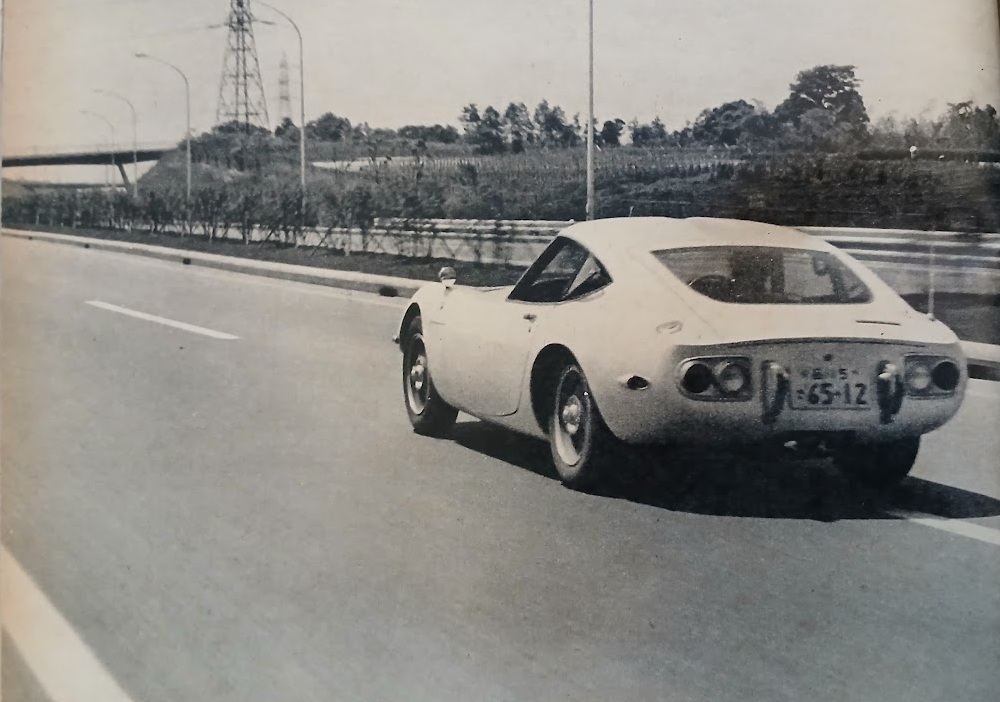
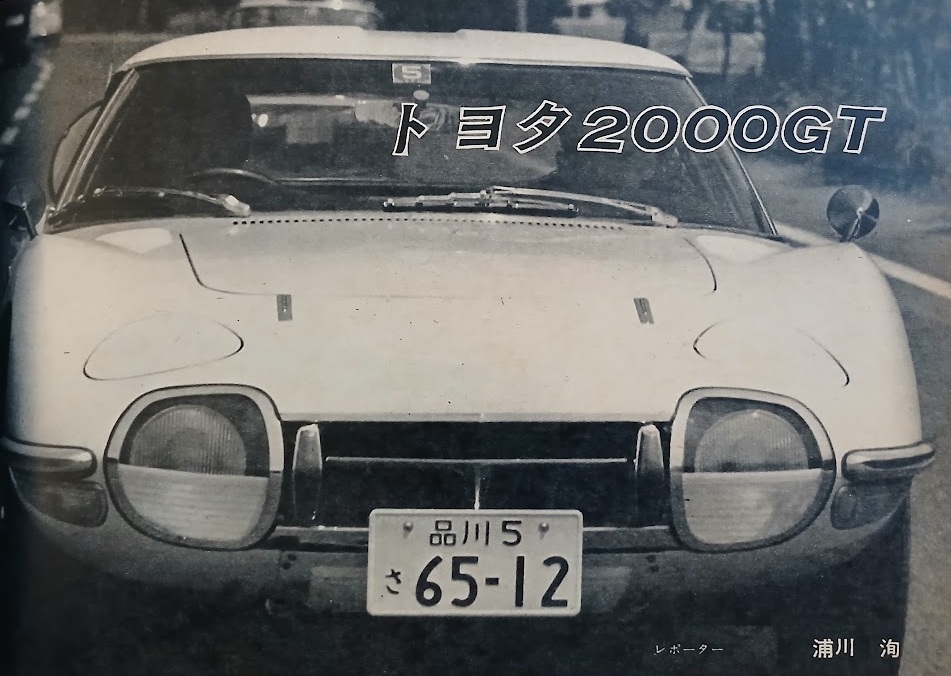
Without delay, I took a Pegasus White example, which had only recently come off the production line and covered approximately 1,000km, and drove from central Tokyo to the Keihin region. What follows is my report.
A High-Class Sports Car
For the launch of the 2000GT, Toyota adopted the slogan, “The authentic luxurious atmosphere befitting a top-class GT.”
It would be fair to say that this description is especially apt when one steps inside the cabin.
First, let’s settle into the driver’s seat. With an overall height of just 1,160mm, getting in requires ducking your head and lowering yourself down, rather like climbing into the cockpit of a fighter aircraft. For the sports-car enthusiast, however, this is an irresistible part of the appeal. Simply taking one’s place behind the wheel creates a sporting mood quite unlike that of an ordinary sedan.
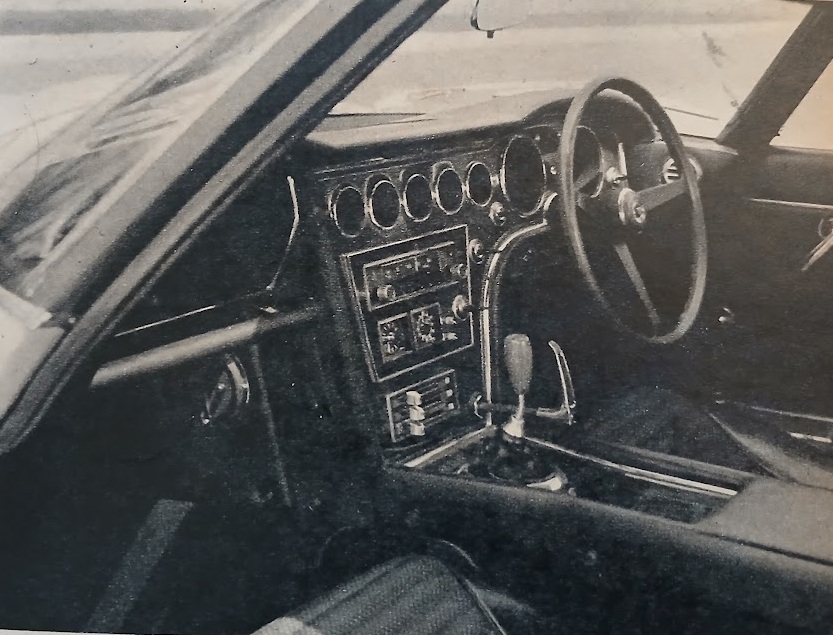
Once seated, the bright Pegasus White exterior gives way to a cabin finished almost entirely in black. The rich, dignified atmosphere immediately conveys the feeling of a high-class car while inspiring a certain sense of calm in the driver.
At the center of the dashboard, heater controls, a clock, a stopwatch, and the radio are neatly set into a restrained woodgrain panel. The color scheme has been very carefully considered, ensuring that these details never detract from the predominantly black interior.
From the driver’s seat, the speedometer with trip meter, tachometer, ammeter, water-temperature gauge, cooling-fan indicator lamp, oil-temperature gauge, oil-pressure gauge, and fuel gauge are all angled toward the driver. They are exceptionally easy to read, and it is no exaggeration to say that every instrument falls naturally within the driver’s field of vision.
For a car that so proudly emphasizes its high-speed performance, this thoughtful attention to cockpit design is something every domestic manufacturer would do well to emulate.
Beside the clock is a stopwatch. It is useful for simple timing exercises, and when driving the car for pleasure, adds another point of interest.
During the test drive, I found myself using this stopwatch repeatedly to measure various aspects of the 2000GT’s performance.
A Steering Wheel That Slides Fore-and-Aft
Another welcome feature—one said to be a first for a domestic production car (though recently adopted on the Mazda Cosmo Sport as well)—is the steering wheel, which slides fore and aft to suit the driver’s preference.
The driving position itself can also be tailored to the individual. Using the pedals as the fixed reference point, the seat can be moved fore and aft, the seatback angle adjusted, and the steering wheel repositioned, allowing the driver to adopt the ideal “arms-outstretched” posture. The steering adjustment sleeve is also exceptionally simple to operate.
Since there was little opportunity for sporting driving in the morning Tokyo traffic, I adjusted the seat slightly forward, set the steering wheel to its fully forward position, adopted a more upright driving posture, and set off.
The 5-speed floor-mounted gear lever is beautifully finished with a woodgrain knob. Its shape, rather like the top half of an egg, makes it comfortable to grip. The aluminum shift-pattern plate on the top of the knob, however, looks somewhat inexpensive for a car of this class, and its color is not very well-judged.
Perhaps because the test car had not yet been fully run in, the gearshift felt stiff, which soon became tiresome. In city traffic, where constant shifting is unavoidable, this proved particularly wearing.
Although it is equipped with a 5-speed gearbox, city driving rarely allows the use of anything beyond second gear. Under stop-and-go conditions in first and second, the green cooling-fan indicator lamp illuminated after only about twenty minutes of driving.
One cannot help regretting that, on Japanese roads, it is impossible to bring out even half the performance suggested by the car’s specifications.
The tachometer’s red zone begins at 6800rpm, while the scale extends all the way to 9000rpm, leaving the impression that the engine is capable of revving much higher. Yet in Tokyo traffic there is simply no way to find out.
Once I reached the Third Keihin Expressway, however, I summoned a little extra courage and began to press harder on the accelerator.
Naturally, I first adjusted the steering wheel, moved the seat all the way back, and settled into a position with my arms fully extended. Before the test drive, I had expected this posture to make the view out rather limited, but visibility proved surprisingly good.
It was also at this point that I was reminded that, for a sports car, the ride was remarkably close to that of a normal passenger car.
In other words, the 2000GT still retains much of the comfort and accommodation one associates with a conventional passenger car.
As mentioned earlier, the excellent visibility extends beyond the view ahead. Rear visibility has also been given careful consideration, completely overturning my initial impression from the car’s exterior that rear visibility would be poor.
The interior rear-view mirror, with its flattened upper edge, is free of distortion and provides an accurate view behind.
When traffic finally thinned out, I tried a gentle slalom at around 130km/h, and found no trace of high-speed instability whatsoever.
Maintaining the same speed, I then flicked the steering wheel more sharply from side to side with small inputs. The steering responded with remarkable sensitivity, faithfully transmitting each movement and reinforcing the car’s sporting character.
Fine Details for Everyday Driving
The transmission is a fully synchronized 5-speed with an overdrive top gear. Fifth has an overdrive ratio of 0.844, contributing to the car’s claimed maximum speed of 220km/h.
At the same time, the gear ratios are closely spaced to give the drivetrain the flexibility needed for easy operation.
After about twenty minutes of driving, the gear lever began to feel more natural in the hand, and shifting became noticeably smoother. At first I assumed the heavy shift action was simply because the car had not yet been fully run in, but I eventually began to suspect that the relatively short gear lever also contributed to the heavy feel.
The gearbox’s usable range is remarkably wide. For a car designed primarily with high-speed performance in mind, the engine is surprisingly flexible. To exaggerate only slightly, at around 50km/h it feels as though the car could be driven in any gear, from first through fifth.
At an indicated 50km/h, the tachometer shows approximately 5000rpm in first, 3000rpm in second, 2200rpm in third, 1850rpm in fourth, and about 1500rpm in fifth.
To test standing-start acceleration, I engaged the clutch at around 4000rpm. There seemed to be a bit of clutch slip, but that is only to be expected in a production car rather than one prepared for racing. The engagement is intentionally more progressive, connecting with the smoothness one would expect from an ordinary passenger car. In other words, Toyota has clearly taken care not to sacrifice everyday drivability in city traffic.
As far as performance is concerned, Toyota may describe the 2000GT as a sports car that does not put performance above all else, but whatever the official position, it is a car whose performance inspires complete confidence.
Superb Ride and Stability
The arrival of a genuine grand touring car of this caliber in Japan is surely something to be celebrated.
There were, however, a few points that caught my attention during the test drive. Setting aside the rather stiff gearshift already mentioned, I noticed that when driving with the side windows open, the airflow around the rear hood latches generated a slight wind noise. Ventilation around the driver’s feet also left something to be desired.
To be fair, the latter is perhaps unavoidable in Japan, where endless slow-moving traffic is part of everyday driving. Even so, in a car designed with such extraordinary attention to luxury, it is difficult not to expect more.
However, I found that the problem could actually be solved simply by opening the rear hatch slightly and securing it with its stay while driving, which noticeably improved ventilation.
The roofline is even lower than that of cars such as the Jaguar E-Type and Porsche, so getting in requires one to crouch down a little more. Even so, the doors open exceptionally wide, and entry is by no means difficult. Once seated, the feeling of security and support is, I would say, superior to that of any comparable sports car.
As for its behavior on the road, the fully independent suspension, with coil springs and torsion-bar stabilizers, provides outstanding stability through corners. Body roll is remarkably well controlled, yet ride comfort remains excellent.
The excellent road-holding seems due in no small part to the well-balanced weight distribution—49.6% over the front wheels and 50.4% over the rear—together with the use of 165HR-15 radial tires.
These Dunlop tires are paired with magnesium-alloy wheels featuring center-lock hubs, a combination that inspires tremendous confidence.
Disc Brakes on All Four Wheels
Another feature of the Toyota 2000GT that deserves special mention is its braking system. It is the first production car built in Japan to employ disc brakes on all four wheels.
The front discs measure 11in in diameter, while the rear discs are 10.5in. The brake pads incorporate an automatic self-adjusting mechanism, and servo assistance is fitted, resulting in an excellent braking system.
Drivers unfamiliar with disc brakes, however, will probably need a little time before they become fully accustomed to the pedal feel.
Another point worth mentioning is the availability of optional final-drive gears as racing parts. In addition to the standard 4.375 ratio, Toyota offers 4.111, 4.625, and 4.875 gearsets. These provide considerable scope for improving performance, and they also make it relatively straightforward to prepare the car for full racing specification.
A wide range of other competition parts is also available, including camshafts, valve springs, valves, clutches, and suspension components.
In any event, the appearance of a GT car of this quality on the Japanese market is evidence that the nation’s automobile industry has, at last, reached an international standard. It also gives enthusiasts even greater reason to look forward to the future. At 2.38 million yen, the Toyota 2000GT is certainly not inexpensive, but when one considers its styling, performance, and practicality, the price can fairly be called appropriate.
Postscript: Story Photos