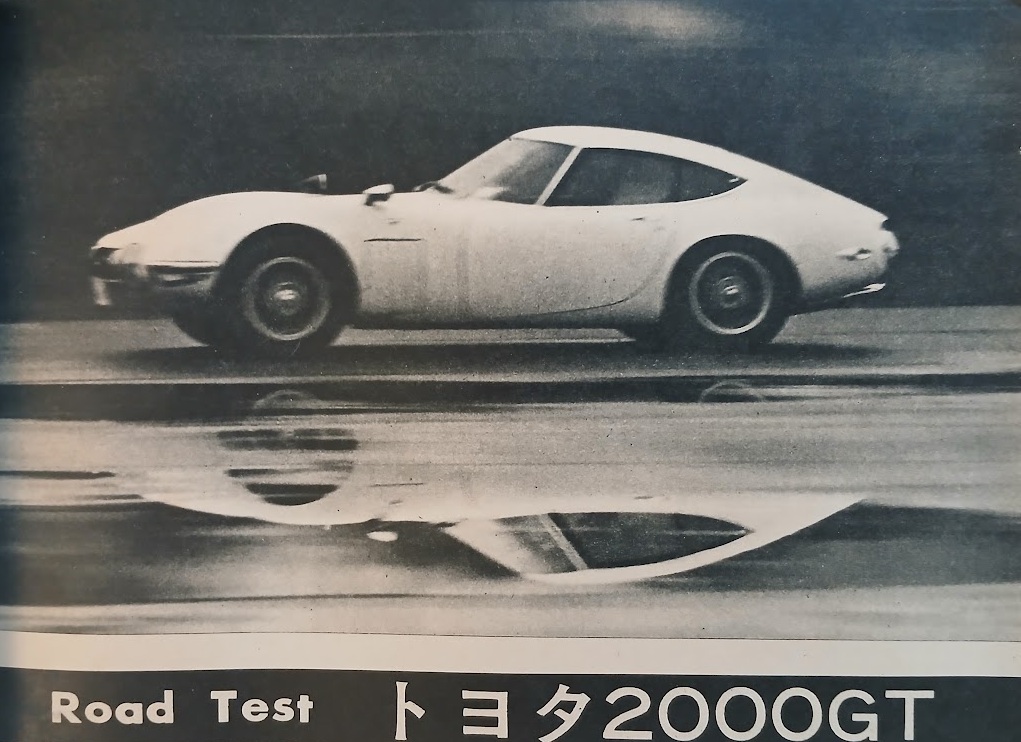
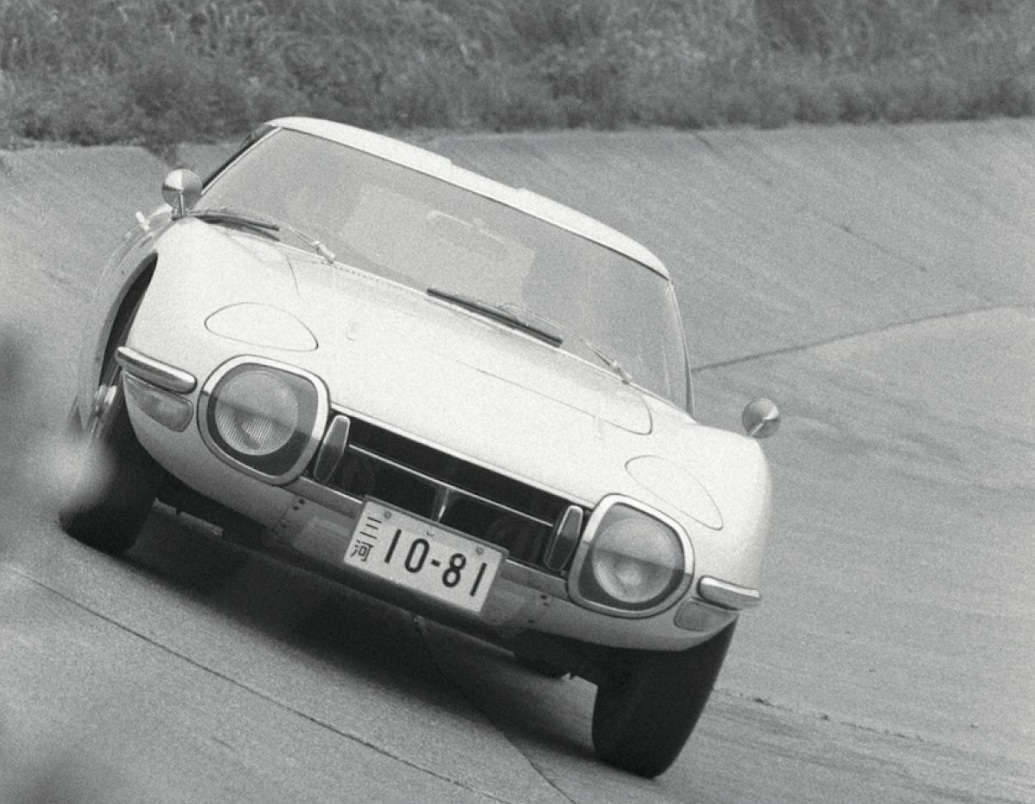
Toyota 2000GT (1967)
Publication: Motor Fan
Format: Road Test
Date: October 1967
Authors (Roundtable): Jiro Kono, Osamu Hirao, Kenji Higuchi, Akio Miyamoto, Yasuhei Oguchi, Taizo Tateishi, Kenzaburo Ishikawa, Toshihide Hirata, Riichi Toyoda, Motor Fan Editorial Staff (uncredited)
A GT Car Bringing Together The Best of Toyota’s Technology
Magazine: To begin, could you tell us about the aims behind the development of the Toyota 2000GT, and give us an overview?
Kono: Perhaps I should start by explaining why Toyota decided to build a car like this in the first place. In 1963, the first Japanese Grand Prix was held, followed by the second the following year, along with a number of other races domestically. In all cases, the field was dominated by boxy sedan-type cars. Seeing this, there was a growing feeling within the company that we should create something more like a true sports car, and use it as a kind of spearhead for Toyota’s lineup.
At that point, the question became whether to make it a car intended purely for racing, or to develop a grand touring car–one that would offer a level of performance, ride comfort, and handling that could not be experienced in an ordinary touring car. In the end, we chose the latter.
The idea was that by bringing together the very best of our technology, and creating a car that was comfortable to ride in, not tiring over long distances, yet also offered strong acceleration and good handling, we ourselves would have much to gain from the process. That was the basic concept behind this car.
That said, this did not mean we would be content to enter races and lose. Our goal—perhaps an ambitious one—was that even in the GT class, it should aim for first-rate performance that would not be outmatched by other cars.
Magazine: When did development actually begin?
Kono: It was immediately after the second Japanese Grand Prix, so around June of 1964.
Magazine: How did development proceed in concrete terms?
Kono: The first major issue was how to approach weight. From our standpoint, ride comfort could never be sacrificed, so we felt the car needed to carry a certain amount of weight–in other words, we did not want to build a car weighing under one ton. We made this request to the company, and it was accepted. As a result, the planning proceeded with relatively little concern for total weight.
However, when it came to weight distribution, we paid very close attention. In particular, we worked to bring the mass as close as possible to the center of gravity of the vehicle, carefully considering front-to-rear balance. For example, we set the engine as far back as possible and made efforts to reduce unsprung weight.
In terms of overall weight, our guiding principle was to concentrate mass as low as possible and as close to the center of gravity as we could. Even if the total weight increased somewhat, we accepted it. Our policy was to include everything that was necessary, and we followed that approach consistently through to the end. This also helped to define the character of the car quite clearly.
There was also considerable discussion about engine size and layout. In the end, we chose a conventional front-engine, rear-drive layout, with the aim of doing the best we could within that framework. For the engine, we decided to make use of as many components as possible from the Crown, which we were already producing, with the intention that any developments could be fed back into that model. For that reason, we deliberately chose not to design an entirely new engine.
As a result, there are some areas that are not entirely ideal, but we believe we were able to achieve a satisfactory level of performance overall. The development process itself also differed somewhat from Toyota’s usual mass-production models. I acted as chief, and we formed a small team of four, which handled the project in a very focused manner.
Once the basic concept had been brought together, we turned to Yamaha Motor, with whom Toyota had an existing relationship, and asked them to produce prototypes and eventually handle manufacturing as well. The relationship is essentially the same as when we entrust body production to Kanto Auto Works in the Kanto region.
A Style That Integrates Function and Beauty
Magazine: Did you build many prototypes before arriving at the current styling?
Kono: Not really. This version was first shown at the 1965 Motor Show, and that was effectively the first prototype–the second car, in fact. The first car had already been undergoing testing before that. We used it for endurance testing, and eventually for setting speed records at the Yatabe test course.
Magazine: You mentioned that the engine was based on the Crown unit, but modified. What exactly was changed?
Kono: It’s based on the Crown’s single overhead cam M-type engine, but we converted it to a double overhead cam design. The cylinder head was completely redesigned, though the cylinder block remains unchanged. As a result, the combustion chamber shape is different, and the valve diameters have been increased significantly—to 42mm on the intake side and 37mm on the exhaust side. Other components like the connecting rods and crankshaft are carried over, but parts like the front cover have been changed, so externally it looks quite different.
Hirao: People often say the body styling resembles the Jaguar E-Type. Was that something you had in mind during development?
Kono: Not at all. When designing a car, there are two general approaches: you can start from the styling, or from the chassis and mechanical layout. In this case, we took the latter approach. First we finalized the chassis, then the front and rear suspension, mounted the engine, and established the space for the occupants. Only after that did we “wrap” it with a body.
At that stage, we didn’t allow any extra margin—we worked right to the absolute limits. I defined all the boundary lines–the limit lines, the outer envelope–and handed those over to the designers. The resulting shape came directly from that process. There was no conscious reference to any other car’s styling.
Hirao: So what you were really focused on was the mechanical layout, and the size and posture of the human occupants.
Kono: Exactly.
Hirao: That’s really how car design ought to be, in principle.
Kono: We believe that function itself is beauty. If you fully satisfy the functional requirements, the result will naturally be something beautiful. That was our guiding idea throughout.
For example, with the driver’s seat, we initially thought about creating something with the feel of an aircraft cockpit. But as we pursued function more and more rigorously, it naturally ended up resembling that concept anyway.
Hirao: So in the end, that aerodynamic form emerges from those very principles.
Kono: Yes, that’s right.
Shaped by Real-World Testing
Kono: To improve a car’s performance, reducing frontal area is just as important as managing weight. With that in mind, we aimed for the simplest possible shape as we developed the body.
However, since we didn’t have access to a suitable wind tunnel, we had to verify everything through real-world testing. We tried fitting a rear spoiler, but it didn’t produce much benefit–in fact, it slightly reduced top speed.
We also photographed the car at speeds above 200km/h to study its attitude–things like pitch and other dynamic changes. Another method we used was attaching strands of yarn across the body surface and observing their movement. By filming from a chase car at various angles, we were able to gather data on airflow behavior.
Higuchi: In some ways, that might be better than a wind tunnel. Unlike aircraft, airflow around a car–especially near the radiator–can differ quite a bit between a scale model and the real thing.
Kono: Of course, if we’d had access to a proper wind tunnel, we would have used it.
Hirao: Looking at European cars, you sometimes see suspension layouts designed to keep the underside of the body flat. Did you consider anything along those lines?
Kono: No, we didn’t go that far. For race cars that consistently run above 200km/h, that kind of thinking becomes necessary. But for this car, we didn’t feel it was required. That said, managing the airflow from the radiator into the engine bay is very important.
Hirao: Right. In this case, it’s vented out to both sides.
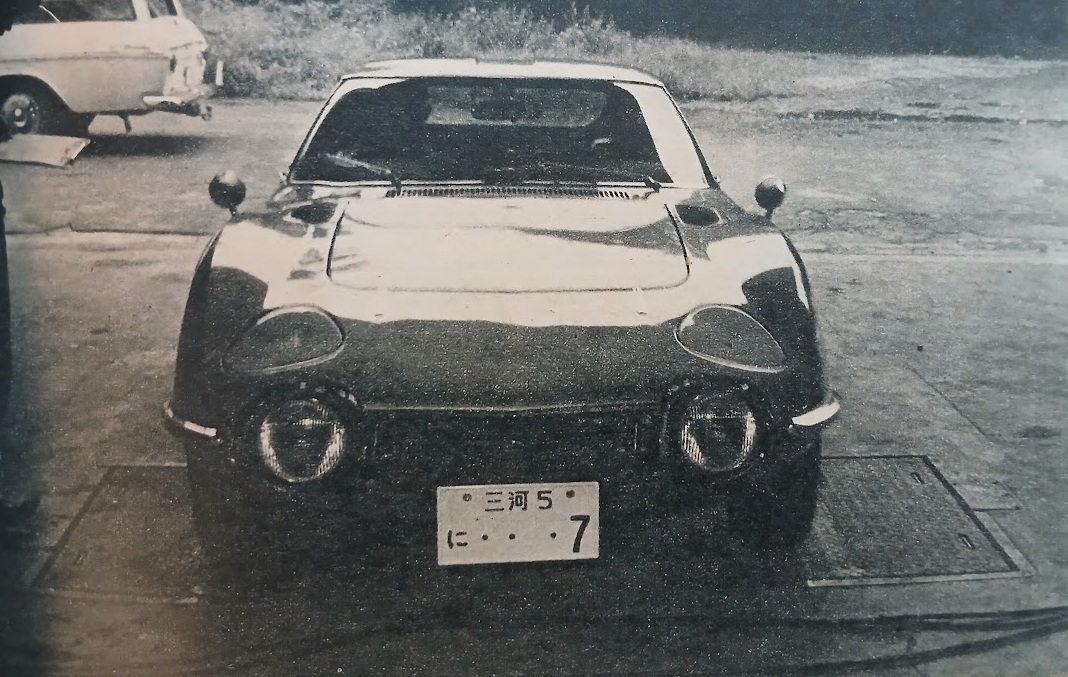
Kono: Yes, although that was more of a practical solution than an ideal one. If we vented the air directly out the rear of the hood, it would be drawn straight into the cabin through the nearby air intake. To avoid pulling hot air inside, we routed it out through both sides instead.
Behind the World Speed Records…
Magazine: Could you tell us a bit about the struggles behind the world record run?
Kono: Professor Hirao was there with us for the attempt. We carried out four rounds of practice beforehand. Using the high-speed course at Yatabe, we ran the car continuously for ten days at first. Well, during the daytime, at least.
But after about 30 hours, failures started to occur. On the second test, issues appeared again after around 45 hours. From the third attempt onward, we decided to just run it continuously, day and night, no matter what, but in the end, we never managed a single complete rehearsal before the actual run.
Our expectations were modest–if we could break three or four records early on, that would be enough. But as it turned out, the engine gradually came into its own as the run went on. In the end, we set a 72-hour average speed of 206.02km/h as a world record, along with three world records and thirteen international records. It became a far bigger achievement than we had expected.
Afterward, when we tore down the engine, it was still in a condition where it could have kept going without any trouble.
Miyamoto: So you were breaking records while still “practicing” (laughs).
Magazine: And that was the very first prototype car?
Miyamoto: Goes to show, persistence really matters.
Kono: Strangely enough, even though the clutch was hardly being used, it kept failing. At a certain speed, it would start slipping, and once that began, it would wear down quickly. We really struggled with the clutch.
On the night before the actual run, we replaced it and just went for it. It was more or less a gamble. Fortunately, that time it held up.
Hirao: Was that due to weak clutch springs?
Kono: No–even if we strengthened the springs, it didn’t solve the problem. In the end, we addressed it through the material of the clutch disc.
Another issue was the tires. At constant high speeds, they would wear down into a kind of polygonal shape. That was another unpleasant problem to deal with.
Among the World’s Best GT Cars
Magazine: What were everyone’s impressions after actually driving the car?
Hirao: I think the primary aim of this car isn’t how it performs on the circuit, but how comfortably it can be driven on ordinary roads. So I looked at it mainly from that perspective–and as you’d expect from a Toyota, it really feels like a top-class machine by global standards.
Everything works very well. The engine has good flexibility, the instrument layout is well thought out, and the seating is quite spacious. Even though the rear window is steeply raked, rearward visibility is better than you might expect. Above all, it has a genuine sports car atmosphere.
That said, as I was driving, I couldn’t help thinking, if you look at it from the standpoint of an average owner, what some call a “husband’s specification,” there will probably be calls for lighter steering and pedal efforts. If there were an optional setup more suited to general users, it might make the car even better.
The shift lever, for example, felt quite heavy. And for use in places like Japan or the United States, air conditioning would certainly be desirable. Since it’s a two-seater with a relatively tight cockpit, something like a spot cooler–adjustable cool air directed from the dashboard–would be very useful. While driving, the face-level vents do a good job, but once the car stops, the cabin quickly starts to feel quite warm.
Higuchi: This is an expensive car, and as I drove it, I found myself evaluating it less as a user and more from the standpoint of a designer.
Looking at it that way, the weight of 1230kg is something I fully agree with. These days, there’s a tendency to think lighter is always better, but for a car, especially one meant to cover long distances, ride comfort that doesn’t lead to fatigue is crucial. For a car in this class, a weight of over 1000 kg is absolutely necessary.
In fact, I think all of this car’s strengths stem from that very point. On the whole, my impressions are very much in line with Professor Hirao’s.
That said, it’s also true that there is demand for a more relaxed, easier-to-drive, more comfortable kind of car. This is sometimes called a “husband’s specification.” Looking at recent American cars, and even European exports to the US, there’s a clear trend in that direction.
Ultimately, you’re looking at things like torque-converter automatics with floor shifters, air conditioning systems that control both temperature and humidity, and a full suite of power-assisted features. Even for a sports car, I think these are considerations that can’t be ignored going forward.
A Toyoglide Version Also Under Development
Miyamoto: Cars like the Mercedes-Benz 300SL and Jaguar E-Type feel a bit too large for Japanese road conditions. In that respect, this 2000GT feels much easier to live with. You can drive it around town quite comfortably.
The styling is so striking that it makes you a little tense at first, but before long, it starts to feel as easy to drive as your everyday car.
That said, it might be worth offering a 2+2 version alongside the current model.
Hirao: There’s a point in the rev range where the engine suddenly becomes quite loud. I imagine that was intentional, but there’s also something appealing about a car that just glides along quietly and smoothly.
Miyamoto: Toyota has the excellent Toyoglide system–couldn’t that be used here?
Kono: We’ve actually fitted it to a prototype. We’d like to evaluate the results before deciding whether to put a Toyoglide-equipped version into production, but at the moment, we’re fully occupied just keeping up with manufacturing, so we haven’t had the time to refine it further.
Hirao: If you were to add a torque converter, you might want a slightly larger engine as well.
Kono: I’ve taken this car to the United States twice this year, and on the highway it performs very well, especially when merging from on-ramps, which it handles with ease. Cornering is also very composed, so overall it’s a very satisfying car to drive.
In terms of speed, even when going up against the large-displacement American cars on the freeway, it’s by no means outmatched. At around 60mph (about 96km/h), you’ll often have other cars following you, but once you reach 100mph (about 160km/h), the number of cars that can keep up drops dramatically, and beyond that, there are hardly any that can follow.
Hirao: It must feel pretty good being able to drive at a pace where nothing can keep up.
Higuchi: This was my first time driving the 2000GT, and my initial impression is that it feels very solid. It’s very much a car that lives up to its price.
It’s fitted with a wide range of equipment. Even if it doesn’t have things like air conditioning or a torque converter, everything that is there is properly executed, and nothing feels cheap or superficial. It gives a strong impression of quality. That, more than anything, stood out to me about the atmosphere inside the car.
Kono: The high price is simply a result of low production volume–we’re not building these in large numbers.
Remarkable Acceleration—and a Wonderful Sound
Higuchi: In any case, with the current level of equipment, I think customers will be satisfied. Then, once you actually set off, what is genuinely impressive is the acceleration and the quality of the sound. At the same time, it doesn’t have much of the rough edge I’ve often found in sports cars. In other words, for a sports car, the suspension feels relatively soft. I imagine that in actual circuit use, it would be set up quite differently.
Kono: For track use, we increase the spring rates by about 10-15%.
Higuchi: In actual driving, the feel through the steering wheel wasn’t particularly unusual either. I didn’t have the chance to drive at very high speeds, but at around 60 km/h, it felt much like an ordinary sedan–an easy, usable car. If anything, I would have liked the steering to be a bit lighter.
Kono: The steering weight is related to the strength of the pinion gear in the rack-and-pinion system. Of course, it would be ideal to offer a range of gear ratios, but if we were to use a more relaxed, “husband’s” ratio in the current layout, the strength of the pinion would become questionable.
Hirao: I think it could be addressed by adding another stage of reduction…
Higuchi: Or add a changeable gear set (laughs). Use a lower ratio for everyday driving, and when you want to go faster, change to another gear…
Hirao: The carburetor settings didn’t seem quite right on the test car. When you let the revs drop too low, it begins to stumble. At around 1000rpm in first gear, what speed would that be?
Kono: About 10km/h. At that speed, it should still be able to run smoothly.
Hirao: I had a similar experience–I let the revs drop too far in second, and it jerked a bit. I immediately thought it must be the carburetors.
Kono: Covering the entire range of engine speeds is very difficult. Ideally, we’d like drivers to keep it above about 1200 to 1300rpm.
Toyoda: We also have to ensure it performs well at high speeds, so that balance was something we struggled with quite a bit.
Hirao: Up to what engine speed can it be safely extended?
Kono: Up to 7000rpm.
Hirao: So in first gear, that would take you to about 70km/h.
Higuchi: On the university campus, I could only use first gear (laughs).
Hirao: I drove it around town mostly in first and second. Once I got onto the expressway, I tried a few different things, and it would pull quite comfortably in top gear even at 40km/h.
Magazine: The backbone frame and the suspension both incorporate a number of new ideas for Toyota. Could you tell us about the challenges during development?
Kono: Almost everything was new to us, so we approached it somewhat cautiously, but in the end it worked out quite well. There were some changes along the way, of course.
The car uses fully independent suspension on all four wheels, with double wishbones front and rear, and high-mounted springs in both cases. The shock absorbers are hydraulic telescopic units, and torsion bars are used for the stabilizers front and rear. We also use rubber bushings throughout the suspension to keep vibration and noise to a minimum. In addition, the overall center of gravity is very low–just 440mm–which contributes to improved cornering characteristics.
Top Speed: 235km/h!!
Magazine: Now, let’s hear the performance test results from the Hirao Laboratory.
Oguchi: The day of the test was rainy, so the road conditions were poor, and the numbers are somewhat lower than ideal. The test car had 7,990km on the odometer, so it had been fairly well broken in. Test conditions included two occupants plus the instruments, for a total load of 139.5kg.
Beginning with standing-start acceleration, the time-to-distance results were 0-50m in 4.5 seconds, 0-100m in 6.9 seconds, 0-200m in 10.4 seconds, and 0-400m in 16.1 seconds. In terms of time to speed, it took 5.2 seconds to reach 60km/h, 7.4 seconds to reach 80km/h, 9.6 seconds to reach 100km/h, 12.5 seconds to reach 120km/h, and 14.4 seconds to reach 130km/h. So, by the 400m mark, the car is already traveling well over 130km/h.
Next, overtaking acceleration. Since this car has four gears with overdrive, starting from 30km/h in third gear, it takes 8.6 seconds to reach 60km/h, 16.5 seconds to reach 100km/h, and 22.7 seconds to reach 130km/h. From 40km/h in top gear (fourth gear), it takes 17.2 seconds to reach 100km/h and 22.2 seconds to reach 120km/h. Finally, starting at 50km/h in overdrive (fifth), it takes 20.0 seconds to reach 100km/h.
Starting in third gear from 30km/h or fourth from 40km/h doesn’t quite match the natural character of this car, but we kept the same test format for consistency. One thing I noticed during testing: aerodynamic drag is extremely low. In a coasting test from 70-80 km/h, the car rolled all the way to the corner of the Murayama course. The Mechanical Testing Lab track really isn’t suited for testing this car’s capabilities.
Kono: That’s right. Ideally, it would have been taken to Yatabe.
Magazine: With the 0-400m time of 16.1 seconds being affected by the wet surface, what kind of figures does Toyota’s internal data show?
Kono: The catalog lists 15.9 seconds, and our best internal time was around 15.3 seconds. That was done on a perfect day with optimized tires to see the absolute best performance.
Oguchi: Under ideal conditions, a 16-second run would be easily achievable. We lost some time at the start due to wheelspin. From the driver’s seat, the initial g force at launch doesn’t feel especially strong, but the way it pulls in the upper range is excellent. The acceleration from around 80-100km/h is especially impressive.
Magazine: Obviously, we couldn’t test the top speed, but what will it reach?
Kono: The figure listed in the catalog is 220km/h, but at Yatabe, the average lap was 225km/h, and the peak speed reached around 235km/h.
Hirao: I wonder what the international record is. Around 250km/h for a 2000cc car?
Kono: I believe it’s closer to 270km/h.
Quiet, Passenger-Car-Like Noise Levels
Magazine: Next, we’d like to hear the results of the noise and vibration tests conducted by the Watari Laboratory.
Tateishi: First, regarding suspension vibration, since this is a two-seater, measurements were taken for the front seats only. The sprung vibration frequency was 1.5cps at both the front and rear wheels. As for unsprung vibration, the front measured approximately 13-13.5cps, while the rear came in at 15cps. In other words, the sprung vibration frequency is the same front and rear, while in terms of unsprung vibration, the front is somewhat softer and the rear slightly stiffer.
Next, noise. Interior noise was measured in fourth gear from 40km/h up to 120km/h. The results were 65 phons at 40km/h, 69 at 60km/h, 72 at 80km/h, 75 at 100km/h, 76 at 110km/h, and 77 phons at 120km/h.
As for exterior noise, up to now we have measured it by accelerating at full throttle from 50% and 75% of the engine speed at which maximum power is produced. However, since a JIS standard for exterior noise measurement was adopted at the end of March this year, we have followed that method for this test.
Under those conditions, the measurements were taken at the floor-mounted gearshift, with the transmission in third gear, on a wet road surface, at an indicated speed of 50km/h and an engine speed of 2200rpm. The measured value was 77.5 phons.
Returning to the earlier point, a sprung vibration frequency of 1.5cps is very much in line with that of a passenger car. As for noise, based on the data from previous Motor Fan tests, there is a general range we use for comparison, and this car falls within, or slightly below, that range, which means it is on the quieter side.
For exterior noise, since this is our first time using this method, we do not yet have direct comparison data. However, even when compared with the previous method–such as taking measurements at around 50% of engine speed in third gear, for sports cars–it can be said to be quite quiet.
In that sense, from the standpoint of both suspension vibration and noise, I think it is fair to say that this is a car with a ride quality that is very much like that of a passenger car.
A Luxury-Car Feel in Weight and Braking
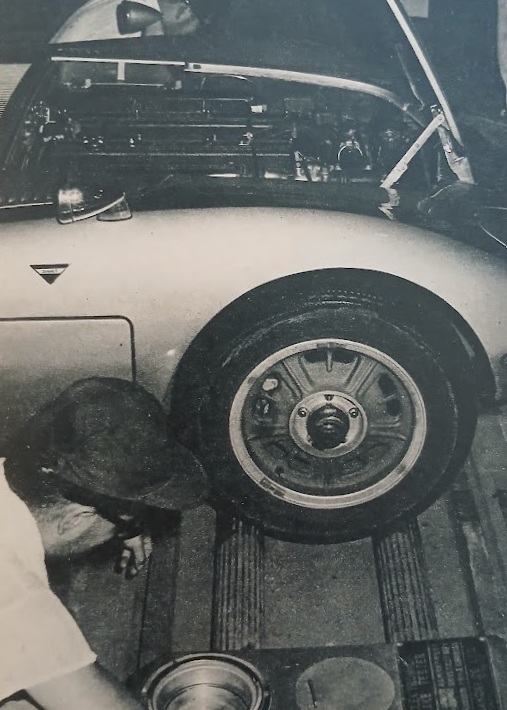
Magazine: Next, let’s move on to the measurements taken at the Ship Research Institute.
Ishikawa: First, the weight figures. With a spare tire, tools, and a full tank of fuel, the car comes in at 1134kg. Weight distribution is 575kg at the front and 559kg at the rear, or 51:49. One notable point is the difference between the front wheels—the left front is about 30kg lighter than the right (272kg vs. 303kg).
We also measured the weight with one and two occupants on board. With two aboard, total weight rises to 1257kg, and the balance shifts slightly rearward to 614kg front and 643kg rear, or 49:51.
The official dry weight is 1120kg. If you divide that by the car’s overall length and width, or footprint, you get 168kg/m², which is on the heavier side.
Hirao: How does that compare to the Benz 300SL?
Ishikawa: It’s about the same as the Benz sports car. Generally speaking, luxury cars tend to be built heavier.
Kono: If the body shape allowed for more curvature in the panels, it could be lighter. But aerodynamic considerations and other factors pushed the weight per square meter up.
Ishikawa: That said, output per ton is 134ps/ton, which is quite high. So although it’s relatively heavy, the strong power means acceleration and overall performance are still very good.
As for wheel alignment, the front shows a very slight toe-out, while the rear has a bit of toe-in. These values hardly change when one or two people are on board.
Now, the brakes. This is the first Japanese car to feature disc brakes on all four wheels, along with a vacuum servo to reduce pedal effort. As a result, the pedal force required to achieve 0.6g deceleration is about 25kg, which is relatively low. A typical sedan is around 20kg, so it’s only slightly higher. Without the servo, it would likely be closer to 40kg, so in that sense it’s a very easy-to-use setup.
The servo’s rest point is at around 20kg of pedal effort. These measurements weren’t taken under heavy acceleration, but under higher load conditions, vacuum would increase, and the servo would likely remain effective closer to that 25kg (0.6g deceleration) point.
Brake force distribution at around 20kg pedal effort is 65:35 front-to-rear. Given that the static weight distribution is nearly even, this setup clearly prioritizes avoiding rear wheel lockup.
Pedal stroke is 50mm at 0.6g deceleration (25 kg). That’s on the long side, and combined with the servo assistance, gives an overall soft, progressive feel. It takes about 5.7kg of effort to move the pedal 1cm–roughly half that of a typical car, which is closer to 10kg.
The parking brake is particularly effective. With rear discs, parking brakes are often weak, but here it works very well. To generate braking force equivalent to 20% of the vehicle’s weight, it requires about 19kg of effort, comparable to a conventional drum setup. It uses a stick-type lever that is pulled outward, which is also quite easy to operate. At 19kg, the stroke is 78mm.
As for control efforts overall, the gear lever requires about 3-5kg, which is typical for a sports car. A regular sedan would be closer to 2-3kg, so it’s slightly heavier, but it has a satisfying feel.
The clutch, however, is fairly heavy–14 kg to disengage and 12 kg to engage. Most sedans disengage at around 10-11 kg and engage below 10 kg, so this is noticeably heavier.
Accelerator pedal effort is under 5kg in most situations. At a steady cruise with two occupants, it takes about 1.5kg; for brisk acceleration, around 4.5kg; and at full throttle, 8kg. In everyday use, though, it stays within about 5kg, which is quite typical.
Magazine: With four-wheel disc brakes, how is the parking brake mechanism handled?
Kono: Pulling the lever actuates a cable that operates a dedicated parking caliper mounted on the rear discs.
Magazine: Adjustable steering column length is also a first for a Japanese car, isn’t it?
Miyamoto: Benz has had it for some time.
Higuchi: Being able to adjust the steering column length is a real advantage. Driving positions change between city and highway driving, so it’s better if the steering wheel position can change accordingly.
A Roll Angle Suitable For a Sports Car
Magazine: Next, let’s hear the results of the handling and stability tests conducted by the Kondo Laboratory at Tokyo Institute of Technology.
Akutsu: The tests were carried out with two occupants plus instrumentation (42 kg). The spare tire and tools were removed. First, we measured the practical minimum turning radius, based on the outermost path traced by the body, and it came out to 5.78m.
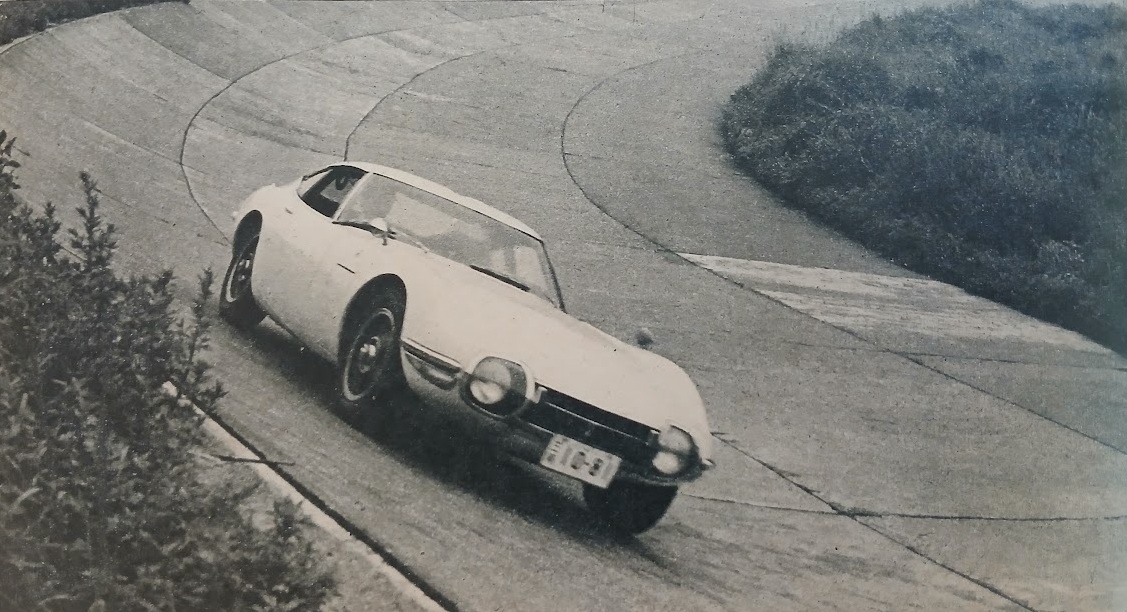
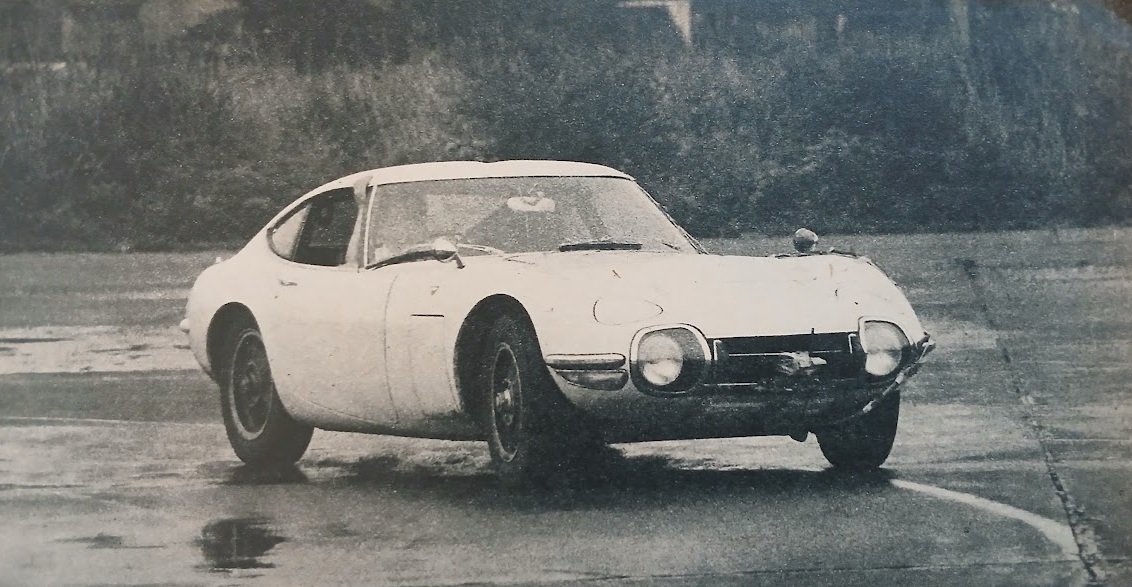
Next, in steady-state circular cornering tests, the car showed understeer up to a lateral acceleration of 0.65g. Beyond that point, it transitioned rather abruptly into oversteer. Steering effort at that moment peaked at 4kg. The roll angle was about 3.3°, which I think is an appropriate figure for a sports car.
To measure low-speed steering effort, we conducted a figure-eight test. At 0.25g lateral acceleration, steering effort was 8kg when entering the curve and 3kg when exiting. For high-speed steering effort, we ran a slalom test. At a maximum lateral acceleration of 0.25g, steering effort measured 2.6kg to the right and 2.8kg to the left, which are both good values.
At a standstill, steering effort was somewhat high. Turning the wheel to the right, it exceeded the scale limit (over 16kg) at 180°, and to the left it went off-scale at around 90°. So in that sense, it does feel a bit heavy.
For straight-line stability in the free-release test, we tried this at speeds up to 120km/h, and the car settled nicely. It’s quite stable.
We also measured 0–400m acceleration at the Kondo Laboratory using a self-recording accelerometer. The result was 15.9 seconds, matching the catalog figure. The graph clearly showed a noticeable vibration immediately after clutch engagement.
Magazine: Did you observe the same understeer-to-oversteer transition in your in-house testing?
Kono: I haven’t personally experienced it to that extent…
Hirao: This car has a differential lock, doesn’t it?
Kono: It uses a limited-slip differential, yes.
Hirao: If you push it hard in cornering, that could explain it. As the inside wheel starts to bind and approach lock, the limited-slip effect would begin to come in.
Kono: Yes, that’s certainly possible.
Magazine: Next, let’s move on to the visibility measurements conducted at Tokyo University of Agriculture and Technology.
Hirata: As usual, we placed a dummy in the driver’s seat and mounted a camera with a fisheye lens at eye position to take measurements.
The eye point height from the ground is 98.5cm with the seat slid fully forward, and 99.8cm when fully back. The horizontal distance from the lens cap to the windshield ranges from 6.5-42 cm, and the total fore-aft movement of the eye point is 5.5cm.
Expressed as angles on the horizontal plane, including the eye point, the forward field of view through the windshield is between 126-114°. Vertically, it ranges from about 22-18°, and the downward angle to the road surface is about 7°.
Rearward visibility spans 41.5-48° horizontally, while vertically it’s just 4-3°, so it’s very narrow in height, but relatively wide side-to-side.
As for the wiper sweep, it covers 90.5-86.5° in the horizontal plane. Because the design differs slightly from typical setups, the fender mirrors remain clearly visible even while the wipers are operating.
Forward blind spots amount to 44.0°, or about 24.4% of the total field, and this does not change even when the seat is moved rearward.
The interior rearview mirror is particularly effective–it provides a full view of 100% of the rear window. That’s quite rare. The rear window itself is small, but even so, the mirror works remarkably well.
Low Seating Gives Excellent Ride Comfort
Magazine: Next, let’s go over the dimensional measurements carried out by the Higuchi Laboratory.
Onda: We haven’t measured a domestic car of this type before, so there’s nothing we can directly compare it to, but I’ll share a few impressions from the process.
Looking first at the exterior, one thing that stood out is the headlamp arrangement. The smooth, flowing lines of the body are somewhat spoiled when those “eyes” pop up. Of course, they’re only raised at night, so the awkward look isn’t too noticeable in practice… as I understand it, this setup was required to meet US regulations specifying a minimum height above the ground. That’s why retractable lamps were installed in addition to the fixed units at the nose. For the domestic version, though, it might actually look better without them.
Then, when I got underneath the car to measure ground clearance, I noticed how flat and cleanly finished the floor and underside are. Everyone was impressed by that.
Another point: the triangular vent windows have been eliminated, and ventilation is handled entirely by a strong built-in system. In any case, getting rid of those “fussy” little windows really cleans up the styling.
As for the rear, I do wonder whether the luggage hatch really needs to be quite so large. If you’re going to carry bulky items back there, you’d probably want some sort of retaining strap. If it’s mainly for smaller luggage, a smaller hatch might have allowed for a more cohesive design.
The steering column adjustment is listed in the catalog as 60mm, but perhaps we didn’t handle it quite right, as we could only get about 40mm of travel.
The seats are set very low, which helps maximize headroom. They’re also very comfortable–very much what you’d expect of a proper sports car seat–and there’s actually more space than you might think. That said, it would be nice to have footrests on both sides of the passenger seat. In a car capable of 200km/h, you do feel the need to brace yourself with both legs.
As for the controls, the turn signal switch is mounted in an unusual position compared to a typical sedan, and having to cancel it manually each time is a bit inconvenient. It probably wouldn’t matter much on long touring drives or on the track, though…
The headlights are also controlled by separate switches, one for the retracting mechanism and another for the main lights, and they don’t appear to be linked. It would be preferable to combine them into a single switch.
That said, the reach to all the controls is good, and the fact that the gauges are all angled toward the driver gives a very pleasing, driver-focused feel.
Kono: The large rear hatch is necessary to allow the spare tire to be taken in and out. If it were any smaller, that would become quite difficult.
Above-Average Safety Equipment
Magazine: Next, we’ll look at the safety check carried out by the Higuchi Laboratory.
Higuchi: For the safety evaluation, we consider five areas: the body, the cabin, operational safety, seating, and driver protection. Based on references such as American safety standards, we compiled a checklist of 30 items. Each item is scored on a scale from a maximum of five points to a minimum of one. A score of five represents an exemplary feature, something that could serve as a model for other cars, while one point indicates a deficiency that should be improved immediately. An average rating is three points.
This checklist is applied equally whether we’re evaluating sedans, GT cars, or sports cars, which is not always ideal, but based on this common scale, this car received a total of 72 points. For cars in this class, scores typically fall in the 65 to 70 point range, so I think it is fair to say that it is slightly above average.
Looking at the details, the items that received five points include the energy-absorbing aspect of the steering system, which is designed to offset a certain amount of impact in the event of a collision, which should contribute to driver safety. Another is the standard fitment of full harness-type seat belts, as well as a heated rear window defroster. The dashboard is finished entirely in black to reduce glare, and even the wipers are non-reflective.
On the other hand, one area that I would like to see improved immediately is the front bumper. At present, it is a small, split design on the left and right sides, while at the rear there are only simple overriders. From the standpoint of a bumper’s function, this seems insufficient. This relates more to “protection” of the body than to driver safety, though…
Aside from that, many of the items fall in the four-point range, and it can be said that the car is equipped with safety features that are above the general standard.
Eighty-Five Percent for Export
Magazine: What are the production plans for this car?
Kono: It was originally scheduled to go on sale at the end of last year, but because we made various revisions to different components, the start was delayed considerably. Even so, we are aiming to produce 500 units within this year.
As for the breakdown, we plan for around 80-85% of total production to be exported overseas, primarily to the United States. The remaining roughly 20% will be allocated to the domestic market. Even if we send 400 units to the US, Toyota currently has about 650 dealers there, so it doesn’t even amount to one car per dealer.
For that reason, with safety regulations set to become stricter next year, the idea is to build up as many units as possible within this year.
Magazine: Are there any plans to introduce a 2+2 version later on, like the Jaguar E-Type?
Kono: We’ve conducted various studies on the market potential for a 2+2 in the US as well. Jaguar, it seems, intended for that version to sell quite well, but in reality it hasn’t been very popular, and there have even been reports of the 2+2 being discounted by $300 recently.
As for our own policy, we intend for this car to remain strictly a two-seater, and at present we are not considering a 2+2 version.
Magazine: Thank you all very much for your time.
Postscript: Story Photos