Toyota 2000GT (1967)
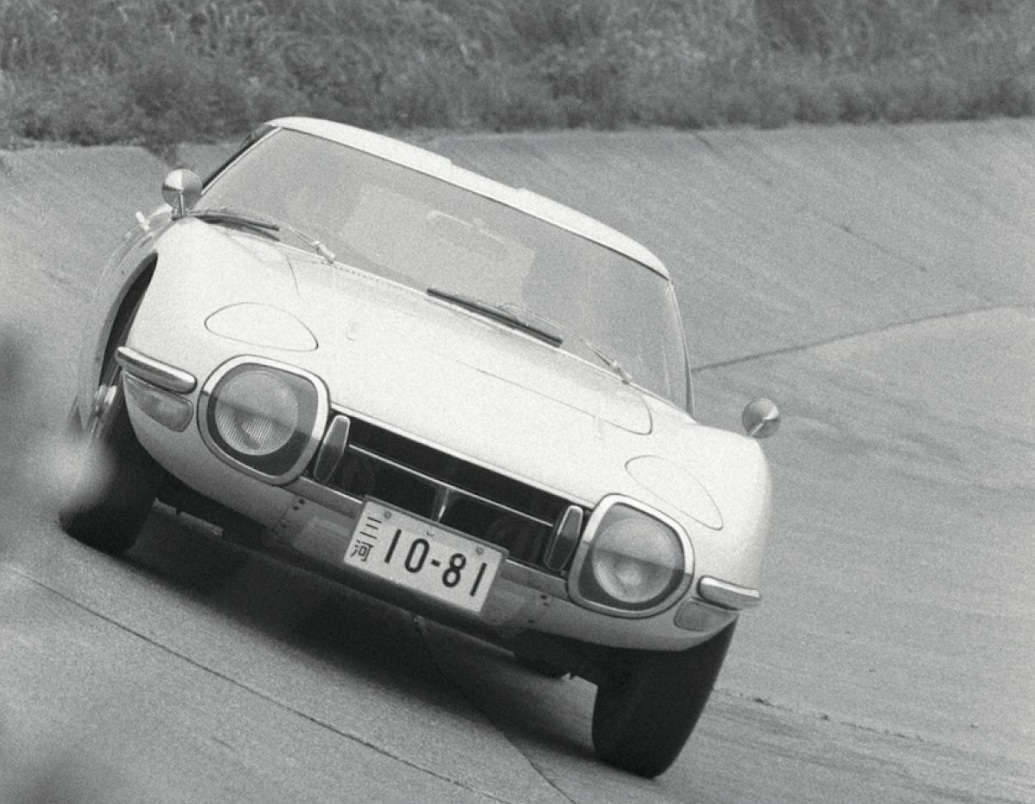
Publication: Motor Fan
Format: Road Test
Date: August 1967
Authors (Roundtable): Jiro Kono, Osamu Hirao, Kenji Higuchi, Akio Miyamoto, Yasuhei Oguchi, Taizo Tateishi, Kenzaburo Ishikawa, Toshihide Hirata, Riichi Toyota, Motor Fan Editorial Staff (uncredited)
Magazine: First, please tell us the purpose of the development of the Toyota 2000GT and its outline.
Kono: Let me begin by explaining why Toyota started making such a car. The first Japanese GP was held in 1963, and from then until the second GP the following year, various races were held in Japan, but most of the entries were boxy sedans. Seeing this, an idea arose within the company to somehow create something that resembled a real sports car and make it the vanguard of Toyota’s products. The question then was whether to make a car that was used purely for racing, or to make a grand touring car with performance, ride comfort, and maneuverability that could not be experienced in a normal touring car. In the end, we decided on the latter. The idea behind this car was that we could gain a lot from bringing together the best of our technology to create a car that was comfortable to drive, didn’t tire you out even when driving long distances, and had good acceleration and maneuverability.
However, that didn’t mean we’d be happy to enter a race and lose, so we were greedy and set our sights on achieving first-class performance that would rival any other car in the GT class.
Magazine: So when did development actually begin?
Kono: Right after the 2nd Japan GP, so around June 1964.
Magazine: How did development proceed specifically?
Kono: The first problem was deciding what to do about the weight. From our perspective, we couldn’t sacrifice ride comfort under any circumstances, so we told the company that it had to weigh at least a certain amount, in other words, that we didn’t want to make a car that was less than one ton. This was accepted, and we proceeded with the plan with relatively little concern for the weight. However, we were very particular about the weight distribution, and we tried to get the front-to-rear weight distribution, especially the mass weight, as close to the center of gravity as possible. For example, we moved the engine far back and tried to reduce the unsprung weight, but as for the total weight, we stuck to the idea of concentrating the weight as low in the chassis and as close to the center of gravity as possible. It didn’t matter if the overall weight increased a little. We went with the policy of adding everything we could. This made the character of the car quite clear.
There were many discussions about the size and arrangement of the engine, but we aimed to make the best engine we could using the orthodox FR method, and using as many parts as possible from the Crown that we currently make, aiming to feed the results back to the Crown, so we deliberately did not design a new engine. So, although there were some shortcomings, I think we were able to achieve a certain level of performance. The development method was also somewhat different from Toyota’s previous mass-produced models. I was the chief, and a team of four people was organized under me, and everything was carried out under this team’s authority.
We then sent the completed plan to Yamaha Motor Co., which happened to have a relationship with Toyota, to make a prototype and also manufacture the car. The relationship between Toyota and Yamaha is exactly the same as, for example, having Kanto Auto Works, located in the Kanto region, manufacture the car’s body.
A Style That Combines Function and Beauty
Magazine: Did you make many prototypes before you got to the style you have today?
Kono: Not many. This type was first exhibited at the Tokyo Motor Show in 1965, and that car was the second prototype. The first prototype had been in testing before then. It underwent durability tests, and was finally used to set a speed record at the Yatabe test course.
Magazine: You said that you modified the engine from the Crown, but what did you do specifically?
Kono: It was based on the single OHC Crown M-type engine, but it was changed to a double OHC. The head was completely changed, but the cylinder block remained the same. The shape of the combustion chamber was also changed, and the valve diameter was significantly larger, at 42mm for intake and 37mm for exhaust. In addition, the connecting rod and crankshaft are the same, but the front cover has been changed, and the exterior shape is quite different.
Hirao: It is said that the body style is very similar to the Jaguar E-type. Was this something you were aware of during the design process?
Kono: I didn’t think about that at all. When designing a car, there are two ways to do it: either start from the style or from the suspension and structure. This car was the latter. First, we finalized the chassis structure, finalized the front and rear suspension, put the engine in, and then we left space for the people inside and put a body on it. In this process, we didn’t think about any extra space, we just made it as close-coupled as possible. I defined all the limits, like this was the limit line, this was the borderline, and then I handed it over to the designer. The result was this style, and we didn’t think about the style of other cars.
Hirao: In the end, what you were conscious of was the mechanism, and the size and posture of the people.
Kono: That’s right.
Hirao: That’s how car design should be, originally.
Kono: We believe that function is beauty. We worked hard on the idea that if functionality is satisfied, it will inevitably become beautiful. We had the idea of making the driver’s seat look like an airplane cockpit, but in the end, we focused on functionality and ended up making it closer to that.
Hirao: So that’s where the aerodynamic style came from.
Based On Data From Actual Vehicle Tests
Kono: To improve the performance of a car, apart from the weight factor, it is necessary to reduce the frontal area. So we proceeded with the production with the simplest shape possible. However, since we didn’t have access to a suitable wind tunnel, we actually drove the car to check the effect. We tried adding a tail spoiler, but it didn’t have much effect, and the top speed actually dropped. After that, we took photos of the posture when it was driven at over 200km/h, and measured the inclination and various other elements. We attached wool to the surface of the car’s body, drove it, and took photos of the wool’s swaying from various angles from the accompanying car to collect data.
Higuchi: It might actually be better to test it with an actual car rather than a model in a wind tunnel. Unlike an airplane, the air flow around the radiator of a car is quite different between a model and the real thing…
Kono: Of course, if there was a suitable wind tunnel, we would have liked to have done wind tunnel tests.
Hirao: If you look at European cars, there are suspensions that are designed to make the underside of the body flat. Did you think that far?
Kono: No, we didn’t go that far. That’s necessary for cars like race cars that constantly run at over 200km/h, but I don’t think it’s necessary for this car. However, I think it’s important to deal with the air that flows from the radiator to the engine compartment.
Hirao: That’s right. This is vented on both sides.
Kono: Actually, we had no choice but to do that. If we vented the air directly from behind the hood, the cabin air intake would be right behind it, and the hot air would be sucked into the car. That’s why we vented it on both sides.
Behind the New World Record…
Magazine: Please tell us about the struggles that took place behind the scenes of the world speed record.
Kono: We asked Professor Hirao to be present during this record run, and we practiced four times. We borrowed the high-speed course at Yatabe, and at first, we ran it for 10 days straight, but only during the day. However, after about 30 hours, something broke. During the second test, the car started to feel unwell after about 45 hours. From the third test, we tried to run it day and night, no matter what, but in the end, we went into the real thing without completing even a single full rehearsal. We had hoped that we would be able to break three or four records at the beginning, but the engine gradually got better halfway through, and we ended up setting a major record run with three world records, 13 international records, and a world record of 206.02km/h average for 72 hours. When we took apart the engine later, it was still in good enough condition to run.
Miyamoto: So you kept breaking records as you practiced (laughs).
Magazine: So that car was your first prototype.
Miyamoto: It really had to be tenacious.
Kono: The strange thing is, even though we hardly used the clutch, it kept going wrong. Once it reached a certain speed, the clutch would slip. And it would gradually wear down. So we agonized a lot over the clutch. The night before the race we replaced it and tried it one more time, and that time it worked.
Hirao: So was it because the clutch spring was too weak?
Kono: No matter how strong you made it, it just wouldn’t work. So we covered it with disc material. Then, when you were driving at a constant speed, the tire would wear down into a polygonal shape. That was also unpleasant.
The World’s Best GT Car
Magazine: So, professors, what was your impression after actually test driving it?
Hirao: I think the first goal of this car is not to drive on a circuit, but on normal roads, so I observed it from that point of view, but as you would expect from a Toyota car, I think it is world-class compared to similar cars. Everything works very well. The engine is firm, and the instrument layout and seats are quite spacious. Even though the rear window is tilted, there is a good view to the rear. Above all, it has the feel of a sports car.
However, as I was driving, I thought about it, as a car for ordinary people, or perhaps a “husband-spec” model, I’m sure there will be opinions that the effort of the steering and pedals should be a little lighter. I think it would be even better if there were an option that was a little more suitable for the general public. The shift lever also felt quite stiff. Also, if you’re driving it in Japan or the US, you’ll want an air conditioner. This is a two-seater with a small cockpit, so I think it would be convenient to have a spot cooler, or something like that, that can blow cool air from the dash, which can be adjusted appropriately. There is ram-air face-level ventilation when driving, but when the car stops, it feels quite hot inside.
Higuchi: This car is very expensive, and while I test drove it, I looked at it from the perspective of a designer rather than a user. So, the car weighs 1230kg. I agree with this. Recently, there is a general belief that light cars are good, but when it comes to cars, it is important that they are comfortable enough to drive long distances without getting tired, and a car weight of over 1000kg is definitely necessary for this class of car. I think all the good points of this car come from this point. I completely agree with Professor Hirao about this car.
However, it is true that there is a demand for cars that are a little more gentle, easy to drive, and comfortable. Some people call this “husband spec,” and if you look at recent American cars, including those exported from Europe, you’ll see this trend. The latest ones have floor-shift torque converter automatics and air conditioners, and it’s a type of an air-conditioning that controls both temperature and humidity. It seems that the trend in the future will be to have other power accessories, too, so even if it’s a sports car, I think this should be taken into consideration.
A Prototype With Toyoglide Has Also Been Built
Miyamoto: The Mercedes Benz 300SL and Jaguar E-Type are a bit too big for the road conditions in Japan. In that respect, the 2000GT feels much more comfortable and easy to drive around town. The overwhelming style makes you feel a bit nervous at first, but soon you get the illusion that it’s the car you normally drive, and it’s so easy to use.
However, if possible, I think it would be good to sell a 2+2 type in addition to the current car.
Hirao: When you get right to the point where the engine comes on cam, it suddenly makes a loud noise. I think that was probably done intentionally, but I think it’s better to run smoothly without making a sound.
Miyamoto: Toyota has a great Toyoglide, so why not use that?
Kono: It is installed on a prototype car. We would like to decide whether to produce a version with Toyoglide after checking the results, but at the moment we are busy with manufacturing and don’t have time to modify it.
Hirao: If you were to add a torque converter, I would like to make the engine a little bigger.
Kono: I’ve been to America twice this year with this car, and it’s easy to enter highway on-ramps. It also corners well. It’s very comfortable. In terms of speed, it can compete with American high-horsepower cars on the freeway, and I honestly think it will never lose. When you’re driving at about 60mph (about 96km/h), many cars line up behind you, but at 100mph (about 160km/h), the number of cars that follow you is very small, and at over 100mph, there is no one following you.
Hirao: It must be nice to be able to drive so fast that no cars follow you.
Higuchi: This was my first time driving a 2000GT, and the feeling I got from driving it was that it was solid and a car worth the price. It’s very well equipped. It doesn’t have an air conditioner or a torque converter, but it has everything you need. And none of the fittings are cheap, they’re solid. The first thing that impressed me about this car was the atmosphere in the interior.
Kono: The reason they are so expensive is because they are not made in large quantities.
Amazing Acceleration and Sound!
Higuchi: In any case, I think customers will be satisfied with that level of equipment. So, when I started driving, I was surprised at how great the acceleration and sound were. Also, I didn’t feel any of the stiffness that I’ve felt in other sports cars I’ve driven. In other words, it seemed like the suspension was softer for a sports car. I’m sure it will be very different when actually used on a circuit.
Kono: The spring constants and other things are about 10% to 15% stronger for circuit use.
Higuchi: When I actually drove it, it didn’t feel that unusual. I wasn’t able to drive it very fast, but as long as I drove it at a speed of around 60km/h, it was not much different from a normal sedan, and I got the impression that it was a good car to simply drive. I do wish the steering effort was a little lighter, if possible.
Kono: The weight of the steering is due to the strength of the pinion gear of the rack-pinion. Of course, it would be nice to have a variable ratio, but if you put the gears for the “husband spec” ratio in the same position, the strength of the pinion will be questionable.
Hirao: I think it would be better to slow it down by one step…
Higuchi: If you put a gear changer on it… (laughs). Normally you would lower the gear, and when you’re going fast, you would shift and change the gear ratio…
Hirao: It seemed like the carburetor setting on the car we drove wasn’t very good. If you let the revs fall a little too far, it jerks. How fast is it going at 1000rpm in low gear?
Kono: About 10km/h. It should be able to run normally at that speed.
Hirao: Actually, I also felt some jerkiness when I let the revs drop too much in second gear, but I immediately realized it was the carburetor.
Kono: It’s very difficult to cover that rotation range. That’s why we would like you to keep the engine above 1200-1300rpm.
Toyota (Riichi): We had to cover the high-speed range as well, and we had a lot of trouble with that.
Hirao: How many revolutions can you pull the engine up to?
Kono: Up to 7000rpm.
Hirao: So that means you can get up to about 70km/h in low gear.
Higuchi: On the university campus, low gear was the only gear I could use… (laughs).
Hirao: I drove around town, and I could use low and second. Once I got on the highway, I tried a lot of different gear and speed combinations, but 40km/h in top gear was fine.
Magazine: Toyota has adopted a lot of new things in this design, like the backbone frame and the suspension. How difficult was it during the development stage?
Kono: It was all new, so we were a bit anxious, but it turned out pretty well. There were some changes along the way, but all four wheels are independently suspended, the suspension system is double wishbone both front and rear, and the springs are high-mounted. The shock absorbers are hydraulic telescopic units, and the front and rear stabilizers use torsion bars, and the suspension uses rubber bushings to minimize vibration and noise. The center of gravity of the entire car is also very low at 440mm, improving cornering characteristics.
The Maximum Speed is 235km/h
Magazine:Now, let’s please announce the results of the dynamic performance tests conducted by the Hirao Laboratory.
Oguchi: It was raining on the day of the test, and the road conditions were poor, so I must ask you to excuse the poor figures. The test vehicle’s odometer read 7,990km, which means it is a heavily used vehicle. The test conditions were two passengers plus the test equipment, so the vehicle was loaded with a total of 139.5kg.
First, in terms of standing-start acceleration, the time-to-distance results were 0-50m in 4.5 seconds, 0-100m in 6.9 seconds, 0-200m in 10.4 seconds, and 0-400m in 16.1 seconds. In terms of time to speed, it took 5.2 seconds to reach 60km/h, 7.4 seconds to reach 80km/h, 9.6 seconds to reach 100km/h, 12.5 seconds to reach 120km/h, and 14.4 seconds to reach 130km/h, so by the end of the standing 400m, you will be traveling at a speed of 130km/h.
Next, overtaking acceleration. This car has an overdrive on top of fourth gear. In overtaking acceleration from 30km/h in third gear, it takes 8.6 seconds to reach 60km/h, 16.5 seconds to reach 100km/h, and 22.7 seconds to reach 130km/h. In overtaking acceleration from 40km/h in top gear (fourth gear), it takes 17.2 seconds to reach 100km/h and 22.2 seconds to reach 120km/h.
Finally, we also measured overtaking times in overdrive, and from 50km/h in overdrive, it took 20.0 seconds to reach 100km/h. As with the tests from 30km/h in 3rd gear and 40km/h in top gear, this didn’t really fit the characteristics of the car, but the results followed the same pattern as before. Also, something I noticed during the test was that the air resistance is very small. So, when we do a coasting test, for example, when coasting from 70km/h or 80km/h, it rolls so much that it goes into the corners of the Murayama course. It’s a little difficult to test this car on the relatively small test course at the Mechanical Testing Center.
Kono: That’s right. I wanted to take it to Yatabe.
Magazine: The weather was bad, the road was wet, yet the 0-400m time was still 16.1 seconds… what is the in-house data?
Kono: The catalog says 15.9 seconds, but the best time within the company is about 15.3 seconds. This was done on a day with good conditions, taking into account the tire conditions, so that we could get the best data possible.
Oguchi: If the test conditions were good, it would have been an easy dash to get 16 seconds. There was a lot of slipping at the start, which caused a loss. When you drive it, the G at the start isn’t that big, but it accelerates well after building up speed. The increase from 80km/h or 100km/h is particularly impressive.
Magazine: Of course, we weren’t able to conduct a top speed test, but how fast can it go?
Kono: In the catalog it says it can go up to 220km/h, but at Yatabe it seems to have reached an average lap speed of 225km/h, with a top speed of around 235km/h.
Hirao: I wonder what the international record is. Is the top speed for 2000cc cars of this type around 250km/h?
Kono: I think it was around 270km/h.
Quiet Noise Level Like a Passenger Car
Magazine: Next, we would like to hear the results of the noise and vibration tests carried out at the Watari Laboratory.
Tateishi: First, the frequency was measured only in the front seats, since it is a two-seater. Going over the test bumps, the sprung frequency was 1.5cps for the front wheels and 1.5cps for the rear wheels, while the unsprung frequency was about 13 to 13.5cps for the front wheels and 15cps for the rear wheels. Therefore, the sprung frequency is the same for both the front and rear wheels, and the unsprung frequency is that the front wheels are softer and the rear wheels are a little harder.
Next, noise. We measured the interior noise from 40km/h to 120km/h in 4th gear, and the results were 65 phons at 40km/h, 69 at 60km/h, 72 at 80km/h, 75 at 100km/h, 76 at 110km/h, and 77 phons at 120km/h. As for the external noise, we had been measuring the sound by accelerating at full speed from 50% and 75% of the maximum horsepower revolutions, but since the JIS for measuring external noise was adopted at the end of March this year, we decided to follow it from this time.
Therefore, in terms of the measurement conditions, we measured the sound with the floor change, the gear shift position in third gear, the road surface condition in rain, the gauge speed at 50km/h, and the revolution speed at 2200rpm. The measured value was 77.5 phons. The sprung vibration frequency of 1.5cps mentioned earlier is a very passenger car-like value.
Also, regarding noise, there is a zone based on the data of each car in the motor fan test, and it is below that zone, which is also on the low side. In other words, in this respect, it can be said that it is a quiet car like a passenger car. Since this is the first time we have used the method for external noise, we do not have any comparative data, but in the past, sports cars have been measured at 50% of third gear, and compared to those, we can say that this is quite quiet. In other words, in terms of vibration and noise, I would say it is a car that is as comfortable to ride as a passenger car.
The Weight and Brakes Give it a Luxury Feel
Magazine: Next, let’s present the results of the measurements taken at Funaken.
Ishikawa: First, we measured the vehicle weight, and it weighed 1,134kg with a spare tire, tools, and a full tank of gas. The weight distribution is 575kg in the front and 559kg in the rear, for a percentage of 51:49. What is particularly noticeable is that the left front wheel is about 30kg lighter than the right (front left: 272kg, front right: 303kg). We also measured it with one person and two people on board, and with two people on board, the total weight is 1,257kg. The distribution is 614kg in the front and 643kg in the rear, for a percentage of 49:51.
The official weight of this vehicle is 1,120kg when empty, but if you divide this by the overall length x width, or the so-called occupied area, the weight per square meter is 168kg, which is quite heavy.
Hirao: How much is the Benz 300SL?
Ishikawa: It’s almost exactly the same as the Benz sports car. Generally speaking, luxury cars are made heavier…
Kono: If we changed the body style a little more and made the sheet metal bulge, it would be lighter, but there were issues with air resistance and other things, so the weight per square meter became heavier.
Ishikawa: If we look at the horsepower per ton of vehicle weight, it’s 134ps/ton. This is a very large number, and even though it’s heavy, the horsepower is large, so acceleration and other things are good. Next, as for the wheel alignment, the front is slightly toe-out, but this is also very slight. Conversely, the rear is slightly toe-in. With one or two people on board, this figure has hardly changed at all.
As for the brakes, this is the first domestically produced car to have disc brakes on both the front and rear wheels, and to prevent the pedal force from becoming too large, a vacuum servo device is used. Therefore, the 0.6g pedal force is 25kg, which is a relatively low figure. A normal sedan weighs about 20kg, so it’s only a little heavier than that. If there was no servo, it would be 40kg, but considering that, it’s a very easy-to-use brake. The servo rest point is at about 20kg of pressure. I didn’t do this when accelerating much, but if I did it more, the vacuum would be higher and the servo would work at 25kg, or about 0.6g of pressure. The front/rear brake force distribution is 65:35 at about 20kg of pressure. The weight is almost the same front and rear, and it can be said that this brake balance makes it very difficult to lock the rear wheels. The stroke of the brake pedal is 50mm at 0.6g and 25kg of pressure, but the stroke is on the long side, and because it uses a servo, it feels soft overall. It takes 5.7kg to press 1cm. In a normal car, it weighs nearly 10kg, so it’s about half as soft.
Parking brakes are usually very difficult to apply when using discs on the rear, but in this car it works very well. To obtain a braking force of 20% of the car’s weight, the operating force is 19kg when in reverse. This is the same as when using normal drum brakes. The parking brake is called a stick type, which is pulled from the front, but it is also very easy to use. The stroke at this 19kg is 78mm.
As for the operating force of each part, the gear shift lever is normal for a sports car, about 3kg to 5kg. A normal sedan is 2kg to 3kg, so it is a little heavy, but it was a nice shift lever. The problem is that the clutch is quite heavy. It takes 14kg to disengage and 12kg to engage. Most normal sedans disengage with 10kg to 11kg and engage with less than 10kg, so this is quite heavy.
The accelerator is less than 5kg, 1.5kg when driving at a constant speed with two passengers, 4.5kg when accelerating rapidly, and 8kg when fully depressed. However, for normal acceleration, the effort is about 5kg, which is a normal value.
Magazine: In the case of four-wheel disc brakes, how does the parking brake work?
Kono: When you pull the brake lever, a cable activates a parking caliper installed on the main disc of the two rear wheels.
Magazine: This is also the first time that the steering shaft length can be adjusted in a Japanese car.
Miyamoto: Benz did it first.
Higuchi: It’s good that the steering shaft length can be changed. The driving position changes between driving in the city and on the highway, so it is better to have the steering wheel in a different position.
Appropriate Roll Rate For a Sports Car
Magazine: Next, please show us the results of the maneuverability and stability tests carried out by the Kondo Laboratory at Tokyo Institute of Technology.
Akutsu: The tests were carried out under conditions of two people plus instruments (42kg). Spare tires and tools were removed. First, the practical minimum turning radius, which was done at the Kondo Laboratory, was 5.78m, which was taken from the trajectory of the outer circumference of the body.
Next, the understeer and oversteer tests using steady circular turns showed that the car understeered up to a lateral acceleration of 0.65g, and suddenly changed to oversteer after that. The maximum steering force at that time was 4kg. The roll rate was about 3.3°, which I think is an appropriate value for a sports car.
As a test of steering force at low speeds, a figure-of-eight test was carried out, with a centripetal acceleration of 0.25g, and the steering effort was 8kg when entering the corner and 3kg at the exit. As for the steering force at high speed, we drove the car through a slalom, at a maximum lateral acceleration of 0.25g, and the steering force to the right was 2.6kg, and the left was 2.8kg, which are good values. The steering force when stationary was 180° right and scaled out (16kg or more), and the left was scaled out at about 90°, which seems a little heavy. The hands-off directional stability test was performed up to 120km/h, and it settled well when we turned and released the wheel.
The Kondo Laboratory also used a self-recording accelerometer to perform a 0-400m starting acceleration, and the value was 15.9 seconds, the same as the catalog. In this graph, the vibration immediately after the clutch was engaged was clearly visible.
Magazine: Did you see such tendencies in the in-house understeer and oversteer tests as well?
Kono: I haven’t had much experience with such things…
Hirao: This car has a differential lock, doesn’t it?
Kono: It uses a limited slip differential, yes.
Hirao: I think that would have had an effect when the cornering became too hard. The limited slip would have kicked in when the inside wheel spun and locked.
Kono: That could have been the case.
Magazine: Next, please show us the results of the visual field measurement conducted at Tokyo University of Agriculture and Technology.
Hirata: As usual, we put a dummy in the driver’s seat, placed a camera with a fisheye lens at eye level, and took various photographs to measure. The height from the ground to the viewpoint was 98.5cm when the seat was all the way forward, and 99.8cm when it was all the way back. The horizontal distance from the lens cap to the windshield was 6.5cm to 42cm, and the seat movement distance, or rather the viewpoint movement, was 5.5cm. The visible range of the windshield, expressed as an angle on a horizontal plane including the viewpoint, is 126° to 114°, and the vertical direction is about 22° to 18°, and the angle at which the road can be seen when looking downward from the viewpoint is 7°.
The rear visibility range is 41.5° to 48°, and 4° to 3° up and down, so the vertical visibility is very narrow, but the left and right visibility is wide. Next, the wiper’s wiping range is 90.5° to 86.5° in the horizontal plane, and the type is slightly different from normal wipers, so the fender mirrors can be seen well even when the wipers are moving.
The blind spot is 44.0° just in front, which is 24.4% of the total, and this does not change even if the seat is lowered. The visibility range of the interior rearview mirror is very good, and 100% of the rear window can be seen. There is no other car like it. The rear window itself is small, but even so, it is a very good rearview mirror.
The Low Seat Provides Excellent Ride Comfort
Magazine: Next, we will look at the results of the measurements of each part that were carried out at the Higuchi Laboratory…
Otoda: We have not measured any domestically produced cars of this type, so we have nothing to compare it to, but I will tell you what we noticed while measuring.
The first thing I noticed when looking at the exterior of the body was the problem with the main lights. The beautiful flow of the body is ruined by having the eyes stick out. Of course, the eyes are only visible at night, so the awkward appearance is not very noticeable… I heard that it is an American standard, and that it has to be at least a certain number of centimeters above the ground, so a retractable light was installed in addition to the light at the tip of the body, but it would be more beautiful if the domestic version did not have that.
Then, when I crawled under the body to measure the ground clearance, I felt that both the floor and the underside of the body were very flat and beautifully made. We were all impressed by this. Also, the triangular window has been removed, and the ventilation inside the car is sufficient with just a powerful ventilator. Anyway, the removal of the “annoying triangular window” has made the car look very clean and tidy.
I also wondered whether the large luggage door at the rear needed to be so large. If you put large luggage in the rear, you’ll need a band or something to hold it down. If it’s small luggage, it would be better to make the rear door smaller and improve the style. The steering wheel adjustment is 60mm in the catalog, but perhaps we were not handling it properly, as it only moved about 40mm. The seat is very low, which saves a lot of headroom, but it is very comfortable to sit in, and it feels like a sports car seat, and there is surprisingly plenty of space. However, I felt that the passenger in the passenger seat should have footrests on both sides. After all, it is a 200km/h class car, so I think you need to brace yourself with both feet.
As for the switches, the turn signal switches are in a different position than in a normal sedan, and it’s quite inconvenient to have to turn them back on every time. It probably isn’t a big problem for long-distance touring or racing, but…
The headlights also have separate retraction switches and main light switches that don’t seem to be linked, so I wish this was made into a single main switch. The reach of each switch is good, and I thought it was really nice that all the meters are facing the driver.
Kono: The rear gate is large so that the spare tire can be put in and taken out. If it were any smaller, it would be difficult to put the spare tire in and out.
Above-Average Safety Equipment
Magazine: Next, let’s talk about the safety checks at the Higuchi Laboratory.
Higuchi: In terms of safety, we created a checklist of 30 items based on American safety standards for the five categories of body, cabin, operation, seat, and driver protection, and gave each car a score of 5 points, with a maximum of 5 and a minimum of 1. Five points is the best, and is an example for other cars, and one point is a bad point that needs to be improved immediately. Three points is normal. This checklist is the same for sedans, GTs, and sports cars, so it’s a bit awkward, but this time, based on this list, we’ve converted it to 72 points. Most cars in this class get 65 to 70 points, so I think we can say that this is a little better than the standard.
Looking more closely, the five points are for steering, which absorbs shock to a certain extent in the event of a collision and is likely to contribute to driver safety. Another point is that the car is fully equipped with full harness-type seat belts, the rear window is also equipped with an electric defroster as standard, the dashboard is completely black and not dazzling, and the wipers do not shine. On the other hand, one thing that I would like to see changed immediately is the front bumper. The front is a small one that is split into left and right. The rear is a simple one that is only for the over-rider, and it seems insufficient in its role as a bumper. This is related to the “safety” of the body rather than the safety of the driver…
Looking at the rest of the car as a whole, most of the items are rated at about four points, so it can be said that the equipment is above average.
85% of the Total is For Export
Magazine: What is the status of the production plan?
Kono: Actually, we were planning to start selling it at the end of last year, but we had to make some adjustments to various parts, so the start was delayed quite a bit. Even so, we are aiming to produce 500 units by the end of this year. In terms of sales breakdown, we plan to export 80% to 85% of the total, mainly to the United States. I think the remaining 20% or so will be distributed domestically. Even if we take 400 units to the United States, Toyota currently has 650 dealers in the United States, so we are in a situation where we cannot even get one for each dealer. Therefore, since safety regulations will become stricter from next year, we are trying to extend the number as much as possible by the end of this year.
Magazine: Are there any plans to release a 2+2 type like the Jaguar E-Type later?
Kono: We did a lot of research on the marketability of the 2+2 in the US, and although Jaguar seemed to have intended to sell it in large quantities, it was not very popular, and it was recently reported that they would be lowering the price of the 2+2 by $300. Our policy is also to continue with this car as a two-seater, and we are not considering a 2+2 model at the moment.
Magazine: Thank you all very much.