Toyota 2000GT (1967)
Publication: Auto Sport
Format: Road Impressions
Date: July 1967
Author: Yukio Fukuzawa, Yoshio Otsubo, Auto Sport Editorial Staff (uncredited)
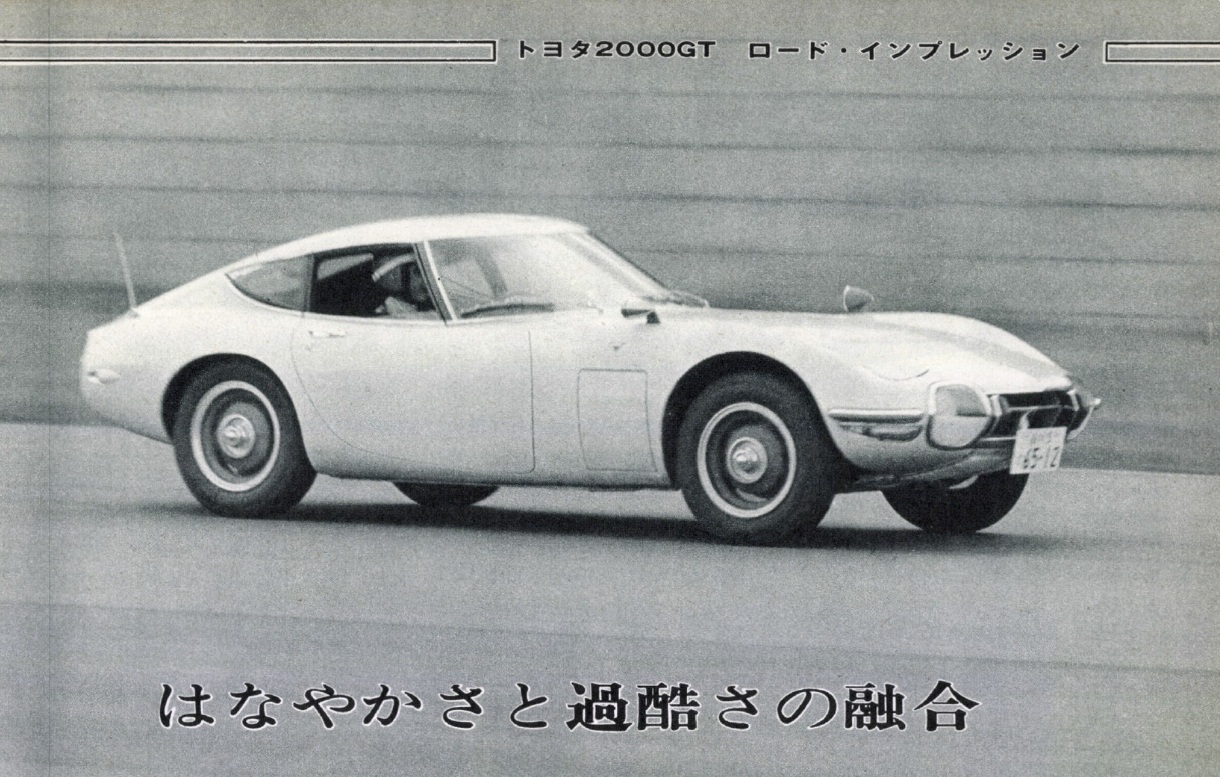
The Union of Elegance and Intensity
A graceful grand tourer on the highway. A fearless competition machine on the circuit. That was the impression left by the recently released Toyota 2000GT after factory drivers Yukio Fukuzawa and Yoshio Otsubo took it out on both road and track.
The Character of a First-Class Grand Tourer
(Yukio Fukuzawa)
We factory drivers spend a lot of time behind the wheel of “hot” tuned machinery, but surprisingly little in production cars–the ordinary street versions. This was true even of the Toyota 2000GT, our own company’s flagship. For that reason, I approached this road test with considerable interest.
The test car was finished in white and, with only about 1,000km on the odometer, was still nearly new. The first thing that struck me when I saw it standing in the parking area was just how low it was. The 2000GT is a familiar sight to me, but seeing it parked among ordinary passenger cars really brought home how exceptionally low its roofline is. As I recall, in fact, it is probably the lowest of any production GT car of its kind.
For example, compared with the Toyota 2000GT’s overall height of 1160mm:
Jaguar E-Type: 1220mm
Porsche 912: 1320mm
Porsche 911: 1320mm
All of them are taller. That comparison, of course, is limited to the production cars.
The styling was the work of Toyota Motor Company’s design department under Satoru Nozaki. The curved windshield formed with compound curves, the front grille based on Toyota’s “T” motif, and the beautifully sculpted tail section—remarkably sophisticated for a production car—all contribute to a design that is both distinctive and luxurious.
Although its basic form is that of a fastback coupe, its overall lines are strikingly original. To my eye, the defining feature is the “razor edge”—a crisp character line flowing from the front fender to the rear fender.
Viewed from the side, the rising lower line of the side windows became such a talking point at European and American motor shows that some even suggested it was inspired by the shape of “Oriental eyes.” Whether or not that was really the intention, it has become one of the car’s most distinctive styling features.
Inside, the first thing to catch the eye is the beautifully polished cherry-wood dashboard. The luxury lies not merely in its appearance, but in the fact that it is made from thick solid timber rather than laminated veneer.
Black pile carpeting covers the floor, while the door panels and headliner are trimmed in black vinyl leather. In every respect, the interior can fairly be described as first-class.
Getting in and out of the cockpit is not effortless. It takes a little practice. Once you learn to sit down first and then bring your legs inside, however, it presents no problems at all. Of course, this kind of car is not intended for frequent entry and exit. What really matters is that it should provide a comfortable driving environment.
The driving position should satisfy almost anyone, thanks to a reclining seat with 140mm of fore-and-aft travel and a steering wheel adjustable through 60mm for reach. One feature that deserves special mention is the seatback, whose shape has clearly benefited from careful ergonomic study. It struck me as having received a level of attention not previously seen in a Japanese production car.
The instruments are arranged so that the water temperature, oil temperature, oil pressure, and ammeter gauges all sweep vertically rather than horizontally. When the engine is operating normally, their needles line up almost perfectly in a straight horizontal row. If even one needle falls out of line, the driver can immediately tell that something is not right with the engine.
The main switches are grouped beneath the steering wheel. Since they are difficult to see, they must largely be operated by feel. The turn-signal switch is also unusual, operating by moving a lever projecting from the instrument panel up or down.
Stable High-Speed Performance
With that, I turned the key and started the engine. I had been told that the running-in period had already been completed, but I still couldn’t help feeling that it would be rather hard on the engine to let it rev too freely.
Since the engine was still cold, I allowed it to warm up. Instead of a conventional cooling fan, however, it uses an electric fan that operates under thermostat control, so it reached operating temperature in no time at all. It settled into a smooth idle at 700-800rpm. The quietness of the DOHC engine is exceptional.
Releasing the handbrake lever mounted on the center console, I set off for Fuji Speedway.
Even so, I was still concerned that the engine might not yet be fully run in. Besides, it simply isn’t in my nature to subject an engine to unnecessary punishment.
For those reasons, I decided to keep the engine well below the red zone, which begins at 7200rpm, limiting myself to 6200rpm.
In practice, though, only first gear allows the engine to be taken that high on public roads. In any of the higher gears, revving it that far would send the car well beyond legal speeds and almost certainly invite unwanted attention from the police. Instead, I tried driving in each gear at the 60km/h speed limit. At that speed, the engine turns 3800rpm in second, 2800rpm in third, 2400rpm in fourth, and just 2000rpm in fifth.
Road holding inspired complete confidence at all speeds, from low to high. The suspension seems to use fairly soft springs, yet the advantages of its independent layout, together with the excellent 50:50 front-to-rear weight distribution, seem to contribute greatly to the car’s stability.
The Japanese-built Dunlop SP4 radial-ply tires also perform extremely well. They seem perfectly matched to the character of the Toyota 2000GT.
Leaving National Route 1 at Kozu and heading toward Matsuda, the road soon climbed into a twisting mountain route. It was here that the car really came into its own. The steering, requiring just 2.5 turns from lock to lock, is delightfully quick, but never loses its reassuring stability as speed rises. It feels almost as though it has become an extension of the driver’s own arms.
Before long, Fuji Speedway came into view.
(Yukio Fukuzawa, Team Toyota racing driver)
Performance on the Circuit
(Yoshio Otsubo)
The Toyota 2000GT, long awaited by motoring enthusiasts, has finally gone on sale. By the nature of my profession, I had already driven Toyota 2000GTs modified somewhat for racing, but in a different sense, I had also been eagerly awaiting the day when this beautiful car would make its debut as a production model.
It was at just such a moment that my teammate, Fukuzawa, and I had the opportunity to evaluate the car on both public roads and the circuit.
Somehow, I felt almost sorry for putting such a beautiful car through its paces on a circuit in completely standard form. Yet to gain a true understanding of a car with genuine world-class performance, this sort of test is indispensable. As racing drivers, it is also part of our responsibility to carry out such tests on behalf of motoring enthusiasts.
That day, beneath clear skies, we headed straight for Fuji Speedway along the Tokaido Highway. The neatly laid-out cockpit was already familiar, as was the view through the windshield—something we had seen countless times before. Yet on this occasion, everything somehow seemed fresh.
At 2:30pm, we arrived at Fuji Speedway. Starting from the Motor Fan / Auto Sport offices in Yotsuya, Tokyo, we had followed the Third Keihin Expressway, the Yokohama Bypass, National Route 1 through Kozu and Matsuda, and then National Route 246 to the circuit, covering a total distance of 122.7km. Fuel consumption over the journey amounted to 17.3 liters, corresponding to 7.09km/l. Considering that the route included crowded Tokyo traffic and that we had driven at somewhat higher engine speeds than normal, this was a perfectly respectable figure for this kind of car.
We began preparing for the circuit runs without delay.
The tire pressures were set at 2.5kg/cm², the standard specification for the production car. Since the car had covered only about 1,000km, I decided to limit engine speed to 6200rpm except when checking its maximum speed.
An Easy 200km/h
I began with a single lap to check the instruments and controls. Everything appeared normal. From the next lap onward, an Auto Sport reporter rode with me.
The first thing that surprised me was how remarkably quiet the engine was. Even at high speeds, there was very little vibration. In fact, it was easy to carry on a conversation with the reporter beside me. Considering that we were travelling at more than 200km/h with the windows open, it was nothing short of astonishing. Even while negotiating the 30-degree banking at over 200km/h, the reporter calmly noted down the instrument readings as I called them out. Surely that says something about how comfortable the car is.
Through the corners, the car rolled by just the right amount. There was no excessive drifting, and the handling remained completely neutral. The four-wheel disc brakes inspired tremendous confidence, fully demonstrating their effectiveness.
Water temperature: 60°C. Oil temperature: 80°C–slightly on the high side. Oil pressure: 4kg/cm².
It was time to see what the car would do down the banking. I pressed the accelerator to the floor. The tachometer needle climbed to 6600rpm.
…220km/h.
With the reporter alongside me, we completed about three laps, recording an average lap time of 2 minutes 30 seconds. Even I found that surprisingly quick.
With revised gearbox and final-drive ratios, slightly uprated suspension, and racing tires–only relatively minor modifications, in other words–I believe the car could comfortably be taken right up to the 7200rpm redline. Under those conditions, it should be possible to reduce the lap time by another 14 seconds or so.
The Toyota 2000GT has the ability to withstand comparison with any domestic or overseas car of similar displacement in its class. After driving it on the circuit, I became more convinced of that than ever.
Between Fukuzawa and myself, we covered 70.7km on the circuit. During that time, the car consumed 16.3 liters of fuel, equivalent to approximately 4.3km/l under racing conditions. For this type of car, that is an impressive figure.
Leaving Fuji Speedway behind in the evening glow, accompanied by the crisp note of the exhaust, we began the journey back to Tokyo. Fukuzawa took the wheel, following the route from Fuji through Matsuda, Kozu, Chigasaki, and the Third Keihin Expressway. Settling into the passenger seat, I was able to appreciate fully just how comfortable the ride really was.
Traffic increased on the Yokohama Bypass, forcing us to crawl along at little more than walking pace. Thanks to the electrically driven cooling fan, however, there was never any concern about overheating, and we negotiated the rush-hour traffic without the slightest anxiety.
The limited time available for the test did not allow us to gather all the data we would have liked. Even so, there is no question that this is a truly captivating automobile. In every respect, it fully deserves to be called Japan’s first true grand touring car.
(Yoshio Otsubo, Team Toyota racing driver)