Toyota 2000GT (1967)
Publication: Auto Sport
Format: Road Impressions
Date: July 1967
Author: Yukio Fukuzawa, Yoshio Otsubo, Auto Sport Editorial Staff (uncredited)
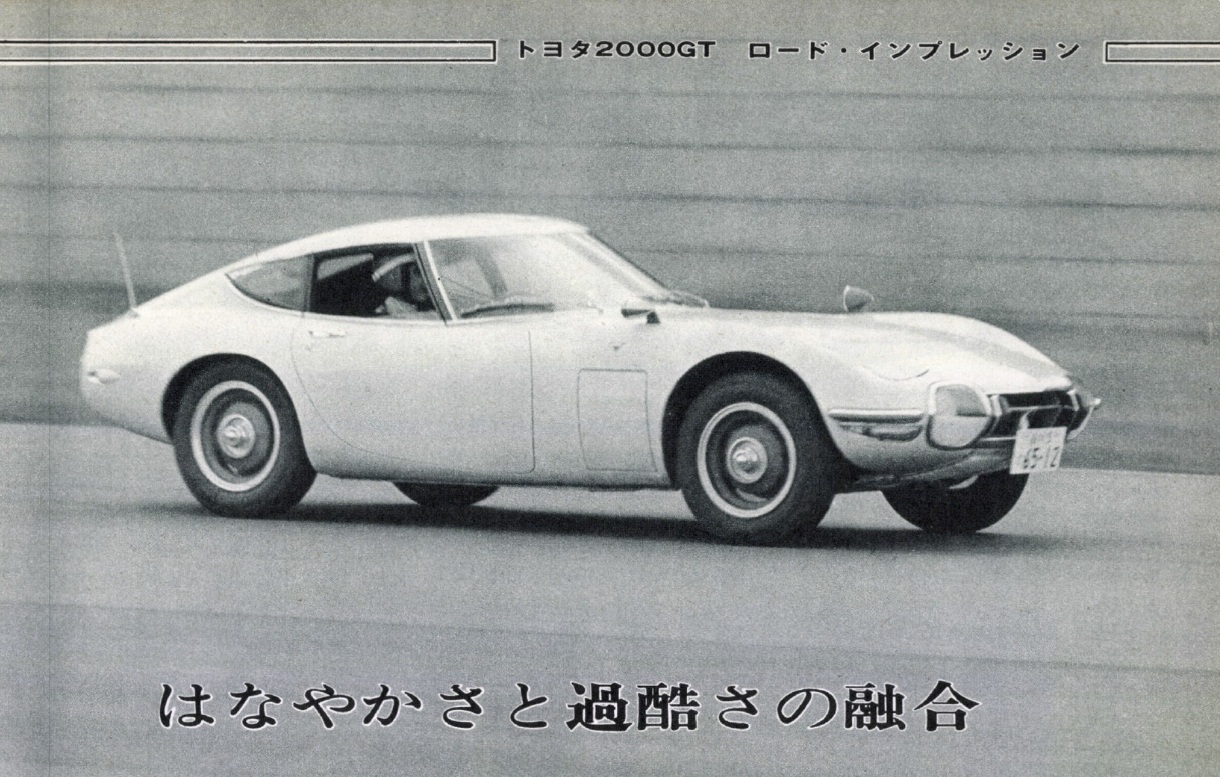
A Fusion of Glamor and Ferocity
A gorgeous GT car on the highway, a fearsome competition machine on the circuit. These were the impressions that factory team drivers Yukio Fukuzawa and Yoshio Otsubo felt when they test-drove the recently released Toyota 2000GT.
A Taste of the World’s Finest GT Cars (Yukio Fukuzawa)
We factory drivers have many opportunities to drive hot-tuned cars, but surprisingly few opportunities to drive the street versions of production cars. This is certainly true of the Toyota 2000GT, a model that exists right under our noses in the racing world. That’s why I was quite interested in this road test.
The car used for the test was white and nearly new, with only about 1,000km on the odometer. When I saw the 2000GT parked in the parking lot, the first thing that surprised me was how low it was. It was a familiar car to me, but seeing it parked among the other passenger cars really made that realization sink in. As far as I remember, the Toyota 2000GT is supposed to be the lowest-riding GT car of its kind.
For example, compared to the Toyota 2000GT’s 1160mm height, the height of the Jaguar E-type is 1220mm, and the Porsche 912 and 911 are 1320mm. In both cases, the 2000GT is significantly lower. Of course, this is only true among mass-produced vehicles.
The design was created by Satoru Nozaki of Toyota Motor Corporation’s design department. Each part of the car is packed with unique and luxurious elements, such as a windshield that incorporates a cubic curve, a front grille based on Toyota’s “T” motif, and a curvaceous tail that is hard to believe belongs to a mass-produced car.
Though based on a fastback coupe shape, the overall lines are extremely original, with the razor-sharp edges that run from the front fenders to the rear fenders being the highlight of the car.
Also, when seen from the side, the window line that rises up towards the rear of the car has been whispered at European and American car shows as being based on the motif of so-called “Asian eyes,” and has become one of the car’s major distinguishing features.
The first thing that catches your eye about the interior is the polished cherry wood dash panel. This is a thick veneer, not plywood, which gives it a luxurious feel. The interior is lined with black thick-pile carpeting, and the doors and ceiling are lined with black vinyl leather. Everything is top-notch.
Getting in and out of the cockpit is not easy. It requires a bit of technique. Just approach it sideways, sit your backside down in the seat first, then pull your feet in. Of course, this type of car is not designed for frequent ingress and egress. The important thing is to drive comfortably.
The driving position is such that most people can find a comfortable posture, with a seat that can slide 140mm fore-and-aft, and a steering wheel that adjusts telescopically by 60mm. What I want to mention in particular is that the seatback has been designed with exceptional attention to ergonomics. I felt that this is a strength that has not been found in Japanese cars up until now.
The gauges are arranged conventionally, but the water temperature gauge, oil temperature gauge, oil pressure gauge, ammeter, etc. in the center of the dash have the base of their needles at the side of the gauge, rather than at the bottom. This means that they move up and down instead of left and right, and when they read normal, the needles of each gauge line up in a straight line. This way, if any one of the gauges deviates from a straight line, it is immediately clear that the engine’s condition is not normal.
The main switches are located on the lower dash panel under the steering column. You can’t see them well, so you have to feel around for them. The switch for the turn signals is unusual; you operate it by moving a lever sticking out of the panel up and down.
Stable High-Speed Performance
Next, I inserted the key and started the engine. I was told that the engine had been broken in, but I still felt it was too early to rev this engine too much, too quickly.
The engine was cold, so I let it warm up, and since it does not have a mechanical cooling fan, but rather an electric fan operated by the thermostat, it quickly reached operating temperature. It idled at 700-800 rpm. The DOHC valvetrain is extremely quiet.
I released the umbrella-type handbrake lever on the center console and set off for Fuji Speedway.
I was still worried about the engine not being fully run in. Also, I am not the type of person whose driving style is usually gentle to engines. For this reason, I decided to keep the engine speed below 6200rpm, well below the red zone of 7200rpm marked on the tachometer.
However, on public roads, the only gear that can make full use of even this limited rev range is first gear. If you try to pull that many revs in any gear other than first, you’ll be forced to back off to avoid exceeding the speed limit.
Instead, I tried driving in each gear at the speed limit of 60km/h. At this speed, the engine was turning 3800rpm in second gear, 2800rpm in third gear, 2400rpm in fourth gear, and 2000rpm in fifth gear.
The roadholding was very stable from low to high speeds. The suspension seems to use fairly soft springs, and the independent suspension and the good weight distribution (50% front and rear) seem to be a big plus.
The performance of the domestically produced Dunlop SP4 radial tires is quite good, and they seem to match the character of the Toyota 2000GT.
As we left Kozu on National Route 1 and headed towards Matsuda, and onto the winding mountain roads, the car really showed its true colors. The steering, with 2.5 turns from lock to lock, was very sharp, and it didn’t lose stability even when we picked up speed. It felt like it had become an extension of the driver’s body.
Soon, Fuji Speedway would be approaching. (Yukio Fukuzawa, Racing Driver, Team Toyota)
Circuit Driving Ability (Yoshio Otsubo)
The Toyota 2000GT, long awaited by car enthusiasts, has finally been released. In my line of work, I have driven a Toyota 2000GT that was slightly modified for racing, but in a different sense, I have been looking forward to the release of this beautiful car as a production model.
It was just around the time of this release that my teammate Fukuzawa and I first tried driving the production car on both public roads and the circuit.
I felt it was a shame to drive such a gorgeous car on a circuit in such a showroom-new condition. But to truly get to know this car, test drives like this are necessary, and it is also our duty as racing drivers to car fans.
On the day, we drove down the Tokaido Highway in clear weather toward Fuji Speedway. The cockpit was beautifully organized. The view through the windshield was something we had seen countless times before. However, on this day, everything looked fresh.
We arrived at Fuji Speedway at 2:30pm. Starting from the Motor Fan/Auto Sport office building in Yotsuya, Tokyo, I drove 122.7km from the 3rd Keihin Expressway to the Yokohama Bypass, via Route 1 through Kozu and Matsuda, and Route 246 to Fuji Speedway. I used 17.3 liters of fuel during this trip, which works out to a fuel efficiency of 7.09km/liter. This includes the congested roads in Tokyo, and I drove at slightly high revs, so I’d say it’s rather good for this type of car.
We immediately began preparations for the circuit run.
Tire pressure was set at 2.5kg/cm². Of course, the tires and all other equipment were stock. As for the engine speed, we decided to limit it to 6200rpm, except when checking the top speed, because this car had only been driven about 1,000km.
Easily Reaches 200km/h
First, we did one test lap to check the gauges and other equipment. No abnormalities were found. Next, a reporter from Auto Sport magazine joined me for a few laps.
What surprised me was how quiet the engine was. There was very little vibration even at high speeds. I was even able to talk to the reporter in the passenger seat with ease. This was amazing, especially considering that the car was traveling at over 200km/h with the windows open. Even when exceeding 200km/h on the 30-degree banking, the reporter calmly took notes on the readings on the gauges. This is a sure sign of how comfortable the car is.
When cornering, the car rolls a fair amount, but there’s no excessive drift and it feels completely neutral. The brakes are all discs, which is reassuring.
Water temperature remained normal at 60°C, oil temperature reached 80°C (a little high), and the oil pressure was normal at 4kg. I decided to try to achieve top speed on the 30-degree bank. With the accelerator pressed to the floor, the tachometer needle pointed to 6600. That’s 220km/h!
The reporter and I rode together for three laps, and our average time was two minutes and 30 seconds, which surprised even me.
As I know from experience, by simply making modifications such as changing the ratios of the transmission and final gear, strengthening the suspension and fitting racing tires, and by using the full range of the engine up to its 7200rpm redline, you can knock another 14 seconds off the time.
The Toyota 2000GT has the potential to rival any car in its category with the same engine displacement, both domestic and foreign. That’s what I felt most strongly when driving it on the circuit.
The circuit driving distance, between Fukuzawa’s and my turns at the wheel, was 70.7km. During this time, we consumed 16.3 liters of fuel. This means that the racing fuel consumption is about 4.3km/l. This is quite a good number for this type of car.
Leaving Fuji in the evening glow behind, we exited the speedway, leaving behind a light exhaust note. With my teammate Fukuzawa at the wheel, we returned to Tokyo via the Third Keihin Highway through Fuji, Matsuda, Kozu, and Chigasaki back to Tokyo. I was able to fully enjoy the comfortable ride in the passenger seat.
Traffic was backed up on the Yokohama Bypass, forcing us to drive slowly, but thanks to the electric cooling fan there was no need to worry about overheating, and we were able to get through the rush hour traffic without worry.
Although we were unable to gather much statistical data during our limited test time, this is in any case a very attractive car, and in every respect it can be said to be a car that truly lives up to its name as “Japan’s first full-fledged grand touring car.” (Yoshio Otsubo, Racing Driver, Team Toyota)