Toyota 2000GT (1966)
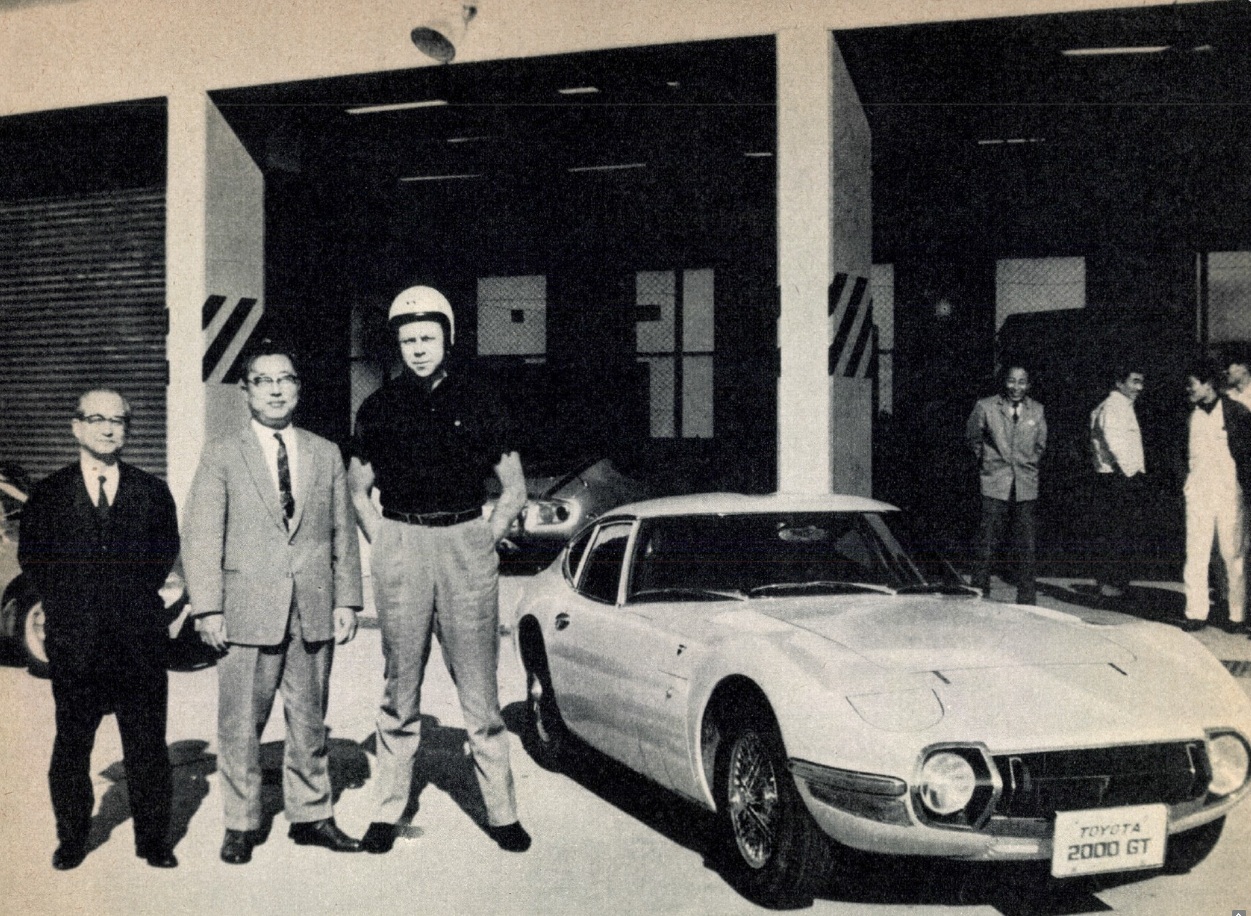
Publication: Auto Sport
Format: Test Drive Report
Date: Spring 1966
Author: Robert Dunham
Robert Dunham’s Test Run: Toyota 2000GT
“The Toyota 2000GT, expected to make an appearance at the Japanese Grand Prix in May, gave every impression of deserving the title of Japan’s first true sports car."
The Toyota 2000GT, expected to make an appearance at the Japanese Grand Prix in May, gives every impression of being worthy of the title of Japan’s first true sports car.
A few weeks after the 1965 Tokyo Motor Show, I had the opportunity to interview Taizo Ishida, chairman of Toyota Motor Company. During our conversation, I received an informal invitation to visit Toyota’s factory. The purpose, of course, was to drive the Toyota 2000GT that had made its public debut at the motor show. Two weeks later, accompanied by a reporter from the Asahi Evening News, I set out for Toyota City.
The first day was devoted to touring the factory. It was not until the second that we took to the test course.
The course, located beside the factory, is an excellent one. It has two long high-speed straights, each ending in a banked curve. The infield features a hairpin and even a spoon curve closely resembling those at Suzuka Circuit.
Purposeful European-Inspired Styling
At first, I rode for several laps in a car driven by one of Toyota’s mechanics. After that, I completed several circuits in a Toyota Sports 800 as a warm-up. The moment I had been waiting for came immediately afterward, when a pure-white Toyota 2000GT was brought out of the garage.
Jaguar XKE, Ferrari GTO, Aston Martin, Corvette Mako Shark–the design draws freely on the best qualities of these European-style sports cars. This is not imitation, but rather a skillful blending of good design principles.
On closer inspection, however, I noticed that some areas of the interior and chassis were finished rather roughly. Since a car of this type would initially be produced only in small numbers, much of the manufacturing process must have been different from that used for mass-produced cars. Once full production begins, however, such problems should naturally resolve themselves.
The first thing that reassured me when I sat down in the 2000GT was that my legs, considerably longer than those of the average Japanese driver, fit comfortably behind the wheel. The seat, pedals, and gear lever are exceptionally well positioned for easy and efficient operation. The steering column can also be adjusted for reach. This is probably a first for a Japanese sports car, and particularly useful in a high-powered model. It can be counted among the Toyota 2000GT’s distinctive features.
A Car for Enjoying Performance
The engine is a DOHC version of Toyota’s new 2000cc inline six, based on the production SOHC M-type engine. The car I drove developed 150ps and was fitted with standard tires and suspension, with no special tuning, yet it was clear that there was ample power under the hood. (I was not permitted to learn any details of the engine’s construction.)
Since the car was still new, I kept engine speed to 4500rpm, well below the 6000rpm redline. There was therefore no question of testing maximum power or top speed, much less acceleration at the limit. The inner course was also narrow and potentially dangerous when taking the curves at high speed, so I kept my average speed to around 140km/h and did not exceed 160km/h. Even so, I believe that once the engine is in a proper state of tune, the car should be capable of more than 200km/h.
The steering is slightly heavy, but firm and precise. In corners, the handling tended somewhat toward understeer, though at the same time I could also feel the rear beginning to step outward. I suspect this was because the car was equipped with standard tires and suspension rather than being prepared to racing specification.
It must be remembered, however, that like the Jaguar XKE, Porsche 911, Sting Ray, and Cobra, this is a high-performance sports car. In other words, it is not the sort of car to be driven casually around town, but rather a “wild horse” that requires a certain degree of skill if the driver is to enjoy its full performance.
No Fatigue Even at High Speed
The gearing fitted was intended for road driving. Although the ratios were well chosen for sporting use, there is no doubt that they would have to be changed for racing.
The transmission is a 5-speed with an overdrive top gear. This is effective in keeping the engine running comfortably at high speeds of 140km/h and above.
My only complaint was the stiffness of the gear change. Even after I had gotten used to the car, the shift remained just as stiff. It was also easy to select the wrong gear when slowing down, so particular care was needed when changing down from top into fourth or third.
On the other hand, when I pressed the accelerator fully while coming out of a curve, the power came in smoothly. I did, however, detect a slight but perceptible hesitation in power delivery when accelerating out of a hairpin in second gear.
To add some variety to the driving, I alternated between the outer and inner circuits, and despite driving at high speed, I felt no fatigue. My overall impression of the Toyota 2000GT was that its steering, road holding, and high-speed performance were all exceptionally good.
Naturally, there were two or three areas in which I felt improvements could be made. Judging from the past achievements of Toyota’s engineers, however, I believe these points will be corrected before the car goes on sale.
A True Sports Car
When I competed in the first Japanese Grand Prix at Suzuka Circuit, I was struck by the poor acceleration and unresponsive steering of Japanese cars, along with their lack of power and excessive weight. At the same time, however, I predicted that Japan’s automakers would soon make rapid advances in the research and development of greater power and performance.
Over the past several years, my prediction has proved correct. And although my expectations have not yet been completely fulfilled, they have nonetheless been largely met.
Because of production costs, very few genuine sports cars with racing capabilities had previously been built on a production basis in Japan. As far as I can remember, the Datsun Fairlady was the first true production sports car to be sold on the Japanese market. It was followed by sports cars such as the Honda S600, and then by cars including the Bellett GT, Contessa 1300 Coupe, Toyota Sports 800, Nissan Silvia, Corona Sports, Skyline 2000GT, and Compagno Spider.
At the same time, many manufacturers began offering high-performance engines in ordinary passenger cars. Yet, viewed from every angle, it would seem that the Toyota 2000GT is the first true sports car built in Japan.