Toyota 2000GT (1966)
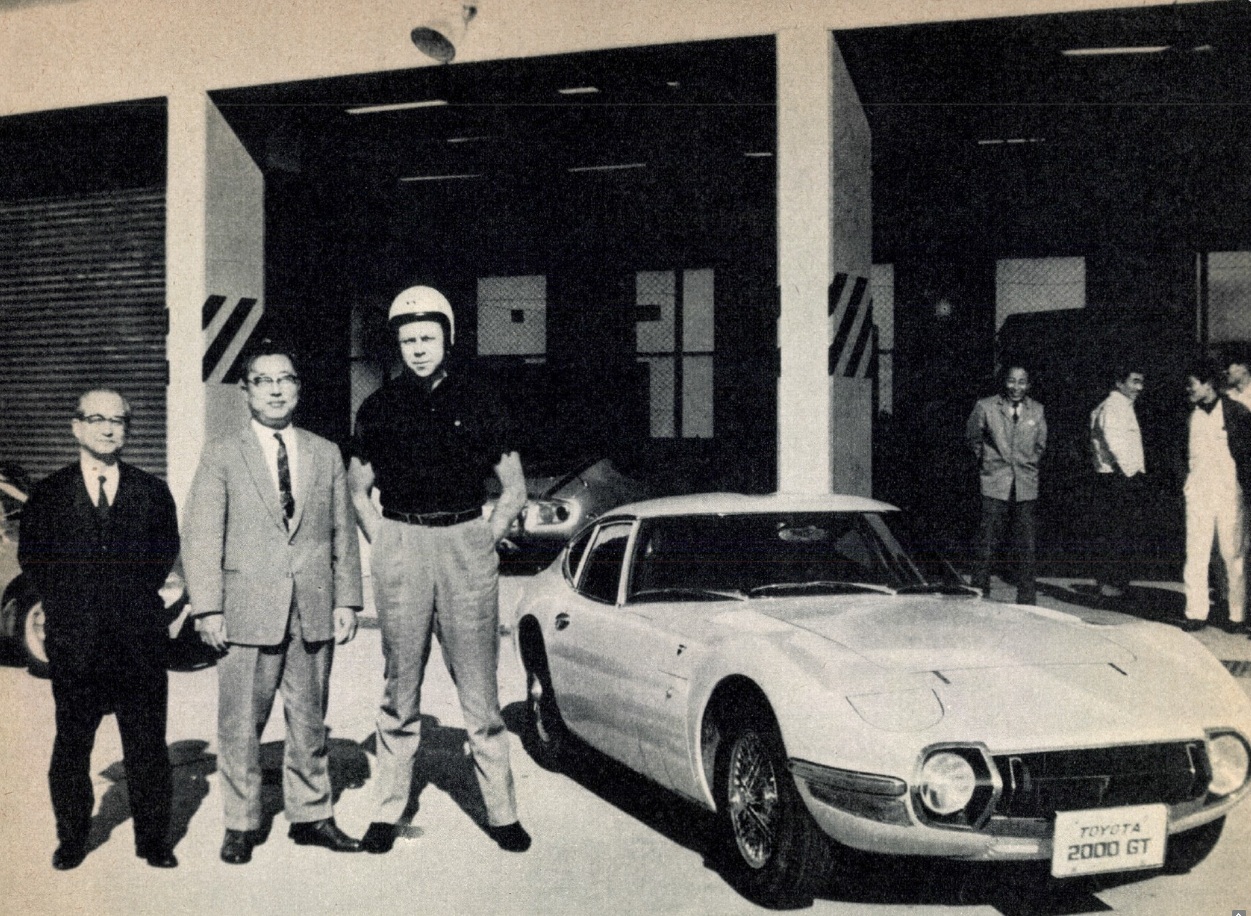
Publication: Auto Sport
Format: Road Impression (original article includes Mazda Cosmo Sport impression, posted separately)
Date: Spring 1966
Author: Robert Dunham
Robert Dunham’s Test Run: Toyota 2000GT
The Toyota 2000GT will be making an appearance at the Japanese Grand Prix in May. In line with this ambition, it left an impression on me as Japan’s first full-scale sports car.
A few weeks after the 1965 Tokyo Auto Show, I had the opportunity to interview Toyota Motor Corporation Chairman Taizo Ishida. During the interview, I received an informal invitation to visit the Toyota factory. The purpose, of course, was to test drive the Toyota 2000GT that was on display at the show. Two weeks later, I traveled to Toyota City with a reporter from the Asahi Evening News.
The first day was a factory tour, and on the second day we were allowed onto the test course.
The test course next to the factory is very nice, with two long high-speed straights, each with a banked curve at the end, and even hairpin and spoon curves on the inside, very similar to those at the Suzuka Circuit.
Exquisite European Style
After taking a few test rides around the course driven by a Toyota mechanic, I warmed up by taking a drive around the course in a Toyota Sports 800. The anticipated moment came right after that, when a pure white Toyota 2000GT was pulled out of the garage.
Jaguar XKE, Ferrari GTO, Aston Martin, Corvette Mako Shark… European-style sophistication abounds in the sleek lines of the 2000GT. This is not an imitation, but a hybrid work that makes use of the best characteristics of good design. However, upon closer inspection, some parts of the interior and chassis were found to be somewhat rough in their finish. However, since this was one of the prototype cars, most of the build process must have been different from that of mass-produced cars. Once the car is mass-produced, this problem will naturally be solved.
The first thing that reassured me when I got into the 2000GT was that my legs, which are much longer than most Japanese people’s, fit comfortably in the driver’s seat. The seat, pedals, shift lever, etc. are all positioned in an extremely user-friendly and efficient way. The steering column can be adjusted for length, which is probably a first for a Japanese sports car, and is particularly useful for a high-horsepower sports car. This can be counted as one of the distinctive features of the Toyota 2000GT.
A Car That Enjoys High-Performance Driving
The engine is Toyota’s new inline six-cylinder, 2000cc, DOHC based on the mass-produced SOHC unit called the M type. The car I drove had 150 horsepower and normal tires and suspension, and although it wasn’t particularly tuned up, it was easy to feel the ample horsepower hidden under the hood (I wasn’t allowed to know details about the engine’s structure).
Since it was a new car, I limited the revs to 4500rpm, which is much lower than the redline of 6000rpm. As a result, I didn’t experience the maximum horsepower or top speed. I couldn’t hope for an extreme acceleration test, either, and the narrow inner course makes it dangerous to take curves at high speeds anyway, so I drove at an average speed of 140km/h and a maximum of 160km/h. However, I think that if the engine is in good condition, it is quite possible to reach speeds of over 200km/h.
The steering is a little stiff, but it is firm and sharp. The basic handling characteristic is that the car tends to understeer a little into the corners. On the other hand, the rear end tends to swing outwards at corner exits. This is probably because the car I tested is not a race car, but is equipped with normal tires and suspension.
However, like the Jaguar XKE, Porsche 911, Stingray, Cobra, etc., it is important to remember that this is a high-performance sports car. In other words, it is not the kind of car you can drive casually around town, but rather a “wild horse” that requires a certain level of skill to enjoy its high performance.
You Won’t Feel Tired Even at High Speeds
The gears used in the test car were the standard ratios that will be fitted to production cars for road driving, and although they were well-chosen for sporty driving, it is certain that different ratios would have to be fitted for racing.
The transmission is a 5-speed with overdrive, which is effective in keeping the engine running smoothly at high speeds of over 140km/h.
The only complaint I had was that the shifting was stiff. Even after I got used to the car, the shifting was still hard. Not coincidentally, I also made mistakes when downshifting. Gear engagements are prone to slipping, so you have to be careful when going from fifth to fourth or even third gear.
Also, while the power came on smoothly when I used full throttle coming out of most curves, I did feel a slight, subtle lag in the power when exiting the hairpin corner in second gear.
To vary the driving, I alternated between driving on the outer and inner perimeters, and I didn’t feel tired even though I was driving at high speed. Overall, the Toyota 2000GT has very good handling, road holding, and speed performance.
Naturally, there are a few areas that could use improvement, but given the track record of Toyota’s engineers, I expect these will be rectified before the car goes on sale.
Authentic Sports Car
When I participated in the first Japanese Grand Prix race held at Suzuka Circuit, I was keenly aware that Japanese cars had poor acceleration, poor steering, and were weak and too heavy. However, at the same time, I predicted that Japanese automakers would make rapid progress through research and development into the relationship between horsepower and overall performance.
Over the past few years, these predictions have proven correct, and my expectations have been met, if not fully.
Due to production costs, in Japan, true sports cars that were suitable for racing were rarely made on a mass production basis. As far as I can remember, the Datsun Fairlady was the first real production sports car sold in Japan. This was followed by production sports cars like the Honda S600, then cars like the Bellett GT, Contessa 1300 Coupe, Toyota Sports 800, Nissan Silvia, Corona S, Skyline 2000GT, and Compagno Spider.
At the same time, many manufacturers began to offer high-performance engines for regular passenger cars as well. However, from every angle, the Toyota 2000GT appears to be the first full-fledged sports car made in Japan.